See also:
1971
2 February: Justice Roger Ormrod finally read his judgment on Corbett vs Corbett. Arthur Corbett was found that morning in a coma at his villa in Spain and thus did not attend the hearing. Ormrod redefined legal intersex status as the discordance of chromosomal, gonadal and genital sex, and only then are psychological factors to be taken into consideration. The Corbett marriage was annulled; and the £6 a week alimony payment to his wife April Ashley was cancelled. Corbett v Corbett became case law in the UK and in Australia. The correcting of birth certificates for many intersex and all transgender persons ceased, and such persons lost the legal right to be treated as their new gender – in particular to marry a person of the now opposite gender.
The Nullity of Marriage Act, 1971, defined valid reasons for annulment according to British law. The draft version did not mention the sex of the parties, but such a clause was added during the report stage, this being only months after the Corbett vs Corbett divorce case. This was the first time in British law that marriage was actually defined as being between a man and a woman. This was carried over into the Matrimonial Causes Act 1973 and into The Marriage (Scotland) Act, 1977, and The Marriage (Northern Ireland) Order, 2003, all of which are still in force, although they were amended to allow same-sex marriage by the Marriage (Same Sex Couples) Act 2013.
Divorce Reform Act 1969 came into effect allowing divorce by mutual consent after two years separation, This could have been used by the Corbetts, but Arthur had other ideas.
April Ashley rallied by opening a restaurant just round the corner from Harrods, which was an immediate sensation, and she continued to run it for five years until she had a heart attack.
Georgina Somerset sent a copy of her book to Justice Ormrod, and he wrote back: "you and I have arrived independently at the same conclusions as to the legal position".
Ina Barton had been having problems, and passed on. April Ashley commented that she: “had recently died from a combination of booze and pills. I believe an open verdict was recorded but that's splitting hairs - in effect she killed herself.”
Genesis P-Orridge made that his legal name. He was later tutored in magick by Brion Gysin and worked with William Burroughs.
Journalist/historian Jan Morris had been accepted in the program at Charing Cross Hospital, but withdrew as they insisted that Jan and her wife be divorced.
Georgina Somerset submitted medical reports and underwent blood tests and other medical examinations as part of her legal case against Pulse International which back in 1969 had compared her to Christine Jorgensen. In reply she libelled Jorgensen: "implying that I was homosexual, would have had breast implants, electrolysis and was probably not legally married, I had no choice but to instigate libel proceedings for, indeed, all these premises were totally false". Jorgensen, like Somerset was an openly heterosexual woman. Somerset was not denying being lesbian, she was denying being androphilic – an odd thing for a woman married for seven years to say.
For the first time Somerset discovered her chromosomal constitution: mosaic XO/XY. If she had lost the case she would have been forced into bankruptcy. However two days before the scheduled hearing, the defendants offered an apology based on Georgina's medical records, and a statement was read in the High Court by her barrister, Leon Brittan (later a controversial minister in Thatcher's cabinet and posthumously famous for losing a detailed dossier on child abuse by prominent men).
Shortly after moving to Richmond, journalist Liz Hodgkinson had heard gossip about a “strange person who looked like Marilyn Monroe from the neck up and a garage mechanic from the neck down”. She soon spotted Betty Cowell in the post office, and struck up an acquaintance. Betty took a shine to Liz, and made many of her documents available. They started writing a book together about Cowell’s life, but in the end Betty did not approve it for publication.
The male persona of Judy Cousins was reported as 'missing, presumed dead' in the Farmham Herald in March 1971. This was to spare the family the truth that he had become Judy Cousins, but it generated newspaper stories and she was traced. At a time when there was almost no support for families, it took a few years for them to adjust.
The future Mark Rees failed to get into medical school, but was accepted for the Dentistry course at the University of Birmingham. The plan was to qualify as a dentist before before becoming a man. However the stress of remaining the wrong sex for five years proved to be too much and in 1971 she asked to start on male hormones. The university supported Rees in his role change. His vicar suggested a week at the Anglican Franciscan Friary in Dorset, an all-male community, before returning home and to the third year of his dentistry studies. In December The Daily Telegraph ran an article by medical journalist Wendy Cooper, "Gender is a Mutable Point". Mark wrote to her, and she interviewed him for a subsequent article. He was asked if he would meet with journalist Sally Vincent whose subsequent article showed several misunderstandings. He was also put in touch with other female-to-male transsexuals. Nonetheless Mark withdrew from the dental course after the third year - he knew that he wasn’t really dextrous enough to make a good dental surgeon.
The Gay Liberation Front (GLF) had been established at London School of Economics on 13 October 1970. At first there was no drag. Later "It started with jellabas and kaftans and long hair and flowers ... then we discovered glitter ... and the nail varnish. Later some of us - a quarter of the men, I'd say, at some time or other - would get a nice new frock for the next Gay Lib dance. Then a few people began wearing it to meetings. It just evolved." -- Michael James. Some GLF queens wore drag because it felt right, some for fun and some for political reasons - the last became known as the RadFems.
Separate from the RadFems and political drag was the GLF Transvestite, Transsexual and Drag Queen Group which started meeting in late 1971. Rachel Pollack and her wife Edith, had moved to London and Rachel became the contact person for the Group, which is how she met Roz Kaveney, and together they formed a transvestite presence at the GLF meetings. Rachel and Edith were misunderstood in different ways by both GLF and the political lesbians, but raised issues by their very presence. In line with the magical reality of her fiction, Rachel challenged the biological definition of women. Edith was active in the Women’s Liberation Front.
22 January : Police with a warrant for drugs bust the GLF Disco at the Prince of Wales pub, Camden.
30 January: GLF Dance at Camden Town Hall with the Pink Fairies and Hawkwind.
4 February: 5 women had been arrested 21 November 1970 for disrupting the Miss World Contest at the Albert Hall. There was a demonstration outside the Bow Street Magistrates Court when they came up for trial and GLF Street Theatre including some RadFems were invited to join in.
13 February: GLF women selling tickets in the lesbian club The Gateways for a GLF Dance are thrown out. 26 February: GLF Dance at Kensington Town Hall.
30 April: GLF dance at Camden Town Hall.
23 July: GLF dance at Hammersmith Town Hall.
Virginia Prince came on her second UK visit, and stayed with Alice Purnell.
Although Anne Heming had had surgery in Switzerland in 1959, she and her wife had remained married. They finally divorced in 1971. Anne had, since completing transition in 1959, combined both stereotypical masculine and feminine occupations. She made her own clothes, and built a house, brick by brick. She set up an electrical and second-hand goods shop in Bristol. She also made electronic organs (the musical kind), and was known for spending time and energy helping younger transsexuals.
Della Aleksander who had had surgery from Dr Burou in June 1970 founded GRAIL (Gender Research Association International Liaison)
Caroline Cossey, then 17, started living as female, and working as a showgirl and topless dancer.
Michelle Confait was working as a trans prostitute, and in 1971 was arrested for importuning and served five months in HMP Wormwood Scrubs (a men's prison) where she was protected by and provided sexual favours to Douglas Franklin. Later that year after release, she frequented the Black Bull Pub in Lewisham High Street where she met Winston Goode, an occasional transvestite. Goode had broken up with his wife although she and their children still lived in the same house in Doggett Road, Catford. Michelle became a lodger in the house at £2.50 a week. A fire started in the early morning of 22 April 1971. Goode awoke, evacuated his wife and children and ran to Catford Bridge railway station, almost next door, to dial 999. The Fire Brigade arrived and extinguished the fire within ten minutes. They also found a body, later identified as Michelle Confait. It was established that Confait had been strangled and there was no struggle. There were a few other fires in the area in the next few days. An 18-year old with the mental age of eight, and two younger boys were arrested and interrogated without either their parents or a social worker being present. The three boys were found guilty of manslaughter, despite having alibis for the estimated time of death, and claims of being hit by the police.
The North West Campaign for Homosexual Law Reform became the Campaign for Homosexual Equality (CHE). Allan Horsfall ran the group 1971-4, and then was president for life. CHE quickly became the largest gay and lesbian rights organisation in England.
The Christian Festival of Light was held 9 September and at its culmination was a pair of mass rallies in Trafalgar Square and Hyde Park. Homophobia and opposition to increased sexual freedoms was on the agenda; anti-sex activist Mary Whitehouse, singer Cliff Richard and writer Malcolm Muggeridge were on the stage. GLF organized a zapping, including members in drag and as nuns (Russell Hunter drummer with the Pink Fairies was one).
The Oz obscenity trial. The counter cultural magazine Oz, edited by ex-patriot Australians. Reacting to criticism that Oz had lost touch with youth, the editors had put a notice in the magazine inviting "school kids" to edit an issue. The opportunity was taken up by around 20 secondary school students, who were responsible for Oz No.28 (May 1970), generally known as "Schoolkids Oz". This term was widely misunderstood to mean that it was intended for schoolchildren, whereas it was an issue that had been created by them. The editors were charged with Conspiracy to Corrupt Public Morals. The trial in June 1971 was, at the time, the longest obscenity trial in British legal history, and it was the first time that an obscenity charge was combined with the charge of conspiring to corrupt public morals. Many known persons in music, showbiz and the arts were either defence witnesses or protested outside the trial. The editors were found not guilty on the conspiracy charge, but they were convicted of two lesser offences and sentenced to imprisonment; they were taken to prison and their long hair forcibly cut, an act which caused an even greater stir on top of the already considerable outcry surrounding the trial and verdict. The convictions were overturned on appeal. Afterwards circulation jumped to 80,000 but then faded. The last issue was November 1973.
GLF was divided about the Oz trial. On the one hand many found the magazine to be misogynist and homophobic, but others stressed that if Oz were censored, their turn would come next.
- John B. Randell. "Indications for Sex Reassignment Surgery". Archives of Sexual Behavior, 1:2, 153-161, 1971.

- Wendy Cooper, "Gender is a Mutable Point". Daily Telegraph Magazine, 10 December 1971.
- Roger Bowdler. Sense and Sensuality. The Falstaff Press, 1971. Immediately on the heel s of the Corbett vs Corbett ruling, a novel about Franny Updike, ex-Borstal, who has become a fashion model, kept by a film star and feted by press and television. From there she descends to a disastrous relationship with a violent man, and finishes by working in a drag show.
- Roy Ward Baker (dir). Dr Jekyll and Sister Hyde. Scr: Brian Clemens, with Ralph Bates as Henry Jekyll, Martine Beswick as Sister Hyde. UK Hammer 97 mins 1971. Searching for an elixir of life, Dr Jekyll uses female hormones taken from corpses. After taking the potion, he transforms into Sister Hyde who as Jack the Ripper kills to obtain the hormones.
- Malcolm Leigh (dir & scr). Games That Lovers Play. With Joanna Lumley and Jeremy Lloyd. UK 91 mins 1971. A sex comedy that partially includes the seduction of a drag queen. A drag ball scene was included and 42 of London’s drag artists were used, including Barrie Chat and Terri Gardener. They all provided their own dresses. However the credits do not list them individually, but as "The Queens played by themselves”.

1972
Jan Morris returned from surgery with Dr Burou in Casabalanca. She resigned from the all-male Travellers' Club, gave away James' dinner jacket and wrote to Who's Who to change her entry. At her own pace she changed her public identity.
Carol Riddell also returned from surgery with Dr Burou. She had been there at the same time as Jan Morris. She presented a paper to the National Deviancy Conference 10 on “Transvestism and the Tyranny of Gender” in which she analyses the two-gender system as a feature of capitalism – which was an early influence on sociologist Dave King who later wrote on the sociology of trans persons. The revised edition of Approaching Sociology in 1972 names the co-author as Carol S. Riddell. This work inspired the then undergraduate Richard Ekins who later also wrote on the sociology of trans persons.
Angela Morley moved to Los Angeles.
Bobbie MacKenzie had been attending the GLF Women’s Group meetings. She made a living turning tricks on Park Lane. Several of the women in the group made it clear that Bobbie was not welcome. Later at a gay event Bobbi did a striptease and, because she was so feminine, the crowd gasped when she revealed her genitals.
The future Rachael Webb had broken up with his wife and restarted on hormones. However he then married again, qualified for a Heavy Goods Vehicle (HGV) license, became a long-distance lorry driver, and had two more children.
March: Michael Bateman interviewed Betty Cowell for The Sunday Times. Cowell’s house was “cluttered with pilots’ helmets, high-frequency radios, models of planes and racing cars. She’s logged 1,600 hours as a pilot (recently she flew at Mach 2 twice the speed of sound )... She doesn’t approve of the Permissive Society and she doesn’t welcome Women’s Lib. She certainly hopes the trend towards Unisex has stopped. It’s unhealthy, unnatural. ‘My experience shows that men and women are so completely different as to be almost different species.’” She also disapproved of other transsexuals: “I was a freak. I had an operation and I’m not a freak any more. I had female chromosome make-up, XX. The people who have followed me have often been those with male chromosomes, XY. So they’ve been normal people who’ve turned themselves into freaks by means of the operation.”
January: Ventriloquist Bobbie Kimber and her dummy Augustus appeared on the amateur talent show Opportunity Knocks, which led to a flurry of letters from old fans, and enquiries from agents. On the 2 February the Daily Mirror ran a positive article on Bobbie, “Geared Up for a Comeback”, written by Clifford Davis, the same journalist who had denounced Bobbie twenty years before. This time he wrote her up as a female impersonator. But then only 13 days later, the sister publication, the Sunday Mirror, ran the first of three three-page spreads written by Bobbie. According to these articles she had had transsexual surgery two years before, but not told her wife and daughter until December 1971. Of her earlier years she wrote: “But my happiness as a man [after marriage] was short-lived. I found myself fighting a constant inner desire to become a woman. … I also started to change physically. Over the years my male parts began to shrink. My chest began to fill out developing into full breasts. The Army discharged me for ‘ceasing to fulfill physical requirements’. … Yet never in my life have I taken any kind of hormone treatment.” Kimber claimed that a rich Moroccan had paid for her to be flown to Casablanca, and be operated on by Dr Burou in January 1970.
Bobbie Kimber placed a half-page advert in The Stage newspaper in late March 1972 , referencing “the Sunday Mirror’s Sensational ‘He & She’ Story”, and was booked by clubs in Sheffield and Barnsley, Nottingham and Manchester, usually as the star attraction. A fellow performer commented: “I worked in a revue with Bobbie Kimber at The Devonshire Music Hall, Manchester in the early 70s. She had shoulder length natural greying hair and always dressed as a woman. This was after the news article about her being transgender that had regenerated interest in her as a performer. She was like a very nice, polite middle aged woman and in no way flamboyant or brash like the stereotype Drag Act. She did tell me that she was the only person to appear at the London Palladium both as a male and later as a female. She was very professional, a terrific Vent' and a lovely person.”
January: The GLF Transvestite, Transsexual and Drag Queen Group contributed material to the Lesbian Issue of Come Together, the GLF newspaper.
The Radical Feminists (trans) in the Gay Liberation Front had aligned themselves with lesbians against the masculine gay men who were dominating the GLF meetings. When the women finally split from GLF in February 1972, the Rad Fems began to dominate at the All-London meetings at All Saints Hall in Powis Square, which was a bit intimidating for newcomers.
Local GLFs founded. The first were Ealing, Harrow, West London, Camden and South London.
15 April: The all-London meeting was abolished and meetings at All Saints then known as Notting Hill GLF.
11 April GLF Dance at Fulham Town Hall, for Trevor Woods, held in Italy on a drugs charge.
6 May: GLF People’s Dance at Digbeth Civic Hall.
12 May: GLF Dance at Fulham Town Hall.
May: Gay News founded as a collaboration between GLF and CHE members. However, the initial issues of Gay News were hostile to GLF in general and even more so to the queens. Editorial: “Gay News, as you will doubtless tire of hearing and reading after the first few issues, is not our paper, but yours; it belongs to the whole of the gay community. It’s for gay women as well as gay men, for transexuals and transvestites, for anyone with a sexual label but who we like to call ‘gays of all sexes’ ’’.
19 June: The RadFems demonstrated against the July launch of the new feminist magazine Spare Rib, which allowed The Sunday Times to run an article on the irony of feminist men telling women how they should behave. The fledgling Gay News used this to disassociate from what they referred to as 'fascists in frocks'.
30 June: Gay Pride Grand Ball at Fulham Town Hall. Local youths become aware of GLF presence. Trouble between Gay News seller and radical queens.
1 July: first gay pride march in London.
However a few days earlier, GLF had been allocated a timeslot with the Boilermakers Union to picket the US Embassy about what they were doing to Vietnam. Only the Radfems turned up, a band was playing, and Bette Bourne and Michael James started a waltz. The US school band packed up in a fit of pique. The queens sauntered off and ended up at Piccadilly Circus. The police asked where they, the queens and the rent boys, intended to go, and said they would escort the march which went via Oxford Street to Hyde Park.
7 July: GLF Dance at Fulham Town Hall.
8 August: Colville Terrace, Notting Hill, squatted by queens from Brixton and joined by other queens in Notting Hill to form the GLF Notting Hill Commune.
18 November: GLF members in drag attacked on Northern Line tube after GLF disco at Bull & Gate in Kentish Town.
Anne Heywood, Miss Great Britain 1950, had been playing nice girls in films for 20 years, and wanted more challenging roles. She had played a lesbian in The Fox, 1967. She was married to film producer Raymond Stross, and persuaded him to buy the film rights to the novel I Want What I Want so that she could play Wendy the transsexual. Novelist Gillian Freeman did the script, and wanted a male actor. Review. No thought was given to casting a trans actor.
The second trans film of the year was The Triple Echo, based on the recently published novel by H.E. Bates, about a WWII deserter who takes a female persona. It was the first film directed by Michael Apted, and the first film for actor Brian Deacon playing the deserter. In this case a male actor played the trans woman.
By the early 1970s, Mrs Shufflewick was mainly performing in gay pubs, especially the Black Cap in Camden and the Vauxhall Tavern in Lambeth. She recorded an LP live at the Black Cap which sold well, but within a few months there were performers who were doing her full act under their own names. Patrick Newley (1955 – 2009) became her manager in 1972, and managed to get her back into the West End as a support act to Dorothy Squires. Newley also managed Douglas Byng, and introduced the two of them.
Danny La Rue in another Royal Command Performance, and in the film Our Miss Fred, his only starring film role, in which he played an actor playing in drag for the English troops in wartime France, when he is caught by a Nazi advance, and stays in character.
The Adventures of Barry Mckenzie, an Australian film about a naive young Australian in London. Edna Everage (played by Barry Humphries) is his aunt. Jean Fredericks has a cameo.
- Michael Bateman interviews Betty Cowell. Atticus, The Sunday Times, 12 March 1972. Online.
- Clifford Davis. “Geared Up For a Comeback”. Daily Mirror, 2 Feb 1972. re Bobby Kimber.
- Bobbie Kimber. “He She: Five days a week I am a woman. At weekends my wife wants me as a man“. Sunday Mirror, 13 February 1972: 10-12.
- Bobbie Kimber “He buys his first dress as a woman; She has a close shave in a girl’s bedroom”. Sunday Mirror, 20 February 1972: 10-12.
- Bobbie Kimber “He gets his first marriage proposal as a SHE; tells of his life as a man – and a woman”. Sunday Mirror,27 February 1972: 10-12.
- Jan Kimber. “Our Incredible marriage”. Sunday Mirror, 27 February 1972: 12.
- Sidney Vaunces. “Light Entertainment”. The Stage, 18 May 1972: 3. re Bobby Kimber
- Transvestite, Transsexual and Drag Queen group. “Don’t Call Me Mister, You Fucking Beast”. Come Together, 11, the Lesbian Issue, January 1972.
- “On Going Out Alone in Drag for the First Time”. Come Together, 11, the Lesbian Issue, January 1972.
- The Drag Queens. 1972. Magazine - three issues only.

- Margaret A Coulson & Carol Riddell. Approaching Sociology. Routledge & Kegan Paul, 1972.
- John Dexter (dir) I Want What I Want, novel by Geoff Brown, scr: Gillian Freeman, producer: Raymond Stross, with Anne Heywood as Roy/Wendy, Harry Andrews as her father. UK 91 mins 1972. IMDB Fullfilm
- Michael Apted (dir). The Triple Echo, scr: Robin Chapman, based on the novel by H.E. Bates, with Glenda Jackson, Oliver Reed and Brian Deacon as Barton. UK 94 mins 1972. Nominated a Golden Prize Award for the film at the 8th Moscow International Film Festival. IMDB. Review.
- Bruce Beresford (dir). The Adventures of Barry McKenzie. Scr: Bruce Beresford & Barry Humphries, with Edna Everage, Jean Fredericks. AU 114 mins 1972. IMDB.
- Bob Kellet (dir). Our Miss Fred. Scr: Hugh Leonard, with Danny La Rue. UK 96 mins 1971. IMDB. Wikipedia.
- Spike Milligan. The Goon Show Scripts. Woburn Press, 1972. Tells us more of the Goon Show character, Major Denis Bloodnok. After he was cashiered from the army having been found cross-dressed, he re-enlisted as Florence Bloodnok and served a year in the women’s ATS, at one point having to report a sailor for trying to interfere with her in an air-raid shelter.
- Mrs Shufflewick. Live from the New Black Cap. LP 1972. Online.
- David Bowie and Mott the Hoople. “All the Young Dudes”. CBS Single, July 1972. Went to number 3 in the UK charts, and became an anthem of Glam Rock. “though he dresses like a queen/ He can kick like a mule”.

1973
4 June: Della Aleksander co-produced a BBC2 Open Door program on transsexuals which also featured Rachel Brown, Jan Ford and Laura Pralet, and two male commentators: Leo Abse, the Member of Parliament for Pontypool who had introduced the private member’s bill to decriminalize homosexuality that had become law in 1967, and Dr Schlicht, a psychiatrist.
Adèle Anderson was accepted on the program at Charing Cross GIC. She worked as a civil servant and as a secretary, and was attempting to become a jazz singer.
Jan Morris issued the second volume of Pax Britannica, Heaven's Command: An Imperial Progress, with her male name on the title page.
March: Some of the surviving RadFems took over the anarchist Agitprop bookshop/commune at 248 Bethnal Green Road, which at one time had been owned by a banker to the Kray Brothers gang, and had a wall safe. Agitprop had been raided twice by the police in the two years that it had been open, and two of its members were on conspiracy-to-procure-firearms charges. Agitprop had already sponsored the East London GLF and now the queens took over and renamed the building Bethnal Rouge. They actually continued the bookshop for several months. The local pub was freaked out when they first arrived, but as some of them could play piano, and others were good at singing, there was some degree of acceptance.
22 June: Bethnal Rouge Benefit Disco.
26 June: West London Disco at Fulham Town Hall.
October: the Bethnal Rouge queens raided the Gay News office and took the files. Gay News responded with an article that went so far as to equate drag queens and violence. However at the last GLF Think In at Sussex University that November opinions were more on the side of Bethnal Rouge, and that the Office Collective had ceased to be useful.
May: Gluck, artist and aging trans man, mounted a one-man show. The first exhibition of Gluck’s work since 1937.
The Rocky Horror Show opened at the Royal Court Theatre (Upstairs) on 19 June 1973 (after two previews on 16 and 18 June 1973). It later moved to several other locations in London and closed on 13 September 1980. The show ran for a total of 2,960 performances and won the 1973 Evening Standard Theatre Award for Best Musical. A rock-and-roll, science fiction re-interpretation of transvestity, that opened the door for cis persons to cross-dress.
Mrs Shufflewick, as both the actor and the character became known, became a fixture of the thriving gay scene of the 1970s. He gave an interview to Gay News in 1973, and was now open about his own sexuality. He did not seem to understand what the Gay Liberation Front was about, but twice Shuff was on a prominent float in the Gay Pride march. He was also a celebrity judge at Andrew Logan’s Alternate Miss World.
The new Charing Cross Hospital, now located in the site of the former Fulham Hospital was formally opened in 1973. Initially it was called Charing Cross Hospital, Fulham, but eventually the ‘Fulham’ was dropped. The numbers of trans patients increased, still only 15% of patients achieved surgery. By then John Randell was arguing that surgery could be appropriate and that psychotherapy did not work. Even then he restricted surgery to sane, intelligent, single and passable individuals. Passable implied conforming to Randell’s old-fashioned ideas of being ‘ladylike’, that many women had abandoned by the 1970s. Until the end he continued to refer to patients, including post-operatives, by the pronouns of their birth gender, and would tell a trans women, accepted for surgery, that ‘you’ll always be a man’.
The underground group The Pink Fairies, previously known as The Deviants, played and recorded 1966-1977 and were happy to play at GLF events. Their drummer, Russell Hunter, had been a drag nun at the zapping of the 1971 Festival of Light. In performance he often wore make-up and dresses. However there is no record that he later transitioned.
- John B. Randell. Sexual Variations. London: Priory Press. 1973.

- James Morris. Heaven's Command: An Imperial Progress. Faber and Faber, 1973.
- Mary Douglas. Rules and Meanings: The Anthropology of Everyday Knowledge. Routledge, 1973: 115-7. Uses uses Ormrod's 1971 ruling as an example of the social construction of reality.
- Roxy Music. For Your Pleasure. LP Island, March 1973. Amanda Lear on the cover.
- The Pink Fairies. “I Wish I Was a Girl”. Kings of Oblivion, Polydor, 1973.
- Jim Sharman (dir & producer). The Rocky Horror Show, music, lyrics and book by Richard O'Brien, with Tim Curry as Dr Frank N Furter, Richard O’Brien as Riff Raff. Royal Court Theatre from June 1973.
- “The Fabulous Mr Jean Fredericks”. Follow-Up: the monthly magazine for the gay scene. 1973.
- Polly Perkins. “Camping it up in Camden Town”. The Stage, 5 July 1973.On drag at the Black Cap, Camden.

1974
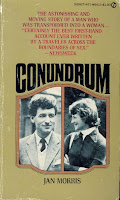
Jan Morris’ autobiography, Conundrum, was published and became one of the best selling and most discussed transsexual autobiographies. Jan and her wife did later divorce, but keep on living together as a couple.
Pioneer trans man Jonathan Ferguson, transitioned 1958, pilot, engineer, civil servant, died age 59 after falling from a ladder while doing maintenance at home.
Peter Stirling, Australia’s first surgical trans man, after transition at Guys Hospital, London, worked mainly in shoe retailing, rising to branch manager. In 1974 Peter returned to Australia with his wife and started to reconnect to his original family, especially his mother and daughter. Again he mainly worked in shoe retailing.
Alice Purnell was on BBC Radio 4 with agony aunt Claire Raynor.
Mark Rees had a bilateral mastectomy in 1974, followed by an appearance on BBC Radio 4 Woman's Hour.
Georgia Ziadie from Jamaica met and married Lord Colin Campbell. They were divorced the next year. She continued to use the name Lady Colin Campbell.
Rachel Horsham who will become a trans activist in the late 1990s, emigrated to the Netherlands in 1974 because that country recognised trans women as women at a time when the UK did not.
Caroline Cossey had breast augmentation and Adam’s Apple reduction surgery, and then genital surgery in 1974, under Dr John Randell at Charing Cross Hospital.
February: Bethnal Rouge was invited by Goldsmith College Gay Soc to give a Pre-Disco talk. Group 4 Total Security working for the College attacked them before they even spoke, and when Lewisham police arrived they were told that Bethnal Rouge had come to the disco to cause trouble. One queen needed hospital treatment; another was head butted and lost two front teeth. One was arrested and later that night thrown through a glass door in the police station. The rest escaped. Shortly afterwards the commune were evicted from 248 Bethnal Green Road.
31 March: financial problems lead to end of Bethnal Rouge.
March: South London Gay Community Centre, 78 Railton Rd, Herne Hill, London. The building and next-door had been empty for many years when they were squatted in 1974 and became the Gay Community Centre and the Women's Centre. Alternate lifestyles, art and politics flourished. "Gender bending was encouraged to dissolve rigid categories of masculine men and feminine women. For others dressing in drag was a sheer pleasure and an opportunity for ingenious invention".
Winston Goode, suspect in the 1972 killing of Michelle Confait, swallowed cyanide and died – several publications had hinted that he was involved in the crimes. The next year Mrs Goode was quoted in the media that her husband had once tried to kill her, and she was certain that he had started the fire and murdered Confait.
Ernest Marples, who had been Minister of Transport 1959-64, and exposed in the Denning inquiry 1963 as one who paid for sissification by prostitutes, had not been a minister in the Conservative government of 1970-4. He retired as an MP at the 1964 election, and later that year he was made a life peer as Baron Marples of Wallesey.
March: the University of Leeds hosted the country's first national conference for transvestite and transsexual people. Titled Transvestism and Transsexualism in Modern Society, it attracted 102 attendees (185 at the disco) and included talks and a screening of the 1968 New York documentary The Queen (they wanted the film I Want What I Want, but were unable to get it). The main organisers were Caroline R., a postgraduate student at Leeds University and June Willmott, who was in both the local Beaumont Society and the Leeds TV.TS Group. The term ‘transgender’ was used by several people at this conference, the earliest attested use of the term in the UK.
The article in The Guardian mentioned: Martine O'Leary, "a radical drag queen at Leeds, says that he buys old dresses from Oxfam shops, wears neither make-up nor substitute breasts, and tries to shake people out of their preconception of what a man is, a woman is, or more important, what he is."
Gay News charged with obscenity for cover photograph of 2 men kissing. Acquitted.
- Bobbie Jacobson. “The Sex Changers”. World Medicine, 9, 13 Feb 1974. Features Della Aleksander and Georgina Somerset.
- Christine Doyle. "Trans-sexuals: an investigation". The Observer, 28 Apr 1974.
- David Holden. "James & Jan". The Sunday Times, 10 March 1974.
- Jan Morris. Conundrum. Faber and Faber, 1974.
- Russell R. Davies. "Mr Morris Changes Trains". Review of Conundrum, The Times Literary Supplement, 26 April 1974: 431.
- S. Pritchard. "Clouded Conundrum". New Statesman, 26 April 1974: 596.
- Leeds University TV.TS. Group. Transvestism and Transsexualism in Modern Society: Conference Report,Leeds University TV.TS. Group, 1974.
- M Parkin. ‘Mixed Feelings’, The Guardian, 4 March 1994. Also Appendix F(i) in The First National TV.TS Conference Report, Leeds: 36. The only newspaper report of the Leeds conference.
- Martine O'Leary. Gay Liberation, reformism and revolution. LSE-Gay Culture Society. Isophile Pamphlets, 16pp 1974.
- Bruce Beresford (dir). Barry McKenzie Holds His Own. Scr: Bruce Beresford & Barry Humphries, with Edna Everage and real-life Australian Prime Minister Gough Whitlam. AU 93 mins 1974. Whitlam in the film makes Edna Everage a Dame.

1975
Alice Purnell was a co-founder of the Beaumont Trust, a registered charity which, separately from the Beaumont Society, set up a helpline and published educational booklets on transgender topics.
Mark Rees had a total hysterectomy in 1975. He then studied at Christ Church College, Canterbury, at first in teacher training, but then for a University of London BA in Literature and Religious Studies. He was out with the college authorities in that it was not then possible to change the gender on any legal documents. He submitted an article to The Nursing Mirror, but they wanted an accompanying medical article which Dr Randell was happy to supply. As per his usual practice Randell referred to female-to male transsexuals as 'ladies'.
Mark felt that he was being called to ordination within the Church of England. He was both a guide and a server at Canterbury Cathedral which was in effect his local church at that time. However it said 'Brenda' on his baptismal certificate. He wrote to the Archbishop, Dr Donald Coggan, who replied courteously that because he was still legally a woman and at that time the Church of England did not ordain women, Mark could not be considered for the priesthood.
A network of UK trans activists loosely affiliate themselves with US-originated organisation Transsexual Action Organisation (TAO). The group in Birmingham was run by Brooklyn (ftm) and Leyla (mtf) who were a couple. They urged an "anarcho-transformative, transsexual-separatist agenda" such as protesting a National Front march. Stephen Whittle, for a short while ran a London TAO group. Birmingham TAO put out a leaflet: "The T.A.O. is a national organization which is open to all transsexuals (whether they are presently undergoing sex change treatment or not) irrespective of their race, religion, politics or sexual orientation. The T.A.O. has no official membership at present and is not structured. All decisions as to the running of the organization are taken collectively."
The UK TAO later broke all links with the US TAO: “We broke away from the American TAO because we found that the differences were too great. The American organisation has Presidents and Directors, is male-to-female transsexual orientated, and it also places a great emphasis on the occult”.
The new Labour Home Secretary Roy Jenkins referred the Michelle Confait case to the Court of Appeal with the result that all three convicted boys were found not guilty and freed. The judge particularly criticised the police for not putting more emphasis on the fact that there had been no struggle.
Ernest Marples found that his business activities were catching up with him. The tenants of a block of flats he owned in Putney were demanding that he repair serious structural faults; he was being sued for £145,000 by the Bankers Trust merchant bank; Inland Revenue was demanding that he pay nearly 30 years of back taxes on his residence in Eccleston Square; and that he pay capital gains tax on other properties. In early 1975 he fled to Monte Carlo, and the Treasury froze his assets in Britain.
The Rocky Horror Picture Show – the film of the 1973 musical play, with most of the same cast and crew, although with Hollywood star Susan Sarandon as Janet.
17 December: The autobiography The Naked Civil Servant by the non-binary Quentin Crisp was made into a television film, with great success.
Genesis P-Orridge was with Throbbing Gristle, the pioneering industrial music band from 1975-81, looking increasingly androgynous.
Stella Nova, then still answering to Steve New, replied to an advert in Melody Maker that turned out to be for a second guitarist for the Sex Pistols, but he was rejected when he would not cut his hair. However Glen Matlock, newly fired from the Sex Pistols, invited Steve to join his new band the Rich Kids.
Conference '75 was at Leicester University, a follow-up to the Leeds Conference of the previous year. This was organised by the Beaumont Society with a less diverse range of Participants.
Three glam-drag theatre shows flopped: Trocadero Gloxiana Ballet, Cycle Sluts and Simon and Monique's Playgirls Revue, from Sydney.
- Dawn Langley Simmons. All for Love. Star Books, 1975. Dawn's second autobiography.
- Jim Sharman (dir). The Rocky Horror Picture Show, scr: Richard O’Brien & Jim Sharman, with Tim Curry, Richard O’Brien, Susan Sarandon, Barry Bostwick, Charles Gray. UK 100 mins 1972. IMDB Wikipedia.
- Thames Television's The Naked Civil Servant with John Hurt as Quentin Crisp. 17 Dec. BAFTA for Best Actor. IMDB Wikipedia


