This site is the most comprehensive on the web devoted to trans history and biography. Well over 1800 persons worthy of note, both famous and obscure, are discussed in detail, and many more are mentioned in passing.

There is a detailed Index arranged by vocation, doctor, activist group etc. There is also a Place Index arranged by City etc. This is still evolving.

In addition to this most articles have one or more labels at the bottom. Click one to go to similar persons. There is a full list of labels at the bottom of the right-hand sidebar. There is also a search box at the top left. Enjoy exploring!

Showing posts with label office worker. Show all posts

24 March 2024

Lyn Raskin (1928 - ) aspirant playwright, bookkeeper, secretary

Part I: life until first visit to Benjamin clinic

Part II: Transition

Part III: comments


(Citation dates refer to entries in Raskin's book,  Diary of a Transsexual)

Edward Raskin, originally from Pennsylvania, was the fourth child of a father who became a Miami hotel keeper. He did an accounting degree at the University of Miami, where he was seduced by one of the professors. He then slept with many of the other students, and also with guests in his father’s hotel.

 In 1950 with dreams of making it as a playwright and lyricist for musicals, Raskin spent three months in New York before admitting defeat. 

In 1953 when the Christine Jorgensen story was in the press Raskin realized that she was more trans than gay, and went to see a doctor in Miami. The doctor said that Raskin was a perfectly developed male, and a sex change woule be possible only if she already had ovaries. 

Later that year the 25-year-old Raskin tried again to make it in New York. Shortly after arrival Raskin decided on the name ‘Lyn’ for her other self, and from then wrote her diary as if to Lyn. Edward left copies of his plays with agents and producers, and worked as a bookkeeper. There were false starts re producing his plays, but nothing came to fruition. Edward did get lots of gay sex, but was frustrated in that she really wanted to be made love to as a woman. 

“My frustration was not curbed by sleeping around as l have been doing, so I went to Bellevue Psychiatric Clinic for a free consultation with a Dr. Cassity, who I call Hopalong Cassity. He was always jittery, even when I was relaxed. I had about a dozen visits with him. He felt that of all his patients I was the one who accepted his homosexuality more than the others. Most of his other patients were latent homosexuals. However, he also knew my desire to be a woman. During my last visit, the receptionist said to go into his office, but the doctor wasn’t there when I walked in. They attempted to locate him, for he had just stepped out of his office moments before I arrived. They looked for him in vain. They never found him. I have a feeling he was an inmate in their psycho ward. He was probably nuttier than I was.” (September 24, 1955)

Raskin completed actor training at theatre school in 1964 but was unable to get cast as an actor. In 1966 he was working as a secretary. 

“l have been working as a secretary since last November. You know, it’s interesting being a secretary. I’m in competition with all women and I enjoy it. I feel more comfortable competing with women than I ever did with men. Being a part of the female world as I have been these past years, working as a secretary, I realize how much we have in common. I find I think very female. I envy their clothing.” (February 9, 1966). 

But the job lasted only a few months, although afterwards he did temporary secretarial work.

January 19, 1969 Raskyn ran into an ex-trick who told of a friend who was transitioning, and finally Raskin realized that the Miami gynecologist 16 years before may have been wrong saying that internal ovaries were required for a sex change. The next day Raskin phoned around and for the first time found out about Dr Harry Benjamin who had been actively aiding transsexuals since 1957. Benjamin’s secretary said that he was not practicing at that moment as he was writing, but gave Raskin an appointment for the next day with “Dr Len William” (actually Leo Wollman) at Benjamin’s office. This was shortly after trans philanthropist Reed Erickson had terminated his subsidy of Benjamin’s practice, which had therefore returned to smaller premises at 44 East 67th St. Raskin commented: 

“Walking into Dr. W.’s office today was like walking into a chamber of horrors. It is a Park Avenue address but it is a dingy office. You have to walk down a long dimly-lit corridor to get to his office. When I entered the waiting room several other patients were already there. It looked like a movie set for a quack doctor's office.” (January 21, 1969). 

Wollman approved Raskyn for the operation, and said that it would take a full year. Each visit to Wollman cost $15, the initial physical was $35, the urine/blood tests were $43, and the operation would be $750. After her next unemployment check, Raskin purchased two copies of Benjamin’s 1966 book – one for her brother, and started dreaming about selling an exclusive about herself to a magazine such as Life. She also read Christine Jorgensen’s autobiography. Being unemployed, Raskin was reliant on monies from her brother and father, and so had to explain what she was doing. They spoke to their doctor in Miami who could find no listing for Drs Benjamin and Wollman, and suggested tests at Johns Hopkins. Drs Wollman and Rish (whom Raskin had seen about a nose job) pointed out the long waiting list at Johns Hopkins, but Raskin wrote to John Money anyway. The long waiting list was confirmed by a two-page article in the New York Sunday News that a friend clipped and sent. 


·         Jack Metcalfe. “They Change Men into Women”.  New York Sunday News, February 9, 1969:106-7.


20 November 2023

Arnold Wyss (1878 - ?) office worker - first Transvestitenschein in Switzerland.

 We know of Wyss only from the police file in Zurich. We do not know Wyss’ female name.

---

Arnold Wyss was born and raised in Bern, Switzerland. At the age of eight he found a suitcase belonging to a deceased women, and was able to dress as female secretly. As a teenager he visited a coffee house with a female impersonater show, and then encounted the performer on the street in female dress. Wyss married a woman, Maria in 1902, hoping that marriage would cure his inclinations. They adopted a daughter. However after a while, when alone at home he cross-dressed. In 1910 Wyss read an account in a newspaper of a ‘man’ dressed as female who appeared in court, but had a permit, a Transvestitenschein. After a second such newspaper article, Wyss wrote to Dr Magnus Hirschfeld in Berlin. The reply introduced him to the term ‘Transvestiten”, and as a law-abiding citizen, he decided to apply to the Zurich authorities for a permit. A later letter to Hirschfeld asked how to apply, but no answer was received. However he was able to obtain and read Hirschfeld’s 1910 book, Die Transvestiten.

After first moving to Zuring in December 1911 where Wyss worked as a porter in a factory, the family had moved to Geneva and then to Brig in southern Switzerland. In January 1914 they returned to Zurich and Wyss was employed as an office clerk. Maria worked from home as a dress-maker. Wyss mentioned to his work supervisor that he was an hermaphrodite and legally entitled to dress as female. Wyss was forbidden to do so at work, however some of the employees had seen him so dressed. Maria had not previously known of her husband’s dress preferences, until this time when he became more and more depressed and she sought to talk to him. After a while she accepted the situation in that dressed as female, Wyss was good-humoured, efficient and capable, but otherwise was suicidal. 

Wyss sought help from a Dr Frank, and applied for a permit from the Zurich Police and Justice Department in 1914 to live as a woman. In addition an anonymous letter signed ‘Bertrand’ denounced Wyss’ cross-dressing as it could only be mischief. The police explained that there was no Swiss law specifying how men and women must dress, and referred Wyss to the psychiatrist Dr Müller. Müller was acquainted with Hirschfeld’s book, but apparently did not understand Hitschfeld’s distinction between transvestism and fetishism in that he described Wyss as an ‘extreme fetishist who not only has an item of clothing as the object of his worship, but the entire female wardrobe”. Müller also interviewed Maria and the daughter, and conducted a physical examination. He concluded: Wyss was a clothes fetishist belonging to the subgroup of transvestites; heterosexual; did not move in an unethical milieu; he was ethically superior, since he had never received financial compensation for his adopted child. Müller considered a permit to be necessary, since Wyss was very depressed and unpredictable consequences might ensue if the permit was refused.

On 30 June 1914, Wyss was granted the requested permit, signed by Heinrich Mousson, Director of Justice, Police and Military.

  • Herbert Benedikt Stieber. Einleitung Transvestismus Cross-Dressing Was bedeutet. Silo.Tips, August 11, 2016. Online.

26 July 2022

Ruth Fischer-Freund (188? - ?) tax official, Hirschfeld patient

Rudolph Fischer was a tax official in Berlin. In 1912 he married Hilde Freund who was aware of his cross-dressing and rather enjoyed the masquerade. In 1916 Fischer was conscripted into the Landstrum, the reserve army. However as a tax official he was left in Berlin, and wore the uniform during office hours only.

In 1920 Rudolph and Hilde had a son Heinrich, despite protesting that they rarely did regular sex. Rudolph was off put by Hilda’s pregnancy and birth pains and he decided to be castrated. He did achieve being castrated - in Leipzig in 1924. In 1927 Fischer took early retirement from the tax bureau after working there fifteen years, and also citing a nervous condition. Fischer’s pension was 150 Reichsmarks a month.

Fischer was now to live full-time using the name Ruth. Their son was sent to live with his uncle in Dresden, and Ruth and Hilde took a small flat in the Babelsberger Str, deciding to rent out rooms to transvestites. Both Ruth and Hilde Fisher went to the “Lotte in der Behnerstrasse”, Hirschfeld’s little club which was run by Karl Giese and Charlotte Charlaque, and through them met Magnus Hirschfeld. Ruth also met Dorchen Richter and following her example decided upon a penectomy. This was performed at the Urban Krankenhaus in January 1930. The marriage was now dissolved, but Ruth and Hilde kept living together. Hirschfeld saw to it that Ruth continued to receive the tax office pension.

By 1931 Ruth had her legal name changed to Ruth Fischer-Freund. However for some reason Ruth lost her previous boldness and confidence when she had not cared whether she was read or not, and became sensitive about having to shave, her hair, her voice, and if she went out she wore men’s clothing. She applied for a vaginoplasty, which was performed in 1932.

The coming of the Third Reich required some adaptation. The name ‘Fischer’ was sometimes taken to be Jewish. To show that it was otherwise, Hilde joined the Nationalsozialistische Frauenbund, and their son Hienrich entered the Hitlerjungend.

After WWII Ruth and Hilde settled in East Germany, and ran a boarding house in Losehwitz near Dresden, renting out to summer visitors. Ruth joined the Communist Party of Saxony (KPS).


  • letter from Charlotte Charlaque to Harry Benjamin, August 9, 1956.

  • Joanne Meyerowitz. How Sex Changed: A History of Transsexuality in the United States. Harvard University Press, 2002: 298n110.


Disambiguation:

*not Ruth Fisher (1895-1961) a prominent member of the German Communist Party in the 1920s who fled to Paris in 1933, and the US in 1940.

*not Ruth von Fisher (1911-2009) a Swiss artist.


Charlotte says of Ruth: that her “first name was now Friedel (the three names the Nazis permitted sex changes to take were Christel, Toni, and Friedel)”. This quoted in Meyerowitz p298n110, and has been repeated citing Meyerowitz. However I have not been able to confirm this. In particular there is no mention of it in Rainer Herrn’s “Transvestitismus in der NS-Zeit – Ein Forschungsdesiderat”(Transvestitism in the Nazi era - a research desideratum). Zeitschrift für Sexualforschung, 26,2,2013.


17 April 2022

Elsa B (1888? - ?) government clerk, Gutheil patient

Emil Gutheil (1889-1959) was born in Czerlany close to Lviv, which was originally in Poland, but then part of Austria-Hungary and now is in the Ukraine. He was educated at the University of Vienna. He became a neuro-psychiatrist at the university Psychiatric Clinic, and was mentored by psycho-analyst Wilhelm Stekel (1868-1940), who is credited with coining the term ‘paraphilia”.

In the early 1920s a trans man then 34-years old, whom Gutheil refers to only as ‘Elsa B’ came to Gutheil. He states: 

“Case 70. Introductory remarks: This patient agreed to an analysis under one condition: that under no circumstances should we destroy her particular sexual strivings. She was only desirous of enlisting our aid in gaining permission from the police to wear men’s clothing.”

B was a government clerk and also played the violin. Despite being there only to get support in obtaining a Transvestitenschein, a legal permit to ‘cross-dress’, he did attend 33 sessions with Gutheil, during which the psycho-analyst continued to refer to him as ‘she’ and as a ‘woman’. B’s father had died when the child was two, and B had been rejected by his mother, who had wanted a boy, and raised by his grandparents. His mother's second husband repeatedly told B that he was ugly. B had dressed as male since teenage, and urinated standing up. His hair was short in a male style. Religious scruples inhibited him from having sex with women (what others would regard as ‘homosexuality') and personal taste from having sex with men. He found wearing men’s clothing to be erotically arousing, even to the point of orgasm. When wearing male attire “a great oppression leaves me and instead of feelings of inferiority, I feel free and easy”. B saw himself as the father of a family. 

With the outbreak of war in 1914, B was suspected of being a Serbian spy and severely beaten on the street. That was the first time that he begged the police for a Transvestitenschein so that he could legally wear male clothing. He was held for six days, at first examined by a police surgeon, and then by a psychiatrist. But he was not given a Transvestitenschein.

Gutheil’s paper on B was included as Chapter XVI of Stekel’s book on fetishism. The two psycho-analysts criticised Hirschfeld for overlooking latent homosexuality as an important factor in transvestism, although as Bullough points out they take every denial of homosexuality as an admission. This despite Gutheil’s final twist that 

"the transvestitism is an anchorage of the patient’s heterosexuality, the difference being that instead of the forbidden incestuous object she has fixed upon a symbol : the clothing. … the chief cause of the flight being an active castration complex expressed in a manifestly sadistic phantasy”.

Stekel’s book title was (in translation) Sexual Aberrations: The Phenomena of Fetishism in Relation to Sex, and his idea was to systematize the structure of all paraphilias as a single entity under the model of fetishism. He was in reaction to Magnus Hirschfeld’s biologically oriented model of sexual intermediaries. However B’s transgender orientation does not fit the model.

They conclude: 

“Despite its striking inner resemblance with fetishism, we cannot consider transvestitism as a form of genuine fetishism. It is a special form of a compulsion neurosis in which the patient’s desire for the genital of the other sex is displaced to the clothing.

The transvestite satisfies himself with the appearance of belonging to the opposite sex; he makes use of the clothing in order to possess some rudiment of reality in the fictitious transformation which he has accomplished. Whereas the fetishist reconstructs an infantile scene and becomes a child again in order to experience something definite, the transvestite projects his wish into the future and anticipates the great miracle, the miracle of his sexual metamorphosis.

Fetishism is thus retrospective and transvestitism prospective in purpose.”

We are not told if B was granted his Transvestitenschein.

Havelock Ellis, in the 1928 edition of his Eonism, included a four page summary of Gutheil’s chapter. He regarded B as “female Eonist”.

In 1937, Los Angeles psycho-analyst Ralph Greenson was in Vienna to be analysed by Wilhelm Stekel. However 12 March 1938 saw the Anschluß Österreichs, the Nazi takeover of Austria. Stekel and his wife immediately fled via Switzerland to England where he killed himself in June 1940 for medical reasons. Greenson returned to Los Angeles. Gutheil had emigrated to the US in 1937 where he founded the Association for the Advancement of Psychotherapy and the American Journal of Psychotherapy.

We do not know what happened to B in the Third Reich.

  • Emil Gutheil. “XVI. Analyse eines Falles von Transvestitismus,” in Wilhelm Stekel. Der Fetischismus, vol. 7, Störungen des Trieb- und Affektlebens. Urban & Schwarzenberg, 1923: 534-570. Translated by S Parker: “Analysis of a Case of Transvestism” inSexual Aberrations: The Phenomena of Fetishism in Relation to Sex. John Lane The Bodley Head Ltd, 1930: 281-318.
  • Havelock Ellis. “Eonism” In Eonism and Other Supplementary Studies, Random House, 1928: 17-23.
  • Vern L. Bullough & Bonnie Bullough. Cross Dressing, Sex, and Gender. University of Pennsylvania Press 1993: 214-6.
  • Clare L Taylor. Women, Writing, and Fetishism 1890-1950: Female Cross-Gendering.Clarendon Press, 2003: 90-3.
  • Patricia Gherovici. Transgender Psychoanalysis: A Lacanian Perspective on Sexual Difference. Routledge, 2017: 48-54.
  • Katie Sutton. Sex between Body and Mind: Psychoanalysis and Sexology in the German-speaking World, 1890s–1930s.University of Michigan Press, 2019: 186-7, -191.

Despite the cisplaining, the misogyny of Stekel and Gutheil, it is a shame that this case is not better known. The real-life persons behind Sigmund Freud’s case studies have been identified and we know what happened to them afterwards. With B we do not know.

It is heartening that B does not want to be ‘cured’. He is and wants to be a man, but male hormones will not be available until the late 1930s.

He is also quite open about finding male attire to be erotic. It is a misfortune of sexology and psycho-analysis that it came to be dogma that a) women are not fetishistic, b) cross-dressing by women was pragmatic, not transvestic - that they did so to get a better job and/or to marry a woman, not as an end in itself. This of course did erase many female assigned persons from discourse and from history, but not from reality.

As it happened, we had to wait for Louis Sullivan in the 1980s and Pat Califia in the 1990s to explain that, for some trans men, male clothing is erotic.

22 January 2022

Hertha Wind (1897 - ?) office worker, Hirschfeld patient

Wind was born in Ludwigshafen am Rhein, across the river from Mannheim, and was raised with the name Adolf. 

With the start of the Great War in 1914, Adolf volunteered for the German Navy, was first assigned in the trenches in Flanders, but was then transferred to the SMS Friedrich der Große, a Kaiser-class battleship which survived the war intact. After the November 1918 Armistice the Friedrich der Grosse and most of the other German Kaiser-class ships were interned by the British Navy in Scapa Flow in the Orkney Islands, where the German Admiral had the fleet scuttled so that they could not be used by the British. The crews were interned on the islands before being returned to Germany. 

By this time Adolf had become an accomplished wrestler. After more time in the Navy, Adolf returned to Ludwigshafen, and found an office job with one of the companies that merged in 1925 to found I G Farben, which became the largest company in Europe and the largest chemical and pharmaceutical company in the world. Adolf also became well-known as a wrestler in the Mannheim area. 

In April 1923 Adolf married Elisabeth, and within two years they had two sons. In October 1928 Wind came down with a severe case of rheumatism that took months to get over. Afterwards Wind was a different person: 

“I started to take an interest in women’s clothes and dresses. I began to feel awkward at times when I mixed with my fellow men-workers.” 

Wind also took up knitting and did the family darning. Wind first wore female clothing at the Shrove-tide festival (Mardi Gras) as many men did. An attempt at suicide led to an explanation to Elisabeth. 

After an initial shock, Elisabeth was supportive and urged a consultation with doctors. Adolf spoke to the welfare department at I G Farben and they arranged a visit to Berlin to see Magnus Hirschfeld. Hirschfeld confirmed that Wind was becoming a woman, explained that an operation was possible and Wind was sent home to discuss the issue with Elisabeth. 

At last, in October 1931, Wind entered a clinic in Frankfurt for the first of seven operations and an experimental hormone treatment. It was felt that Wind belonged in neither the men’s nor the women’s wards, and room was found in the children’s ward. For the first time in her life Wind took an interest in children and was even assumed by a visitor to be the children’s nurse. 

Afterwards, back home, there was a problem with the two sons in who this strange woman was. The boys settled the issue by calling Wind “Tante” (=auntie). Wind took the name Hertha, and was said to be the sister of Elisabeth. Hertha left I G Farben who gave her a pension. Her co-workers gave her a leaving present of a fur coat. 

The Winds had previously run a small food shop below their flat as a sideline. Now Elisabeth mainly served in the shop while Hertha did the domestic work. However Wind’s legal position had not changed. In 1937 she was called up for reserve training with the Navy. On arrival she was assumed to be Frau Wind who had called to collect her husband’s papers. By luck the former captain of the Friedrich der Grosse was in the building, and Wind was able to explain to him, and he got the situation put right. 

However Hertha’s paper’s were still those of a man. Her doctor urged her to stage a showdown. She went to the public baths in Frankfurt and attempted to enter the men’s section, showing her id that said that she was a man. The kerfuffle seemed to be going nowhere, but a few months later she did receive official permission to wear women’s cloths, and the next year new identity documents but as Fraulein, not Frau. And she became Frau a year after that. 

In 1940, in the early stages of the new war, Elisabeth and Hertha applied to adopt a baby girl. After Hertha took a four-month Mothers’ Course and gained a diploma, they were permitted to do so. 

One of their sons died on the Russian front. They lost their home and all their belongings during an Allied bombing raid. 

Elisabeth and Hertha divorced after WWII. In 1955 they were in the news when Hertha had proposed to publish her autobiography, and Elisabeth applied to a court in Mannheim in objection as it would impact on her privacy.

-------

I presume that Elisabeth won her case.   I could not find a statement to that effect but there is no book listed in World Cat for Hertha Wind.

Some sources refer to Hertha as 'Elisabeth Wind'.  It is possible that she took her wife's name, but is more likely that it is a reporter error.

In the 1930s one remained Fraulein until marriage.   In modern Germany, one becomes Frau on turning 18. 

There was another trans woman in Ludwigshafen: Liddy Bacroff, who was less accepted in the Third Reich and died in the Mauthausen concentration camp in 1943.

  • Ronald Clark. “Sex change secret out after 25 years”. The Sunday People, January 23, 1955: p1.
  • Hertha Wind & Ronald Clark. “My Life as Man and Woman”. The Sunday People, January 30, 1955: p3.
  • Ronald Clark. “His two sons began to call him ‘Auntie’ ”.The Sunday People, February 6, 1955: p2.
  • Ronald Clark. “ ‘He’ wins a Diploma for Motherhood”. The Sunday People, February 130, 1955: p2.
  • Eine lange queere Geschichte in Rheinland -Pfalz. Blätter zum Land Nr. 86:7-9. PDF.
  • “Ludwigshafen: Gedenkfeier zum weltweiten „Transgender Day of Remembrance“ “. Die Rheinpfalz, 20. November 2019. Online.
  • Zoe Playdon. The Hidden Case of Ewan Forbes: And the Unwritten History of the Trans Experience. Scribner, 2021: 90.

22 March 2021

Barbara de Lamere previously known as Bunny Eisenhower

Several trans histories tell us that Bunny Eisenhower and Lee Brewster founded the Queens' Liberation Front in 1970, and that they worked with Sylvia Rivera. We know quite a lot about Lee Brewster, but who was Bunny?  Nobody seems to have dug into this question.     David Kaufman's Ridiculous!: The Theatrical Life and Times of Charles Ludlam mentions her several times in that she was a minor actor in the plays considered in the book.   However Arthur David Kahn's The Many Faces of Gay contains a fairly detailed biography of Bunny.  This was published in 1997 and nobody seems to have noticed.  Kaufman has details that Kahn does not.   Putting them together we get the account below.

++ Original September 2015, revised March 2021 after being informed by her brother that "Esther" was really Enid Dame, the noted poet. 

----------

Eddie Dame (1940 - )  began cross-dressing at age 3, but usually only when the parents were away. The family regarded him as effeminate, and called him 'Butch' to toughen him up. Cousins slapped him around, to the same end. By age 13 he had started drinking, as did most of the family. Eddie's sisters helped him with makeup, and Nellie, the elder, introduced him to her fiancé with the comment: "my brother wears my clothes". However the rest of the family played a game of denial.

Anticipating being drafted Eddie volunteered for the US Air Force in 1959, where he entered into a relationship with Larry. From 1963, the year that they completed service, to 1967, they lived as a couple in New York. Larry refused to escort Eddie when he was cross-dressed. In 1967 Larry, announcing that he wanted children, married a woman. Eddie was the best man, and Eddie and Larry had sex the night before, as they continued to do occasionally until 1982 when Larry was seriously ill. Eddie never heard from him again.

After the wedding, Eddie went to New Orleans for Mardi Gras and bought a full set of female clothing. Back in New York Eddie started going out dressed female.

In 1968 he joined Charles Ludlam's Ridiculous Theatrical Company, and had a part in When Queens Collide. The name Inez Bunny Eisenhower was first proposed for cis actress Regina Hirsch, without her approval, and both names were listed for her in the flyer for Jack Smith's film Big Hotel. However she settled on the nom d'etage of Lola Pashalinski by the time that she was in Bill Vehr's Whores of Babylon. By the time of the production of Ludlam's Turds in Hell, 1969 the name had been assigned to Eddie.

He took up with Esther Enid Jacobs, the daughter of Jewish radical labor activists in Pennsylvania.  She was active in a Communist anti-war group, had had lesbian affairs and was okay with his transvestity, however she felt that the group would not be, so she left the group. Enid was not accepted by the Ridiculous Theatrical Company, so Eddie gave up acting. Eddie's father died in 1970, and later Eddie and Enid were married in a Unitarian Church, a second marriage for both of them. His mother came, but was already drunk.

Bunny and activist Lee Brewster founded the Queens' Liberation Front in 1970. They campaigned successfully to de-criminalize cross-dressing in New York. Previously a bar or club could be closed and patrons arrested, simply because a single person, deemed to be cross-dressed, was present.
Enid & Bunny in 1973 gay parade.   p8 Drag Magazine 3.11

Eddie and Enid stayed married for seven years. When Eddie let his hair grow and grew a beard, Enid thought that his cross-dressing would stop, but he continued with a scarf to hide his beard. 

In 1977, Eddie got a position as a proof-reader in a law firm. The next year he and Enid divorced.

Eddie now considered the possibility of transition. A therapist provided a reference to an electrologist and an endocrinologist. She came out at work after speaking up when the supervisor made comments about transsexuals. Word spread though the firm, and as Eddie became increasingly androgynous, colleagues would stop by her office to see 'the company freak'. Outside Eddie was taken as a woman, but at work was still addressed as a man. She was unnerved by this, developed ulcers and thought of suicide. After a bad experience with a Catholic family values psychologist, Eddie was referred to a therapist who was positive and helpful. She gave up drinking at home and worked overtime to accumulate savings for the operation, which, as Barbara de Lamere, she achieved in 1982. 

Barbara was able to retain her job as a proof-reader. She became active in gay organizations. In 1990, the Gay Veterans Association was excluded from the Veterans Day Parade and Barbara joined the GVA. She became a member of the board and editor of the newsletter. In 1993 she was arrested while marching in the unofficial St Patrick's Day Parade with the Irish and Lesbian Gay Organization.
  • Jayne County & Rupert Smith. Man Enough to Be a Woman. London: Serpent's Tail, 1995: 64.
  • Arthur David Kahn. The Many Faces of Gay: Activists Who Are Changing the Nation. Westport, Conn: Praeger, 1997: 3, 15-20, 266-9.
  • David Kaufman. Ridiculous!: The Theatrical Life and Times of Charles Ludlam. Applause Theatre & Cinema Books, 2002: 95, 98, 107,119.
  • Susan Stryker. Transgender History. Seal Press, 2008: 87.   2nd edition, 2017:111. 

Enid Dame

Enid Dame become known as a poet, gained a PhD in English from Rutgers University in 1983, and taught there and at the New Jersey Institute of Technology.  Her third husband was the poet Donald Lev, but she retained her second husband's surname.  The two edited Home Planet News, a literary review.  Enid's poetry often expanded the Torah from a midrash and feminist perspective, for example by invoking the personae of Lilith and Eve. 

Enid died in December 2003.  The Academy of American Poets Prize bestows the Enid Dame Memorial Poetry Prize for the best poem by an undergraduate.
  • Burt Kimmelman.  "The Historical Imperative in Contemporary Jewish American Poetry: Enid Dame, Michael Heller, and Nikki Stiller".  Shofar:  An Interdisciplinary Journal of Jewish Studies, 21,2, Fall 2002: 103-110. 
  • "Enid Sue Jacobs Dame".  Legacy, The New York Times, Jan 9, 2004.  Online.  
  • "Enid Dame (1940?- ) Jewish American". In Linda Cullum (ed).  Contemporary American Ethnic Poets: Lives: 91.  Greenwood, 2004.
  • "Honoring Enid Dame".  Friends of Rutgers English, Spring Summer 2005.  Online.  
  • Madeline Tiger & DeDe Jacobs-Komisar.  "How Enid Dame Led Us Beyond Paradigms".  Bridges, 16,1, Spring 2011: 200-7.  
___________________________________________________________

Kahn refers to Enid as Esther, which I initially followed until corrected by her brother.  


The following is found on p98 of Kaufman's book:
 A flyer about the cast of a theatrical production by custom may take liberties with the truth.   Either way I could not see how to fit in the work in Chicago and Los Angeles between the marriages to Larry and to Enid.

Slights

In Stryker’s book the only mention is that “drag queen Lee Brewster and heterosexual transvestite Bunny Eisenhower” founded the Queens Liberation Front.  As you see above, to simply describe Eddie/Bunny/Barbara as a ‘heterosexual transvestite’ raises a lot of difficulties.  ++For the second edition of her book, Stryker could not be bothered to add the extra information about her transition.

WikipediaContemporary American Ethnic Poets: Lives, etc, etc totally ignore Enid's first two marriages and her being in a Communist group, simply describe Donald Lev as her husband, not as her third husband, and do not explain why her surname is 'Dame".  

17 June 2018

Thomas de Croismare (1779-1847) soldier, book-keeper, civil servant, musician

Thomas de Croismare was a lieutenant with Napoleon’s army at the Battle of Borodino 1812 outside Moscow (Bataille de la Moskova) the deadliest day of the Napoleonic Wars.

He was also present when Napoleon was defeated at the Battle of Waterloo 1815. de Croismare was wounded in the shoulder and the mouth.

With the creation of Belgium in 1830, de Croismare became a book-keeper, and later an employee at the Ministry of Finance, where he rose to a post of considerable trust.

He was noted for his playing of the violoncello, and for the attentions that he paid to women, although he never did marry.

He died at the age of 68. This resulted in an astonishment in that, when his body was being washed prior to interment, it was discovered that it was of the female type.

  • “Life-Time Disguise of Sex” various newspapers May 1847. Reprinted in William Arthur. The Antiquarian and General Review, Vol 3, 1847: 264 Online; reprinted in The Western Literary Messenger, 1847: 354 Online; reprinted in the Port Tobacco Times, 13 May 1847 Online;  

22 April 2018

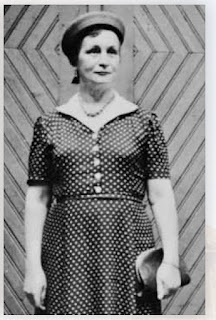
Charlotte McLeod (1925 - 2007) Part II: fame and marriage

Part 1: Youth and Copenhagen
Part II: fame and marriage
Part III: The geography of Charlotte McLeod in New York, 1957

Charlotte was offered night-club appearances. A reporter, who worked at the National Press Club and normally wrote religious articles, proposed to do a book on her, and put her up in a hotel in Washington, DC while they worked on it, but it was never finished, and he ran out of money.

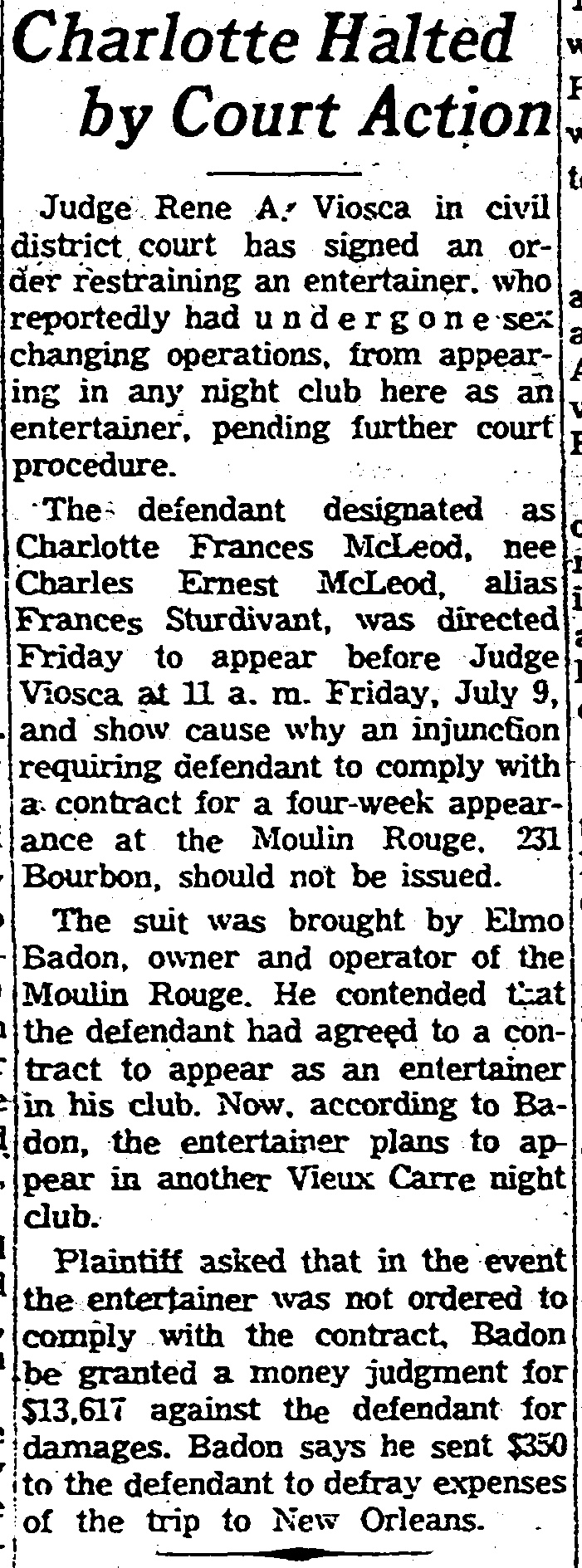
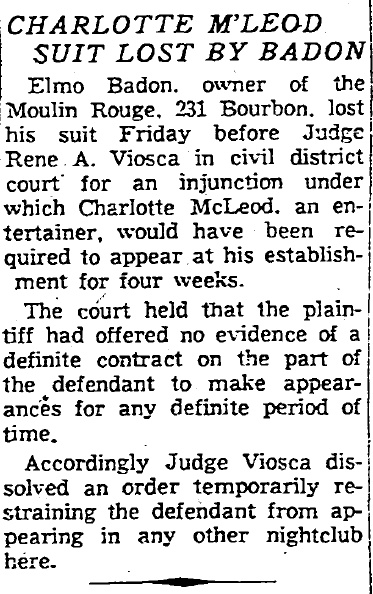
She took a gig in New Orleans, but found that the contract was with a strip club.
“And right across the street was a very, well the nicest club on the street. No hard bumps and grinds and strips and all that kind of thing. And to get me out of the verbal contract the owner paid for me going to court. And the next thing I am sitting up in front of the judge. I never will forget, I had a great big felt cart wheel hat on. Couldn’t sit on the seat because the cart wheel hat hit the back and I had to take my hat off. I don’t know why I should remember that. In that day and time ladies wore their hats. And he released me from the contract and I went across to the Show Bar, which was the nicest club on the street.” (Stryker:26)

A dancer-comedienne called Cupcake wrote material for Charlotte:
“ I’ve been to many places, environments strange, and then I went to Denmark, just for a little change”.
Then she moved on to the Casino Royal in Washington where she was backed by a band. She had become a member of the American Guild of Variety Artists, and was represented by Miles Ingles who was also the agent for Cyd Cherise and Polly Bergen. One time she appeared on stage in between Gypsy Rose Lee and Mae West. She also did modeling. Charlotte met Christine Jorgensen once when they were both appearing in New Orleans.

In August 1955, Charlotte had breast implants with New York plastic surgeon, Else La Roe (1918 – 2006).

In 1956 she wrote a brief autobiography for the Mr Annual, in which she claimed that her condition was physically caused, and that 95% of transsexuals should have psychiatric treatment.

Dorothy at the all-night beauty salon
Charlotte worked as a secretary and then as a receptionist at an all-night beauty counter.

She was becoming annoyed by star reporter and television personality, Dorothy Kilgallen.
“I got tired of Dorothy Kilgallen chasing me around and writing things about me that I have never thought of doing. And I went to her house [45 E 68th Street] one day and knocked on her door and the butler recognized me, it was strange, he said, ‘aren’t you Miss Charlotte?’ And I said, yes. And he said, don’t go away. I said, well I have no intention, that’s why I’m here. So I met Dorothy. And I said, well Dorothy, I’m tired of this, this business and I need a job. If you’ll help me get a job, I’ll tell you anything you want to know. Her husband is Dick Kollmar a Broadway producer, and he owned the Left Bank Club. He owned a little French restaurant and bar right across the street from Madison Square Garden. And in that day and time, the hat check and cigarette concession could make you a decent living. So they were most pleased to get me to be the hostess and hat check girl. The main thing that’s fun, I met everybody that ever was in show business.” (Stryker: 28)
This was 1957. It was while working at the Left Bank Club that Charlotte met Harry Benjamin, who came in as a customer. He became her physician, and also would take her out to lunch and introduce her to such conservative activists such as William Buckley as well as film stars.

Charlotte was living at the Washington-Jefferson Hotel on West 51st Street.  Ralph Heidal, whom she had met in Bergen, had stayed in touch by mail. They ran into each other in Maxie’s, a bar close by. He offered to take her away.

In 1959, Christine Jorgensen had been denied a marriage license by a clerk in New York City, on the basis that her birth certificate listed her as male; Jorgensen did not pursue the matter in court.

Charlotte in Miami 1959
Charlotte had been working in Miami, first as a secretary, then demonstrating cosmetics. After some months, Charlotte and Ralph, having become regulars at a Miami church, were married there in November. She did not mention her birth gender, however, or the fact that she was still legally a male. Press interest was aroused, but the Florida authorities confirmed that the marriage was not in violation of state law.

Dorothy Killgallen had contacts in Miami as everywhere, and their wedding was featured in her column.

A few months later, Mr and Mrs Heidal moved to California. They lived in Berkeley, then Oakland and then Marin County. Charlotte reconnected to Harry Benjamin who spent his summers in San Francisco. He introduced her to trans women Aleshia Brevard and Kathy Taylor who had been friends since their days at Finocchio’s nightclub, where Kathy performed as Stormy Lee.

Mrs Heidal’s marriage to her husband lasted seven years.
“And bless his heart, he couldn’t do a darn thing but drive a steamship around the world. Never did teach that rascal to drive a motor car. In fact, that’s why we broke up. I had visions of a little cottage on the side of Mt. Tamalpias. And oh how we did love it. But Ralph didn’t find a job. Everything he knew was diesel, whatever made steamboats run. I took him to every plant in Northern California trying to find a job for him. And finally, I got the proverbial Dear John letter. He said it was how it is every year we had to write but unless I was willing to go back to New York, where he was perfectly happy. And we would have to part company and I wouldn’t go back to New York.” (Stryker:31)
Dorothy Kilgallen died in November 1965 at age 52 after ingesting alcohol and barbituates. Some say that she was murdered (more) for digging into the Kennedy assassination – her folder of documents on the case had disappeared and was never seen again.

After her divorce, Charlotte moved to Laguna Beach, south of Los Angeles, because she had friends there. She got a job as a receptionist at a beauty salon. Charlotte arranged to have vaginoplasty:
“I was living at Laguna Beach. And a little Japanese doctor did it. And there was some instrument that he had to have, I think. He was under the impression that he could use the same instrument on me that he could on a normal woman that needed that surgery done. Well he did and perforated my colon. And I had to go to Stanford to have the colostomy to repair his work and while I was there I stumbled on Dr. Donald Laub [head of the Sexual Identity Unit]. Oh, me. What a to-do that was.” (Stryker:22)
One of the beauticians mentioned that her brother-in-law had lost his wife to suicide. They were introduced and started dating. He was a military officer with two children, eleven and twelve. The kids started calling her Mom.

On 8 August 1969 she was visiting Kathy in Los Angeles where they could see a commotion across the canyon that turned out to be the aftermath of the murder of Sharon Tate and 3 others by members of the Manson Family.

The military officer asked Charlotte to marry him, but something had to be explained first.
“In fact, it was Cathy who went to him and explained to him the situation because we had debated. He hadn’t the vaguest idea. And I knew, if he hadn’t already asked me to marry him, Cathy said, let me see if I can help. And she went and talked to him. And Cathy’s husband did not take it so well. In fact, he was very belligerent when he did find out.” (Stryker:41) [Cathy=Kathy of course.  Aleshia Brevard, who knew her, spells it with a 'K'.   The transcription of the interview spells it with a 'C'.]
Charlotte and the military officer were married in Las Vegas in 1970 – this time with no press attention. Again the marriage lasted seven years.

Return visits to the Stanford clinic and Dr Laub created problems when her husband went with her.
“And that really ruined my marriage with my second husband. We were going up and stopped by for a chat with him. And we went in and Donald had started, he was so very selective, very selective. He had a Gorgeous George sitting in there with tattoos all over him.” (Stryker:44) “He did ruin my marriage. My husband saw me in a different view from what he had in mind.” (Stryker:45)
After the end of her second marriage Charlotte moved back to Dyersburg, Tennessee to look after her ageing mother. She stayed in touch with her step children. The son died in middle age without finding out about Charlotte’s past; at the turn of the century, Charlotte was very sick and wrote to tell the daughter on her own terms in that it would come out if she died.  That daughter has had children, and thus Charlotte became a grandmother.

++Charlotte remained in Dyersburg, and died at age 82.   Her passing was not noticed by the press, which probably would have been to her liking.

*Not the mystery writer, nor the character in the television show, McLeod’s Daughters.
_________

The Washington-Jefferson Hotel is still in business. Its rooms are now $126 a night and up. Charlotte says: it “was a place for retired show people who lived there” which probably means that even after adjusting for inflation it was cheaper in 1957, particularly if you paid by the month.

Aleshia Brevard in The Woman I Was Born to Be, 2010, p48 writes:

This is quite different to what Charlotte said, whereby the wedding was after the confrontation at Kilgallen’s apartment, and the husband was certainly aware of Charlotte’s past before he married her.

Tina Thranesen gives the name of the New York plastic surgeon as Rachael LaRoe; Joanne Meyerowitz gives it as Else La Roe. I have gone with the latter.

In the Stryker interview it sometimes becomes confusing about when things are happening. I have placed the vaginoplasty operation just before Charlotte met her second husband because she says that she was living in Laguna beach at the time, and Donald Laub was not at the clinic at Stanford until 1968.

Charlotte says that she was already married when she observed the Tate killings from a distance, but that happened in August 1969, and she also says that the wedding was in 1970. Time does affect our memories. (Stryker: 38-9)

The Wikipedia page on Dorothy Kilgallen says nothing at all about Charlotte. Likewise Lee Israel’s 1979 biography, Kilgallen. Likewise Mark Shaw’s The Reporter Who Knew Too Much: The Mysterious Death of What's My Line TV Star and Media Icon Dorothy Kilgallen.

There is something missing from the source documents:  Dorothy Kilgallen's articles about Charlotte are not online.  The collection of newspaper articles found at TransasCity is very good, but does lack this component.

Trivia: Dorothy Kilgallen was at 45 E 68th Street; Harry Bemjamin’s office was only a block away at 44 East 67th St.


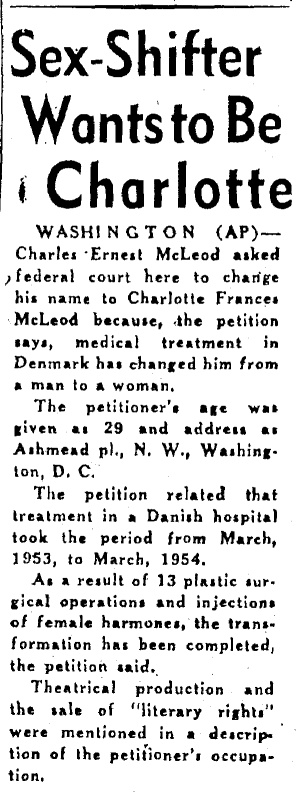
  • “Sex-Shifter Wants to be Charlotte”. Boston Daily Record, June 15, 1954: 4. Online.
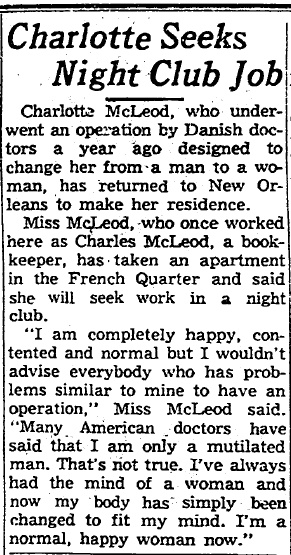
  • “Charlotte Seeks Night Club Job”. New Orleans Times Picayune, June 24, 1954: 8. Online.
  • “Charlotte Halted by Court Action”. New Orleans Times Picayune, July 4, 1954: 11. Online.
  • “Charlotte M’Leod Suit Lost by Badon”. ”. New Orleans Times Picayune, July 10, 1954:1. Online.
  •  Charlotte Mcleod.  “I Changed My Sex”. Mr Annual. Winter 1956. 
  • “Sex-Changed Ex-GI Becomes Miami Bride. UPI, Nov 13, 1959. Online.
  • “Bride Revealed as Forner GI”. San Diego Union, 11/14/1959: A3. Online.
  • Joanne Meyerowitz. How Sex Changed: A History of Transsexuality in the United States. Harvard University Press, 2002: 82-3, 84, 89, 91, 148, 304n93.
  • Susan Stryker interviews Charlotte McLeod, transcribed by Loren Basham. GLBT Historical Society, August 22, 2002. PDF.
  • Aleshia Brevard. The Woman I Was Born to Be. A Blue Feather Book, 2010: 5, 48.
  • Brittany Shammas.  “Five Moments in Miami’s LGBTQ History, From 1937 to 2015”.  Miami New Times, March 12, 2019.  Online.  

TransasCity Collection       Vidensbanken om konsidentitet

23 November 2017

Phoebe Smith (1939–) Part II: state worker, activist


Continued from Part I.

Back in Atlanta early 1969 after a first visit to Dr Barbosa, Phoebe Smith was taken shopping by an aunt who bought her three dresses. Phoebe made an appointment with Harry Benjamin in New York for a hormone prescription. Two aunts and a cousin went to New York with her.

Phoebe attempted to return to work at Rich’s Department Store, but a few co-workers objected, and the supervisor said no. Phoebe appealed up two levels but without success.

A gay former co-worker gave a big party to introduce Phoebe to the local gay scene – but she did not feel that she belonged there.  She was interviewed for a local television news program.

In November Phoebe returned to New York to see Harry Benjamin, and was told that she was ready for the final surgery. She immediately wrote to Dr Barbosa, but he did not reply – and then by telegram – until March 31 giving an appointment for April 11. She was in the hospital for two weeks, and even when she left was in considerable pain.

At first she wanted to be open about her past when applying for jobs, but quickly found that that was not going to work. She took the Georgia State Merit test, and got a position in Disease investigation. In May 1971 she transferred to Medicaid.

She was now undergoing electrolysis, and for a short while worked with a local transsexual support group before it discontinued.

Phoebe several times met persons who knew someone who knew her previous self, but it did not become a problem. One man threatened to out her if she did not date him. In spring 1974 a trans woman whom Phoebe had spoken to with the support group applied to Medicaid in the hope of having her surgery paid for. They met at the elevator, and the woman introduced herself. This made Phoebe think that everyone was talking about her. A close work friend told her that “we all know and we still love you”.

In 1975 Phoebe transferred to Family and Children Services. One day a co-worker rushed in and exclaimed: “Y’all, there is a transsexual that works for the State!”. Again it turned out that most of the co-workers already knew, and never said.


By June 1979 Phoebe had written her first autobiography, Phoebe. She self-published it and advertised in trans newsletters. A thousand copies were printed, and a New York bookstore bought four hundred. Reactions at work were mixed. People she had not previously known became friendly; no man at work ever asked her out again.

In 1980 she put together a brochure, “The Journey from One to Forty was Difficult but Successful”. It included a photograph of herself at age one with father, and a photo at age 40. It criticized the report from Jon Meyers of John Hopkins of the previous year that had been used as an excuse to close its Gender Identity Clinic.
“I have worked for the State of Georgia for almost ten years. During my fourth year of employment, knowledge of my surgery became widespread. It was upsetting, but also a big relief to get it in the open.”
Later that year a new communications office was established, and Phoebe became its supervisor, but with a pay cut.

The sale of the autobiography resulted in mail, much of it from persons seeking information. This led to the idea of a newsletter, The Transsexual Voice. The first two issues were complimentary, and 30 copies were printed. Within a few months there were over 100 subscribers.

A subscriber contacted her wanting to find someone to train in electrolysis. Phoebe jumped at the chance and for the next 15 years they worked on each other.

By the mid-1980s there were over 300 subscribers including Leo Wollman, Rupert Raj and Michelle Hunt. Phoebe mailed packets of transsexual-related material to newspaper editors, television news programs, talk show hosts etc. Very few responded.

Through the 1980s Phoebe’s family health problems deteriorated. Her younger brother was diagnosed with cancer, and died at age 40. Her father died age 74 in 1989 after various health problems. Her mother needed daily care such that Phoebe had to discontinue The Transsexual Voice in 1995. Her mother died in 1998, when Phoebe was 59.

She retired in in 2000. She had worked for the State of Georgia for almost 30 years.
  • Phoebe Smith. Phoebe. P Smith Pub Ind, 1979.
  • Phoebe Smith. “FMI Forum: The Transsexual Voice”. Female Mimics International, 14,6, 1985. Online. This is the 1980 brochure, which is also found p106-8 in Phoebe’s 2015 book.
  • Rupert Raj. “Tribute to Phoebe Smith”. Twenty Minutes, August 1989:3. Online.
  • Joanne Meyerowitz. How Sex Changed: A History of Transsexuality in the United States. Harvard University Press, 2002:158.
  • Phoebe Smith. From Sharecropper's Son to Who's Who in American Women. CreateSpace, 2014.
  • Eve Shapiro. Gender Circuits: Bodies and Identities in a Technological Age: Second edition. Routledge, 2015: 158.
  • Dallas Denny. “Creating Community: A History of Early Transgender Support in Atlanta”. dallasdenny.com, Nov 7, 2015. Online.
_____________________

Dr Barbosa’s $4,000 fee in 1969 would be $26,600 now!

Phoebe arrived for the first time at Dr Barbosa’s office only two months after Lynn Conway had completed surgery there.

There is no mention at all of Phoebe in Wesley Chenault, Stacy Lorraine Braukman, Gay and Lesbian Atlanta, Arcadia Pub 2008. Come to that, there is no mention of Jayne County or Dallas Denny either.

Phoebe had started electrolysis in 1971, after her two surgeries. In 1981 she trained as an electrologist and then for 15 years she and one other worked on each other. That is 25 years of electrolysis. I was done and complete in less than two years in the mid-1980s. Presumably there was not an electrologist in the Atlanta area at that time who knew how to do it on transsexuals.

It is striking in Phoebe’s autobiography that there is no mention at all of other trans people in Atlanta other than the trans woman who attempted to apply for Medicaid. The famous Atlanta trans women – Jayne County, Diamond Lil, Lady Bunny, RuPaul – were of a performance persuasion, and mostly took off for New York. However, apart from that there was trans man Jerry Montgomery, and Dallas Denny, who arrived in Atlanta in 1989. AEGIS and Southern Comfort Conference were established in Atlanta shortly afterwards.

Dallas Danny says: “With the Louisiana-based Erickson foundation no longer in operation, Phoebe’s Transsexual Voice was so far as I know for many years the only peer-produced transsexual-specific support publication in the world. Phoebe produced the last issue in 1995. It was an astonishing run, and helped thousands of people”.

13 June 2016

Clara Miller (1899 - ?) fur merchant, office worker

Ralph was born in London, the 11th of 13 children to Jewish parents, The father was a fur merchant of varying success, and also a Yiddish language novelist and playwright, although without any success.

At age five, Ralph contracted diphtheria, and for nine weeks was on the verge of death. From then on an older sister encouraged him to wear girls’ clothes and took him for walks so dressed. Even dressed as a boy he was regarded as effeminate, and would be beaten up by the boys at school.

The father refused a bar mitzvah for Ralph because of his effeminacy. At 15 he was taken from school and went to work for a friend of the father. One night, working late, he was raped by two co-workers, a boy and a girl. He told his father, who called the police and both assailants were sentenced to five years in prison. The girl died there.

Ralph, as Clara, went out at night, and found a sweetheart who kissed and held hands. However Clara finally had to tell the truth and the relationship ended. At 16 Clara asked the family doctor that her male organs be removed. The doctor called in the parents, and the father gave Ralph a good beating.

At 17 he was sent to New York to help a brother run the business. The brother let Ralph be Clara and even took her to parties. In 1918 Ralph enlisted in the US Army to make a man of himself. However he could not take it and deserted.

In 1921 he returned to London, as his father was dying. With his mother he took over the business, but the stress made him ill-tempered and he flew into rages. Despite this the business prospered. Clara met another who also aspired to become a woman. In 1923 Ralph met May, a young woman, 17. Under pressure from his mother, Ralph and May became engaged and then married. He could perform sexually, only underneath and when wearing something feminine. They managed to have a son and a daughter in the first three years, and then discontinued sexual activity.

They returned to New York, where Ralph became an office worker. He wore female clothing at home, and sometimes went out so dressed, against May’s objections, and later the children’s strong objections.

Ralph served in the US Army in the Second World War in North Africa, and admitted his earlier desertion. Early in 1945 he found work at the Veterans Administration as a clerk. He was also elected president of his local Veterans of Foreign Wars branch.

At the end of 1944, his daughter Barby and her husband set up a small business, and moved in with Ralph and May to save expenses. Barby nagged him constantly that he was not to be seen in female clothing. This got worse after the birth of a grandchild.

In spring 1947, after a late-night scene with Barby, Ralph dressed quickly and went out. He encountered a rookie policemen keen to make an arrest, and was charged with male prostitution. He was lucky to get a considerate judge, who required only a psychiatric report, after which he was released.

The fights with Barby got worse, and Ralph made a suicide attempt. Shortly afterwards, Barby, her husband and child moved to California. Ralph was able to be Clara more often.

She she became a patient of Harry Benjamin, and had surgery in 1957. Three years later she started living with a man, fifteen years younger, who was separated but could not obtain a divorce because he was Catholic.

Clara reports that they have excellent sex, and that the man has no idea about her earlier life. For a while she had associated with two other trans women, but broke away in case they gave away her secret. She reported being happier and better adjusted than before, and has no regrets about transition.
  • Harry Benjamin. The Transsexual Phenomenon. Julian Press, 1966. Warner Books Edition 1977: 256-272, 289-298. PDF: 118-128, 136-8.
________________________________________________________________________________

In "The Transsexual Operation" by Tom Buckley, Esquire. April 1967,  we find:

Is this Clara?  Apparently this uncredited photograph is by Diane Arbus, 

20 August 2015

Jennifer McCreath (1973 - ) government employee, marathon runner, political candidate.

McCreath was born in Halifax, Nova Scotia, and raised in Toronto, did business degrees at Toronto's Humber College, 2000, and Alberta's Athabasca University, 2005, and obtained a position as Senior Policy Analyst with the Government of Newfoundland.

Some months later she started transition as Jennifer, after appearing female at a Halloween party. In 2007 she did a series of interviews on provincial television station NTV about transitioning. She started getting positive reactions from people on the street who had seen her on television, but a year later lost her job.

She is also a marathon runner. She ran 30 marathons 2007-11, including the Boston Marathon in 2009 and 2010. She won a gold medal for achievement in the 2009 World OutGames in Copenhagen . She ran the 1500 metre freestyle swim and marathon run in the third gender category.

She took work as a filing clerk. She became involving in organizing St John's Pride Week, and founded the East Coast Trans Alliance.

Following trans surgery in January 2011, Jennifer applied to Nova Scotia for a revised birth certificate, but it took longer than usual. Jennifer had committed to run in a marathon, and had to fly with her male passport. Changing planes she was detained at US Immigration in Toronto, made to wait 90 minutes before being interviewed, photographed and fingerprinted, and subjected to many intrusive and irrelevant personal questions.  As a result she missed her flight and had to pay $80 for changing flights.

In 2013 she ran for deputy mayor in St John's.
“Everyone said I didn’t have any chance at all. Initially, I couldn’t get anyone to work with me. Nobody would sign my nomination papers. But six weeks later, I walked away with close to 6,000 votes — 17 per cent of the popular vote.”
In 2015 Jennifer ran in the federal constituency of Avalon. Although she was previously a member of the New Democratic Party, she ran as a candidate of the newly formed Strength in Democracy Party.
jennifermccreath.blogspot.ca     LinkedIn


____________________________________________________________________________

US immigration was never particularly friendly, and has become a lot worse since 2001.  Here is a recent story of an 8-year-old being turned away in that he might be a 'terrorist'.   Many Canadians now avoid flying into or changing planes in the US.   We might note that not a single trans person has yet turned out to be a terrorist, and that harassment based on gender incongruity has nothing to do with preventing terrorism.  

16 November 2014

Maria Clara Spinelli (1985 - ) civil servant, actress.

Spinelli was raised Assis in São Paulo province, and as an adult became a public servant.

After some theatre work Maria Spinelli was cast as a transsexual lawyer in Quanto Dura o Amor?, 2009 (known as Paulista outside Brazil), and won the Best Actress award at the local Paulinia Film Festival, and again at the Hollywood Brazilian Film Festival and the Monaco Charity Film Festival.

She has since been in several episodes of the Salve Jorge telenovela, again playing a transsexual.


PT.WIKIPEDIA    IMDB

14 July 2014

Paula Nielsen (1938 - ) secretary, evangelist, performer,

Larry Nielsen of Portland, Oregon, became a born-again Christian at age 12.

In the 1960s Nielsen became a patient of Harry Benjamin, and as Paula transitioned in 1963. In stealth Paula was active in her local Foursquare Church and its choir. She worked as secretary to the comptroller for a theatrical agency.

In the 1970s Paula joined the gay and lesbian oriented Metropolitan Community Church. She became church secretary, came out publically as transsexual, assisted the pastor, edited the church newsletter and participated in the student clergy program. She was the religion editor for the NW Fountain, a gay community paper.

Through the 1980s, Paula wrote a column that was printed in four different alternate publications. In 1980 Paula débuted on the stage of the Darcelle XV showplace where, billed as "Portland's Own Red Hot Mama", she did Sophie Tucker impersonations.

From December 1987, Paula had her own television gospel show, and was featured as a guest on television shows in the US, the UK and Canada. She is now on the internet. For seven years Paula worked on her autobiography, and it was published in 2012.
"...God has chosen the foolish things of the world to confound the wise.....and things which are despised, hath God chosen...." (I Corinthians 1:27, 28)
*not the Swedish actress.
BLOG   YouTube   CreateSpace

17 April 2014

Simone Heradien (1967?–) secretary, activist.

Simone dressed and lived as female from age 18. She was contingently accepted for surgery but told that she must work for a year as a woman first. She managed to obtain work as a secretary/personal assistant in the Department of Health of the House of Representatives, the Parliament for coloured South Africans in the Apartheid system, while being open about her past.

However, a year later, the surgery program had been suspended. Simone ended up waiting ten further years. Then using her contacts she heard that the program at Groote Schuur Hospital, Cape Town (where Christiaan Barnard had performed the first heart transplant in 1967) had been revived and they were doing operations again. Transgender operations had been done, on and off, at Groote Schuur since 1970 but ironically were discontinued after the end of Apartheid, as was state funding for the operation. Simone, one of the last to have the operation there, was approved in 1994 for state funding but her insurance company stepped in once assured that the operation was medical and not cosmetic. She told her then boss that she was having gender surgery and he thought that that meant that she would become a man.

Simone's elder sister Tammy was also trans but died of AIDS before she could have surgery – 23 days before Simone had her second-stage surgery.
 
Even after surgery, the embedded gender number range in her National ID number kept outing her to banks and government bureaucracies. Working with the Gender Research Unit at the University of the Witwatersrand in Johannesburg, and with the nerve to make an appointment with the Attorney General himself, Simone was able to threaten to go to the Constitutional Court. The Department of of Justice and the Department of Home Affairs agreed to change her ID book and even her ID number as a one-off.

Simone found a boyfriend who was quite accepting of her past, and they were engaged. However he had a history of depression, and hanged himself in March 2003.

Simone had been working with the Triangle Project, a trans support group in the Western Cape at that time. On the Internet she discovered that the National Assembly was discussing an Alteration of Sex Description Bill. With Estian Smit and Sally Gross (an intersex person), also of the Triangle Project, they prepared a submission to the Assembly committee – even though they had only three weeks to do so. Simone was given three weeks off work to attend portfolio committee after committee. Against opposition from established gay and lesbian organizations, they formed the independent Cape Town Transsexual/Transgender Support Group to lobby that surgery not be a requirement and that provision be made for intersex persons.
"Refusing to legally recognize a transsexual person’s reassigned sex serves no purpose. It impedes their ability to live and work in their new gender, in accordance with their medically prescribed treatment. Being able to obtain correct identity documentation is the key to equal participation in employment and educational opportunities for a transsexual person. Rather than erecting additional barriers in the path of transsexual people, the law should encourage and support their successful adjustment by providing them with the legal recognition necessary to be productive members of society."
The resulting Alteration of Sex Description and Sex Status Act 2003 was voted for by the ruling African National Congress and most opposition parties with the conspicuous exception of the Christian Democratic Party.

Simone later became involved with Gender DynamiX.