Essays on trans, intersex, cis and other persons and topics from a trans perspective.......All human life is here.
This site is the most comprehensive on the web devoted to trans history and biography. Well over 1800 persons worthy of note, both famous and obscure, are discussed in detail, and many more are mentioned in passing.
There is a detailedIndexarranged by vocation, doctor, activist group etc. There is also a Place Index arranged by City etc. This is still evolving.
In addition to this most articles have one or more labels at the bottom. Click one to go to similar persons. There is a full list of labels at the bottom of the right-hand sidebar. There is also a search box at the top left. Enjoy exploring!
William Ross Ball was raised, one of four children in Chilliwack, British Columbia. Their alcoholic father killed himself when the child was eight, followed by the mother having a nervous breakdown two years later. The children were then raised in group and foster homes. Shelley later said: "I wanted to be a woman since I was a kid, as far back as I can remember". At 13 she was committed to a mental institution near Vancouver for dressing in female clothes. Ball's teenage years were spent in reformatories and institutions across Canada, and even for a while at a boys' school in Washington State - he was kicked out for attempted arson. Whenever Ball ran away, she survived as a female sex worker, selling her body to heterosexual men who very well knew what she was. This fed a heroin addiction. She admitted robbing some of her customers, and had been stabbed several times. One night she was beaten, robbed and left for dead on a railway track in Vancouver.
In 1977, Shelley, now 24, was working at a house for ex-mental patients in Edmonton. In February, she met a trick in Edmonton's skid row section, and went to his hotel room with him. Either: when he admitted that he had no money, she claimed to be a member of the police moraliy squad, he got nasty, she slapped him, and it escalated. Or: the client became enraged when he realized that she was trans. She ended up stabbing him 17 times.
There was some confusion at the trial in February 1978 about which pronouns to use. Edmonton psychiatrist Donald Milliken testified that Ball was transsexual, and already on female hormone therapy. He said that she would be more confortable in a women's penitentiary. Shelley, in male clothing, at first refused to testify in that there was a group of 14-15 year-old school children present in the court in pursuit of a language project. The court accepted her contention that the case was not suitable for such young children and they were withdrawn,
Mr Justice Tevy Miller "with a great deal of trouble and soul-searching" found Shelley guilty of second-degree murder, and imposed the mandatory life sentence - which ruled out parole for the first ten years. Unusually, the judge also recommended a sex-change operation. The chief of medical services for the federal corrections service approved the operation in that Ball would be molested in a male prison, and that the operation would likely decrease his violent tendencies.
This was the first such surgery for a convict in Canada, and is in marked contrast to how all other trans prisoners were treated until Synthia Kavanagh won her appeal in 2000.
Ball, who already had breasts, but was 1.88 m (6'2'') and 73 kg (162 lb.) did time in three different male institutions, and had no trouble. "In Prince Albert (Saskatchewan), I think I went out with nine different guys while I was there. I had more husbands than Zsa Zsa Gabor."
Shelley in 1984
Shelley had partial (no vaginoplasty) genital reassignment surgery in 1980 and was then transferred to Kingston Penitentiary for Women. It was reported that the operation cost $250,000 - which led to cries of outrage. Vancouver trans activist Stephanie Castle wrote to The Province newspaper pointing out that "The $250,000 is enough for 30 such surgeries. ... Doing SRS in Canada currently costs about $8,000." She was given the reply that "Ancillary security costs to guard Ms Ball during repeated hospital visits pushed up the costs".
She was initially treated badly by the other women inmates, and attempted suicide several times. However she had an affair with an inmate and decided, after a lifetime of having sex with men, that she was a lesbian. She took a a hairdressing course while in Kingston, and later a Queens University psychology course.
There were two attempts at parole. On one she made an unauthorized trip to Vancouver to see her mother, but the mother was too drunk to recognize her, which prompted Shelley to go back on heroin. Both the trip and the heroin led to the parole board revoking her privileges, and her hoped-for release in 1990 did not happen.
She accepted that her life is in prison, and became chairperson of the prisoners' committee, pushing for more services for the other prisoners.
She was in the news again in 1998, still in Kingston Penitentiary, when she attempted to slash her own throat.
Toronto Star 1979.8.12 p2
*Not the Canadian football player, not the insect ecologist.
"Trans-sexual trial sparks confusion". Red Deer Advocate, February 15, 1978: 2.
Dick Schuler. "Prostitute gets life for stabbing death". Edmonton Journal, February 15, 1978.
Isabel Miller. "Not in Front of the Children". Letter, Edmonton Journal, February 21, 1978: 5.
Peter O'Neil. "Sex-change operation proves less than blessing". The Vancouver Sun, Aug 5, 1989: B3.
Beth Gorham. "Transsexual is content in prison". Calgary Herald, February 5,, 1989: 29.
Holly Horwood. "A female 'eunuch's' cry for help". The Province, Jan 29, 1995: A2.
Stephanie Castle. "Hurts transsexuals". Letter in The Province, Fenbruary 6, 1995: 17.
W is an anonymising initial issued by the judge, William Charles, in the case, and does not reflect their real names. We have no other name or pseudonym to refer to the persons.
W was born 1947, in the North of England. Because she had indeterminate genitals, the parents were asked did they want to raise a boy or a girl. The father chose ‘boy’. A year later the child was adopted by a cousin of the mother and her husband. The child was raised male but opted for girl toys and female clothing whenever she could.
At secondary school she refused to shower with the boys and to wear the boys’ uniform. The school compromised and allowed her to wear a female top. By age 15 she had noticeable breasts and a female body shape. The adoptive father convinced the family doctor to administer testosterone injections. W resisted and had to be held down by the adoptive father. There was no effect and when the adoptive father proposed increased dosage and frequency, and surgery to remove the breasts, W ran away and lived as a girl. However she was found and returned home.
At age 17 W ran away for good. She lived with a man in Manchester, apparently alternating genders, but he complained that she was too feminine, and the relationship ended.
W was scheduled for correction surgery at age 23, but this was postponed indefinitely because of a cerebrovascular accident. It was not until 1980 that she started on oral oestrogen. She finally had correction surgery in 1987 with a ‘Dr D’.
She married in 1990, and shortly afterwards had a Trachea Shave to reduce her Adams Apple. However the marriage did not last, and ended after two years. It was annulled on the basis that she was not female -- this was on the persuasion of her then solicitor that that was the cheapest way to end the marriage.
A second marriage in 1993, which gave the husband the right to remain in the UK, lasted three years and they were divorced in 1997. She had had a breast augmentation in 1996.
The husband further applied in 1998 for an annulment so that he could re-marry in church – although he remarried before his case came to court in October 2000. This time Mrs W defended against such an annulment, which would declare her legally male, and thus would interfere with her application for a revised birth certificate, and her future freedom to marry. Both parties jointly instructed Dr Conway, a consultant endocrinologist. Information was sought and obtained from ‘Dr D’ as to W’s anatomical details prior to surgery. Justice Charles found that she easily fell into the intersex exception as per the Corbett test: emphasis was placed on the natural lack of congruence of the chromosomes, gonads and genitals. Conway also gave in evidence the opinion that if Mrs W had been born in a later decade, she would have been raised as a female. Justice Charles copied much of Justice Roger Ormrod had written in 1971 in the Corbett v Corbett case.
Thus the Respondent was declared to be legally female, and her ex-husband’s application to have the marriage declared void was thus refused.
“W. v W. Case Law”. October 2000. Online and Online.
Dr Conway stated that “It is extremely difficult to be conclusive about an original diagnosis of an intersex state after surgery has been completed", but suggested that W had partial androgen insensitivity which is why the enforced testosterone injections failed to have any effect.
Whether you regard W as intersex or a transkid, she was badly failed by the medical system in the 1970s. There was a Manchester gender clinic at Witherington Hospital from 1972 and a TV/TS group in the city from 1973. W should have been offered an early transition, and not have had to wait until almost middle-age.
As W had not had her birth certificate revised before either of her two marriages, she was at risk of being charged that in violation of the Perjury Act, 1911, she had “knowingly and wilfully caused a false statement to be entered in a register of marriage”, as Victor Barker had been so convicted in 1929. The authorities sensibly did not so charge her.
There was a W. v W. divorce case in South Africa 1976 that involved a trans woman.
A black trans girl, for whom we are not given a name, not even a doctor’s
pseudonym, was in the New Jersey foster care system as her mother was disabled
and indigent. As she entered her teens, she expressed the kinds of statement
that trans girls usually do. For this she was committed to a psychiatric
institution and labeled ‘schizophrenic’. For the next fifteen years, her gender
identity issues were taken as evidence of ‘delusion’, ‘mental retardation’ and
‘sexual perversion’.
In 1978 Jeanne
Hoff, who had taken over Harry
Benjamin’s practice, and had recently completed her own transition, became
aware of the case. The patient was now 30 years old. Hoff interviewed her, and
petitioned for her release.
“Through all the florid language of the [psychiatric] reports there is an
unmistakable moralistic disapproval of her effeminacy and homosexuality but not
the slightest hint that the diagnosis of transsexualism was suspected, even
though it was quite evident from the details provided. . . . She should be
placed in the community, preferably living by herself” and “she should be
permitted to explore the various problems that arise from cross-gender living,
hormonal therapy, and surgical gender reassignment.”
Julian Gill-Peterson. Histories of the Trangender Child. University
of Minnesota Press, 2018: 159-160, 248n105.
--------------------
Gill-Peterson found this account in the Jeanne Hoff archives at the Kinsey Institute. He discusses, of course, how maltreatment of this sort was more often inflicted on black people. We have already seen Chris Thompson, a dancer, who was black, gay, trans and asthmatic. She sought treatment for asthma at New York’s Bellevue Hospital in 1970, but was locked in the psychiatric wing for not being heteronormative.
Again we do not know what happened afterwards. One hopes that the woman in New Jersey was discharged, but she would still have needed help after 15 years of incarceration.
Lance had, almost since his first year, loved to parade in the shoes and
clothes of his mother and sister. He also loved jewelry and makeup. The mother
regarded this as just childhood play, but then a neighbor complained, and a
teacher at school reported that he involved his friends in games of
cross-dressing. At age five, Lance was taken by his mother to the University of
California Los Angeles Gender Identity Research Clinic (UCLA GIRC).
Richard
Green saw him twice weekly for six months, until called away, and then
psychoanalyst Ralph Greenson continued the treatment. Robert Stoller,
psychoanalyst and head of the GIRC analyzed the mother.
Greenson was a celebrity psychoanalyst in Los Angeles and had analyzed
several film stars, such as Frank Sinatra and Tony Curtis, and most famously had
been Marilyn Monroe’s analyst at the time of her death in 1962. Lance was his
first time treating a child.
He quickly noticed the child’s intelligence and athletic ability. He treated
Lance mainly at the swimming pool at his own home, where he even taught Lance to swim.
Most of the sessions were comprised of games in the water. This helped Lance to
overcome his fears about being alone with a male adult. One day, while out for a walk,
they encountered a group of girls playing with a Barbie doll, and Lance,
becoming excited, asked to watch. At first he was mocked by the girls, but then
became the center of their game. Later he begged Greenson to buy him a Barbie
doll. Greenson did so, but on the condition that Lance could play with it only
when with Greenson. After this point Lance largely stopped wearing female
clothing. Lance did a drawing of the happiest day of his life, which was of
himself in the pool, with a man outside watching. Lance avoided touching
Greenson until the fifth month when they were playing together in the pool.
Greenson was replacing Lance playing with the doll by playing with an adult
male. According to Greenson, Lance had had difficulty differentiating loving an
object from wanting to be the object. Initially he had referred to the doll as
‘me’.
Stoller analyzed the mother. She was in her forties, and had also an
11-year-old daughter. Her grandparents had been prize-winning lace-makers, and
her father was noted for his needlework and weaving. She had been a creative
dress designer before marriage, and still made all her own clothes. She
permitted her children to see her nude and engaged in much body contact with
them. Stoller describes her as looking ‘boyish’, and with shortish hair,
although usually in a skirt. She took pride in her teenage photographs where she
appeared to be a boy. She had passed as male whenever convenient; competed with
boys in athletics and games; and played both male and female parts in
theatricals. This was quite accepted by her family. She said:
"When you take off your own clothes and put on different clothes, you can be
anyone".
Her own mother was emotionally distant, but her father comforted her, bought
her clothes and took her, but not her brothers, to sports events. That is, until
her younger sister was born. However at puberty she accepted her anatomical
destiny, and developed her femininity. A brother 13 years younger was also
a cross-dresser. She left home at 16. She married a man who was frequently away
at work. They had a daughter and then Lance. Stoller describes both her mother
and her husband as ‘empty’. He also diagnoses the mother as having ‘penis envy’.
He summarizes:
“Let us review what has happened in this particular case. A strongly bisexual
woman, with severe penis envy derived from her father and older brothers, in its
turn the result of a sense of emptiness produced by her mother, married an empty
man and had a son. On the one hand, the boy was (the phallus) of her flesh; on
the other, he was clearly a male and no longer of her flesh. He was therefore
both to be kept as a part of herself, by identification, and treated as an
object whom she would feminize. He was his mother's feminized phallus.”
After many months of analysis, it came out that it was she, rather than her mother,
who had brought up the brother, 13 years younger, who was also a cross-dresser.
And he had the same name that she gave to her own son.
After Lance’s sessions with Greenson, he was deemed to be cured. Stoller, in
a different essay (1968: 254) says:
“The first successfully treated case of childhood transsexualism is that of
Greenson; a report written after the treatment was ended gives a vivid and warm
account of this boy's rescue.”
A few years later when Agnes
confessed to Stoller that she had taken external estrogens before first seeing
him, she agreed for him to meet her mother, and he was able to analyze her. He
found a pattern similar to that of Lance’s mother. He found a few more such, and
proposed his intergenerational model of transsexual etiology, for which he
became famous.
Robert Stoller. “ Mother’s Contribution to Infantile Transvestic
Behavior”. International Journal of Psycho-Analysis, 47, 1966:
384-395.
Ralph R. Greenson. “A transvestite boy and a hypothesis”. International
Journal of Psycho-Analysis, 47, 1966: 396–403.
Robert Stoller. Sex and Gender: On the Development of Masculinity and
Femininity, Science House, 1968.
Ralph R Greenson. Explorations in Psychoanalysis. International
Universities Press, 1978.
Pierre-Henri Castel. La métamorphose impensable: essai sur le
transsexualisme et l'identité personnelle. Gallimard, 2003: 88-9,
432n17.
Riccardo Galiani. “Un cas, deux écritures, une catégorie “. Topique,
3, 108, 2009 : 143-156. Online.
Richard Green. “Robert Stoller’s Sex and Gender: 40 Years on”. Archives
of Sexual Behavior, 39, 2010: 1460-1.
------------------------
When Stoller reprinted his article in his 1968 collection of papers, he
renamed it “Mother’s Contribution to Transsexualism”; likewise when Greenson
reprinted his in his 1978 collection, he renamed it “A transsexual boy and a
hypothesis”. Stoller (1968: 131) explains how he distinguishes the words: "I found myself, on calling the child an "infantile transvestite," continuously having to explain that although he cross-dressed, he did not have essential qualities of the adolescent or adult male transvestite (e.g., love of and anxious regard for his penis)."
As is often the case with psychoanalytical studies, we have no follow-up.
Lance became an adult at the end of the 1970s, and will now be turning 60. Did
Lance later return to being a woman? Did he, like the presumed pre-transsexuals
in the UCLA/Richard Green Feminine Boy Project of the 1970s, become a gay man instead? Does the claim that he was ‘cured’ by Greenson mean that he was not
really trans to begin with? We know of apparent trans kids who desist. A major
example from the 1960s would be Kim
Christy who grew up to be cis heterosexual, father and grandfather. No
adult, cis man or trans woman has come forward to identify with Lance. Unlike
Freud’s published case studies where the corresponding real-life persons have
been identified.
If Stoller and Greenson were right about what they were doing, then it was
wrong in that it was conversion therapy, which today would be illegal. However
if the only result of Greenson’s therapy was to teach Lance to swim, and to
make him comfortable in the presence of an adult male, then no real harm was
done. However to the extent that an attempt was made to induce an Oedipal complex through the transferential interventions of a male therapist, than that is something else.
Stoller is critical of Lance’s mother’s lifestyle: nudity in front of the
kids, body touching, interest in clothes, freedom to wear whatever clothing. A
few years later this kind of lifestyle was dubbed ‘hippie’. Surely there was much
in it that is positive. Stoller implies that the mother's passing as a teenage male was somehow perverse. This would have been the early 1930s. Her accepting her body changes at puberty, and switching to being a woman, could equally well imply a healthy attitude to reality.
Stoller regards it as important that she admitted that it was she, rather than her own mother, who had raised the brother who cross-dressed. However he was 13 years younger, and she left home at 16. So she raised him only for the first three years. Yet Stoller implies that she repeatedly turned boys into cross-dressers.
Stoller calls the mother 'bisexual'. He is not using the term as we do today. There is no suggestion of a female lover. It would be better if he used 'bigender'.
Did the UCLA GIRC provide the therapy sessions pro bono (as it was research) or was the family
sent a bill? As usual, we are not told.
Castel (p88) describes Lance as the archetype of a child transsexual. Really!
This, of course was long before the recent expansion of numbers of trans kids,
but there are serious candidates for the term from the 1950s/1960s: Sally
Barry, Jill
Monroe, Hedy
Jo Star and of course Agnes.
Stoller writes of “a mother's unconscious wishes on the infant who is later
to become perverse.*" and immediately adds a footnote: “After studying
transexuals , I am much less certain what the word "perverse" means”.
To my mind the most perverse thing in the article is Stoller’s designation of
the mother’s mother and of her husband as “empty”. However that is just a word.
Stoller does not explain how he is using the word, and more importantly he does
so on the word of a single analysand.
Stoller adds a footnote that after three years Lance’s father was persuaded
to come in once a week and to see a different team member, but we are told
nothing further.
Sampaio, from Aquiraz in
the province of Ceará, in the north-east of Brazil, was using the name Valentina
by age 10. She was accepted as a girl by her parents, a fisherman and a
schoolteacher, and by the local community.
At college in the nearby provincial capital of Fortaleza, she studied
architecture, at the same time as she was doing modelling work. She was fired
from at least one gig specifically for being trans.
However, barely 19 years old, Valentina went from doing local shows and photo
shoots to being in São Paulo Fashion
Week, and being on the cover of Elle Brasil and L’Officiel
Brasil. She had to file a lawsuit to rectify the name and gender on her
identity documents, but had a favourable ruling.
International recognition came when she was on the cover of Vogue Paris, March 2017,
with the by-line: ‘Transgender beauty: How it’s shaking up the world’ and with
an editorial inside.
She acted in the film, Berenice Procura, 2017, and is a spokeswoman
for L’Oreal Paris.
Neto Lucon. “’Nenhuma cirurgia vai me fazer mais ou menos mulher’, diz a
modelo trans Valentina Sampaio”. Nlucon.com, Novembro 14, 2016. Online.
Paul McQueen. “Everything You Need to Know About Transgender Model Valentina
Sampaio”. Culture Trip, 3 March 2017. Online.
Anna Jean Kaiser. “Meet The Transgender Model Who Broke Fashion's Highest
Barrier”. Buzzfeed, June 05, 2017. Online.
Only one week before the issue of Vogue Paris with Valentina on the cover,
another trans woman in Forteleza, Dandara
dos Santos, 42, was brutally murdered; the crime was recorded on a phone and
uploaded to the internet. In this case at least, the killers were convicted and
sentenced to 16+ years each.
Willi
Pape was raised in the Berlin suburb of Spandau. His father owned a wooden-shoe factory and
his mother was a dressmaker. He had said from an early age that he did not want
to be a boy, and took pleasure in female clothing, and in working with his mother
as she made dresses.
In teenage he had
seen a female impersonation on the stage of a Berlin variety theatre, and very
much wished to do the same. His parents had arranged for Willy to study to
become an artist, and he was engaged to a young woman, Emma, whom he loved and
with whom he had been intimate.
Reading
in the newspaper that a male-impersonator in Hamburg was looking for an
opposite-sex partner, Willi, who was then 17, stole 300 marks from his parents
and travelled to Hamburg, where firstly he purchased female clothing. The project did not realize, and Willi
further travelled to Stettin and then back to Berlin. This was done while presenting as female,
travelling in the women’s section on trains, and registering in hotels as Selma
Bruegge. Not knowing how to continue, Selma took a
hotel room in Friedrichstadt and cut the arteries of her left hand.
Pape was rescued by the hotel staff and taken
to the Urban hospital. Given the
circumstances of her dress, the head physician contacted Magnus Hirschfeld, who
visited on the third day after admission.
Willi confided in Hirschfeld, and also mentioned that he did not find
men attractive, and could not understand that such was possible. Hirschfeld contacted the parents, explained
the situation and led them to understand that the best solution was to allow
Willi to become a performer.
Using the
stage name of Voo-Doo, Pape became a Travestiekűnstler, Pape is discussed in the Suicide chapter of
Hirscheld’s Die Transvestiten as P.
from Standau, and is pictured under the name of Willy Pape in Hirschfeld’s Der erotische
Verkleidungstrieb (Tafel XVI), where he is
described as a “highly successful Variété artist who performs as a Snake Dancer”.
Pape actually presented himself in female
clothing when summoned for military service in 1914.
By 1918 Willi had a male lover, Emile
Schmidt, but never set foot in a gay establishment until ten years after that.
Willi became a prominent figure in Berlin’s
sexual subculture. In 1927, by which time
Voo-Doo was celebrated across Europe, the lesbian magazine Die Freundin
featured a photograph of Voo-Doo alongside an article about women’s fashion
(fig. 5.16). The article, introduced by the magazine’s editor as an “Open Forum
regarding Questions of Fashion,” launched what she hoped would be a “lively
discussion regarding this timely issue.”
·Magnus Hirschfeld translated from the German
by Michael A. Lombardi-Nash. Transvestites: The Erotic Drive to Cross-Dress Prometheus
Books. 1991: 316-8.
·Magnus Hirschfeld and Max
Tilke, Der erotische Verkleidungstrieb (Der Transvestiten), Illustrierter
Teil (Berlin: A. Pulvermacher, 1912: Tafel XVI..
·Anonymous, “Meinungsaustausch
über Modefragen: Ein Mann über Damenmode,” Die Freundin, Jg. 4, 14,
1927: 27-28.
·“(Photo Gerlach) Der
Transvestit Voo-Doo, einer der bekanntesten internationalen Tanzsterne.” Die Freundin, Jg. 3, 4, 1927: 27.
·Jens Dobler. Der
Travestiekünstler Willy Pape alias Voo-Doo. Invertito 6, 2004:110-21.
·Rainer Herrn. Schnittmuster des Gesch-lechts.
Transvestitismus und Trans-sexualität in der frühen Sexual-wissenschaft. Giessen: Psychosozial-Verlag 2005: 76, 93. ·Julie Nero. Hannah Höch,
Til Brugman, Lesbianism, and Weimar Sexual Subculture. PhD Thesis, Case
Western Reserve University, 2013: 234-5.
Charles Schultz was born in West Seattle. By early teenage, Schultz had
acquired a trunk full of female clothing, and often rode on the city streetcars
where she passed easily.
She got work at the local Florence Theatre. Her
family and friends were aware, and proud of her professional photographs. She
took the stage name of Francis Blair.
In the 1930s Francis was in the chorus line of the Rivoli Burlesque. Her
gender was known and her dressing space was separated from that of the cis women
by a screen. She sometimes played the organ for the show.
She was in the dishwashers’ union in case no theatre work was available; she
was an officer in the performers’ union.
Very unusually for the time, Francis wore her hair long, and did not have to
wear a wig. When out in male persona, he concealed it under a hat.
Francis was one of the first performers to join the Garden of Allah in 1946.
Syndicated columnist Walter Winchell wrote
about Francis as ‘the boy with the million-dollar legs”. She was known for her
singing, but also danced, stripped, produced shows and designed costumes.
During the Korean War, Francis did shows for the United Service Organizations
(USO) which provided entertainment for the US Military. A rather prim hostess of
the show had a fit when Francis stripped down to only a G-string.
She was also a comedian and in contrast to her usual glamor act did a double
act with Kenny Bee as ‘Two Old Bags from Tacoma’ where they wore old clothes
with holes in their stockings. They took that act to Finocchio’s
in San Francisco as ‘Two Old Bags from Oakland’.
Years later, Francis and her husband of 20 years took a vacation in San
Francisco, and they were attacked in Golden Gate Park. The husband and their dog
were killed. Francis was left to drive home to Seattle alone, and was killed in a
car crash in Oregon.
*Not Charles Schultz the cartoonist.
Don Paulson. “Gay History: Francis Blair - Seattle's quintessential female
impersonator”. Seattle Gay News, no date. Online.
Don Paulson & and Roger Simpson. An Evening at the Garden of Allah:
A Gay Cabaret in Seattle. Columbia University Press, 1996: 135-141.
Gary L. Atkins. Gay Seattle: Stories of Exile and Belonging.
University of Washington Press, 2003: 63.
Melissa Gohike. “San Antonio’s Drag Culture of the 1930s and 40s”. The
Top Shelf, October 22, 2012. Online.
As with Jackie
Starr, there is no mention of Francis in either Lawrence Senelick's The
Changing Room or F Michael Moore's Drag! Male and Female Impersonators
on Stage, Screen and Television.
It is odd that we do not have a date, not even a year, for Francis’
unfortunate demise.
Charles McLeod Jr., the only child of a Ford Motors salesman, was born in
Nashville and raised in Dyersburg,
Tennessee. The parents divorced when he was 16: both remarried. He was a lonely
sensitive boy who lacked interest in masculine things. He was sometimes taken as
a girl in boys’ clothing.
He consulted doctors and in the early 1940s went to the Mayo Clinic in Rochester,
Minnesota. He also stayed with cousins in Los Angeles in the hope of finding a
medical specialist in that city who could help – but without success.
McLeod served three months in the US Army 1948 before being medically
discharged with a 4-F rating. McLeod found doctors sympathetic to the idea of a
sex change, but they apologized that the US laws re Mayhem
would not permit such surgery.
McLeod was advised to “find such little happiness as I could in life by
going to one of the ‘colonies’ that abound in our large cities” (McLeod,
1956:12). In 1948, McLeod moved to the French Quarter in New Orleans, but did
not fit in the gay world either. He did find work as a bookkeeper for $75.00 a
week (a good wage at the time). He tried Boston for a while, but returned to New
Orleans.
He went to the Mayo Clinic a second time. They still could not offer
anything, because it would be illegal.
In April 1953 McLeod, at age 28, read about Christine Jorgensen and her
operation in Copenhagen. He quickly packed, and went to Dyersburg to tell his
father what he was doing. With apparent parental approval, McLeod continued to
New York and quickly took ship to Denmark using a minor inheritance from a grand
aunt. He sailed on the MS-Maasdam.
Many of the people on the ship were crossing to England for the Coronation in
June.
In Denmark, the Folketing had passed a new
law restricting sex-change operations (that is the ‘first’ operation, the
orchiectomy or castration) to Danish nationals who were not over 26. By asking
around, McLeod was directed to a renegade doctor, Dr Emil Petersen:
“a rather unscrupulous physician, a man who had been charged with
collaborating with the Nazis and who had only recently returned from exile. … of
frightening appearance who, from the results of a British bullet through the
base of his skull, habitually walked so bent over that he never met one’s eye.”
(McLeod, 1956:13).
McLeod moved into the doctor’s apartment and waited five days while Petersen
came down sufficiently off narcotics to regain his surgical skill. His wife and
eldest son were to assist with the operation which took place on the kitchen
table. The wife administered the anesthetic.
McLeod awoke in great pain and hemorrhaging. Petersen retreated into drugs,
and collapsed outside McLeod’s door. She tore the stitches in her abdomen
attempting to get him up, and then an infection set in. She fled and found that
she no longer had her passport. She reported this to the police, and she was
told that she had to leave the country, but was allowed time to settle her
medical problems.
McLeod was admitted to Bispebjerg
hospital. The first operation being already done, it was now legal to
complete the transition. The Danish doctors led by Dr Jens Foged (1897 – 1956)
agreed to do a penectomy and relocate the urethra. Christian Hamburger, who had
attended to Christine Jorgensen, was the endocrinologist, and explained to
Charlotte about the need for external hormones. She was unable to pay for the
medical attention, and so the medical team worked free of charge.
Charlotte then started wearing female clothes, and applied to the US embassy
for a new passport. It was re-issued but again in the name of Charles. Her
father was contacted, but said that he would give neither financial nor
emotional support.
After recovery, Charlotte went with a church outing for a weekend in Bergen, Norway, where she met a
US-Norwegian, Ralph Heidal, a seaman, who helped her with skiing.
Twice in 1953, on 5 March and 20 May, a Polish pilot defected to the West by
landing
his MIG fighter plane on the Danish island of Bornholm in the Baltic. It was
probably the second occasion when Charlotte was there having been invited to
visit for the weekend. She created a stir: “ I never saw so many Russian troops.
Microscopic was their examination of all of our papers and when it was found
that my passport didn’t match, I think they thought that they had found the
master spy.” (Stryker: 23)
In early 1954 Charlotte gave a very brief interview to journalists in
Copenhagen. A 47-page pamphlet, Da Karl blev Karl: En dansk læges
bedrift, came out telling of a second US person operated on – this
time on a kitchen table. The book names the person as Karla, and the doctor as
Petersen.
A few weeks later, on 24-5 February the Danish publication,
Aftenbaldet (Evening Magazine) told almost the same story of Charlotte
McLeod – and in retrospect it is apparent the Karla and Charlotte were the same
person.
The US press picked up on the story immediately.
In early March the story broke that Roberta
Cowell in England had also completed a gender change.
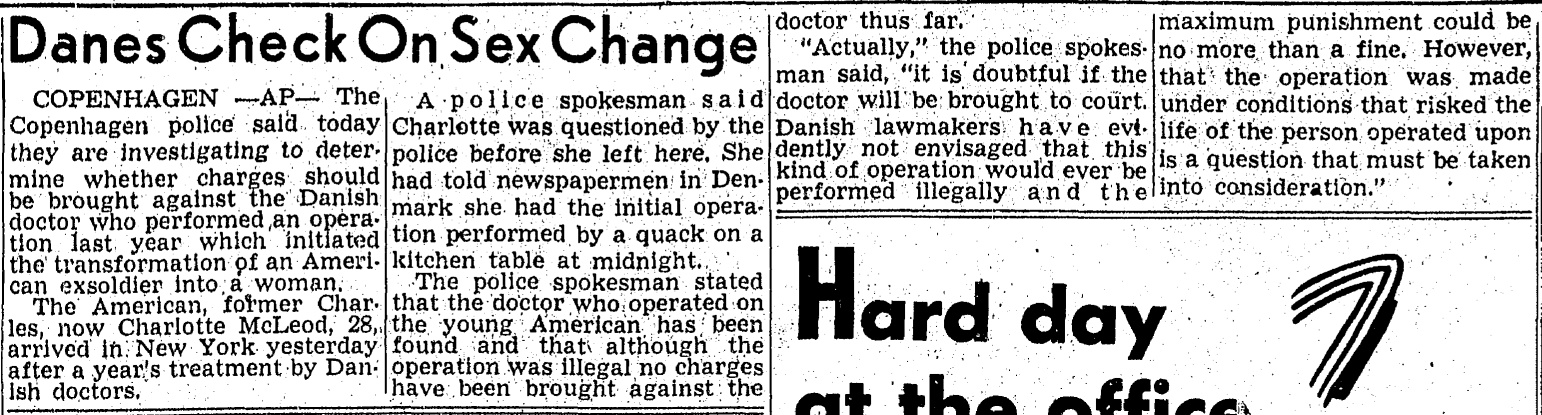
In late April the Copenhagen police found that Dr Petersen was the doctor who
did the initial operation, and after statements that perhaps he would not be
charged, finally he was charged with violating the castration law.
Charlotte inadvertently interrupted a press event for the Canadian actress,
Yvonne de Carlo:
“She had all the press lined up for this big landing that she was going to
make when she came in from Europe. And they found that I was in next car coach
and everybody that was supposed to interview her came gang banging on me.”
(Stryker p24)
It was 16 April 1954 when Charlotte arrived at New York’s Idlewild
airport. She intended to transfer and fly directly to Tennessee. However fog
grounded the plane. She stayed overnight in a hotel, and was swarmed by the
press, to the point that she fell over. It was said that in the struggle she
struck a photographer with her umbrella, and she and they were arrested and
charged with assault. However the charges were quickly dropped.
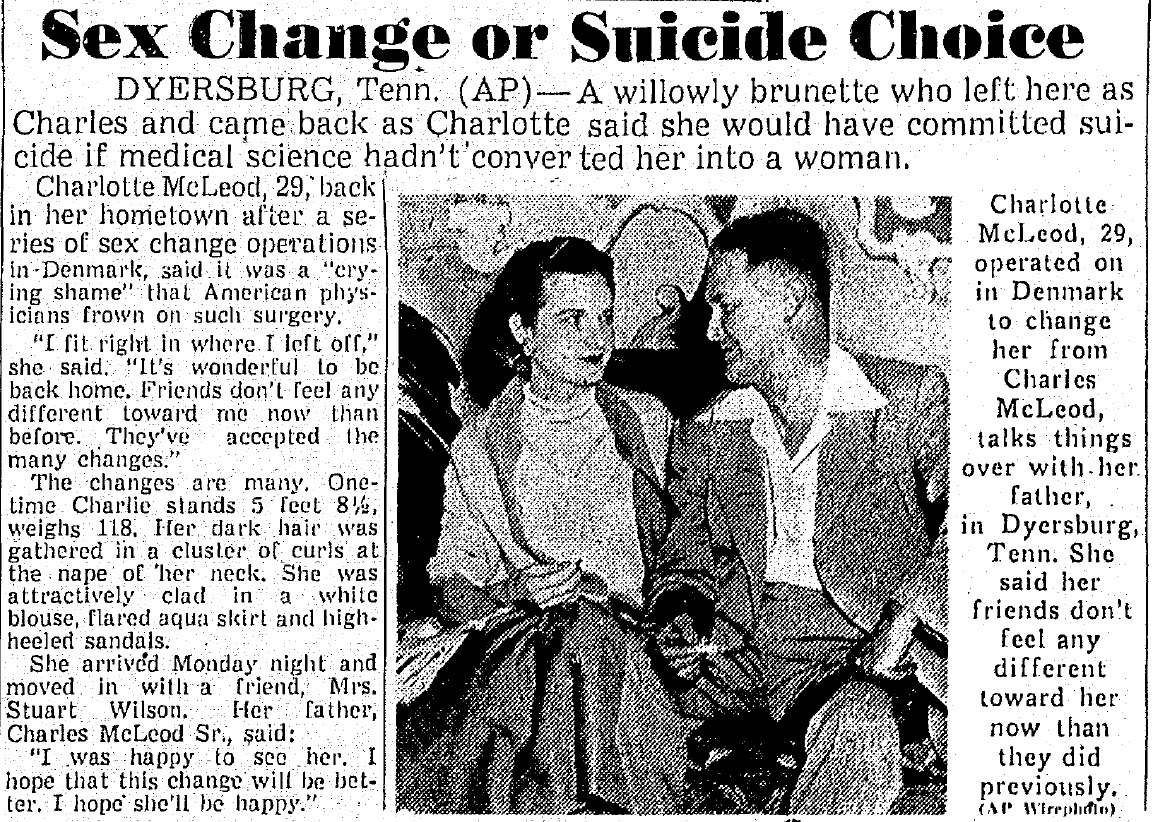
Charlotte reconciled with her father.
She returned to Dyersburg and was reconciled with her father.
Thank you to Tina Thranesen ofVidensbanken om kønsidentitet who
first identified that Da Karl blev Karl: En dansk læges bedrift was
actually about Charlotte.
The high quality photographs are from Transas City.
In an interview with Susan Stryker in 2002, Charlotte said (p6) that her father
was a Ford Motors salesman. However several newspaper accounts in 1954 said that
he was in insurance.
She also said that she was in Denmark for ‘two years’ (p24, 29). However
April 1953-April 1954 is one year.
Charlotte did not know, most trans persons in 1953 did not know, but Elmer Belt had quietly started doing vaginoplasties for trans women at the
University of California at Los Angeles. He got around the Mayhem restrictions
by preserving the testicles, pushing them into the abdomen.
The encounter with Yvonne DeCarlo. This is recounted on p24 of the interview
with Susan Stryker. Charlotte says it immediately after saying that she was in
Denmark for two years which implies that it was at about the time that she
returned to the US. It is unclear whether it happened in Denmark or the US. The
expression ‘next car coach’ implies that that they were on a train. I have
placed the anecdote immediately prior to her flight to the US, but with further
information this may have to be adjusted.
Bent Rosenwein. Da Karl blev Karla: En dansk læges bedrift. Self
published, 1954.
“Ny amerikansk Chris Jørgensen skjult her I byen efter operation”.
Aftenbaldet. 24 feb 1954. PDF. Text.
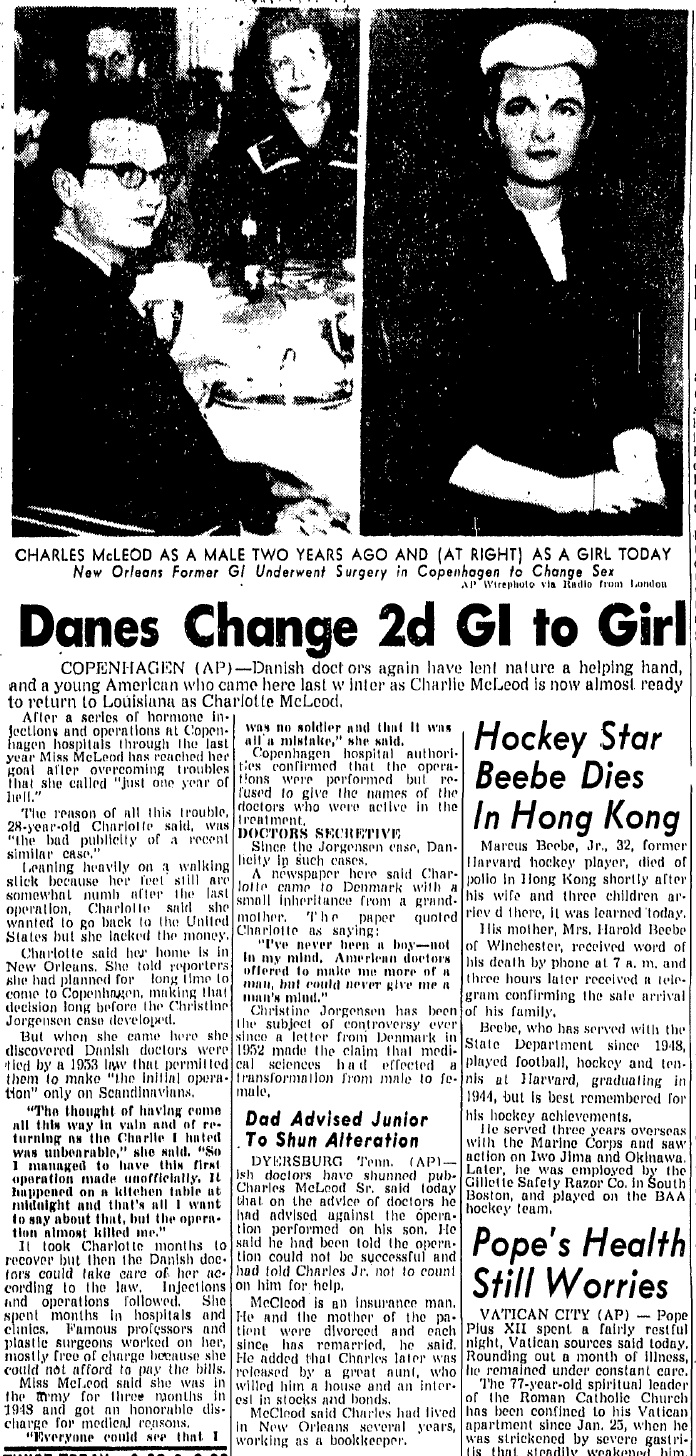
“Danes Change 2d GI to Girl”. Boston American, Feb 24, 1954:
3. Online.
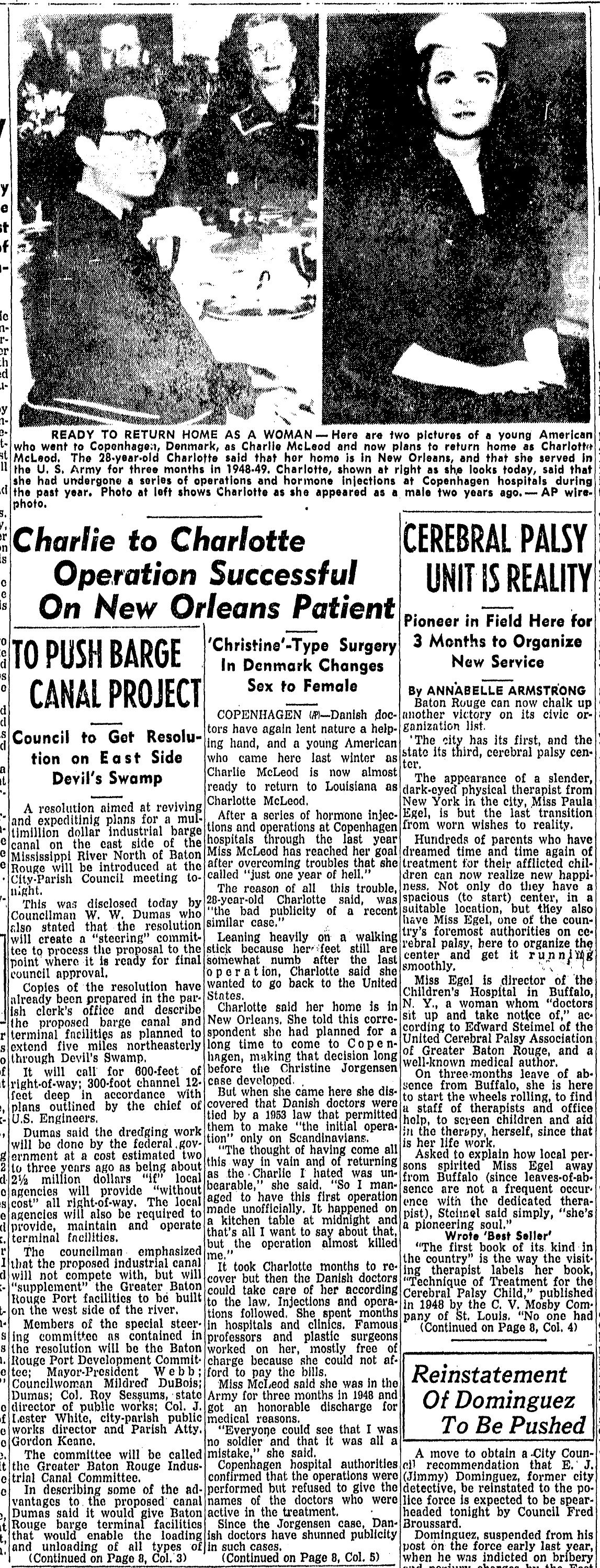
“Charlie to Charlotte Operation Successful on New Orleans Patient:
‘Christine’-type Surgery in Denmark changes Sex to Female”. Baton Rouge State
Times Advocate, 2/24/1954: 1-a, 8-a. Online.
“Operation Changes Sex of American”. Eugene Register-Guard. 24 Feb
1954. Online
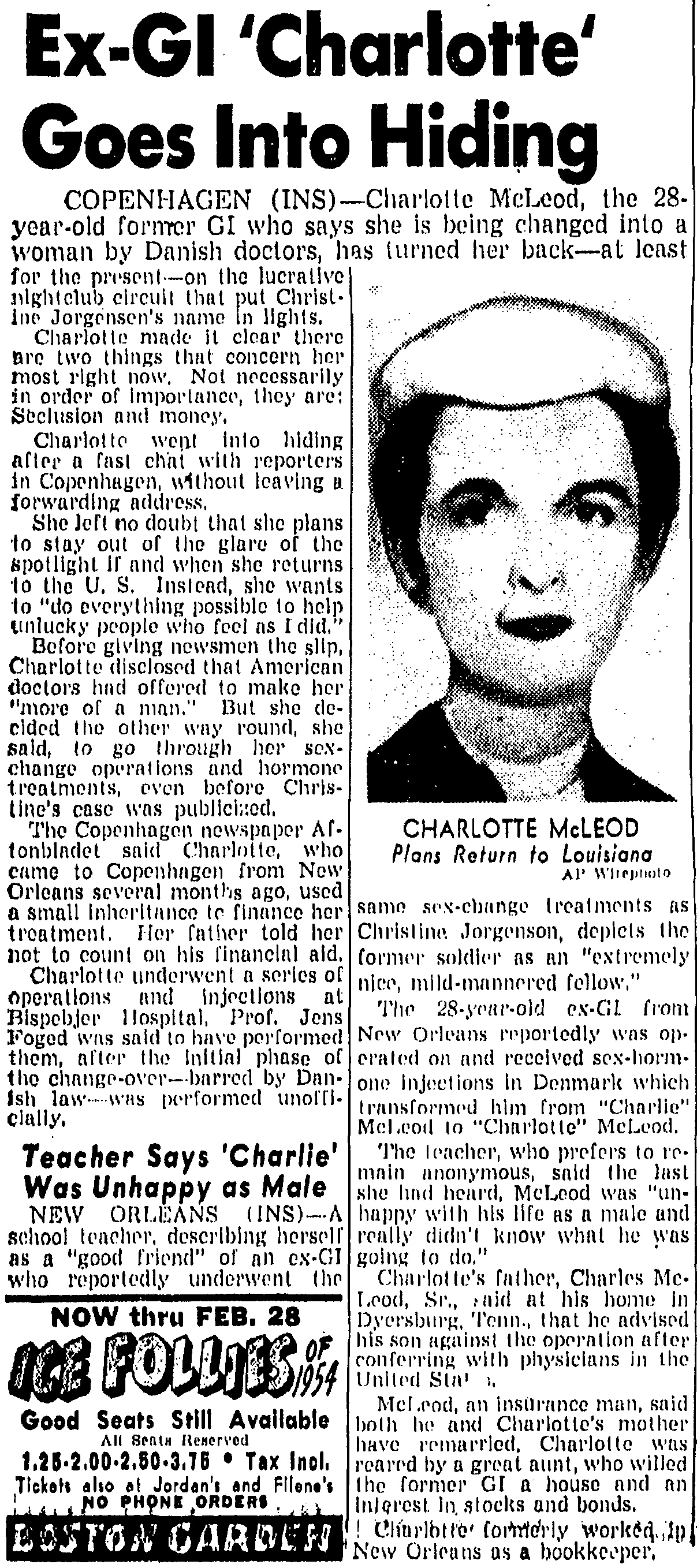
“Ex-Gi ‘Charlotte’ Goes into Hiding”. Boston American, Feb 25, 1954:
3. Online.
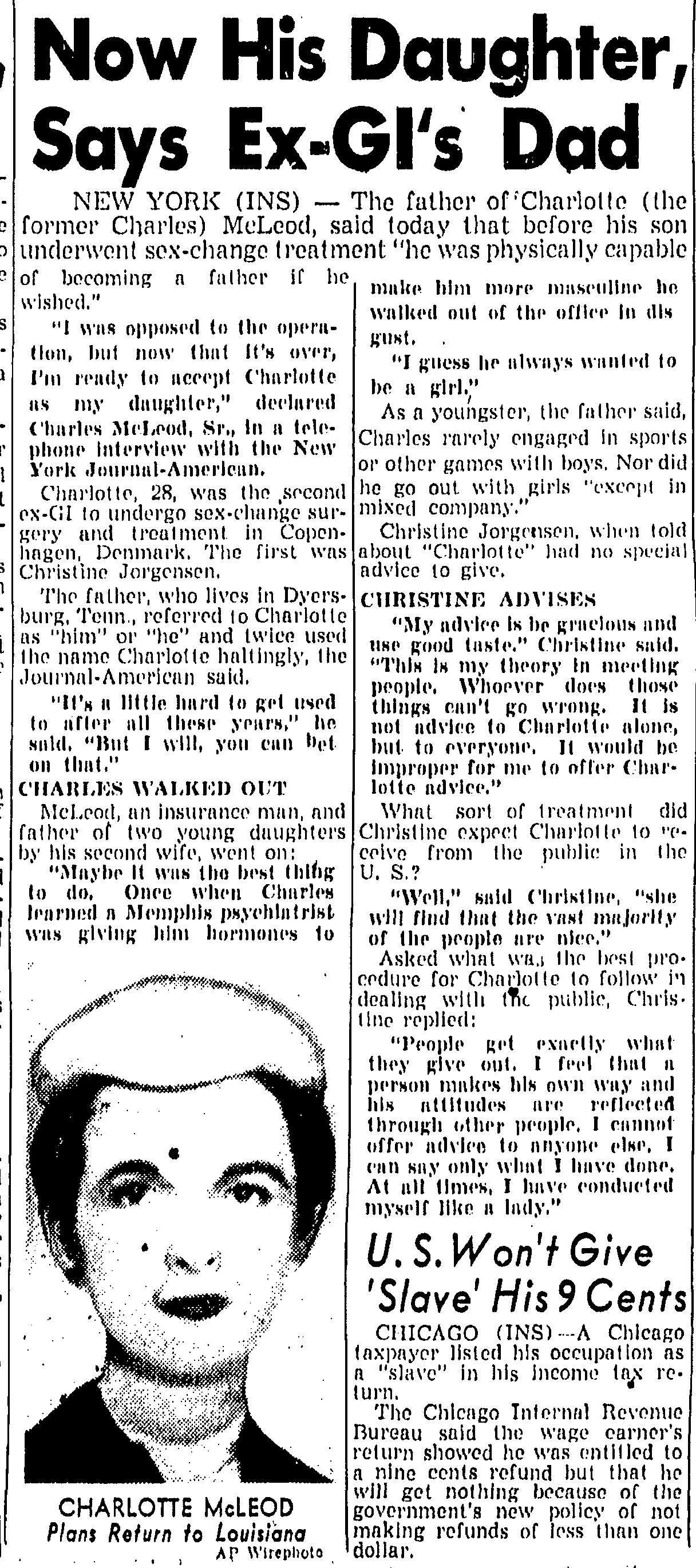
“Now His Daughter, Says Ex-GI’s Dad”. Boston American, Feb 25, 1954: 3.2. Online.
“Medicine: In Christine’s Footsteps”. Time, March 8. 1954. Online.
“Charlotte, Who Was Charles, Falls in Hotel Scuffle”. Sacramento Bee,
17 April, 1954:6. Online.
“Danes Check on Sex Change”. Sacramento Bee, April 19, 1954: 7. Online.
“Sex Change or Suicide Choice”. Boston Daily Record, May 13, 1954:3.
Online.
Susan Stryker interviews Charlotte McLeod, transcribed by Loren Basham.
GLBT Historical Society, August 22, 2002. PDF.
Vega was born in Santiago, Chile, with a father who owned a printing
business. At age 8, teachers discovered that Vega had an aptitude for opera
singing, which led to singing and acting in local productions. This was a safer
space away from the all-boys school where Vega was bullied for being
‘effeminate’.
Performing at a Santiago nightclub allowed experimentation with glam and
goth. At first androgynous, but increasingly feminine, by age 15 she identified
herself as trans, and her family was immediately supportive. Her father later
appeared with her on television talk shows.
In 2011 Daniela debuted in La mujer Mariposa, a one-woman stage show
based on her own experiences of transitioning. This piece included her singing,
and ran for eight years in Santiago. Her first movie role was in La
visita, 2015 where she played a trans woman at her father’s wake.
She was approached by film director Sebastián Lelio who was developing a film
about a trans woman, but actually did not know any such in Chile (Lelio lives in
Berlin). At first she was a consultant to the film, but then it became obvious
that she was ideal to play the lead role. The film became Una mujer
fantástica (A Fantastic Woman), 2017. The protagonist must struggle against
rejection and suspicion after her boyfriend dies.
Vega at Berlinale 2017
The film won
much international acceptance including a Golden Bear at the Berlin
International Film Festival, Best Actress at the Havana Film Festival, and Best
Foreign Language Film at the Academy Awards. Daniela was also a presenter at the
Academy Awards – the first openly trans person to do so.
Later in 2017 Daniela played a cis woman in Un domingo de julio en
Santiago (A Sunday in July in Santiago).
“As far as her own identity goes, she has stated that if she were born again,
she’d choose to be trans, not cisgender – and that she enjoys unsettling the
kind of people who can’t cope with who she is. ‘It actually gives me a physical
pleasure to annoy conservatives,’ she smiles. ‘I don’t have to be violent, I
don’t have to insult anyone – my mere existence shakes those people up.’ " …" ’In
Chile, you can’t legally change your gender identity in a straightforward way.
If you want to change the name on your documents, you have to go to court.’ She
could easily do that, but refuses to – that would mean recognising political
oppression.” (Guardian interview)
The Spanish word 'mariposa' means 'butterfly' but it is also used to mean 'queer'. So La mujer Mariposa can mean either A Butterfly Woman or A Queer Woman.
ES.Wikipedia has a very short account of Daniela's transition: "At age 15, Vega identified herself as a trans woman to her family, who immediately supported her." While EN.Wikipedia is otherwise almost the same as ES.Wikipedia, even this little has disappeared.
Sözeri was born in Nuremberg, Germany. In 1982 the family moved back to İzmir (Smyrna).
Ayta had confirmation surgery in her early 20s. She did a business degree at
Ege University and
then studied Turkish music at Dokuz Eylül
University, both in İzmir.
After working as a support vocalist, Ayta started getting acting roles in
television and then in films. She has been in 13 television programs and in 5
films.
In March 2018 she was awarded as Best Female Actress In A Supporting Role at
the 50 SIYAD (Film Critics Association) Awards Ceremony, for her role in Aile
Arasında (Within the Family).
Golden was born near Philadelphia, the child of an electronics engineer and a
high-school guidance secretary. The family was gay-friendly, and one grandmother
was openly lesbian. Family funding paid the costs of transition including
surgery.
Golden graduated from Philadelphia College of Art, 1975 (before it became
part of the University
of the Arts). She read Neils Hoyer’s book on Lili
Elbe and Jan
Morris’ Conundrum; started hormones at 18, started living as a woman
at 20, and had surgery as soon as she was 21. Eve had done two years at Towson State
University as a man, took a semester off and returned as herself. That was
okay with the students, but less so with the faculty. The head of the theatre
department said that he would never allow her on stage. She would be a
distraction -- and what if an actor had to play a love scene with her. However
Eve did graduate in 1979.
She acted for about five years: Off-Broadway, in commercials and summer
stock. In 1984 Eve got a job as a secretary with a New York advertising agency,
and talked her way into a copywriting position.
Being a classic-movie buff, she was annoyed that there was no good book on Jean Harlow, and eventually
had a go at writing one herself. She managed to get an agent, a publisher and an
advance, and the book came out in 1991. It got good reviews and sold well.
By that time she was working as a senior editor. She followed up with books
on silent actress Theda
Bara, 1997, Essays on Silent Film Stars, 1998, Anna Held and Ziegfeld’s
Broadway, 2000, the 1950s actress Kay Kendall, 2002.
From 2005 Golden was working as a freelance writer and photographic
archivist. In 2007 she published a book on the Ragtime dancers, Vernon and Irene
Castle.
Eve next intended to do a book on Peg Entwistle, the
British actress, who is mainly remembered in that she jumped to her death from
the Hollywood Sign in 1932 at the age of 24. However after starting research,
she discovered that a first-time writer, James Zeruk, was already working on
such a biography. Impressed by the quality of his work, she helped him.
Her most recent books have been Essays on film stars 1930s-60s, 2009, and on
the silent actor, John Gilbert,
2013.
Eve Golden. Platinum Girl: The Life and Legends of Jean Harlow.
Abbeville Press, 1991.
Eve Golden. Vamp: The Rise and Fall of Theda Bara. Vestal Press,
1997.
Eve Golden. Golden Images: 41 Essays on Silent Film Stars. McFarland,
1998.
Eve Golden. Anna Held and the Birth of Ziegfeld's Broadway.
University Press of Kentucky, 2000.
Eve Golden. The Brief, Madcap Life of Kay Kendall. University Press
of Kentucky, 2002.
Eve Golden. Vernon and Irene Castle's Ragtime Revolution. University
Press of Kentucky, 2007.
Eve Golden. Bride of Golden Images: Essays on Stars of the 1930s-60s.
BearManor Media, 2009.
Eve Golden. John Gilbert : the last of the silent film stars.
University Press of Kentucky, 2013.
James Zeruk, with an introduction by Eve Golden. Peg Entwistle and the
Hollywood Sign Suicide: A Biography. McFarland Publishing, 2013.
Michelle was born in Salinas in the
Canelones Department of Uruguay. She transitioned at age 15 with the support of
her mother.
Accepted at the Universidad
de la República in Montevideo, she was the first out-trans person to attend
university in Uruguay. She suffered transphobic harassment and a professor who
specialized in human rights refused to grade her work. She also set a precedent
in changing her legal gender status. She graduated and became the first out
trans lawyer in the country in 2010.
That year her mother died. Michelle joined Ovejas Negras (Black Sheep), an
LGBT rights organization. There she made a major contribution to the draft bill
for equal marriage legislation. The bill was presented to congress in 2011,
initially passed in 2012, and finally approved in 2013.
In 2012 Michelle published a book on the difficulties that some minorities,
including trans and gay, have in achieving human rights.
She joined the Communist Party (PCU) which is part of the ruling coalition
Frenta Amplio (Broad Front) and was elected an alternate senator (with limited
voting rights).
In October 2017, Senator Márcos Carámbula resigned and Suárez became a full
Senator. She said that she would introduce a bill that would allow trans people
to legally change their identity without a court order. The measure would also
require Uruguay to set aside 1 percent of government jobs for trans people and
create a pension to compensate those who suffered persecution during the
country’s military dictatorship, 1973-1985, because of their
gender identity.
However in December, two months later, she was found guilty in a case of an
estranged father’s parental rights having been cancelled in a document with the
wrong signatures. Suárez resigned her seat.
Michelle Suarez Bértora. Hacia una Igualdad Sustantiva (Towards a
Substantive Equality). Mujer y Salud en Uruguay, 2012.
Avelar was born in Chalatenango
Department, in the north of El Salvador, just before the Civil War,. From an early age, despite being
dressed as a boy, she came across as a girl, and most in the neighbourhood
called her Karla rather than Carlos.
By the age of 10 she had been raped twice by one cousin, and another would
shoot at her, and said that he would kill her as there were only machos
in the family. She left without money.
In the capital, San Salvador, she spent the first six months sleeping in the
bus station or on the street, begging and finding whatever to eat in the trash.
She was taken in by a woman who made her work hard at domestic chores. She was
raped by the woman’s son. One of her chores was to buy tortillas, but the
tortillería was in a neighbourhood run by the Mara Salvatrucha (MS 13) gang.They
decided to gang rape her. After 15 men, she seized an opportunity and was able
to escape.
Homeless again she met a trans woman, Diana, who showed her how to
survive by sex work. The more established trans whores resented newcomers. They
bullied her, they called her la machorra (the dyke) because of her short
hair, and they stole her money, until she learned to fight back.
While the civil war raged, the capital was comparatively peaceful. Over
80,000 were killed in the country, the vast majority by the forces of the
US-backed Junta. In 1992 the UN brought the two sides together and enforced
peace accords. However criminal gangs such as MS-13, reinforced by members
deported from the US, tightened control.
Many – including prostitutes – emigrated to the US if they could. The term
transgeneros was not yet in use. One of the terms used for trans women was locas
(literally: crazy women).
There was a serial killer in San Salvador who would drive by and shoot at
trans women. He became named Matalocas. It was said that he had an
artificial leg. One night in 1992, 14-year-old Karla was in a john’s car giving
head when she realized that he had an artificial leg. He hit her with his gun,
but she was able to grab the wheel and forced a crash. She grabbed his gun as
she escaped the car and threw it away. However he had a second gun and shot her
nine times.
She went into a long coma, but the hospital doctors saved her. They also
informed her that she was HIV+. Officials could not find her next of kin while
she was unconscious, so a television station broadcast her picture, and her
grandmother came to sit with her in the hospital.
Karla was the first of Matalocas’ victims to survive and who could
identity him. The police had retrieved the gun which was registered. Further the
man, a high-ranking military official, went to reclaim his firearm. However he
was never charged with anything.
Karla was approached by William Hernández who had just founded an LGBT rights
group, Entre Amigos.
Karla was willing to go public. She and Entre Amigos held a press conference and
gave the real name of Matalocas. The only result was that they received death
threats.
After recovery, Karla returned to sex work. She and Paty Hernández
organized a trans-rights group, El Nombre de la Rosa. Those working as
prostitutes gave a portion of their earnings – almost like a union. At first the
government refused to register the group as a non-profit, saying that its aims
were “contrary to morality”.
In 1996 Karla was working near the national monument, Monumento
al Divino Salvador del Mundo, when three gay men taunted her and another
trans woman. They removed their belts as if to whip her and she stabbed one of
them as the other trans woman fled. She alone was arrested, and sent to the
notorious Sensuntepeque prison where she was gang-raped on the first day.
While the prison had a Sector 2 for gay and trans prisoners, the gang inmates
were free to come and go in Sector 2 as they pleased. They treated Karla and the
others as personal slaves for housekeeping tasks and for sex. She was also
tortured by the guards.
The first pride march was in 1997 – this was followed by a new wave of
violence. Trans women were vanishing. Between the late 1990s and 2003, the
number of adult trans women known to Entre Amigos and El Nombre de la
Rosa dropped from around 200 to 40. Some emigrated (mainly to the US), some
died of AIDS, other were murdered.
Karla was released in 2000, suffering from being HIV+, and having lost a lot
of weight. Even so, she went back to sex work. In 2006 she started
antiretroviral therapy, but was shot five times for refusing to pay ‘rent’ while
working on gang turf. She survived the shooting and also being stabbed twice in
the back by the same gang the next year.
Karla’s friend Diane was killed, also in 2007, by her lover, a police
officer. El Nombre de la Rosa had evolved into ASPIDH-Arcoiris,
but Karla was not welcome, having been too pushy before. She started a new
group, COMCAVIS Trans. At first it was funded by sex workers' contributions, but
Karla taught herself how to do paperwork to incorporate the organization, and
how to do Excel accounting. It got a USAID grant in 2011.
In 2010 COMCAVIS filed a first complaint against Sensuntepeque prison, and
then others in 2011 and 2014. They won the trans inmates the right to wear
female clothing, and then a partition was put up to separate Section 2, the same
year that gang members were removed to a separate prison. Then condoms were made
available. Karla visits the prison regularly to speak up for the trans inmates.
Tania
Vásquez, a trans activist was murdered in 2013, and no one was ever
arrested. Karla filed a complaint. The Attorney’s General Office responded with
the threat to arrest Karla, a search warrant and a confiscation of the technical
equipment of COMCAVIS TRANS.
However that year, Karla became the first trans woman to appear before the
Inter-American Commission on Human Rights (IACHR) and to denounce the State of
El Salvador for discrimination and hate crimes. Paty Hernández, emigrated in
2014 after 20 years of activism. In 2015, Karla participated in the Universal
Periodic Review (UPR) at the United Nations Human Rights Council in Geneva,
which submitted an alternative report, which resulted in the first UN
recommendation to the state of El Salvador on LGBTI matters.
Karla frequently travels abroad to speak for trans rights to international
bodies. Now about to turn 40, she is one of only a few trans women in El
Salvador over 35. She is constantly receiving death threats, and has had to move
seven times in the last two years. In 2017 she was announced as a finalist for
the Martin Ennals Award for Human
Rights Defenders, quickly followed by extortion attempts to seize whatever
prize money she might get.
In a country where soldiers and death squads working for the junta killed 70,000 people, where serial killers go free, criminal gangs have impunity and young women are regularly raped on the street, an organization to protect trans women is refused registration on the grounds that it is “contrary to morality”.
Phillip Forrester was born and raised in Savannah, Georgia. He was in drag at
age 5, and as a child sang on Savannah radio.
At Halloween 1953, he and a drag friend got dolled up and crashed a party at
a local American legion. Only after several drinks did it come out that they
were not cis women. They quickly left but driving home they were followed by two
soldiers who shot out a tire on their car, and Forrester was orally raped.
"It was so scary: there's no words for it. But I made a decision that night
that I was out. A real weird way to come out, though."
The first public drag performance was at age 18. She was popular with sailors
in the port and would perform on ships docked there. Eventually this led to
Forrester being discharged from the Georgia Air
National Guard, and fired from a secretarial job at the Seaboard
Railroad. The Savannah police arrested her several times, once on a
drummed-up loitering charge.
It was time to move and she arrived in Atlanta in 1965. At that time she had
a husband, and they started a small antiques shop near Peachtree and
11th Streets. That area became ‘the Strip’ where bohemians and gays
were to be found.
She dabbled in drag shows using the name Leslie Diamond. Jayne
County wrote in her autobiography:
“It was considered a very big deal to go to straight clubs and pass as a
woman, and there weren’t many of the queens who could pull it off. One who could
was an older queen called Diamond Lil, who was the mother of all the young
street queens in Atlanta.”
In 1968 a friend asked Diamond to headline a new drag show at Mrs P’s, a
restaurant in the basement of the Ponce de Leon Hotel. There was an arrangement
with the police: only on week-nights, and the show was not to be advertised. She
took the name Diamond Lil as a last minute inspiration on the opening night. At
first she mouthed to Motown records, but started singing with her own voice –
one of only a few drag performers to do so.
For six months in 1970 there was a bar called the Club Centaur. Diamond and
another drag artist, Phyllis Killer, performed backed by a live band. Diamond
became known for her hard-driving rock’n’roll songs. She added in her own songs,
and released them on 45s – some of them were played on jukeboxes across the
city.
Diamond performed several times for the Georgia
Gay Liberation Front. She also wrote, for the alternate weekly, The
Great Speckled Bird, the first time after being caught in a police raid on a
club in Savannah in 1970.
Diamond Lil, mid 1980s
In the early 1970s, Diamond moved to Sweet Gum Head, a focal point for the
burgeoning drag scene. Other performers included Rachel Wells, Lavita Allen and
Charlie Brown.
In 1972 Diamond did a benefit for the Committee on Gay Education at the
University of Georgia and sang “Stand by Your Man.” UGA officials did all they
could to throw the COGE off campus, but Lil’s support gave COGE financial
backing and a public profile.
Diamond started a column in the gay paper, Sunset People, and then in
the nightlife magazine, Cruise.
In 1984 Diamond Lil put out a full LP of original material, The Queen of
Diamonds/Silver Grill. She was an acknowledged influence on Lady Bunny and RuPaul who
started out in Atlanta at this time. However, by then Diamond was losing her
fans to AIDS. There were fewer places to perform, and she reduced her
performances and concentrated on a new antiques business. She was writing for
the bar magazine Etcetera – these articles were often obituaries.
In the 1990s she had a few revival shows. In 2002 she re-released her album
on CD. She put out two more albums: Live at the Moonshadow Saloon, 2004,
and Verge, Vigor and Vim, 2007. In 2014 the readers of the Georgia Voice
newspaper voted her Best Icon; in 2015 Atlanta Pride and Touching Up Our Roots
honored her in the first ever Our Founding Valentines event. After a struggle
with cancer, Lil was moved into a hospice. She died age 80.
Lady Bunny is quoted in The Atlanta Journal Constitution:
"She was singing with a live band and I had never heard of a drag queen doing
that. That really helped shaped my experience because it was not disco music, it
was rock 'n' roll and it was original. What always interested me about Diamond
Lil, she broke the boundaries of what most drag queens thought they could do.
Most thought they could either lip sync or do a celebrity impersonation and she
said no, I’m going to front a rock band and do original music...I did love the
mock grandeur of her. I totally bought it, when you were in the same room with
her, she was regal. She really was magic. She really was
unique."
Diamond Lil. ‘Diamond Lil, Most Glamorous Queen in the World, In Captivity’.
The Great Speckled Bird, 3, 38, September 28, 1970:10-11. Online.
Jayne County with Rupert Smith. Man Enough to be a Woman. Serpent's
Tail, 1995: 29- 30, 160.
James T. Sears, Rebels, Rubyfruit, and Rhinestones: Queering Space in the
Stonewall South. Rutgers University Press, 2001: 81, 159.
Tray Butler. “God save the Queen: If Diamond Lil is the grand dame of
Atlanta drag, why can't she get a steady gig?” Creative Loafing, Oct 9,
2003. Online.