This site is the most comprehensive on the web devoted to trans history and biography. Well over 1800 persons worthy of note, both famous and obscure, are discussed in detail, and many more are mentioned in passing.

There is a detailed Index arranged by vocation, doctor, activist group etc. There is also a Place Index arranged by City etc. This is still evolving.

In addition to this most articles have one or more labels at the bottom. Click one to go to similar persons. There is a full list of labels at the bottom of the right-hand sidebar. There is also a search box at the top left. Enjoy exploring!

Showing posts with label Laub patient. Show all posts

27 January 2025

Claire Elgin (1905 - 1976) – Part II: business woman

Part I: beginnings
Part II: business woman
Part III: bibliography and comments

In 1962 Claire encountered Yugoslavian immigrant Franz Kolterer who founded Micro Science Associates, a precision etching firm. Claire provided skill in micro-photography, and was manager of the art and photo department and a director of the company until 1967.

Claire in Benjamin's book, 1977
October 3rd, 1963 Claire was admitted to Stanford Hospital with an incarcerated hernia. Her doctor there was Donald Laub (1935-2024), then an intern but who later became known for transgender surgery. She told him that she herself had removed her penis. She also gave him an alternate autobiography:

“She explained it to me. She told me further that she was born in Arabia, the son of a Scottish trader who ran a ship between Arabia and England, and was educated aboard ship by specialized tutors. She was genetically XY, a male born with a grade 3 hypospadias, a birth defect in which the urine comes out just above the scrotum. The mistake was made that Clair was a female because the genitalia resembled a clitoris and labia in appearance. The diagnosis was plausible, since no genetic karyotype was available in Arabia in 1900. When puberty came along she developed an ample penis, which was upsetting to her, having been raised for 15 years as a female. For many years, she sought medical advice but there was no one who would help her. Unable to live as the woman she felt she was, she removed the penis and the rest of the male apparatus with a sharp knife and presented herself at the University of California emergency room. She was taken care of there by urologist Dr. Goodwin, who was sympathetic to her plight and fixed her up as well as possible at the time.” … “I asked her about her body art, and she told me she’d once traveled with a circus as a tattooed lady and sword swallower.”

The surgery to fix the hernia went well. However follow-up tests revealed adenocarcinoma of the kidney cells, and the left kidney had to be removed. Again the surgery went well.

Dr Laub got to know Claire as a person:

“Well, Clair had some idiosyncrasies, as you might have suspected by now. Having been raised Muslim, she had good habits; she abstained from drinking coffee or alcohol. Despite being female, Clair had retained some of her male spirit, owning a motorcycle, a gull-wing Mercedes, and a 300 Savage telescopic rifle. She had a fondness for Japanese architecture. Her profession was photography, which she had been taught on the ship during her schooling years, and during the birth of Silicon Valley she was able to make microphotography negatives of the plans for a computer chip; the manufacturing process utilized silver salts in the negatives of her microphotos to etch silicon into chips.

“Clair was rewarded for her efforts and gained a large number of shares in one of the more prominent laser and computer companies in the Silicon Valley. With her money she built a Japanese home, a five-sided pagoda on the top of one of the highest hills in a most exclusive suburb, Los Altos Hills. She included koi fish tanks where the fish were able to swim from outside the home into the inside for Clair’s pleasure. The five alcoves of the pagoda each had a wind-generated musical organ, insulated so that there was no sound of blowing air during the playing of the pipes.”

Harry Benjamin’s seminal book on Transsexuals came out in 1966. He condensed his three years of meetings and correspondence 1953-5 and described Claire in three paragraphs, but, as she requested, without giving a reference name. No photographs were included in the book, but medical and other professionals could request them if they wrote in on medical stationary. Black stripes were placed over Claire’s face to prevent recognition.

“One patient who is now, several years after the operation, a decidedly masculine-looking 'woman,' with tattoos all over her body, is getting along well in an active business and is unrecognized as a former male. She is merely considered eccentric by her associates.

“Under no circumstances, she assured me repeatedly, would she ever go back to living as a man. 'This way I am at least myself and can relax,' were her own words.

“A couple of times she was arrested under the suspicion of 'impersonating.' When she was taken to a police station, examined and declared to be a woman, the arresting officers apologized and in one instance, bought her a dinner. Not all patients in such situations fared equally well”.

In his introduction to the 1969 anthology, Transsexualism and Sex Reassignment edited by Richard Green and John Money, Benjamin wrote, probably with Claire in mind:

“These few instances of attempted self-castration by definitely non psychotic individuals impressed me greatly. Their desperation as well as the entire clinical history with their vain search for help, often from childhood on, made me realize that the medical profession truly treated these patients as ‘stepchildren’. Educational and medical lectures and scientific publications were urgently needed.”

In 1967 Micro Science had merged with Alloys Unlimited. That was the year that one of the company’s acid tanks sprang a leak in March, and a fire captain had to be rushed to hospital. There was a further incident in October 1971 when there was fire in a tank of nitric acid.

The firm was sold to the British Plessey Group and became Plessey Micro Science Inc in 1974, and then Kolterer set up Koltron Corp. By now Claire was no longer involved, but she had invested in shares of Micro Science Associates, Alloys Unlimited and then Plessey Micro Science Inc, and had become a millionairess.

However, by the end of the 1960s, with age, the many lines in her face made her look more male than female. Laub and his team did a face-lift, which went very well. By this time, Dr Laub had started doing transgender surgeries – his first trans patient (other than Claire) was Ella in 1968. In 1969 Donald Laub founded Interplast to provide necessary reconstructive surgery for persons in developing countries. Claire became the official Interplast photographer, and travelled to central and south America and chronicled surgeries for cleft lip, cleft palate, and burn scar deformities. She was greatly appreciated for the excellence of her photography and her compassion toward patients, even though she was not passing that well. The patients – affectionately – referred to her as “SeƱor Clair”.

Vernon Gregory, an organist who played the mighty Wurlitzer organ, took over the Avenue cinema in Oakland to install the Wurlitzer that his son had found in Chicago. They moved it to Oakland, installed it and started a program of films accompanied by the organ, but were deeper and deeper in debt until Claire – who played a smaller organ at home – came in to rescue the project in 1972. She also bought a plane that year and learned to fly.

Claire lost most of her money in the recession of the 1970s, and was for a while bankrupt. She developed a working 3-D television and patented it, but it was the alternate model by Matsushita Electric (now Panasonic) that was more successful.

Claire in later years
In 1976, Claire called Dr Laub complaining of severe pain in the rib when she coughed. After a preliminary examination, Claire was admitted to the Stanford Hospital oncology medical service. X-rays showed that her lung cancer had metastasized to the rib. Claire asked how long she had left and was told about six weeks. She asked for a glass of water, and took one of the cyanide pills that she had in her purse.

The next year Benjamin’s The Transsexual Phenomenon was reprinted as a Warner Books Paperback. This time the photographs were included within the book, and the black strips hiding Clair’s face were removed.

Joanne Meyerowitz. How Sex Changed: A History of Transsexuality in the United States, 2002, included 5 short mentions of Claire disguised under the pseudonym of Caren Ecker. These mentions were based solely on documents in the Kinsey archives, mention her auto-castration and surgery in 1953, her contact with Louise Lawrence and with Worden and Marsh, but say nothing about Claire’s subsequent career as a business woman and photographer.

Both Claire’s only son, age 82, and her business partner, Frank Kolterer, age 76, died in 2007.

22 April 2018

Charlotte McLeod (1925 - 2007) Part II: fame and marriage

Part 1: Youth and Copenhagen
Part II: fame and marriage
Part III: The geography of Charlotte McLeod in New York, 1957

Charlotte was offered night-club appearances. A reporter, who worked at the National Press Club and normally wrote religious articles, proposed to do a book on her, and put her up in a hotel in Washington, DC while they worked on it, but it was never finished, and he ran out of money.

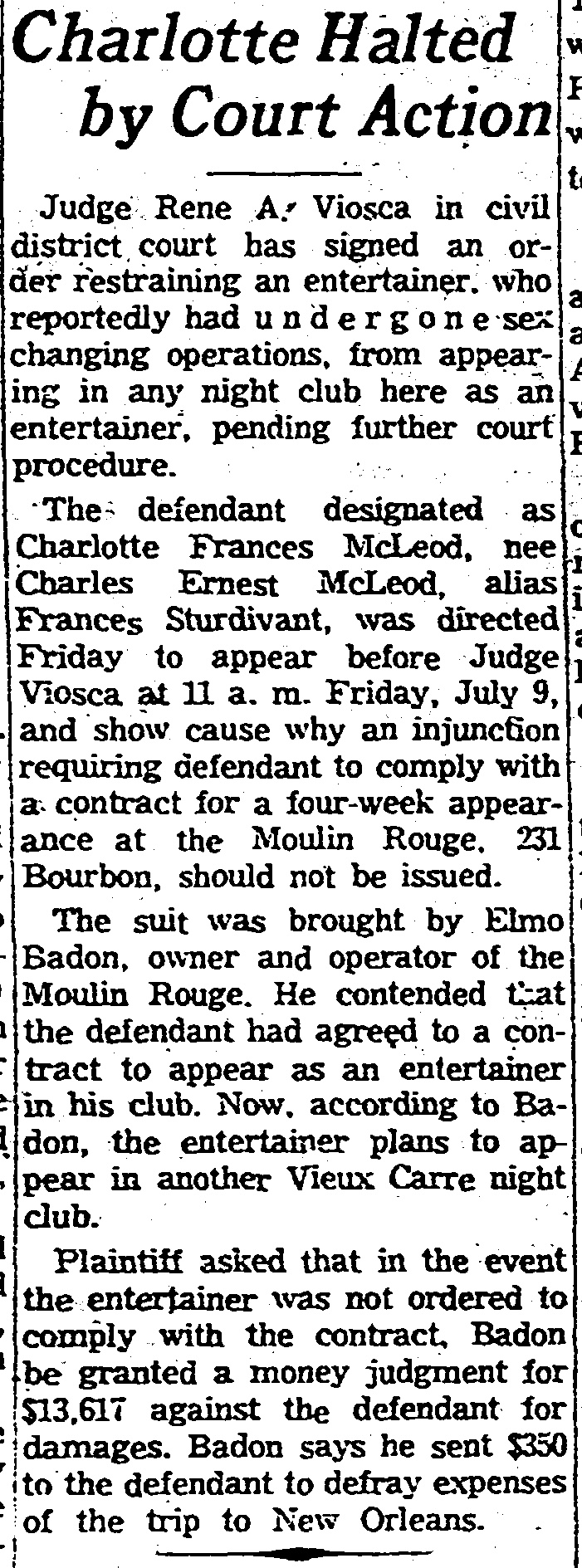
She took a gig in New Orleans, but found that the contract was with a strip club.
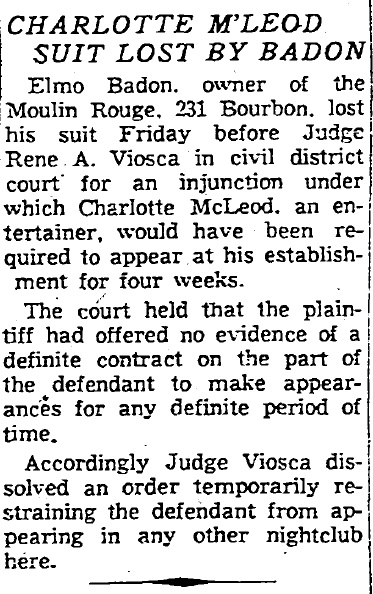
“And right across the street was a very, well the nicest club on the street. No hard bumps and grinds and strips and all that kind of thing. And to get me out of the verbal contract the owner paid for me going to court. And the next thing I am sitting up in front of the judge. I never will forget, I had a great big felt cart wheel hat on. Couldn’t sit on the seat because the cart wheel hat hit the back and I had to take my hat off. I don’t know why I should remember that. In that day and time ladies wore their hats. And he released me from the contract and I went across to the Show Bar, which was the nicest club on the street.” (Stryker:26)

A dancer-comedienne called Cupcake wrote material for Charlotte:
“ I’ve been to many places, environments strange, and then I went to Denmark, just for a little change”.
Then she moved on to the Casino Royal in Washington where she was backed by a band. She had become a member of the American Guild of Variety Artists, and was represented by Miles Ingles who was also the agent for Cyd Cherise and Polly Bergen. One time she appeared on stage in between Gypsy Rose Lee and Mae West. She also did modeling. Charlotte met Christine Jorgensen once when they were both appearing in New Orleans.

In August 1955, Charlotte had breast implants with New York plastic surgeon, Else La Roe (1918 – 2006).

In 1956 she wrote a brief autobiography for the Mr Annual, in which she claimed that her condition was physically caused, and that 95% of transsexuals should have psychiatric treatment.

Dorothy at the all-night beauty salon
Charlotte worked as a secretary and then as a receptionist at an all-night beauty counter.

She was becoming annoyed by star reporter and television personality, Dorothy Kilgallen.
“I got tired of Dorothy Kilgallen chasing me around and writing things about me that I have never thought of doing. And I went to her house [45 E 68th Street] one day and knocked on her door and the butler recognized me, it was strange, he said, ‘aren’t you Miss Charlotte?’ And I said, yes. And he said, don’t go away. I said, well I have no intention, that’s why I’m here. So I met Dorothy. And I said, well Dorothy, I’m tired of this, this business and I need a job. If you’ll help me get a job, I’ll tell you anything you want to know. Her husband is Dick Kollmar a Broadway producer, and he owned the Left Bank Club. He owned a little French restaurant and bar right across the street from Madison Square Garden. And in that day and time, the hat check and cigarette concession could make you a decent living. So they were most pleased to get me to be the hostess and hat check girl. The main thing that’s fun, I met everybody that ever was in show business.” (Stryker: 28)
This was 1957. It was while working at the Left Bank Club that Charlotte met Harry Benjamin, who came in as a customer. He became her physician, and also would take her out to lunch and introduce her to such conservative activists such as William Buckley as well as film stars.

Charlotte was living at the Washington-Jefferson Hotel on West 51st Street.  Ralph Heidal, whom she had met in Bergen, had stayed in touch by mail. They ran into each other in Maxie’s, a bar close by. He offered to take her away.

In 1959, Christine Jorgensen had been denied a marriage license by a clerk in New York City, on the basis that her birth certificate listed her as male; Jorgensen did not pursue the matter in court.

Charlotte in Miami 1959
Charlotte had been working in Miami, first as a secretary, then demonstrating cosmetics. After some months, Charlotte and Ralph, having become regulars at a Miami church, were married there in November. She did not mention her birth gender, however, or the fact that she was still legally a male. Press interest was aroused, but the Florida authorities confirmed that the marriage was not in violation of state law.

Dorothy Killgallen had contacts in Miami as everywhere, and their wedding was featured in her column.

A few months later, Mr and Mrs Heidal moved to California. They lived in Berkeley, then Oakland and then Marin County. Charlotte reconnected to Harry Benjamin who spent his summers in San Francisco. He introduced her to trans women Aleshia Brevard and Kathy Taylor who had been friends since their days at Finocchio’s nightclub, where Kathy performed as Stormy Lee.

Mrs Heidal’s marriage to her husband lasted seven years.
“And bless his heart, he couldn’t do a darn thing but drive a steamship around the world. Never did teach that rascal to drive a motor car. In fact, that’s why we broke up. I had visions of a little cottage on the side of Mt. Tamalpias. And oh how we did love it. But Ralph didn’t find a job. Everything he knew was diesel, whatever made steamboats run. I took him to every plant in Northern California trying to find a job for him. And finally, I got the proverbial Dear John letter. He said it was how it is every year we had to write but unless I was willing to go back to New York, where he was perfectly happy. And we would have to part company and I wouldn’t go back to New York.” (Stryker:31)
Dorothy Kilgallen died in November 1965 at age 52 after ingesting alcohol and barbituates. Some say that she was murdered (more) for digging into the Kennedy assassination – her folder of documents on the case had disappeared and was never seen again.

After her divorce, Charlotte moved to Laguna Beach, south of Los Angeles, because she had friends there. She got a job as a receptionist at a beauty salon. Charlotte arranged to have vaginoplasty:
“I was living at Laguna Beach. And a little Japanese doctor did it. And there was some instrument that he had to have, I think. He was under the impression that he could use the same instrument on me that he could on a normal woman that needed that surgery done. Well he did and perforated my colon. And I had to go to Stanford to have the colostomy to repair his work and while I was there I stumbled on Dr. Donald Laub [head of the Sexual Identity Unit]. Oh, me. What a to-do that was.” (Stryker:22)
One of the beauticians mentioned that her brother-in-law had lost his wife to suicide. They were introduced and started dating. He was a military officer with two children, eleven and twelve. The kids started calling her Mom.

On 8 August 1969 she was visiting Kathy in Los Angeles where they could see a commotion across the canyon that turned out to be the aftermath of the murder of Sharon Tate and 3 others by members of the Manson Family.

The military officer asked Charlotte to marry him, but something had to be explained first.
“In fact, it was Cathy who went to him and explained to him the situation because we had debated. He hadn’t the vaguest idea. And I knew, if he hadn’t already asked me to marry him, Cathy said, let me see if I can help. And she went and talked to him. And Cathy’s husband did not take it so well. In fact, he was very belligerent when he did find out.” (Stryker:41) [Cathy=Kathy of course.  Aleshia Brevard, who knew her, spells it with a 'K'.   The transcription of the interview spells it with a 'C'.]
Charlotte and the military officer were married in Las Vegas in 1970 – this time with no press attention. Again the marriage lasted seven years.

Return visits to the Stanford clinic and Dr Laub created problems when her husband went with her.
“And that really ruined my marriage with my second husband. We were going up and stopped by for a chat with him. And we went in and Donald had started, he was so very selective, very selective. He had a Gorgeous George sitting in there with tattoos all over him.” (Stryker:44) “He did ruin my marriage. My husband saw me in a different view from what he had in mind.” (Stryker:45)
After the end of her second marriage Charlotte moved back to Dyersburg, Tennessee to look after her ageing mother. She stayed in touch with her step children. The son died in middle age without finding out about Charlotte’s past; at the turn of the century, Charlotte was very sick and wrote to tell the daughter on her own terms in that it would come out if she died.  That daughter has had children, and thus Charlotte became a grandmother.

++Charlotte remained in Dyersburg, and died at age 82.   Her passing was not noticed by the press, which probably would have been to her liking.

*Not the mystery writer, nor the character in the television show, McLeod’s Daughters.
_________

The Washington-Jefferson Hotel is still in business. Its rooms are now $126 a night and up. Charlotte says: it “was a place for retired show people who lived there” which probably means that even after adjusting for inflation it was cheaper in 1957, particularly if you paid by the month.

Aleshia Brevard in The Woman I Was Born to Be, 2010, p48 writes:

This is quite different to what Charlotte said, whereby the wedding was after the confrontation at Kilgallen’s apartment, and the husband was certainly aware of Charlotte’s past before he married her.

Tina Thranesen gives the name of the New York plastic surgeon as Rachael LaRoe; Joanne Meyerowitz gives it as Else La Roe. I have gone with the latter.

In the Stryker interview it sometimes becomes confusing about when things are happening. I have placed the vaginoplasty operation just before Charlotte met her second husband because she says that she was living in Laguna beach at the time, and Donald Laub was not at the clinic at Stanford until 1968.

Charlotte says that she was already married when she observed the Tate killings from a distance, but that happened in August 1969, and she also says that the wedding was in 1970. Time does affect our memories. (Stryker: 38-9)

The Wikipedia page on Dorothy Kilgallen says nothing at all about Charlotte. Likewise Lee Israel’s 1979 biography, Kilgallen. Likewise Mark Shaw’s The Reporter Who Knew Too Much: The Mysterious Death of What's My Line TV Star and Media Icon Dorothy Kilgallen.

There is something missing from the source documents:  Dorothy Kilgallen's articles about Charlotte are not online.  The collection of newspaper articles found at TransasCity is very good, but does lack this component.

Trivia: Dorothy Kilgallen was at 45 E 68th Street; Harry Bemjamin’s office was only a block away at 44 East 67th St.


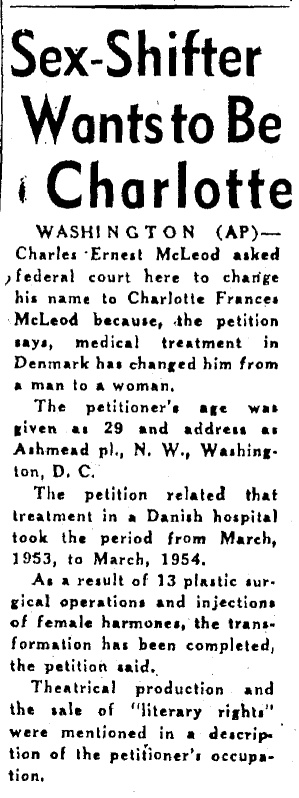
  • “Sex-Shifter Wants to be Charlotte”. Boston Daily Record, June 15, 1954: 4. Online.
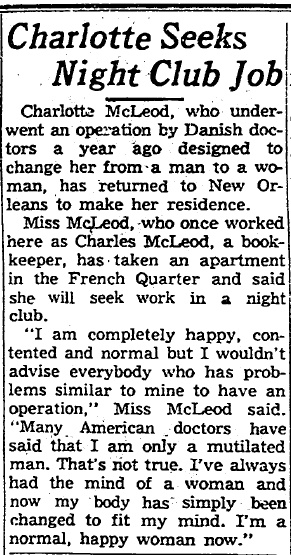
  • “Charlotte Seeks Night Club Job”. New Orleans Times Picayune, June 24, 1954: 8. Online.
  • “Charlotte Halted by Court Action”. New Orleans Times Picayune, July 4, 1954: 11. Online.
  • “Charlotte M’Leod Suit Lost by Badon”. ”. New Orleans Times Picayune, July 10, 1954:1. Online.
  •  Charlotte Mcleod.  “I Changed My Sex”. Mr Annual. Winter 1956. 
  • “Sex-Changed Ex-GI Becomes Miami Bride. UPI, Nov 13, 1959. Online.
  • “Bride Revealed as Forner GI”. San Diego Union, 11/14/1959: A3. Online.
  • Joanne Meyerowitz. How Sex Changed: A History of Transsexuality in the United States. Harvard University Press, 2002: 82-3, 84, 89, 91, 148, 304n93.
  • Susan Stryker interviews Charlotte McLeod, transcribed by Loren Basham. GLBT Historical Society, August 22, 2002. PDF.
  • Aleshia Brevard. The Woman I Was Born to Be. A Blue Feather Book, 2010: 5, 48.
  • Brittany Shammas.  “Five Moments in Miami’s LGBTQ History, From 1937 to 2015”.  Miami New Times, March 12, 2019.  Online.  

TransasCity Collection       Vidensbanken om konsidentitet