This site is the most comprehensive on the web devoted to trans history and biography. Well over 1800 persons worthy of note, both famous and obscure, are discussed in detail, and many more are mentioned in passing.

There is a detailed Index arranged by vocation, doctor, activist group etc. There is also a Place Index arranged by City etc. This is still evolving.

In addition to this most articles have one or more labels at the bottom. Click one to go to similar persons. There is a full list of labels at the bottom of the right-hand sidebar. There is also a search box at the top left. Enjoy exploring!

Showing posts with label dissociative disorder. Show all posts

18 October 2021

Walt Heyer (1940 - ) manager, counselor, writer, changeback

Walt Heyer, raised in Los Angeles, had a grandmother who loved to dress him as a girl, and an uncle who sexually abused him. He married in 1965 and they had children. His wife knew about his cross-dressing. He became national manager of port operations for American Honda Motor Company, a job that required frequent travel to ports around the US. 

Since childhood his inner woman, who named herself Christal West, had expressed herself in his cross-dressing. Walt moved his family to Sonoma, north of San Francisco so that he would have easy access to the city’s Tenderloin area. At first he went to the drag bars, particularly the Roadrunner, in male guise, until he found a friend who let him change, and then in female guise. 

From there he was given the name of a doctor in Beverly Hills who prescribed female hormones, and then a plastic surgeon for top surgery. At this point his sex life with his wife had ended. In 1981 Heyer obtained the name of gay psychologist Paul Walker from the grapevine. Walker was building a practice catering to transsexuals, and was located on nearby Union Street. Heyer enrolled as a patient. Walker recognized Heyer, having seen his female persona in the Roadrunner. According to Heyer’s account, at the end of the first session Walker diagnosed gender dysphoria, and in the third session gave Heyer a letter recommending trans surgery. This despite the 1979 Harry Benjamin International Gender Dysphoria Association Standards of Care (of which Walker was the major co-author) requiring two such letters and at least one year of cross-living before surgery. 

Heyer actually went to Trinidad, Colorado and saw Dr Biber. His intention was to have a surgical sex change without telling his boss, his wife or anyone else. The choice of Biber was almost unavoidable he recalled: 

“He was the only one anyone talked about. At the time he was the only one doing the surgery. I had tried to get into UCLA and other places, but everyone had shut down their clinics. There was nothing left. You had one choice.” (Smith p 15) 

Biber read the letter from Walker and asked his usual questions. Heyer gave a check for $7,500, and agreed to the additional hospital fees. He went then to the hospital, felt bad about what he was doing, and returned to Biber’s office with a change of mind. He got a 50% refund. Back home Heyer finally told his wife. Divorce proceedings were started. 

In 1983 Heyer again gained approval from Walker, and again went to Trinidad. Some things had changed. Heyer had started using the name Andrea West. Andrea had had buttocks implants, a nose job and electrolysis. However her resolve had wavered, and she had had her breast implants removed, but later had them replaced. As Walt she was still working for Honda and had been transferred to southern California. Walt’s drinking had become more intense. On return to Trinidad it was Andrea West who signed the papers, but then the name Laura Jenson popped into her head and that is who she became. It was still her intention to continue to work as Walt, and to be Laura out-of-work. She finally told her mother what she was doing. She actually continued to work as Walt. However her attorney maintained that she could not legally continue to work using the name Walt. She procrastinated for several months, until October 1983 when during a business meal and appearing as Walt, she explained that she had already had the surgery. The stunned boss took the issue to the president. Two weeks later she was offered six months severance pay, and she was to disappear and not discuss the termination with anyone.

Laura
Laura Jensen could not find another job, but still had alimony, child support and mortgage to pay. She was still drinking, and started taking cocaine. Most of her friends had disappeared, but one offered to help get her sober and took her to an Alcoholics Anonymous (AA) meeting. One AA member offered a garage to sleep in, and others offered odd jobs, but one of the others, also trans, took her to a bar, and she relapsed into alcohol and cocaine. AA again helped her out of that. Her son was the only family member still in contact, although she dressed as a man to meet him. 

Laura’s break came when she was taken in by a Christian family, with a father who was a psychologist with a masters in theology. Laura ended up staying nine months, and returning often over the next twelve years. The family led her to accept Jesus as her savior, and helped her to decide to return to being Walt. Walt obtained a job in an auto body shop owned by a Christian man who also convinced him to start attending Bible classes. However, as Walt later wrote: 

“Laura tormented Walt’s thoughts, enticing him to switch back. I began feeling more and more fragile, slowly crumbling under the weight of wanting relief from the intense emotional pain.” (Smith p 91) 

It was Laura who climbed onto the roof of a restaurant and shouted that she wanted to die. This led to Walt losing his job and a court ordered recovery treatment. It was Laura who was admitted into a residential Women Recovery Association program. She began attending a local church in Foster City, south of San Francisco, where the pastor, while admitting that he had no experience with trans persons, welcomed her and they met regularly. 

Laura took courses to become a counselor for people in drug or alcohol recovery - this at the same time as working a job, and working with her church and with AA. She began noticing differences between her two personas. Laura preferred healthy food; Walt was a junk-food fan. Walt’s voice was lower, while Laura’s was pitched higher. Their handwriting and opinions often were quite different. She remained Laura at school and at work, rather than risking discovery by changing whenever the impulse to do so struck. She attended men’s AA group meetings as Walt, and women’s AA group meetings as Laura. She knew that the major imperative was to stay sober. She did and she graduated in 1989 with an advanced certificate in drug and alcohol studies. Working with her pastor, Laura asked if it would be okay to come to church as Walt. After discussion and prayer it was arranged that the pastor gave a sermon on the theme of a sinner saved by repentance, and then told of Walt’s journey, and then Walt in person was well received.

Walt began working at CityTeam, a non-denominational Christian non-profit in San Jose. But at weekends she was still Laura. Walt was baffled by this as were friends and psychologists. Walt/Laura made a follow-up appointment with Paul Walker who had diagnosed gender dysphoria in 1981. By Heyer’s account, Walker responded to her claim of four years of sobriety, by admitting that he too was in a 12-step program, that he had been addicted to drugs and alcohol after a ski accident, and that he was HIV+. Before he died in 1991, Walker wrote to her that therapists should address alcohol and drug issues before moving on to gender issues. He assured Jensen/Heyer “that I share, as best I can, some of the pain that this mistake has caused you”. Heyer seized onto the word “mistake”. 

Walt’s 12-month contract with CityTeam also ended in 1991, and he applied for a position as a counselor in a psychiatric ward in southern California - but as Laura, as all his papers were in that name. The job required working with severe psychological disorders, including self-mutilation and schizophrenia. The psychiatrist who oversaw her work took note of her as a person, and proposed clinical meetings in his free time. After three weeks he had her consult with another colleague, who used a term to explain Laura’s condition: Dissociative disorder (more popularly known as Multiple-Personality disorder). Laura sought a third and fourth opinion. Both confirmed: Dissociative disorder. A Dissociative disorder specialist used hypnosis, and identified 13-15 separate personalities. Penmanship varied according to which persona was active: Andrea’s signature was tight, small, and slanted left; Laura’s was bold and slanted right. If Walt/Laura had Dissociative disorder, it explained why transition had not solved her problems. 

Laura returned to the San Francisco Bay area to be close to those who supported her best. She restarted at AA, and after an initial hesitancy, was welcomed back to the Foster City church. A new therapist advised that working a job interfered with the required therapy: Laura couch surfed, ran errands for a restaurant in exchange for meals and applied for permanent disability income. Whilst praying with her therapist, she had a religious experience, a vision of Jesus who took her into his arms. For the next few years Walt and Laura alternated. A friend who had taken in Laura some years before was dying of cancer at age 46. Walt became part of her support network, and got to know a woman named Kaycee who was doing the same. They started to meet in addition to supporting the friend. Kaycee accepted him while knowing his past. He had his breast implants finally removed and changed what documents he could. After five years Walt and Kaycee were formally dating. They married in May 1997. The gender switching stopped.


In 2006 Heyer published his first autobiography, Trading My Sorrows, in which he discusses his diagnosis of Dissociative Disorder. In 2008 he set up sexchangeregret.com. At first response was small. However in 2015, when Caitlyn Jenner was front-page news, Heyer was suddenly in demand. “I did forty radio and TV shows in five days”. He appeared at events with Paul McHugh and Ryan T Anderson, both of whom have also written books decrying transsexuality. Heyer endorsed both McHugh’s and Ray Blanchard’s ideas. He repeats conspiracy ideas that George Soros and Barack Obama have respectively financed and appointed activists to push a transgender agender: 

“They want to destroy the moral fabric of society, of the Church, and if you can destroy gender, then you can destroy the basis of man-woman marriage, and then in due time destroy the foundation of society, which is the male-female family and spawning of offspring. So George Soros is totally against God and family.” (Smith p 145) 

In 2018 Heyer edited an anthology of accounts by 30 others who detransitioned.

By Heyer:

  • Trading My Sorrows: A True Story of Betrayals, Bad Choices, Love, and the Journey Home.  Xulon Press, 2006. Reissued as A Transgender’s Faith. CreateSpace, 2015.
  • Perfected with Love. Xulon Press. 2009.
  • Paper Genders: Pulling the Mask Off the Transgender Phenomenon. Make Waves Publishing, 2011.
  • Paper Genders: Pulling the Mask Off the Transgender Phenomenon.Make Waves Publishing, 2011.
  • Gender, Lies and Suicide: A Whistleblower Speaks out. CreateSpace, 2013.
  • Kid Dakota and the Secret at Grandma’s House. CreateSpace, 2015. A novel based on Heyer’s childhood.
  • (ed)Trans Life Survivors. Bowker Identifier Services, 2018.
  • Articles of Impeachment against Sex Change Surgery. Walter Heyer, 2020.

www.tradingmysorrows.com

www.sexchangeregret.com

https://waltheyer.com

https://www.thepublicdiscourse.com/author/walt-heyer/

https://www.dailysignal.com/author/walt-heyer/

https://www.focusonthefamily.com/contributors/walt-heyer/

https://thefederalist.com/author/walt-heyer/

Other:

  • "Walt Heyer". TransChristians, February 21, 2010. Online.
  • "Walt Heyer?" Maple Centers, October 2, 2011 – January 25, 2012. Online.
  • Jeff Schapiro. "Transsexual Returns to Original Gender After Relationship With Christ". Christian Post, January 11, 2012. Online.
  • Sheila Jeffreys. Gender Hurts: A feminist analysis of the politics of transgenderism. Routledge, 2014: 73-4.
  • Jay Akbar. “The man who's had TWO sex changes: Incredible story of Walt, who became Laura, then REVERSED the operation because he believes surgeons in US and Europe are too quick to operate”. The Daily Mail, 26 January 2015. Online.
  • Zinnia Jones. “Walt Heyer and ‘sex change regret’ ”. Gender Analysis, July 31, 2015. Online.
  • Ryan T Anderson. When Harry Became Sally: Responding to the Transgender Moment. Encounter Books, 2018: 87-91.
  • Martin J Smith. Going to Trinidad: A Doctor, a Colorado Town, and Stories from an Unlikely Gender Crossroad BowerHouse, 2021: Passim.

EN.Wikipedia     Conservapedia    Susan’s Place

------------------------

Ephilei at TransChristians wrote in 2010: 

“Walt Heyer was never transgender, yet underwent SRS. Distraught that he was approved for surgery, he hopes to make the psychological community stop SRS.

Walt has a unique circumstance. Walt was eventually diagnosed with dissociative identity disorder, archaically called multiple personality disorder. One of his identities happened to be a woman and that identity gradually came into dominance. Not realizing this, he interpreted his feelings as transexual and had SRS. Eventually counselors gave him an accurate diagnosis which provided the proper treatment to eliminate his other false identities. Heyer's situation is undoubtedly tragic.”

Walt Heyer is probably the best known detransitioner or changeback although of course there are many who have done so. Like Alan Finch he set up a webpage and advocated against other people choosing to transition. Some revert to their original gender and admit to a personal mistake. However others go on a crusade to decry that others may decide to do what did not work out for them personally. Back in 2014 I estimated detransition as around 3% based on the data in this encyclopedia. Most other estimates are roughly the same. This Wikipedia article summarizes various studies and concludes: “It is estimated that the number of detransitioners ranges from less than one percent to as many as five percent”. As others have pointed out a 95% success rate makes sex-change surgery one of the most successful branches of medicine.

Heyer claims that 40% of trans persons attempt suicide. He does not differentiate between those who so attempt because they are not able to transition, those who are oppressed by others for being trans and those who actually regret transition.

Heyer is of course right that trans persons with substance abuse/alcoholism should get that sorted out before proceeding with transition. He is also right that those with a Dissociative disorder should get that sorted out first. The persona who becomes the final dominant persona may not want to transition.

There is a divide among trans persons between those who regard therapy as essential and those for whom such a requirement is at best an irritant. I was never offered nor ever wanted professional counselling. I was accepted after one session with Russell Reid. By that time I was working as female, and living so 24/7. I had several years in trans support groups and had talked with, even counselled, many others. I knew what I was doing, and 35 years later have no regrets. Apparently the only trans women that Heyer had met by 1981 were those in the Roadrunner bar. He was on the down-low, and had definitely not done a social transition prior to surgery.

If it actually was as Heyer tells it, Paul Walker did indeed make a serious mistake.

Heyer credits his destiny to grandma's purple dress, father's chastisement and uncle's sexual abuse.  However many children experience worse and become neither trans nor dissociative.   It is not that simple.


11 January 2015

Lili Ilse Elvenes, surgery and womanhood

Part I:  Einar Wegener, artist
Part II: Lili Ilse Elvenes, surgery and womanhood
Bibliography
Part III:  Lili Elbe, media construct


In Spring 1930 Einar was depressed in that Lili seemed to be taking over. He had been to several doctors, one of whom was a radiologist, who had perhaps exposed him to too much x-ray therapy. This had been all to no effect and he was contemplating suicide. A friend arranged an appointment with the Dresden Doctor Kurt Warnekros who was visiting Paris. It was not Lili but Einar who attended, and Warnekros, after an examination, made an appointment for further examination and surgery in Berlin the next week.

Einer alone went to Berlin – in male clothes and with a change of only male clothes in his suitcase. Warnekros arranged blood tests, and for Magnus Hirschfeld to do a psychological examination. This required a visit to Hirschfeld's Institut für Sexualwissenschaft, where he encountered trans women, and it is highly likely that they included Charlotte Charlaque, Toni Ebel and Dörchen Richter, all of whom had had a first operation by this date. Einar did not relate to them:
"He felt intensely uncomfortable. In this large room a group of abnormal persons seemed to be holding a meeting – women who appeared to be dressed up as men, and men of whom one could scarcely believe that they were men. The manner in which they were conversing disgusted him; their movements, their voices, the way in which they were attired, produced a feeling of nausea." (p54).

Later that day, Einar dined with his Berlin friend Neils Hvide who puts a question:
"'As a man you have always seemed to me unquestionably healthy. I have, indeed, seen with my own eyes that you attract women, and that is the clearest proof that you are a genuine fellow.' He paused, and then placed his hand on [Einar]'s shoulder. 'You won't take it amiss if I ask you a frank question? ...Have you at any time been interested in your own kind? You know what I mean'. [Einar] shook his head calmly. 'My word on it, Niels; never in my life. And I can add that those kind of creatures have never shown any interest in me'. 'Good, [Einar]! That's just what I thought'."(p56)
And two paragraphs later Einar adds:
"I will  honestly and plainly confess to you, Niels, that I have always been attracted to women.  And to-day as much as ever. A most banal confession!"
After Einar's orchiectomy at the age of 48, which was probably done by Dr Erwin Gohrbandt, Gerda arrived and purchased women's clothes for Lili, and Wegener was declared to be no longer male and was now entitled to enter Warnekros' Staatliche Frauenklinik (National Women's Clinic) in Dresden, where a second operation was done.

Lili and Gerda then returned to Copenhagen in October 1930, a few weeks before Magnus Hirschfeld left Germany for New York, never to return. King Christian X Schleswig-Holstein-Sonderburg-Glücksburg annulled the marriage of the Wegeners, and Lili was issued papers in her new legal name of Lili Ilse Elvenes, including a passport.


In 1931 Gerda married Fernando Porta, an Italian officer, aviator and diplomat and went to live with him in Morocco.

A further operation on Lili Elvenes to implant ovaries, or maybe an uterus, taken from a 26-year-old woman was done at the Dresden Clinic by Warnekros. However Elvenes died three months later, probably of transplant rejection, but maybe from infection or a heart attack. She was buried in Dresden.

Gerda Porta was still in Morrocco when she heard of Lili’s death. She divorced Porta in 1936, and returned to Denmark in 1938. She held her last exhibition in 1939, but by then was rather out of fashion. She died alone and impoverished in 1940, of a heart attack at age 54, shortly after the German occupation.
Lili in Copenhagen, late 1930

______________________________________________________________________________

It is not my practice to name essays by the pre-transition name of the person if the post-transition name is on record.   I have made an exception in this case in that the name Lili Elvenes is not generally known, and would probably not be recognized.  Almost all accounts refer to her simply as Lili Elbe, but that was never her real name. 

As already mentioned, the book by Lili Elbe is an unreliable narration.   To take two examples.  It is claimed that the orchiectomy not only changed her voice from a tenor to a soprano, but altered her handwriting to a definitely feminine style.    It only it were so!  Secondly Lili Elvenes appears to be the only person to have had four gonads: two testicles which were removed in the orchiectomy, and two ovaries which had been feminizing his body.  Note that Dr Norman Haire in his introduction to the English version of the biography says that Einar "was sufficiently normal both psychologically and physically to be able to fulfil  his functions as a husband".

Lili claims that Einar's monthly bleedings from the nose and elsewhere which were taken as representative of menstruation.  30 years later Dawn Langley would also claim to menstruate.

When Lili had her final operations to transplant ovaries/uterus she was 49, an age when many women have reached menopause, and the childbearing years are definitely over.

So how does "I can add that those kind of creatures have never shown any interest in me" fit with the repeated reports of men chasing, making passes and wanting to marry Lili.  Are we to presume that 'those kinds of creatures'=gay, while those who made passes at Lili were 'healthy'=straight.   It was an open secret in both Copenhagen and Paris that  Einar=Lili, and at least some of those making passes must have heard the rumours.

On the eve of the operation Einar asserted an 'banal' interest only in women.  And yet shortly afterwards wanted the extra operations so that Lili could marry a man and bear children.   While such a turnaround is not inconceivable, the assertion of it is very much part of Louise Lassen's program of re-assuring her readers that there is nothing queer in the story.

Sandy Stone, raises the naughty question of whether Einar wrang the turkey's neck, and continues: "No wonder feminist theorists have been suspicious.  Hell, I'm suspicious."

Is Neils Hvide, Neils Hoyer?

Was Einar/Lili intersex?  Here is an article by Karin of OII Australia that argues that she was.  However many of the pioneer transsexuals, Betty CowellDawn Langley, etc maintained that they were intersex, with as little proof.  There is also the problem that most intersex persons stay with the gender of rearing.  An intersex person may or may not be trans, and probably is not.

My opinion is that Einar was what is often called a Natural Beauty, a man who is often taken as a woman, even when not trying.  The pre-transition Coccinelle, April Ashley, Rachel Harlow were all natural beauties.  Nobody has really argued that this condition is a type of intersex, nor does it always lead to transition: Jaye Davidson, who was cast as Dil in The Crying Game, was so cast because of his beauty, but afterwards continued his life as a man.

Although I must admit that looking at the male-dressed photographs of Einar, I do not see a Natural Beauty, although we may put this down to the low-definition photography andthe unflattering male clothes and hairstyles of the 1920s.   But if Einar was not a Natural Beauty why did so many men assume that the male-dressed Einar was a woman in trousers?   Maybe in fact they did not, and again this is part of the unreliable narration.  Lili would not be the last trans woman to overestimate both how well she passed, and how attractive she was.

Why was Elvenes accepted for surgery, when so very few were?  Unlike Charlotte Charlaque, Toni Ebel and Dörchen Ritcher she was not living fulltime as female.  It was Einar who showed for the Paris appointment, and again it was Einar who arrived in Berlin, with only male clothing in a suitcase.  Many transsexuals in later times were rejected until they started arriving dressed as the target gender.  Warnekros did not have Hirschfeld’s experience with trans persons; he was a gynecologist and obstetrician and radiologist, and apparently he wanted to be famous.  I suggest that he mistook being a Natural Beauty for being a transsexual.

It is not clear just what operations Lili Elvenes had.  However there is a general assumption that death was caused by a transplant, either of ovaries or of a uterus.   Orchiectomy, penectomy and vaginoplasty were quite safe though experimental.   Unlike Elvenes, Hirschfeld’s patients lived: Charlotte Charlaque was still alive in New York in 1952; Toni Ebel lived until 1961; nothing is known of Dörchen Ritcher after 1933, but the presumption is that she was murdered by Nazis, not that she died as a result of her surgeries.   If Elvenes had settled for the same she also probably would would have lived several years more.

It was not Lili's age, 49 in 1931, that affected her survival chances.  She was in fact one year younger than Toni Ebel.

We do not have enough information to be sure, but it would seem that Carla, Toni and Dörchen were more androphilic than gynephilic, and they would have been early transitioners if the social support had existed at the time.   So was Lili the first gynephilic transsexual to achieve surgery?   It is of course ironic that Charlotte Goiar proclaims Lili, and not Carla, Toni or Dörchen, as the first surgical HBS person.  Incidentally there was an earlier attempt at gynephilic transgender surgery in Berlin, as early as 1921.   I will return to that later in the month.

We should of course mention Dr Eugen Steinach (1861 - 1944) of Vienna.   Steinach proposed that ligation of the vas deferens, while causing atrophy of spermatogenic tissue, would produce additional testosterone. This vasoligation, unlike the similar vasectomy, was done on one testicle only, and most patients (that is men) reported increased vigour and sexual power. This of course was homeogender not transgender surgery.  Some of the men who had this operation were Sigmund Freud, Harry Benjamin and WB Yeats, all of whom were well pleased with the results.  Benjamin became Steinach's US disciple and performed over 500 Steinach operations in New York (unlike Steinach who never did the surgery himself).  Norman Haire, In London, also performed the operation.  Some other doctors, both then and now, say that the results were psychogenic rather than hormonal.

Along with Steinach, Benjamin pioneered an equivalent operation for women, diathermy, applied to one ovary, supplemented by x-ray treatment of the area.   So much for the idea in the book that Einar's visits to a radiologist had damaged his birth ovaries.

Steinach also did apparent ‘sex changes’ on guinea pigs with castrations and gland transplants.   This was the background behind the decision to transplant ovaries in Lili Elvenes (who of course should not have needed new ovaries if she had two of her own all along).   Could Steinach's results be also achieved in humans?  Steinach did report that he implanted a testicle into a man who was castrated, passive and feminine, and that the man became a 'normal' heterosexual. There is however a lack of verifications and replications.

09 January 2015

Einar Wegener, artist

Part I:  Einar Wegener, artist
Part II: Lili Ilse Elvenes, surgery and womanhood
Bibliography
Part III:  Lili Elbe, media construct


(all page references are to the Blue Boat edition of Man Into Woman, 2004)

Part III will be a discussion of the fact that Man Into Woman appears to be an unreliable narration.  However without it we have almost no story at all.  So in parts I and II details from the book will be used.   However bear in mind that this is tentative.

________________

Einar Mogens Andreas Wegener (1882 - 1931), the son of a grocer in Vejle, Denmark, was educated as a painter at Vejle Tekniske Gymnasium and then Copenhagen Kunstakademi (Art School) where he met Gerda Gottlieb (1886-1940), the only survivor of four daughters of a pastor. Einar and Gerda married in 1904.

After graduation Gerda exhibited at the Autumn Art Exhibition, The Charlottenborg Spring Exhibition and the Journalists' Union. Her breakthrough was in 1907 when she won a competition organized by Politiken newspaper, and in the same year several female painters including Gerda were rejected from the Charlottenborg Exhibition – which became known as the Peasant Painter Controversy.

One of Gerda's early commissions was a portrait of Anna Larssen (1875 - 1955), the popular actress. One day Anna was unable to attend, and on the phone suggested that Einar's legs be used as had been done once before. This time Gerda fully dressed Einar in a dress and wig. In the end Anna did arrive, and on seeing Einar exclaimed:
"I will christen you my girlie. You shall receive a particularly lovely musical name. For example Lili. What do you say to Lili?" (p 67)
A few weeks later Lili appeared at the Artists' Ball and was a great success. Gerda found Lili to be a charming companion. Einar did landscape paintings and Gerda illustrated books and fashion magazines. Einar received the Neuhausens prize in 1907 and exhibited at Kunstnernes Efterårsudstilling and at Vejle Art Museum.

Lili/Einar was an open secret, and in 1912 when Einar and Gerda decided to leave Copenhagen, a satirical poem by Vigge Afrelius, was published in Eksta Bladet, a sister publication to Politiken, that included the lines: "hvis vi tro kan, hvad Saga fortæller,/Michelangelo og som Zahrtmann/you bru'r kun mandelige Modeller! (if we can believe/what the story tells you used/such as Michelangelo and Zahrtmann male models!)".

After travels in Italy and France Gerda and Einar moved to Paris later that year, and at first stayed at the Hôtel d’Alsace, and were shocked to find themselves in room 16, the very room where Oscar Wilde had died twelve years earlier. They took inspiration and read Wilde's writings out loud to each other.

Gerda worked for Vogue and La Vie Parisienne. She also held regular exhibitions at the Ole Haslunds gallery in Copenhagen, and came to be considered a major Art Deco artist and was well known for her erotica. Einar exhibited in the Salon de Paris and Salon d'Automne in Paris. However he de-emphasized his own work to help Gerda, and became her favourite model.
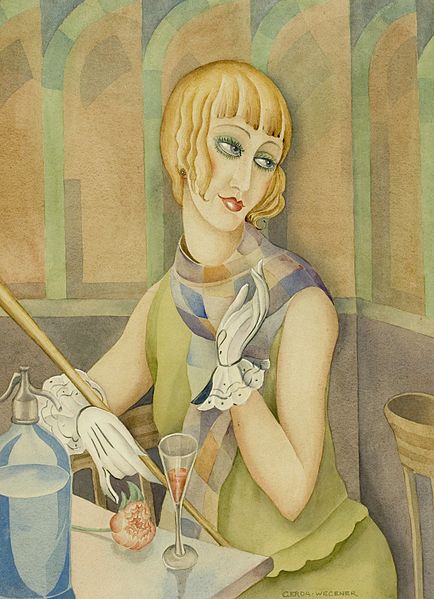
Lili painted by Gerda

Gerda became famous for her paintings of women, and it was later discovered that most of them were actually of Lili. In 1924, Einar, on a trip back home, was interviewed by the København newspaper, and spoke about dressing as a woman during Paris Carnival.
 
Through the 1920s Einer was increasingly Lili. She attended public events, entertained at home as Lili, and went on trips to the countryside. She passed well and men even proposed to her. Gerda introduced her as Einar’s sister. Einar was often depressed and suffered from coughing spells; however Lili was bright and happy: Gerda came to prefer the company of Lili. Einar in male clothing was several times taken as a woman in trousers.


One day Einar said:
"Really I cannot imagine what existence would be like if Lili should one day vanish for ever, or if she should no longer look young and beautiful, Then she would no longer have any justification for living at all."
Gerda replied:
"In recent months I have felt prickings of conscience because I was, to a certain extent, the cause of creating Lili, of enticing her out of you, and thus becoming responsible for a disharmony in you which reveals itself most distinctly on those days when Lili does not appear." (p92).
and she continued:
"It often happens thatwhen she poses for me as a model a strange feeling comes over me that it is she whom I am creating and forming rather than the girl whom I am representing on my canvas.  Sometimes it seems to me that here is something which is stronger than we are, something which makes us powerless and will thrust us aside, as if, indeed, it wanted to be revenged on us for having played with it." (p93)

Later Einar wrote:  "Formerly I had found distraction in reading.  Now I never opened a book or journal.  What were the fates of strange persons to me, unless I could find consolation in reading about a person of my own kind?  But of such a person no author had been able to able to write, because it had never occurred to any author that such a person could ever have existed."  (p110-1)  (This was 20 years after the publication of Magnus Hirschfeld's Die Transvestiten, and 2 years after Havelock Ellis' Eonism and Other Supplementary Studies.) 


 Paintings by Einar Wegener     Paintings by Gerda Wegener  
 __________________________________________________________________________

Do click through to see paintings by both Einar and Gerda.   In Part III Louise Lassan will describe  Einar’s paintings as ‘virile’ but I do not see them as so.  They strike me as ordinary landscapes.   To my eye Gerda was obviously the more adventurous painter.

Some sources claim that Gerda was lesbian.   I found no confirmation of this, and of course she will re-marry to a man as soon as her marriage to Einar is annulled in Part II.

Presumably Einar and Gerda were in Paris during the Great War.  However there is no mention of it in Man into Woman.  

Anna Larssen was a popular actress in the 1900s.   Surprisingly, she quit acting in 1909 and became a Pentecostal minister, and with her second husband founded the Danish Apostolic Church.  No date is given for when Anna named Einar as Lili, but 1907 must be a terminus post quem and 1909 a terminus ante quem.  Thus it must have been only months before her abandonment of her acting career to dedicate her life to God.

The poem published on the departure of Einar and Gerda from Copenhagen in 1912:.

[...] Jolies Popo’s – petites Nichon’s
kan ingen som Fru Gerda tegne –
og ganske ligegyldigt hvor –
for sligt ser ens ud allevegne! [...]

Med Kunstens Store du i Slægt er,
hvis vi kan tro, hvad Saga fortæller,
som Michelangelo og Zahrtmann
du bru’r kun mandelige Modeller!

Den Ting har saare mig bedrøvet
og din er Skylden, skønne Tegner!
Tænk! Jeg har glædet mig ved Former,
Der rim’ligvis har tilhørt Ejnar! [...]

[...] Pretty butt - small breasts
no one like Mrs. Gerda can draw,
and no matter wherever -
as such looks the same everywhere. [...]

The Great Art thou art related,
[and] if we can believe what the story tells
you used such as Michelangelo and Zahrtmann male models!

The thing I was extremely saddened
and yours is the guilt, beautiful illustrator!
Imagine that! I'm pleased me to forms
that have probably heard Ejnar! [...]
  •  "Afrelius, Vigge:" Ved en Bortrejse ". In: Ekstra Bladet, 04.03.1913; 2.

10 October 2010

Sanda Davis (1955 - ) psychotherapist, Mother God.

Romanian-born Sanda Davis, has psychology degrees from the Universities of Bucharest and Ottawa, and wrote a doctorate thesis, Principes a Appliquer en Education Familiale, Surgis du Fonctionalisme Systémique, at the University of Mons, Belgium in 1999. However she is currently listing herself as "Phd Cnd". She published two books in 1995: Multiples in Love and Am I a Man or a Woman? Both by Personality Press which has not published anything by anyone else.

She takes the concept of 'introjection', a term that has been used by psychoanalysts and Gestalt therapists, but puts her own spin on it. An introjection is an internal image of another person. We all have introjections, and for many they are no more than memories. Many of us have strong introjections where the memory becomes obsessive, especially if it is associated with trauma or abuse. In one of Davis' stronger examples she uses the concept of introjections to explain how abuse victims later become abusers themselves in that the remembered voice of the initial abuser is still inside and controlling the person.

She sees multiple personalities (dissociative identity disorder) as competing introjections. She sees Gender Identity Disorder (her preferred term) as a special type of dissociative identity disorder in which one of the alternative identities (introjections) has become so dominant that it becomes the major personality.
"All humans acquire Introjects. Depending on specific factors, Introjects may or may not lead to dissociation, even to severe forms of dissociation. Reflecting the person that is imprinted as an Introject, some Introjects are content with limited control, while others take over completely, using, abusing, and transforming the body. Such is the case with Gender Identity Disorder: a cross-gender Introject takes over the body, and demands gender reassignment.(DIFH:1.2)"
"In most cases Gender Identity Disorder is a psychological disorder of traumatic origin that usually starts in early childhood, and afflicts millions of people in the entire world. Cross-dressing and transsexuality are the most popular manifestations of this disorder. In reality, GID is a much deeper disorder characterized by confusion, trance states, attention deficit, memory problems, headaches, psychosomatic symptoms,physical numbness, reduced or variable sexual potency, possible impotence, mood swings, reading and learning difficulties, potentially lethal depression, low self esteem, self mutilation and more.(DIFH: 2.1)"
She explains that most men have introjections of their mothers, sisters, girls at school, wives etc, but in a male with GID these female introjections coalesce and become dominant. This composite introjection comes to think of itself as the true person in the body, and then starts wearing female clothing and proclaiming herself to be woman. Well-meaning friends and relatives make the situation worse by accepting the claim. Davis says that she can cure any case of GID by getting the female introjection to admit that she is not the true personality of the body.
"Once the 'female' introject that splits the male's personality system is released and the original parts integrate, the male has no more Gender Dysphoria" (Davis, 1995:152).
An obvious omission from her book is any discussion of religious experience in terms of introjections. However the Ottawa Citizen from 1997 quotes Davis saying that
"she has seen demons surface in her psychotherapy clients, then laugh and walk out of the office with them. Other clients have been inhabited by the souls of the dead. "
It also quotes the College of Psychologists of Ontario that
"Ms. Davis can't legally advertise her services as a psychologist because she is not registered with the college. But she says there is nothing to stop anybody from advertising their services as a psychotherapist, or as a soul worker."
At that time she was charging up to $80 a hour, and described herself as a "conservative Christian".
Since then she has had an epiphany and realized that she is The Mother God. On her Blogger profile she says:
"I am GOD. The Original GOD, in human form with infinite aspects to my being.
Why are people not engaging in dialogue with me when I tell them who I am."
She says that she is now able to cure paraplegia, quadriplegia, blindness, HIV, Dissociative Identity Disorder, Attention Deficit Disorder, Learning Disabilities, Gender Identity Disorder, Post Traumatic Stress Disorder, The Stockholm Syndrome, Obsessive Compulsive Disorders, Sexual Disorders, Intractable Depression, Battered Women Syndrome, Chronic Pain, Chronic Fatigue, Numerous Psychosomatic Disorders, Chronic Anger, Chronic Violence, and more.

She is located in Burlington, Ontario.
    ___________________________________________________________

    For those of you who think that autoandrophilia was Ontario’s greatest gift to gender theory, here is an unexpected delight.

    Davis lists many Blanchard papers in her bibliography, discusses autoandrophilia in her text,  but neither he nor it is in her index.

    She speaks mainly of female introjects in male bodies, and only briefly of male introjects in female bodies.   She is hardly alone in this bias.

    One of the good practices of psychoanalysis is that all psychoanalysts must themselves be psychoanalyzed.  Has Sanda spoken to another psychotherapist about her Mother God Introjection?