This site is the most comprehensive on the web devoted to trans history and biography. Well over 1800 persons worthy of note, both famous and obscure, are discussed in detail, and many more are mentioned in passing.

There is a detailed Index arranged by vocation, doctor, activist group etc. There is also a Place Index arranged by City etc. This is still evolving.

In addition to this most articles have one or more labels at the bottom. Click one to go to similar persons. There is a full list of labels at the bottom of the right-hand sidebar. There is also a search box at the top left. Enjoy exploring!

Showing posts with label arrived for surgery in male clothes. Show all posts

20 April 2018

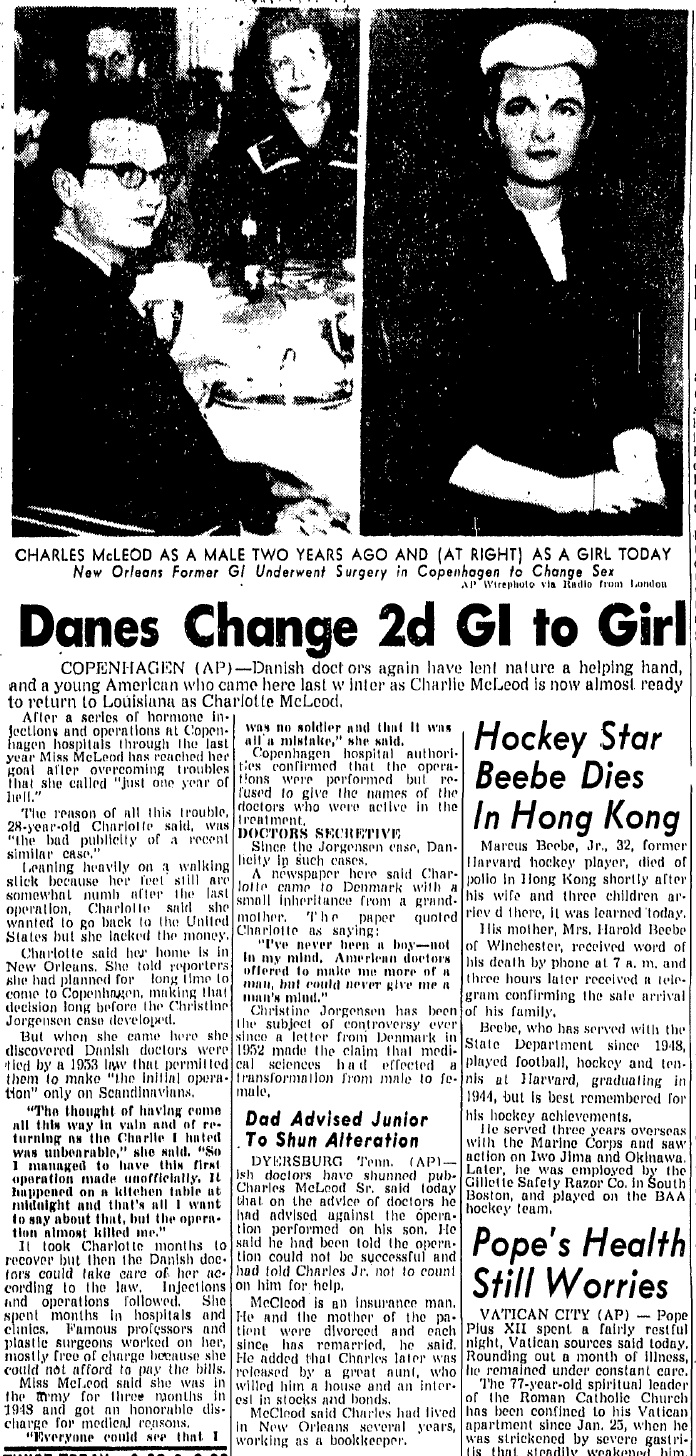
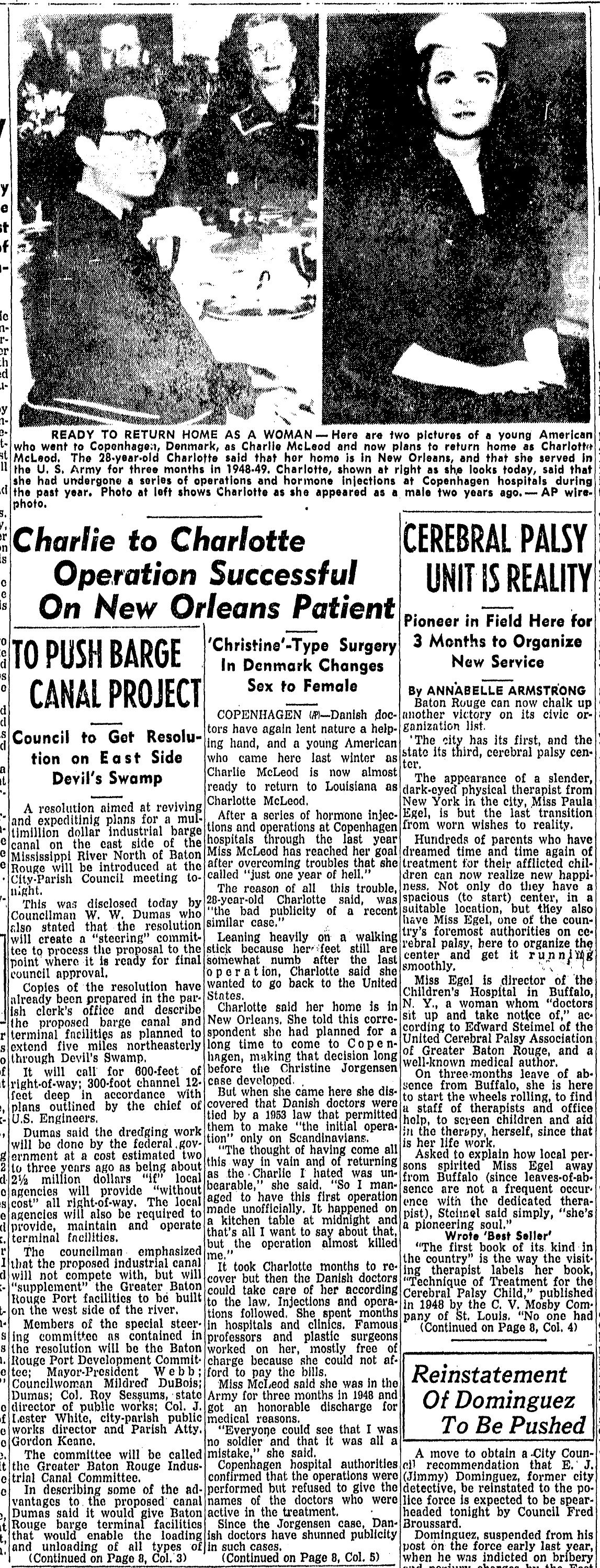
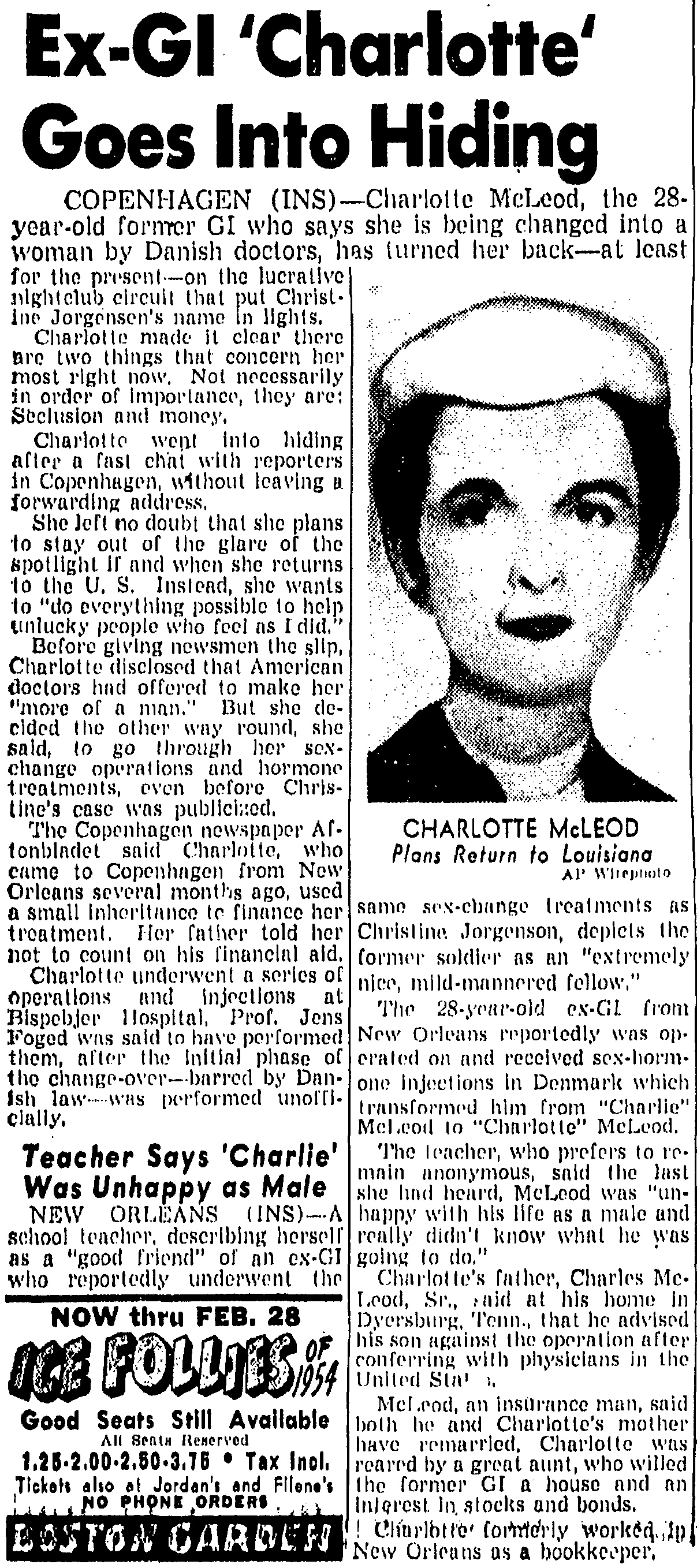
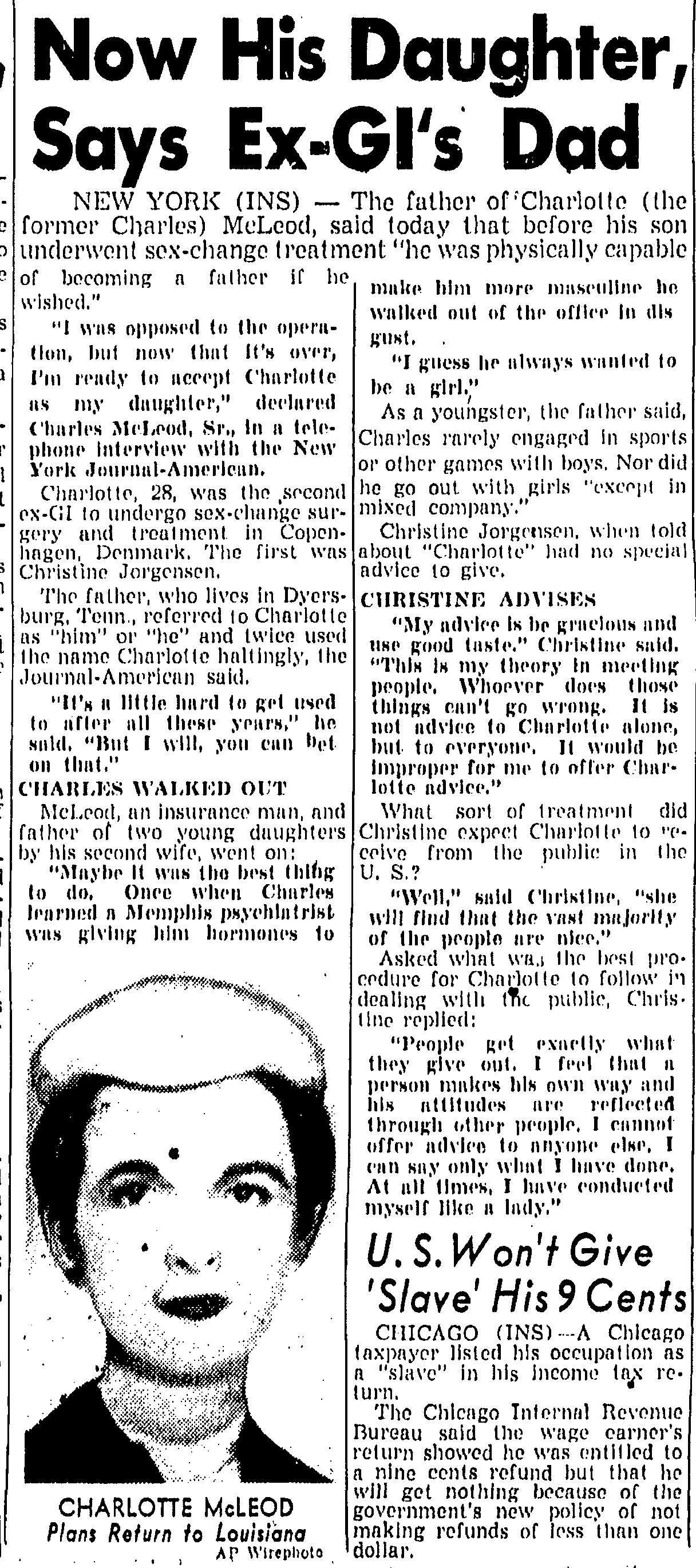
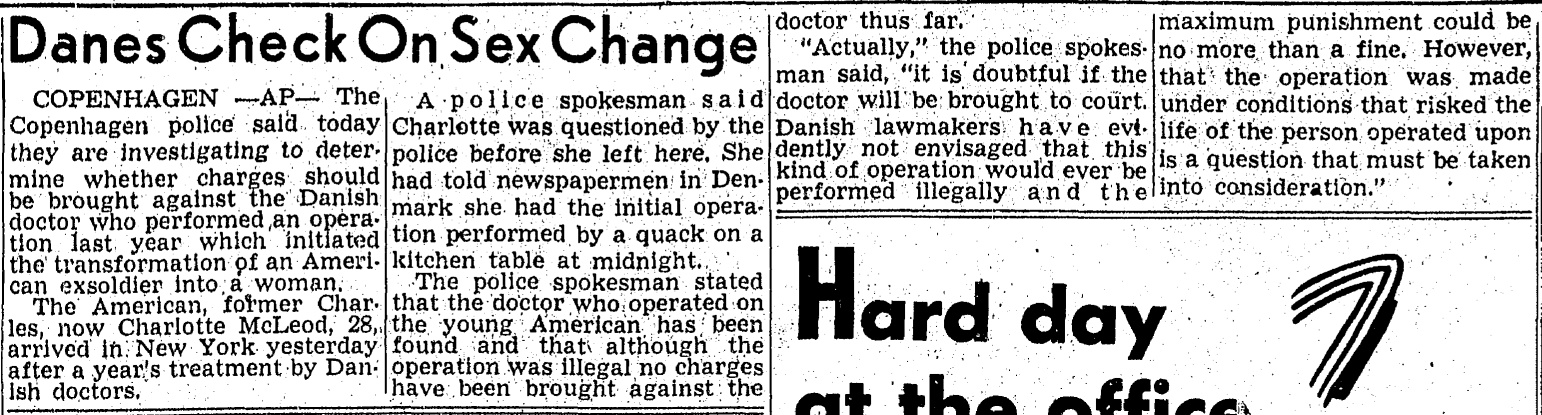
Charlotte McLeod (1925 - 2007) a bookkeeper goes to Copenhagen

Part 1: Youth and Copenhagen
Part II: fame and marriage
Part III: The geography of Charlotte McLeod in New York, 1957

Charles McLeod Jr., the only child of a Ford Motors salesman, was born in Nashville and raised in Dyersburg, Tennessee. The parents divorced when he was 16: both remarried. He was a lonely sensitive boy who lacked interest in masculine things. He was sometimes taken as a girl in boys’ clothing.

He consulted doctors and in the early 1940s went to the Mayo Clinic in Rochester, Minnesota. He also stayed with cousins in Los Angeles in the hope of finding a medical specialist in that city who could help – but without success.

McLeod served three months in the US Army 1948 before being medically discharged with a 4-F rating. McLeod found doctors sympathetic to the idea of a sex change, but they apologized that the US laws re Mayhem would not permit such surgery.

McLeod was advised to “find such little happiness as I could in life by going to one of the ‘colonies’ that abound in our large cities” (McLeod, 1956:12). In 1948, McLeod moved to the French Quarter in New Orleans, but did not fit in the gay world either. He did find work as a bookkeeper for $75.00 a week (a good wage at the time). He tried Boston for a while, but returned to New Orleans.

He went to the Mayo Clinic a second time. They still could not offer anything, because it would be illegal.

In April 1953 McLeod, at age 28, read about Christine Jorgensen and her operation in Copenhagen. He quickly packed, and went to Dyersburg to tell his father what he was doing. With apparent parental approval, McLeod continued to New York and quickly took ship to Denmark using a minor inheritance from a grand aunt. He sailed on the MS-Maasdam. Many of the people on the ship were crossing to England for the Coronation in June.

In Denmark, the Folketing had passed a new law restricting sex-change operations (that is the ‘first’ operation, the orchiectomy or castration) to Danish nationals who were not over 26. By asking around, McLeod was directed to a renegade doctor, Dr Emil Petersen:
“a rather unscrupulous physician, a man who had been charged with collaborating with the Nazis and who had only recently returned from exile. … of frightening appearance who, from the results of a British bullet through the base of his skull, habitually walked so bent over that he never met one’s eye.” (McLeod, 1956:13).
McLeod moved into the doctor’s apartment and waited five days while Petersen came down sufficiently off narcotics to regain his surgical skill. His wife and eldest son were to assist with the operation which took place on the kitchen table. The wife administered the anesthetic.

McLeod awoke in great pain and hemorrhaging. Petersen retreated into drugs, and collapsed outside McLeod’s door. She tore the stitches in her abdomen attempting to get him up, and then an infection set in. She fled and found that she no longer had her passport. She reported this to the police, and she was told that she had to leave the country, but was allowed time to settle her medical problems.

McLeod was admitted to Bispebjerg hospital. The first operation being already done, it was now legal to complete the transition. The Danish doctors led by Dr Jens Foged (1897 – 1956) agreed to do a penectomy and relocate the urethra. Christian Hamburger, who had attended to Christine Jorgensen, was the endocrinologist, and explained to Charlotte about the need for external hormones. She was unable to pay for the medical attention, and so the medical team worked free of charge.

Charlotte then started wearing female clothes, and applied to the US embassy for a new passport. It was re-issued but again in the name of Charles. Her father was contacted, but said that he would give neither financial nor emotional support.

After recovery, Charlotte went with a church outing for a weekend in Bergen, Norway, where she met a US-Norwegian, Ralph Heidal, a seaman, who helped her with skiing.

Twice in 1953, on 5 March and 20 May, a Polish pilot defected to the West by landing his MIG fighter plane on the Danish island of Bornholm in the Baltic. It was probably the second occasion when Charlotte was there having been invited to visit for the weekend. She created a stir: “ I never saw so many Russian troops. Microscopic was their examination of all of our papers and when it was found that my passport didn’t match, I think they thought that they had found the master spy.” (Stryker: 23)

In early 1954 Charlotte gave a very brief interview to journalists in Copenhagen. A 47-page pamphlet, Da Karl blev Karl: En dansk læges bedrift, came out telling of a second US person operated on – this time on a kitchen table. The book names the person as Karla, and the doctor as Petersen.

A few weeks later, on 24-5 February the Danish publication, Aftenbaldet (Evening Magazine) told almost the same story of Charlotte McLeod – and in retrospect it is apparent the Karla and Charlotte were the same person.

The US press picked up on the story immediately.

In early March the story broke that Roberta Cowell in England had also completed a gender change.

In late April the Copenhagen police found that Dr Petersen was the doctor who did the initial operation, and after statements that perhaps he would not be charged, finally he was charged with violating the castration law.

Charlotte inadvertently interrupted a press event for the Canadian actress, Yvonne de Carlo:
“She had all the press lined up for this big landing that she was going to make when she came in from Europe. And they found that I was in next car coach and everybody that was supposed to interview her came gang banging on me.” (Stryker p24)
It was 16 April 1954 when Charlotte arrived at New York’s Idlewild airport. She intended to transfer and fly directly to Tennessee. However fog grounded the plane. She stayed overnight in a hotel, and was swarmed by the press, to the point that she fell over. It was said that in the struggle she struck a photographer with her umbrella, and she and they were arrested and charged with assault. However the charges were quickly dropped.
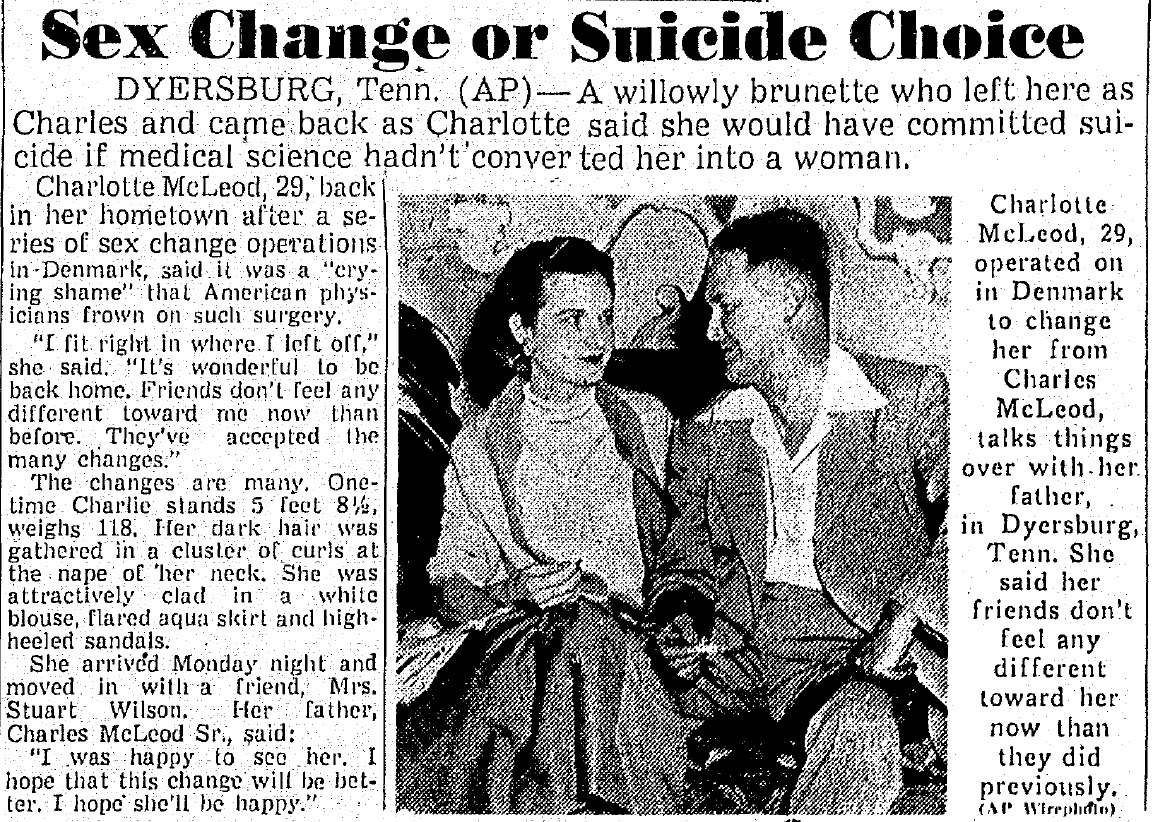
Charlotte reconciled with her father.

She returned to Dyersburg and was reconciled with her father.


Continued in Part II.
__________________

Thank you to Tina Thranesen of Vidensbanken om kønsidentitet who first identified that Da Karl blev Karl: En dansk læges bedrift was actually about Charlotte.

The high quality photographs are from Transas City.

In an interview with Susan Stryker in 2002, Charlotte said (p6) that her father was a Ford Motors salesman. However several newspaper accounts in 1954 said that he was in insurance.

She also said that she was in Denmark for ‘two years’ (p24, 29). However April 1953-April 1954 is one year.

Charlotte did not know, most trans persons in 1953 did not know, but Elmer Belt had quietly started doing vaginoplasties for trans women at the University of California at Los Angeles. He got around the Mayhem restrictions by preserving the testicles, pushing them into the abdomen.

The encounter with Yvonne DeCarlo. This is recounted on p24 of the interview with Susan Stryker. Charlotte says it immediately after saying that she was in Denmark for two years which implies that it was at about the time that she returned to the US. It is unclear whether it happened in Denmark or the US. The expression ‘next car coach’ implies that that they were on a train. I have placed the anecdote immediately prior to her flight to the US, but with further information this may have to be adjusted.
  • Bent Rosenwein. Da Karl blev Karla: En dansk læges bedrift. Self published, 1954.
  • “Ny amerikansk Chris Jørgensen skjult her I byen efter operation”. Aftenbaldet. 24 feb 1954. PDF. Text.
  • “Danes Change 2d GI to Girl”. Boston American, Feb 24, 1954: 3. Online.
  • “Charlie to Charlotte Operation Successful on New Orleans Patient: ‘Christine’-type Surgery in Denmark changes Sex to Female”. Baton Rouge State Times Advocate, 2/24/1954: 1-a, 8-a. Online.
  • “Operation Changes Sex of American”. Eugene Register-Guard. 24 Feb 1954. Online
  • “Ex-Gi ‘Charlotte’ Goes into Hiding”. Boston American, Feb 25, 1954: 3. Online.
  • “Now His Daughter, Says Ex-GI’s Dad”. Boston American, Feb 25, 1954: 3.2. Online.
  • “Medicine: In Christine’s Footsteps”. Time, March 8. 1954. Online.
  • “Charlotte, Who Was Charles, Falls in Hotel Scuffle”. Sacramento Bee, 17 April, 1954:6. Online.
  • “Danes Check on Sex Change”. Sacramento Bee, April 19, 1954: 7. Online.
  • “Sex Change or Suicide Choice”. Boston Daily Record, May 13, 1954:3. Online.
  • Susan Stryker interviews Charlotte McLeod, transcribed by Loren Basham. GLBT Historical Society, August 22, 2002. PDF.

TransasCity Collection           Vidensbanken om konsidentitet


22 November 2017

Phoebe Smith (1939–) Part I: retail worker


(Phoebe transitioned in Atlanta in the 1960s.   In those days she had great difficulty in finding out about other transsexuals, and in finding any professionals who even knew where to point her, let alone to actually help.   If she were in New York or Paris, she would have had more information even in the 1960s – but she did not know that. Fortunately she was determined.)


James Smith was born to a family of sharecroppers in Irwin County, US Georgia. His relatives referred to him as a ‘sissy’ from an early age, and he was bullied at school, more so because of his disinterest in sports.

In September 1953, the family pickup was hit by a flatbed truck. The father had his left arm crushed and had to give up farming; the mother was in constant pain afterwards. They moved to Atlanta. At the new school Smith was called ‘queer’.

In 1955 a neighbor showed him a magazine article about someone who had a sex-change operation, and asked him why he did not have it also. Smith wrote to a preacher on the radio that he had been listening to, and later phoned him. This was the first time that he ever told someone that he wanted to change sex. The preacher said that he saw nothing wrong or sinful in Smith’s desire, but couldn’t offer any help. In September 1956 Smith attempted suicide by taking his mother’s pain pills. After recovery he insisted on quitting school – he was then seventeen.

After temporary and part-time work, Smith found a position at Rich’s Department Store where he stayed for ten years. Every now and then there would be an article in the news about a transsexual, but when Smith attempted to correspond with a doctor or psychiatrist, he was told that a change of sex was impossible.

In November 1961 Smith was called to report to the Draft Board. He explained himself and was classified 4-F. If questioned he said that this was because of a bad back resulting from the 1953 road crash. Around this time, his father driving a cement mixer was hit by a train on a crossing. Smith’s younger brother joined the US Marines, but was discharged after being diagnosed with chronic bronchitis.

By 1964 Smith had rented a mailbox and was writing letters prolifically: to doctors, to medical universities, to politicians. Many were not answered; some were rudely answered. One, who was helpful, was Amy Larkin, the agony aunt at the Atlanta Constitution (actually a pseudonym for Olive Ann Burns (1924 – 1990) who later became renowned for her novel Cold Sassy Tree). Larkin passed anonymous information about Smith to Harry Benjamin in New York (who was then working with John Money so that the Johns Hopkins Gender Identity Clinic would open the next year). Benjamin wrote back that “there seems very little doubt that this patient is a transsexual”.

Larkin arranged an appointment with a local endocrinologist, but he, despite the letter from Benjamin, maintained that what was wanted could not be done.

Smith wrote to the Governor of Georgia who passed the letter to the Dean of the Medical College of Georgia who replied that the surgery was illegal within Georgia.

Smith contacted Atlanta Constitution journalist, Dick Herbert, who became interested and wrote a sympathetic story (by the standards of the time) using a pseudonym: “Long-Ill Tim Gets New Hope to Solve Endocrine Malady”.

Smith applied to Georgia Vocational Rehabilitation and Georgia Mental Health Institute. They responded with a mixture of ignoring him, giving a run-around and even rudeness. In 1968 Smith saw Christine Jorgensen on the Merv Griffin television show, and wrote to ask for Christine’s address. Christine put Smith in touch with a doctor, who in turn gave the names and addresses of two surgeons: Dr Burou in Casablanca and Dr Barbosa in Tijuana. Smith decided on the latter.

In January 1969, Smith moved out of the family home to stay with a friend; resigned his job; sent a letter to his parents saying for the first time that he was transsexual and asking them to borrow $4,200 against their house to lend to him. Smith paid $200 for a flight to Los Angeles, and then took a train to San Diego, crossed the border into Mexico at 2am. After resting in a hotel, Smith arrived at Dr Barbosa’s office – still in male clothes.

Dr Barbosa examined Smith and then explained that he required a full year of hormone therapy prior to surgery. Further examination discovered a thyroid problem. Dr Barbosa compromised and treatment for the thyroid condition was provided as well as an orchiectomy. While in the clinic, Smith contemplated a female name and decided on Phoebe.

She had brought a mail-order catalogue with her and made her first purchases of female clothing. On return to Atlanta, Phoebe was welcomed by her family and relatives. The mail-order purchases had arrived, and from that day on, she never wore male clothing again.

Continued in Part II.

18 July 2017

Stefánie Faludi (1927 – 2015) photographer

István Friedman was raised by prosperous Jewish parents in Budapest. However with the coming of anti-Semitic fascism in the 1930s, all was lost. 17-year-old István became a legend in his family when in 1944, wearing a stolen armband of the fascist Arrow Cross, and carrying an empty gun, he removed his parents from a holding building for Jews, and supplied them with with false papers which enabled them to live in an abandoned flat in Pest.

At the end of the war, István changed his surname to Faludi (Magyar for ‘of the village’), and was part of a youth film club, and he and two other members were able to get to Denmark, initially to replenish the Hungarian film stock.

After an idiosyncratic alteration to their passports, they were able to get on a ship to Rio de Janeiro. Through Hungarian expatriates and luck they were able to talk themselves into a team that did photography for the Instituto Brasileiro de Geografia e Estatística, which involved journeys by canoe and plane across the Mato Grosso. They applied for visas to the US, but when they came through after three years in 1953, only István used it. His childhood sweetheart had also survived the war, and was living in New York. However on arrival he found that she was engaged to another.

Faludi, now calling himself Steven (English for István) lived in a cheap room in the Upper West Side, and found darkroom work for the photo departments of Manhattan advertising agencies. He met his wife Marilyn at a Jewish émigré cocktail party in 1957. They married six weeks later in a Reform synagogue. They acquired a house in Yorktown Heights, outside New York City, and had a son and a daughter. From the 1960s onward Faludi largely worked in the Condé Nast’s art production department doing difficult darkroom alterations for the photography that appeared in Vogue, Glamour, House & Garden, Vanity Fair, Brides. Susan Faludi (p7): “I’d always known my father to assert the male prerogative. He had seemed invested—insistently, inflexibly, and, in the last year of our family life, bloodily—in being the household despot. We ate what he wanted to eat, traveled where he wanted to go, wore what he wanted us to wear. Domestic decisions, large and small, had first to meet his approval.”

By 1976 the Faludis were separated. Later that year he broke into Marilyn’s house, and badly assaulted the man she had started seeing. He then claimed he had saved his family from an intruder, and got off with a small fine. He even claimed to be the wronged party at the divorce trial, and avoided alimony. After the 1977 divorce, Faludi moved into a Manhattan loft that was also his commercial photo studio.

In 1990, after the end of the Communist regime, Faludi visited his parents in Israel, the only time that he ever did so. He then moved to Budapest. He attempted to get the deeds of the buildings that the family used to own in Budapest, and then attempted to reclaim the buildings, but without success.

In 2004, at age 76, Faludi, now using the name Stefánie, had vaginoplasty and breast augmentation with Dr Sanguan Kunaporn in Phuket, Thailand. At this stage she had minimal experience of going out as a women – she had done this mainly in Vienna, rather than Budapest. As she did not have psychologists’ letters that approved her for surgery, Faludi wrote a letter as if from a Hungarian friend, and this was accepted by Dr Kunaporn. She also deducted 10 years from her age, in case she was rejected for being too old. Faludi flew out in men’s clothes and with women’s clothes for after surgery, and with several cameras, a tripod, a videocam, a computer and DVD player, and a suitcase full of films, music, and opera recordings. Faludi was able to persuade Kunaporn’s staff to film the operation.

Afterwards she spent time recovering in Melanie’s Cocoon in Phuket, a guesthouse run by Melanie Myers from Portland, Oregon, who had had the same operation from Dr Kunaporn as well as facial feminization from Douglas Ousterhout in San Francisco, which resulted in her losing her job as a commercial printing salesman. The guesthouse was aimed at trans women, and Mel passed her business card to Kunaporn’s patients. Stefánie was by far the oldest guest.

As Dr Kunaporn’s Post-Operative Medical Certificate specified 1937 as birth year, Stefánie used her professional skills to make an altered copy with the correct birth year so that she could change her Hungarian birth certificate.

Later in 2004, after a quarter century of non communication, Stefánie contacted her daughter Susan Faludi who had become a well-known author with her books Backlash, 1991, and Stiffed, 1999. Susan visited her father in Budapest several times, and wrote up her discovery of he father’s womanhood and of Hungary in the 2016 book In the Darkroom.

Stefánie died at the age of 88.


  • Susan Faludi. In the Darkroom. Henry Holt and Company, 2016.
  • Marcie Bianco, Raewyn Connell, Jay Prosser, Susan Stryker & Judit Takács. “Short Takes: Susan Faludi's In the Darkroom”. Signs Journal, 2016. Online.
  • Laura Miller. “Susan and Stefánie”. The Slate Book Review, June 10, 2016. Online.
  • Michelle Goldberg. “Susan Faludi’s ‘In the Darkroom’”. The New York Times, June 16, 2016. Online.
  • Rachel Cooke. “In the Darkroom review – an elegant masterpiece”. The Guardian, 19 June 2016. Online.
  • Kay Brown. “In the Dark Room”. On the Science of Changing Sex, June 23, 2016. Online.
  • Louise Adler. “In the Darkroom, Susan Faludi: dealing with Stefanie, her father”. The Australian, September 3, 2016. Online.
  • Stacia Friedman. “book review: susan faludi’s ‘in the darkroom’”. Women’s Voices for Change, October 24, 2016. Online.
-----------------------------

While there is some information about the trans scene and persons in Hungary, there is nothing about Hungary's best-known trans persons: the 19th-century novelist Sándor Vay; the artist Anton Prinner who left for Paris in 1927; Charlotte Bach who left Hungary at about the same time as Faludi pere and became a theorist of gender. Nor is there any mention of Desiré Dubounet, an immigrant from the US who settled in Budapest.

A few years later Melanie reverted to being Mel so that he could marry his Thai girlfriend and get her into the US.

In 2003, as part of the preparation to join the European Union, Hungary passed the Equal Treatment Act. They were so eager that they added extra categories: in addition to race, religion and sex they included ‘family status’, ‘motherhood’, ‘fatherhood’, ‘circumstances of wealth and birth’, ‘social origin’, ‘state of health’, ‘language’, ‘part-time work status’, and ‘trade union representatives’. They also added ‘gender identity’, which made Hungary the first country in the world to do so. However the legislation was very far in front of public opinion, and while gender changes are legally recognized, public acceptance is low.  Susan Faludi does not mention any case of a Hungarian trans person being able to use the law.

Susan Faludi, as is to be expected, gives a potted history of trans surgery. Then very briefly, p151, she brings in Michael Bailey and takes his side. Transgender activists ‘hounded’ him and his supporters. Why they would do so is not explained. Susan has entered an ongoing controversy and given only one side.  She is, of course, on thin ice here. If she thinks that Bailey’s position is defensible or even cogent, then she must think that her father was an autogynephile, but she quite avoids saying so. Kay Brown of course makes this explicit, and reasonably complains that she leaves “the reader with the notion that perhaps ALL MTF transfolk are like her father” - but then it is probably true that most biographies of their nature present their protagonist as some kind of exemplar.

Stefánie Faludi was a photographer.   There are a lot of descriptions in the book of photographs, but the book itself contains no photographs at all except for one of the author on the back flap.

Twice in the book, Susan tells us why we say Hallo on the phone: “Hallo. As my father liked to note, the telephone salutation was the coinage of Thomas Edison’s assistant, Tivadar Puskás, the inventor of the phone exchange, who, as it happened, was Hungarian. ‘Hallom!’ Puskás had shouted when he first picked up the receiver in 1877, Magyar for ‘I hear you!’.” I was unable to confirm this.


11 January 2015

Lili Ilse Elvenes, surgery and womanhood

Part I:  Einar Wegener, artist
Part II: Lili Ilse Elvenes, surgery and womanhood
Bibliography
Part III:  Lili Elbe, media construct


In Spring 1930 Einar was depressed in that Lili seemed to be taking over. He had been to several doctors, one of whom was a radiologist, who had perhaps exposed him to too much x-ray therapy. This had been all to no effect and he was contemplating suicide. A friend arranged an appointment with the Dresden Doctor Kurt Warnekros who was visiting Paris. It was not Lili but Einar who attended, and Warnekros, after an examination, made an appointment for further examination and surgery in Berlin the next week.

Einer alone went to Berlin – in male clothes and with a change of only male clothes in his suitcase. Warnekros arranged blood tests, and for Magnus Hirschfeld to do a psychological examination. This required a visit to Hirschfeld's Institut für Sexualwissenschaft, where he encountered trans women, and it is highly likely that they included Charlotte Charlaque, Toni Ebel and Dörchen Richter, all of whom had had a first operation by this date. Einar did not relate to them:
"He felt intensely uncomfortable. In this large room a group of abnormal persons seemed to be holding a meeting – women who appeared to be dressed up as men, and men of whom one could scarcely believe that they were men. The manner in which they were conversing disgusted him; their movements, their voices, the way in which they were attired, produced a feeling of nausea." (p54).

Later that day, Einar dined with his Berlin friend Neils Hvide who puts a question:
"'As a man you have always seemed to me unquestionably healthy. I have, indeed, seen with my own eyes that you attract women, and that is the clearest proof that you are a genuine fellow.' He paused, and then placed his hand on [Einar]'s shoulder. 'You won't take it amiss if I ask you a frank question? ...Have you at any time been interested in your own kind? You know what I mean'. [Einar] shook his head calmly. 'My word on it, Niels; never in my life. And I can add that those kind of creatures have never shown any interest in me'. 'Good, [Einar]! That's just what I thought'."(p56)
And two paragraphs later Einar adds:
"I will  honestly and plainly confess to you, Niels, that I have always been attracted to women.  And to-day as much as ever. A most banal confession!"
After Einar's orchiectomy at the age of 48, which was probably done by Dr Erwin Gohrbandt, Gerda arrived and purchased women's clothes for Lili, and Wegener was declared to be no longer male and was now entitled to enter Warnekros' Staatliche Frauenklinik (National Women's Clinic) in Dresden, where a second operation was done.

Lili and Gerda then returned to Copenhagen in October 1930, a few weeks before Magnus Hirschfeld left Germany for New York, never to return. King Christian X Schleswig-Holstein-Sonderburg-Glücksburg annulled the marriage of the Wegeners, and Lili was issued papers in her new legal name of Lili Ilse Elvenes, including a passport.


In 1931 Gerda married Fernando Porta, an Italian officer, aviator and diplomat and went to live with him in Morocco.

A further operation on Lili Elvenes to implant ovaries, or maybe an uterus, taken from a 26-year-old woman was done at the Dresden Clinic by Warnekros. However Elvenes died three months later, probably of transplant rejection, but maybe from infection or a heart attack. She was buried in Dresden.

Gerda Porta was still in Morrocco when she heard of Lili’s death. She divorced Porta in 1936, and returned to Denmark in 1938. She held her last exhibition in 1939, but by then was rather out of fashion. She died alone and impoverished in 1940, of a heart attack at age 54, shortly after the German occupation.
Lili in Copenhagen, late 1930

______________________________________________________________________________

It is not my practice to name essays by the pre-transition name of the person if the post-transition name is on record.   I have made an exception in this case in that the name Lili Elvenes is not generally known, and would probably not be recognized.  Almost all accounts refer to her simply as Lili Elbe, but that was never her real name. 

As already mentioned, the book by Lili Elbe is an unreliable narration.   To take two examples.  It is claimed that the orchiectomy not only changed her voice from a tenor to a soprano, but altered her handwriting to a definitely feminine style.    It only it were so!  Secondly Lili Elvenes appears to be the only person to have had four gonads: two testicles which were removed in the orchiectomy, and two ovaries which had been feminizing his body.  Note that Dr Norman Haire in his introduction to the English version of the biography says that Einar "was sufficiently normal both psychologically and physically to be able to fulfil  his functions as a husband".

Lili claims that Einar's monthly bleedings from the nose and elsewhere which were taken as representative of menstruation.  30 years later Dawn Langley would also claim to menstruate.

When Lili had her final operations to transplant ovaries/uterus she was 49, an age when many women have reached menopause, and the childbearing years are definitely over.

So how does "I can add that those kind of creatures have never shown any interest in me" fit with the repeated reports of men chasing, making passes and wanting to marry Lili.  Are we to presume that 'those kinds of creatures'=gay, while those who made passes at Lili were 'healthy'=straight.   It was an open secret in both Copenhagen and Paris that  Einar=Lili, and at least some of those making passes must have heard the rumours.

On the eve of the operation Einar asserted an 'banal' interest only in women.  And yet shortly afterwards wanted the extra operations so that Lili could marry a man and bear children.   While such a turnaround is not inconceivable, the assertion of it is very much part of Louise Lassen's program of re-assuring her readers that there is nothing queer in the story.

Sandy Stone, raises the naughty question of whether Einar wrang the turkey's neck, and continues: "No wonder feminist theorists have been suspicious.  Hell, I'm suspicious."

Is Neils Hvide, Neils Hoyer?

Was Einar/Lili intersex?  Here is an article by Karin of OII Australia that argues that she was.  However many of the pioneer transsexuals, Betty CowellDawn Langley, etc maintained that they were intersex, with as little proof.  There is also the problem that most intersex persons stay with the gender of rearing.  An intersex person may or may not be trans, and probably is not.

My opinion is that Einar was what is often called a Natural Beauty, a man who is often taken as a woman, even when not trying.  The pre-transition Coccinelle, April Ashley, Rachel Harlow were all natural beauties.  Nobody has really argued that this condition is a type of intersex, nor does it always lead to transition: Jaye Davidson, who was cast as Dil in The Crying Game, was so cast because of his beauty, but afterwards continued his life as a man.

Although I must admit that looking at the male-dressed photographs of Einar, I do not see a Natural Beauty, although we may put this down to the low-definition photography andthe unflattering male clothes and hairstyles of the 1920s.   But if Einar was not a Natural Beauty why did so many men assume that the male-dressed Einar was a woman in trousers?   Maybe in fact they did not, and again this is part of the unreliable narration.  Lili would not be the last trans woman to overestimate both how well she passed, and how attractive she was.

Why was Elvenes accepted for surgery, when so very few were?  Unlike Charlotte Charlaque, Toni Ebel and Dörchen Ritcher she was not living fulltime as female.  It was Einar who showed for the Paris appointment, and again it was Einar who arrived in Berlin, with only male clothing in a suitcase.  Many transsexuals in later times were rejected until they started arriving dressed as the target gender.  Warnekros did not have Hirschfeld’s experience with trans persons; he was a gynecologist and obstetrician and radiologist, and apparently he wanted to be famous.  I suggest that he mistook being a Natural Beauty for being a transsexual.

It is not clear just what operations Lili Elvenes had.  However there is a general assumption that death was caused by a transplant, either of ovaries or of a uterus.   Orchiectomy, penectomy and vaginoplasty were quite safe though experimental.   Unlike Elvenes, Hirschfeld’s patients lived: Charlotte Charlaque was still alive in New York in 1952; Toni Ebel lived until 1961; nothing is known of Dörchen Ritcher after 1933, but the presumption is that she was murdered by Nazis, not that she died as a result of her surgeries.   If Elvenes had settled for the same she also probably would would have lived several years more.

It was not Lili's age, 49 in 1931, that affected her survival chances.  She was in fact one year younger than Toni Ebel.

We do not have enough information to be sure, but it would seem that Carla, Toni and Dörchen were more androphilic than gynephilic, and they would have been early transitioners if the social support had existed at the time.   So was Lili the first gynephilic transsexual to achieve surgery?   It is of course ironic that Charlotte Goiar proclaims Lili, and not Carla, Toni or Dörchen, as the first surgical HBS person.  Incidentally there was an earlier attempt at gynephilic transgender surgery in Berlin, as early as 1921.   I will return to that later in the month.

We should of course mention Dr Eugen Steinach (1861 - 1944) of Vienna.   Steinach proposed that ligation of the vas deferens, while causing atrophy of spermatogenic tissue, would produce additional testosterone. This vasoligation, unlike the similar vasectomy, was done on one testicle only, and most patients (that is men) reported increased vigour and sexual power. This of course was homeogender not transgender surgery.  Some of the men who had this operation were Sigmund Freud, Harry Benjamin and WB Yeats, all of whom were well pleased with the results.  Benjamin became Steinach's US disciple and performed over 500 Steinach operations in New York (unlike Steinach who never did the surgery himself).  Norman Haire, In London, also performed the operation.  Some other doctors, both then and now, say that the results were psychogenic rather than hormonal.

Along with Steinach, Benjamin pioneered an equivalent operation for women, diathermy, applied to one ovary, supplemented by x-ray treatment of the area.   So much for the idea in the book that Einar's visits to a radiologist had damaged his birth ovaries.

Steinach also did apparent ‘sex changes’ on guinea pigs with castrations and gland transplants.   This was the background behind the decision to transplant ovaries in Lili Elvenes (who of course should not have needed new ovaries if she had two of her own all along).   Could Steinach's results be also achieved in humans?  Steinach did report that he implanted a testicle into a man who was castrated, passive and feminine, and that the man became a 'normal' heterosexual. There is however a lack of verifications and replications.

17 October 2009

Miranda Ponsonby (1933 - ) soldier, farmer, nurse.

Rhodri Davies was raised in a house on Wimbledon Common. His father was a fighter pilot in the Great War, and reservist who died in the Second World War. His mother died in an air accident over Frankfurt in 1952.

He had sexual experiences at his boys' public school, where he gained respect by becoming the captain of the cricket XI.

After school he went to Africa to work on the family’s cattle farm, where he was also a big game hunter.

He did National service in the Life Guards, part of the Household Cavalry, and stayed for ten years rising to the rank of captain and serving in Egypt and Aden, where he was almost killed when his vehicle was blown up. He escorted the Queen, was in the guards at Whitehall, and played polo.

He then took over the family farm in Leicestershire. He met his wife, June, on a course for riding instructors. They had two sons.

After 30 years of marriage they divorced and his oldest son took over the farm. In 1994 Rhodri decided that it was time to become Miranda Ponsonby (Ponsonby being her mother's maiden name). She couldn’t be bothered with a real life test:
“I said bugger that to all that messing about. I saw this chap, a cosmetic surgeon, at a clinic in Huntingdon. I don't think he's practising any more. I asked him how much to skip all that bloody nonsense. He said £6,000. About a week later, I went up to some dreadful place called Rotherham. I hadn't ever dressed as a woman before. So I bought some women's clothes, put them in a suitcase, and drove up on a rainy, awful day. It was a horrifying operation. They managed to leave part of one of my testicles behind. Which was a bit careless. After a day, I decided to go home."
Miranda trained as a nurse at Guys Hospital, and is the oldest nurse ever to qualify in the National Health Service. She has now worked at the Kettering General Hospital for 10 years, and is currently in the coronary care unit.

She is quite open about her past. Her family, her regiment and the hunting set all cut her off. She claims that she is no happier now than she was before the operation. Her advice to those contemplating sex change surgery is "I would say don't do it. I am a very strong person and if you are not you will be destroyed by it”.

She published her autobiography in 2009.