This site is the most comprehensive on the web devoted to trans history and biography. Well over 1800 persons worthy of note, both famous and obscure, are discussed in detail, and many more are mentioned in passing.

There is a detailed Index arranged by vocation, doctor, activist group etc. There is also a Place Index arranged by City etc. This is still evolving.

In addition to this most articles have one or more labels at the bottom. Click one to go to similar persons. There is a full list of labels at the bottom of the right-hand sidebar. There is also a search box at the top left. Enjoy exploring!

Showing posts with label Minnesota Gender Clinic. Show all posts

30 June 2021

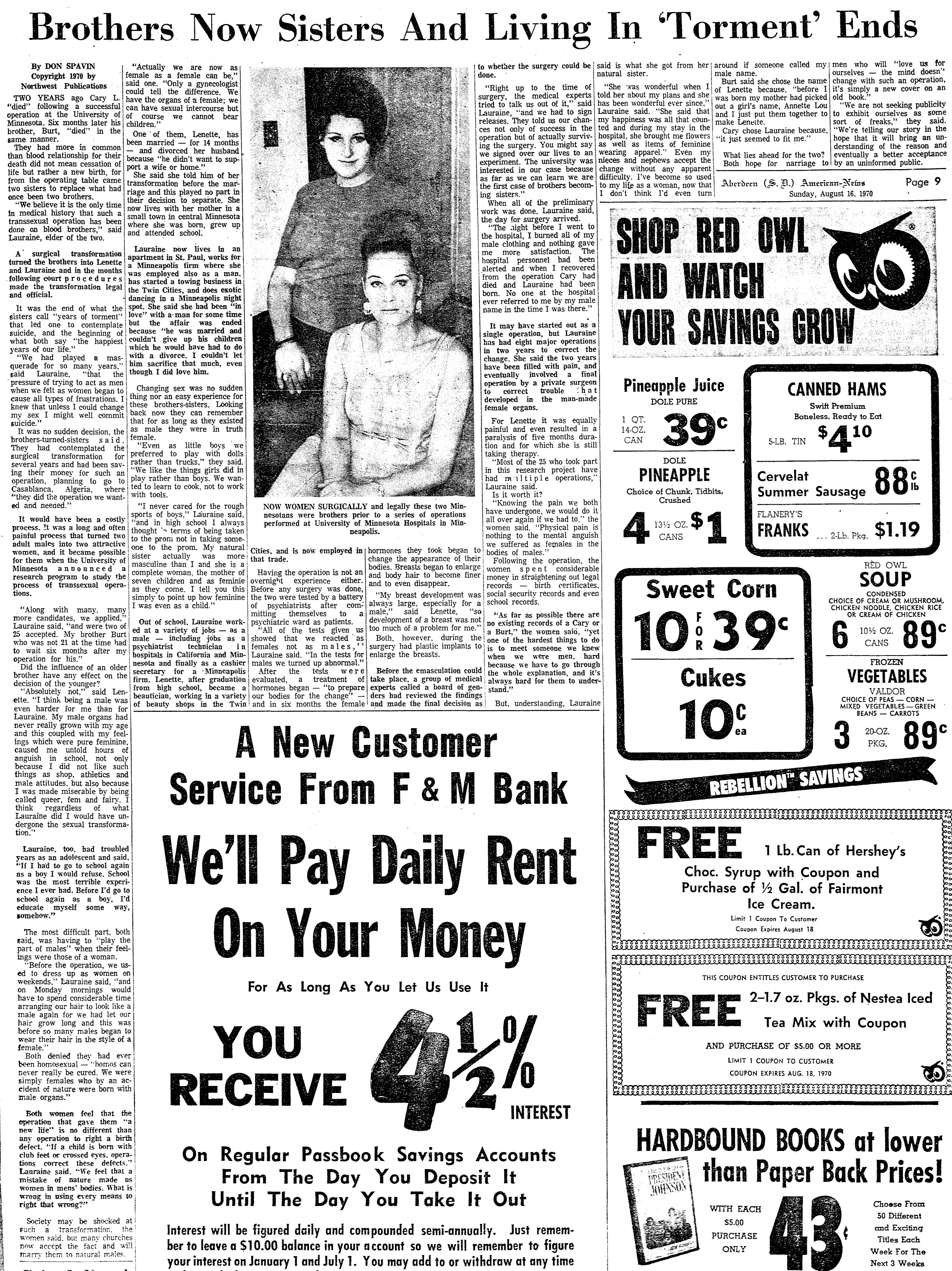
Lauraine Lee (1942 - ) & Lennette Lee (1947 - ) Minnesota pioneers

Lauraine and Lennette, siblings from a small town in Minnesota, after years of frustration and torment at having to pretend to be men, were saving in the hope of going to Dr Burou in Casablanca, when at the end of 1966, the Minnesota Medical School in Minneapolis announced a research program for transsexuals including surgery. Of course they both applied. After a battery of psychiatric tests, they were accepted and after six months on female hormones had surgery in 1968. Lenette had to wait an extra six months until she turned 21. There were post-operative complications that required extra surgeries. There was pain but they were accepted by their family. 

It was Lenette who first married. She had told her husband of her transformation before the wedding, and that was not an issue. However the marriage broke up after 14 months for financial reasons. Lauraine moved to St Paul and for a while worked as a cashier/secretary where she had previously worked before transition. In 1970 Lenette was working as a beautician. 

In 2015 Lauraine commented on the article about them in Transas City. She was then 73 and had been married to the same man for 41 years, and Lennette had had a similar long-lasting second marriage.

  • “Brothers Made Sisters in Rare Sex Operation”. Boston Record American, 28 July 1970: 5. Online.
  • “Half-sisters who used to be half-brothers”. Daily Mirror, July 28, 1970. Online.
  • Don Spavin. “Brother Now Sisters and Living in ‘Torment’ Ends”. Aberdeen, SD, American News, August 16, 1970. Online.
  • Una Nowling. “Lenette and Lauraine Lee, 1970”. Transas City, 2015. Online.
------------

The newspaper articles from 1970 spell Lennette with one N, however Lauraine in 2015 spells it with 2 Ns.

10 November 2020

Colin Markland (1929 - 2012) sex-change surgeon

Colin Markland, whose father owned a butcher’s shop in Bolton, Lancashire, won local and state scholarships to Bolton Grammar School and Cambridge University (Caius College) and trained medically at Westminster Hospital.

At age 24 he started a general practice in a small Canadian town near Windsor, Ontario with office hours twice daily, house calls, surgery, obstetrics, local hospital staff, even serving as the township medical officer. After six years he started a urology residency at Massachusetts General Hospital in Boston, followed by a year as a Post-Doctoral Fellow at the Renal Research Unit, Leeds University in the early days of organ transplantation. After being Assistant Professor at the University of Iowa he became an Associate Professor of Urology, University of Minnesota Medical School in 1964 where he worked in neurovesical dysfunction, along with the challenges of resident training. He ran a Graduate Trainee Program in Urology, with research interests involving radical cancer surgery, pediatric urology, neurologic vesical dysfunction and renal function after ischemia.

The Gender program opened at the University of Minnesota Medical School, shortly after the similar program at Johns Hopkins in Baltimore. The first Minnesota operation was done secretly but the press found out anyway. The program opened officially in December 1966. Dr Donald Creevy, the head of the urology department was in his late 60s and disinterested in such a new development. He delegated to Markland who was pleased to be given such a challenge, and became the chief surgeon on the program, sometimes assisted by Daniel Merrill who later wrote a book about the operations. Markland was under the incorrect impression that Christine Jorgensen’s operations in Copenhagen had included vaginoplasty, although it was noted that the Danish physicians had not described how to do one. But Markland, having to innovate, had given much thought to the procedure drawing on his experience doing perineal prostatectomy where the surgeon must develop a space between the urethra and prostate above and the anus and rectum below to expose the prostate gland – this is the space where the neo-vagina is formed. He intended to use the inverted penile skin to line the neo-vagina, but found it insufficient. He supplemented it with a skin graft from the right buttock. The details of Dr Burou’s penile inversion method did not become available until some years later.

The first two-dozen operations where financed by the state as a research program. Up to closure at the end of the 1970s, 41 trans women were operated on, and later 8 trans men also. This from the 300+ applications that the Clinic received each year. The most famous patient was the Mexican dancer, Shalimar.

In 1969 Creevy retired. Markland hoped to gain his position as head of the Urology Department, but Elwin Fraley, who had been junior to Markland at Massachusetts General, was appointed instead. As Fraley puts it: “Colin decided to be helpful rather than an adversary, as too often happens in these situations”.

In 1971 the Erickson Educational Foundation announced that the National American Urological Association had presented an award to Markland for a film referred to simply as “the University of Minnesota Transsexual Research Project Movie,” which he had screened at the annual meeting of the American College of Surgeons. The film followed Minnesota’s gender identity clinic five-year treatment program, giving what the newsletter called “an interim report on how well the total project is faring” and reviewing “surgical procedures and results” of its twenty-five “male [-to-female] transsexuals.

Markland gave a paper based on his work at the September 1971, Second International Symposium on Gender Identity, Elsinore, Denmark.

In 1974 Markland used bowel segments. This was the first intestinal vaginoplasty done on a trans woman (apart from Charles Wolf in 1942). This procedure was quickly adopted by Dr Laub at Stanford. John Brown also offered it later in his career, but with less satisfactory results.

Markland had lost interest in doing transsexual surgery by 1975, and passed the task to Merrill and others in the department who used his techniques.

Fraley, the Urology Department head and a political conservative, did not like the concept of sex-change surgery and questioned it repeatedly. Finally he closed it in 1979, shortly before the similar program at Johns Hopkins was also closed.

Markland spent a year as Fulbright scholar professor in Burma, followed by three years at Louisiana State University as chairman of a new training programme. After a midlife crisis he was professor at the Medical University of South Carolina in Charleston, where he stayed until retirement. Afterwards he acquired a 47 foot Wellington cutter, sailed two years from Newfoundland to South America, and several Atlantic crossings. He regarded the US Coast Guard Captains license the toughest exam ever.

Colin Markland died of a heart attack at age 83.

  • Colin Markland. “Testicular Tumors”. Current Problems in Surgery, 5, 9, 1968. 
  • Colin Markland & Daniel Merrill. “Accidental Penile Gangrene”. The Journal of Urology, 108, 1972.
  • “Symposium Highlights” and “Genetic Females, Too”. EEF Newsletter, 4,4, Winter 1971. Online.
  • “Minnesota Film Honored,” EEF Newsletter2, Summer 1972: 3. Online.
  • Colin Markland. “Complications in male transsexual surgery”. In Donald Laub & Patric Gandy (eds) Proceedings of the Second Interdisciplinary Symposium on Gender Dysphoria Syndrome, Palo Alto, Stanford University Press, 1973.
  • Colin Markland & Donald Hastings. “Vaginal Reconstruction using Cecal and Sigmoid Bowel Segements in Transsexual Patients”. The Journal of Urology, 111, 1974.
  • Colin Markland & Donald Hastings. “Vaginal Reconstruction using Bowel Segments in Male-to-Female Transsexual Patients”. Archives of Sexual Behavior, 7, 4, 1978.
  • Colin Markland & Donald Hastings. “Post-Surgical Adjustment of Twenty-Five Transsexuals (Male-toFemale) in the University of Minnesota Study”. Archives of Sexual Behavior, 7, 4, 1978.
  • David M Brown, Colin Markland & Louis P Dehner. “Leydeig Cell Hypoplasia: A Cause of Male Pseudohermaphroditism”. Journal of Clinical Endocrinology and Metabolism, 46, 1, 1978.
  • Colin Markland. “ ‘Red Alert!’ Accidental Penile Necrosis”. JAMA, 244, 11, 1980.
  • Margaret Dierdre O’Hartigan. Chrysalis, 2, 3, Spring 1996. Online. 
  • “Obituaries: Alan Colin Markland”. BMJ, 2012;345:e7448. 
  • “Obituaries: Alan Colin Markland”. ObitTree, September 2012. Online.
  • Daniel C Merrill. Trapped: The true stories of Shalimar, Linda and Jackie – transsexuals who believed they were female born in a male’s body. Xlibris, 2012: ix, 23, 26-7, 30-2, 35-6, 49, 51, 54-5, 82. Excerpt
  • Elwin E Fraley. Teaching Surgeons’ Hands to Heal: A Urological Surgical Chairman’s Chronicle: The History of the Department of Urological Surgery, University of Minnesota 1969-1993. Author House, 2014: 9, 53, 77, 140.

-------------------

Merrill in his book writes: “It also is clear that he [Markland] has no recollection of my contribution to the project other than as an assistant in some of the procedures he performed. Specifically, Dr. Markland believes that it was his idea to use the sigmoid colon to form a neovagina for our male transsexual patients. I expect that, when all is said and done, it is not at all that important whose idea it was to form a neovagina out of a segment of large intestine. It is important, I think, to document that this innovative approach to the problems inherent in the formation of a neovagina were first employed by surgeons of the division of urology at the University of Minnesota.” p49

And “I contacted him recently to fill in some of the blank spots in the narrative I was writing for this book. Dr. Markland indicates that he lost interest in the project because the transsexual patients were very demanding and because he received no compensation for the complicated and laborious surgical procedures he performed on them.” p49

Merrill claims that Shalimar was the first trans patient in the Minnesota program after it formally opened - however he also says that he fictionalized his account.

++Both Elmer Belt and Markland were prostate surgeons.   If Belt published an account of how he did transgender surgery, I have not found it.  I suspect that Marland's method was a re-invention of how Belt did it. 

17 October 2020

Three dancers in the mid-1960s who went for completion surgery

These are only snapshots. We know no more.

Zorana Pop-Simonović (1938 - ?)

Born in  Serbia, Zorana worked as a chorus girl from 1955, and then as a belly-dancer in a night club. In 1967 she was a car accident, and was outed by the doctors at the hospital. Thus out, she applied to the Yugoslav 4 government to have a sex change operation. 

  • Thomas Porter. “Car Crash 6 Uncovers a 12-Year Secret…Belly Dancer is a Man!” National Enquirer, Oct. 1, 1967.
  • TVIC, 2,23, Dec 15 1973: 5. Online.
  • Ms Bob. “Tabloids and Men’s Soft Core — Part 6”. TGForum, Sep 17, 2012. Online.

Roxanne Algeria (194? - )


  • Roxanne Algeria. “The man who became a woman: America’s Top 14 Topless Star tells All! My Sex Change … Why I Did It … My Love Life”. Confidential, 15 15,1, January 1967.
  • Ms Bob. “Tabloids and Men’s Soft Core — Part 6”. TGForum, Sep 17, 2012. Online

Shalimar (194? - )

The Ranchio Escondido in Juarez, 1964

A renowned performer originally from Mexico. She took up residence in Minnesota and was able to get in the program at Minnesota University Gender Identity Clinic. Urologist Daniel C. Merrill later took three cases including Shalimar and semi-fictionalized their stories.

  • “Latin Illusion: Shalimar”. Female Mimics: Premiere Issue, 1963: 18 12-8. Online.
  • “Shalimar … Mexico, Mexico City”. 22 Transvestism Around the World, 23 Number 1, S-K Press, 1964: 52-61. Online.
  • Daniel C Merrill MD. Trapped: The True Stories of Shalimar, 27 Linda, and Jackie – transsexuals who believed they were females born in a 28 male’s body. Xlibris, 2012. 

22 March 2010

Liz Lyons (1919 - 1991) performer.

In the 1940s Rubin Elkins, in the northwest USA, became a raunchy female impersonator under the name Lee Leonard.   She performed at Finocchio’s and the Garden of Allah

++She took up with fellow performer Robin Raye.  They toured together, but did separate acts.  However in 1958 Raye married a female stripper and they drifted apart.

+Later using the name Liz Lyons, she became a woman in 1968 at the University of Minnesota Gender Clinic.

In the mid and late 1970s Liz put out x-rated LPs, such as Up Your Ass, Live at the Club Morocco, 1975, and Liz Lyons, Live,1979. Her later stage show often included a display that she was indeed female.

* Not the Lee Leonard, a radio/TV personality, nor Liz Lyons the social scientist nor the novelist.


09 March 2009

Margaret Deirdre O’Hartigan (195? - ) activist.

Margaret O’Hartigan transitioned in Minnesota in 1979. She was on public assistance and successfully sued the State to pay for her surgery.

She moved to Everett, Washington, where she worked as a typist. She applied for a job with the State Police and discovered that only police forces and a few others may require a polygraph test asking questions to prospective employees about private matters. With the ACLU she sued the Police in 1987 on this matter. In 1989 they won, but in 1992 the Washington State Supreme Court reversed the ruling.

In the early 1990s Margaret obtained a ruling against a Seattle bisexual women’s group that excluded her because she is transsexual.

In the mid 1990s she moved to Portland, Oregon, where she persuaded the Phoenix Rising Counseling Center to include trans persons. She publicized the role the Unitarian Universalist Church had had in publishing Raymond’s The Transsexual Empire. She established the Filisa Vestima Foundation in order to collect funds to aid indigent transsexuals gain access to health care.


In 1993 she wrote:
"Every application of the term transgender to me is an attempt to mask what I've done and as such co-opts my life, denies my experience, violates my very soul. I changed my sex. Like the hijra of India and the gallae of Rome I took cold steel to myself and proved that anatomy is not destiny. Like the Siberian Chukchee shaman I have died and been taken apart, reassembled, changed sex, and come back with new powers. Like the inkte of the Mdewakanton Siouxs I grew up amongst, I have had my visions.
I am not transgender."
She helped Dean Kotula, herself and others file complaints in Oregon on the basis that they were covered under disabilities anti-discrimination laws. A newly qualified lawyer, trans woman JoAnna McNamara, successfully presented a brief with supporting theory and case law to much the same effect. This led to a squabble over the credit. Margaret put down McNamara and her client as ‘men’ who had enjoyed ‘adult white male privilege’ because they had not become women until their 40s.

In 1994 she wrote an article “The Joy of Fat” about being overweight in Dimension Magazine that was reprinted in Harper’s Magazine.

In 1996 Margaret controversially accused Jessica Xavier of racism. In the same year she received Pride NorthWest’s “Spirit of Pride Award” for her “tireless advocacy for the trans community and for trans consciousness raising with both the Les/bi/gay and general straight cultures”. She has opposed the removal of Gender Identity Disorder from the DSM in that the associated HBIGDA Standard of Care is non-abusive unlike what she was exposed to as a child, and attacked Phyllis Burke's Gender Shock which documents abusive attempts to 'cure' gender variant children as a 'transphobic' book.


In 1999 she opposed the Portland Lesbian Community Project extending its services to trans women whom Margaret referred to as ‘men’, and cited Janice Raymond as part of her argument. This article was later reprinted by the Vancouver Rape Relief & Women’s Shelter during the dispute that arouse when they rejected Kimberly Nixon as a counsellor.

Margaret contributed a chapter on Alan Hart to Dean Kotula’s 2002 book, The Phallus Palace.
___________________________

One must take whatever civil rights are available wherever you live. However I do feel uneasy about trans persons being covered under laws relating to disabilities.

Why is this woman not being saluted by the HBS people as the pioneer that she is for their cause? Partly I think in that none of the HBS websites have any historical component. They do not seem to have any interest in what persons like themselves did in earlier decades.

O’Hartigan is just as contentious as Goiar in wishing to deprive other transgender persons of civil rights; but unlike Goiar she has actually achieved something useful as well.

Willow Arune, here, says: "Now, bearing in mind that Blanchard found two distinct types, he wanted to avoid the primary-secondary terminology. It had been abused in the system, with status and bias (such as Margaret Deirdre O’Hartigan in Minnesota and then Oregon)." I have previously raised the question: does HSTS=HBS? An observer might consider O’Hartigan to be both. However I wonder what Margaret herself thinks about such jargon?