This site is the most comprehensive on the web devoted to trans history and biography. Well over 1400 persons worthy of note, both famous and obscure, are discussed in detail, and many more are mentioned in passing.

There is a detailed Index arranged by vocation, doctor, activist group etc. There is also a Place Index arranged by City etc. This is still evolving.

In addition to this most articles have one or more labels at the bottom. Click one to go to similar persons. There is a full list of labels at the bottom of the right-hand sidebar. There is also a search box at the top left. Enjoy exploring!

Showing posts with label Burou patient. Show all posts

15 May 2020

Abby Sinclair (1938 - ) performer

Sinclair was raised in Flatbush, Brooklyn. By age 14 Sinclair was starting to be perceived as gender variant, and at age 17 left home and found work as a female impersonator at the Circus Bar in Miami.  
However the club closed after two years, and Sinclair returned home, and found a sympathetic doctor who found female hormones in a blood sample.  Sinclair was then drafted, and explained the circumstances to the medical officer.  
“I was told I would get a discharge, not because I wasn’t physically fit to serve, but for psychological reasons.  I Waited four months to be processed out and then suddenly I learned that my company was being sent to Trieste.”  
An officer in Trieste was sympathetic and arranged for Sinclair to serve as a hospital orderly.

After discharge Sinclair rented an apartment in Manhattan, and found work as a female impersonator in clubs on Long Island and in the Catskills, sometimes with the Jewel Box Revue.  This was supplemented by work as a photographer’s model, usually in furs – this paid up to $70 an hour. She was by now taking female hormones, and having electrolysis to remove facial hair, and she had been told of the outstanding work of Dr Burou in Casablanca.

They corresponded, and then Abby with a female friend for support travelled to Casablanca.  The operation cost $5,000. A few weeks later, they were in Paris. Abby even had a brief fling with a count who took her to the Riviera.

Back in Manhattan, Abby became a stripper – one known to be transsexual.  In Summer 1965 Female Mimics magazine ran a photo-spread on her and announced that she was to wed a New York Lawyer.


  • Watson Crews. “Sex Change Breaks Up Old Gang of His (Hers)”. New York Sunday News, 43, 47, March 22, 1964: 1-3,26.  Online.
  • “MD’s Knife Changed my Sex”.  The National Insider, 5, 14, Oct 18, 1964.
  • Abby Sinclair, George Griffith, Carlson Wade & Latina Seville. I Was Male. Novel Books. 95 pp 1965.
  • “Abby Sinclair .. Ex-GI now a Bride-to-be”.  Female Mimics, 1, 6, August 1965: 54-63”. Online.
  • “Dear Abby: A Change is Gonna Come”.  Pulp International, Oct 18 2011. Online
  • Joanne Meyerowitz. How Sex Changed: A History of Transsexuality in the United States. Harvard University Press, 2002: 199-201.

-------

$70 in 1963 is equivalent to $580 now.
$5000.00 is equivalent to $42,000 now.

07 June 2016

Betty (?1938 - ?) female impersonator, salesgirl, model

Betty was raised in the US Northwest, one of five children. He was initially permitted to dress as a girl, but his parents divorced when he was five, and the step-father objected to the cross-dressing.

At 15, Betty was raped. At 16 she read about Christine Jorgensen and knew what she wanted. She had seen the Jewel Box Review when it came to town, and a close friend had obtained a position there as a chorus boy. After winning first prize at a local Halloween ball she sent photographs to the friend at Jewel Box Review, and got back a wire from the manager offering a job.

She grew her hair to shoulder length, which led to complications when out in male guise – this being over a decade before men began growing their hair long. After a two-month club residency, the troupe played Betty’s home town, and then she was laid off.

She asked her parents to permit that she have a sex change – she being a minor – but they refused, and at their request she visited a psychiatrist. The psychiatrist discovered what Betty already knew: she was androphilic and desperately wanted to become a woman. She continued to find find work as a female impersonator.

At age 20, after a period of despondency at not having a female body, he decided to return to being a man, cut his hair short and then volunteered to join the US Navy. He was almost rejected when the medical inspection discovered the old rape, but he asserted that he had been a victim, and was accepted. He was assigned to record keeping, and deployed to Japan, where he quickly discovered the gay bars, and then a male geisha house. Citing his female impersonator experience, he was taken on as a male geisha. She had a thrill when several of her shipmates came into the bar, but they did not recognize her. Back in the US he had an affair with a man in Oklahoma City.

One day after being honorably discharged she was back on the stage as a female impersonator. During a nine-month engagement at a “well-known club” in New York, she met two performers who had transitioned, and knew instantly that she wanted to do the same. She grew her hair again, and started going out as a woman, quite successfully even before starting female hormones. When her show went on tour, she stayed in New York to continue hormone treatment. She found another job as an impersonator-dancer at a “major nightspot”.

Late in 1961 she was invited to the table of a man, an ambassador of a Latin American country, who invited her first to have a drink, and then offered to pay for her transformation. He “took me to an internationally famous endocrinologist, whose prices I could never have afforded”. She also underwent electrolysis to eliminate her facial hair.

A year later, July 1962, she was ready for surgery, and the ambassador arranged a trip to Casablanca. In Paris she was joined by another impersonator making the same journey. The cost at the Casablanca clinic was US$1250. The operation apparently went well. However a week later when she was back in Paris, she suffered continual vaginal bleeding, and went to a US hospital. A week of douching fixed the problem. On return to the US, Betty felt obliged to explain to immigration why she had only female clothes in her suitcase: that she was a professional female impersonator.

For a few months she worked as a prostitute, “to prove to myself that I was really a woman”, but then found such work distasteful. She worked as a salesgirl, and as a fashion model. She finally won acceptance from her mother and step-father. She started writing, with the aid of professional writer, her autobiography. During the mid-1960s she acted as a confessor and adviser to other transsexuals in the city.
  • Harry Benjamin. The Transsexual Phenomenon. Julian Press, 1966. Warner Books Edition 1977: 239-255, 308-313.
________________________________

The Transsexual Lives Appendix to Harry Benjamin’s book by REL Masters says that “Betty” is a pseudonym, although she uses it for herself in her autobiographical segment. Other than that we do not have a name for her.

It is a problem for the historian that Betty does not give the name of the clubs where she works, or the doctors that she went to, although the “internationally famous endocrinologist, whose prices I could never have afforded” is obviously Benjamin and the surgeon in Casablanca is obviously Dr Burou. If there is any information about her after 1966, it is not found in that we do not have her name. Is the “well-known club” in New York the 82 Club?

Jan Morris also had need of further medical attention after returning from Dr Burou’s clinic.

One wonders if the unnamed ambassador asked for anything, sexual of otherwise in return. However we have come across another rich man, Rex/Gloria who paid for younger trans women to go to Dr Burou without such requests.

The information about Betty is in two parts. An excerpt from her unpublished autobiography, and a clinical overview by Masters. Despite having her account to consult, Masters is sloppy with facts. He puts her first attempt at surgery, which was vetoed by the parents, before the first period of working as an impersonator; he says that Betty joined the Army rather than the Navy. Also he continues to refer to Betty as ‘he’ even after surgery.

We have no information about Betty after Benjamin's book in 1966.

14 March 2016

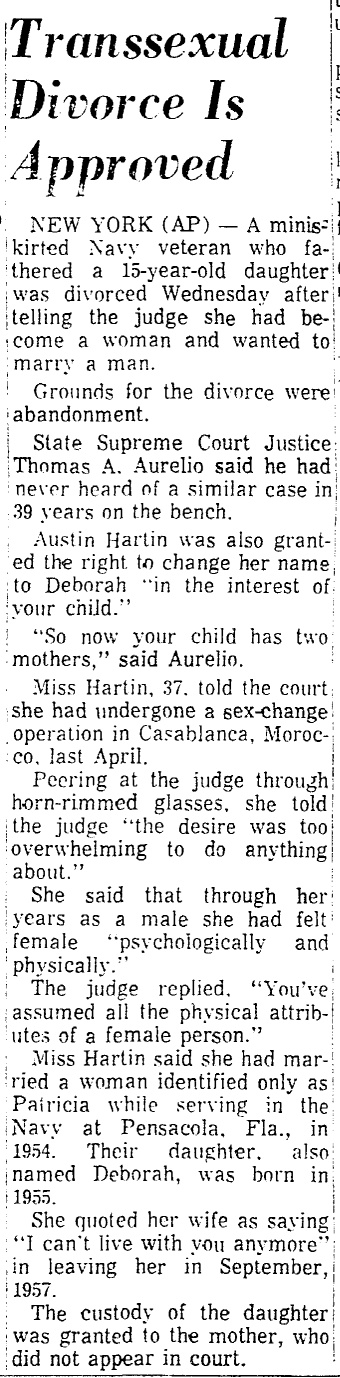
Deborah Hartin (1933 -2005) sailor, activist

The AP wire photo of Debbie
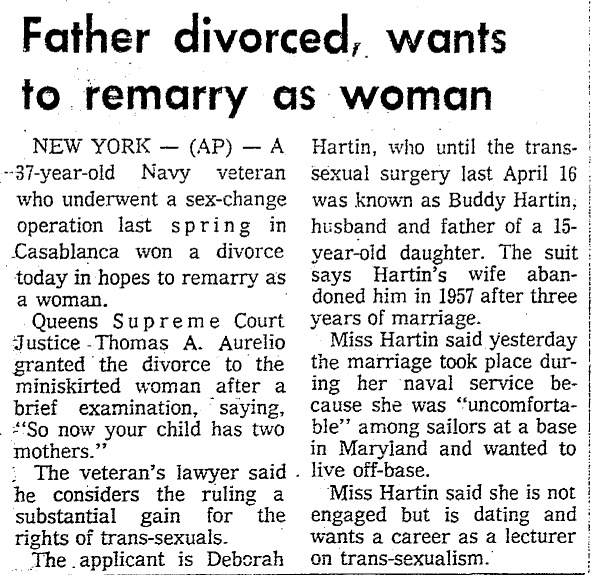
Austin Hartin joined the US Navy in 1953. He married while serving in Florida the next year. Later Hartin would explain that he married to escape from having to live in the all-male environment on the navy base. A daughter, Deborah, was born a year later. The Hartins separated in 1957.

Hartin became a patient of Leo Wollman, and then had surgery from Dr Burou in Casablanca, April 16 1970. She was granted a divorce later that year from the wife not seen since 1957. A name change to Deborah Hartin was also granted. The mother retained custody of the daughter. The case attracted press attention as it was one of the first divorce cases where one party had transitioned.

In 1971 Debbie was featured on local cable television and in Screw magazine. Both appearances included a clear view of her vagina. Later, in March the Queens Liberation Front presented themselves in a class on homosexuality at New York University, where Debbie also spoke. Later Debbie spoke about her problems with ‘her family, her neighbors and her daughter’ at a meeting that was supposed to be the inaugural meeting of Transsexuals Anonymous held at the office of Dr Benito Rish.

That same year she was on the New York David Susskind Show, and later was filmed being interviewed and examined by Leo Wollman. Again this examination included a close-up of her vagina. The segment was eventually incorporated in the 1978-released film Born A Man... Let Me Die A Woman. She was living with her parents at that time.
from Let Me Die a Woman

Deborah had been able to get her name and sex changed on her baptismal certificate and certificate of discharge from the navy. She applied to get the same changes on her New York birth certificate. The name was changed but sex left blank. The Bureau of Records had adopted a committee report in 1965 to omit a sex designation from amended birth certificates for transsexuals. This had been tested legally but unsuccessfully in Matter of Anonymous v. Weiner, 1966. This was re-inforced by an amendment to the New York City Health Code which was adopted unanimously in 1971 that a re-issued birth certificate for a transsexual should not indicate the applicant’s sex. Nevertheless Deborah sued the Director of the Bureau of Records in 1973 in that she was not issued a revised birth certificate saying ‘female’ and that this was arbitrary and capricious and constituted an abuse of discretion. However the court denied her suit ruling that the Board had acted in a rational manner and made no error with regard to their own rules. They cited the 1966 precedent.

In 1976, Jude Patton and Deborah were guests on the syndicated The Phil Donahue Show.

Deborah died age 71.
  • “Father divorced, wants to remarry as woman”. Seattle Daily Times, October 7, 1970: F1. Online.
  • “Transsexual Divorce Is Approved”. Mobile Register, October 8, 1970: 7F. Online.
  • Heidi Handman. “He Ain’t Heavy, He’s My Mother”. Screw, 109, April 5, 1971: 4,center spread.
  • Drag, 1,3, 1971: 10. Online
  • Garry Pownall, “AV View”. New Scientist, 54, 793, 27 April 1972: 221. Online
  • Hartin V. Dir. Of Bur. Of Recs. Supreme Court, New York County, August 3, 1973. Online
  • Doris Wishman (dir). Born A Man... Let Me Die A Woman. Hosted by Leo Wollman, with trans persons Deborah Harte, Leslie, Lisa Carmelle, Ann Zordi, and porn stars Harry Reem, Angel Spirit and Vanessa del Rio. Scientific and medical advisor: Dr Leo Wollman. US 78 mins 1978. Debbie is featured from 90-100 minutes.
  • M.J. Lucas. Let Me Die A Woman: The Why and How of Sex-Change Operations. New York: Rearguard Productions. 1978: 22-4.
  • Joanne Meyerowitz. How Sex Changed: A History of Transsexuality in the United States. Cambridge, Ma, London: Harvard University Press, 2002: 202, 236, 249, 278.
  • Samuel E Bartos. “Letting "privates" be private: Toward a right of gender self-determination”. Cardozo Journal of Law and Gender, 15,67, 2008. PDF

EN.Wikipedia     IMDB

__________________________________________

Deborah is the only trans woman that I have come across who took her daughter's name.

16 February 2016

Capucine (193?–) performer

Original March 2007.

Capucine was a performer at Le Carrousel and was frequently mentioned along with Coccinelle and Bambi.

Capucine and Coccinelle

April Ashley comments:
"Anyway, Capucine's heart was pierced by a conflict: the ancient sugar-daddy and luxury, or the young blades and penury?  Of course the luxury always won in the end because Capucine's keeper was a very famous millionaire, enabling Capsy to compete with and overtake Coxy's mink collection.  But unlike Coxy, Capsy wanted to be 'a lady' as well.  This put him into agonising quandries when he fell for a bricklayer or a road-digger (which was frequently, because Capsy couldn't resist the boue)."
In 1960, the same year as Bambi and April, Capucine went to Dr Burou clinic in Casablanca for surgical completion.

In 1961 she starred in the Amsterdam extension of Madame Arthur. In 1963 she was part of the first Le Carousel tour of Japan. She also performed at Le Boeuf sur le Toit in Paris.

*Not the French film actress.
  • Vittorio Sala (dir).  I don giovanni della Costa Azzurra.  With Curd Jurgens, Coccinelle and  Capucine.  Italy 98 mins 1962.  IMDB
  • “Capucine”. Female Mimics,1,6, August 1965: 27-37. Online.
  • Duncan Fallowell & April Ashley. April Ashley's Odyssey. Jonathan Cape, 1982: 67-8. Arrow 1983. Online.
_________________

Capucine is the French word for the nasturtium flower.

Unlike Coccinelle, Bambi and April Ashley, Capucine never published her autobiography. We don't even know where she came from. Is she Parisian? Nor, what happened to her after the mid 1960s. The Female Mimics article is mainly photographs with content-less text. There is an obvious comparison to Hans Crystal who was in also a star female impersonator at the 82 Club, had her surgical completion in the mid 1960s, and likewise disappeared from view.

There is a confusing tradition among drag performers of taking the name of an established cis star. Germaine Lefebvre was an established French film star from the early 1950s using the name Capucine. Other drag performers to take an established name include Lynne Carter who took his name from the 1940s actress; Murry Pickford , was not Mary Pickford); Gloria Swanson (who was a big name in Chicago and New York drag circles in in 1920s, but not the Hollywood actress): Jean Malin who performed drag under the name of Imogene Wilson, one of the most famous of the Zeigfeld Follies showgirls otherwise known as Mary Nolan; Helen Morgan who used the name of the famous torch song singer; Brenda Lee the Brazilian activist who was not the country singer; and Bibíana Fernández, the transgender actress who used to be known as Bibí Andersen, only two letters away from the name of the Swedish actress Bibi Andersson.

Both IMDB and EN.Wikipedia claim that the Capucine in I don giovanni della Costa Azzurra (Beach Casanova) is the other Capucine, Germaine Lefebvre (1928 – 1990). This conflation went so far that after Lefebre took her life in 1990 by jumping from her eighth-floor Lausanne apartment, some actually said that she did so because she was transsexual.  !!!

For some reason, Capucine is not mentioned at all in April Ashley's second autobiography, The First Lady.

05 January 2015

Jo Shanley (1936 - ) machinist

Joseph Shanley of Billerica, Massachusetts, had felt since childhood that he was the wrong sex. In 1969, at age 33, Shanley went to Casablanca and had surgery with Dr Burou.

However on return Shanley continued dressing as a man to keep his job as a machinist. Shanley dressed and lived as Jo outside work.

Shanley retired in 2001, and with her sister, Ann Cavanaugh, bought a house in Claremont, New Hampshire. After a few weeks, it was apparent that the arrangement was not working, and the house was put back on the market. On October 4th three real estate agents and two prospective buyers heard gunshots, found Shanley apparently intoxicated, and Cavanaugh dead on a bedroom floor.

Joseph Shanley was arrested, pleaded guilty to second-degree murder, and was sentenced to 22 years to life. Shanley also filed a motion to be declared a woman. The state attorneys objected to the motion on procedural and jurisdictional grounds in that the court had no power to make such a ruling.

However, after Shanley's physical state was confirmed, the prosecutors were agreeable that she be placed in a Connecticut prison with a special transgender unit. A year later she was transferred to the Correctional Center for Women, in Purdy, Washington.
__________________________________________________________

There are unanswered questions.   Was the sister unaware of Jo’s womanhood?   If not, what was Jo thinking in agreeing to share a house?  Shanley was presenting as male at the time of arrest, even though she had retired and moved to another town.

05 November 2013

Jan Morris (1926 - 2020) Part 2: transition and empire

Part 1: youth and journalism.
Part 2: transition and empire.
Part 3: travel writer.

Morris investigated transsexualism. One winter evening in Ludlow he found a half-price copy of Lile Elvenes (Elbe)'s Man into Woman, and "with what agonies of embarrassment" bought it. Morris also read Robert Stoller, an unspecified account of Charlotte D'Eon and one transsexual novel: Geoff Brown's I Want What I Want.
"I trod the long well-beaten, expensive and fruitless path of the Harley Street psychiatrists and sexologists, one after the other, getting their names from their published works, or being passed from one to the other. None of them in those days, I now realize, knew anything about the matter at all, though none of them admitted it."
Morris was one of thirty cases featured in Georgina Turtle's Over the Sex Border, 1963. In 1964 Morris was in New York and visited Harry Benjamin, who advised him that a change of body must be a last resort, and that he should try working life as a man. Shortly afterwards Morris obtained an appointment with a London endocrinologist who said:
"What it would do to your personality or your talent, we cannot say. It is a grave decision to take, but it must be your own. You do know what you are doing?"
Morris returned to Venice with a box of oestrogen tablets, but considered the advice of both men and flushed them down a lavatory. However a subsequent prescription from Dr Benjamin he did take.

During this time Mottis was preparing a Empire trilogy, Pax Britannica.

With the support of Elizabeth, Morris lived as a woman in Oxford, but travelled the British Empire androgynously, sometimes being taken as male, and sometimes as female. Jan was issued a new passport 'without any indication of sex at all'.

Word of course got around. Morris' old tutor at Christ Church College had heard from a colleague at Harvard before being told directly. Some in London knew of Jan but others only of James. Private Eye magazine jested that if Morris were invited to a function 'dressed informally', it was Jan who was expected. At their other home in Pwllheli, Gwynedd in North Wales, Jan and Elizabeth presented as sisters-in-law to explain why two women had the same surname.

The first volume of James' trilogy, The Climax of Empire, was published in 1968 to mixed reviews but commercial success. In 1971 Morris was invited to write a short book on the Cascade Mountains and she and Elizabeth travelled by boat and car along the range being accepted as two women.

However "The book was still-born, all the same, for in Chapter Three the publishers discovered my unquenchable antipathy to the Douglas Fir".

Jan had been accepted in the program at Charing Cross Hospital Gender Clinic, but it was insisted that Jan and Elizabeth be divorced before surgery.
"I saw his point, for he could not know the nature of the relationship between us. And indeed I recognized that we must be divorced in the end. But after a lifetime of fighting my own battles I did not feel in a mood to offer my destiny like a sacrifice upon the benches of Her Majesty's judges. Who knew what degradations we might both endure? What business was it of theirs, anyway?"
Jan completed transitioned to Jan in 1972 at age 46, with two weeks in the clinic of Dr Georges Burou in Casablanca. She was in his clinic the same time as Carol Riddell.
"Dr B--'s craftmanship, though aesthetically brilliant, was functionally incomplete, and I underwent two further sessions of surgery in an English nursing home."
She commented on being a woman:
"I don't feel it incumbent on me to read Kate Millet and Germaine Greer. I like being a woman. But I mean a woman! I like having my suitcase carried. I like gossiping with the lady upstairs. If Elizabeth would let me, I'd be wildly extravagant about clothes, though I must say I'm not much interested in cooking. Never was. And yes, I like to be liked by men."


______________________________________________________________________________

Morris' comment that she needed further surgery on return to the UK is very imprecise. Does it mean that Burou's technique was not as good as we are told in other autobiographies?

The statement that Jan was issued a new passport 'without any indication of sex at all' means less than it appears.  I was granted the same privilege 16 years later.   The old pre-European-Union UK passports had no 'sex' box to be filed with either 'F' or 'M'.  Sex, or gender as we would now say, was merely implicit from the person's honorific: Lord, Lady, Sir, Dame, Mr, Mrs, Miss.   Despite the ruling in Corbett v. Corbett, the UK Passport Office dealt with transsexuals by simply not putting a honorific.   Incidentally doctors (PhD or MD) were issued passports that said Dr and were therefore gender neutral if the person's name and photograph permitted.  This is a much better solution than the new fashion in the 2010s of issuing a passport with gender=X.

23 September 2013

Nana (1939 - ) sex worker, performer. housewife, Place Blanche , Paris circa 1960


Nana was raised in Oran, Algeria. In 1955 she met Bambi and others in the Le Carrousel cast who were on tour. Nana realized instantly that was what she wanted to do.

There was a roundup of the queers in Oran in August 1957. However Nana had already left as her brother had told her that their parents had intended to have her locked up with the Ain Sefrah White Fathers, a Catholic order.

Nana arrived in Paris 5 August 1957, presenting as male but having already started female hormones. Nana and a friend took a room at the hotel Fairyland. The friend knew Fetiche who was a performer at Chez Madame Arthur, and Nana sewed for her in addition to working in a travel agency.

Nana's mother turned up in 1958 and took a room in the same hotel. She intended to take her son back to have him locked up by the White Fathers. However a flare-up in the ongoing War for Independence closed all the Algerian airports. Mother was able to get herself home by phoning the secretary of a minister whom she knew. Only one seat was available.

Nana was increasingly dressing as female. She left the travel-agency job, and met the Swedish photographer  Christer Strömholm.

She started to solicit in the Place Pigalle. The pimps at that time left the trans women alone for they would lose status as a man by pimping them. The police frequently arrested the trans women and charged them with being dressed as a woman outside the carnival period. As she was from Algeria she was called a 'dirty Arab'.

One summer Nana and a friend went to the South. Nana was arrested in that her ID card said that she was a man. The policeman even paid for a barber to cut her hair, and then she had to hitchhike back to Paris looking like a man in women`s clothes as those were the only clothes that she had.

In 1959 Nana created an act and obtained work at le Fifty, a cabaret on rue Fontaine. She worked in Cabarets until she was 45, but also kept working the streets.

One time a pimp slapped her and claimed that she owed 5,000 Fr for working on 'his' territory. Nana had to go and see the local godfather, and argue that she was not a woman.

Through Christer Strömholm, Nana was introduced to several artists. In 1970 Nana moved to Luxembourg to live with a boyfriend. In 1972 she had surgery with Dr Burou in Casablanca; in 1977 she met a lawyer in Lyon who was able to effect her change of Civil Status, and her name became Eva. She and her boyfriend were married in 1980.

  • Hélène Hazera interviews Nana. "Aujord'hui Nana Se Raconts". In Christer Strömholm. Les Amies De Place Blanche. Stockport: Dewi Lewis, 2011: 50-9.


Nana 1959

03 August 2013

Marcella Di Folco (1943 - 2010) film actor, activist, councillor

Marcello was raised in Rome. After school he worked as a porter at the Hotel Rivoli, and then from 1965 at the Piper Club.

In 1969 Di Folco had to deliver a letter to the Cinecitta film studios, where he was spotted by director Frederico Fellini and given a part in Fellini Satyricon. From then till 1980 Di Folca appeared in several more Fellini films, and even more films by other directors. He was credited as Marcello Di Falco (actually the originally spelling of the family name).
Cross-acting as the Prince in Amarcord, 1973

In 1980 Di Folco did what she had wanted for many years and had transgender surgery with Dr Burou in Casablanca. On return Marcella worked as an intercontinental operator for Italcable.

Marcella 1999
She became an active participant in the newly founded Movimento Italiano Transessuali which achieved legal recognition of changed gender two years later. In 1986 Marcella moved to Bologna where MIT had its headquarters, and two years later became its president. In 1990 Marcella was elected to the Bologna City Council, and again from 1995-9.

In 1994 MIT opened in Bologna the world's first gender identity clinic managed by transsexuals. In 2000 she persuaded the Equal Opportunities Minister to set up a Gender Identity Commission.

In 2001 she was a Girasole (Sunflower, ie Green) list candidate. In 2004 she was Communist candidate for the European Parliament and for the Provincial Council of Bologna. In 2006 she was a Green Candidate for the Senate.

Marcella died aged 67 of a tumour.

A Bologna street has been named in her honour.
LIBEROCINEMA     IT.WIKIPEDIA    IMDB     WIKIPINK

The Italian sites claim that Marcella was the first open trans person elected to a city council.  Not to diminish her achievement, but Rachel Webb was elected to Lambeth Council in 1986, and Mark Rees to Tunbridge Wells Borough Council in 1994.

11 July 2013

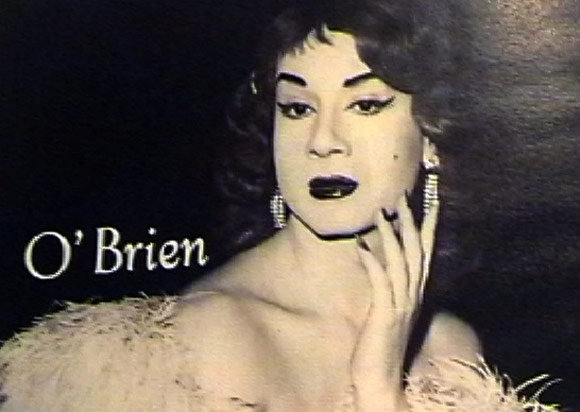
Giorgia O’Brien (1928 - 2004) singer, actor.

Giorgio Montana, born in Palermo, Sicily, was keen on singing and spent eight years in amateur choirs. He had the unusual ability to switch between baritone and soprano. He was almost accepted at the Accademia Nazionale di Santa Cecilia in Rome, but a man who could sing soprano did not have the respectability then required.

He worked in Germany and France, often en travesti. One of his co-workers was Coccinelle. On return to Italy he became a star of the avanspettacolo, and performed at Rome's Teatro Ambra Jovinelli, singing both pop and opera.

In 1970 Giorgia completed transition with De Burou in Casablanca. She changed her surname to O'Brien in homage to Margaret O'Brien who played Beth in the 1949 version of Little Women.

Giorgia worked three years at Milan's Teatro Piccolo, and collaborated with Franco Zeffirelli and Guiseppe Bertolucci. The latter cast her in his 1979 film, Oggetti smarriti. Giorgia was noted for her rendition of Wagner's Ride of the Valkyries wherein she sang both Brunnhilde (soprano) and Wotan (bass).

In 1985 she and Christine Jorgensen were featured in the Danish documentary about transsexuals, Paradiset er ikke til salg. 

In 1991 she was cast as the wife of the minister in Johnny Stecchino in 1991. In real life she became the wife of Georges Argand.

In 1998 she revived her half-man-half-woman act.

Giorgia died at the age of 76 after a short illness. Her husband died shortly afterwards.
IT.WIKIPEDIA    IMDB


26 May 2013

Jacqueline Galiaci (194? - ) 1st Brazilian to have gender surgery

Jacqueline is the first known Brazilian to have transgender surgery, which she had from Dr Burou in Casablanca in 1969. This was two years before the first surgery in Brazil, that on Waldirene Nogueir by Dr Robero Farina.

She requested the addition of 'Jacqueline' in the margin of her birth registration. The Magistrate authorized both this and the registration of her female sex.

Jacqueline's entry was deleted from the official PT.WIKIPEDIA in 2008. http://pt.wikipedia.org/wiki/Wikip%C3%A9dia:P%C3%A1ginas_para_eliminar/Jacqueline_Galiaci.

24 May 2013

Jean Lessenich (1942 - ) artist

Lessenich, from Remagen, was educated in graphic design in Cologne. After a failed marriage and a period as a prostitute, she completed transition in 1973 with surgery from Dr Burou in Casablanca.

This was at a time when advertising was trendy and sexy and Jean obtained work as art director for advertising agencies in Dusseldorf and Frankfurt, and later as a freelance illustrator for magazines in Hamburg and Munich.

Through friends she was able to make extended trips to Japan and to visit Native Americans. In 1985 she returned to living as a man so that she could marry her Japanese lover and obtain for her permanent residency in West Germany. Her lover died in 1996.

Jean returned to being female. Now in her seventies, she continues to participate in art exhibits.

She does not identify with the idea of a female soul in a male body, or say that she always was a woman, although she did want to be a girl when young. She chose Jean as a name in that it is male in French and female in English.
  • Jean Lessenich. Nun bin ich die ewig junge Hirschkuh oder der Ajilee Mann. Edition Suhrkamp 1988.
  • Jean Lessenich. Mit den Zähnen am Zweig. Selbstverlag 200.
  • Jean Lessenich.Die transzendierte Frau. Eine Autobiografie. Gießen 2012, Psychosozial-Verlag.
  • Andrea Bronstering. "Die transzendierte Frau: Eine Autobiografie: Amazon.de". Transgenderradio Berlin, 2012. http://am-toerichten-bach.de/blog-2/index.html.
  • I Am a Woman Now. Michiel van Erp (dir) with April Ashley, Marie-Pierre Pruvot, Colette Berends, Jean Lessenich, Corinne van Tongerloo. Netherlands 80 mins 2011.
  • Am törichten Bach: Die Stimme des Tales ist Buddhas weite und lange Zunge. http://am-toerichten-bach.de.
DE.WIKIPEDIA

02 March 2013

Rex/Gloria (190? -1970) businessman

Rex, of Clarion, Pennsylvania, became a millionaire early in life. He married several times, and had a large alimony bill. He was 6'4" (1.9 m). In the early 1960s a stroke partially immobilized his face.

 A keen cross-dresser, he felt that he was too old for surgery, but enjoyed the presence of younger trans women. As Gloria, he networked through Transvestia, and was featured in the February 1963 issue. Katherine Cummings recorded her visit to his estate later that year.

From that time until his death, Gloria sponsored young trans women, took them into his house, paid for them to go to Dr Burou's clinic in Casablanca, and other expenses. Gloria called this his Girl Factory. He also had a home in the Hollywood Hills, California, and networked with the trans scene there.


  • Lillian Faderman & Stuart Timmons. Gay L. A.: A History of Sexual Outlaws, Power Politics, and Lipstick Lesbians. New York: Basic Books, 2006: 114-5. 
  • Robert S. Hill. ‘As a man I exist; as a woman I live’: Heterosexual Transvestism and the Contours of Gender and Sexuality in Postwar America. PhD Dissertation. University of Michigan. 2007: 157, 415.
  • Kate Cummings. Katherine's Diary - the Story of a Transsexual. William Heinemann Australia 1992. Revised and updated 2008: 154-6.

16 August 2012

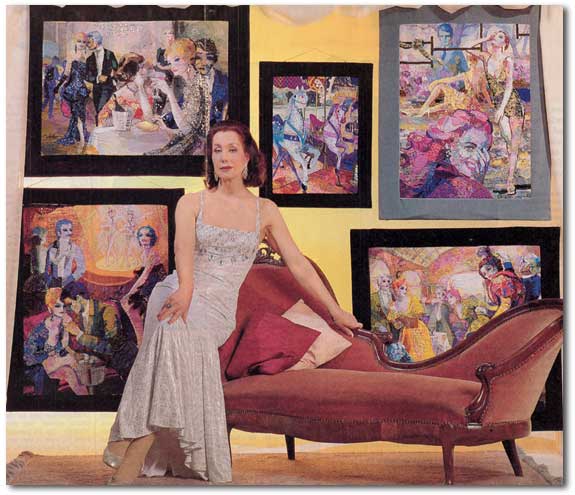
Colette Berends (1934 - 2012) performer, beautician, fabric artist.

Berends was raised in Zwolle, Overijssel, Netherlands. After a few years of window dresser, she went to Amsterdam and found work in a nightclub as a travestie, and later appeared at Madame Arthur in Amsterdam and Paris.

She had breast augmentation in 1956, and made the transition to regular night clubs, and sang and danced in clubs all over Europe and North Africa. She completed transition to Colette with surgery from Georges Burou in 1971. Two Moroccan gynaecologists certified that she had all the external characteristics of a woman. Three months later, with the help of the noted endocrinologist, Dr O de Vaal, she was able to have her birth certificate re-issued.
“Some people said: the most remarkable fact is that you remained precisely the same person, but now it looks more natural. Indeed, I remained the same. Some transsexuals totally reject their past. They tear apart old photo albums in order not to be reminded by the past. However, I have also lived before my surgery and in some way I was happy too. This is not bothering me too much. I am as I am, I do not impose anything on myself. Sometimes they say: as a woman you have to behave such and such. Nonsense. Even should I have a male characteristic. I don’t know if I have one - then it is like that and that makes me not unhappy.”.
She continued as a performer until she was 48. This gave her the money and the time to take holidays all around the world. Colette then returned to Zwolle, despite the fact that she and her past were known there. At first she opened a beauty salon, but became known for her artistic work with tapestries, for which she has won many awards.

She spent the last 30 years of her life with the same boyfriend, Ton. She died at age 77.
TS Successes

01 September 2011

Jenny (192? - ?) electrician, Burou’s first transsexual patient.

A nightclub electrician who worked in Nice had approached Coccinelle and Bambi when La Carrousel performed there in the mid-1950s. Bambi noted how feminine he was even then.

As Jenny, the electrician approached several gynecologists seeking a correction of her birth sex, but with no success until she approached and pestered Dr Burou in Casablanca in 1956. Burou developed a technique to create a vagina using a live graft taken from the penile skin, and was able to give Jenny what she needed. As it was the first time that he had done such an operation, it was pro bono.

In 1958, Jenny again approached Coccinelle on her return to Nice:
“Shortly before, I was still in Nice. In the lobby of the Negresco, a young woman approached me: "Do you remember me? " she asked me point blank. I saw so many faces that it was almost impossible to remember them all, but I do not like to offend people, so faithful to my habit, I replied: "Yes ... at least I think ... It seems ... “. In general, the person undertakes to revive my memory, and everyone is happy. But instead of the expected scenario, my stranger bursts out laughing: "That would surprise me very much! She says. That would be a miracle!” And then, just to explain, spoke to me of a young electrician who visited me in my dressing room during a previous tour in Nice with intent to sell me some disks: she was that boy ...I nearly fell over backwards! Now I could see very well the young man in question: so thin, so frail ...
How could he have become this beautiful woman? "I had an operation" she told me simply. Then Jenny - it was her name - showed me obligingly her anatomy transformed: her beautiful female sex, her breasts harmoniously developed ... I was dazzled, I hardly dared believe it! So everything about what I have always dreamed, everything could become reality.”
Coccinelle and her colleague Pamela applied to Dr Burou, and also became women. And were followed by Bambi, April Ashley, Amanda Lear and Capucine.

10 July 2011

Karūseru Maki カルーセル麻紀 (1942–) performer.

Hirahara Tetsuo 平原 徹男 was born in Kushiro, Hokkaido.  His father, a veteran of the Greater East Asia War, named him Tetsuo=Iron. Nonetheless, Tetsuo developed feminine interests.

He was trained as a ballet dancer, and at age 11 appeared in New York City Ballet Company production of The Nutcracker Suite in Los Angeles.

At 15 he ran away and worked in a gay bar in Sapporo, and then in Carrousel in Osaka. She had castration at age 19 and become a woman Hirahara Maki 平原 麻紀, and performed as Karūseru Maki (Anglicized as Carousel Maki), a name she took from the gay bar in Osaka, which in turn was named in homage to the Le Carrousel tours of Japan in the 1960s.


She had final surgery from Dr Burou in Casablanca in 1973.

She has acted in 11 films since 1969, and is a well-known nightclub performer.

In 2001, she was arrested for possession of drugs, and spent 41 days in a male jail because the family registry still listed her as male.

In 2002 she published her autobiography. Finally in 2004 she was able to be recognized legally as female under the new laws.

In 2006 her home was burgled and ¥8 million-worth of jewellery and ¥3 million in cash was stolen.
www.carrousel.co.jp    JA.Wikipedia      IMDB.

04 July 2010

Michael Brinkle (1951 - ) performer, sex worker, waitress.

Michael and his elder sister were left at the Baptist Children’s Home in Memphis, Tennessee when he was three. He was sexually abused in the home and later in the scouts. He and his sister were adopted by the same parents when he was nine. Michael had been called ‘Butch’ at the home, and his new parents continued this.

When he was 18 he ran away to Baltimore because he had heard about sex changes at the Johns Hopkins Hospital. He worked in a restaurant, and started going out in drag. He found Inferno, the local drag bar. Kelly, a cis woman stripper, had him move in as a roommate so that her boyfriend would not come back.

Michael became Michelle, became a dancer and turned tricks. She went to New York for silicone injections. She never did register at Johns Hopkins. Another trans woman told Michelle about the operations in Casablanca, and together they applied for passports, but had to make a scene at the Passport Office before they were given the application forms. They flew to Casablanca, but Dr Burou didn’t want to perform on Michelle as she was only 19, but eventually after her pleading he took her $2,000 and did so.

On return, Michelle phoned her mother and let her know what had happened. The mother came to accept her second daughter, but still called her Butch. Michelle also had to report to the draft board where the doctor made her disrobe where others could see.

Her first lover was AWOL from the army and already married. They visited each other’s parents but he was constantly chasing other women, until she tired of that and left him.

Michelle and Kelly worked together as exotic dancers. Only some years later did Michelle have electrolysis, to remove her light beard growth, and legally change her name. She married Kelly’s brother, Frank, in Chicago, who did deals and petty crime and was very jealous. She left him and went to Hawai’i where she got a job in a nightclub. Frank somehow traced her, and brought her home at gunpoint. They moved to Memphis. He pulled a job in the club where she was working, and after a few more robberies was arrested. She stayed by him the two years he was in prison. They then separated by mutual consent. Frank later got 12 years for shooting and wounding a policeman.

Michelle stopped taking female hormones because they were increasing her weight. At age 28, with her parents encouragement, she went to beauty school and qualified as a cosmetologist.

The next year she read the Bible and decided that her life was wrong in eyes of God. As Michael, he had his breast implants removed. He still has a high voice and is still sometimes addressed as ‘ma’am’. He joined a church and told of his past, and was accepted. He kept in touch with both Kelly and Frank for some time, but finally drifted away. He attended his mother’s funeral as Michael in 1987, and his father’s in 1994.

In 2006 he published his autobiography.
  • Michael Brinkle. Return to Michael: A Transgender Story. Lincoln: iUniverse. 2006.
________________________________

Other than his own autobiography, I am unable to find any information about Michael Brinkle.

On p38 Michael tells: “A so-called doctor came to town [Baltimore] every so often pumping the girls and trans-genders full of silicone.  We called him ‘Dr Plastic’.  He mixed the silicone in the bathtub!  Rumors were going around that he used ‘Turtle Wax’! No, he didn’t finish us off with a buff cloth either!  He was later arrested and put on trial for killing that trans-gender.  Kelly was supposed to testify against him but she started getting death threats over the phone.”     This would be about 1970, a year after Stonewall.  The Johns Hopkins Gender Identity Clinic was still operating.  Can anybody identify this so-called doctor?

The book is 63 pages of text.  It is then followed by 40 pages, 40 photographs all of Michael before he ran away to Baltimore.  The only photograph of Michelle is that on the front cover.  No photographs of Michael after 30 are provided.  Nor does Michael tell us how he made a living after returning to being Michael.

On p40, there is a remarkable apology:  “Could I stop here a moment and confess something else in my memories?  I’m really ashamed to admit today that most of the men I had sex with didn’t have a clue about my real story.  I think that it must have been an inner desire to get revenge on the whole male population for the abuse that they gave me.  To this day they probably still don’t realize that they had sex with Michael and not Michelle.  At the time it was thrilling for me to know that they had no idea that they were enjoying sex with a man but in their own minds were having sex with a woman.  I really wasn’t in my right mind, was I?”   ----- I think that most of us will disagree with this paragraph.  Michelle thought that she was not a real woman, which partially explains why she changed back.

Michael thinks that being sexually abused and the absence of his biological father explains his trans nature.  If this were so, there would be many more transsexuals.

26 March 2009

Jacqueline Charlotte Dufresnoy (1931 - 2006) performer.

Jacques Charles Dufresnoy was born in Paris, but his family moved to Marseilles when he was a teenager. He was given the name ‘Coccinelle (ladybird)’ when he wore a wore a red dress with black polka dots to a party.


Jacques was discharged from the army conscription after six days because his presence caused disruption. He took to wearing female clothing to escape constant comments on how feminine he was. From 18-25 Coccinelle was kept by an important politician, whose name she always kept secret.

She became a star at Chez Madam Arthur, where her mother sold flowers, and then Le Carrousel de Paris in the 1950s, where she worked with Bambi , with whom she shared a home, Toni April (the future April Ashley) and Peki d’Oslo (the future Amanda Lear). Word was put out that she was a real woman. Others said 'A woman as beautiful as Coccinelle can only be a man'.

She took hormones from 1952 and became a woman in Casablanca in 1958, surgeon Georges Burou. She was the first gender impersonator and the first French person to have a sex-change.

In 1959 she was in the film Europe di notte, and the Italian singer Ghigo Agosti named a song for her, which added to the media controversy. In 1960, she married Francis Bonnet, a sports journalist. The requirement for the wedding in Notre Dame Cathedral was that she be baptised again as Jacqueline. She was given away by her father. However when she fell in love with another, she obtained a divorce on the declaration that she was still a man, and on these grounds was excommunicated. After this the French State stopped changing official papers for transsexuals until Maud Marin changed hers in 1974.

She was in six films between 1959 and 1968. In 1964 she was a major star and her name was up in giant red letters for her revue “Cherchez la Femme” at at the Paris Olympia.

Her second husband was Mario Costa, a Paraguayan dancer, who then wrote her biography Coccinelle est lui, 1963. A second biography by the American Carlson Wade came out shortly afterwards. Mario and Jacqueline were together until his death in 1977.

From 1978 to 1987 she lived in West Germany performing cabaret including at Romy Haag’s club in Berlin. At this point she brought out her third biography, this time written by herself.

She founded and worked with French transsexual groups, especially with Association Devenir Femme, which she and her third husband, the transvestite Thierry Wilson, founded in 1994.

From 2002-5 she operated a traditional French cabaret in Marseilles. She died of a stroke at age 75.

_________________________________________________________________________________

Calumnies: 


In Peter Ackroyd's Dressing Up, page 107, we find "Coccinelle, the male cabaret artiste". That is it. That is all.

In Vern Bullough's Cross Dressing, Sex and Gender, page 245, she is only in the "Cross Dressing on the Stage chapter", not in the "Transsexualism" chapter. Bullough gives her male name and her stage name but never her female name. And of course he does not mention her marriages at all.
_________________________________________________________________________________

15 December 2008

Carol S. Riddell (? - ) sociologist.

Sociologist David Riddell, married and with a daughter, was a lecturer at the University of Lancaster, when he co-authored Approaching Sociology: A Critical Introduction, 1970, a work inspired by humanist Marxism, symbolic interactionism, phenomenological sociology and ethno-methodology. This work inspired the then undergraduate Richard Ekins who later wrote on the sociology of trans persons.

David completed transition to Carol with surgery from Dr Georges Burou in Casablanca in 1972. She was in the clinic there the same time as Jan Morris. The revised edition of Approaching Sociology in 1972 names the co-author as Carol S. Riddell.

Also in 1972, she presented a paper to the National Deviancy Conference 10 on “Transvestism and the Tyranny of Gender” in which she analyses the two-gender system as a feature of capitalism – which was an early influence on sociologist Dave King who also later wrote on the sociology of trans persons.

In 1980 Carol wrote a critical pamphlet reviewing Janice Raymond’s 'The Transsexual Empire' criticizing its factual errors, its betrayal of feminist ideals and its use of masculinist ideas. This was well received and much reprinted.

In 1985 she became a devotee of Sai Baba and the Findhorn Foundation, and her later work is devoted to the sect and to the Hebrides where it is located.
  • Carol Riddell. “Divided Sisterhood : A Critical Review of Janice Raymond's 'The Transsexual Empire' “. Liverpool: News from Nowhere 1980. Parts 2,3,5 reprinted in Richard Ekins & Dave King (eds). Blending genders: social aspects of cross-dressing and sex-changing. London and New York: Routledge. 257 pp. 2002; reprinted in Stephen Whittle & Susan Stryker (eds). The Transgender Studies Reader. Routledge. 752 pp. 2006.
  • Richard Ekins & Dave King. The Transgender Phenomenon. London: Thousand Oaks; California: Sage. 2006: 2, 5. Excerpt online at http://www.sagepub.com/upm-data/11790_Chapter01.pdf.
  • www.carolriddell.co.uk. No longer available.
Books
  • Carol Riddell. Social Self-Government: Theory and Practice in Yugoslavia. Our Generation, 1970.
  • Margaret A Coulson & Carol Riddell. Approaching Sociology. Routledge & Kegan Paul, 1972. 
  • Carol Riddell. The Findhorn Community: Creating a Human Identity for the 21st Century.  Findhorn Press, 1990.
  • Carol Riddell. The Path to Love Is the Practice of Love: An Introduction to Spirituality with Self-Help Exercises for Small Groups. Findhorn Press, 1995.
  • Carol Riddell. Tireragan: A Township on the Ross of Mull : a Study in Local History. Highland Renewal, 1996.
  • Carol Riddell. Introducing ESOL Skills for Life Provision in a Further Education College: The Quest for Materials. University of Manchester, 2005.
  • Carol Riddell.  A Way Forward for Humanity: The Spiritual Basis of the Findhorn Community. 2013.

12 December 2008

Vanessa Van Durme (1948 - ) performer, writer.

Born and raised in Ghent, Belgium, Van Durme studied Dramatic Arts at the Ghent Conservatory, and worked as an actor.


Vanessa transitioned in the 1970s with surgery from Dr Georges Burou in Casablanca in 1975.

In the 1990s, she wrote plays and television scripts, especially for VRT, the Flemish public channel for which she directed Liefde Geluk (Love and Chance). She also did comedy on the radio. She returned to acting in the role of Tosca in Allemaal Indiaan (all Indians) at the Avignon Festival in 1999.

In 2005 she toured across Europe in a play based on the autobiography of Charlotte von Mahlsdorf.

She wrote her own autobiography Kijk mama, in ik (Look Mom, I dance), 2006, which has also been turned into a monologue which she has performed.
  • Vanessa Van Durme. Kijk mama, ik dans : 's lands bekendste transseksueel vertelt. Leuven: Van Halewyck. 2006.
 FR.WIKIPEDIA

09 October 2008

Della Aleksander (1923? - 2002) school teacher

Revised September 2017, August 2018. 

Derrick Alexander, had an adventurous early life in South Africa, worked with the European National Movement, and was an officer in the National Reserve.  He was a teacher in Bermuda in 1969 and paid to resign as the effects of administered hormones became apparent. 

Alexander  was a client, and then a friend of Charlotte Bach, the pioneering but idiosyncratic Hungarian non-op transsexual living in London who was made famous by another of Derrick's friends, the writer Colin Wilson.

Aleksander became a patient at Charing Cross Hospital and after a buccal smear, and EEG and several 10-15 minutes interviews was given a prescription for stilboestrol.
"What is so amusing and tragic is that female hormones are given to quieten the male libido, but something much more insidious happens.  The patient feels more female. Oestrogens essentially convert a transvestite into a transsexual.  If I hadn't been on hormone therapy I would never have dreamt of changing my sex." (Jacobson p19)
As Della Aleksander,  she had surgery in June 1970 from Dr Georges Burou in Casablanca.

She and her wife were several times guests at the home of Colin Wilson, and Wilson was pleased to learn from them, but in his book, The Misfits, he reduced her contribution to a slightly mentioned:  "a forty-four-year-old TV called Derrick Alexander", as mainly a sidekick of Charlotte Bach.

Della was the founder of GRAIL (Gender Research Association International Liaison), which campaigned for transsexual rights.

In 1973 she co-produced a BBC2 Open Door program on transsexuals which featured the Member of Parliament for Pontypool, Leo Abse, who had introduced the private member’s bill to decriminalize homosexuality that had become law in 1967.  (See embedded video below)

Della gave papers at the pioneering gender conferences at Leeds 1974, and Leicester 1975 (the latter was attended by the sociologist, Dave King, who would later write on transgender persons).  At Leeds she said:
"Being a transvestite or a transsexual cannot, by its nature, be a social protest phenomenon, for it seeks to conform to accepted norms of the sexual division and the manner in which the sexes are distinguished by dress. In this it is very conformist and not to be confused with unisex of the David Bowie genre with which it is frequently confused. Unisex mirrors Man’s sexual ambiguity. Transvestism and transsexualism does something about this ambiguity."
and
"Transsexualism is not, by itself, a viable life style, for it is a journey, and as such must have a destination. Though it is a truism that it is better to travel than to arrive, what makes it so is the knowledge of the certainty of arriving. To be robbed of that certainty would be to consign the traveller to a permanent limbo."
She also wrote a pamphlet on Theocratic Socialism, which she dedicated to Charlotte Bach.

*Not the first lesbian character in the BBC soap opera East Enders.
  • Bobbie Jacobson. “The Sex Changers”. World Medicine 9, 13 Feb 1974: 16, 19, 25.
  • Della Aleksander. ‘Outline Copy of Lecture’, reported in The First National TV.TS Conference, 1974. Transvestism and Transsexualism in Modern Society, sponsored by Leeds University TV.TS Group, Leeds, 15–17 March, pp. 11–12.
  • Harry Brierley. Transvestism: A Handbook with Case Studies for Psychologists, Psychiatrists, and Counsellors. Pergamon Press, 1979: 14, 235.
  • Della Aleksander. Theocratic Socialism Is Here! 1978-1979. A New Day Publication 1980.
  • Colin Wilson. The Misfits: A Study of Sexual Outsiders Grafton Books. 271 pp1988 Carroll & Graf Publishers, 1989:30-32.
  • FrancisWheen. Who Was Dr Charlotte Bach? Short, 2002: 108-9, 113.
  • Richard Ekins & Dave King. The Transgender Phenomenon. London: Sage, 2006: 3-4, 44.
  • Dave King & Richard Ekins.  "The First UK Transgender Conferences, 1974 and 1975".  Gendys Journal, 39, Autumn 2007.  Online.  
  • Ian Millard.  Review of  Colin Wilson's The Devil's Party: A History of Charlatan Messiahs, 28 July 2008.