This site is the most comprehensive on the web devoted to trans history and biography. Well over 1800 persons worthy of note, both famous and obscure, are discussed in detail, and many more are mentioned in passing.

There is a detailed Index arranged by vocation, doctor, activist group etc. There is also a Place Index arranged by City etc. This is still evolving.

In addition to this most articles have one or more labels at the bottom. Click one to go to similar persons. There is a full list of labels at the bottom of the right-hand sidebar. There is also a search box at the top left. Enjoy exploring!

Showing posts with label post-transition marriage. Show all posts

16 May 2025

A.C. (1920 - ?) day laborer

A.C. (a name assigned by the psychologist) was the ninth of 12 children. The father, who was mean and beat all the children, ran a cotton gin and store in Arkansas. A.C. was assigned female, but even as a small child refused to wear dresses, even when starting school, where it was required for the girls. A.C. was so embarrassed and hid under a desk. The mother was able to arrange a transfer to another school where all the farm children, male and female, wore overalls. In 1932, when A.C. was 12, the father age 53 was shot to death by a drunken employee, which A.C. experienced as a relief. A.C. suffered earaches and headaches, and attributed them as nervous strain in not being accepted as male, and also suffered from malaria. A.C. was a loner, and would go to movies alone, read the Bible and attended church, although expressing the opinion that "preachers are merely money crazy”.

When A.C. was 17 there was an operation for appendicitis, and A.C. later reported that the attending physician had said that he found "internal male sex organs but they were in some way diseased or injured, and were removed". 

The mother died of cancer age 66 when A.C. was 23 years. A.C. said that the mother "was ignorant and did not understand my situation. She stated over and over again it was her fault for bringing me into the world". 

A.C. married a woman who had a daughter from a previous marriage. However their marriage was unhappy, and ended after A.C. found out that his wife was doing sex work on the quiet. At age 26, he attempted suicide by slashing his wrists, and was admitted to a mental hospital, and underwent shock treatments. He was discharged after a week with the diagnosis of “a psychopathic personality, with homosexual complications”.

He had a discontinuous relation with another woman six years younger than himself, who likewise had a child from an earlier marriage. They were ‘legally married’ in 1952, despite hostility and threats from the bride’s parents. The new wife had a few hundred dollars saved, and they invested that in a clothing business – but the business failed. A.C. sought work as a day laborer in farms, but was not always engaged. They sought a loan from the wife’s parents, although the daughter stayed away concerned that her parents would trap her in their home. A.C. went to visit them having sent a telegram to himself referring to the financial need to provide for the health of his wife’s child. The mother-in-law intercepted the telegram, and did give some money for the child’s benefit. However she then thought again, and accused A.C. of obtaining money under false pretenses in that he did not pass the money to his wife. Despite the wife’s statement that she had been given the money, A.C. was arrested, and by court order was committed to the Arkansas State Hospital in Little Rock where he was assessed by psychologist Robert S Redmount, who applied a battery of psychological tests.


The wife was by then with her parents in that she had nowhere else to go. Redmount’s final question to A.C. was: If you were granted three wishes in life, what would you want most?

(1) I want to see that professor in New York, to see if he can help me.

(2) I want them to leave me alone after I serve my time.

(3) I want my wife and I to live together and be happy, and everybody keep their mouths shut and leave us alone.

Redmount wrote up the case and published it in a psychology journal in 1933. His conclusion:

 “Underlying psychologic factors indicate that the patient's problems are of a more complicated nature. Her life-long adjustments seem to represent less an attempt to accept reality and more of a protest against it. … The process of maturation in the male role was additionally complicated by the patient's apparent underlying motivations for marital status as a husband. She needed the utilization of her marriage and her marriage partner predominantly in order to gain the support, acceptance, and protection that she originally sought in her mother. Her own immature and incomplete psychologic growth process seems to preclude the possibility of devoting herself to the role of a husband in terms of any value or goal beyond her own passive- receptive needs. That the marriage was able to maintain itself at all attests to the needs of both the patient and her wife to escape from shattering, unkind realities.

It is quite possible that, unless society provides the patient the opportunity for a social or a psychologic solution to her problems, she will culminate her protest in a fantasied retribution on society through her own self-destruction.”

-------

Redmount leaves the story hanging: was there a trial?; was A.C. convicted?; did he restart his marriage or did the mother-in-law keep them apart thereafter? What happened to A.C. later in life?

Of course a middle-class cishet person in 1933 Arkansas would not be subjected to a court-ordered psychological evaluation following such a dispute over money. Was the mother-in-law ever so evaluated?

Incidentally, was electro-shock treatment followed by being told that one is a 'psychopathic personality'  the standard reponse to suicide survivors in 1946?

Was the 1946 suicide attempt brought on by the break-up of the first marriage? Redmount’s account does not clarify this, but the dates fit. Lothstein attributes it to the mother’s death from cancer, although that was three years earlier.

“professor in New York”. Harry Benjamin? Was Benjamin sufficiently well-known in 1953?

-------

Redmount’s paper is included in Richard Green’s Bibliography addendum to Harry Benjamin’s The Transsexual Phenomenon, 1966, but is not mentioned in the text.

Joanne Meyerowitz’ How Sex Changed, 2002: 130, 136, 137, 159, 314n1, 315n15n19, 319n86 has disconnected quotes from Redmount’s account, but in such a way that the reader will not realize that they are from the same case.

Lothstein, 1983: 

“This case history is a pivotal one in that most of Redmount’s conclusions about the dynamics of the case have been accepted and supported by other investigators (oftentimes with little or no mention of Redmount’s contribution to our understanding of female transsexualism). … The importance of this case focused on two factors. The first factor was Redmount’s recognition of the psycho-dynamic triad in female transsexualism: an abusive father with whom the patient identified; a warm supportive mother who needed to be rescued (the patient reported that mother ‘was the only friend I had. When I lost her I had none.’); and a daughter who attempted to rescue her mother and protect her from the father’s onslaughts.” Lothstein’s position was that [intrafamily] “dynamics involved the transsexual-to-be identifying with a physically assaultive father who was unavailable to his weak, emotionally withdrawn wife, and having a need to rescue the mother from him (playing the role of a surrogate husband). In effect, the family dynamic, first reported by Redmount, has remained unchallenged up to the present time.”

!!!

Henry Rubin, 2003: 

“This choice, between viewing the patient’s claims as delusional or strategic, is found in many of the accounts, but nowhere as starkly as in the aforementioned report on an FTM criminally accused by his mother-in-law of fraudulent financial affairs. Dr. Robert Redmount concludes his remarks on this case with this pithy summary: ‘Her life-long adjustments seem to represent less an attempt to accept reality and more of a protest against it’ (110; emphasis added). Redmount hardly concurs that this protest is viable. His ultimate aim would be to help the patient avoid ‘her own self-destruction’ (111). The use of the female pronoun throughout these cases, plus the ubiquitous comments on the normal physiological condition of these patients, indicates the psychologists’ beliefs that these patients are delusional. Endocrinologists might defer to the patient’s desire for treatment based on the likelihood that a physiological etiology for their condition would eventually be uncovered. The psychologists could only view their patients as at worst deluded, and at best strategic.”


  • Robert S. Redmount. “A Case of a Female Transvestite with Marital and Criminal Complications”. The Journal of Clinical and Experimental Psychopathology, 14, 2, 1953:95-111.

  • Leslie Martin Lothstein. Female-to-Male Transsexualism: Historical, Clinical and Theoretical Issues. Routledge & Kegan Paul, 1983: 23-4, 37.

  • Henry Rubin. Self-Made Men: Identity and Embodiment among Transsexual Men.Vanderbilt University Press, 2003: 56-7.

21 June 2024

Frank Blunt (1865 - ?) pioneer trans man, gigolo

Original version October 2011.

Initially from Halifax, Nova Scotia, Blunt had been raised as a girl named Annie Morris. The father was abusive and at age 13, Morris ran away.   Morris was accepted by a horse trader, James Blunt, and they presented Morris as his son, Frank Blunt. They traveled within the US.  Frank worked men's jobs.  For a while Frank managed a lumber camp in northern Wisconsin.   

The Blunts moved to Milwaukee and opened a saloon, a rooming house and a retail coal business.  Frank gambled in (men-only) pool-halls, voted and chased women.  He thrived as a gigolo, and was funded by several woman.  James Blunt later commented: "He was never fond of work. He felt he had done his time and that part of his life was over."

Frank married a wheat heiress, Lulu Seitz, in Fond du Lac.   The marriage was reported as "happily consummated", but after six years, he began seeing other women, and Lulu demanded a divorce. 

Later he married Gertrude Field of Eau Claire, and they started a restaurant together, but they had already separated by the time of his arrest.

In July 1893 Frank visited J G Perkins in Fond de Lac, Wisconsin, claiming to be a long-lost nephew.  After he left it was dicovered that $175 (over $6,000 today) was missing from a trunk, and an empty wallet was concealed in the chimney.  


Perkins filed a warrant and Blunt was arrested in downtown Milwaukee, and returned to Fond de Lac for trial.  During examination, it was discovered that he was female-bodied, and that he had previously been Annie Morris.  The judge asked Frank Blunt why he had chosen to live life as a man. Was this the only crime he had committed under a false identity? Frank told the judge that once he put on a man's suit, he felt like a real person for the first time. As a girl he had been scared. As a man, his life finally began: and he drank, smoked, swore and gambled as much as any other man.  This is who he felt himself to be: a man. He did not intend to return to women's clothing or a women's life, no matter what the verdict was.

A witness, a Milwaukee saloon-keeper confessed to nearly shooting Blunt dead for "paying heavy attentions to his wife." "She always dressed stylishly, mingled with men, and succeeded in having an easy time of it," he told the court. "She was always very sporty".

Another barkeeper reported Blunt had stolen away his wife and taken $450 (almost $16,000 today) He followed the couple to Chicago, Oshkosh and Milwaukee, but Blunt was "too cute for them." Reunited in Walker's Point, the saloon man fired six shots at Blunt but missed.

In January 1894, convicted of larceny, Anna Morris - not Frank Blunt - was sentenced to 12 months in the penitentiary.  

Blunt's defense costs had been provided by his second wife, Gertrude Field, and she embraced him and wept for a half-hour.  

He was released for good behavior in December 1894, and quickly disappeared, and was never heard of again.


  • " 'Anne Morris' Guilty".  Watertown Republican (Wisconsin), Nov 29, 1893.  Online
  • "He was a Woman: For Fifteen Years - She lived here for several years and was married to another woman".  The Weekly Leader, (Eau Clair), Jan 7, 1894,
  • "One Year for 'Frank Blunt' ".  Grant County Witness (Platteville, Wisconsin), Jan 10, 1894.
  • Michael Lesy: Wisconsin Death Trip. Pantheon Books, 1973, - under 1894.
  • Jonathan Katz. Gay American History: Lesbians And Gay Men In The U.S.A. New York: Crowell 1976. New York: A Discus Book.1978: 352.  Online.
  • Ria Brodell. "Frank Blunt & Gertrude Field" Butch Heroes.  Online.
  • Wisconsin LGBTQ History Project. "Frank Blunt" XTwitter, Nov 20, 2021. Online
  • Michail Takach & B J Daniels.  "The Curious Case of Frank Blunt'. In  A History of Milwaukee Drag: Seven Generations of Glamour.  The History Press, 2022: 30-2.

30 September 2023

William Smith (1824 - ?) boot cutter

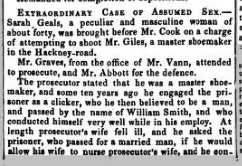
William had been raised as a girl called Sarah Geals, and trained in the family trade of boot-making. In the 1840s Smith arrived in London, began to dress as male and gave out the name of William Smith. His brother – and possibly his mother – knew of his gender change and were supportive. Soon after he was joined by Caroline, his apparent wife. They lived in a small house in Shoreditch, an area then known for furniture making. Money was tight, but William found work as a ‘clicker’ cutting out leather for boots and shoes, a high status role in the shoe industry. Much of this was work-at-home, but also some shop work, for James Giles, a boot-master on the Hackney Road. This arrangement continued for over a decade. At a time when most working-class couples did not socialize together in pubic, William and Caroline were often seen walking together, especially on Sunday.

In January 1863 Mrs Giles took to her bed with a severe illness. James asked William if his wife could come and nurse, which she did. However Mrs Giles died three days later. Caroline continued to go during the day to organize the household and help out, and this continued for a few months. At some point she let it slip that William was a ‘woman’.

Giles took advantage of this insisting that William dress as a woman, and also that Caroline become his wife. In exchange, William – now to be Sarah again - would be set up as manager of Giles’ second shop on Bow Street in Covent Garden and would continue at a man’s wage. And ‘Sarah’ and Caroline were allowed to spend Sundays together.

Sarah and her brother only were present at the wedding of James and Caroline. James lodged Sarah in what he called ‘respectable apartments’, actually a row of tenements on the Mile End Road owned by a single landlord where many of the other tenants were sex workers. After two years Giles decided that the profit at the Bow Street shop was inadequate and it should be closed. After an altercation which was remembered differently by all three, Giles received an unsigned letter which was clearly from Sarah in which she wrote that she was a “woman for spirit”, and suggested that he pay for emigration to New Zealand. 

A month went by with no answer, and then Sarah went to Giles’ shop with a gun, aimed at his face and pulled the trigger. The gun was incorrectly loaded, and he was unhurt. Giles was somewhat traumatised and it was a while before he summoned a constable. The policeman found her at home, and she went quietly to a police station. It was decided that the case warranted being sent to the Central Criminal Court. Sarah was taken to Newgate prison where she waited for her case to come to trial. 

The trial at the Old Bailey was on Wednesday 20 September 1865. The charge was:

"Feloniously attempting to discharge a loaded pistol at James Giles, with intent to murder him. Second count: with intent to do him some grievous bodily harm".

The first witness was Giles who emphasised that he had ‘helped’ Sarah regain her rightful identity and that her attack was supreme ingratitude. Two employees of his shop testified as did the police constable. All stated that the pistol had been incorrectly loaded. The defense called several persons who had known the defendant as William, and spoke of his excellent character. Caroline did not appear. Sarah never spoke. The judge instructed the jury as to the gravity of the crime, but added that if they believed she had merely intended to frighten or threaten the complainant, they might find her guilty of the second count only. Which they did. Sarah was then sentenced to five years – the minimum that incurred penal servitude rather than time in a local prison.

Sarah was removed to Millbank Prison, (located on the river front where the Tate Art Gallery now stands, ⅔ of a mile from Parliament) where she was given her first work assignment. She was to sew or pick thread from ropes for 10 hours a day, and was separated from other inmates for the first several months. In February she was transferred to Brixton Prison (then a women’s facility). The three-monthly report in the prison ledger for Sarah always stated: "Surgeon's report: good. Behavior: good". After 3 ½ years she received a ticket of leave, and was released 5 February 1869. 

Neither William Smith nor Sarah Geals was heard of again.

  • Camilla Townsend. " ‘I Am the Woman for Spirit’: A Working Woman's Gender Transgression in Victorian London”. Victorian Studies, 36, 3, Spring 1993.

-------

Why did Caroline tattle on William? Townsend muses: 

“There are several possible reasons for Caroline's actions. She may have thought the new situation would be economically advantageous for both Sarah and herself. She may have feared exposure, or have been threatened by James, who could apparently be violent. (She was "frightened almost to death" of him, according to Sarah, which was not unreasonable, as he once held Sarah herself until her arms were "black and blue.") Or she may have been tired of feeling different, wishful of being a real ‘wife’.”

Was five years penal servitude lax or harsh in the context of 1860s penology? Townsend compares with three other sentences from the same judge that same morning: 

“a man who had run over a child and killed her received nine months; a man who had killed another man in a fight received twelve; a man accused of rape was released”. 

So was she also being punished for gender transgression, and also in that Giles was of a higher station?

Townsend never uses male pronouns, despite the almost twenty years lived as William.

Apparantly William and Caroline had a fairly nice life - by the standards of the time - but then it fell apart, and even more so when the shop in Bow Street was closed.  Understandably William was aggreived.  This should have been understood.   A middle-class jury did not do so; the judge - who was of an even higher station - did not do so.   Townsend compares newspaper accounts and find that those aimed at the middle classes were generally negative, the penny and half-penny news-sheets aimed at workers were much more sympathetic, understanding why a 'woman' would pass as a man to get a man's wage. 

 
The Shoreditch Observer, 29 July 1865 page 3


23 September 2023

Leon Belmont (1853- ?)

Raised as a girl in Warren, Massachusetts, east of Springfield, Addie Walker, the child of a shoemaker, became Mrs Leon Stanley.  

In 1876 Walker/Stanley was indicted in Springfield, Massachusetts for obtaining money under false pretenses, and was jailed for nine months. 

Walker took the name Leon Belmont  around 1878, and moved to Kansas, and then the Dakota territory. There Leon met Clarinda Watts and her daughter, Grace. He courted Grace, went on carriage rides with her, and they became engaged.  He returned with Clarinda and Grace to their home in Minneapolis, which Clarinda ran as a boarding house. Leon was allowed to live there rent free, and started studies with a local doctor. 

However he transfered his attentions to another tenant, Grace’s friend, Sarah Bracket.  He was still allowed to stay rent free, and Sarah loaned $50 to Leon. When he did not repay it, she, in late October 1880, went to the police claiming that he had obtained the money under false pretenses – that is by pretending to be a man.  As Minneapolis had passed a city ordinance against transvesting in 1877, the police chief quickly arrested Belmont and arranged for Dr Putman to examine him.  The doctor reported that Belmont was ‘entirely feminine”.  

In court, Belmont ‘confessed’ to being a woman, and was ordered to pay $50 or serve 60 days in jail.  He declined to pay.  However he was not taken to the jail, but was to serve the time in the home of one of the sheriffs – an unusual arrangement.  

Belmont became a local celebrity.  Photographs of Belmont in a photography gallery, and in the windows of a bookstore attracted crowds of people. A fundraiser to pay his fine was started.  Belmont avoided speaking to the press but did receive supporters in the sheriff’s parlor.  At first the local press was positive, but as no further information was forthcoming, in the second week Belmont was denounced – not as a gender deviant but as a liar who had misled the community that welcomed him.  

11 November Belmont was recalled to court and paid the $50 fine.  It was expected that he would then face re-arrest for obtaining money from Sarah Brackett, but her attorney withdrew the charge, and Belmont was free.   

Then rumors started that he was actually a man. A reporter for the Minneapolis Tribune attributed this idea to 61-year-old Charlotte O. Van Cleve, who worked on behalf of ‘fallen women’ and was famous as the first white woman to be born west of the Mississippi.  Van Cleve had visited Belmont and was said to have verified  his masculinity.  However she immediately sent a letter to the editor saying that she 

“supposed, with others, that [Belmont] is a woman in man’s attire, and [had] consulted with her and others with regard to the preparation of clothing suitable to her sex”.   

A few days later, the St Paul Pioneer Press published an interview with Dr Albert Alonzo Ames, a former mayor of Minneapolis.  Ames maintained that Belmont was a man who had pretended to be a woman to escape from matrimonial promises to Grace and Sarah.  This was complicated when the Minneapolis Tribune discovered an affectionate letter to Belmont from a James Taylor who had lived with Belmont in the Dakota territory.  Two men loving each other was inconceivable.   

Dr Putman, whose original examination was being questioned, confronted Belmont and demanded that he admit that he was a woman.  Belmont refused but agreed to a second examination – for which he never showed up.  By this time Van Cleve had changed her mind, and wrote a second letter to the Tribune

“Leon A. Belmont is unequivocally masculine, and hence entitled to wear the garments he now wears”. 

By mid November the Leon Belmont story was running nationwide, including on the front page of the Boston Globe, and papers in Connecticut – where a reader recognized Addie Walker and wrote to a friend in Minneapolis who passed the information on to the Tribune.  The Boston Globe confirmed the indictment in Springfield, and other early details. 

Belmont largely ignored the kerfuffle and in midwinter met one Melvina Campbell.  Campbell divorced her husband and moved in with Belmont.  In April 1881 they moved to the hamlet of Spencer Brook, 40 miles north of Minneapolis, were people did not read the Minneapolis/St Paul newspapers.  They were married by a Justice of the Peace with Campbell’s brother and sister-in-law as witnesses. 

Later they moved back to Minneapolis where Belmont ran for the office of city physician – but without success.  In 1884 they moved away from Minnesota.

  • Lizzie Ehrenhalt. “ ‘Curious and Romantic Sensation‘: Sex, Fraud, and Celebrity in the Leon A. Belmont Case of 1880. Minnesota History, 67, 5, Spring 2021.
  • Lizzie Ehrenhalt. “The Story of Leon Belmont”.  Minnesota Now, Jun 26, 2023.  Online.
---------------

$50 in 1880 is just over $1,500 today.   Average wages in the US in 1880 were 12-16 ¢ per hour. So $6 for a 40 hour week, or $9 for a 60 hour week.   $50 was a considerable sum.

14 August 2022

Berthold Buttgereit (1891 - 1983) bookkeeper

Buttgereit was born and raised in Berlin, a tomboy who grew up to be a trans man. In 1912, at the age of 21, Buttgereit approached Magnus Hirschfeld and with an expert opinion from Hirschfeld and the neurologist Ernst Burchard was able to obtain a Transvestitenschein from the Berlin police. 

He lived with a woman who was in all but name his wife. In 1918 the Buttgereits moved to Cologne and he obtained a Transvestitenschein from the police there. 


His Transvestitenschein


The next year he attempted to legally change his first name to Berthold, and obtained new expert opinions from the Berlin physicians Ernst Burchard and F. Lehmann. A year later, September 1920, the process was still ongoing. In an attempt to speed it up, he submitted his Transvestitenschein, and the application was finally approved. The decision became legally effective with the announcement on 8 November 1920 in the Deutscher Reichsanzeiger and the Preußischer Staatsanzeiger


The public announcement in the Deutscher Reichsanzeiger.


Buttgereit then applied to officially marry his wife of eight years, but the registry office refused based on his birth certificate. Despite being represented by the Berlin lawyer Walther Niemann (who was close to the WhK) he apparently did not succeed. 

Buttgereit lived the rest of his life in Cologne. From 1920-5 he was a bookkeeper, from 1926 - 1942 (through most of the war) he was bookkeeping foreman, and in 1950 he was promoted to office manager. By 1958 he had retired, and he died at the age of 92.

  • Magnus Hirschfeld. Geschlechtskunde, (4th vol.).  Stuttgart : Julius Püttmann, Verlagsbuchhandlung, 1930: 593 (fig. 883, 884).
  • Rainer Herrn. Schnittmuster des Geschlechts. Transvestismus und Transsexualität in der frühen Sexualwissenschaft. Giessen, 2005: 128-131.
  • Erwin In het Panhuis. “Bertha/Berthold (Emma Charlotte) Buttgereit (1891 – 1983) Tragen von Herrenkleidung nicht untersagt”. Lesbengeschichte, 2006. Online.
  • Erwin In het Panhuis. “Queerer Pionier: Als trans Mann offiziell anerkannt vor genau 100 Jahren”. queer.de.    Online.

27 March 2022

Karl M. Baer (1885 – 1956) journalist, accountant, manager, Hirschfeld patient

Baer was born in Arolson, Hesse, Germany, to a Jewish family, and was assigned female and raised with the name Martha. After a childhood of not fitting in with other girls and preferring to play with boys, her puberty was odd in that she grew facial hair, her voice changed and she never menstruated or grew breasts - she thought that perhaps she had tuberculosis. 

After school, Baer was trained in economics, sociology and pedagogy in Berlin and Hamburg, and became a social worker and feminist activist in B’nai B'rith working against the sexual trafficking of Jewish women. In 1904 she was sent to Lemberg (later Lwow, now Lviv which was then in Galacia) but was sent back early after censure about her male body language. 

By 1905 Baer was living as male. He smoked and drank beer, and was in love with Beile Heilpern Waldberg from Czernowitz, a married woman whom he had met in Lemberg, and who had been supportive in his gender change. They were even contemplating joint suicide, when Karl was hit by a tram and was admitted to the Berlin Charité Hospital. Inspection resulted in him being moved - under protest - to the women’s special ward. He came to the attention of Magnus Hirschfeld, whose opinion that he was mainly male was seconded by Dr Iwan Bloch. Surgery by Dr Georg Merzbach corrected his body to male as far as was possible in 1905, releasing a penis and one testicle. Baer was discharged with a medical certificate confirming his male identity, and an endorsement by Magnus Hirschfeld. In the jargon of the time, he was deemed to be a male pseudo-hermaphrodite.

To get the State to endorse the change of documented birth sex, a wax form was made of the corrected external genital area and taken with a report by Hirschfeld to be inspected by the Minister for the Interior, and since now this was clearly not a female, the Minister conceded to the request for a correction of documents. Hirschfeld gave a lecture on Baer and two others, with Baer present, for Wochenschrift für soziale Medizin, Hygiene und Medizinalstatistik, 1905, using the pseudonym “Anna Laabs” for Baer, and worked with him on his book, a semi-fictional, semi-autobiographical account published under the name N. O. Body. The book was called Aus eines Mannes Mädchenjahren (Memoirs of a Man’s Maiden Years). The account in the book said that Body was French Catholic rather than Jewish, born in Bergheim in Saxony-Thuringia, and named Nora later Norbert.

In January 1907 Baer received his revised birth certificate. He gave his name as Karl M Baer. Initially the M was for Martha, but later he said that it was for Max.

He wrote accounts of the trafficking in women for the magazine Arena and for the journal  Sexualwissenschaft Nr. 9, and then a book on the topic, published by Seemann Nachf in Berlin, all in 1908.

Beile sued for divorce from her husband, Herr Waldberg, who raised the question whether Beile’s affair with Baer should equally be considered adultery as Baer was apparently actually a man. The divorce was granted and she and Karl married. However she died of pneumonia in March 1909. This led to a new court case in that the Heilpern family contested - albeit unsuccessfully - Baer’s inheritance on the grounds that he was not a man.

Karl then married Beile’s friend Elza.


The N. O. Body book sold well and was positively reviewed even in the conservative press. It was reprinted at least six times. It was made into a film twice, in 1913 and 1919 (the latter directed by Karl Grune)

Baer worked for the Victoria Versicherungs AG of Berlin selling life insurance until 1911 when he started working for the Berlin Jewish community. In 1920 he became the director of the Berlin B’nai B'rith. In 1937 B’nai B'rith was raided by the Gestapo and Baer was violently interrogated. On release he sold his apartment and he and Elza moved to Palestine. 

He again worked as an insurance agent, and then as an accountant. He had an affair with his secretary Gitla. Elsa died in 1947, and three years after that Karl married Gitla.

Karl died in 1956 age 71. His tombstone says that M is for Meir.

  • Magnus Hirschfeld: "Drei Fälle von irrtümlicher Geschlechtsbestimmung". Medizinische Reform. Wochenschrift für soziale Medizin, Hygiene und MedizinalstatistikXV, 1906, 51:
  • O. Body: Aus eines Mannes Mädchenjahren. Vorwort von Rudolf Presber. Nachwort von Dr. med. Magnus Hirschfeld.Riecke, 1907.
  • Baer: “Mädchenhandel”. Arena.3. 5 August 1908: 549–555.
  • M. Baer-Berlin. “Über den Mädchenhandel”.Zeitschrift für Sexualwissenschaft Nr. 9, 1908: 513–528.
  • M, Baer. Der internationale Mädchenhandel. Seemann Nachf, 1908.
  • Seigfried Dessauer (dir). Aus eines Mannes Mädchenjahren. Based on the book by N.O.Body. Germany 21mins 1913.
  • Magnus Hirschfeld. Sexualpathologie : Ein Lehrbuch für Ärzte und Studierende. 2. Teil: Sexuelle Zwischenstufen: Das männliche Weib und der weibliche Mann. Marcus & Webers Verleag,1918: 44-8.
  • Paul Legband & Karl Grune (dir). Aus eines Mannes Mädchenjahren. Scr: Karl Grune & Beate Chess, based on the book by N.O.Body, with Erika Glässner as NO Body . Germany75 mins
  • O. Body: Aus eines Mannes Mädchenjahren. Reprint Hermann Simon mit einer Vorbemerkung und einem abschließenden Beitrag: „Wer war N.O. Body?“ Ed. Hentrich, 1993.
  • Sander L. Gilman. Making the Body Beautiful: A Cultural History of Aesthetic Surgery. Princeton, N.J.: Princeton University Press, 1999: 281-2.
  • Myriam Spörri. “N. O. Body, Magnus Hirschfeld und die Diagnose des Geschlechts: Hermaphroditismus um 1900”. L’Homme Z F G, 14,2, 2003.
  • N O Body. Memoirs of a Man’s Maiden Years.English Translation by Deborah Simon of Aus eines Mannes Mädchenjahren. University of Pennsylvania Press, 2006.

  • Sander L Gilman. “Whose Body is it Anyway? Hermaphrodites, Gays and Jews in N. O. Body’s Germany” in Simon, 2006.
  • Hermann Simon. “Afterword: In Search of Karl Baer” in Simon, 2005.
  • Petra Henderson, Original English Wikipedia page on Karl M Baer. 3 November 2008. Online.
  • Jana Funka. “The Case of Karl M.[artha] Baer: Narrating ‘Uncertain’ Sex”. In Ben Davies & Jana Funke (eds) Sex, Gender and Time in Fiction and Culture. Palgrave Macmillan, 2011: 132-153.
  • Geertje Mak. “Scripting the Self: N.O. Body’s Autobiography”. In Doubting Sex: Inscriptions, Bodies and Selves in Nineteenth-Century Hernaphrodite Case Histories. Manchester University Press, 2012.
  • David A. Brenner. “A German-Jewish hermaphrodite: or what sexology contributed to B’Nai B’rith”. In German-Jewish Popular Culture Before the Holocaust: Kafka's Kitsch. Routledge, 2014: 41-9. .
  • “Karl M. Baer”. In: Persönlichkeiten in Berlin 1825 - 2006. Erinnerungen an Lesben, Schwule, Bisexuelle, trans- und intergeschlechtliche Menschen. Senatsverwaltung für Arbeit, Integration und Frauen, Berlin 2015, S. 10–11.PDF.
  • Michaela Koch. “N.O. Body and the Making of a True Man”. In Discursive Intersexions: Daring Bodies between Myth, Medicine, and Memoir. Transcript-Verlag, 2017: 75-111.
  • Ofer Oderet. “Recalling the First Sex Change Operation in History: A German-Israeli Insurance Salesman: The long-forgotten story of a German Jew who was born as Martha and escaped the Nazis as Karl, rediscovered by a Tel Aviv University student”. Haaretz, May 10, 2018. Online.

DE.Wikipedia     EN.Wikipedia      PATA Queens

----------------------

While it is always difficult to interpret old medical accounts in terms of modern diagnoses, it is plausible that Baer had 5-Alpha Reductase Deficiency, which would have been hard for a non-specialist doctor to spot in 1885 as it was not officially recognised until 1961.

No explanation is given of how he avoided conscription 1914-18.

Geertje Mak compares Baer to Herculine Barbin: “The protagonists of N. O. Body’s autobiography Aus einem Mannes Mädchenjahren (Memoirs of a Man’s Maiden Years), published in 1907, and of Barbin’s autobiographical writings have a lot in common. Both were raised as girls and only discovered that they were male in their twenties. Both had already had a passionate love affair with a woman for quite some time before the medical discovery of the error of sex. For both the breakthrough came after a confession of their life story, which in both cases led to a medical examination. Both had been more or less aware that there had been a mistake with regard to their sex, although Barbin seemed to have been more clear about the exact nature of the mistake than N. O. Body. Both were relatively well educated and obviously modelled their narratives on fictional or (auto)biographical examples they themselves had read.”

The major difference of course - which Mak does not mention - is that Barbin did not want to be a man, did not have a male gender identity, but was compelled into being a man. Thus Barbin used suicide to escape from masculinity, while Baer thrived as a man. Some writers compare Baer to David Reimer assuming that biology will out, that a biological male cannot be raised successfully as female. However Reimer was not intersex, he was a cis male. Mak’s comparison of Barbin and Baer is valid in that both had comparable intersex conditions, but what the comparison should show is that biology is only part of what we are. The self-fashioning resulting from biology and environment and choice produces different results.

Petra Henderson in her original version of the EN.Wikipedia page on Baer wrote: “Copies of the medical publications obtained by the University Medical College of Oregon enabled at least one of their female graduates (Dr. Alan L. Hart) to get his sex change surgery in the University hospital in 1917”. It is possible that Dr J Allen Gilbert did read German, and had come across Hirschfeld’s lecture to Wochenschrift für soziale Medizin, Hygiene und Medizinalstatistik  1906, but it was more likely to have read Hirschfeld’s Die Transvestiten, 1910. In either case the diagnosis and treatment were very different between Baer and Hart. Hart did menstruate, did not have a testicle and underwent a hysterectomy.

IMDB gives the plot of the 1919 film as: “A child born without a clear gender is raised by the father as a boy, later by the uncle as a girl and dissected after death” - which is a further deviation from Baer’s life.

Of the three biographies of Magnus Hirschfeld, that of Charlotte Wolff, Magnus Hirschfeld,1986, of Elena Mancini, Magnus Hirschfeld and the Quest for Sexual Freedom, 2010 and of Heike Bauer, The Hirschfeld Archives, 2017, none make any mention of Martha/Karl Baer, Anna Laabs or N. O. Body.

30 April 2021

Tamara Rees (Stevenson) performer, wife, property investor

Part I: Parachutist, soldier, pilot
Part II: performer, wife, property investor

++February 2022: added comment by Walter Alverez.

Rees then wandered from job to job, city to city. By 1951 she was in Los Angeles and had consulted a few psychiatrists about her gender quandary. 

Rees then found a “kind and understanding” psychiatrist on Wilshire Boulevard. They wrote to the American Medical Association re treatment for gender issues. 

“Their reply was to state that no legal medical aid of this problem could be obtained in the United States (although there are no legal restrictions against transitions).” (p32)

Later the AMA provided the names of three specialists in Europe, and the first that the psychiatrist wrote to was the endocrinologist, Dr Christian Hamburger in Copenhagen who had just become famous because of his patient, Christine Jorgensen. He advised hormonal treatments, and stated that sex-change surgery was no longer available in Denmark for foreigners since a change in the law. He suggested that they contact Dr. Frederick Hartsuiker in Haarlem in the Netherlands. 

The psychiatrist prescribed female hormones, and also suggested that Rees, Tamara as she was becoming, should also live and dress as female. 

“he also wanted or thought he could prove that with freedom of expression and acceptance that the desire for surgical transition would become less intense, indicating this change of social pattern … I will state that it came as close to giving me the emotional release I was seeking than any other type of therapy attempted up to that time. Together with the hormone therapy plus the present experiment, I felt happier and more at ease but I had told him at the commencement of this experiment that I knew this would not be in total the solution I required. This proved to be quite true.” (p33)

After six months they began corresponding with Dr Hartsuiker. 

“He in turn requested a complete resume of the psychiatric history and tests, together with all physical and biological tests, that had been performed. We complied with this request and late in 1953 we received confirmation that this psychiatrist would be willing to take my case under advisement.” (p33)

In November 1953, Tamara sailed on a Holland American steamship to Rotterdam. She took a train to Haarlem, and quickly had an appointment for the following Monday. Hartsuiker

 “stressed again and again the importance that my choice would be irrevocable, slow and painful and the outcome could never be entirely assured. Upon receiving my assurance that I realized all of this and releasing him from any personal claim, I still felt and requested that such procedure for surgical transition should be carried forth without further delay.” (p34)

A second opinion was obtained from Dr Carp of the Psychiatrische Cliniek in Leiden, and one other, and then, as required by law, the opinion was submitted to a court of magistrates which reviewed the decision, decided it was correct and approval was granted.

The operation (presumably castration) was on 5 January by Dr Nauta in the Diaconessenhuis in Haarlem. On recovery, Tamara went shopping for female clothes, and moved into an apartment that had been rented. The landlady became inquisitive, and Tamara told her the situation: 

“To my surprise I found her very understanding and while she said that she could not put her finger on the exact reasons for her suspicions, she knew that something was not right. I then showed her the letters and other documents from my doctors and attempted to explain the circumstances. This woman accepted me with open arms and agreed to help me in the many little ways which would be necessary to completely reestablish myself. I say now with all sincerity that I owe this woman a debt of gratitude which I can never repay.” (p38)

As required by law Tamara registered with the Aliens Police (Vreemdelingendienst) and afterwards was followed and observed. She was to wait six months for the second stage operation (penectomy). Tamara learned some Dutch, and adjusted to their then lifestyle. With the changes from the female hormones, and given that Tamara was small framed and only 5’4” (1.613m) she was able to pass. She had frequent appointments with Hartsuiker, Nauta and a study group at the University of Leiden. 

In May she was seriously ill, which was attributed to the hormonal regime. After recovery and several weeks of testing, the second operation was arranged. A more experienced surgeon was required, and the services of a professor of medicine who had come to Holland as a refugee from the concentration camps of the previous decade. The surgery was done in a small secluded hospital in early June, and Tamara was 15 days in the hospital afterwards. 

She had also annoyed the Aliens Police who did not know where she was. 

The US Consulate was very “understanding and cooperative” but did not produce a revised passport. Rees also wrote to the US State Department and to her California congressman. Finally, after many months, a temporary passport would be issued for the one trip home to then be surrendered until a legal change as required by the laws of California was effected. Rees’ parents did not understand and wrote bitter letters. Tamara arranged that they should speak to Harry Benjamin during his summer months in San Francisco, but they rejected the offer. 

After receiving a “very disturbing letter” from her parents in November, Tamara took an overdose of sleeping pills and was unconscious for three days. The Aliens Police then arrested her as an attempted suicide, and put her on a ship for New York. Her gender history was supposed to be private, but she discovered that the ship's officers had been told, and they had passed it on to the crew. 

In addition, the US Consul General in Amsterdam had asked the Veterans Administration to make special arrangements. An official there violated privacy and notified the New York Daily News, where the editor was a personal friend. The press were awaiting her arrival, but also a nurse and an official from the Veterans Administration who got her off the ship quickly, and through Customs and took her by staff car to a hospital in Brooklyn. In exchange for a four-article series of stories in her own wording, The Daily News transferred Tamara away from the hospital and other reporters and to the Hotel Commodore in Manhattan (later known as the Grand Hyatt). 

After some days of shopping and writing the articles, Tamara flew to Los Angeles where she was met by the celebrity journalist Florabel Muir who took her nightclubbing, and the next day flew with her to Sacramento to meet her parents, who despite the bitter letters, were now welcoming.

The press were still interested. Tamara struck feminine poses and claimed that her ex-wife’s children had been fathered by someone else. At the end of the year she published a short autobiography. Back in Los Angeles, she performed in burlesque clubs, and also gave talks to gender-segregated audiences about sex and psychology. In 1955 in Reno she married James Courtland, a makeup artist, and hairdresser for 20th Century Fox. This was regarded as the first transsexual wedding, but lasted only a short time because of his jealousy.

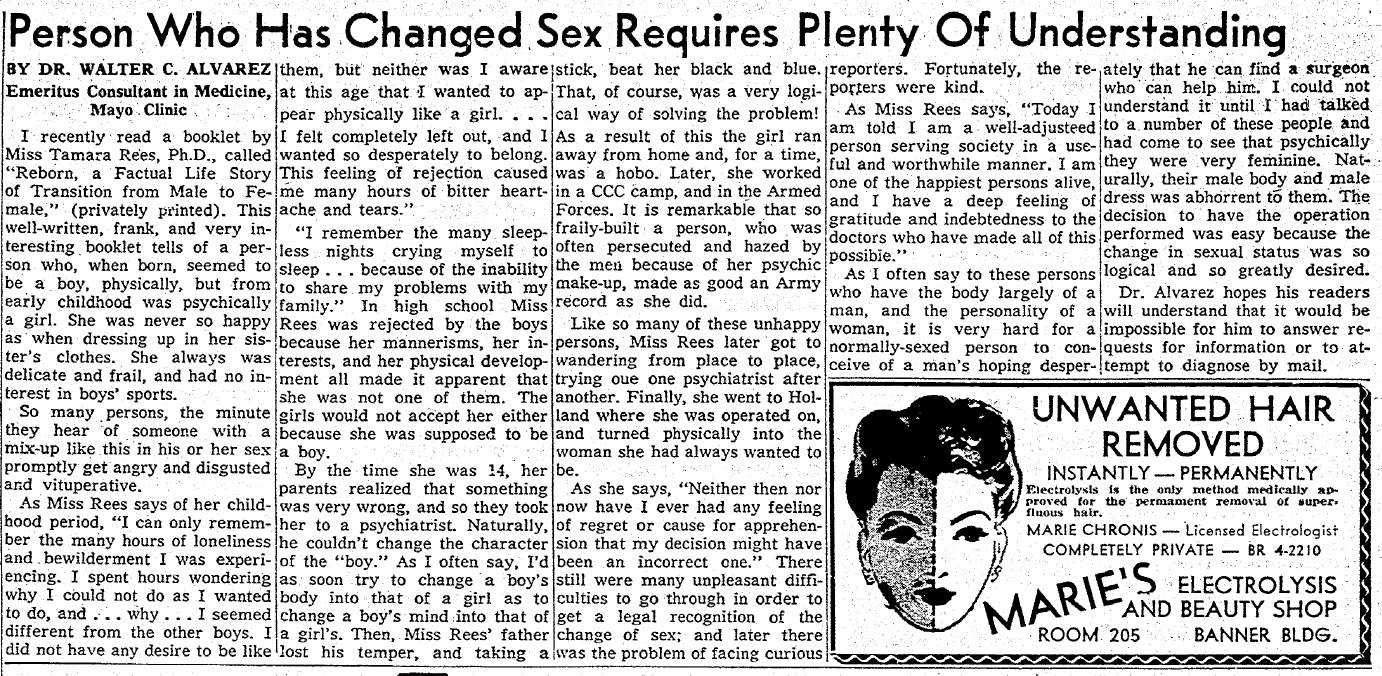
Her autobiography came to the notice of Mayo Clinic Consultant and journalist, Walter Alvarez, who wrote it up in in column and commented:  "As I often say to these persons who have the body largely of a man, and the personality of a woman, it is very hard for a normally-sexed person to conceive of a man's hoping desperately that he can find a surgeon who can help him.  I could not understand it until I had talked to a number of these people and had come to see that psychically they were very feminine."
She married again, to Bob Stevenson, and adopted children. Like Jorgensen, she became a patient of

Harry Benjamin who used her as a counseling resource for other transsexuals, and in the early 1960s she was interviewed by Ralph Greenson, psychiatrist to Marilyn Monroe and other stars, who interpreted her as in flight from homosexuality.

The Stevensons lived in Youngstown, Ohio and invested in property a little at a time. In 1975 they owned 4 small homes; in 1995 they owned 32. Bob was apparently very controlling, but they did remain married until the his death in 1997. Tamara then sold all the properties, and moved to Sacramento, California to be close to her sister. Roger the brother of her adopted son Bruce lived with her and became her carer. She fractured a hip in early 2000, and also developed cancer. The pain was so bad that she was on morphine. 

Tamara died at age 76. 

  • Tamara Reese. "Reborn": a factual life story of a transition from male to female. Irene Lipman, 1955, PDF.
  • Walter C Alvarez.  "Person Who Has Changed Sex Requires Plenty of Understanding".  Syndicated, July 2, 1957.  Online.
  • Ralph R. Greenson. “On Homosexuality and Gender identity”. International Journal of Psycho-Analysis. 45, 1964.
  • Joanne Meyerowitz. How Sex Changed: A History of Transsexuality in the United States. Harvard University Press, 2002: 84-5, 90, 133,173, 305n98-102.
  • John Marks. “Information about Robert Rees”. User Trees. https://www.genealogy.com/ftm/m/a/r/Jack-Marks-CA/WEBSITE-0001/UHP-0026.html.
  • Alek Bakker. “In the Shadows of Society: Trans People in the Netherlands in the 1950s”. PRISM, 2020: 154-5, 159, 161. PDF.

Transas City

_____________________________________________

Special thanks to Transas City for the best photographs and for the PDF of Tamara's autobiography.

Tamara spells her surname as ‘Reese’ on her autobiography, but everywhere else the name is spelt ‘Rees’.

In her book Tamara says that she had two operations, in January and then June 1954. This was presumably first castration and then penectomy as was the usual practice prior to Dr Burou in Casablanca inventing penile inversion vaginoplasty. In her autobiography (p43) she writes: “ in early June I underwent my second and most intensive surgery of my transition. I could have stopped here but felt that one further operation would be necessary. … I was still, not to all intent and purposes, fully of the female sex.” So presumably the third operation would have been vaginoplasty, except that she was deported before it could happen. However in 1955 she was assuring her audiences that the operation “enables me to fulfill my physical obligations as a woman”. So part of the story is missing.

Bakker, contrarywise, after claiming that her memoirs “are certainly not factually reliable” without giving details, assumes that she had only one operation in the Netherlands - castration and penectomy combined. In his footnote 42, he writes: “Correspondence between Benjamin and Hartsuiker shows that Rees’s story about having had a second and third genital operation in the Netherlands is not true".

Rees says that she was deported after an assumed suicide attempt. Bakker claims that the police changed their mind about permitting women in transition to dress as women.

Bakker p154 writes: “Rees is considered to be the third American transgender woman after Christine Jorgensen to have received gender confirmation surgery, the second being Charlotte McLeod.” By my count Rees was #6.

John Marks, Tamara’s nephew writes “The plastic surgeon (first of it's kind) worked on Tamera's face. During the operation, a nurse accidently poured alchohol on the open skin on the face and severely ruined the facial tissue. This forced her to go through several skin graphs in order to try and restore the skin to the cheeks and nose.” This is otherwise unknown. I have assumed that this is actually a reference to the 1946 mastoid operation that went wrong. It would be extraordinarily unfortunate for one person to have two separate facial operations go badly wrong.

I have looked for but was unable to find the four-article series of stories that Tamara wrote for the Daily News.

Given that Florabel Muir was a well-known journalist, did she not write about Tamara?  Again I could not find such.

13 January 2021

James How (1714–1780) publican

In December 1732 Mr James How took unto marriage one Mary Snapes. Together they had a small nest-egg of £30 (£6,000 in today’s money). They found a small pub in Epping, northwest of London, which was to let, and they took it. James was involved in an altercation with a young gentleman that resulted in a lameness of his hand. This was of such a nature that he entered an action against the gentleman and obtained damages of £500 (over £100,000). James and Mary were then able to seek a better situation, and took a public house in Limehouse. They lived there many years, in good credit and esteem. They then bought the White Horse pub on Poplar High Street, which they also ran successfully.

Manion p45

A woman by the name of Bentley, resident not far away, had known James when they were both young. In 1750 she asked for £10 (£2,000) that James’ sex not be discovered (this at a time when £20 a year was a good wage). James complied, and the matter was settled for many years.

James served in most parish offices and more than once was a jury foreman, although some regarded him as somewhat effeminate. 

In 1765, at Christmas time, Mrs Bentley sent a repeated demand for £10, and a fortnight after that she sent again. 

Around this time Mrs How took ill, and went to a friend in the country. James was not able to join her before she died, and she told their secret to the friend. The “friend” visited James in his grief and "insisted not only on their share of the whole effects, but more”. 

Mrs Bentley escalated her demands and recruited two men, John Charles and William Barwick, who pretended to be a constable (Bow Street Runner) sent by Justice John Fielding (the brother of Henry Fielding the novelist). A neighbour, Mr Williams, a pawn broker was passing and was informed of the situation. He urged How to go to the local Justice. While he stepped out to change his shirt, the two men forcibly took How to the house of Mrs Bentley, where after threats How gave a draft for £100 on Mr Williams payable at a later date, and they released him. 

How and Williams applied to the local bench for advice, and when Bentley and Barwick came for the payment there was a real constable waiting and they were taken to the bench of Justices sitting at the Angel in Whitechapel. How, now being outed, had reverted to female dress, and now gave the name of Mary East. Under examination, Bentley denied sending for the £100, and Barwick declared that he would never have gone if she had not sent him. They were committed unto the Clerkenwell Bridewell until the next session. Charles disappeared and was never heard of again. Bentley and Barwick served four years in prison and Barrick also stood in the pillory three times.

It was noted “The alteration of her dress from that of a man to that of a woman appeared so great, that together with her awkward behavior in her new assumed habit, it caused great diversion”, for of course he was 33 years unused to it.

Either How gave it out, or the newspapers added the story that both Mary East and Mary Snapes had been abandoned by men in their youth. In East’s case the man had been arrested for being a highwayman and transported to the American colonies. They gave up on men, and tossed a coin to decide which of them would act as the man in their relationship. Mrs How’s name, Mary Snapes, was not given in any of the accounts.


How/East sold the White Horse and retired to another part where he was not famous. He lived till 1780. When he signed a will in 1779 it was as Mary East.

  • “The FEMALE HUSBAND; or a circumstantial Account of the extraordinary Affair which lately happened at POPLAR; with many interesting Particulars, not mentioned in the publick Papers.” London Chronicle, 7-9 August 1766. Reprinted: Rictor Norton (ed) as "Mary East, the Female Husband", Homosexuality in Eighteenth-Century England: A Sourcebook. 6 December 2003. Online.
  • “Mary East, The Female Husband”. The Odd Fellow, 2 May 1840.
  • “A Curious Married Couple: Thirty-four years of pretended matrimony”. Fincher’s Trade Review, July 25, 1863. Reprinted in Jonathan Katz. Gay American History: Lesbians And Gay Men In The U.S.A. A Discus Book.1978:343-4.
  • “A Fortified Public House: Strange Story of Mary East, the ‘Man-Woman’ who Lived There”. Illustrated Police Budget, 13 May 1899.
  • “The Romance of the White Horse”. Tower Hamlets Independent and East End Local Advertiser, 27 January 1900.
  • Bram Stoker. “Mary East” in Famous Imposters.  Sturgis & Walton, 1910: 241-8. 
  • Rictor Norton. Mother Clap’s Molly House: The gay Subculture in England 1700-1830. GMP, 1992: 237.
  • “Mary East (aka James How) and Mrs How of the White Horse, Poplar”. East End Women’s Museum, 23 June 2017. Online
  • Jen Manion. “The Pillar of the Community” in Female Husbands: A Trans History. Cambridge University Press, 2020: 44-67.

Isle of Dogs Life

-------------------

The story of the transported lover and the coin toss may be true or untrue. It was a telling that went well with the newspapers in that it downplayed the idea that How was gender deviant. However given the 33 years that he maintained the role and that he was regarded as an outstanding citizen implies that he had an affinity for being male.

I was not able to ascertain from the various accounts just when in 1766 Mrs How, Mary Snapes, did die.  Was it before the trial of Bentley and Barwick in August?  It is not at all explained how friends or family of Mrs How could claim half the property.  Under the various coverture laws that lasted into the 19th century, wives had no property rights apart from their husband.   

Almost all accounts spell their surname as 'How'.  Manion, without discussing why she dissents, spells it "Howe".

Some of the immediate accounts in 1765 used How’s well-earned masculine pronouns for the period pre-1766. However after his death in 1780, almost all used she/her only, put ‘wife’ in quotation marks and some even referred to him as ‘Mrs Mary East’ as if he had been married to a Mr East!!. The very recent book by Manion opts for the hopefully-temporary fashion of using they/them which of course is not How’s choice of pronouns, and is confusing.

 “They were in the business of keeping public houses, which they did to great success by evidence of their ability to upgrade their situation numerous times over the years before settling in at the White Horse Tavern for roughly two decades.” (p46) Does ‘they’ mean James alone or Mr & Mrs How together?

When the two thugs sent by Bentley accost How, is ‘they’ the two thugs or How himself? “to impersonate officers of the court who roughed Howe up physically and suggested they would be executed for their crimes” (p46).


31 October 2020

More on Robert Allen

I wrote in June 2015 about Robert Allen who was an assistant to legendary 1940s film directors Michael Powell and David Lean,  transitioned in 1944 with a revised birth certificate and married his girlfriend.  He then retrained as a radiologist.  He published an autobiography in 1954.  

See the full story at zagria.blogspot.com/2015/06/robert-allen-1914-film-maker.html

Chris 0'Rourke has contacted us to point out the back page of the Daily Mirror 30 August 1957. 

From this we learn that Robert was divorced from his first wife.  Remember this was before the Divorce Reform Act 1969 which introduced no-fault divorce.   The law then in effect was the Matrimonial Causes Act 1937 which required demonstration of adultery, desertion, cruelty etc.  In addition Robert had become a Catholic in 1951.   So the divorce is certainly not explained.  Note that the second marriage was in Congregational Church.


20 October 2020

Edgar Wales Burnham (1841 – 1918) forgotten musician

Burnham, originally known as Ellen – her mother’s name - was born in Woodstock, Vermont.  The family moved to Lawrenceville, New York in 1850, and then to Brodhead, Wisconsin in 1857.  

The father, Milo Burnham, a physician, established a medical practice, and also, as many physicians did at that time, operated a drug store.  He became a deacon of the town’s newly established First Congregational Church.  Dr Burnham, a “radical temperance man” refused completely to sell any liquor.  

Ellen, then 16, was a promising musician and organised classes in addition to horse-back riding and working in her father’s drugstore.  At age 18, she became engaged to LW Powell who had come to Brodhead as school principal, but had resigned and founded the town’s only newspaper, The Reporter.   They were married in the Congregational Church in February 1860.  Mrs Powell quickly learned the newspaper trade and the printer’s trade.  

In April 1861, as the US Civil War started, Powell volunteered for the 7th Wisconsin regiment and was was ordered to Washington.  Mrs Powell accompanied her husband.   Her somewhat masculine appearance was noted by a government detective who decided that she was a man, and therefore must be a spy. He followed her on the same train to Chicago and arrested her on an overnight stay.  Telegrams were sent to and from the Governor of Wisconsisn and Mr Powell before she was released.   Mr Powell arrived and escorted his wife back to Brodhead.   

However they had to face up to Ellen’s increasing virilization.  Ellen left alone for Chicago, while Mr Powell visited the local tailor and had a suit made.   That was then shipped to Chicago.   Powell informed Dr Burnham that Ellen was not a woman and was now wearing male attire.   An examination with a  doctor in Chicago was arranged which confirmed what Powell had said.   Finally Dr Burnham was permitted to examine his child, who was now to be known as Edgar.  

A divorce of the Powells was effected.  A position for Edgar became available at a drug wholesaler in Chicago.  Edgar was regarded as a good-looking man.  He was the organist at two churches and became engaged to the daughter of his landlady.  

In 1863 Edgar returned to Brodhead and again worked in his father’s drug store while maintaining his relationship with the fiancée in Chicago.   The drug store was popular as townsfolk flocked to see the handsome young man with an interesting past.  The Chicago engagement being over, Edgar  courted and married one of his former music students, a Miss Gertrude Everett, against the wishes of her parents.  

In 1864, Dr Burnham sold up his properties in Brodhead and moved to Waterloo, Iowa, 165 miles / 266 km west, taking his family and Edgar's wife with him.   Edgar worked again in the family drug store. Edgar had commissioned a pipe organ, an 8-stop instrument in a 9-foot case with gilded front pipes.  When it arrived in Waterloo, it was installed in the First Congregational Church where Edgar both performed and taught.   

In late 1867 someone in Waterloo, having heard something about Edgar’s past, wrote to the editor of the La Cross, Wisconsin Democrat seeking more information.  That editor published a version of Edgar’s life in January 1868.  This account contained errors such as claiming that the Powells had a child, and was republished in other newspapers in the next few weeks. In response, the editor of the Brodhead Independent published a longer and more reliable account 1 February.

Edgar taught, performed, conducted, served as church organist and eventually organized the Iowa State Conservatory of Music. He also joined the staff of the Iowa Normal School in nearby Cedar Falls (now the University of Northern Iowa) as a professor of music.  


In 1877 his father Dr Burnham financed the building of the Burnham Opera House in Waterloo which seated 1,000 people.  Edgar also became the manager of the opera house, an event organizer and the manager of a performing troupe, the Burnham Novelty Company, that featured his wife’s singing.  

While the troupe was in Minneapolis-St Paul, someone remembered the press stories from 1868, and they were retold in the St Paul Pioneer-Press in March 1882, and repeated in other papers.   The company folded later that year.  

Dr and Mrs Burnham retired and moved to Chicago.   In 1885 the opera house was sold, and Edgar and Gertrude also moved to Chicago, and then a few years later to San Diego, California, where Gertrude died age 44 in 1891.  

Edgar remarried to Teresa, an Irish woman with three children, and moved his new family back to Chicago.  His father died in 1893, and his mother six years after that.  The Waterloo Opera House was destroyed by fire in 1906. The marriage with Teresa endured.   Edgar died in 1918.  Teresa, 20 years younger, never remarried, and stayed in Chicago until her death age 87 in 1946.   

  • “HE, SHE, OR IT: A Correct Account of the Mysterious Female Man: Truth Stranger Than Fiction“. The Brodhead (Wis.) Independent, Feb. 1, 1868. Online.
  • “A Most Strange Chapter”. Vermont Transcript, Feb 7, 1868.  Online.   Online
  • “A Remarkable Case”. St Paul Pioneer Press, March 14, 1882.  Online
  • “A Strange Metamorphosis”. Dubuque Times, Mar 28, 1882.  Online.
  • “Edgar W Burnham (Obituary)”. The Waterloo Times-Tribune, May 10, 1918.  Online.
  • Frank D Myers. “The curious case of Ellen/Edgar Burnham (Part 1)”.   Lucas Countyan,  December 07, 2015.   Online.
  • Frank D Myers. “The curious case of Ellen/Edgar Burnham (Part 2)”.   Lucas Countyan,  December 08, 2015.   Online.

------------------------

The Wikipedia page for Waterloo, Iowa lists around 60 notable residents, but does not include Dr Milo Burnham who financed the building of their Opera House, nor Edgar who organized the Iowa State Conservatory of Music.

The Obituary says that Edgar met his second wife in Chicago, but Myers says San Diego.   I have gone with the second.

Despite lacking a modern understanding of what happened to his body, and despite being outed twice, it seems that Edgar had a good life.

12 September 2020

John Talbot divorced 1967

In 1961 John David Talbot married a widow, Mrs Eileen Poyntz, matron of an old people’s home in Brighton, Sussex. Eileen, now Mrs Talbot, realized that John was anatomically not the man she expected – but continued to live with him for a year.

Five years later she filed for divorce. The judge in the case, Justice Ormrod, declared that John Talbot was a woman, and immediately granted a decree nisi of nullity. John Talbot did not contest the petition and was ordered to pay the costs.


  • Talbot (otherwise Poyntz) v Talbot, (1967) 111 S.J. 213.
  • “’Husband’ was a woman”. Liverpool Echo, 27 February 1967: 14.
  • “’Husband’ turned out to be a woman!”. Reading Evening Post, 27 February 1967: 1.
  • Stephen Cretney. “The Nullity of Marriage Act 1971”. The Modern Law Review, 35,1, 1972: 57n4.
  • Christopher Hutton. The Tyranny of Ordinary Meaning: Corbett v Corbett and the Invention of Legal Sex. Palgrave MacMillan, 2019: 74, 83.

There seems to be a small confusion as to whether Justice Ormrod in this case is the same Justice Roger Ormrod (1911-1992) as in Corbett v Corbett. Cretney and Hutton write as if they are the same. EN.Wikipedia(Timeline_of_LGBT_history_in_the_United_Kingdom) says that the Justice was Benjamin Ormerod (1890-1974) – but is alone in this claim.

Hutton says p83: “Whereas in Talbot, Ormrod had in effect brushed aside the (non-)marriage, in Corbett he felt obliged to deploy the full range of medical and legal argumentation”.  Surely a pertinent difference was that April Ashley (Mrs Corbett) had had confirmation surgery but there is no suggestion that John Talbot had also.

The Inner Temple Library booklet Transgender Law: A Short History, Online, quotes Justice Ormrod as saying re Talbot v Talbot: “Marriage is a relationship which depends on sex, not gender”.  However this sentence is actually taken from his Judgment (p19) on Corbett v Corbett.

Several sites (example, example, example, example) repeat the Ormrod sentence assigned to Talbot v Talbot and actually add that he thereby ruled that transsexuals were not permitted to marry under British law. However as John Talbot apparently had not had surgery this was not so. Nor was Talbot v Talbot cited as a precedent in later cases.

09 August 2020

The Bellinger v Bellinger Recognition of Marriage Case 2000

Elizabeth Bellinger, born 1946, was raised as male, and at age 21, under some pressure, was married to a woman. The marriage lasted for four years. After that she undertook eight years of counselling which led to transition.  She had completion surgery in 1981. Later the same year, she went through a ceremony of marriage at a Registry Office with Michael Bellinger, a widower of the same age who was fully aware of the situation. She was described on the marriage certificate as a spinster. In the late 1990s, following the claims of BSTc differentiation in trans women, and the Human Rights Act, 1988 which made rulings of the European Convention on Human Rights authoritive in UK courts, she sought to clarify the legal status of her marriage,

For 30 years since Corbett v Corbett, the criteria for determining sex for purposes of marriage had stood. Trans women were not women for such purpose, but an exception was made for intersex women using the definition of a natural non-congruence of the chromosomes, gonads and genitals.
In 2000 two cases came to court. In the first W. v W., a divorced husband attempted to have the marriage annulled also, but his request was denied when it was established that his wife did meet the Corbett exception.

In November that year, Mrs Bellinger sought a declaration under the Family Law Act, 1986, c. 55, § 43, Part III, Declaration of Status (Eng.), that her marriage had been valid at its inception. This would require that she be recognised as female for the purposes of section 11(c) of the Matrimonial Causes Act 1973 (which incorporated the Nullity of Marriage Act, 1971), which in turn would necessitate giving the expressions 'male' and 'female' in that Act a novel, extended meaning: that a person may be born with one sex but later become, or become regarded as, a person of the opposite sex.

The respondent Mr. Bellinger filed no objecting reply. It was the Attorney General who elected to intervene to argue the case against granting the declaration. Evidence was taken from Professors Louis Gooren and Richard Green and consultant urologist Timothy Terry, and Russell Reid was cited. However the High Court applied the Corbett test and found that Mrs Bellinger was male in that at birth the chromosomes, gonads and genitals had been congruent: ‘the present state of medical knowledge lead inexorably to my dismissing her petition’.

In 2001 at the Appeal Court, Mrs Bellinger’s counsel argued that the terms ‘male’ and ‘female’ had been deliberately left undefined in the Nullity of Marriage Act, 1971. They sought to expand the range of factors in that scientific understanding had advanced since 1971, and referred to the non-congruance of brain structure, particularly the size of the BSTc (stria terminalis) citing Zhou et al, 1995, and argued that therefore she should be understood as covered by the intersex exception as set out in Corbett. Two of the three judges responded that they were intrigued by the evidence but as the evidence would require a dissection at autopsy, evidence with regard to Mrs Bellinger’s brain could not be obtained. Thus the stated advances could not be brought to her aid. They ruled that Mrs Bellinger was not female as the law then stood. The third judge did dissent, and urged the abandonment of purely biological tests. On psychological grounds he would have recognised Mrs Bellinger as a woman under English law. All three judges accepted that "the profoundly unsatisfactory nature of the present position and the plight of transsexuals require careful consideration". However, the two judges said any change in the law must be a matter for Parliament. The court was dismayed to hear that no steps had been taken by the Home Office following the report in April of the previous year of an inter-departmental working group on transsexual people.

An appeal went to The House of Lords. In the meantime the European Court of Human Rights (ECHR) had ruled in Goodwin v United Kingdom and I. v United Kingdom. In both cases involving completed trans women the claim was that UK policies violated their rights to privacy under Article 8 and to marry under article 12 of the European Convention on Human Rights. The ECHR repudiated the Corbett test, arguing that gender dysphoria is a medical disorder and that this obviates any need to determine its aetiology and that the emphasis on chromosomal sex was disproportionate in that in some intersex conditions the gender identity is not congruent with the chromosomes. The minority opinion in the Bellinger appeal was cited with approval.

While it was still left to the UK to establish a workable definition of gender transition and marriage, the ECHR did conclude that the UK’s policies were in violation of articles 8 and 12 of the European Convention on Human Rights.

In December 2002 the UK Government announced that it would bring forth legislation on the matter, and government counsel conceded that UK law was incompatible with the articles 8 and 12.

In April 2003 the House of Lords considered Bellinger v Bellinger and upheld the majority decision of the Court of Appeal, but indicated its incompatibility with the judgements of the ECHR. This was the first such declaration of incompatibility. However they declined to apply section 3 of the Human Rights Act 1988 which states that domestic law must, if possible, be interpreted in a way that makes it compatible with the ECHR. The judges did not accept that the terms ‘male’ and ‘female’ in the Matrimonial Causes Act 1973 could be extended to include the marriages of transsexuals. To read the 1973 Act in such a new way would be a major change to the law and such change is not the duty of the courts. The issue was handed back to Parliament.

In 2004 the UK government enacted the Gender Recognition Act, and then Bellinger would be entitled to apply for a Gender Recognition Certificate. Certainly a step forward, but hardly the confirmation of the legal status of her marriage in 1981.
  • J-N Zhou, M A Hofman, L J Gooren & D F Swaab. “A Sex Difference in the Human Brain and its Relation to Transsexuality”. Nature, 1995, 378: 68-70. Reprinted in The International Journal of Transgenderism, 1997, 1,1. Online.
  • “W. v W. Case Law”. October 2000. Online.
  • “Rights of Transsexual are upheld”. Dublin Evening Herald, 23 May 2001.
  • “Transsexual loses appeal over 20-year ‘marriage’ “. The Telegraph, 18 Jul 2001. Online.
  •  "Judgments - Bellinger (FC) (Appellant) v. Bellinger" House of Lords, 10 April 2003. www.publications.parliament.uk/pa/ld200203/ldjudgmt/jd030410/bellin-1.htm.
  • Clair McNab. "Government FAQ: Bellinger v. Bellinger". Press For Change, January 2004. www.pfc.org.uk/node/326.
  • S Cowan.  ‘That Woman is a Woman! The Case of Bellinger v Bellinger and the Mysterious (Dis)appearance of Sex’ Feminist Legal Studies, 12, 2004: 79-92.
  • Lisa Fishbayn. " 'Note Quite One Gender or the Other': Marriage Law and the Containment of Gender Trouble in the United Kingdom". Journal of Gender, Social Policy & the Law, 15,3, 2007: 429-432. http://digitalcommons.wcl.american.edu/cgi/viewcontent.cgi?article=1252&context=jgspl.
  • Christopher Hutton.  The Tyranny of Ordinary Meaning:  Corbett v Corbett and the Invention of Legal Sex.  Palgrave Macmillan, 2019: 145-152. 
_______________________

There are issues not discussed in the source accounts. Was Mrs Bellinger risking being charged with ‘perjury’ for presenting herself as female, or her status as 'spinster' at her marriage in 1981?

Did the Gender Recognition Board require the Bellingers to divorce before she was awarded her Gender Recognition certificate?

It is just as well that the legal changes were not built on the assumptions about BSTc as proposed by Zhou et al. Twenty-five years later that line of research has not proved productive. 

The European Convention on Human Rights and the European Court of Human Rights are not part of the European Union. They are part of the Council of Europe, a wider organisation. Russia is a member. Only Belarus is not. The current Johnson government equivocates and does not commit to remaining in the Council of Europe. If it were to withdraw, and also repeal the Gender Recognition Act, the legal status of trans persons would be back to what it was in 1971.