This site is the most comprehensive on the web devoted to trans history and biography. Well over 1800 persons worthy of note, both famous and obscure, are discussed in detail, and many more are mentioned in passing.

There is a detailed Index arranged by vocation, doctor, activist group etc. There is also a Place Index arranged by City etc. This is still evolving.

In addition to this most articles have one or more labels at the bottom. Click one to go to similar persons. There is a full list of labels at the bottom of the right-hand sidebar. There is also a search box at the top left. Enjoy exploring!

13 July 2021

A Miscellany of Typologies

 Of the making of typologies there is no end.

To some extent they are needed in that trans persons are and can be very different. Those who attempt to abolish our variation by banning the obvious words like Traassexual and Tranvestite deform us by making everybody a vanilla Transgender.

Howver none of the Typologies work comprehensively. Whichever one you prefer, there are many trans persons who do not fit in any of the boxes.

Unfortunately, for the last couple of decades one particular typology that of HSTS/Autogynephilia as propouned by Kurt Freund/Ray Blanchard/Michael Bailey/Anne Lawrence/Kay Brown/Rod Fleming has dominated the discussion. There was a basic insight there in that early transitioners are indeed different from those who are first husband and fathers before transition - but their confaltion of other variables with the basic dichotomy increases the number of those of us who do not fit into the schema.

The typologies give us words to describe ourselves, and even to organise. However they should not be taken dogmatically.

You will immediately notice that almost all of these typologies apply to trans women, and extremely few to trans men.

Magnus Hirschfeld

1 Heterosexual

2 Bisexual

3 Homosexual

4 Narcissistic

5 Asexual


Albert Moll

1 Impulsive States. The individual compelled by strong inner force.

2 Homosexual. Part of the perversion.

3 Heterosexual. Constitutes a part of a contrary sexual state.

4 Pronounced heterosexual desire to imitate and enter into the feelings of the opposite sex.

5 Pseudo-transvestism for reasons of employment.


Virginia Prince 1957

 three types of ‘males’ who may share ‘the desire to wear feminine attire’:

  1. homosexuals,
  2. transvestites
  3. transsexuals
  • “Homosexuality, Transvestism and Transsexuality: Reflections on Their Etiology and Differentiations”. The American Journal of Psychotherapy, 11, 1957: 80-5.


Georgina Turtle, 1962

A: The Immature type

Mr A, 25 and in catering, subject all his life to over-doting parents, no associates of his own age and sheltered from the outside world. No sexual experience and no opportunities to cross dress.

B: The Aesthetic type

A sensitivity of feeling, a desire of everything that is fine and clean, a love of music and the arts. A disassociation of all fine things from masculinity. A feeling that one cannot express finer emotions and remain masculine. A man's life is shallow and superficial while femininity represents purity, cleanliness, finesse, charm and gracefulness, gentleness and beauty. These transsexualists are intelligent and well-educated, and are successful in passing as male. They can be talked out of transition if the illogicality of associating aesthetic characteristics with womanhood is forcefully brought home. Mr B, 34, engineer, an only child raised by his father to avoid aesthetic and beautiful things. He spent good money so that his female clothes were just right. After a period on female hormones, he reverted to male after realizing that his female state would be less than perfect.

C: The Oedipus type

Identify with their mother, and are antagonistic to their father. Mr C, 44, chemical processing executive. His desire to cross-dress is repressed by his fear of ridicule, and when he does, he quickly burns the items afterwards.

D: The Homosexual type

Unlike the above, this type has friends, and does not feel guilty about cross-dressing, and often will reach a stage of being a man only for work. Many work as female impersonators, and transition earlier. Mr D, 42, engineer, served in the forces, taken for a girl as a child and overcompensated by being good at rugby and cricket. Attracted to men but rejects homosexuality. Has been to many doctors, and has started living as female, though unable to obtain surgery.

E: The Anti-Social type

Turtle sees this as a variation on the Homosexual type. They are selfish and cowardly, and desire to be female in that things must be easier for females. They want to be pampered and looked after without having to work hard. They enjoy the pleasure of fooling people by their appearance, and are exhibitionists. Often they will abandon wife and children to live full-time as female, and have fantasies about becoming prostitutes. Mr E, 56, married with several children, has lived on and off as a woman for much of his life, and has obtained a female National Insurance card. Has made no effort to seek treatment. Has been arrested for theft.

no letter The Glandular type

Glandular, that is endocrinal imbalances, result in a man in his twenties who does not shave, or a woman with a muscular physique and hirsutism. Of those so affected, only few become transsexualists. However for those few, the adoption of a cross-sex role comes easily. Those born boys often take up work as a female impersonator, but move on to a sex change, and afterwards desire marriage. Those who manage to obtain female hormones early avoid the male secondary sexual characteristics, and have less past to leave behind them. Turtle, however, cautions: "Nevertheless, it must be remembered that however much justification these individuals might appear to have they are no less biologically of the sex they were born, and can still only be called transsexualists. We are not therefore speaking here of someone who is intersexual."

F: The Basic Female transsexualist

Turtle admits that there should be a corresponding typology for female-born transsexualists, "Nevertheless, all cases known to the writer had intimate female partners, suggesting that most were probably homosexually oriented." There was no significant loneliness or need for secrecy. Miss F, 25, an only child, wanted to be a boy from childhood. Since the age of 18 has sought help from doctors, but with no success. Has had a female companion for many years.

G: The Intersexual group

In true intersexuality "sexual ambiguity is caused by a conflict of the biological factors affecting development, and, in contrast to transsexualists who often prove the normality of their sexual function, intersexes are often both physically and sexually immature and may indeed be sterile". However "intersexes may continue through life quite happy in their sex of rearing, regardless of their 'true' sex". Miss G, 37, realised from early years that her interests and feelings were those of a girl. "In spite of her inner feelings there was never any question of wanting to dress up or resort to transvestism, and it was only when she was eventually obliged to see a sexologist that her physical intersexual state was revealed."


British Medical Journal, 1966

3 kinds of transvestism:

  • as a masturbatory ritual associated with erotic excitement
  • a symptom associated with other anomalies such as homosexuality
  • a means of gratification without genital excitation or interest in homosexual behaviour.

It followed Kinsey in that a transvestite may or may not be homosexual, and rejected the common attitude in psychoanalysis that (1) was the main form.


Early Harry Benjamin

Divided all transvestites into three groups:

  • those who merely want to ‘dress’ and be accepted as women.
  • those who waver, who want breast development but shy away from surgery.
  • ‘fully developed’ transsexuals.

Benjamin had arrived at this typology after observing over 200 patients, of whom more than half he diagnosed as transsexuals.


Harry Benjamin 1966

  • Pseudo Transvestite
  • Fetishistic Transvestite
  • True Transvestite
  • Non-op Transsexual
  • True or Core Transsexual (moderate intensity)
  • True or Core Transsexual (high intensity)


Virginia Prince 1966

In reaction to Benjamin.

  • Fetishist
  • Low intensity TV
  • True femmiphile TV
  • Asexual type
  • Gender type TS
  • Intensive sexual type TS
  • Operated TS


Robert Stoller

  • Primary (androphilic)
  • Secondary (other)


Ethel Person

Types of transsexuals:

1 Primary - functionally asexual and who progresses resolutely toward a surgical resolution without significant deviation toward either homosexuality or heterosexuality, no evidence of effeminacy in childhood.

2a Secondary, homosexual - effeminate from earliest childhood, preferred girls as playmates, avoided boyish pursuits and were "mother's helpers." Crossdressing began in childhood, initially for narcissistic satisfaction, but later at puberty to attract male sexual partners. Cross-gender fantasies were frequently tied to identification with movie actresses and drag queens. The authors note that the homosexual cross-dresser wants to be noticed and to this end often wears flamboyant and colorful clothing and engages in theatrical endeavors.

2b Secondary, transvestic - appropriately masculine, and occasionally exceedingly hyper-aggressive and hyper-competitive. They neither played with girls nor engaged in female pursuits. They fantasized about being girls when cross-dressed, but valued their assertiveness and maleness.

This typology was in contradistinction to Stoller’s writings where the androphilic early transitioner was regarded as primary.


Charlotte Bach 1978

Central to Bach’s theory is an eight-box typology that is based on the old trapped soul concept. You may be a male soul in a male body, a female soul in male body, a female soul in female body or a male soul in a female body. Which gives four options. However the soul strives to become the other sex, and this striving can be denied or asseverated. Now we have eight options:

The stable options:
  • Male positive denialist. The heterosexual male, physically and psychologically male, denying the pull to become female.
  • Female positive denialist. The heterosexual female, physically and psychologically female, denying the pull to become male.
  • Male negative denialist. A female soul in male body who denies the pull to the other psychological sex, i.e. male. This is a transvestite or drag queen.
  • Female negative denialist. A male soul in female body who denies the pull to the other psychological sex, i.e. female. This is a butch lesbian.
The changeable/creative options:
  • Male positive asseverationist. The male, physically and psychologically male, accepting the pull to become female. (This is not properly explained. Would this be a metrosexual or a psychologically androgynous male who is accepting of his female side?)
  • Female positive asseverationist. The heterosexual female, physically and psychologically female, accepting the pull to become male. (This is not properly explained. Would this be a psychologically androgynous female who is accepting of her male side? Would one type of this be a career woman?)
  • Male negative asseverationist. A female soul in male body who accepts the pull to the other psychological sex, i.e. male. He will be masculine, and dress definitely so, and might be quite aggressive. (This is what others have called a homovestite. Would homophobia fit here?)
  • Female negative asseverationist. A male soul in female body who accepts the pull to the other psychological sex, i.e. female. This is a femme lesbian who dresses extra femme. (Although surely a heterosexual femme or homovestite would fit here also.)

  • Colin Wilson. Mysteries: An Investigation into the Occult, the Paranormal and the Supernatural. Putnam, 1978 : Grafton Books 1979: 514-523.


Ray Blanchard 1989

Adapted from Kurt Freud, and endorsed by Michael Bailey, Anne Lawrence, Kay Brown and Rod Fleming.

Two types of transsexualism:

  • Homosexual Transsexual (that is Androphilic) but also early transition and living on the margins of society without a regular job. Many are assumed to be prostitutes, performers or to work in gay bars
  • Autogynephile, usually a husband and father, also a late transition and usually well-employed.


Four types of Autogynephilia:

  • Transvestic – being aroused by the act or the fantasy of wearing women’s clothes
  • Behavioural - being aroused by the act or the fantasy of doing stereotypical female things, e.g. knitting, or having one’s hair’s done
  • Physiological - being aroused by the fantasy of menstruating or being pregnant
  • Anatomical - being aroused by the act or the fantasy of actually having breasts and a vagina.

    • “The concept of autogynephilia and the typology of male gender dysphoria”. The Journal of Nervous and Mental Disease, 177, 616-623. 1989


Alice Novic

A rewrite of Blanchard’s typology to be more polite

  • Love to be Femme (Cross-dressers and late transitioners. a) enjoy being women b) not spontaneously effeminate c) basically gynephilic d) business or technical careers)
  • Act-Femme (Drag queens and early transitioners. a) act like women naturally b) don’t automatically love being women, but if it works they go with it c) androphilic d) people-oriented or creative careers),

https://aliceingenderland.com/twotypesoftranswomen


After Anne Vitale

The gender neutral version

G1. A high degree of cross-sexed gender identity. The cross-gender expression of identity of these individuals appears very difficult or impossible for them to conceal. They transition naturally, without anxiety and with relatively little difficulty

G2. A lifelong history of rejecting the dress conventions of their assigned gender along with conventional toys and activities. … these individuals typically take full advantage of the social permissiveness since the late 1960s and the gay and lesbian movements to wear gender-neutral clothing. They transition without anxiety.

G3. Individuals who look and act unambiguously as society expects them to but privately identity as the opposite gender. For these female-identified males and male-identified female the result is a more complicated and insidious sex/gender discontinuity. From earliest childhood these individuals typically suffer increasingly painful and chronic gender dysphoria. They tend to live secretive lives, often making incrementally stronger attempts to convince themselves and others that they are the gender they were assigned at birth.


Kris Kirk 1984

"If there is any one lesson to be learned from studying this field it is that the individual is individual. People define themselves and the self-definition must always takes priority over the received wisdom. I have met self-defined draq queens whom others would describe as TV either because they enjoy 'passing'; or because they 'dress' so often that it could be seen as a compulsion; or because they wear lingerie, either to turn men on or to make themselves feel sensuous. I have met drag performers who have grown to dislike drag, and men who insist on being called 'cross-dressers' because they dislike what the word 'drag' stands for, and men who wear part-drag in order to create confusion and doubt amongst others, but who would never wear full drag because that would defeat their object. I know self-defined TVs who are gay or bisexual or oscillating, some of them having learned to cross this sexuality barrier through their cross-dressing. I have met TVs who dress like drag queens and drag queens who dress like TVs, and TVs whose cross-dressing has encouraged them to question their 'male role', which in turn has made them examine their idea of 'femininity'. And perhaps most important of all, I have learned how marshy a terrain is the middle ground between our earlier clear-cut distinction between transvestites and transexuals."


Richard F Docter, 1988

a 5-part typology for heterosexual transvestites:

  1. fetishism,
  2. fetishistic transvestism,
  3. marginal transvestism,
  4. transgenderism
  5. secondary transsexualism.

a 4-part typology for homosexual transvestites:

  1. primary transsexualism,
  2. secondary transsexualism,
  3. "so-called drag queens"
  4. female impersonators.
  • Transvestites and Transsexuals: Toward a Theory of Cross-Gender Behavior.Plenum Press, 1968


Anne Bolin 1996

  1. hermaphroditic genders
  2. two-spirit traditions
  3. cross-gendered roles in the manly heart tradition
  4. woman-marriage
  5. cross-gendered rituals

  • “Traversing Gender”, in Sabrina Ramet. Gender Reversals and Gender Culture,1996


Richard Ekins 1996

3 modes:

  • body (as in transsexual changes)
  • gender (emphasis on doing and passing)
  • erotic (self explanatory).

5 phases:

  • Beginning (often in childhood, the first time)
  • Fantasying (sic) (he spends a lot of time on telephone sex-lines, but also pornography and the individual imagination)
  • Doing (solitary, solo, dyadic or group)
  • Constituting (the search for an explanation and maybe the adoption of a label)
  • Consolidating (a way of fitting femaling into one's life, e.g. by completing the transsexual change, by deciding not to change sex, but fitting into the transvestite subculture, or by finding an androgynous mix).

    • Male Femaling: A Grounded Approach to Cross-Dressing and Sex-Changin Routledge, 1996.


Richard Ekins & Dave King 1999

four major modes or styles of body transgendering:

  1. Migrating - crossing the gender divide permanently
  2. Oscillating - crossing back and forth
  3. Erasing - seeking to eliminate the divide (renamed Negating in 2006)
  4. Transcending - seeking to ‘go beyond it’.
    • "Towards a sociology of transgendered bodies". The Sociological Review, 47:580–602, 1999.
    • The Transgender Phenomenon. Thousand Oaks; 2006.


Myra J Hird 2002

(1) authenticity – transsexualism and ‘real’ sex and gender;

(2) performativity – transsexualism and fictive sex and gender;

(3) transgression – transsexualism and the disruption of sex and gender.

  • “For a Sociology of Transsexualism”. Sociology, 36, 3, 2002.


Charlotte Goiar 2005

  • HBS
  • Autogynephile


Ariadne Kane 2005

 The Transgender Phenomenon Flowchardt

Group A:

  • Bigenderist
  • Transgenderist
  • Androgyne
  • Gender Bender

Group B:

  • Masculine or Femme Impressionist
  • Cross-Dresser
  • Transvestite
  • Drag King or Queen

Group C:

  • Transsexual
  • Intersexual
    • Crossing Sexual Boundaries: Transgender Journeys, Uncharted Paths. Edited by J. Ari Kane-Demaios and Vern L. Bullough. Prometheus Books, 2005.


Mercedes Allen 2008

1.Zucker-Blanchard Model

2.HBS Model

3.Transgender Model

http://bilerico.lgbtqnation.com/2008/05/3_models_of_transsexuality.php


Koloa 2020


 I: Trans Individuals with higher risk tolerance, yet low adaptability manifest dysphoria at a younger age, fail to adapt to their assigned gender, yet feel more free to transition before mid-life if not in their teens and early 20’s because they are socially risk tolerant.

II: Trans individuals with high social risk tolerance and high adaptability are the most visible and carefree in their gender variance. Examples are Drag performers or gender rebels like Eddie Izzard and Conchita Wurst.

III: Trans individuals with high adaptability yet low social risk tolerance find they can live long successful lives as their assigned gender and often never transition at all. They avoid expressing variance due to a low social risk intolerance. And if they do transition it is usually mid-life or later after a process that enhances their social risk tolerance. Many MtF in quadrant III are gynophillic which might contribute to adaptability to their assigned gender.

IV: Trans individuals with both low social risk tolerance and low adaptability experience the worst situation because they cannot find any comfort in their assigned gender. The inability to adapt and the fear of the social and material consequences gives them a life bereft of expression putting their mental health and very lives at risk. Individuals in this quadrant simply endure until they experience a mental collapse that leads to treatment, or loss of life. This crisis can come at any age.

https://www.tapatalk.com/groups/crossdreamlife/a-transgender-typology-and-unification-theory-t3063.html

And

https://www.crossdreamers.com/2020/08/koloas-approach-to-transgender.html

05 July 2021

Tammy (195? - ) electronics engineer

Tammy was born with ambiguous genitals, and her parents went with female. This went well until Tammy’s puberty when as Youngson & Schott put it, her “ equipment soon grew to respectable dimensions”. The embarrassed parents quickly switched the child to male clothing. The father, who was a doctor, was especially disconcerted and embarrassed; Tammy hated the change and knew it was all wrong. The father refused to talk to Tammy on the subject and considered his child’s objections to be unreasonable. 

Making the best of the situation, Tammy got a good degree in electronics and moved to London with a job in computer mainframe maintenance. She was still Tammy; Tammy was still female inside, and dressed appropriately at evenings and weekends. This led to homophobic abuse from her landlord, and after a co-worker recognised her, a warning at work from the boss. 

Tammy’s doctor was skeptical and unsympathetic. However she persevered and was taken on at a gender identity clinic, probably that at Charing Cross Hospital. She was subjected to the usual evaluations and delay tactics, but was finally approved and put on female hormones. 

As she dressed female full-time, she lost her job, moved to cheaper lodgings and lived on the dole. After completion surgery she still had problems finding work, but did find work developing CD-ROM disc drives, where she was obviously competent and was promoted. 

Her mother embraced her new daughter, but her doctor father continued to be disgusted by her development.

  • Robert Youngson & Ian Schott. Medical Blunders: Amazing True Stories of Mad, Bad, and Dangerous Doctor Robinson, 1996: 106-111.
  • Ian Schott & Robert Youngston. A Brief History of Bad Medicine: True stories of weird mediicne and dangerous doctors. Robinson, 1999:101-3.

--------------

Medical Blunders and Bad Medicine are the same book issued under different titles. Robert Youngson gained an extra ‘t’ in his surname for the latter. Both authors were doctors. That said, their research into transsexuality is amazingly deficient. The books jump from topic to topic giving an example of inadequate or bad doctoring. For most of the episodes I can only accept what they say.

However the section labelled ‘Sex Change’ contains only this one example. Tammy (presumably a pseudonym) is obviously intersex, and is not best described as a transsexual although she had to go through the usual transsexual conversion. It is most likely that she had the condition popularly referred to as ‘Penis-at-Twelve’, what doctors properly call 5-alpha Reductase Deficiency (5-ARD). 5-Alpha Reductase is an enzyme that converts testosterone to dihydrotestosterone. A baby deficient in this enzyme develops as a girl until puberty, and indeed may have a pseudovaginal perineoscrotal hypospadias which would be taken as a vagina. At puberty different and stronger forms of testosterone kick in and cause virilization. This condition is due to a defect on an autosome (not a sex chromosome) and requires two mutated genes, one from each parent. I have no idea why Youngson and Schott do not explain this. Nor why they do not name the Charing Cross GIC.

The authors open with: “Tammy ... was undoubtedly a man. A test had shown that every cell in his body contained an X chromosome and a Y chromosome”. So they have presumably not read the first chapter of Benjamin’s The Transsexual Phenomenon. 

Later they write: “As a result of his parents’ mistake, Tammy was a transsexual”. They do not tell us when Tammy was born. Assuming that she completed transition in her middle to late 20s, and we know that CD-ROMs came out in the early 1990s, she would have been born in the early 1960s, possibly the late 1950s. Knowledge of 5-alpha Reductase Deficiency was very rare around 1960, and thus it is totally unfair to accuse the parents of making a mistake at that time. However if we assume that Tammy arrived at puberty in the early 1970s, that is the same time as endocrinologist Julianne Imperato-McGinley was investigating the high frequency of 5-alpha Reductase Deficiency children in a village in the Dominican Republic and awareness of the condition was expanding. A particularly well-informed local doctor might have heard of it at that time.

“As a result of his parents’ mistake, Tammy was a transsexual”. Many books have been written on nature vs nurture, it is congenital or caused by rearing? In the 1960s it was fashionable to blame the parents, especially the mother, for all sorts of things. Two doctors writing in the mid-1990s should know better than to blame the parents like this.

The authors do not say what would have constituted good doctoring in this case. We now know that some 5-alpha Reductase Deficiency children choose to grow up as men and some as women. Tammy should have been listened to and counselled at puberty. Given that she felt that she was female, she should then have been offered female hormones to maintain her original sex - such therapy is offered in the village in the Dominican Republic.

Tammy was not transsexual, not in the sense of an apparent boy who grows up to be a woman. She was a girl whose girlhood was disrupted and only regained at great effort.

30 June 2021

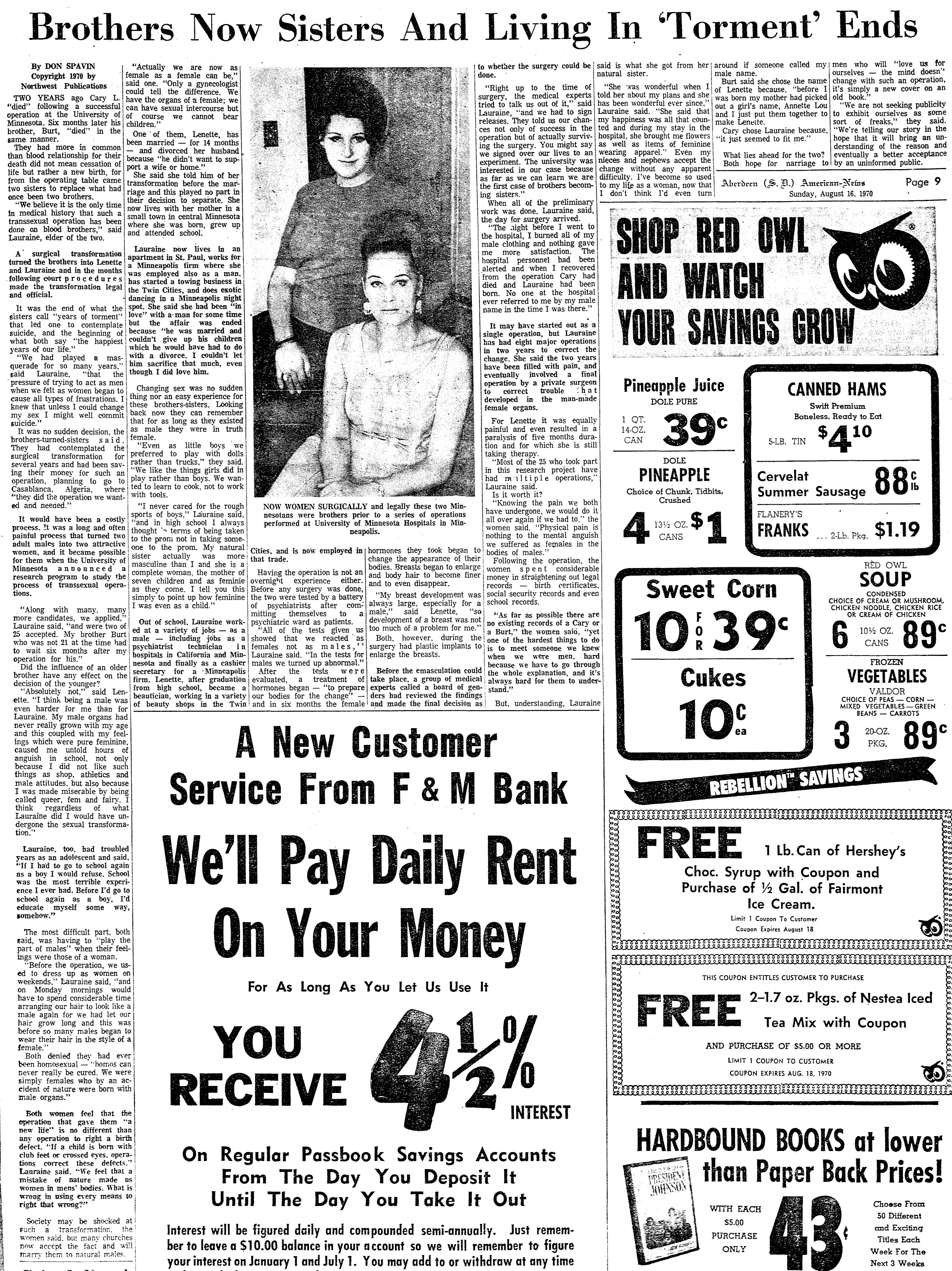
Lauraine Lee (1942 - ) & Lennette Lee (1947 - ) Minnesota pioneers

Lauraine and Lennette, siblings from a small town in Minnesota, after years of frustration and torment at having to pretend to be men, were saving in the hope of going to Dr Burou in Casablanca, when at the end of 1966, the Minnesota Medical School in Minneapolis announced a research program for transsexuals including surgery. Of course they both applied. After a battery of psychiatric tests, they were accepted and after six months on female hormones had surgery in 1968. Lenette had to wait an extra six months until she turned 21. There were post-operative complications that required extra surgeries. There was pain but they were accepted by their family. 

It was Lenette who first married. She had told her husband of her transformation before the wedding, and that was not an issue. However the marriage broke up after 14 months for financial reasons. Lauraine moved to St Paul and for a while worked as a cashier/secretary where she had previously worked before transition. In 1970 Lenette was working as a beautician. 

In 2015 Lauraine commented on the article about them in Transas City. She was then 73 and had been married to the same man for 41 years, and Lennette had had a similar long-lasting second marriage.

  • “Brothers Made Sisters in Rare Sex Operation”. Boston Record American, 28 July 1970: 5. Online.
  • “Half-sisters who used to be half-brothers”. Daily Mirror, July 28, 1970. Online.
  • Don Spavin. “Brother Now Sisters and Living in ‘Torment’ Ends”. Aberdeen, SD, American News, August 16, 1970. Online.
  • Una Nowling. “Lenette and Lauraine Lee, 1970”. Transas City, 2015. Online.
------------

The newspaper articles from 1970 spell Lennette with one N, however Lauraine in 2015 spells it with 2 Ns.

28 June 2021

Trans Magyar/Hungary - a timeline - Part II: WWII to now

 Continued from Part I


1946

The Second Hungarian Republic (Magyar Köztársaság) was created following the formal abolition of the Hungarian monarchy in February.

István Faludi emigrated via Denmark to Brazil, and in 1953 to the US, where the name István was anglicised to Stephen.

  • Anton Prinner.La femme tondue. Paris: APR, 1946.

1948

Hajdu Karoly from Budapest spoke fairly good English, and managed to get into the British sector in Austria, and from there to England as a refugee. As Karl Hajdu he found work in small hotels and nightclubs, and was experimenting with cross-dressing.

  • Anton Prinner. Le livre des morts des anciens Egyptiens..

1949

The Hungarian People's Republic (Magyar Népköztársaság). The surveillance and treatment of queer persons remained the same as it had been under the monarchy, except that the police now surveilled lesbians as well.

Anita Verig Sandor, raised as a girl, at age 15 found her birth certificate that said that she was a boy. She was told to shut up and not ask questions.

1950

Anton Prinner, having spent most of the German occupation of France in hiding, in 1950 settled in Vallauris, close to Antibes and to Italy, as had Picasso. He made ceramics and sculptures, including esoteric statues and protective deities. After 1954 Prinner discovered a passion for ancient Egypt and esotericism. He did an androgynous female Pharaoh, and a female Buddha.

1956

The Hungarian Uprising.

When the Hungarian Uprising began in October 1956, Anita was afraid of being raped by the Russians, so she cut her hair, dressed in some of her father’s clothes and fled to the West. As Sandor he was shot in the knee, and was two months in hospital before getting to England.

After the Hungarian Uprising, Karl Hajdu in London collected ₤2,000 to send ‘freedom fighters’ into Hungary, and led a march to Downing Street. However he was not able to explain where the money went.

1957

Karl Hajdu was pressed into bankruptcy listing 26 creditors, and returned to cross-dressing. He took the name of Michael Karoly and took a course in hypnotherapy. He never graduated but set up in business as a hypnotherapist anyway. He was also commissioned by Paul Elek, a Hungarian, to write a book on hypnosis. The book, the only one of his ever published, includes an early explanation of the joys of cross-dressing, and many of the patients in the book are aspects of himself.

1959

Sandor, presenting as a man, found work in a London hotel stillroom, and met and married a French woman in 1959. They had two sons, but separated after four years, and were divorced in 1967, with the wife retaining custody of the children.

1961

Decriminalisation in Hungary of Homosexuality. Six years before England.

  • Michael B. Karoly. Hypnosis. Elek, 1961.

1960s

Gobbi Hilda, an award-winning Hungarian actress, known for her portrayals of elderly women. During the German occupation she had worked with the Resistance distributing forged documents to exempt men from military service. She was a member of the Communist Party until 1956, when she left over ideological differences feeling that it had abandoned the people. Even before 1961 she was openly lesbian and frequently wore men’s clothing.

1963

Karl Hajdu was charged at Knebworth with a breach of the peace after being arrested dressed as female. He separated from his wife, founded Divorcees Anonymous and seduced several of the women who attended. After a denouncing article in the Sunday People, both his hypnosis patients and members of Divorcees Anonymous stayed away. Later that year both his wife and her son died in separate incidents.

1964

Anton Prinner returned to Paris, and to painting, and was exhibited.

15-year-old, Russian-born El Kazovsky moved to Budapest.

1966

European Athletics Championships held in Budapest, with visual inspection sex testing of all 243 female athletes by 3 female doctors. The intersex athlete Ewa Kłobukowska passed the sex test and won two gold medals.

1968

The New Economic Mechanism (NEM) introduced free-market elements into the socialist command economy. As a result of a relatively high standard of living, a more liberalised economy, a less censored press, and less restricted travel rights, Hungary was generally considered one of the more liberal countries in Eastern Europe.

1970

Karl Hajdu/Michael Karoly changed her name by deed poll in 1970 to Charlotte Maria Beatrix Augusta Hajdu, but normally used the surname Bach. She started writing the enormously long Homo Mutans, Homo Luminens which presents the transsexual urge as the key to human evolution, but could not interest any publishers.

1972

Thomas Kando, born in Hungary and educated at the Universities of Amsterdam and Minnesota, was looking for a dissertation topic when Minnesota’s medical school did its first sex-change operations. He interviewed 17 post-op MTFs, aged 21 to 55, two weeks to two years post-op. He found his subjects to be more stereotypically feminine than other women, and referred to them as ‘reactionary’ and ‘the uncle toms of the sexual revolution’.

  • Thomas Kando. “Passing and Stigma Management: The Case of the Transsexual’.The Sociological Quarterly13, Fall 1972.

1973

  • Thomas Kando. Sex Change;The Achievement of Gender Identity Among Feminized Transsexuals. Springfield, Ill: Thomas 1973.

1976

After the 1967 divorce, Anita returned to living as a woman. She was working as a cinema usherette when she met 17-year-old Peter, a building labourer. They socialised and went on holidays with the other building workers. The major problem was his parents who objected to Anita being so much older.

She had applied for a sex-change operation as it was then known. Peter accepted this and they were able to get a council flat in Islington, north London. In 1976 they decided to get married at an Anglican church in Hackney. She explained that she had lost her birth certificate in flight from Hungary. So they had to go to a solicitor and swear a declaration that she was Anita Verig Sandor born in 1940. There were 50 guests at the wedding, and the vicar attended the reception.

  • Anton Prinner & Lionel Le Barzic. Le Tarot ésotérique et poétique de Prinner: et le développement scientifique, poétique, anecdotique de la cartomancie. [S.l.]: Édition Aujourd'hui, 1976.

1978

The age of consent for gay sex set at 18 in new Hungarian Penal Code.

The English writer Colin Wilson having read Charlotte Bach’s Homo Mutans, Homo Luminens, interviewed her for the magazine Time Out, and featured her prominently in his book, Mysteries, 1978.

  • Colin Wilson. Mysteries: An Investigation into the Occult, the Paranormal and the Supernatural.Putnam, 1978 : Grafton Books 1979: 514-523. With a significant section on Charlotte Bach.

1979

  • Ray Chapman. “Secret of the bride in white: she’s the father of two sons”. The News of the World, 25 March 1979. Online. About Anita Sandor.
  • Janice G. Raymond. The Transsexual Empire: The Making of the She-male.Beacon Press. 1979: 79-86. Includes 7 pages enthusiastically summarising the work of Hungarian Thomas Kando.
  • Thomas Szasz, (Szász Tamás István) “Male and Female He Created Them: review of The Transsexual Empire: The Making Of The She-Maleby Janice G. Raymond”, New York Times Book Review, June 10, 1979: 11, 39. Reprinted in Thomas Szasz. The Therapeutic State. Prometheus Books. 1984: 327-9. Hungarian-born Szasz enthusiasticly reviewed Raymond’s book, which was quoted on both the back and front of the reprint of her book.

1980

  • Thomas Szasz.Sex by Prescription. Anchor Press/Doubleday 198 pp 1980: 86-92. He refers to trans women as ‘he’ etc; compares the operation to clitorectomy; sees sex change as a fraud, accepts uncritically the study that justified the ending of surgery at Johns Hopkins University Hospital, ignoring all the methodological problems that have been raised, but does not respect the decision made by the individual transsexual. He embraces Janice Raymond's claim that sex changes are anti-feminist, and his review of her book is quoted on both its front and back pages. He has said “If a man cuts off his own penis psychiatrists call him a schizophrenic, but if he can persuade a surgeon to cut it off for him, then they call him a transsexual”.

1981

Charlotte Bach died of untreated liver cancer, having refused to go to a doctor, at the age of 60. The revelation that she was a ‘man’ was a surprise to Colin Wilson.

1982

  • Makk Károly & Xantus János(dir) . Egymásra nézve(Another Way), Scr: Makk Károly & Galgóczi Erzsébet, based on the novel by Galgóczi. Hungary 102 mins 1982. It won the Best Actress award at the 1982 Cannes Film Festival and was nominated for the Palme d'Or. A film about the difficulties of being lesbian in Hungary at that time, which became a cult film for lesbian audiences in eastern Europe.

1983

Anton Prinner died in poverty at age 81. Prinner had never returned to Hungary except for a quick visit in 1930, and never discussed his gender change.

1985

  • Anton Prinner,. Anton Prinner, 1902-1983. Paris: Binoche et Godeau, 1985.

1988

The Homeros Society, Hungary's first gay organization, was founded. Initially a social group, it quickly evolved a political side.

1989

All police files about and the registry of homosexuals disappeared and were most likely destroyed by the Communist Party during or shortly after the democratic changes.

1990

May: Free elections held. Power then alternated at each election between the Democratic Forum (conservative) and the Socialist Party.

After the end of the Communist regime, Faludi visited his parents in Israel, the only time that he ever did so. He then moved to Budapest. He attempted to get the deeds of the buildings that the family used to own in Budapest, and then attempted to reclaim the buildings, but without success.

1996

US inventor William Nelson had created the EPFX (Electro-Physio-Feedback-Xrroid System), which he said would diagnose and eliminate all diseases from Aids to cancer. The US Food and Drug Administration indicted him on felony fraud charges in 1996, and he relocated to Budapest.

Parliament passed a law that recognised unregistered cohabitations. It applied to any couple living together in an economic and sexual relationship (common-law marriage), including same-sex couples. No official registration was required. The law gave some specified rights and benefits to any two persons living together.

1997

First LGBT Pride in Budapest - the first in Eastern Europe. This became an annual event.

2002

William Nelson became Desiré Dubounet. She performed with her band, Hunz, at conventions for fans of her machines and in her own club. She also made films at a Budapest studio, and was an activist for LGBT rights in Hungary.

A Constitutional Court decision set the gay age of consent to be the same as for heterosexual activity, that is 14.

  • lFrancis Wheen. Who was Dr Charlotte Bach?Short Books, 2002.

2003

As part of the preparation to join the European Union, Hungary passed the Equal Treatment Act. They were so eager that they added extra categories: in addition to race, religion and sex they included ‘family status’, ‘motherhood’, ‘fatherhood’, ‘circumstances of wealth and birth’, ‘social origin’, ‘state of health’, ‘language’, ‘part-time work status’, and ‘trade union representatives’. They also added ‘gender identity’, which made Hungary the first country in the world to do so. However the legislation was very far in front of public opinion, and while gender changes became legally recognised, public acceptance was low.

2004

At age 76, Faludi, now using the name Stefánie, had vaginoplasty and breast augmentation with Dr Sanguan Kunaporn in Phuket, Thailand. At this stage she had minimal experience of going out as a women – she had done this mainly in Vienna, rather than Budapest. As she did not have psychologists’ letters that approved her for surgery, Faludi wrote a letter as if from a Hungarian friend, and this was accepted by Dr Kunaporn. She also deducted 10 years from her age, in case she was rejected for being too old. Faludi flew out in men’s clothes and with women’s clothes for after surgery, and with several cameras, a tripod, a videocam, a computer and DVD player, and a suitcase full of films, music, and opera recordings. Faludi was able to persuade Kunaporn’s staff to film the operation.

Later in 2004, after a quarter century of non communication, Stefánie contacted her daughter Susan Faludi who had become a well-known author in the US with her books Backlash, 1991, and Stiffed, 1999. Susan visited her father in Budapest several times.

2007

Parliament adopted a registered partnership bill submitted by the Hungarian Socialist Party–Alliance of Free Democrats Government. The bill was found unconstitutional by the Constitutional Court because it duplicated the institution of marriage for opposite-sex couples. In February 2009, the Parliament approval a modified version of the bill. Since 1 July 2009, same-sex couples could enter into registered partnerships. The law gave the same rights to registered partners as to spouses except for adoption, assisted reproduction or taking a surname.

The first year that LGBT Pride was violently attacked.

Budapest hosted Mr Gay Europe as part of Pride Island Europa, Central and Eastern Europe's largest new International GLBTQ celebration

  • Bence Solymar & Judit Takacs. “Wrong Bodies and Real Selves: Transsexual People in the Hungarian Social and Health Care System”. In Roman Kuhar & Judit Takacs, Beyond the Pink Curtain: Everyday Life if LGBT People in Eastern Europe. Peace Institute, 2007.

2008

More violent attacks during LGBT Pride. An amendment to punish violent behaviour aimed at hindering other persons’ participation in a public demonstration was adopted in the Criminal Code.

El Kazovsky, one of Hungary’s leading painters, died age 60. Although AFAB he had lived his life as an androphilic man.

Budapest hosted Mr Gay Europe again.

Transvanilla Transgender Association (Transvanilla Transznemü Egyesület) activist group founded

2010

The Fidesz party led by Orbán Victor won a supermajority and proposed to change the constitution.

Andrea and Balazs, marriage of a trans man and a trans woman.

2011

Singer Szecsődi Kári  came out as trans in a television interview. She defined herself as “not a boy, not a girl, not straight, not bisexual, not gay, just me”.

2012

Szecsődi Kári had top surgery.

Budapest hosted the gay EuroGames.

A new constitution, enacted by the Parliament in 2011, came into effect, restricting marriage to heterosexuals, and removed all protections from discrimination for GLBT persons. However the 2003 Equal Treatment Act was still in effect.

The Jobbik party introduced a constitutional amendment to the Parliament seeking to ban "the promotion of sexual deviations". The amendment would punish the "promotion of homosexuality or other disorders of sexual behaviour" with up to eight years in prison. The amendment ultimately failed to pass.

2014

5th European Transgender Council held in Budapest.

2015

Stefánie Faludi died age 88. Daughter Susan was working on a biography, but also an account of her own discovery of her father’s womanhood and of the history of Hungary.

Hungarian-born Swedish ballet dancer, ballet teacher, and former soloist with the Finnish National Ballet, Julia Horvath, transitioned.

2016

Szecsődi Kári, after the failure of her single was living abroad with a US boyfriend and doing erotic work.

  • Susan Faludi. In the Darkroom. Henry Holt and Company, 2016.

2017

December: A government decree was published, establishing for the first time a legal basis for gender transitions. After 1 January 2018, transgender people living in Hungary were theoretically able to change their legal gender. They required a diagnosis from a medical professional, but did not have to undergo hormone therapy, sterilization or sex reassignment surgery.

2018

Transvanilla reports that the government was refusing to honour applications for the legal gender change.

2019

A joint case of 23 trans people was created and submitted to the European Court of Human Rights in that their rights are being denied.

2020

During the Coronavirus lockdown Orbán Viktor was enabled to rule by decree following an emergency powers act. On 31 March, the Transgender Day of Visibility, a bill was submitted that redefined the Hungarian term "nem", which may mean either "sex" or "gender", to mean sex at birth, defined as "the biological sex determined by primary sexual characteristics and chromosomes". Parliament voted in favour of the bill on 19 May 2020, making it impossible for individuals to change their legal gender. The vote was 134 yes, 56 no, and 4 abstentions. Dunja Mijatović, commissioner for human rights in the Council of Europe, stated it "contravenes human rights standards and the case law of the European Court of Human Rights"

December: the Equal Treatment Authority (ETA) was abolished. Its duties, including the legal protection against racial, gender and other discrimination, were taken over by the Commissioner for Fundamental Rights. ILGA expressed grave concerns.

2021

June: a new law prohibiting the showing of "any content portraying or promoting sex reassignment or homosexuality" to minors.


The following were consulted.

  • Francis Wheen. Who was Dr Charlotte Bach? Short Books, 2002.
  • Geertje Mak. "Sandor/Sarolta Vay: From Passing Woman to Sexual Invert". Journal of Women's History. 16 (1) 2004: 54–77.
  • Linda Rapp. Hungary. glbtq, 2004.
  • Bence Solymar & Judit Takacs. “Wrong Bodies and Real Selves: Transsexual People in the Hungarian Social and Health Care System”. In Roman Kuhar & Judit Takacs, Beyond the Pink Curtain: Everyday Life if LGBT People in Eastern Europe.Peace Institute, 2007.
  • Judit Takács. “Queering Budapest”. In Matt Cook & Jennifer V Evans (eds). Queer Cities, Queer Cultures: Europe since 1945. Bloombuey, 2014: 191-210.
  • Tamas Bezsenyi. “The Great War in the Backyard: The Unsettling Case of a Rural Hit(Wo)man”. In Nari Shelekpayev, Francois-Oliver Dorais, Daria Dyakonova & Solene Maillet (eds). Empires, Nations and Private Lives: Essays on the Social and Cultural History of the Great War. Cambridge Scholars Publishers, 2016.
  • Susan Faludi.In the Darkroom. Henry Holt and Company, 2016.

EN.Wikipedia(LGBT rights in Hungary) EN.Wikipedia(LGBT History in Hungary)

26 June 2021

Trans Magyar/Hungary - a timeline - Part I: to WWII

Note: Hungarians put the family name first, as do Basques, Chinese etc.   In the account below name of Hungarians living in Hungary are written family name first.   However as Hungarians living elsewhere adjust their names to the local practice, they are then written family name last.


1848

Although the Revolution of 1848 failed, it did lead to Hungary becoming the third country of Continental Europe (after France 1791 and Belgium 1831) to hold democratic elections (June, 1848), and thereafter, set up a representative type of parliament which replaced the feudal-estates based parliamentary system.

1849

The Hungarian Parliament proclaimed and enacted the first laws of ethnic and minority rights in the world.

Austrian military intervention in the Kingdom of Hungary resulted in strong anti-Habsburg sentiment among Hungarians. Thus the events in Hungary grew into a war for total independence from the Habsburg dynasty. Around 40% of the private soldiers in the Hungarian Revolutionary Army consisted of ethnic minorities. After a series of Austrian defeats in 1849, the Austrian Empire came close to the brink of collapse. The young emperor Franz Joseph I called for Russian help. Tsar Nicholas I sent a 200,000 strong army with 80,000 auxiliary forces. The joint army of Russian and Austrian forces defeated the Hungarian forces. After the restoration of Habsburg power, Hungary was placed under martial law.

1867

The Austro-Hungarian Compromise of 1867 (German: Ausgleich, Hungarian: Kiegyezés) established the dual monarchy of Austria-Hungary. A single monarch, Franz Joseph I, reigned as Emperor of Austria in the Austrian half of the empire, and as King of Hungary in the Kingdom of Hungary. Hungarians widely considered the compromise as a betrayal of vital Hungarian interests and the achievements of the reforms of 1848.

1869

Gay man, Karl-Maria Benkert, although born in Vienna, was raised in Budapest. He later Magyarised his name to Kertbeny Károly Mária. In 1869 he published two pamphlets using the terms he had coined: homosexual and heterosexual.

1870

After 11 years of being raised in Pest province as a boy and taught fencing, fishing, horseback riding and shooting, it was revealed that Vay Sándor was a girl, and she was sent to Dresden and enrolled under her legal name of Sarolta in a girls’ school, from where she ran away with a lover.

1878

The first Hungarian Penal Code punished homosexuality between men (természet elleni fajtalanság – perversion against nature) with prison up to one year.

1880s

Vay Sarolta became one of the first Hungarian women to graduate with a university education. He then reverted to being Sándor. He lived entirely as a man, engaging in typical upper class behaviour such as drinking, duels and travel. Vay regularly contributed to newspapers. He had a reputation as a carouser, frequenting houses of prostitution and night clubs. Around 1882, he was involved in a duel over the actress, Hegyesi Mari, though it is unknown if she returned his affection for her. From 1883 to 1887, he was in another relationship with an actress, Eszéki Emma, whom he had met in the provincial town of Nyíregyháza. The couple were married by a priest and lived together in Pest.

1889

Vay ended his relationship with Eszéki when he met Mari Engelhardt, a 26-year-old Austrian schoolteacher. To free himself from the existing marriage, Vay paid a large settlement to Emma. Against the wishes of the Engelhardt family, the new couple eloped and married in August 1889. Struggling financially, possibly due to gambling debts, Vay borrowed Ft800 from his new father-in-law, which he claimed was needed as a bond to obtain employment in a stock company. Herr Engelhardt then saw Vay as a swindler, sued him for fraud, and had him arrested. Some of Vay’s documents were found to be counterfeit, and his biological sex was revealed. Mari testified that she had no idea that he was not a man.

Based upon the physicians' statements to the court, that Vay was an invert and unable to behave differently, the court acquitted Vay of fraud and released him without requiring him to revert to being a woman. He returned to Budapest and to journalism.

1900

Vay had his greatest success between 1900 and 1910. He compiled over 400 stories and published them in 15 volumes, becoming a popular and well-established author.

  • Adolf Ágai (Vay Sandor). Régi magyar társasélet. Budapest: Atheneum, 1900.

1903

A young dancer had been with the Royal Opera for a few years. She was admired for her grace and modesty. However after developing signs of mental distress, she was taken to the Leopoldifelder Insane Asylum. Subsequent examination revealed that she was male-bodied (Hirschfeld p314)

  • Vay Sándor. D'Artagnan meséi.Budapest: Voss József, 1903.

1906

Vay began working as a merchant in Rijeka/ Fiume in Croatia. He sold coffee and imported goods, and wrote and distributed a free newspaper called the Kávé Ujság (Coffee News). Though initially promising, his business failed and he returned to journalism.

  • Luz Fraumann. Ein merkwürdiger Roman [Captured Women: A Remarkable Novel], Budapest: M. W. Schneider, 1906. A novel by one of Hirschfeld’s patients which depicts the marriage of a trans man and a trans woman.

1907

  • Vay Sándor. Pestvármegyei históriák. Budapest: Érdekes Újság Kiadóhivatala, 1907.

1908

  • Vay Sándor. Régi nemes urak, úrasszonyok: históriák, legendák, virtusos cselekedetek. Budapest: Singer és Wolfner, 1908.

1909

Michael Semeniuk was head waiter at one of the most prestigious restaurants in Czernowitz (then in Austria-Hungary). He was well-regarded and popular. In 1909 he fell ill. Neighbours summoned a doctor, who met with such resistance when he attempted an examination that he had to leave without making a diagnosis. Michael poisoned himself overnight. Examination of the body disclosed that he was female-bodied.

1910

24-year-old Fődi Viktória escaped from a bad marriage, took the name Pipás Pista (Pista is a nickname derived from Istvan or Steven, and Pipás is a pipe smoker) wore male clothing and travelled around the Great Hungarian Plain doing male jobs such as plowing, sowing, harvesting and slaughtering pigs. He was primarily employed by widows or wives whose husbands were unable or not doing the job for whatever reason. The advent of war in 1914 increased such work opportunities.

1914

The Great War started in Sarajevo with the assassination of the heir presumptive to the Austro-Hungarian throne.

1918

March: suffering from pneumonia, Vay Sándor was admitted to hospital. After undergoing surgery, he died of pleurisy age 58 on 23 May 1918 in Lugano, Switzerland.

With the end of war, the dual sovereignty of the Austrian Empire and the Kingdom of Hungary fell apart. Austria became a republic. In Hungary, after a year of being a republic, strongman and last Admiral of the Hungarian Navy, Miklós Horthy took over, re-established the Kingdom of Hungary and declared himself Regent. The apparent king, Károly IV, twice attempted to take the throne, but was rebuffed, exiled to Madeira and died shortly afterwards. Hungary continued as a kingdom without a king. By the Treaty of Trianon, 1920, Hungary lost over 70% of its territory and 66% of its population as Czechoslovakia, Yugoslavia and Poland came into being, and Romania was enlarged.


1919

Some wives, having become used to independence, were not too happy with the return of their husbands from the war, especially if they were abusive. Divorce was not an option. In 1919 Pipás Pista performed his first husband-killing, that of Börcsök István, with the help of two male assistants, and in front of the wife and children. Pipás, hiding behind the main door, put a rope around Börcsök’s neck, at which moment his accomplices threw the other end of the rope over the beam, and started to pull it as quickly and as strongly as they could. They then carried the body to the stable—with the help of the victim’s oldest son—and hanged him so that it would resemble suicide. Pipás put a chair under the hanging corpse and knocked it down to look like it had been kicked away.

It is not recorded how many husbands were removed by Pipás Pista. Word of his services spread by word of mouth, but the authorities were not informed. The land was poor in the region, and small farmers were fairly often driven to genuine suicide.

1920s

Aranka Gyvengy performed female roles and minor parts on the stage in Budapest for 23 years before being outed.

1926

Prinner Anna, student at the Magyar Képzőművészeti Egyetem (Hungarian University of Fine Arts) had two paintings hung by error in the Szépművészeti Múzeum (Museum of Fine Arts) where they were a great success.

1927

Prinner moved to Paris in 1927, taking a French-style male name of Anton Prinner and from then wearing male clothes, a beret and smoking a pipe. Picasso would greet him as "Monsieur Madame".

  • Pál G., A homoszexuális probléma modern megvilágításban[The homosexual problem in a modern light]. Budapest: Mai Henrik és Fia Orvosi Könyvkiadó,1927. Estimated over 10,000 urnings in Budapest.

1929

  • Turcsányi G. (ed.), A modern bűnözés [Modern Criminality]. Budapest: Rozsnyai Károly Kiadása, 1929. A chapter devoted to the punishment and cure of homosexuality. Claims the proportion of homosexuals used to be half a per cent of the population, but due to the war, and the long terms of internment for prisoners of war which went with it, this rate had recently reached 1 per cent. In modern big cities this rate could have been even higher: in Budapest, for example, the male population was 438,456 in 1925, while the number of homosexual men can be estimated at more than 5000, which is more than 1 per cent.

1932

Anton Prinner the artist had a constructivist period from 1932, and a figurative period from 1937. He did his first wooden sculpture in 1940, a medium that he so made his own that Picasso called him the "petit pivert" (little woodpecker). Himself only 1.5 metres, he carved statues up to five metres high.

In June 1932 local police broke up a couple’s quarrel, and walked the woman home. The man’s former wife was the daughter of one of the husbands that Pipás Pista had eliminated. The woman talked too much, and soon afterwards Pipás Pista was arrested and with two clients and assistants was put on trial. After the Tiszazug scandal in 1929 where 129 murdered husbands had been discovered, authorities wanted to minimize the charges against Pipás Pista. The arrest of course outed Pipás Pista as having a female body, and he was compelled to dress as a woman for the trial, something that caused obvious distress. He remained unwilling to admit to being a woman, even though it was reported that his gender was an open secret.

1933

Pipás Pista was sentenced to death in January 1933, but the sentence was commuted by the Regent Miklós Horthy.

Martha Toth worked 20 years at a factory in Buda Pest. She had lived by herself, and had no man in her life. At age 50 she had a heart attack and died. The summoned doctor found that she was male-bodied.

1934

  • Nemes Nagy Zoltán,Katasztrófák a szerelmi életben. Sexualpathologiai tanulmányok. II. kötet [Catastrophes in the love life. Sexual-pathological studies. Volume II.]. Budapest: Aesculap Kiadás, 1934. A chapter on homosexuals in Budapest. ‘Budapest is the first metropolitan city in the whole world where semi-official records are compiled on homosexuals’ for about 15 years. The author estimates that ‘the real number’ of homosexual men in Budapest is about 15,000, most of whom will never be detected as they belong to ‘upscale circles, carefully trying to avoid publicity’.

1936

  • Magnus Hirschfeld. Sexual Anomalies and Perversions: Physical and Psychological Development and Treatment : a Summary of the Works of the Late Magnus Hirschfeld.London: Francis Aldor, 1936. Actually this was mainly a précis written mainly by the Hungarian expatriate Arthur Koestler (Kösztler Artúr).

1940

Pipás Pista died in prison age 56 suffering from emphysema and myocardial degeneration.

Hungary formally joined the Axis powers in November. In 1941 it was part of the invasions of Yugoslavia and the Soviet Union.

1944

March: After Regent Miklós Horthy sought a secret peace pact with the allies, German troops occupied Hungary.

October: Soviet troops arrived.

December: Soviet troops surrounded Budapest.

The war left Hungary devastated, destroying over 60% of the economy and causing significant loss of life. In addition to the over 600,000 Hungarian Jews killed, as many as 280,000 other Hungarians were raped, murdered and executed or deported for slave labour by Czechoslovak, Soviet and Yugoslav forces.


Continued in Part II.

20 June 2021

The Black Cap, Camden

A pub in Camden Town, London, at 171 Camden High Street.   It was first licensed in 1751 and was originally called the Mother Black Cap, after a local supposed witch, one Jinny Bingham (c.1600- c.1680), known as Mother Damnable, whose parents had been hanged for witchcraft and procuring a death.   Another pub, the Mother Red Cap, was also named after her.  

From the mid-1960s The Black Cap was a well-known gay pub, and later became known for its drag-queen cabaret. Its most famous performer was Mrs Shufflewick (who was often taken as a cis woman) who did a Sunday Lunch performance during the 1970s.  After she died in 1983, the upstairs bar was renamed The Shufflewick Bar - the management also paid for her funeral.  


Other performers included Lilly Savage, Danny La Rue and Regina Fong.  

Three murderers frequented the pub:

The gay Dennis Nilsen killed at least 12 young men and boys from 1978-1983.  One of his victims was Carl Stotter who performed at the Black Cap as Khara Le Fox. Nilsen started to kill him, but then let him go.  Stotter testified at Nilsen’s trial in 1983 (which resulted in a Life Sentence) - however he never got over the experience and became alcoholic and died age 52.  Nilsen died in prison age 72.

The heterosexual divorcee Anthony Hardy (The Camden Ripper) also frequented the Black Cap.  He murdered the woman he was living with and two female sex workers in 2002.  He has been given a whole life tariff and thus will never be released.

Also in 2002 Thomas McDowell, a homophobic male prostitute met a German trainee rabbi in the Black Cap, took him home and murdered him.   It is recommended that he never be released.

The pub continued as a venue for queer culture until 2015, when it was proposed to convert the building into flats.  However there has been a campaign to raise £3 million to purchase the pub and partner with an LGBTQ+ operator to operate it.

  • Richard Benner (dir). Black Cap Drag, with Shane and Laurie Lee.  UK/US 42 mins 1969.  
  • Mrs Shufflewick.  Live from the New Black Cap.  LP 1972.  Online.
  • Polly Perkins.  “Camping it up in Camden Town”.  The Stage, 5 July 1973.  
  • Patrick Newley.  “A drag pub to cap it all”. The Stage, 25 January 1996.  
  • Lawrence Senelick.  The Changing Room: Sex, drag and theatre.  Routledge, 2000: 231, 370.
  • Patrick Newley. The Amazing Mrs Shufflewick: The Life of Rex Jameson. Third Age Press. 2007.
  • "Historic Drag Pub Camden's Black Cap Closed Down By Owners". This Is Cabaret. 2015-04-13.  Online.
  • Martin Plaut &Andrew Whitehead. “The story of burlesque at the Black Cap”.  Kentishtowner, September 30, 2015.  Online.
  • Michael J Buchanan-Dunne.  “The Deadliest Pubs in London”.  Murder Mile Tours, 20/5/2016.  Online.  
  • Dan Carrier.  “Rival bids to buy Black Cap pub as famous venue is put up for sale”.  Camden New Journal, 21 November 2019 Online.  

 EN.Wikipedia       WeAreTheBlackCap     


12 June 2021

The Hamilton Lodge Ball

Harlem’s Hamilton Lodge, also known as Rockland Palace, was founded by the Grand United Order of Odd Fellows, Lodge 710, on 155th street and 8th Avenue in Manhattan. It was initially a home for affluent African Americans, and provided political events, banquets, church sermons, lectures and pageants.


From 1869, it sponsored the Masquerade and Civic Ball each February, the fanciest such ball in New York. While transvesting persons attended from the beginning, the gay and trans component blossomed after a new group of organisers took over in 1923.The event was then informally known as the Faggots’ Ball or the Dance of the Fairies. It became the most popular gay event in town, attended by both black and white queers, and also artists and writers. About 800 attended in 1925 and fifteen hundred in 1926. Growing numbers of spectators attended not to dance but just to gawk. Three thousand spectators in 1929 watched two thousand dancers, and in the next few years a total of up to seven thousand spectators and dancers attended.

In 1928 the Committee of Fourteen, a private anti-vice organization that was mainly concerned with prostitution, and mainly in white neighborhoods, employed a black teacher to investigate Harlem’s nightlife. Following her report, Adam Clayton Powell, the pastor of the Abyssinian Baptist Church fulminated against sexual perversions, and the New York Age published his sermons. Bishop R. C. Lawson, the founder and pastor of Harlem’s Refuge Church of Christ attended the ball with two parishioners. He then offered a sermon titled “The ‘Faggots’ Ball, and What It Means in the Light of the Scriptures”, and drew an overflowing crowd to hear him denounce those at the ball, the spectators as well as the dancers. However the popularity of the Hamilton Lodge Ball continued to increase after their attacks.

All kinds of persons attended the balls: celebrities, socialites, businessmen, prostitutes, bohemians and families. Singer Ethel Waters attended and boasted that the drag queens to whom she lent gowns won prizes. Gay writer Max Ewing wrote in 1930: “all the men who danced . . . were dressed as women, wearing plumes and jewels and decorations of every kind”. The heiress A’Leila Walker and the singer Nora Holt were prominently present that year. Tickets were a dollar cheaper if you were in costume. Two of the daughters of Fred R Moore, the conservative black publisher of the New York Age, had short haircuts before attending and “They were dancing and having a good time, and they would come up to us. We’d say, ‘We’re women, no, no.’ . . . [but] they didn’t know whether we were the real thing or not.”

In early 1931 the New York police were harassing the Pansy Clubs, and later moved to close down the drag balls as well. However, the police - having made their point - backed down and the February 1932 Hamilton Lodge ball was on as usual, although competing events in Times Square and Madison Square Gardens were discontinued.

The ball is featured in two novels about homosexuality of the early 1930s. 

Blair Niles, a middle-aged woman on the Social Register who investigated gay New York, in 1931 wrote: 

“thousands of people crowding a great hall. Three thousand....No, more than that. Some one said there were five thousand, many of them sight-seers, come to look on. There were Harlem people and down-town people. There were celebrities of the stage and the literary world. A rumor went about that Bentrice Lillie was there, and for a moment many eyes focused on the box she was supposed to be occupying. …. Such crowds of people seen now through a haze of smoke—black people and white people and all the intervening combinations, people filling the boxes, leaning over the railings to look down upon those who thronged the floor. People packing the aisles and the stairways. The hall so hot. The air blue-gray, the electric lights showing as in a fog. The sound of many voices blended into one great reverberant voice. A great orchestra playing. The music seeming to come from far off. Figures dancing to that distant music. Throngs of people talking...staring...dancing. An incredible spectacle!

Now the floor being cleared by the police. This was a licensed masquerade party with police protection. All violations of the Penal Code of the State of New York scrupulously avoided. Thus it was the officers of the Law who cleared the floor for the parade of the “fairies,” holding back the crowd, while a long elevated platform was set up in the center of the hall. They held back the crowd, too, while the “fairies” came on in single file, to mount platform and slowly walk its length, pausing now and then to strike attitudes, to stiffen into statuesque poses, to drop curtsies or to execute some syncopated phrase. The crowd surged forward and was again and again pressed back to make room for the paraders.”

Fird & Tyler, in their 1933 novel which was published in Paris, but banned in the UK and the US, wrote:

 “The ball was too large to be rushed at without being swallowed. The negro orchestra on the stage at one end was heard at the other end with the aid of a reproducer. On both sides of the wall a balcony spread laden with people in boxes at tables. Underneath were more tables and more people. The dancefloor was a scene whose celestial flavor and cerulean coloring no angelic painter or nectarish poet has ever conceived.”

The Hamilton Lodge Ball, more than any other ball, was much reported in newspapers such as the Amsterdam News, and the New York Age, Baltimore’s Afro-American, and the Inter-State Tattler. In the 1920s the reports had used negative terms such as ‘subnormal’ and ‘fairies’, but as the attendance went up so did the positivity of the words used. In 1932 a reporter for the New York Age wrote: 

“To one of the largest gatherings that has ever graced this hall [Rockland Palace] came the all-conquering Hamilton Lodge, resplendent in all the panoply of pomp and splendor, to give to Harlemites who stood in wide-eyed astonishment at this lavish display a treat that shall never be forgotten. The usual grand march eclipsed in splendor all heretofore given by them, and women screamed full-throated ovation as the bizarre and the seeming impossible paraded for their approval. . . . [We] say ‘All Hail, Hamilton’.”

Amsterdam News 6 March 1937 


In 1938 over 8,000 attended. The police then exerted pressure and threatened a raid. Seventeen AMAB persons were arrested including two laborers, two unemployed men, a dishwasher, a domestic servant, an elevator operator, a counterman, a handyman, an attendant, a clerk, and a nurse, along with a musician, an artist, and an entertainer. More than half were under thirty, and only one was over forty years old.

The Lodge found that securing the necessary permits was no longer possible, and discontinued sponsoring the event.

  • Blair Niles. Strange Brother. H Liveright, 1931: 210-220. Wikipedia.
  • Charles Henri Ford & Parker Tyler. “I Don’t Want to be a Doll” in The Young and Evil.The Obelisk Press, 1933: 151-178. Essay.
  • George Chauncey. Gay New York. Basic Books, 1994: 130, 227–228, 252, 257–264, 266, 294, 295, 296, 332–334.
  • Thaddeus Russell. “The Color of Discipline: Civil Rights and Black Sexuality”. American Quarterly,60,1, 2008.
  • Chad Heap. Slumming: Sexual and Racial Encounters in American Nightlife, 1885-1940. The University of Chicago Press, 2009: 91, 94, 261, 265–67, 271–72, 382n62.
  • Anna Lvovsky. Queer Expertise: Urban Policing and the Construction of Public Knowledge about Homosexuality, 1920–1970. PhD thesis, Harvard University, 2015: 39-42, 48-53, 75-81, 96. Online.
  • Oliver Stabbe. “Queens and queers: The rise of drag ball culture in the 1920s”. International Museum of American History, April 11, 2016. Online.
  •  “The Oft-Overlooked ‘Drag Balls’ of Harlem”. Bowery Boogie, June 28th, 2019. Online.

 QueerMusicHeritage