Essays on trans, intersex, cis and other persons and topics from a trans perspective.......All human life is here.
This site is the most comprehensive on the web devoted to trans history and biography. Well over 1800 persons worthy of note, both famous and obscure, are discussed in detail, and many more are mentioned in passing.
There is a detailedIndexarranged by vocation, doctor, activist group etc. There is also a Place Index arranged by City etc. This is still evolving.
In addition to this most articles have one or more labels at the bottom. Click one to go to similar persons. There is a full list of labels at the bottom of the right-hand sidebar. There is also a search box at the top left. Enjoy exploring!
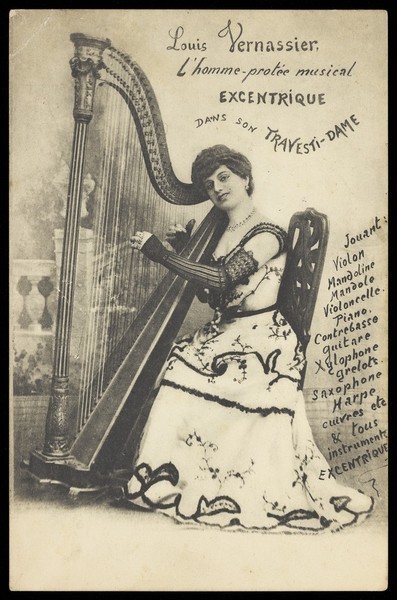
L'homme protée (French for protean man) was a term used for stage female impersonators cum quick-change artists from the turn of the 20th century to the mid 1920s,
A "Vernassier, Louis" was killed in action at Saint-Jean-de-Bassel on 20 August 1914 (only three weeks into WWI) - this may be the same person.
----------------
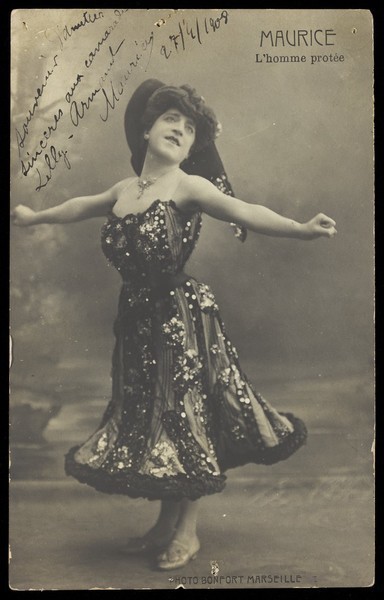
Lilly-Armand Maurice, 1908
Both these photographs are in the Digital Transgender Archive, and are taken from the James Gardiner 20th Century Drag Postcards collection at the Wellcome Library.
An article on the front page of La Volanté, 20 Juillet 1933.
Translation
Anti-Semitism Against Science.
Professor Magnus Hirschfeld whose work on sexuality is famous, is in exile in Paris
---------------
and 180 of his works, 40 thousand volumes that he had collected, have been burned in Berlin by the Nazis.
He has been our guest for a month, staying at the Hotel d'Orsay, with his countless filing cards and a young Japanese secretary, Tao-Li, who follows him like his shadow.
A strange man, this exile from Hitler's regime, Magnus Hirschfeld: a Don Quixote of sexuality, who travelled the globe for 40 years, from Europe to China, studying the problem of sexual perversion, in Man and in animals-- even insects--to defend and treat a mystery of nature. A really great mystery, when a huge, bearded guy has an irresistible urge to put on a dress and make tapestries.
In his museum of sexuality in Berlin he saw 40,000 cases, strange cases mixing buffoonery and drama, a museum where garter belts and bras serve as men's outfitting.
I should say his former museum. For it's all gone. His 14,000 volume collection on the subject, his own 180 papers, a collection that would astonish Freud, Malthus and the Marquis de Sade-- all burned.
Tao-Li showed me in. The professor was wearing a white shirt. His dreamy blue eyes focussed on me rather severely. I was a little embarrassed. Would he take me for case no. 40,001? Thank God, his scowling expression, darkened by his gray moustache, like a Indian sculpture, lightened up. "Forty years ago," he said, "when I was a young doctor, one of my patients, an officer, killed himself on the night before his wedding. I learned the real reason for his despair only after he died. I was interested. I wrote a pamphlet under a pseudonym. The day after it was published, my bookstore was swamped with requests-- an unexpected bookseller's success. That's how I got started.
At the professor's invitation, I interviewed him. "It isn't true", he said, "that Germany has a monopoly on inverts. But there, they are legally controlled and they attract attention, while in France, the Napoleonic Code does not interfere with the private affairs of individuals. Here, cases like that of Oscar Wilde or Prince Eulenburg would go completely unnoticed."
But what about all those 'special' clubs in Berlin? "That's just it. The police watch them carefully; the problem is kept in one place where it's easy to control. According to the statistics, there are one million inverts in Germany. In Berlin alone there are 20,000 female domestic arrangements and thousands of men in dresses and silk stockings."
His answer was vague: Several countries offered to take him, including America, China and Egypt, but he would rather stay in Europe: "I feel more at home, especially in France, where I always find a warm welcome, and two scientists who initiated me are here, Brown-Sequard and Charcot."
It was time to leave. I was starting to feel a little insecure about my own sexuality, escpecially after Tao-Li, who was himself well versed in the subject, showed me some of the profesor's books with photos of strange patients. One of them was cutting women's hair, another only liked white gloves, a third killed himself because he couldn't get permission to dress as a woman!
On the way back, I could not get out of my mind everything that this good man had revealed to me. I began to freak out passers-by with an abnormal exprssion. At the Place de la Concorde a big car passed driven by a Japanese. Riding in back, with his hair flying in the wind, was Professor Magnus Hirschfeld.
Yvonne NOVIA
-------------------
Of course Tao-Li was Chinse, not Japanese.
It was good to see this on the front page of La Volanté. I have not found any English languages papers that paid the same attention to Hirschfeld in Paris.
Charlaque was born in Berlin-Schöneberg and raised with the name Curt Scharlach. There was a brother Hans, seven years older. The family, who were Jewish, emigrated to the US at the turn of the century and settled in San Francisco, where Edmund Scharlach worked as a sales representative in textiles. However the mother, Jenny, returned to Germany in 1910. Edmund, who had become a US citizen stayed and remarried in 1916.
Hans returned to Germany shortly after the start of the Great War in 1914. After 1919 he worked as an independent banker, until he sold his business in the mid-1920s. Curt worked briefly as a female impersonator, and consulted Harry Benjamin who suggested Magnus Hirschfeld in Berlin. Curt moved to Berlin in 1922 when Jenny was seriously ill, and lived with Hans for a while, but also spent time in France and became proficient in the language.
Increasingly Curt was rather Charlotte, and obtained a Transvestitenschein, to legally dress as the woman that she felt she was. She had completion surgery at the Am Urban hospital in Berlin-Kreuzberg in 1929-30, under the aegis of Magnus Hirschfeld’s Institut für Sexualwissenschaft. The surgery was done by Erwin Gohrbandt, and Felix Abraham paid the required 50 Reichsmarks. Like Dörchen Richter, Charlotte worked at the Institute, Dörchen as a maid, Charlotte as a receptionist. Her formal name was now Charlotte Curtis Charlaque.
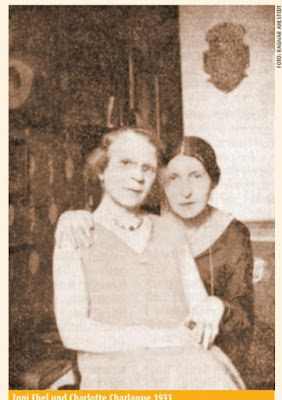
Charlotte met Toni Ebel and introduced her to Hirschfeld who accepted her into the surgical program. Toni had completion surgery in several operations in 1932. By that time Charlotte and Toni had become lovers. The Swedish journalist Ragnar Ahlstedt visited them at their flat at Nollendorfstraße 24 in Berlin-Schöneberg, and wrote about them in his Män som blivit kvinnor, 1933. They lived cheaply: Charlotte said that she was an actress and Toni was able to sell some paintings and drawings.
Under Charlotte’s guidance, Toni converted to Judaism. In addition Toni had previously been a member of the Socialist USPD. After the Nazi takeover, one of Toni’s half sisters warned them that they were under observance, and they fled to Karlovy Vary (Karlsbad), in Czechoslovakia’s Sudetenland, the largest spa town in Europe, in May 1934. Charlotte gave English and French lessons, and Toni painted pictures for guests at the spa. The next year they moved to Prague and then to Brno. However they had to report to the police every fortnight and were advised to leave.
So they returned to Prague in 1938. Charlotte taught English and French and also gave acting courses and worked as a translator. She translated at least three stage works by the Czech writer Olga Scheinpflugová (1902-1968) into English. These are the dramas Chladné světlo (The Cold Light) , Láska není všecko (Love is not everything) and Pan Grünfeld a strašidla (Mr. Greenfeld and the Ghosts).
In March 1942 Charlotte was arrested by the Czechoslovak Aliens Police and jailed for being a Jew. Toni managed to persuade the Swiss consul that Charlotte was a US citizen, that she had submitted her documents to the US consul in Vienna and was waiting for a new passport. This resulted in Charlotte being sent to an “American camp” and later deported to the US. She sailed from Lisbon 2 July 1942. Toni attempted to follow but was not approved as Reichsdeutsche, and was not allowed to travel to Lisbon.
In New York Charlotte had to endure an extended medical exam. She was taken in by the Red Cross who housed her in a poor house in Leroy Street, Manhattan. She did some translations but suffered in her gallbladder and she had a stomach ulcer. She corresponded with Toni who settled in East Germany. She could not afford to return to Germany, and as a Jew was reluctant to do so. Later she made a living coaching young actors in “English diction”, and she also acted in several Off-Broadway productions, and was known for a while as the Queen of Brooklyn Heights Promenade. In December 1952 she wrote to Christine Jorgensen’s parents to explain that she too was transsexual.
Ragnar Ahlstedt. Män som blivit kvinnor. Två fall av könsväxling på operative väg. En study of transvestitism. Tranås: mountain, 1933: 4.
Joanne Meyerowitz. How Sex Changed: A History of Transsexuality in the United States. Harvard University Press. 2002: 30, 48, 294n53.
Raimund Wolfert. “ ‘Sage, Toni, denkt man so bei euch drüben?’ Auf den Spuren von Curt Scharlach alias Charlotte Charlaque (1892 -?) und Toni Ebel (1881-1961)”. Lesbengeschichte, 3/2015. Online. And also at issuu.com Online.
Raimund Wolfert. Charlotte Charlaque: Transfrau, Laienschauspielerin, „Königin der Brooklyn Heights Promenade“. Hentrich & Hentrich, 2021.
Rivka Wolf. “Finding My Queer Heritage: My great-aunt Charlotte was trans and queer. Her story was lost to my family: until now”. Medium.com, Sep 14, 2021. Online.
Two Nazi-era German films, Liebe geht - wohin sie will, 1935 and Junges Blut, 1936 feature an actor Hans Scharlach. It is not known whether this is Charlotte’s brother.
Wolfert says of the ‘American camp’ that it was “probably the Liebenau internment camp, which was set up in 1940 in a former sanatorium near Tettnang (Lake Constance district) in southern Germany. Foreign women and children from the entire German Reich or interned in areas occupied by the Wehrmacht, which were intended for exchange with Americans and British of German origin.”
Meyerowitz discusses Charlotte Charlaque under the pseudonym of Carla van Crist.
There is no mention of any Charlotte or ‘queen of Brooklyn Heights’ in Hugh Ryan’s When Brooklyn was Queer.
Bathyllus was born in Alexandria in the mid of the last century BCE and maybe was originally called Gaius Theoros. He was a slave in the house of Maecenas, but later was given his freedom. He, along with Pylades of Cicicia, was credited as a pioneer of Roman pantomime (no dialogue), around 22 BCE in Augustan Rome. However the pantomimos danced a combination of old and new dances, of Greek and Asiatic traditions, and the term pantomimos had first appeared for the performer Ploutogenes before 75 BCE. Possibly what Bathyllus and Pylades did was to expand the musical accompaniment. A pantomimos was a solo artist who danced all the roles in a sequence with a different closed-mouth mask for each role, and was accompanied by a chorus who sang a libretto, a fabula saltica, supported by musicians.
Senelick p32
Unlike Pylades, Bathyllus was noted for his feminine grace. He mainly acted female parts and his solo act, Leda with the swan was acclaimed. He was regarded as the epitome of comedic performance, and as one of the leading modernizers of performance.
Maecenas, not longer Bathyllus’ owner, was said to have become/remained his lover.
Juvenal: “When the effeminate Bathyllus lasciviously dances Leda, just watch the women. Tuccia can’t control her bladder, Apula suddenly moans in drawn-out ecstasy, as if in a passionate embrace. Country-girl Thymele’s all rapt attention, she’s learning fast.” (chironomon Ledam molli saltante Bathyllo/ Tuccia vesicae non imperat, Apula gannet,/ [sicut in amplexu, subito et miserabile longum.]/ attendit Thymele: Thymele tunc rustica discit.)
One of the interlocutors in Plutarch’s Table Talk refers to Bathyllus’ performance as a danced imitation of ‘Echo or some Pan or Satyr revelling with Eros’.
Certainly the innovations of Pylades and Bathyllus quickly became popular, and the style was even incorporated into the Emperor cult, particularly at the Sebasteion in the city of Aphrodisias in Caria (off what is now the Turkish coast) where Aphrodite and the Imperial Family were celebrated.
However there were periods of rioting among the spectators and sometimes the dancers were banished from Rome and even Italy because of these passions.
Athenaeus, Sophists at Dinner 20e
Juvenal. Satires bk 6
Libenius On Behalf of the Dancers
Lucian On Dancing 1
Plutarch Table Talk, Moral Essays 711e-f.
Tacitus. Annals 1,54
Lillian B Lawler. The Dance in Ancient Greece. Adam & Charles Black, 1964:139-141,
F Michael Moore. Drag!: Male and Female Impesonators on Stage, Screen and Television: An Illustrated World History. McFarland & Compamy, 1994:129.
Laurence Senelick. The Changing Room: Sex, drag and theatre.Routledge, 2000:31-2.
Preciado, born in Burgos in northen Spain was raised and educated as Beatriz, and having earned a Fulbright Fellowship, at the age of 28 and generally taken to be a queer lesbian, took Philosophy and Gender Theory at the New School for Social Research in New York studying with Agnes Heller and Jacques Derrida. Her doctoral topic was
“Saint Augustine’s conversion as a process of transsexuality: when converting, Augustine moved from a luxurious desire and a booming sexual activity to an ethical imperative of chastity and sexual self-renouncement”.
She started to think of sexual plasticity as something that exceeded modern gender politics, and wanting to get deeper into the discourse on deconstruction,
“I took my odd Augustinian topic from the New School to the School of Architecture at Princeton University. Entering the world of architecture meant a radical deferral of my philosophical practice. Though trained in constructivist theories of gender, I had never reflected about the very materiality of the performative processes of gender construction.”.
This emerged as a PhD in Philosophy and Theory of Architecture: Pornotopía: Architecture and Sexuality in Playboy During the Cold War. (quotes from the Introduction to the English version of Countersexual Manifesto: 2-3)
In 1998 Preciado participated in a Diana Torr drag king workshop in New York, and later took Torr to France and Spain acting as the translator in the workshops.
Preciado’s first book was Manifeste contra-sexuel (2000) written while she was Princton working on her PhD and available initially only in French. It is posited as a disruption of feminism and of queer theory, and calls theorists such as Derrida, Foucault, Butler, and Haraway to task for not going nearly far enough in their attempts to deconstruct the naturalization of normative identities and behavior, and invokes countersexuality’s roots in the history of sex toys, pornography, and drag in order to rupture the supposedly biological foundations of the heterocentric regime. It was acclaimed by French critics as “the red book of queer theory” and became a key reference for European queer and trans activism.
Six years later Preciado provided the text for a series of photographs by the gender-variable Del Lagrace Volcano.
From 2005 to 2014 Preciado dated the writer and film-director Virginie Despentes, a woman with sex-work experience.
Preciado’s next book was Testo Junkie. In French and Spanish 2008, English 2016. Preciado discusses the taking of self-administered testosterone, and how the body is politicised by "pharmacopornographic capitalism”. Taking testosterone is both political and performance, and Preciado discusses the changes and how they interact with the relationship with Virginie Despentes, and also deals with other drugs that transform the body such as birth control, Viagra, performance-enhancing drugs, Prozac, and estrogen.
Pornotopia, the book version of Preciado’s PhD dissertion came out in French in 2010 and in English in 2014. It was awarded a 2011 Prix Sade in France.
Preciado, in his mid-40s in 2014, announced that he was transitioning, and shortly afterwards that he had taken the name of Paul.
In 2018 the English translation of Countersexual Manifesto finally came out with a foreword by Jack Halberstam.
November 2019, Paul Preciado was invited to speak in front of 3,500 psychoanalysts at the annual conference in Paris of the École de la Cause Freudienne (Lacanian). Aware that most of those in attendance regarded him as a “mentally ill person” suffering from “gender dysphoria”, Preciado drew inspiration from Kafka's “Report to an Academy” in which a monkey tells an assembly of scientists that human subjectivity is a cage comparable to one made of metal bars. He touched on the homophobia and transphobia of psychoanalysis and spoke of its complicity with the ideology of sexual difference dating back to the colonial era. This he regarded as rendered obsolete by technological advances allowing us to alter our bodies and procreate differently. He called for a new psychoanalytic discourse allowing for a multiplicity of bodies without reducing the body to its sole heterosexual reproductive capability, and without legitimizing hetero-patriarchal and colonial violence. This was met with heckles and boos, and he was not permitted to finish. What he had said had been filmed on smartphones, was published online, where fragments were transcribed, translated, and published with little regard for exactitude.
Meanwhile he published An Apartment on Uranus: Chronicles of the Crossing. Despentes provided an Introduction. The book, mainly a collection of essays previously published in Libération, recounts the transformation from Beatriz into Paul B., but also considers political, cultural, and sexual transition, discussing issues from the rise of neo-fascism in Europe to the technological appropriation of the uterus, from the harassment of trans children to the role museums might play in the cultural revolution to come.
“My trans condition is a new form of uranism. I am not a man. I am not a woman. I am not heterosexual. I am not homosexual. I am not bisexual. I am a dissident of the gender-sex binary system. I am the multiplicity of the cosmos trapped in a binary political and epistemological system, shouting in front of you. I am a uranist confined inside the limits of technoscientific capitalism.” (p29)
A year later Paul published the correct text of the unfinished address to the École de la Cause Freudienne, and followed that by Feminazis in which he discusses the insults from the “lords of colonial patriarchy”.
“Since women speak for themselves, representatives of the old sexual regime have been so nervous that now they are the ones who are beginning to run out of words. Perhaps that is why the lords of colonial patriarchy have been digging into their necropolitical history books for insults to throw us in the face and, by curious chance, have chosen the one they always have at hand: nazi!”
Preciado was Head of Research of the Museum of Contemporary Art of Barcelona (MACBA) and Director of its Independent Studies Program (PEI) from 2011 to 2014. He has taught Philosophy of the Body and Transfeminist Theory at Université Paris VIII-Saint Denis and at New York University. From 2014 to 2017 he was Curator of Public Programs of documenta 14 exhibited in Athens and in Kassel Germany. He participated in the LUMA Foundation, Arlès, France.
Beatriz Preciado translated to French by Marie-Hélène Bourcier. Manifeste contra-sexuel. Paris: Balland, 2000, 157 pp. An English version was issued 18 years later as by Paul B. Preciado translated by Kevin Gerry Dunn with a forward by Jack Halberstam. Countersexual Manifesto. Columbia University Press, 2018, xvi+216 pp.
Del LaGrace Volcano with text by Beatriz Preciado. Sex Works 1978-2005: From Love Bites to Postporn, Tübingen: Konkursbuch, 2006, 159 pp.
Beatriz Preciado, Testo junkie: sexe, drogue et biopolitique, Paris: Grasset & Fasquelle, 2008, 400 pp. English translation by Bruce Benderson. Testo Junkie: Sex, Drugs, and Biopolitics in the Pharmacopornographic Era. Feminist Press, 2013, 427 pp,
Beatriz Preciado, Pornotopía: arquitectura y sexualidad en Playboy durante la guerra fría, Barcelona: Anagrama, 2010, 220 pp. English translation Pornotopia: An Essay on Playboy’s Architecture and Biopolitics, Zone Books, 2014, 303 pp.
Paul B. Preciado with an introduction by Virginie Despentes. Un appartement sur Uranus: chroniques de la traversée.Paris: Grasset, 2019, 334 pp. English translation by Charlotte Mandell. An Apartment on Uranus: Chronicles of the Crossing. Semiotext(e), 2020, 263 pp. [8]
Paul B. Preciado, Yo soy el monstruo que os habla: Informe para una academia de psicoanalistas, Barcelona: Anagrama, 2020, 96 pp. English translation by Frank Wynne. Can the monster speak? a report to an academy of psychoanalysts. Semiotext(e), 2021.
Paul B. Preciado. Feminazis. Gato Negro, 2021.
Paul B. Preciado. Terreur anale. 2022.
-----
Diane Torr & Stephen Bottoms. Sex, Drag, and Male Roles: Investigation Gender as Performance. The University of Michigan Press, 2010: 165.
Rachel Santee. “Review: Testo Junkieby Paul B. Preciado, Translated by Bruce Benderson”. Akashic Books, September 17, 2013. Online.
Sarah K Hansen. “Paul B. Preciado, Testo Junkie: Sex, Drugs, and Biopolitics in the Pharmacopornographic Era”. philoSOPHIA, 6,1, 2016.
RL Goldberg. “Even This Review Is a Dildo: On Paul B. Preciado’s Countersexual Manifesto. LA Review of Books, February 16, 2019. Online.
Crispin Long. “Boundary Issues: In An Apartment on Uranus, Paul B. Preciado undermines geopolitical, technological, and gender binaries”. BookForum, July 30, 2020. Online.
Wind was born in Ludwigshafen am Rhein, across the river from Mannheim, and was raised with the name Adolf.
With the start of the Great War in 1914, Adolf volunteered for the German Navy, was first assigned in the trenches in Flanders, but was then transferred to the SMS Friedrich der Große, a Kaiser-class battleship which survived the war intact. After the November 1918 Armistice the Friedrich der Grosse and most of the other German Kaiser-class ships were interned by the British Navy in Scapa Flow in the Orkney Islands, where the German Admiral had the fleet scuttled so that they could not be used by the British. The crews were interned on the islands before being returned to Germany.
By this time Adolf had become an accomplished wrestler. After more time in the Navy, Adolf returned to Ludwigshafen, and found an office job with one of the companies that merged in 1925 to found I G Farben, which became the largest company in Europe and the largest chemical and pharmaceutical company in the world. Adolf also became well-known as a wrestler in the Mannheim area.
In April 1923 Adolf married Elisabeth, and within two years they had two sons. In October 1928 Wind came down with a severe case of rheumatism that took months to get over. Afterwards Wind was a different person:
“I started to take an interest in women’s clothes and dresses. I began to feel awkward at times when I mixed with my fellow men-workers.”
Wind also took up knitting and did the family darning. Wind first wore female clothing at the Shrove-tide festival (Mardi Gras) as many men did. An attempt at suicide led to an explanation to Elisabeth.
After an initial shock, Elisabeth was supportive and urged a consultation with doctors. Adolf spoke to the welfare department at I G Farben and they arranged a visit to Berlin to see Magnus Hirschfeld. Hirschfeld confirmed that Wind was becoming a woman, explained that an operation was possible and Wind was sent home to discuss the issue with Elisabeth.
At last, in October 1931, Wind entered a clinic in Frankfurt for the first of seven operations and an experimental hormone treatment. It was felt that Wind belonged in neither the men’s nor the women’s wards, and room was found in the children’s ward. For the first time in her life Wind took an interest in children and was even assumed by a visitor to be the children’s nurse.
Afterwards, back home, there was a problem with the two sons in who this strange woman was. The boys settled the issue by calling Wind “Tante” (=auntie). Wind took the name Hertha, and was said to be the sister of Elisabeth. Hertha left I G Farben who gave her a pension. Her co-workers gave her a leaving present of a fur coat.
The Winds had previously run a small food shop below their flat as a sideline. Now Elisabeth mainly served in the shop while Hertha did the domestic work. However Wind’s legal position had not changed. In 1937 she was called up for reserve training with the Navy. On arrival she was assumed to be Frau Wind who had called to collect her husband’s papers. By luck the former captain of the Friedrich der Grosse was in the building, and Wind was able to explain to him, and he got the situation put right.
However Hertha’s paper’s were still those of a man. Her doctor urged her to stage a showdown. She went to the public baths in Frankfurt and attempted to enter the men’s section, showing her id that said that she was a man. The kerfuffle seemed to be going nowhere, but a few months later she did receive official permission to wear women’s cloths, and the next year new identity documents but as Fraulein, not Frau. And she became Frau a year after that.
In 1940, in the early stages of the new war, Elisabeth and Hertha applied to adopt a baby girl. After Hertha took a four-month Mothers’ Course and gained a diploma, they were permitted to do so.
One of their sons died on the Russian front. They lost their home and all their belongings during an Allied bombing raid.
Elisabeth and Hertha divorced after WWII. In 1955 they were in the news when Hertha had proposed to publish her autobiography, and Elisabeth applied to a court in Mannheim in objection as it would impact on her privacy.
-------
I presume that Elisabeth won her case. I could not find a statement to that effect but there is no book listed in World Cat for Hertha Wind.
Some sources refer to Hertha as 'Elisabeth Wind'. It is possible that she took her wife's name, but is more likely that it is a reporter error.
In the 1930s one remained Fraulein until marriage. In modern Germany, one becomes Frau on turning 18.
There was another trans woman in Ludwigshafen: Liddy Bacroff, who was less accepted in the Third Reich and died in the Mauthausen concentration camp in 1943.
Ronald Clark. “Sex change secret out after 25 years”. The Sunday People, January 23, 1955: p1.
Hertha Wind & Ronald Clark. “My Life as Man and Woman”. The Sunday People, January 30, 1955: p3.
Ronald Clark. “His two sons began to call him ‘Auntie’ ”.The Sunday People, February 6, 1955: p2.
Ronald Clark. “ ‘He’ wins a Diploma for Motherhood”. The Sunday People, February 130, 1955: p2.
Eine lange queere Geschichte in Rheinland -Pfalz. Blätter zum Land Nr. 86:7-9. PDF.
“Ludwigshafen: Gedenkfeier zum weltweiten „Transgender Day of Remembrance“ “. Die Rheinpfalz, 20. November 2019. Online.
Zoe Playdon. The Hidden Case of Ewan Forbes: And the Unwritten History of the Trans Experience. Scribner, 2021: 90.
In 1968 Benjamin and philanthropist Reed Erickson had been in disagreement, mainly over money and who was to decide what, and after that year there was no more funding, and Benjamin had to vacate the large office.
It was back to 67th St.
Leo Wollman returned to his office on Mermaid Avenue, Coney Island, Brooklyn.
The Harry Benjamin Foundation wanted a book to emerge from their work, but this was felt to be too narrow. In particular that would exclude the important work being done in Europe. The book, financed again by Erickson’s EEF, eventually came out in 1969 as Transsexualism and Sex Reassignment edited by Richard Green and John Money.
Also in 1969 Benjamin recruited Charles Ihlenfeld, an internist with an interest in endocrinology, mainly to cover the office during the summer while Benjamin was in San Francisco. Ihlenfeld learned on the job, and stayed on.
45 East 74th St, again between Madison and Park Avenues
Roberto Granato started doing vaginoplasties and phalloplasties and Benjamin and Ihlenfeld were pleased to refer patients to him.
In 1972 Ethel Person was introduced to Benjamin. He allowed her to interview some of his patients, and asked her to write a biographical portrait of him to be published after his death. She formally interviewed him to this end a dozen times.
Two papers by Person and Lionel Ovessey based on Person’s patient interviews were published, and came to standard psycho-analytic conclusions. Several of those who had been interviewed by Person were outraged.
Ihlenfeld came out as gay in 1973. Benjamin was surprised but then became supportive.
Benjamin’s office was here until his retirement in 1975. Charles Ihlenfeld then took over the practice for a short while.
1 East 72nd St, at 5th Ave close to Central Park
In 1976 Wardell Pomeroy moved to California, and brought in Leah Schaefer as his replacement.
The practice was still open for existing patients. It was being managed under the aegis of the Orentreich Medical Group, a dermatology and hair restoration practice, also located at 1 East 72nd St. It was then still administered by Benjamin's office manager and assistant Virginia Allen.
223 West 22nd St, between 7th and 8th Avenues
Charles Ihlenfeld resigned in 1976 to begin a psychiatric residency in the Bronx, and Eugene Hoff took over. Hoff fired Virginia, the nurse Mary Ryan, and the physician Agnes Nagy, and pleased Dr Orentreich by moving the practice downtown to a townhouse behind the Chelsea Hotel.
Hoff transitioned to Jeanne and had surgery with Dr Granato in 1977.
Leo Wollman had been working with Doris Wishman, one of the very few female exploitation film directors of her generation, and in 1978 they released Born A Man... Let Me Die A Woman, which is both a documentary and pornography.
Working with Connie Christine Wheeler, Leah Schaefer interviewed Harry Benjamin in 1979 about his history, he took to them and trusted them with his files. They read all the 1500 or so files, and started meeting regularly with him to discuss what they found.
The third edition of the Diagnostic and Statistical Manual of Mental Disorders (DSM III) 1980 added transsexualism for the first time, and subdivided it into asexual, homosexual, heterosexual and unspecified. Thus it was roughly congruent with the typologies proposed by Robert Stoller, Person-Ovesey and Virginia Prince. Furthermore ‘transvestism’ was defined as done by a heterosexual male. Again congruent with Stoller, Person-Ovesey and Prince. However to the chagrin of Prince (who had been insisting on a differentiation from fetishism) it was defined as done for sexual excitement.
By 1980 there were few patients left in Hoff's practice, and Hoff had already taken a job in a psych ward in Brooklyn. The next year she sold the building and moved away, first to Massachusetts and then California.
1980 the Yonkers Professional Hospital, where transgender surgery was done by Drs Wessor and Rish was closed down after a surprise inspection by the state.
Surgeon David Wesser who had done 200 sex-change operations, many referrals from Benjamin, was charged before a panel of the New York Department of Health in 1981, The panel was rigged and he was driven out of business.