This site is the most comprehensive on the web devoted to trans history and biography. Well over 1800 persons worthy of note, both famous and obscure, are discussed in detail, and many more are mentioned in passing.

There is a detailed Index arranged by vocation, doctor, activist group etc. There is also a Place Index arranged by City etc. This is still evolving.

In addition to this most articles have one or more labels at the bottom. Click one to go to similar persons. There is a full list of labels at the bottom of the right-hand sidebar. There is also a search box at the top left. Enjoy exploring!

16 February 2021

Trans Scotland - a Timeline: Part II - to the Gender Recognition Act

Part I: to to the Wolfenden Report

Part II: to the Gender Recognition Act 

Part III: after the GRA

1965-7

Ewan Forbes (pdf) was to assume the Baronetcy after the death of his elder brother. His cousin, John Alexander Cumnock Forbes-Sempill, contested the inheritance on the grounds that Ewan was female. A two-year court battle ensued, first in the Scottish Court of Session where Dr Charles Armstrong gave evidence that Ewan was intersex, and then the case went to the Home Secretary (the future Prime Minister), James Callaghan. A letter from Ewan’s sister was produced to the effect that he was female, but Ewan’s wife testified that they had normal intercourse. The Session judge decided that Ewan was “predominately male”, though intersexed. Callaghan, after consulting with the Lord Advocate, directed that Sir Ewan Forbes (he had dropped the ‘Sempill’) should be entered in the Roll of Baronets as The 11th Baronet of Craigievar and The 20th Lord Sempill, Sir Ewan Forbes of Craigievar. All public records of these events were removed, although some knowledge survived in newspaper archives. The case was deliberately not made available as a legal precedent – in particular April Ashley’s barrister in Corbett vs Corbett 1970 was forbidden to mention it. More

1967

Sexual Offences Act enacted in England and Wales (but not Scotland or Northern Ireland), decriminalising male homosexuality in private between consenting adults over 21.

The closing sessions of the in camera Ewan Forbes case took place as the UK Parliament was debating the Sexual Offences Act. If the case had been allowed as legal precedent, there would have been a paired advance of gay and trans rights together.

1969

May: Formation of Scottish Minorities Group (SMG).

Virginia Prince, visiting the UK, visited Beaumont Society members in Scotland.

1970

Bobby MacKenzie, from a small Scottish fishing village, was in London and living as female.

1972

Scottish Minorities Group launched Edinburgh Gay Switchboard.

1974

The first International Gay Rights Conference was held in Edinburgh, leading to the formation of the International Lesbian and Gay Association in 1978.

Scottish Minorities Group bought 60 Broughton Street to set up a gay centre in Edinburgh, with a café, information centre, meeting rooms and befriending service.

Lindsay Kemp opened Flowers, a mime and music show based on Jean Genet's Our Lady of the Flowers at the Edinburgh Festival. Kemp played Divine, the trans character.

1975

Dr Martin Whittet in Inverness was willing to treat trans men and women. Word got out and trans persons from Newcastle, Leeds and Manchester (including a young Stephen Whittle) drove north for a consultation.

1977

In Glasgow, 534 Sauchiehall Street became Britain's first named Gay Centre.

1978

Scottish Minorities Group (SMG) became Scottish Homosexual Rights Group (SHRG).

1979

Sandra MacRae, lawyer, who had been Scottish Nationalist Party (SNP) candidate in Edinburgh 1966, 1970, 1973, left wife and job, and transitioned. In 1979 Sandra joined the legal services department at Inverness District Council.

1980

Scottish Homosexual Rights Group (SHRG - previously SMG) opened a Gay Club on Queens Crescent.

Criminal Justice (Scotland) Act 1980, brought Scots law on male homosexuality into line with English law. It was decriminalised if in private and both parties over 21.

1982

Lavender Menace – Scotland’s first LGBT bookshop – opened on Forth Street.

Scottish TV/TS Group started social support meetings in Edinburgh.

1984

Sandra MacRae, lawyer, had surgery in Glasgow in 1984. She held posts with Angus District Council and with the Ethnic Minorities Law Centre in Glasgow. She worked in private practice in East Calder before returning to Dundee to set up Alexandra MacRae & Co. She specialised in immigration law and working for ethnic minority groups.

  • Ian Banks. The Wasp Factory. Macmillan, 1984. The first published novel by Banks. Told in the first person by Frank Cauldhame, who lives on a Scottish island with his father. The younger Frank was told that he had lost his genitals when attacked by a dog. He also killed three relatives. At the end of the book Frank discovers that he had been born female and his father had been feeding him male hormones. Wikipedia.
  • Ewan Forbes. The Aul' Days.Aberdeen University Press, 1984. An exercise in nostalgia.

1984-95

Robert Miller, one of Britain’s most successful cyclists, raised in Glasgow, won one prize after another in the Tour de France, the Giro d’Italia, the Vuelta a Espana etc. See 2017.

1985

The all-girl singing group Fascinating Aida performed at the Edinburgh Fringe, and Adèle Anderson was read, which led to her being outed in the press. However the other members of the group were very supportive.

Ruby Todd, a co-ordinator of the Scottish TV/TS Group was in the press in that he was refused access to buses in that when dressed femme he did not match the photograph on his his bus pass. More.

1986

Claudia, one-time opera singer from Glasgow, was referred by Russell Reid and had surgery in London.

1987

Bobby MacKenzie, still in London, had been suffering from Huntington’s Chorea since 1978. She chose to end her life at the age of 38.

1988

Section 28 (2A in Scotland) passed by the Thatcher government prohibited the 'promotion' of homosexuality or transgender by local authorities, which then included schools.

1991

Lily Savage, drag comedian, at the Edinburgh Fringe posed with firemen after setting off the alarms, was then on front page of the papers, and went on to make the shortlist for the Perrier Award.

1992

January: Scottish TV/TS Group launched its newsletter, Tartan Skirt, edited by Anne Forrester.

Sandra MacRae  was the SNP candidate in Glasgow Provan election in 1992, taking 21.7% of the vote and coming second to Labour.

1993

Stuart Lorimer, future consultant psychiatrist at Charing Cross Gender Identity Clinic, graduated from Aberdeen Medical School.

1995

The first Scottish Pride March held in Edinburgh. This was then an LGB event. However the organisers began consulting with trans people.

Glasgow LGBT Centre was opened on 4 November on Dixon Street.

October: Last issue of the Tartan Skirt, No 16 edited by Anne Forrester. She was succeeded by Julia Gordon.

Julia Gordon ran a trans support group in Inverness, and also worked with the LGBT charity Reach Out Highland.

  • Val McDermid. The Mermaids Singing. Harper Collins, 1995. A detective novel. The serial killer is revealed to be a trans woman who kills men that do not return her affection. Wikipedia.

1996

Bette Bourne, drag performer, delivered the Alasdair Cameron Memorial Lecture, Glasgow University,

The Second Scottish Pride held in Glasgow. It finished with a festival on Glasgow Green.

The Sex Offenders Bill (UK) 1996 to set up a sex offenders registry. As originally written gay and bisexual men would have been included for consensual sex when heterosexual men with the same age disparity would not. Campaigners in London had succeeded in getting this section removed from the English part of the bill. It was noticed only just in time that the same removal from the Scottish section had not happened. This required LGBT activists to quickly learn how to lobby.

1997

Sandra MacRae  disappeared and it transpired that £18,000 was missing from her law practice. After seven weeks she was arrested at King's Cross Station, London, and appeared and was arraigned in Dundee. She admitted to embezzling money from a client's account in order to pay her Dundee firm's debts. She was struck off and later sentenced to 15 months. She then made history as the first trans woman in the UK to be sent to a women's prison. She served the time in the women's wing at Craiginches Prison, Aberdeen.

The Third Scottish Pride held in Edinburgh. Trans people were fully involved this time.

Pride Scotland included a workshop on trans inclusion. Julia Gordon from Inverness attended as part of Reach Out Highland. Agreement was reached that Equality Network should be created.

1998

Eight performance pieces at the Tramway, Glasgow, included Diane Torr’s Mr EE in Bull.

  • Jackie Kay. Trumpet. Novel about Scottish jazz musician Joss Moodywho is found on his deathbed to be female-bodied, a secret known only to his wife Milly. Trumpet wins the Authors' Club first novel award and the Guardian fiction prize.

1999

Following a referendum, and the Scotland Act 1998, a devolved Scottish Parliament/ Pàrlamaid na h-Alba; was established in Edinburgh, and members elected.

Equality Network produced a manifesto for the new Scottish Parliament calling for legal gender recognition and gender identity non-discrimination policies.

2000

Jackie McAuliffe, London sex worker and pianist, was featured in a panel discussion Genetically Modified Fame at the Guardian Edinburgh International Television Festival. She received hundreds of letters, many from other transsexuals.

LGBT activists campaigned to repeal Clause 2A (Section 28) which prohibited discussions of gay and trans topics in schools and anywhere at local government level.  A Keep the Clause counter campaign, backed by the Daily Record (Scotland’s best-selling newspaper) and the Roman Catholic Church, put homophobic billboards all over Scotland, and Brian Souter of the Stagecoach Group (Britain’s largest privately owned public transport company) provided £1 million for a postal poll re the Clause. Fewer than a third of voters returned the poll form, although of them 87% voted to keep the Clause..

Most Members of the Scottish Parliament (MSP) regarded the poll as invalid, and voted that Clause 2A (Section 28) be repealed in Scotland as part of the Ethical Standards in Public Life etc. (Scotland) Act 2000: only Conservative MSPs voted against repeal. It took three more years for Section 28 to be repealed for England and Wales.

The LGB activist organisation, Stonewall, opened a Scottish office. It was made clear that being LGB only was not acceptable in Scotland, and so Stonewall Scotland was LGBT inclusive from the start. This was not so of the English Stonewall for another 15 years.

2001

Sandra MacRae appeared in court again and was sentenced to three years when another embezzlement of almost £100,000 came to light. It was taken from an elderly client before her death, and then from the estate. Shares had been sold, and the proceeds put into accounts in MacRae's name. This time she was jailed for three years.

The Convention Rights (Compliance)(Scotland) Act complies with the European Convention on Human Rights and repeals the law that had criminalised gay sex where more than two people are present. The repeal was enacted 2 years later in the rest of the UK.

Singer Song-writer Simon Ruth de Voil set up Scotland’s first trans youth group.

2002

Jo Clifford's first play about being transgender, The Night Journey.

Diane Torr, male impersonator and coach who had grown up in Aberdeen, put on a Man for a Day workshop in Glasgow.

Sandra MacDougal had transitioned in 2000. Previously MacDougall had been with the army in Northern Ireland, and was featured in several newspapers in 2002 when her transition was not going very well, and she was suffering abuse from people in the small town in Ayrshire where she lived. Lynn Conway included Sandra in an article, still available, on transsexual regrets. See 2015.

2003

ILGA (International Lesbian and Gay Association) Europe conference in Glasgow is the biggest ever.

Pride Scotland went bankrupt. That year’s and subsequent prides were organised by Pride Scotia.

Diane Torr presented another Man for a Day workshop in Glasgow

2004

Helen Savage, vicar and wine expert, from Northumberland, completed transition as a patient at the Edinburgh Royal Infirmary.

Claudia, who had surgery in 1986, was now expressing regrets. She was featured with a full-page photograph in David Batty’s article on detransition. “Mistaken identity”. The Guardian, 31 July 2004.

Gender Recognition Act (UK) was passed, Birth registration is a devolved matter, so Scotland could have chosen to pass its own gender recognition legislation. However the then Scottish government, a Labour-Lib Dem coalition preferred to accept the UK legislation. Input was taken from Scottish civil servants and from The Equality Network. The latter called for a non-medicalised self-declaration, but this was rejected.

15 February 2021

Trans Scotland - a Timeline: Part I - to the Wolfenden Report

Part I: to to the Wolfenden Report

Part II: to the Gender Recognition Act 

Part III: after the GRA

518

The prince of Rheged/Strathclyde, Owain Mab Urien, was to make a dynastic marriage with Teneu of Gododdin/Lothian, and they had a child who became Saint Mungo. However Owain, who was apparently trans, was not interested in marriage.

1567

James Stuart, king of Scotland 1567-1625, and of England 1603-25, is taken by many historians to be gay because of his interest in young men. Certainly his reign was one with only a few prosecutions for sodomy. He wrote a book on demonology that is quoted in Shakespeare’s Macbeth, and sponsored a translation of the Christian Bible that became canonical.

Unlike England, there was no Buggery Act in Scotland. Those who were charged were so because of what it says in Leviticus.

1570

Double prosecution and execution of John Swan & John Lister of Edinburgh for consensual sodomy. They were smith and servant of the same master.

1630

Michael Erskine was accused of witchcraft and sodomy, convicted of the latter and executed,

1645

Gavin Bell tried for sodomy. After this there were no other Sodomy prosecutions until the 19th century.

1657

Stephen Evison, a soldier was discovered to be female during the Parliamentary occupation of Scotland during the Civil War, and was identified as Anne Dymoke, from a distinguished family in Lincolnshire. She and her lover, John Evison, having no means of support, had entered service as two brothers. They then took a sea voyage during which John was drowned. Knowing not what else to do, Stephen then enlisted giving his name as John. (Frazer p225)

1707

The Acts of Union/Achd an Aonaidh uniting England and Scotland. Initial Scottish proposals in the negotiation over the Union suggested a devolved Parliament be retained in Scotland, but this was not accepted by the English negotiators.

1732

The Beggar's Benison club founded in Anstruther, Fife. Members celebrated male sexuality, drank from phallic-shaped goblets and were initiated through collective masturbation rituals. An Edinburgh chapter opened in 1766. The clubs continued until 1836.

1746

Charles Edward Stuart, aka Bonnie Prince Charlie, was on the run after the failure of the Jacobite uprising and the defeat at the Battle of Culloden, the last battle fought in Britain.  The rumour was put out that he passed himself as Betty Burke, an Irish maid.

1806

John Fubbister, from Orkney, went to Rupert’s Land (now western Canada), and worked for the Hudson Bay Company as a labourer.

1807

John Fubbister outed as Isabel Gunn after giving birth.

1809-12

James Barry, at the age of 14 went to the University of Edinburgh Medical School to enroll as a student. He graduated in 1812 with a thesis on the hernia of the groin, which, as was normal at the time, he wrote and defended in Latin. The following year he passed the Army Medical Board exam and became the medical surgeon that he would remain for the rest of his life. See 1865.

1817

John Trott was convicted of attempted sodomy, the first Scottish case since 1645. After that sodomy cases became regularly prosecuted.

1821-8

David Lyndsay wrote a variety of short stories, essays and poems which were published in Blackwood’s Edinburgh Magazine and elsewhere between 1821 and 1828. Collections of fiction were also published as books: Dramas of the Ancient World, 1822 and Tales of the Wild and the Wonderful, 1825.

1824

  • Walter Scott. Redgauntlet. Archibald Constable  & Co, 1824.  Androgynous protagonist is kidnapped and forced into woman’s riding outfit.  Wikipedia.

1827

David Lyndsay, had been raised as Mary Dods, the illegitimate daughter of George Douglas (1761-1827), the sixteenth Earl of Morton, lord lieutenant of Fifeshire and of Midlothian, Lord High Commissioner of the Church of Scotland. Lyndsay took the name Walter Sholto Douglas when father died. Douglas married the pregnant and abandoned Isabelle Robinson. Their friend, Mary Shelley, helped them to get passports and Mr and Mrs Douglas moved to Paris.

1829

Walter Douglas was in debtors' prison. He declined both physically and mentally, and he died a year later.

1832

A legal text dated 1832 added a then recent case in which a man, on confession to two acts of sodomy out of nine initially charged, was transported for life.

1861

David Gray (1838-61) poet from Kirkinilloch died of consumption after a failed attenpt to make it in London. His close friend Robert Buchanan described him thus: “…there was in Gray’s nature a strange and exquisite femininity – a perfect feminine purity and sweetness. Indeed, till the mystery of sex be medically explained, I shall ever believe that nature originally meant David Gray for a female; for besides the strangely sensitive lips and eyes, he had a woman’s shape – narrow shoulders, lissome limbs, and extraordinary breadth across the hips. ”

1865

James Barry
Scottish military medical surgeon James Barry died in London and at the layout out of his body was identified as female-bodied.

1869

In Kirknewton, east of Edinburgh, John Campbell married Mary Ann, pregnant and already the mother of two.

1870

The Edinburgh Seven, the first group of women admitted to study medicine at a British university had been admitted in 1869. They received obscene letters, were followed home, had fireworks attached to their front door, mud thrown at them. This culminated in the Surgeons' Hall riot on 18 November 1870 when the women arrived to sit an anatomy exam at Surgeons's Hall and an angry mob of over two hundred were gathered outside throwing mud, rubbish and insults at the women. Influential members of the Medical faculty eventually persuaded the University to refuse graduation to the women by appealing decisions to higher courts. The courts eventually ruled that the women who had been awarded degrees should never have been allowed to enter the course. Their degrees were withdrawn.

1870-1

Smallpox epidemic in the Glasgow area. John Campbell attended his landlady when she fell ill. When the doctor called, he insisted that John needed to be admitted to the infirmary. John agreed only if he were to remain fully clothed. The doctor pressed, his suspicions aroused, and John admitted that he was Marie Campbell. In Kirknewton, parish authorities had sought Mary Ann’s husband. She had admitted that her husband was a woman, but as her children were not John’s her character was questioned and her claim dismissed. On hearing the news from Renfrew, it was decided that Mary Ann and a Will Waddel, a witness to the marriage, should accompany the Inspector of the Poor to Renfrew. John Campbell was charged with contravening the Registration Act, and shortly afterwards disappeared. He arrived in New York and gave his name as Murray Hall from Govan, Glasgow. He became a major figure in Tammany Hall politics.

1872

A peak in the number of sodomy cases in Scotland prosecuted with 22 High Court prosecutions (many more cases short of sodomy were to appear before the country’s sheriff courts), with sentences ranging from 1 year to 15 years.

1885

Section 11 of the Criminal Law Amendment Act 1885, commonly known as the Labouchere Amendment made "gross indecency" a crime in the United Kingdom. In practice, the law was used broadly to prosecute male homosexuals where actual sodomy could not be proven. The first legislated prescription of homosexuality in Scotland.

1887

Removal of death penalty for Sodomy. England had done so in 1861. Scotland was the last country in Europe to remove it.

1892

August: William Sharp published what became the only issue of the Pagan Review, in which he, under a set of pen names, argued for the establishment of a neo-paganism which would abolish gender inequality. The review was received negatively; among other things, critics wrote that its paganism was far removed from the pagan writings of the ancient world.

1893

Fiona Macleod joined the circle of writers in the Celtic Revival. The poet W B Yeats welcomed her writings, unlike those of William Sharp.

1901

Scottish emigrant Murray Hall died in New York and was found to be female-bodied.

1903

Hector MacDonald (1853-1903), son of a crofter who rose to Major-General, KCB, DSO, was accused of sexual activity with young men in Ceylon and shot himself. He was discovered to have a secret wife and son. He had seen her only four times in nineteen years of marriage. He remains a hero in Scotland: a 100ft memorial was erected in 1907.

1905

William Sharp (1855-1905), poet and biographer from Paisley, died in Sicily, and was found to be also the author of the prose and poetry published under the name of Fiona Macleod.

1921

Frederick Alexander Macquisten KC the Unionist MP for Glasgow Springburn proposed a new clause to Section 11 of the Criminal Law Amendment Act. He wanted to include female same-sex sexual acts. The House of Commons agreed that both heterosexual marriages and the mental health of women were at risk, so the matter was passed to the House of Lords… who disagreed. They argued there was not enough research into the subject, meaning prosecution was unlikely. They also argued there’s not much public knowledge of the existence of female same-sex relationships. The amendment did not pass into law.

1925

George Buchanan, MP for Glasgow Gorbals, in a House of Commons debate on blackmail commented:

“They were without dress, or any male attire, but with tight fitting jackets; and all that; with their hands finely chiselled – far more finely chiselled than, say, the hands of my wife; who called each other by female names, used the scents common to women, and even painted.They were known to the police”. Despite the almost complete silence in Scottish papers on such subjects, he wished for further suppression: “My own feeling is that I would go almost to the extent of suppressing accounts of such cases: No man who was brought up in the strict Presbyterian circles, in which most of us were brought up, wishes to see or read that sort of thing, or cares to think that his children or relatives, particularly the young folk, would know anything of the sordid and cruel details of some divorce cases.”

1926

  • Masculine Women Feminine Men.A popular ditty: “It’s hard to tell ’em apart today And say…/You go and give your girl a kiss in the hall/But instead you find you’re kissing her brother Paul/Mama’s got a sweater up to her chin, Papa’s got a girdle holding him in…/Sister is busy learning to shave,/Brother just got a permanent wave,/It’s hard to tell ’em apart today! Hey, hey!”

1931

Norma Jackson was briefly in Edinburgh before being arrested in Blackpool later that year, and becoming Britain’s most famous trans person at that time.

1934-40

William Merrilees of Edinburgh CID made his name by arresting homosexuals, particularity effeminate prostitutes. He had been part of the crackdown on the Kosmo Club in 1933 which was aimed at female prostitution, The next year they targeted Maxime's Dance Hall aiming at both male prostitution and consensual male sex. Merrilees affected a lisp and a gay walk to get into cruising grounds and the Russian baths. He was part of a raid on a gay brothel where men cross-dressed and wore make-up. He was later promoted and became Chief Constable of the Lothians and Peebles Constabulary (which includes Edinburgh).

1935

Patrick Clarkson, future sex-change surgeon, graduated MRCS from Edinburgh University.

1942

Leo Wollman, future New York sexologist, completed his medical education in Edinburgh. Over his lifetime he treated 2,800 trans persons.

1944

Elizabeth Forbes-Semphill graduated in medicine from University of Aberdeen.

1952

Ewan Forbes (previously Elizabeth Forbes-Semphill) petitioned the court under section 63 of the Registration of Births, Deaths and Marriages (Scotland) Act 1854 to enter in the Register of Corrected Entries substitutions of his name and sex. It was argued that subsequent examination had found Forbes to be male. The request was granted, based on his oath and medical evidence. A few months later, he married Isabella Mitchell, his housekeeper.

1953

Eric Crichton, the future South African sex-change surgeon, became a Fellow of the Royal College of Surgeons of Edinburgh.

1955

Ewan Forbes assumed management of the family estates for his brother.

1957

A trans woman, whose name we do not know, neither her real name, nor her pre-transition name. She is referred to as ‘X, Petitioner’. X had been born in 1907, married in 1939 and fathered two children, They separated in 1945. X then sought to live as a woman and had undergone some physical changes to that end (details are not provided, nor where she went for surgery: Copenhagen? Casablanca?) She petitioned the court under section 63 of the Registration of Births, Deaths and Marriages (Scotland) Act 1854 to have her birth certificate amended, allowing her to be re-registered as female. The petition was refused. The court acknowledged that the petitioner had undergone reassignment surgery, displayed obvious and consistent femininity. But although Sheriff-Substitute Prain noted that any attempt to make the petitioner live as a male again would, in all likelihood, have serious consequences, he concluded that: The doctors are careful to stress that this is not a case of hermaphroditism, but is a genuine case of the very rare condition of transsexualism. … it is however stated that skin and blood tests still show X's basic sex to be male and the changes have not yet reached the deepest level of sex-determination.

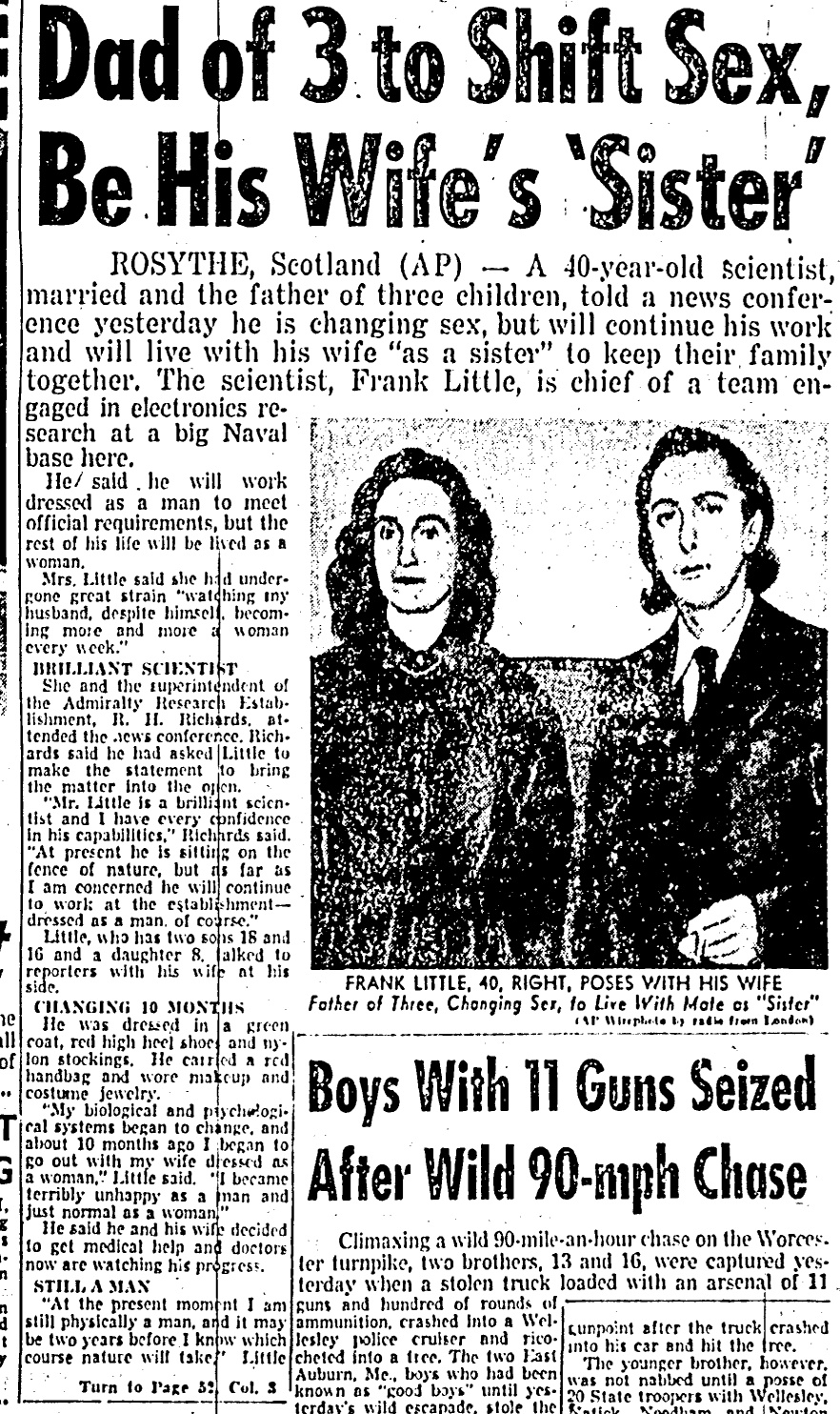
November: Frank Little, Rosythe, who headed a naval electronics research team, announced that “his” sex was changing and that “he” will live “his” life outside work as a woman. His boss had asked for a statement to bring the matter into the open. Mrs Little sat by “his” side. “My biological and psychological systems began to change, and about 10 months ago I began to go out with my wife dressed as a woman. I became terribly unhappy as a man and just normal as a woman.” Little’s choice of a female name was not given. The press lost interest after the first announcement, and there was no follow-up.

The report of the Wolfenden committee, which had been looking into the law on homosexuality and prostitution, was published, with the recommendation that sex between two consenting male 21 or older in private should no longer be an offence.. A Daily Record poll in 1957 indicated that 85% of Scots surveyed opposed the recommendations of the Wolfenden Report. Around the same period in 1957 a poll conducted by the Daily Mirror, south of the border, showed a much more even split where 51% opposed decriminalising homosexuality.

James Adair OBE, a former Procurator Fiscal of Glasgow and Edinburgh, had sat on the Wolfenden committee and formed the only dissenting voice. His minority report was printed in The Scotsman on 5 September 1957. He addressed The General Assembly of the Church of Scotland as a commissioner from the Presbytery of Glasgow and urged the assembly to disapprove of what was suggested by the Wolfenden committee regarding any amendment to the law in Scotland.

Wolfenden Report's recommendation on homosexual law reform was rejected by General Assembly of the Church of Scotland.

The ruling Conservative Party in London chose to do nothing about the recommendations re homosexuality, although those re prostitution were incorporated in the Street Offences Act 1959. Those re homosexuality did not become law until 1967 when the Labour Party was in power. Even then Scotland was excluded as per the wishes of James Adair and the Church of Scotland. Northern Ireland was also excluded. The changes were finally effected in Scotland in 1980.

-----

The following were consulted:

11 February 2021

Pyander, a transvesting ingle in 1599

  • Thomas Middleton
     Thomas Middleton.“Satire 5 - Ingling Pyander” in MicroCynicon: Six Snarling Satires. 1599.

A work of poetic satire by the English playwright who was then 18. Later he wrote plays and other
poems, many of which include gender swapping plots, and sex between men.

“Ingle” was used in different ways in the 16th and 17th centuries, but more often than not it was a term for what we would call queer. It was especially applied to pretty young men who might be kept or might be whores. The terms “catamite” and “ganymede” were near synonyms. The verb form, ‘to ingle’ usually means to have anal sex with an ingle, or for an ingle to have sex. Some ingles transvested.

In recent decades, Middleton’s poem has become a topic for theses and books, and is used by some writers to argue that transvesting ingles were common on the streets of London in the 1590s. While Middleton used female pronouns for Pyander, none of the modern commentators do. Nor do most of them seem to have read anything about trans sex workers for comparison. Certainly no trans person seems to have commented on Pyander.

This essay will be a survey of the major writing about Pyander. Are they cisplaining? Did Middleton base his poem on an actual person? What is the order of events in the poem? Poetry, of course, is harder than prose to pin down. Poetic License is a term coined to excuse poetry.

Excerpts from the poem

The 5th satire is a 99-line poem. Click for the full poem).

The most relevant lines are:

The still memorial, if I aim aright, Is a pale chequer'd black hermaphrodite.

Sometimes he jets it like a gentleman,

Other whiles much like a wanton courtesan;

But, truth to tell, a man or woman whether,

I cannot say, she's excellent at either;

But if report may certify a truth,

She's neither of either, but a cheating youth. (lines 21-8)

Of beauty's counterfeits affords not one

So like a lovely smiling paragon,

As is Pyander in a nymph’s attire

Whose rolling eye sets gazers hearts on fire,

Whose cherry lip, black brow, and smiles procure

Lust-burning buzzards to the tempting lure.

And suffer not Pyander's sin appear?

I will, I will. Your reason? Why, I'll tell,

Because time was I lov'd Pyander well;

True love indeed will hate love's black defame,

So loathes my soul to seek Pyander's shame. (lines 31-42)

I spied Pyander in a nymph's attire:

No nymph more fair than did Pyander seem,

Had not Pyander then Pyander been;

No lady with a fairer face more grac'd,

But that Pyander's self himself defac'd;

Never was boy so pleasing to the heart

As was Pyander for a woman's part;

Never did woman foster such another (lines 63-70)

That force perforce I must Pyander prove:

The issue of which proof did testify

Ingling Pyander's damnèd villany.

I lov'd indeed, and, to my mickle cost,

I lov'd Pyander, so my labour lost (lines 75-9)

Trust not a painted puppet, as I've done,

Who far more doted than Pygmalion:

The streets are full of juggling parasites

With the true shape of virgins' counterfeits:

But if of force you must a hackney hire,

Be curious in your choice, the best will tire;

The best is bad, therefore hire none at all;

Better to go on foot than ride and fall. (lines 92-9)

(Note: ‘hackney’ was a 16th century term for a whore, in that like a hackney carriage she could be hired.)

History

The archbishop of Canterbury and the bishop of London issued an order prohibiting the printing of any satires whatever including this one. They required that the published satires of Thomas Middleton, Joseph Hall, John Marston, Thomas Nashe, and others be burned. This was done 4 June 1599 in a Bonfire at the Stationers’ Hall.

The history of the late 16th century and indeed the whole of the 17th century records very few male-born persons in female attire except on the stage where boy-actresses played all the female parts until 1672. There were of course plentiful female-born persons discovered and even arrested in male attire: “female husbands”, those seeking a man’s wage and so on (and the interesting question is which of them should we regard as trans in the modern sense?).

One of the very few mentions of a male-born person transvesting is this poem of Middleton’s. The poem is designated by Middleton as satire, and taken so by the bishops who burnt his work. The obvious question is: is Pyander based on a real-life person or incident in the street, or is she just a poetic fiction?

Alan Bray

The gay historian, Bray, in his pioneering Homosexuality in Renaissance England, 1982, compares Pyander to the mollies of the early 18th century.

“Transvestism of this kind [18th century] had a function crucially different from that of Elizabethan or Jacobean London. Transvestism itself was not new, as one can see from the extensive contemporary description of it in Thomas Middleton's Micro-Cynicon published in 1599; but the significance given to it a century later was radically different. … Transvestism was as common in Elizabethan London as it was to be a century later, but there are sharp differences between transvestism in the two periods; and one of them is present in Middleton's reference to the streets as the haunt of transvestites. Transvestism in the eighteenth-century molly houses was something that took place behind closed doors: it had nothing to do with the streets. The transvestism Thomas Middleton is describing was intended to deceive: that of an eighteenth-century molly house was not; it was quite obviously a man dressed in women's clothes. What then was its purpose? The answer is in the other major difference between Middleton's tale and the conditions of the eighteenth century: Middleton's tale is not concerned with homosexuality. The whole point of the story is that the transvestite was trying to avoid sexual intercourse so as to avoid being discovered. His motives were apparently mercenary, leading to the suggestion - which is probably the best explanation of the sexual ambiguity of the story - that Middleton looked on transvestism as a vice in its own right.”

“extensive contemporary description”? One reference in a satirical poem?

Bray was writing, and pioneering, in 1982, so I don’t want to be too critical. However later academics criticise the uncritical use of 20th-century terms as ‘presentism’. Nobody in 1599 would understand words such as ‘transvestism’ (which did not come into English use until the late 18th century, taken from Italian and French usage) and ‘homosexuality’ (coined in the late 19th century). The verb form ‘transvesting’ is noted in dictionaries as first being used in 1652, and presumably was used verbally before anyone wrote it down. So it would be more suitable. Middleton used the verb term ‘ingling’: Bray is aware of the word, but does not use it.

“Middleton's tale is not concerned with homosexuality. The whole point of the story is that the transvestite was trying to avoid sexual intercourse so as to avoid being discovered. His motives were apparently mercenary”.

This is a very problematic sentence. Some 21st century trans prostitutes regard themselves as gay, some as transgender, some as both, some otherwise. Is it not likely that such a person would deliver sex if the man indicated that he wanted such, but flip to a simple demand for money if not? Of course it is not “concerned with homosexuality”. Neither party has such a concept. Bray does not seem to understand how a transvesting ingle or a modern trans sex worker needs to be adaptable, nor what her motivation would be.

Note that Bray uses male pronouns for Pyander, despite the fact that the narrator uses female:

“But, truth to tell, a man or woman whether,

I cannot say, she's excellent at either;

But if report may certify a truth,

She's neither of either, but a cheating youth.”

Secondly Bray does not make any allowance for the narrator (Middleton?) rewriting the encounter to diminish his interest in having sex with an ingle. Nor that he declares that he had loved her. Is he a reliable narrator?

It is surprising that Bray who was a GLF activist who must have met trans women in London in the 1970s does not even consider that Pyander could be trans.

Bray is cited by all the writers below.

Marjorie Garber,

Garber, a decade later, sort-of summarised what Bray had to say.

“During the period 1580 to 1620, as we have already noted, some women as well as men cross-dressed publicly in London, whether for fashion, for comfort, for pleasure, as a stratagem that facilitated theft of other crime, or as a cultural sign of their social position, high or low.”

She concludes that Pyander

“is not, or not self-evidently, a homosexual but rather a trickster seeking to rob his unwary partner”.

Like Bray she uses male pronouns, is disinterested in any dissimulating done by the narrator and that the narrator says that he loved her.

Rictor Norton

The gay historian, Norton, writing at the same time as Garber, sees through the narrator.

“The author for a time ‘loved Pyander well’, but stung by the pricks of conscience, and the fact that Pyander spent all his money and then deserted him, he repents, and confesses his sin by writing this ‘snarling satire’. This may well be a completely fictional creation based more upon Juvenal’s Satires than upon life in London, but the author seems to expect his readers to recognise such characters as Pyander.”

Norton avoids pronouns for Pyander. He reads in the poem as Bray and Garber did not, that the narrator had taken Pyander as a mistress, until his money ran out and she left. This is completely different from seeing her as a trickster. A cis female mistress may have done likewise without being put down as a trickster.

Bruce Smith

Smith writing two years after Norton had seen it differently:

“The spiral of power and pleasure that locks the satirist and the satirized in a furious embrace is especially tight.” The Author “owns up himself to the vices he lambastes in others”. Because the narrator “actually participated in what he writes about, however, the emphasis falls not on the cozener but on the cozened. What we see from that subjective vantage point is a jolting discrepancy between appearance and reality.”

Again no consideration that Pyander might be trans.

Michael Shapiro

Shapiro, writing four years after Norton, comments:

“There is far less evidence of male cross-dressing in the early modern period than there is of women wearing male apparel, either in literature or in life. … Some English literary works allude to male cross-dressing. The fifth satire of Middleton’s Microcynicon (1599) features Ingling Pyander, a male transvestite posing as a female prostitute … Perhaps such literary figures were modelled on actual male transvestites, but I know of no corroborating non-literary evidence.”

Again the statement that the narrator had taken her as a mistress is ignored, but he makes the important point that there is no evidence of such persons in real life.

Herbert Jack Heller

Heller, a year later, starts by pointing out the unusual narrator. The satire “differs from the other five satires by the involvement of the narrator in the situation he describes. It is unclear whether there is a single narrator or several in Microcynicon, but in the previous four satires, the narrator is an observer, not a participant.” He again sees the narrator as a victim: “His complaint is that he had fallen in love with Pyander, unaware that ‘she’ is a cross-dressing boy”. However. like Smith he sees the poem “implicates its narrator, perhaps more so than even Pyander himself. Any confusion the narrator can raise about Pyander's sex or activities might also serve to diminish the reader's sense of his own culpability. But the narrator is not exonerated.” And even “ while the narrator considers Pyander's parentage, we quickly learn that he is the son of a prostitute that even the narrator has consorted with”.

Heller addresses the unreliability of the narration: “The narrator does not indicate whether his sexual union with Pyander occurred just after they met in the street, or how long it was until ‘So far entangled was my soul by love,/ That force perforce I must Pyander prove’ (74-75). But however long this took, the narrator would have us believe that he always took Pyander for a woman.” Except that he also says: "Sometimes he jets it like a gentleman,/ Otherwhiles much like a wanton courtesan " (23-24), and what are we to make of "time was [he] loved Pyander well ”(40)? Which would imply passage of time between their first meeting and the narrator complaining that he has been cozened

Which is how Norton (not mentioned in Heller) had presented it.

But why quotation marks around ‘she’?

Dimitris Savvidis

Savvidis, 14 years later than Heller, but unaware of his thesis/book and of Norton’s comments, returns to Bray’s model:

“the potential client is deceived by the transvestite prostitute, who manages to lure him to an act that did not match with what the client had in mind. Middleton’s hermaphrodite has a different service to offer, not so much an offer that involves the sexual act per se but a different aesthetic of the sexual experience”.

He also thinks that the narrator actually takes Pyander to be a cis woman. However he rejects Bray’s assumption that they did not have sex - after all one of the meanings of the verb ‘to ingle’ is to have anal sex.

Randolph Trumbach

Trumbach finds yet another reading:

“Middleton bitterly tells of a man who has fallen in love with a boy he then encounters ‘ingling’ or whoring in the street dressed in ‘a nymphs attire’”.

This removes Heller’s quandary of how long is the period from the encounter in the street to the end of their affair, in that for him the street scene comes after, not before.

------

Trumbach and Norton are the only two writers here who have some idea of what it was to be a transvesting ingle.

None of these writers use the word ‘transvesting’. It has fallen out of use, but it is period appropriate and is easily understood.

Most of the writers refuse female pronouns for Pyander - to the point of rudeness.

It is noteworthy that the authors who assume that Pyander was based on an actual person, do not put her name/pseudonym in their index, as they thereby should.

----

  • Alan Bray. Homosexuality on Renaissance England, Columbia University Press, 1982:87-88.
  • Majorie Garber. Vested interests: Cross-Dressing & Cultural Anxiety. Rutledge, 1992: 29-30.
  • Rictor Norton. Mother Clap’s Molly House: The Gay Subculture in England 1700-1830. GMP, 1992: 19.
  • Bruce R Smith. Homosexual Desire in Shakespeare’s England: A Cultural Poetics. The University of Chicago Press, 1994: 181-2.
  • Michael Shapiro. Gender in Play on the Shakespearean Stage: Boy Heroines & Female Pages. The University of Michigan Press, 1996: 29.
  • Herbert Jack Heller, Penitent Brothellers: Grace, Sexuality, and Genre in Thomas Middleton's City Comedies. PhD thesis, Louisiana State University, 1997: 180-7. Online.
  • Dimitris Savvidis. Male prostitution and the homoerotic sex-market in Early Modern England. PhD Thesis, University of Sussex, 2011: 31-2, 101-7. Online.
  • Randolph Trumbach. “From Age to Gender, c1500-1750: From the adolescent male to the adult effeminate body”. In Sarah Toulalan & Kate Fisher (eds) The Routledge History of Sex and the Body.Routledge, 2013: 129.

31 January 2021

Cross-dressing during the Reign of Charles Stuart (reigned 1625-1649) and the ensuing Civil War

James Stuart, king of Scotland 1567-1625, and of England 1603-25, is taken by many historians to be gay because of his interest in young men. Certainly his reign was one with very few prosecutions for sodomy. He wrote a book on demonology that is quoted in Shakespeare’s Macbeth, and sponsored a translation of the Christian Bible that became canonical. He had no interest in gender variance despite it being a common trope in theatre, but in 1620 he commanded his clergy to preach,

"against the insolencie of our women, and their wearing of broad brimmed hats, pointed dublets, their hair cut short or shorn, and some of them stilettoes or poinards, and such other trinckets of like moment."

This was followed by two infamous pamphlets:

Hic Mulier: or, The Man-Woman: Being a Medicine to cure the Coltish Disease of the Staggers in the Masculine-Feminines of our Times. An anonymous pamphlet denouncing the very small increase in women wearing men’s clothing. The Latin uses the masculine form of the demonstrative pronoun jokingly applied to the feminine noun.

Haec Vir: Or, The Womanish-Man. A response to Hic Mulier. Censured men for their effeminate dress and behaviour, while defending women in men’s garb on the grounds of freedom. The Latin uses the feminine form of the demonstrative pronoun jokingly applied to the masculine noun.

1624

3 January. Katherine Jones appeared before the Bridewell governors, after being arrested in the street by the constable of Fleet Street, in men’s apparel. She insisted that ‘she did it in merryment“. The governors accepted it was simply a New Year frolic, and discharged her.

1625

Charles Stuart
James Stuart died and was replaced on the throne by his son Charles. A few weeks later Charles married the 15-year-old French princess, Henriette Marie Bourbon.

Henriette Marie Bourbon was Catholic and openly facilitated Catholic marriages despite it being against English law. She was also fond of theatricals, and in 1626 performed in the play Artenice staged at her London residence, Denmark House – this at a time when women actors were barred from the English stage – and a number of her female attendants played male roles and dressed appropriately. Popular disquiet was voiced. (Stoyle p11)


1627-9 The Anglo-French War

In 1625 Charles Stuart had signed a secret marriage treaty with the French king that he would relax religious restrictions against English Catholics (he did not). He also loaned seven English war ships to help repress the Protestant Huguenots at La Rochelle. Two years later he had changed sides, and sent his favourite, George Villiers to capture the Île de Ré in support of the Huguenots. This held for three months, until re-inforced French forces compelled the English to withdraw in defeat.

One of the soldiers in the expedition was the female-born, Thomas Hall, 25.

Hall afterwards temporarily returned to living as a female seamstress in Plymouth. This did not suit, and a few months later, becoming aware of a ship being made ready to sail to Chesapeake in the Virginia colony, Thomas sailed with it as a male indentured servant.

In addition, Walter Yonge of Colyton in Devon, a puritan Justice of the Peace, noted in his private journal that ‘there was a woman apprehended at Plymouth in the habit of a man, by the mayor of Plymouth, at the time the Lord Denbigh and Sir Henry Martin went to sea (that is sailed with troops to the Île de Ré), Some said that she was Martin’s mistress. (Stoyle p12)

1628

The controversial puritan William Prynne published an invective against women counterfeiting their sex: “these ...unnaturall and unmanly times; wherein ...sundry of our Impudent ...Female sexe, are Hermaphrodited and transformed men ...not onely in their immodest ...and audacious carriage in the ...odious, if not whorish, cutting of their haire.” He claimed England’s foreign policy reversals to be divine punishments for such transgressions. (Stoyle p12)

• William Prynne, The Unloveliness of Lovelockes. 1628.

1629

Thomas Hall, in the Virginia colony, temporarily switched back to female, and was said to have sex with men. There was a public obsession about his sex, and the Council and General Court of Virginia ruled that he was ‘a man and a woman’ and ordered that he wear male clothing but with a female apron and head covering.

1628-31 The Western Rising

As Charles Stuart was determined to rule without Parliament, he needed other sources of income. Royal lands and forests were enclosed and sold off, depriving local people of their use. Riots ensued, some of which featured cross-dressed men using the traditional name Lady Skimmington.

1631

Mervyn Tuchet, 2nd Earl of Castlehaven, was charged both with committing sodomy with a number of servants, and with encouraging a servant to rape Castlehaven's wife. While there is little doubt that he did both these things, it is also obvious that his Catholicism played a major role in ensuring that he was tried, and that the rape and the participation of servants were more important than the charge of sodomy. He was executed in 1631 and two of his servants were hanged the following year. He was attainted, that is his titles and property in England were Forfeit, but as the Buggery Law did not apply in Ireland, his son inherited his Irish titles and property.

1632

Henriette Marie Bourbon and her attendants transvested in another play, The Shepherds’ Paradise.

William Prynne again wrote an attack on women who had the audacity to adopt quasi-masculine styles – ‘our man-women English Gallants’, as he termed them – but had also castigated the ‘women-Actors’ of antiquity, all of whom, he thundered, ‘were ...notorious, impudent, prostituted strumpets. (Stoyle p13)

  • William Prynne. Histriomastix, 1632.

1633

Henriette Marie Bourbon and her attendants transvested in another play, The Shepherds’ Paradise on 9 January. the original performance lasted seven or eight hours. It required four months of rehearsal by its cast.

William Prynne
Prynne’s fulimations were taken as an aspersion on the queen; his passages attacking spectators and magistrates who failed to suppress them were seen as an attack on the king. 

William Noy, the attorney-general took proceedings against Prynne in the Star-chamber. After a year's imprisonment in the Tower of London, he was sentenced on 17 February 1634 to life imprisonment, a fine of £5,000 (over £1 million today), expulsion from being a lawyer, deprival of his University degree, and amputation of both his ears in the pillory where he was held on 7–10 May. Noy died later that year, which Prynne took as God’s punishment. He was released by Parliament in 1640, and his degree and membership of the bar restored.

1634

The Irish cleric, John Atherton, in that the Buggery Act applied only to England, pushed for the enactment of "An Act for the Punishment for the Vice Of Buggery" to be applicable in Ireland.

1630-42

Alexander Gough, actor, specialized in female roles. He continued acting until the theatres were banned, after which he acted in clandestine private productions.

1640

The trial and execution of John Atherton, Bishop of Waterford and his steward. They were charged under the law that Atherton himself had helped to extend to Ireland. The charge was probably proceeded with in that Atherton had become alienated from the large Irish landowners by trying to extend the lands owned by the protestant Church of Ireland.

Henriette Marie Bourbon and also Charles Stuart performed in another play, Salmacida Spolia. Henriette and her ladies appeared dressed in “Amazonian habits”.

1642-1651 Revolution and Civil War
Illustration from the ballad
Valiant Virgin

1642

The theatres were banned.

An anonymous letter written from the Royalist camp in July 1642, and later published in a pro-royalist news pamphlet, describes a woman called Nan Ball who was ‘taken in mans cloathes, waiting upon her beloved Lieutenant’ while in the king’s army near York. A top level-investigation was launched, the lieutenant was sacked from his command and it was suggested that the woman should be shamed by whipping or pillory, although she was merely expelled. (Stoyle p14)

1643

A draft proclamation was drawn up, setting out required standards of behaviour for the royalist army. It included a hand-written memo in the margin from the king himself stating ‘lett no woman presume to counterfeit her sex by wearing mans apparall under payne of the severest punishment’. However the memo was not included in the published version. (Stoyle p18-20)

1644

2 July: The Battle of Marston Moor, is said to have included Jane Ingleby in the Royalist cavalry. (Fraser p221)

1645

March: Oliver Cromwell, in charge of Henry Percy and other Royalist prisoners, noticed one of “so faire a countenance” and asked him to sing, thereby revealing that the person was a damsel. (Stoyle p23)

December: Evesham, Worcestershire: A captain of Horse having served a year, and having obtained leave to visit family in Shropshire, went to a tailor and ordered female clothing supposedly for a sister of the same stature as himself. The tailor was suspicious, and told the Governour, which led to examination where the captain admitted that he was female, and spoke of three others from Shropshire who had taken male disguise to ‘serve in the Warre for the Cause of God’. (Story in The Scottish Dove, London, 3 Dec 1645; Stoyle p 24)

1649

Charles Stuart was indicted, accused of treason. The charge was that he "for accomplishment of such his designs, and for the protecting of himself and his adherents in his and their wicked practices, to the same ends hath traitorously and maliciously levied war against the present Parliament, and the people therein represented", and that the "wicked designs, wars, and evil practices of him, the said Charles Stuart, have been, and are carried on for the advancement and upholding of a personal interest of will, power, and pretended prerogative to himself and his family, against the public interest, common right, liberty, justice, and peace of the people of this nation."

He was beheaded in a formal execution 30 January 1649. Henriette Marie Bourbon returned to France.

1657

Stephen Evison, a soldier was discovered to be female during the Parliamentary occupation of Scotland, and was identified as Anne Dymoke, from a distinguished family in Lincolnshire. She and her lover, John Evison, having no means of support, had entered service as two brothers. They then took a sea voyage during which John was drowned. Knowing not what else to do, Stephen then enlisted giving his name as John. (Frazer p225)

-------------

The following were consulted;

• Antonia Fraser. The Weaker Vessel: Woman’s Lot in Seventeenth-Century England. Methuen, 1985: 220-6.

• Mark Stoyle. “ ‘Give mee a Souldier’s Coat’: Female Cross-Dressing during the English Civil War”. History, The Journal of the Historical Association, 103, 2018

-----------------

It is Henriette Marie Bourbon for whom the Maryland colony was named.

The Wikipedia page on her says nothing at all about her thespian inclinations.

We should remember that many of the women camp followers of both armies in the Civil War had to survive. Ankle-length skirts In muddy fields are quite problematic, and the adoption of breeches was, as Fraser says, “more from convenience than from caprice”.

On why Charles Stuart’s addition to the 1643 declaration did not make it to the published version, Stoyle writes:

“Why should the king have decided to dispense with the strictures against cross-dressed female camp-followers which he had been so keen to insert into the original text? Three possible answers present themselves. First, the king’s military commanders may have informed him that the habit of donning masculine attire was so commonplace among the women who accompanied his army and so important to those women in terms of their day-to-day mobility – not only while on the march, but also while undertaking the foraging trips which helped to keep the royal army supplied with provisions – that it was simply not practicable to outlaw the practice. Second, Charles’s advisers may have pointed out to their royal master that for him to admit – in a formal proclamation – that some of the women who accompanied his soldiers were accustomed to cross-dress would only be to invite the derision of enemy propagandists, who had already demonstrated on numerous occasions – in the partisan pamphlets that spewed from the London presses each week – that they were only too ready to highlight and denounce any hint of ‘gender confusion’ in their opponents’ ranks. Third – and closely related to this latter point – Charles may have had second thoughts about incorporating a stern condemnation of female cross-dressing into his proclamation when he recalled that, just three years earlier, his own queen, Henrietta Maria, together with her ‘martiall ladies’, had appeared on stage dressed in ‘Amazonian habits’ in the court masque Salmacida Spolia.” (Stoyle p18-20)

18 January 2021

Edward Wilson (?1672 – 1694) kept man, murdered

Edward Wilson from Leicestershire served under his uncle in Flanders during the Nine-years war against France, 1688-97. However he was dismissed and sent home to London with 10 guineas (about £2,300 in modern money). This was soon spent. However by 1693 Wilson was living with the equipage and garb of nobility, had redeemed his father’s estate and gave portions to his sister – all this without any visible means of income. It was estimated that he was living at a rate of £4,000 per annum (over three quarters of £1 million in modern money). There was much speculation in the coffee-houses and in clubs as to the source of his income. Had he stolen diamonds, was he passing information to the French, had he discovered the philosopher’s stone, or sold his soul to the devil? Was he a kept man? 

There was only one lady who was said to have enough resources, the intrigante Mistress Elizabeth Villiers (1657-1733) then 36 and the favourite of the then King, William of Orange. It was later said that Wilson and Villiers had been lovers and she was curious to know of a rival. In any case it irked her that she was being mentioned. She engaged one John Law, a card sharper down from Edinburgh to spy on Wilson. He quickly ascertained that most evenings at around 10, Wilson would dismiss his servants and take a sedan chair to a house near Hyde Park Corner. He did not return until 5am. On a later evening Law realised that the house went through to the next street, and a hour after Wilson's arrival a lady left by chair from the back door and proceeded to a nobleman’s house. Some hours later she emerged and the journey was reversed. After some days of watching this, Law contrived to have the lady arrested and taken to a sponging house on charges of an outstanding debt. There he was able to confirm that the lady was Wilson, and was impressed by her gait and demeanour which were consistent with her appearance. Wilson offered money and Law changed sides. It was arranged that Law should burst into the nobleman’s house and discover Wilson with the naked daughter of the French steward. This was reported back to Mistress Villiers.

It so happened that both Wilson’s sister and Law’s mistress, a Mrs Lawrence, lodged at the same abode in St Giles in the Fields. After a spat between the two, Wilson removed his sister elsewhere. Law took the attitude that aspersions had thereby been cast upon the residence, and letters concerning matters of honour were exchanged. On the 9th April 1694, Wilson was drinking with a friend, Captain Wightman at the Fountain Inn in the Strand, when Law arrived and words were exchanged. Law then left. Wilson and Wightman took a carriage to Bloomsbury Square, where they encountered Law again. Law and Wilson drew swords, and after only one pass, Law punctured Wilson fatally to the depth of two inches in the upper part of the stomach. Law remained and was immediately arrested. Wightman went immediately to Wilson’s house, but reported that there were no papers, except for a suggested cure for toothache.

While their encounter did not have the formality of a duel (formal challenge, seconds, a surgeon in attendance etc), it is described so in many accounts. Duelling was illegal, but survivors of duels were almost never arraigned. Law was found guilty of murder on 20th April, sentenced to death. This was then commuted to a fine, but Wilson’s brother lodged an “appeal of murder”, a private prosecution following an acquittal for murder, and Law continued to be imprisoned. On the 6th January 1695 with the help of bribes and drugs to subdue the guards, law escaped to a waiting coach, which took him to a waiting ship and thence to Flanders.

Prior to this period, much of what banking there was had been done by goldsmiths.  John Law (1671-1729) was the son of a Scottish goldsmith and was thus acquainted with the practices and the theory.  He was also good at numbers and odds and at remembering which cards had already been played, and thus was able to win at the game of faro.  After his prison escape he wandered around Europe, living by his wits and his abilities as a card sharper.  He also became an advocate for central banking and paper currency. He published a text entitled Money and Trade Considered: with a Proposal for Supplying the Nation with Money, 1705. Law was in Scotland and participated in the debates leading to the Act of Union with England, 1707. However with the passing of that act he had to leave as he was an escaped felon in England. His propositions of creating a national bank in Scotland were ultimately rejected. In France he was mentored by the Duke of Orleans. The wars of Louis XIV had left the country completely wasted, both economically and financially. The resultant shortage of precious metals led to a shortage of coins in circulation, which in turn limited the production of new coins. After Louis XIV died, and Orleans became regent, Law proposed that the economy be stimulated by replacing gold with paper credit and a centralised bank.  He was the architect of the Mississippi Company which became the Mississippi Bubble in 1720, and the bubble in turn was aggravated by an outbreak of plague in the Marseilles region. People quickly returned to gold and silver currency and there was no further monetary reform until after the Revolution. Law's properties were confiscated. He had been granted a British pardon in 1719, and returned to London in 1723. He died in poverty in Venice in 1729 age 57.

The nobleman lover of Edward Wilson is taken by most writers to be Charles Spencer (1675-1722). He became the heir to the Earldom of Sunderland when his elder brother died in 1688. After the death of Edward Wilson, he became Member of Parliament for Tiverton in 1695 and married the heiress Arabella Cavendish. She gave him one daughter and died in 1698 age 24. He married a second heiress, Anne Churchill in 1700. They had six children and she died in 1716 age 33. Spencer married a third heiress, Judith Tichborne in 1717. They had three children who all died very young. Spencer became the Third Earl in 1702, and he served in several major political offices. In 1718 he became First Lord of the Treasury (in effect Prime Minister). This was at the same time as John Law held the corresponding position in France. The British South Sea Bubble was also in 1720, and Spencer resigned over it in 1721. He died a year later. Love-Letters Between a Certain Late Nobleman and the Famous Mr. Wilson: Discovering the True History of the Rise and Surprising Grandeur of that Celebrated Beau which almost identified him as Edward Wilson’s lover was published a year after that.


Netta Murray Goldsmith points out that neither Spencer nor Villiers was that rich that they could provide for Wilson’s spending. Spencer was still dependent on an allowance from his father. She makes a good case that William of Orange was also Wilson’s lover. Two other attractive young men were raised by William III to wealth and titles: William Bentinck and Arnold van Keppel. All three were regarded as part of a sodomical circle at court.

The suspicious removal of all Wilson's papers, and the arranged escape of Law from prison suggest a conspiracy.  Law would seem to have been a hitman, but who ordered Wilson's death and why?  Had he become over-demanding, or an embarrassment? Had he suggested that he would spill secrets?   

Some historians suggest that the 1723 published Love Letters were among the documents removed from Wilson's house when he was killed.  This detail, like most of the details here is advocated by some and dismissed by others. 

  • Unknown Lady’s Pocquet of Letters, 1708
  • Love-Letters Between a Certain Late Nobleman and the Famous Mr. Wilson: Discovering the True History of the Rise and Surprising Grandeur of that Celebrated Beau. A Moore, 1723.
  • Adolphe Thiers translated by Frank S Fiske. The Mississippi Bubble: A memoir of John Law. W A Townsend & Company, 1859: 29-33. 
  • H Montgomery Hyde. John Law: the history of an honest adventurer. W H Allen, 1948, 1969: 24-33.
  • Rictor Norton. Mother Clap’s Molly House: The Gay Subculture in England 1700-1830. GMP, 1992: 35-43.
  • Antoin E Murphy. John Law: Economic Theorist and Policy-Maker. Clarenden Press, 1997: 20-34.
  • Netta Murray Goldsmith. The Secret: Edward Wilson And The Government Conspiracy. Kindle, 2012.
  • Antoin Murphy. “Two Bubbles and a Plague”. Center for the Study of Economic Liberty, Online.

13 January 2021

James How (1714–1780) publican

In December 1732 Mr James How took unto marriage one Mary Snapes. Together they had a small nest-egg of £30 (£6,000 in today’s money). They found a small pub in Epping, northwest of London, which was to let, and they took it. James was involved in an altercation with a young gentleman that resulted in a lameness of his hand. This was of such a nature that he entered an action against the gentleman and obtained damages of £500 (over £100,000). James and Mary were then able to seek a better situation, and took a public house in Limehouse. They lived there many years, in good credit and esteem. They then bought the White Horse pub on Poplar High Street, which they also ran successfully.

Manion p45

A woman by the name of Bentley, resident not far away, had known James when they were both young. In 1750 she asked for £10 (£2,000) that James’ sex not be discovered (this at a time when £20 a year was a good wage). James complied, and the matter was settled for many years.

James served in most parish offices and more than once was a jury foreman, although some regarded him as somewhat effeminate. 

In 1765, at Christmas time, Mrs Bentley sent a repeated demand for £10, and a fortnight after that she sent again. 

Around this time Mrs How took ill, and went to a friend in the country. James was not able to join her before she died, and she told their secret to the friend. The “friend” visited James in his grief and "insisted not only on their share of the whole effects, but more”. 

Mrs Bentley escalated her demands and recruited two men, John Charles and William Barwick, who pretended to be a constable (Bow Street Runner) sent by Justice John Fielding (the brother of Henry Fielding the novelist). A neighbour, Mr Williams, a pawn broker was passing and was informed of the situation. He urged How to go to the local Justice. While he stepped out to change his shirt, the two men forcibly took How to the house of Mrs Bentley, where after threats How gave a draft for £100 on Mr Williams payable at a later date, and they released him. 

How and Williams applied to the local bench for advice, and when Bentley and Barwick came for the payment there was a real constable waiting and they were taken to the bench of Justices sitting at the Angel in Whitechapel. How, now being outed, had reverted to female dress, and now gave the name of Mary East. Under examination, Bentley denied sending for the £100, and Barwick declared that he would never have gone if she had not sent him. They were committed unto the Clerkenwell Bridewell until the next session. Charles disappeared and was never heard of again. Bentley and Barwick served four years in prison and Barrick also stood in the pillory three times.

It was noted “The alteration of her dress from that of a man to that of a woman appeared so great, that together with her awkward behavior in her new assumed habit, it caused great diversion”, for of course he was 33 years unused to it.

Either How gave it out, or the newspapers added the story that both Mary East and Mary Snapes had been abandoned by men in their youth. In East’s case the man had been arrested for being a highwayman and transported to the American colonies. They gave up on men, and tossed a coin to decide which of them would act as the man in their relationship. Mrs How’s name, Mary Snapes, was not given in any of the accounts.


How/East sold the White Horse and retired to another part where he was not famous. He lived till 1780. When he signed a will in 1779 it was as Mary East.

  • “The FEMALE HUSBAND; or a circumstantial Account of the extraordinary Affair which lately happened at POPLAR; with many interesting Particulars, not mentioned in the publick Papers.” London Chronicle, 7-9 August 1766. Reprinted: Rictor Norton (ed) as "Mary East, the Female Husband", Homosexuality in Eighteenth-Century England: A Sourcebook. 6 December 2003. Online.
  • “Mary East, The Female Husband”. The Odd Fellow, 2 May 1840.
  • “A Curious Married Couple: Thirty-four years of pretended matrimony”. Fincher’s Trade Review, July 25, 1863. Reprinted in Jonathan Katz. Gay American History: Lesbians And Gay Men In The U.S.A. A Discus Book.1978:343-4.
  • “A Fortified Public House: Strange Story of Mary East, the ‘Man-Woman’ who Lived There”. Illustrated Police Budget, 13 May 1899.
  • “The Romance of the White Horse”. Tower Hamlets Independent and East End Local Advertiser, 27 January 1900.
  • Bram Stoker. “Mary East” in Famous Imposters.  Sturgis & Walton, 1910: 241-8. 
  • Rictor Norton. Mother Clap’s Molly House: The gay Subculture in England 1700-1830. GMP, 1992: 237.
  • “Mary East (aka James How) and Mrs How of the White Horse, Poplar”. East End Women’s Museum, 23 June 2017. Online
  • Jen Manion. “The Pillar of the Community” in Female Husbands: A Trans History. Cambridge University Press, 2020: 44-67.

Isle of Dogs Life

-------------------

The story of the transported lover and the coin toss may be true or untrue. It was a telling that went well with the newspapers in that it downplayed the idea that How was gender deviant. However given the 33 years that he maintained the role and that he was regarded as an outstanding citizen implies that he had an affinity for being male.

I was not able to ascertain from the various accounts just when in 1766 Mrs How, Mary Snapes, did die.  Was it before the trial of Bentley and Barwick in August?  It is not at all explained how friends or family of Mrs How could claim half the property.  Under the various coverture laws that lasted into the 19th century, wives had no property rights apart from their husband.   

Almost all accounts spell their surname as 'How'.  Manion, without discussing why she dissents, spells it "Howe".

Some of the immediate accounts in 1765 used How’s well-earned masculine pronouns for the period pre-1766. However after his death in 1780, almost all used she/her only, put ‘wife’ in quotation marks and some even referred to him as ‘Mrs Mary East’ as if he had been married to a Mr East!!. The very recent book by Manion opts for the hopefully-temporary fashion of using they/them which of course is not How’s choice of pronouns, and is confusing.

 “They were in the business of keeping public houses, which they did to great success by evidence of their ability to upgrade their situation numerous times over the years before settling in at the White Horse Tavern for roughly two decades.” (p46) Does ‘they’ mean James alone or Mr & Mrs How together?

When the two thugs sent by Bentley accost How, is ‘they’ the two thugs or How himself? “to impersonate officers of the court who roughed Howe up physically and suggested they would be executed for their crimes” (p46).