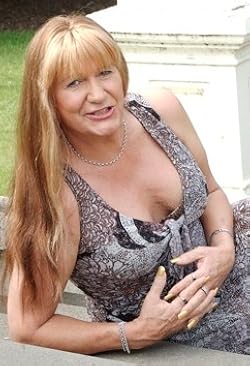
This site is the most comprehensive on the web devoted to trans history and biography. Well over 1800 persons worthy of note, both famous and obscure, are discussed in detail, and many more are mentioned in passing.

There is a detailed Index arranged by vocation, doctor, activist group etc. There is also a Place Index arranged by City etc. This is still evolving.

In addition to this most articles have one or more labels at the bottom. Click one to go to similar persons. There is a full list of labels at the bottom of the right-hand sidebar. There is also a search box at the top left. Enjoy exploring!

29 August 2015

Pooya Mohseni (1978 - ) actress

Pooya was raised in Tehran. As a child she did not even realise that she was not officially female. As a teenager she withdrew, and by 16 was hardly talking or eating.
“I had never met a trans person — never even personally seen a trans person, except as some twisted depiction in a Hollywood movie. ... There was no outside voice: no articles, no television show."
Her mother took her to a friend's husband, a psychiatrist who happened to have studied sexuality and gender, and named her problem as gender identity disorder. Her mother's reaction was that Pooya should not do anything about it until both parents were dead.

Pooya slipped into her deepest depression. She started walking the streets at night and getting into men's cars. She had therapy sessions with three different psychologists who attempted a 'cure'. Her friends stayed away, even after the government psychological board officially declared her to be transsexual. At age 18 Pooya made several attempts to kill herself.

Her parents realised that they would lose their child unless she was allowed to transition, but were still afraid of the social reaction in Tehran. They looked into emigration, and in 1997, the family was able to move to New York City, and initially were living on savings.

Pooya quickly found a psychiatrist and started on hormone therapy. Pooya, though a name given more often to boys, is a unisex name in Iran meaning 'dynamic', and so there was no need for a change.

Pooya studied textile design and fashion at New York's Fashion Institute of Technology (FIT), where she was part of the FIT theatre ensemble. She also trained as a massage therapist.

In 2003, Pooya married a man 17 years older, but arguments developed after her final gender-affirming surgery around the notion that she should have gotten his opinion on the surgery. Finally he tried to choke her.

From 2009, Pooya started singing and acting, and graduated from the Maggie Flanigan Studio in 2012. She now has 32 credits on IMDB.

Working mainly in stealth, she noticed a distinct increase in casting calls for trans actresses, and in applying for them sometimes privately disclosed to the director that she was so. On June 26, 2015, the day that the US Supreme Court ruled that same-sex marriage should be recognised, Pooya announced on her Facebook page that she was trans. The next day, at her current gig, Death of the Persian Prince, she was congratulated by the director-writer and by her co-actors.
IMDB   Pooyaland    BroadwayWorld

26 August 2015

Racheal McGonigal (1955 - ) farmer, businessman, sex worker

McGonigal was raised in Gisborne, north-east New Zealand. He cross-dressed from age 7, but also played in the school's rugby first 15 and was head prefect.

At 21 he consulted a doctor about feeling female, and was advised to grow a beard.

He became a farmer and business man who was married for 14 years, and with his wife had two children. He experimented with female hormones even before divorce.

Afterwards McGonigal had relationships with women while also investigating transsexuality online.

His then girlfriend found out and there was a revelation at his daughter's 21st birthday, and within days all the family knew. His father died 10 days later. Rejected by the children, whom she has not seen since, McGonigal lost 20kg (3 stones) in weight.

Racheal, as she became, had genital surgery and breast augmentation with Dr Sanguan Kunaporn in Phuket, Thailand, February, 2006. The operation was filmed.

Racheal became a prostitute under the name of Storm. With Summer Bardot she escorted across Australia and New Zealand. She later returned to New Zealand and lived in Auckland where she opened a brothel.

She was featured in Rachel Francis &  Michael Larsen's 2012 book about the sex industry in New Zealand.

Racheal has published 6 books: 2 volumes of autobiography, a novel, a book of photographs from Andrew to Racheal; a collection of articles on trans topics and a short guide to transition.
"The only things I'm missing are my kids and a partner. I love my kids and I think about them every day. I'm their father, always was and always will be."
Transgenderstorm    Rachealstorm    Amazon Biography    LinkedIn


_________________________________________________________

Racheal describes herself as a ‘sex-change female', not a phrase that has caught on. 

Top marks to Racheal for her transsexual pride and her willingness to show photographs of her male phase.

23 August 2015

A Ma'dan mustergil (1917–?) landowner, poet.

Her father was a rich Sheik of the Ma'dan معدان‎, the marsh Arabs of southern Iraq where the Tigris and Euphrates rivers meet. She was then the only child her parents had together, but her father had had five sons with his first wife, and her mother had had a son and daughter with her first husband.

Her father's mother raised her. She was moderately deformed. Already as a child, she wanted to live as a boy, and as Ma'dan had a tradition of mustergil (comparable to the Sworn Virgins in Albania/Kosova) it was permitted.
"A family is proud of a girl who wants to live like a boy".
 The mustergil carried weapons and went on hunts.

When he was 20 or so in 1937-8 (AH 1355), his mother was murdered by the second husband's family. His young brother had become the father's favourite, and the elder brothers feared for their inheritance. They did not kill the boy because he was their blood, but the mother was an outsider. The killing was supposed to bring the father to his senses, that he should devote himself to his elder sons. This did not happen, but neither was the murder avenged, on the pretence that the killer was unknown. The mother's first husband's clan did want to get involved as a vendetta would bring government intervention. The mustergil never forgave this lapse, and wrote ridiculing and insulting poems to goad the family. In time the murderer was himself murdered, but not by the family of the first husband.

The father moved both the mustergil and her grandmother to another village where he could keep a better eye on them. The mustergil owned some land in usufruct on which 50-60 rice-growing families lived. The mustergil was afraid that he would lose it, so she applied to the authorities in Basra, who ruled that he would have to pay tenure-fees until 1945, but would then gain the legal title. He erected a meeting house as a male sheik would do, and had coffee distributed to the men of the village.

The mustergil wore male outer and undergarments, but had hair long like a woman and a female kerchief. This retention of token female appearance was because he prayed every day to Allah, and if he did not do so as a woman, prayers would have no consequence.

At harvest-time the mustergil inspected the crop and took a share, and paid the tax to the government.

The mustergil was the only female-born person of the Ma'dan that the sociologists met who could read and write. Poetry was a family tradition: both he father and the mother's first husband were famous local poets, and the half-brother on her mother's side gained national fame for his poetry.
  • Sigrid Westphal-Hellbusch. „Transvestiten bei Arabischen Stämmen“. Sociologus, n.f.6,1, 1956. Berlin. Reprinted as „Transvestiten: Institutionalisierte Möglichkeiten des Ablehnens üblicher Frauen- und Männerrollen im Süd-Irak“ in Brigitta Häuser-Schäublin, Hrsg. Ethnologische Frauen-Forschung: Ansätze, Methoden, Resultate. Berlin: Dietrich Reimer Verlag, 1991. S. 176-189. Translated into English by Bradley Rose as "Institutionalized Gender-Crossing in Southern Iraq" in Stephen O. Murray & Will Roscoe. Islamic Homosexualities: Culture, History, and Literature. New York University Press, 1997: 233-243.
  • "Transgender im Süd-Irak (1956)". rhizom, 2.August 2011. http://rhizom.blogsport.eu/2011/08/02/transgender-im-sud-irak-1956.

    ___________________________________________________________________________

    The paper by Westphal-Hellbusch seems to be all that we have about the mustergil.

    The person described here takes up most of the paper.   It is unfortunate that he is not given a name.   There may well be good reasons for hiding his name, although given the social prominence of the family it is unlikely that local persons do not recognize who he is.    Either way, if it were deemed cautious not to give the real  name, a pseudonym would have been useful for reference.

    As we are not given the person's name, we don't actually whether the person took a male name at any stage. 

    The person would seem to be untypical of mustergils in general, both by the family wealth and by the fact of being literate.  Thus, despite Westphal-Hellbusch's paper, we actually know almost nothing about most mustergils.  By extension we do not know how or if they survived following Saddam's murderous attacks on them after the first Gulf War.

    "he prayed every day to Allah, and if he did not do so as a woman, prayers would have no consequence".   And yet, what must have been his greatest prayer, that the mother's murder be avenged, had no consequence.

    The person was Shi'a, and would look to Iran for religious guidance.   However this is 30 years prior to Ayatollah Ruhollah Khomein's 1983 fatwa that recognized gender changes, after which a similar person would no longer have been required to pray as a woman.

    The Albanian/Kosovan Sworn Virgins that I have discussed fought and suffered as men in the Second World War.  In April 1941 the Iraqis arose and overthrew the Hashemite monarchy that the British had imposed on them without consultation.   The subsequent Anglo-Iraqi War was won by the British and the Hashemites re-imposed.   There is no mention that this person even participated.

    She was proficient in the use of arms.  It could be said that if the mustergil were a cis man of the same class in that culture, he would have killed the mother's murderer himself.   To get upset because no man steps forward to give you vengeance is a stereotypical woman's role.  However traditional third-gender roles often combine limited tolerance with behaviour limits.   We know so little about mustergils that it is unknown whether such were permitted to partake in feuds or vendettas. 

20 August 2015

Jennifer McCreath (1973 - ) government employee, marathon runner, political candidate.

McCreath was born in Halifax, Nova Scotia, and raised in Toronto, did business degrees at Toronto's Humber College, 2000, and Alberta's Athabasca University, 2005, and obtained a position as Senior Policy Analyst with the Government of Newfoundland.

Some months later she started transition as Jennifer, after appearing female at a Halloween party. In 2007 she did a series of interviews on provincial television station NTV about transitioning. She started getting positive reactions from people on the street who had seen her on television, but a year later lost her job.

She is also a marathon runner. She ran 30 marathons 2007-11, including the Boston Marathon in 2009 and 2010. She won a gold medal for achievement in the 2009 World OutGames in Copenhagen . She ran the 1500 metre freestyle swim and marathon run in the third gender category.

She took work as a filing clerk. She became involving in organizing St John's Pride Week, and founded the East Coast Trans Alliance.

Following trans surgery in January 2011, Jennifer applied to Nova Scotia for a revised birth certificate, but it took longer than usual. Jennifer had committed to run in a marathon, and had to fly with her male passport. Changing planes she was detained at US Immigration in Toronto, made to wait 90 minutes before being interviewed, photographed and fingerprinted, and subjected to many intrusive and irrelevant personal questions.  As a result she missed her flight and had to pay $80 for changing flights.

In 2013 she ran for deputy mayor in St John's.
“Everyone said I didn’t have any chance at all. Initially, I couldn’t get anyone to work with me. Nobody would sign my nomination papers. But six weeks later, I walked away with close to 6,000 votes — 17 per cent of the popular vote.”
In 2015 Jennifer ran in the federal constituency of Avalon. Although she was previously a member of the New Democratic Party, she ran as a candidate of the newly formed Strength in Democracy Party.
jennifermccreath.blogspot.ca     LinkedIn


____________________________________________________________________________

US immigration was never particularly friendly, and has become a lot worse since 2001.  Here is a recent story of an 8-year-old being turned away in that he might be a 'terrorist'.   Many Canadians now avoid flying into or changing planes in the US.   We might note that not a single trans person has yet turned out to be a terrorist, and that harassment based on gender incongruity has nothing to do with preventing terrorism.  

18 August 2015

WalesOnline 1st Pinc List

WalesOnline has issued a list of 40 LGBT notable person in Wales in association with Cardiff's Pride Cymru.

The trans persons in the list are:

1. Captain Hannah Winterbourne. Highest ranking trans officer in UK Army.  Newsarticle

2.  Alex Drummond, psychotherapist and photographer in Cardiff, who transitioned six years ago, but has kept her beard. WalesOnline

13. Jenny Bishop, had advised Welsh and UK governments on trans equality, runs support group TransForum, OBE 2015. WalesOnline

20. Sarah Jane Bradley, hairdresser.  Newsarticle

24. Jan Morris, journalist, author. GVWW

26. Rona Rees, Beaumont Society. Beaumont

34. Lauren Harries, television personality. GVWW WalesOnline

40. Sadie Class, co-organizer of Swansea Sparkle.  WalesOnline

---------------------------------------------------------------

Pinc is Welsh for Pink

Compare my 24 trans person from Wales/Ireland/Scotland

16 August 2015

Rachael Wallbank (1956 - ) family lawyer

Wallbank was raised in an Irish Catholic family in Sydney, with a father in the army. Wallbank met a wife at a school dance, and told her of feminine side before marriage.

Wallbank did a Law degree at the University of New South Wales, and was called to the bar in 1980 in Sydney, and has owned a firm, Wallbanks, since 1985. Wallbank is an accredited specialist in Family Law.

The Wallbanks had two daughters and a son.

Wallbank transitioned as Rachael in 1994, after her mother had died. She was apprehensive in that she did not know of any other lawyer who had transitioned. However enough clients stayed that the business could continue.

Mrs Wallbank left and has since remarried. The children
 "showed to their friends that I didn't have horns to the extent that my children could openly refer to me as 'Dad' and no-one would raise an eyebrow". 
Rachael's father was initially unsupportive, but finally came round and gave Rachael her mother's engagement ring. He died in 1999.

A highlight of Rachael's career was acting for Kevin (FTM) and his wife, Jennifer (pseudonyms), who had been denied the right to legally marry. Professors Louis Gooren and Milton Diamond gave evidence. They proposed and the Family Court of Australia recognised that transsexualism is a biological variation in human sexual formation, rather than a psychological disorder.

In 2001, the Family Court of Australia ruled in favour of Kevin and Jennifer, and later the Full Court of the Family Court dismissed the government’s appeal. This was the first ruling in Australia that decided that Corbett v. Corbett (UK, 1971) is not persuasive and does not follow Australian law. A major legal precedent.

Rachael says that her own sex affirmation as a woman never stopped her being a father, and she is on good terms with all three children.

More recently Rachael has been attempting to restore the right of trans children to have medical treatment in their teens without first obtaining approval from the Family Court as required in a 2004 ruling.
TS Successes     LinkedIn

13 August 2015

Joe Carstairs (1900 – 1993): Part III: Lord of the island

Part I: youth and war
Bibliography
Part II: powerboat racer
Part III: Lord of the island

In 1934, 60,000 persons, 50,000 of them descendants of slaves, lived in the Bahamas. Most of the whites lived in Nassau, the capital, and rarely went to the other 700 islands of the archipelago. In the previous few years a series of hurricanes had wraught damage; the rum industry had collapsed since the ending of US alcohol prohibition; the sponge trade was in decline because of overfishing.

One of the first things that Joe did on Whale Cay was to hire seven men to lay a road across the island. Dressed in khaki he laboured alongside them. One day, at lunch, he managed to throw a knife and kill a snake, and then after that he was 'The Boss'.

Buildings went up and a store was opened. Joe paid men 16 shillings a week and women 12 shillings. Joe could curse but no-one else was allowed to. Three hundred men laboured on the great house which was finished in 1936.

They cleared the coconut groves and planted 3,000 palm trees. Fruit and vegetables were planted where suitable. Women are assigned to weeding: weedresses. Joe did not approve of women labourers:
"If there weren't so many lazy men, women wouldn't have to go to work".
The lighthouse was rebuilt, and for the first time an electric beacon installed; a power plant was built, a radio station, a schoolhouse and a museum. Fish were canned or kippered, fertiliser extracted, pigs and chickens reared. Joe bought more islands: Bird Cay, Cat Cay, Devil's Cay, half of Hoffman's Cay, and established plantations of cantaloupes, potatoes, celery, strawberries, asparagus, bananas, carrots, rice and peanuts. A harbour was dredged and more boats were built.

Ruth Baldwin refused to live on Whale Cay as it was too primitive, and Joe bought her a second home near Miami. Joe had a new lover, Addison, also a masculine woman, who 'doped awfully'.

A guest on the island was Hugh Brooke, novelist, who wrote Saturday Island (filmed 1951) while living there. Together Joe and Hugh devised elaborate games for the guests. Joe would, as a prank, do drag as female icons such Salome or Cleopatra.

Friends and acquaintances from England came. They had a beach for every wind. The black employees were expected to keep to their own beach. Joe attempted to ban obeah on the island, but as he was seen with Wadley at his side, wherever he went, he was taken to be a practitioner.

In 1936 Joe's racing trophies were stolen from the house in Chelsea, where Ruth Baldwin still mainly lived. Ruth died a year later, of a suspected drug overdose.

That was the year that Joe parked his yacht on the French Riviera and first met and loved Marlene Dietrich.

In December 1937 a US yacht ran aground. The New York Times reported a 'girl garbed in men's clothing' who guided the US Coast Guard.

In 1938 Joe and Marlene rekindled their affair when Joe helped Marlene to buy a yacht. One night on the Riviera, invited to a formal dinner with Dietrich and soprano Grace Moore, Joe arrived inevitably in a tuxedo. The two women insisted that he change into a dress. Joe complied, but when they saw him so, they agreed that a tuxedo was the right way to dress.

The Bishop of Nassau came to dedicate the church on Whale Cay. Joe arranged for pistol shots to be fired outside his window at 1am, and was impressed that he never said anything about it.

Joe loved to dress up as a woman for parties in frumpy dresses and excessive makeup. He also liked to dress up as a doctor and play the part. But he also did set up a hospital on the island, and captained a ship round the Windward Islands so that the Red Cross could reach those who needed treatment.

Joe administered rough justice to the islanders. In particular, despite his own promiscuity, Joe disapproved of adultery, and those who were found out were usually banished from the island. In one case, in 1939 a man was horse-whipped and complained to the British government, who ruled that whoever owned an island in a dominion was effectively judge and jury. Joe insisted that all the islanders attend church each Sunday, and that they contribute into a health-care fund. He paid for and arranged the funeral of anyone who died on the island. New-born children were taken to Joe to be named. For several of the girls he gave the names Marion and Barbara that he had spurned for himself.

All the servants in Joe's house were men: "I like men. Most of my friends are ordinary men. I've never been frightfully fond of pansies, but manly men." The one pansy she did like being Reverend Julian Henshaw (1904-1951), the vicar of the island church, who was almost as outrageous as Joe, and had a fondness for young men.

Joe gave Marlene ownership of one of the beaches on Whale Cay. However their friendship went sour, partly because of Joe's French secretary who was hired as a companion for Dietrich's daughter and later dismissed, and a dispute over a gem-encrusted bracelet.

In December 1939 Joe gave a banquet for 1200 people in Nassau, the capital of the Bahamas, his first public appearance.

In 1940 the US author, Damon Runyon, wrote in his newspaper column about how a friend of his had landed his amphibious plane at Whale Cay:
"a short, stock-built dame came popping out of a house on the cay with a double-barrelled shotgun in her dukes and dull menace in her lovely orbs".
Edward Windsor, who had been King of the British Empire in 1936, before abdicating to marry a US divorcee, was open in his admiration of Nazi Germany. To get him out of the way, he was appointed Governor of the Bahamas in 1940 for the duration of the war. In January 1941, the Windsors made a formal visit to Whale Cay, which was featured in Life magazine, but again referring to Joe using the disliked name 'Betty'.
Gubernatorial visit, January 1941: Edward, Joe, Wallis, Julian (Wadley insert)

Dolly Wilde died 1941. After Ruth's death in 1937, Joe had started writing poetry. In 1940 and 1941, these and other poems were privately printed under the name of Hans Jacob Bernstein, a supposed Czechoslovakian refugee.
Joe in 1941

In August 1942 the US ship Potlatch was torpedoed, and Carstairs took one of his boats and rescued 47 sailors.

Gwen Farrar died in 1944, as did Mabs Jenkins who had done the world tour with Joe.
That year Joe took up flying. To obtain the licence he needed to supply his birth certificate, and finally discovered his mother's real name.

Erich Remarque, who had been with Marlene Dietrich when she met Joe, put him in his 1945 novel, Arch of Triumph, as a yachting captain, and of course as a man. (It was filmed 1948, and again 1985 but without the yachting captain character)

By 1945 Joe had finally finished paying off his British back taxes. He then applied for US Citizenship, and spent three years attempting to get permission to build a small-craft airport outside Miami.

Serge Voronoff died aged 85 in 1951, as did the Reverend Julian Henshaw who after a trip to Rome, returned with an advanced case of syphilis.

Joe started having aches and pains in his legs from the late 1950s. By the 1960s Joe found the islanders to be less subservient. Increasingly he was living in a houseboat in Miami. There is no record of any interaction of Joe with TAO which was active in Miami Beach at that time.

In 1975 he sold Whale Cay for just under $1 million. He bought a house in Miami and moved all the furniture from the house on Whale Cay. He also set up a display of photographs of all his girlfriends, 120 by this time. He spent the summers in Long Island.

By 1978 he had met a younger man, Hugh Harrison, aged about 60, and invited him to share his home, in Miami, and then in Naples, Florida. They had a cook and a maid, and as Joe's health failed, a series of nurses. Joe refused to take any medicines at all.

His favourite jacket was an English blazer, with a crest, that had been bought in the 1920s. Dietrich played a Miami concert, and Joe sought an audience, and they sort of had a reconciliation.

Bardie Coleclough had left her husband after the War, and, while living on an income from Joe, became a communist, a CND activist, a vegetarian and a Rolls-Royce enthusiast. She died, aged 89 in 1986.

Joe insisted that he was more manly than Hugh because Hugh was gay. When he needed waterproof underwear, he insisted on the male variety. However by this stage he had started regularly wearing foundation and lipstick. He died a few weeks short of his 94th birthday. Joe and Lord Wadley were cremated together.
_______________________________________________________________________________

Obviously Joe was not a feminist who advocated equal job opportunities and wages.

While sexually interested in women, and proud of his 120 conquests, he quickly tired of most of his lovers, and expressed a preference for male company.      Homosocial heterosexuality was very common among men of his generation.   Added to this was his assumption that he was more of a man in that he was not gay!

Joe did some good things for the inhabitants of his islands, but alwys things that he decided, and he imposed rules upon them that he did not conform to himself.

He was sufficiently comfortable in his masculinity that he was able to do reverse drag.

Apart from a few pioneers who happened to have the right connections or be in the right place at the right time, transgender surgery was not feasible, and less so for ftm until the 1960s at the earliest.   By then Joe was an old man suffering from arthritis.   In addition it was very much of his nature to refuse all and every medicine.   So he would not take male hormones.    Unlike Violette Morris he was naturally small-breasted and so did not need any top surgery.

Obviously Julian Henshaw did not catch syphilis in Rome as it takes some years to get to the tertiary stage.

Joe was frequently read.  After all he had been a famous speedboat competitor, and rumours sped about the lord of Whale Cay.

The February 1941 issue of Life, which featured Joe and the Windsors, also contained Henry Luce's essay, "The American Century".