This site is the most comprehensive on the web devoted to trans history and biography. Well over 1800 persons worthy of note, both famous and obscure, are discussed in detail, and many more are mentioned in passing.

There is a detailed Index arranged by vocation, doctor, activist group etc. There is also a Place Index arranged by City etc. This is still evolving.

In addition to this most articles have one or more labels at the bottom. Click one to go to similar persons. There is a full list of labels at the bottom of the right-hand sidebar. There is also a search box at the top left. Enjoy exploring!

23 March 2022

Gerda von Zobeltitz (1891 – 1963) tailor

Original version November 2014.  Revised March 2022.

G. von Zobeltitz from Weißensee, Berlin, a scion of one of Germany's old noble families with ties to the Hohenzollern court, was making a living in Berlin as Gerda, a women's tailor, by 1910, and she was also sometimes a dancer.

In 1912 she was counselled by Magnus Hirschfeld and his colleague Ernst Burchard, and submitted a request for a Transvestitenschein, which would allow her to legally wear female clothing.  Later that year she was arrested in Berlin for public cross-dressing, as reported in the Berliner Tageblatt: "the alleged culprit was soon released once it was determined that it was a case not of disorderly conduct but instead of transvestism". 

Within a year Gerda had acquired the  Transvestitenschein in Potsdam, and when called for military recruitment in 1913, she appeared as Gerda and was deemed ineligible.

However in 1916 she lost her Transvestitenschein after a grand uncle's denunciatory intervention.

Despite this she did survive the Third Reich, possibly because she married a woman and therefore could not be accused of 'homosexuality'.  She had three wives throughout her life.
… 

At the age of 72 Gerda was run over by a car on the Kurfürstendamm in Berlin. She is buried in the  Friedhof Kaiser-Wilhelm-Gedächtniskirche.

  • Berliner Tageblatt, 106, 27 February 1912.
  • Jens Dobler. Von anderen Ufern. Geschichte der Berliner Lesben und Schwulen in Kreuzberg und Friedrichshain. Berlin: Bruno Gmünder Verlag 2003: 75.
  • Katja Koblitz, : „In ihm hat die Natur das berühmte dritte Geschlecht geschaffen“. Gerda von Zobeltitz, ein Transvestit aus Weißensee. In: Sonntags-Club (Hrsg.): Verzaubert in Nord-Ost. Die Geschichte der Berliner Lesben und Schwulen in Prenzlauer Berg, Pankow und Weißensee. Berlin: Bruno Gmünder 2009: 58-80; 
  • Letzte Änderung. "Verzaubert in Nord-Ost". Übersicht von Invertito 12, 31.07.2012. www.invertito.de/det3/d_inv1257.html.
  • Robert Beachy. Gay Berlin: Birthplace of a Modern Identity. Knopf, 2014: 172.
  • “Gerda von Zobeltitz”. In: Persönlichkeiten in Berlin 1825 - 2006. Erinnerungen an Lesben, Schwule, Bisexuelle, trans- und intergeschlechtliche Menschen. Senatsverwaltung für Arbeit, Integration und Frauen, Berlin 2015: 82-3. PDF.
____________________________________________________________

We know of Gerda 1912-16, and of her death in 1963.   But what in-between?   In particular, we know very little of how she survived two world wars and the Nazi regime?


13 March 2022

Mary Jane Furneaux (1840 - ?) fraudster

Arthur Pelham-Clinton (1840-1870) served in the Royal Navy during the Anglo-French attack on the Russian naval base of Kronstad in 1854 (part of the 1853-6 Crimean War), and then during the Indian Mutiny and was present at the Seige of Lucknow, 1857. He was the Liberal MP for Newark 1865-8 being returned unopposed. In November 1868 he was declared bankrupt with debts and liabilities of some £70,000 (over £6 million in today’s money). He stood down at the subsequent election a few weeks later.

In 1870 he was living with Stella Boulton, the trans actress, when she and Fanny Park were arrested on suspicion of homosexuality. That June, a day after receiving a summons to appear at the trial, Clinton died age 29; the official cause of death was scarlet fever but suicide was suspected, as was escape to the Continent or even New York.


Arthur was the youngest brother of Henry Pelham-Clinton, the 6th Duke of Newcastle-Under-Lyme, and as such was entitled to the honorific of ‘Lord’.

-------------

Mary Jane Furneaux first came to the attention of the press and public in November 1871, only months after the sensational trial of Fanny and Stella, and a year and a few months after the announced death of Arthur Pelham-Clinton. Furneaux, a resident of Birmingham, and taken to be a dress-maker, employed a Mrs Morecroft to do some sewing. She became friendly with both Mr and Mrs Morecroft, and after being accepted into their favour, she confessed that she was not actually of ‘plebeian birth’ or even a member of the ‘fair sex’. She was actually Lord Arthur Clinton who had been chloroformed before being placed in his coffin and subsequently burst the lid off and escaped, and was now under an obligation to remain incognito for a period of time. Letters were shown, purportedly from the Countess of Lanesborough, according to which Clinton was to receive several important legacies. The Morecrofts transferred various sums of money to Furneaux on the understanding of future return. However the fact that the tale was a fraud was discovered shortly afterwards, and she was given into custody. Detective Cooper, handling the case, discovered that Furneaux had likewise deceived others not only in Birmingham but also in Dudley and Wolverhampton. At the Birmingham Borough Session in January 1872, Furneaux was sentenced to twelve months imprisonment.

By 1874, having served her time, Furneaux returned to the same enterprise. She took lodging at the home of a Mrs Ward in Birmingham, and came to know Mrs Drew, her sister, a grocer, and their brother James Gething. Again Furneaux told how she was Lord Arthur Clinton and would be coming into estates and legacies. Gething introduced Furneaux to Edward Beynon, an engineer. Gething acted as a an agent, and monies were received from Beynon, usually £74 or £75 each time. Cumulative promissory notes were given each time, each succeeding note being larger to cover previous notes with interest, and the old note being destroyed. 

Doubts were dispelled by letters from Lord Chief Justice Coleridge personally guaranteeing the security of the loan; from the Prince of Wales avowing his support; from the Queen herself, requesting that “Lord Clinton” visit her at Balmoral or Buckingham Palace, assuring him that his case was being carefully considered, and sometimes warning him, sternly, against any further bad behaviour. 

In 1878 Beynon also was invited with Furneaux to Balmoral, Aberdeenshire. They set out together and got as far as Ballator - just seven miles from Balmoral - when Beynon was taken sick. Furneaux continued alone, and after her return to Ballator, a letter arrived for him purportedly from the Queen. Beynon blamed his indisposition on the cold weather, and only later after prodding by the prosecution did he concede that he might have been drugged. 

A Liverpool gasfitter, Benjamin Fowell, aggravated by the non-repayment of his loans, began sending hostile letters. Miss Furneaux took him to court for ‘threatening to murder a lady'. The judge ruled that debt was no excuse for the threats and sentenced Fowell to a year in prison.

Beynon was never actually told that Furneaux was Clinton; hints and suggestions were dropped and he decided that Clinton must be the person. Once the relationship was established, and loans made, Furneaux-as-Clinton frequently visited Beynon’s home, sometimes as a man, sometimes as a woman.

One time Furneaux took a position as a governess, but was dismissed on suggestion that she was actually a man. As Clinton did, so did Furneaux. She was profligate with money, dressed with a dandy’s care, always at the height of men’s fashion: spats, kid gloves, a walking stick. She always wore a man’s shirt, collar and necktie, but sometimes otherwise wore a mixture of male and female clothing. Once a railway guard suspected that she was a man in women’s clothes. She kept fancy dogs and cats, collected musical instruments and model ships and she put on concerts and suppers. A groom said to Fowell that Furneaux was a man given the way that she handled the reins of a carriage.


In 1882 the case came to court, both Furneaux and Gething charged with personation fraud. Lord Chief Justice Coleridge was called as a witness. He affirmed that he knew neither party, and on presentation of letters supposedly written by him, he replied that in no case was it his handwriting or his signature. The major witness was Edward Beynon. After his evidence Furneaux consulted with her solicitor and changed her plea to guilty. She was sentenced to seven years, and Gething acquitted. Her properties were sold at public auction.

  • “Extraordinary Alleged Swindling”. Reynold’s Newspaper, November 26, 1871.
  • “A Woman Personating Lord Arthur Clinton”. Lloyd’s Weekly,November 26, 1871.
  • “From the archive, 9 May 1882: Adventuress sentenced in cross-dressing fraud case”. The Guardian, 9 May 1882, reprinted 9 May 2014. Online.
  • “The Champion Adventuress: Miss Fearneaux, alias Lord Arthur Clinton”. The Penny Illustrated Paper, Feb 25, 1882: 1,11; Mar 4, 1882: 6-7.
  • The History of the Year: A narrative of the Chief events and topics of Interest From October 1, 1881, to September 30, 1882. Cassell, Petter, Galpin & Co, 1882: 83-5. Online.
  • Abigail Joseph. “Jane Furneaux and the Social Lives of Fraud”. In Exquisite Materials: Episodes in the Queer History of Victorian Style. University of Delaware Press, 2019: 78-112.
-----------------------------

Joseph comments: “Jane Furneaux, I want to suggest, embodies a certain queer version of melancholy gender. A lesbian, she assumes a false identity as a gay man, which (though by itself it was by all accounts convincing) she then complicates further by claiming that that gay man is compelled to disguise himself as a woman. Thus she oscillates between fragmented versions of masculinity and femininity, occupying both gender positions and neither one, an in-between state justified by her sensational story of un-death. Unable to let Lord Arthur Clinton die, she incorporates him: she becomes him and, in his name, pursues wealth and friendship; romance with girls and homosocial relations with men; possessions that, in their own eccentricity or in the eccentricity of her ownership, become queer. One explanation would be that what she was mourning—thus attaching to, refusing to cede, and incompletely performing—was the impossibility, as a woman, of phallic authority and elite power, that in her frauds she was trying, through the hyperbolic logic of her facade, to claim them. “

08 March 2022

Jack McConnell (1900 - ?) crane operator, driver, pugilist

In January 1922, in Philadelphia, a young man, Jack McConnell, was arrested after a fracas with his girlfriend. 

McConnell was a remarkable 22-year-old. His grandfather was James Gray, a retired member of the New York and Virginia bar, who had raised the child alone after the deaths of his daughter and then of his wife. They had travelled much across the mid-west, and from mid-teens, Jack had thrived in the more masculine trades. He had worked with machines, as a crane operator, and driven both four-horse teams, five-ton trucks and ambulances. 


He also joined juvenile gangs, usually after demonstrating his ability as a fighter. In Philadelphia it was the Iron Gang. He beat their best swimmers by swimming three and a half miles across the Delaware River, and became the leader of the gang. 

But the remarkable thing about young Jack was that when he was stripped and bathed after arrest, it was discovered that he had a female body. He admitted to another name: Florence Gray. 

The judge granted a suspension of sentence on parole but only on the condition that Jack live exclusively as Florence. She was supplied with a blouse, a skirt, silk stockings and the rest. Her major problem was finding work. Despite her driving experience, no one would employ a woman to drive. 

The transformation of Jack into Florence was kept quiet until August 1922 when the new leader of the Iron Gang entered a soda shop and recognized Jack. He made queer-phobic comments about Jack being in female clothing, a fight ensued but Florence fell over her skirts and came off worse. The man was arrested and sent up for a year. 


But the story was now out. Several newspapers - especially the Washington Times - ran the story in detail for a few weeks, and then, as newspapers do, they lost interest. Florence had spoken at length about getting into the girl-thing, dresses, heels, make-up and so on - as she was expected to do. 

It is not known what Jack/Florence did after the period of parole was up, and the newspapers were no longer paying attention.

--------

Men’s swimming togs in the 1920s included chest covering, which would not automatically have outed Jack.

Yes, silk stockings, not the cotton stocking that most women wore.

The Washington Times was published 1893-1939. The publication currently using the same title is a different publication.

Nowadays, in some jurisdiction Jack could be charged with rape for obtaining sexual services by deceit.  And in others James Gray could be charged with child abuse for allowing his grand-daughter to be a trans-boy.

There is currently (March 2022) a play being performed in Philadelphia that takes the basics of Jack's story, and adds extra.  

  • “Fighting ‘Iron Gang’ Leader, Whipped, Turns Out to be a Girl”. The Evening World, August 9, 1922:8.
  • Florence Gray. “Girl who led Iron Gang, posing as Boy, Seeks Movie Job: Now like Feminine Trinkets”. The Washington Times, August 12, 1922: 2.
  • “’Truck Driver’ proves to be girl”. Calexio Chronicle, August 14, 1922.
  • “Girl Pretender tells about her ‘Gang’ “. The Union Times, August 18, 1922.
  • “Girl Adventurer lived for sixteen years as a boy; ‘Whistling Jack McConnell revealed as Florence Gray”. The Washington Times, September 3, 1922: 3,7.
  • “How they found out Florence was a Girl”. The Washington Times, September 24, 1922: 7.
  • Toby Zinman. “Florence becomes Jack - and famous”. Philadelphia Inquirer, March 7, 2022. Online

27 February 2022

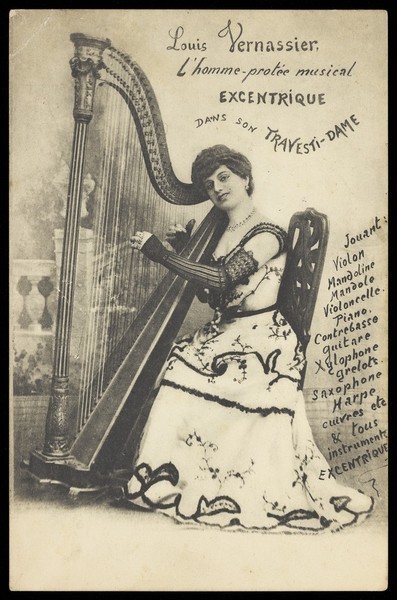
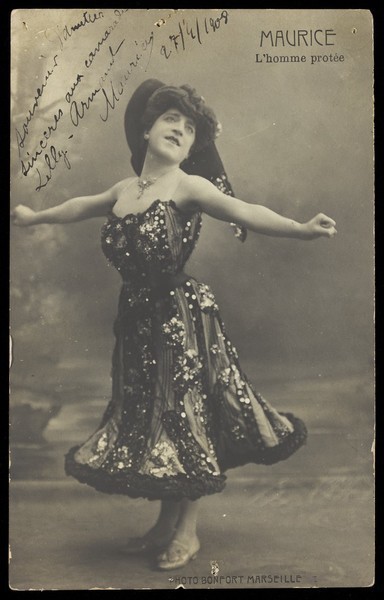
L'homme protée

L'homme protée (French for protean man) was a term used for stage female impersonators cum quick-change artists from the turn of the 20th century to the mid 1920s,

Some examples:

Louis Vernassier, 1906.    See  temposenzatempo.


A "Vernassier, Louis" was killed in action at Saint-Jean-de-Bassel on 20 August 1914 (only three weeks into WWI) - this may be the same person.

----------------

Lilly-Armand Maurice, 1908


Both these photographs are in the Digital Transgender Archive, and are taken from the James Gardiner 20th Century Drag Postcards collection at the Wellcome Library.

22 February 2022

Magnus Hirschfeld in Paris, July 1933

 An article on the front page of La Volanté, 20 Juillet 1933.

Translation

Anti-Semitism Against Science.

Professor Magnus Hirschfeld whose work on sexuality is famous, is in exile in Paris
---------------
and 180 of his works, 40 thousand volumes that he had collected, have been burned in Berlin by the Nazis.


He has been our guest for a month, staying at the Hotel d'Orsay, with his countless filing cards and a young Japanese secretary, Tao-Li, who follows him like his shadow.

A strange man, this exile from Hitler's regime, Magnus Hirschfeld: a Don Quixote of sexuality, who travelled the globe for 40 years, from Europe to China, studying the problem of sexual perversion, in Man and in animals-- even insects--to defend and treat a mystery of nature. A really great mystery, when a huge, bearded guy has an irresistible urge to put on a dress and make tapestries.

In his museum of sexuality in Berlin he saw 40,000 cases, strange cases mixing buffoonery and drama, a museum where garter belts and bras serve as men's outfitting.

I should say his former museum. For it's all gone. His 14,000 volume collection on the subject, his own 180 papers, a collection that would astonish Freud, Malthus and the Marquis de Sade-- all burned.

Tao-Li showed me in. The professor was wearing a white shirt. His dreamy blue eyes focussed on me rather severely. I was a little embarrassed. Would he take me for case no. 40,001? Thank God, his scowling expression, darkened by his gray moustache, like a Indian sculpture, lightened up. "Forty years ago," he said, "when I was a young doctor, one of my patients, an officer, killed himself on the night before his wedding. I learned the real reason for his despair only after he died. I was interested. I wrote a pamphlet under a pseudonym. The day after it was published, my bookstore was swamped with requests-- an unexpected bookseller's success. That's how I got started.

At the professor's invitation, I interviewed him. "It isn't true", he said, "that Germany has a monopoly on inverts. But there, they are legally controlled and they attract attention, while in France, the Napoleonic Code does not interfere with the private affairs of individuals. Here, cases like that of Oscar Wilde or Prince Eulenburg would go completely unnoticed."

But what about all those 'special' clubs in Berlin? "That's just it. The police watch them carefully; the problem is kept in one place where it's easy to control. According to the statistics, there are one million inverts in Germany. In Berlin alone there are 20,000 female domestic arrangements  and thousands of men in dresses and silk stockings."

His answer was vague: Several countries offered to take him, including America, China and Egypt, but he would rather stay in  Europe: "I feel more at home, especially in France, where I always find a warm welcome, and two scientists who initiated me are here, Brown-Sequard and Charcot."

It was time to leave. I was starting to feel a little insecure about my own sexuality, escpecially after Tao-Li, who was himself well versed in the subject, showed me some of the profesor's books with photos of strange patients. One of them was cutting women's hair, another only liked white gloves, a third killed himself because he couldn't get permission to dress as a woman!

On the way back, I could not get out of my mind everything that this good man had revealed to me. I began to freak out passers-by with an abnormal exprssion. At the Place de la Concorde a big car passed driven by a Japanese. Riding in back, with his hair flying in the wind, was Professor Magnus Hirschfeld.

Yvonne NOVIA 


-------------------

Of course Tao-Li was Chinse, not Japanese.

It was good to see this on the front page of La Volanté.   I have not found any English languages papers that paid the same attention to Hirschfeld in Paris.

14 February 2022

Charlotte Charlaque (1892 - 1963) actress, translator, Hirschfeld patient

Charlaque was born in Berlin-Schöneberg and raised with the name Curt Scharlach. There was a brother Hans, seven years older. The family, who were Jewish, emigrated to the US at the turn of the century and settled in San Francisco, where Edmund Scharlach worked as a sales representative in textiles. However the mother, Jenny, returned to Germany in 1910. Edmund, who had become a US citizen stayed and remarried in 1916. 

Hans returned to Germany shortly after the start of the Great War in 1914. After 1919 he worked as an independent banker, until he sold his business in the mid-1920s. Curt worked briefly as a female impersonator, and consulted Harry Benjamin who suggested Magnus Hirschfeld in Berlin.  Curt moved to Berlin in 1922 when Jenny was seriously ill, and lived with Hans for a while, but also spent time in France and became proficient in the language. 

Increasingly Curt was rather Charlotte, and obtained a Transvestitenschein, to legally dress as the woman that she felt she was. She had completion surgery at the Am Urban hospital in Berlin-Kreuzberg in 1929-30, under the aegis of Magnus Hirschfeld’s Institut für Sexualwissenschaft. The surgery was done by Erwin Gohrbandt, and Felix Abraham paid the required 50 Reichsmarks. Like Dörchen Richter, Charlotte worked at the Institute, Dörchen as a maid, Charlotte as a receptionist. Her formal name was now Charlotte Curtis Charlaque. 

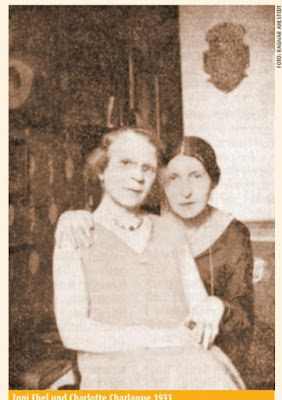
Charlotte met Toni Ebel and introduced her to Hirschfeld who accepted her into the surgical program.  Toni had completion surgery in several operations in 1932. By that time Charlotte and Toni had become lovers. The Swedish journalist Ragnar Ahlstedt visited them at their flat at Nollendorfstraße 24 in Berlin-Schöneberg, and wrote about them in his Män som blivit kvinnor, 1933. They lived cheaply: Charlotte said that she was an actress and Toni was able to sell some paintings and drawings. 

Under Charlotte’s guidance, Toni converted to Judaism. In addition Toni had previously been a member of the Socialist USPD. After the Nazi takeover, one of Toni’s half sisters warned them that they were under observance, and they fled to Karlovy Vary (Karlsbad), in Czechoslovakia’s Sudetenland, the largest spa town in Europe, in May 1934. Charlotte gave English and French lessons, and Toni painted pictures for guests at the spa. The next year they moved to Prague and then to Brno. However they had to report to the police every fortnight and were advised to leave. 

So they returned to Prague in 1938. Charlotte taught English and French and also gave acting courses and worked as a translator. She translated at least three stage works by the Czech writer Olga Scheinpflugová (1902-1968) into English. These are the dramas Chladné světlo (The Cold Light) , Láska není všecko (Love is not everything) and Pan Grünfeld a strašidla (Mr. Greenfeld and the Ghosts). 

In March 1942 Charlotte was arrested by the Czechoslovak Aliens Police and jailed for being a Jew. Toni managed to persuade the Swiss consul that Charlotte was a US citizen, that she had submitted her documents to the US consul in Vienna and was waiting for a new passport. This resulted in Charlotte being sent to an “American camp” and later deported to the US. She sailed from Lisbon 2 July 1942. Toni attempted to follow but was not approved as Reichsdeutsche, and was not allowed to travel to Lisbon.

In New York Charlotte had to endure an extended medical exam. She was taken in by the Red Cross who housed her in a poor house in Leroy Street, Manhattan. She did some translations but suffered in her gallbladder and she had a stomach ulcer. She corresponded with Toni who settled in East Germany. She could not afford to return to Germany, and as a Jew was reluctant to do so. Later she made a living coaching young actors in “English diction”, and she also acted in several Off-Broadway productions, and was known for a while as the Queen of Brooklyn Heights Promenade. In December 1952 she wrote to Christine Jorgensen’s parents to explain that she too was transsexual.

  • Ragnar Ahlstedt. Män som blivit kvinnor. Två fall av könsväxling på operative väg. En study of transvestitism. Tranås: mountain, 1933: 4.
  • Joanne Meyerowitz. How Sex Changed: A History of Transsexuality in the United States. Harvard University Press. 2002: 30, 48, 294n53.
  • Raimund Wolfert. “ ‘Sage, Toni, denkt man so bei euch drüben?’ Auf den Spuren von Curt Scharlach alias Charlotte Charlaque (1892 -?) und Toni Ebel (1881-1961)”. Lesbengeschichte, 3/2015. Online. And also at issuu.com   Online.
  • Raimund Wolfert. Charlotte Charlaque: Transfrau, Laienschauspielerin, „Königin der Brooklyn Heights Promenade“. Hentrich & Hentrich, 2021.
  • Rivka Wolf. “Finding My Queer Heritage: My great-aunt Charlotte was trans and queer. Her story was lost to my family: until now”. Medium.com, Sep 14, 2021. Online.

DE.Wikipedia(Toni Ebel)

-----------

Two Nazi-era German films, Liebe geht - wohin sie will, 1935 and Junges Blut, 1936 feature an actor Hans Scharlach. It is not known whether this is Charlotte’s brother.

Wolfert says of the ‘American camp’ that it was “probably the Liebenau internment camp, which was set up in 1940 in a former sanatorium near Tettnang (Lake Constance district) in southern Germany. Foreign women and children from the entire German Reich or interned in areas occupied by the Wehrmacht, which were intended for exchange with Americans and British of German origin.”

Meyerowitz discusses Charlotte Charlaque under the pseudonym of Carla van Crist.

There is no mention of any Charlotte or ‘queen of Brooklyn Heights’ in Hugh Ryan’s When Brooklyn was Queer.

04 February 2022

Bathyllus, female impersonator in Augustan Rome


Bathyllus was born in Alexandria in the mid of the last century BCE and maybe  was originally called Gaius Theoros. He was a slave in the house of Maecenas, but later was given his freedom. He, along with Pylades of Cicicia, was credited as a pioneer of Roman pantomime (no dialogue), around 22 BCE in Augustan Rome. However the pantomimos danced a combination of old and new dances, of Greek and Asiatic traditions, and the term pantomimos had first appeared for the performer Ploutogenes before 75 BCE. Possibly what Bathyllus and Pylades did was to expand the musical accompaniment. A pantomimos was a solo artist who danced all the roles in a sequence with a different closed-mouth mask for each role, and was accompanied by a chorus who sang a libretto, a fabula saltica, supported by musicians.

Senelick p32

Unlike Pylades, Bathyllus was noted for his feminine grace. He mainly acted female parts and his solo act, Leda with the swan was acclaimed. He was regarded as the epitome of comedic performance, and as one of the leading modernizers of performance.

Maecenas, not longer Bathyllus’ owner, was said to have become/remained his lover.

Juvenal: “When the effeminate Bathyllus lasciviously dances Leda, just watch the women. Tuccia can’t control her bladder, Apula suddenly moans in drawn-out ecstasy, as if in a passionate embrace. Country-girl Thymele’s all rapt attention, she’s learning fast.” (chironomon Ledam molli saltante Bathyllo/ Tuccia vesicae non imperat, Apula gannet,/ [sicut in amplexu, subito et miserabile longum.]/ attendit Thymele: Thymele tunc rustica discit.)

One of the interlocutors in Plutarch’s Table Talk  refers to Bathyllus’ performance as a danced imitation of ‘Echo or some Pan or Satyr revelling with Eros’.

Certainly the innovations of Pylades and Bathyllus quickly became popular, and the style was even incorporated into the Emperor cult, particularly at the Sebasteion in the city of Aphrodisias in Caria (off what is now the Turkish coast) where Aphrodite and the Imperial Family were celebrated.

However there were periods of rioting among the spectators and sometimes the dancers were banished from Rome and even Italy because of these passions.

Athenaeus, Sophists at Dinner 20e

Juvenal. Satires bk 6

Libenius On Behalf of the Dancers

Lucian On Dancing 1

Plutarch Table Talk, Moral Essays 711e-f.

Tacitus. Annals 1,54

  • Lillian B Lawler. The Dance in Ancient Greece. Adam & Charles Black, 1964:139-141,
  • F Michael Moore. Drag!: Male and Female Impesonators on Stage, Screen and Television: An Illustrated World History. McFarland & Compamy, 1994:129.
  • Laurence Senelick. The Changing Room: Sex, drag and theatre.Routledge, 2000:31-2.
  • Ismene Lada-Richards. Silent Eloquence: Lucian and Pantomime Dancing. Bloomsbury, 2007: 19, 22, 23–4, 58-60, 72, 109, 124, 125, 164, 169, 170, 171, 176n1, 177n18, 177n20, 179n4, 188n16.
  • Edith Hall & Rosie Wyles (eds). New Directions in Ancient Pantomime.Oxford University Press, 2008: 8,10, 29, 33, 46, 113-4, 118, 125-7, 146-7, 150, 157-8, 160, 170, 174, 189, 200-2, 265, 270, 297, 375-6, 385,

EN.Wikipedia