This site is the most comprehensive on the web devoted to trans history and biography. Well over 1800 persons worthy of note, both famous and obscure, are discussed in detail, and many more are mentioned in passing.

There is a detailed Index arranged by vocation, doctor, activist group etc. There is also a Place Index arranged by City etc. This is still evolving.

In addition to this most articles have one or more labels at the bottom. Click one to go to similar persons. There is a full list of labels at the bottom of the right-hand sidebar. There is also a search box at the top left. Enjoy exploring!

12 January 2015

Lili Elbe: bibliography

Part I:  Einar Wegener, artist
Part II: Lili Ilse Elvenes, surgery and womanhood
Bibliography
Part III:  Lili Elbe, media construct


Figure 10 in Ein mensch wechselt sein geschlecht


  • Vigge Afrelius. "Ved en Bortrejse". Ekstra Bladet, 04.03.1913; 2.
  • Aldous Huxley.  "Farcical History of Richard Greenow".  In Limbo. Chatto and Windus, 1920.
  • Thorkil Barfod. "Gerda og Einar Wegener fortæller om Paris". København, 03.08.1924; 5.
  • K.P. "Gerda Wegeners Udstilling(Gerda Wegener's Exhibition)“. Politiken, 26.02.1931, 4.
  • Loulou Lassen. "Et Liv gennem to Tilværelser. En Fortid som Mand og en Fremtid som Kvinde. Lili Elbe fortæller om Maleren Einar Wegener og om sig selv"(A life through two existences. A past as male and a future as a woman. Lili Elbe tells about the artist Einar Wegener and about herself ). Politiken, 28.02.1931, 5–6.
  • Dr. Rank: "Manden, der blev Kvinde. Professor von Warnekros fortæller: Lili Elbe blev til ved et i Lægevidenskabens Annaler enestaaende Indgreb“"(The man, who was female. Professor von Warnekros says: Lili Elbe results from an intervention unique in the annals of medical science). Ekstra Bladet. 28.02.1931, 1, 9.
  • Loulou Lassen. "Kønskarakter og dens Svingninger: Prof. Knud Sand udtaler sig om abnorme Kønstilstande hos Mennesker"(Sexual character and its fluctuations: Prof. Knud Sand's opinion on abnormal sex type of people ). Politiken, 01.03.1931, 5–6.
  • Lili Elbe. Fra mand til kvinde: Lili Elbes bekendelser. København: Hage & Clausen, 1931.
  • Lili Elbe (ed Neils Hoyer). Ein Mensch wechselt sein Geschlecht; eine Lebensbeichte. Aus hinterlassenen Papiere. Dresden: Reissner, 1932.
  • Gregorio Marañón & Warre Bradley Wells. The Evolution of Sex and Intersexual Conditions / Translated from the Spanish by Warre B. Wells ; with New Appendix. London: G. Allen & Unwin Ltd, 1932.
  • Lili Elbe (ed Neils Hoyer) translated from the German into English by H.J. Stenning, with an Introduction by Norman Haire. Man into Woman: an Authentic Record of a Change of Sex. The true story of the miraculous transformation of the Danish painter, Einar Wegener. New York: E.P.Dutton & Co, Inc. London: Jarrold Publisher's, xiii, 287 pp 24 plates 1933. London : Beacon Library, 1937. Reissued by NY: Popular Library, 1953. Reissued as Man into woman: the first sex change, a portrait of Lili Elbe: the true and remarkable transformation of the painter Einar Wegener. London: Blue Boat Books, 2004.
  • Maurice Rostand. La femme qui était en lui. Paris: E. Flammarion, 1933.
  • Magnus Hirschfeld. 'L'amour et la science'. Voila, 3, 199, 1 Juli 1933: 6.
  • "A Man Becomes a Woman". Sexology, 1,4, December 1933: 252-4.
  • Sandy Stone. "The Empire Strikes Back: A Posttranssexual Manifesto". In Julia Epstein & Kristina Straub (eds). Body Guards: The Cultural Politics of Gender Ambiguity. New York: Routledge, 1991: 284-9.
  • Sanda Davis. Am I a Man or a Woman? Ottawa: Personality Press, 1995.
  • Bernice L. Hausman. Changing Sex: Transsexualism, Technology, and the Idea of Gender. Durham: Duke University Press, 1995: 15-19.
  • Tim Armstrong. Modernism, Technology, and the Body: A Cultural Study. Cambridge, UK: Cambridge University Press, 1998: chp 6 "Making a woman".
  • Sander L. Gilman. Making the Body Beautiful: A Cultural History of Aesthetic Surgery. Princeton, N.J.: Princeton University Press, 1999: 277-80.
  • Rainer Herrn. Schnittmuster des Geschlechts. Transvestitismus und Transsexualität in der frühen Sexualwissenschaft. Giessen: Psychosozial-Verlag 2005: 204-211.
  • Håkan Lindquist. "Lili Elbe – Vetenskapens stora mirakel". Håkan Lindquist, 25 Juni 2009. http://hakanlindquist.blogspot.com/2009/06/lili-elbe-vetenskapens-stora-mirakel.html.
  • Sabine Meyer. "Mit dem Puppenwagen in die normative Weiblichkeit. Lili Elbe und die journalistische Inszenierung von Transsexualität in Dänemark". NORDEUROPAforum, 20, 2010,1-2: 33-61. PDF.
  • Susanne Kailitz. "Das Experiment: 1930 führte der Dresdner Gynäkologe Kurt Warnekros eine der weltweit ersten Geschlechtsumwandlungen durch". Zeit Online, 13. Januar 2012. www.zeit.de/2012/03/S-Geschlechtsumwandlung,
  • Nadya Lev. "The Incredibly True Adventures of Gerda Wegener and Lili Elbe". Coilhouse, August 3rd, 2012. http://coilhouse.net/2012/08/the-incredibly-true-adventures-of-gerda-wegener-and-lili-elbe.
  • Diana Wyndham. Norman Haire and the Study of Sex. Sydney University Press, 2012: 222.
Bundesstifung MagnusHirschfeld   GLBTQ   DA.WIKIPEDIA LGBTHistoryMonth    EN.WIKIPEDIA  
Kay Brown’s TransHistory    Paintings by Einar Wegener
Vidensbanken om kønsidentitet   

11 January 2015

Lili Ilse Elvenes, surgery and womanhood

Part I:  Einar Wegener, artist
Part II: Lili Ilse Elvenes, surgery and womanhood
Bibliography
Part III:  Lili Elbe, media construct


In Spring 1930 Einar was depressed in that Lili seemed to be taking over. He had been to several doctors, one of whom was a radiologist, who had perhaps exposed him to too much x-ray therapy. This had been all to no effect and he was contemplating suicide. A friend arranged an appointment with the Dresden Doctor Kurt Warnekros who was visiting Paris. It was not Lili but Einar who attended, and Warnekros, after an examination, made an appointment for further examination and surgery in Berlin the next week.

Einer alone went to Berlin – in male clothes and with a change of only male clothes in his suitcase. Warnekros arranged blood tests, and for Magnus Hirschfeld to do a psychological examination. This required a visit to Hirschfeld's Institut für Sexualwissenschaft, where he encountered trans women, and it is highly likely that they included Charlotte Charlaque, Toni Ebel and Dörchen Richter, all of whom had had a first operation by this date. Einar did not relate to them:
"He felt intensely uncomfortable. In this large room a group of abnormal persons seemed to be holding a meeting – women who appeared to be dressed up as men, and men of whom one could scarcely believe that they were men. The manner in which they were conversing disgusted him; their movements, their voices, the way in which they were attired, produced a feeling of nausea." (p54).

Later that day, Einar dined with his Berlin friend Neils Hvide who puts a question:
"'As a man you have always seemed to me unquestionably healthy. I have, indeed, seen with my own eyes that you attract women, and that is the clearest proof that you are a genuine fellow.' He paused, and then placed his hand on [Einar]'s shoulder. 'You won't take it amiss if I ask you a frank question? ...Have you at any time been interested in your own kind? You know what I mean'. [Einar] shook his head calmly. 'My word on it, Niels; never in my life. And I can add that those kind of creatures have never shown any interest in me'. 'Good, [Einar]! That's just what I thought'."(p56)
And two paragraphs later Einar adds:
"I will  honestly and plainly confess to you, Niels, that I have always been attracted to women.  And to-day as much as ever. A most banal confession!"
After Einar's orchiectomy at the age of 48, which was probably done by Dr Erwin Gohrbandt, Gerda arrived and purchased women's clothes for Lili, and Wegener was declared to be no longer male and was now entitled to enter Warnekros' Staatliche Frauenklinik (National Women's Clinic) in Dresden, where a second operation was done.

Lili and Gerda then returned to Copenhagen in October 1930, a few weeks before Magnus Hirschfeld left Germany for New York, never to return. King Christian X Schleswig-Holstein-Sonderburg-Glücksburg annulled the marriage of the Wegeners, and Lili was issued papers in her new legal name of Lili Ilse Elvenes, including a passport.


In 1931 Gerda married Fernando Porta, an Italian officer, aviator and diplomat and went to live with him in Morocco.

A further operation on Lili Elvenes to implant ovaries, or maybe an uterus, taken from a 26-year-old woman was done at the Dresden Clinic by Warnekros. However Elvenes died three months later, probably of transplant rejection, but maybe from infection or a heart attack. She was buried in Dresden.

Gerda Porta was still in Morrocco when she heard of Lili’s death. She divorced Porta in 1936, and returned to Denmark in 1938. She held her last exhibition in 1939, but by then was rather out of fashion. She died alone and impoverished in 1940, of a heart attack at age 54, shortly after the German occupation.
Lili in Copenhagen, late 1930

______________________________________________________________________________

It is not my practice to name essays by the pre-transition name of the person if the post-transition name is on record.   I have made an exception in this case in that the name Lili Elvenes is not generally known, and would probably not be recognized.  Almost all accounts refer to her simply as Lili Elbe, but that was never her real name. 

As already mentioned, the book by Lili Elbe is an unreliable narration.   To take two examples.  It is claimed that the orchiectomy not only changed her voice from a tenor to a soprano, but altered her handwriting to a definitely feminine style.    It only it were so!  Secondly Lili Elvenes appears to be the only person to have had four gonads: two testicles which were removed in the orchiectomy, and two ovaries which had been feminizing his body.  Note that Dr Norman Haire in his introduction to the English version of the biography says that Einar "was sufficiently normal both psychologically and physically to be able to fulfil  his functions as a husband".

Lili claims that Einar's monthly bleedings from the nose and elsewhere which were taken as representative of menstruation.  30 years later Dawn Langley would also claim to menstruate.

When Lili had her final operations to transplant ovaries/uterus she was 49, an age when many women have reached menopause, and the childbearing years are definitely over.

So how does "I can add that those kind of creatures have never shown any interest in me" fit with the repeated reports of men chasing, making passes and wanting to marry Lili.  Are we to presume that 'those kinds of creatures'=gay, while those who made passes at Lili were 'healthy'=straight.   It was an open secret in both Copenhagen and Paris that  Einar=Lili, and at least some of those making passes must have heard the rumours.

On the eve of the operation Einar asserted an 'banal' interest only in women.  And yet shortly afterwards wanted the extra operations so that Lili could marry a man and bear children.   While such a turnaround is not inconceivable, the assertion of it is very much part of Louise Lassen's program of re-assuring her readers that there is nothing queer in the story.

Sandy Stone, raises the naughty question of whether Einar wrang the turkey's neck, and continues: "No wonder feminist theorists have been suspicious.  Hell, I'm suspicious."

Is Neils Hvide, Neils Hoyer?

Was Einar/Lili intersex?  Here is an article by Karin of OII Australia that argues that she was.  However many of the pioneer transsexuals, Betty CowellDawn Langley, etc maintained that they were intersex, with as little proof.  There is also the problem that most intersex persons stay with the gender of rearing.  An intersex person may or may not be trans, and probably is not.

My opinion is that Einar was what is often called a Natural Beauty, a man who is often taken as a woman, even when not trying.  The pre-transition Coccinelle, April Ashley, Rachel Harlow were all natural beauties.  Nobody has really argued that this condition is a type of intersex, nor does it always lead to transition: Jaye Davidson, who was cast as Dil in The Crying Game, was so cast because of his beauty, but afterwards continued his life as a man.

Although I must admit that looking at the male-dressed photographs of Einar, I do not see a Natural Beauty, although we may put this down to the low-definition photography andthe unflattering male clothes and hairstyles of the 1920s.   But if Einar was not a Natural Beauty why did so many men assume that the male-dressed Einar was a woman in trousers?   Maybe in fact they did not, and again this is part of the unreliable narration.  Lili would not be the last trans woman to overestimate both how well she passed, and how attractive she was.

Why was Elvenes accepted for surgery, when so very few were?  Unlike Charlotte Charlaque, Toni Ebel and Dörchen Ritcher she was not living fulltime as female.  It was Einar who showed for the Paris appointment, and again it was Einar who arrived in Berlin, with only male clothing in a suitcase.  Many transsexuals in later times were rejected until they started arriving dressed as the target gender.  Warnekros did not have Hirschfeld’s experience with trans persons; he was a gynecologist and obstetrician and radiologist, and apparently he wanted to be famous.  I suggest that he mistook being a Natural Beauty for being a transsexual.

It is not clear just what operations Lili Elvenes had.  However there is a general assumption that death was caused by a transplant, either of ovaries or of a uterus.   Orchiectomy, penectomy and vaginoplasty were quite safe though experimental.   Unlike Elvenes, Hirschfeld’s patients lived: Charlotte Charlaque was still alive in New York in 1952; Toni Ebel lived until 1961; nothing is known of Dörchen Ritcher after 1933, but the presumption is that she was murdered by Nazis, not that she died as a result of her surgeries.   If Elvenes had settled for the same she also probably would would have lived several years more.

It was not Lili's age, 49 in 1931, that affected her survival chances.  She was in fact one year younger than Toni Ebel.

We do not have enough information to be sure, but it would seem that Carla, Toni and Dörchen were more androphilic than gynephilic, and they would have been early transitioners if the social support had existed at the time.   So was Lili the first gynephilic transsexual to achieve surgery?   It is of course ironic that Charlotte Goiar proclaims Lili, and not Carla, Toni or Dörchen, as the first surgical HBS person.  Incidentally there was an earlier attempt at gynephilic transgender surgery in Berlin, as early as 1921.   I will return to that later in the month.

We should of course mention Dr Eugen Steinach (1861 - 1944) of Vienna.   Steinach proposed that ligation of the vas deferens, while causing atrophy of spermatogenic tissue, would produce additional testosterone. This vasoligation, unlike the similar vasectomy, was done on one testicle only, and most patients (that is men) reported increased vigour and sexual power. This of course was homeogender not transgender surgery.  Some of the men who had this operation were Sigmund Freud, Harry Benjamin and WB Yeats, all of whom were well pleased with the results.  Benjamin became Steinach's US disciple and performed over 500 Steinach operations in New York (unlike Steinach who never did the surgery himself).  Norman Haire, In London, also performed the operation.  Some other doctors, both then and now, say that the results were psychogenic rather than hormonal.

Along with Steinach, Benjamin pioneered an equivalent operation for women, diathermy, applied to one ovary, supplemented by x-ray treatment of the area.   So much for the idea in the book that Einar's visits to a radiologist had damaged his birth ovaries.

Steinach also did apparent ‘sex changes’ on guinea pigs with castrations and gland transplants.   This was the background behind the decision to transplant ovaries in Lili Elvenes (who of course should not have needed new ovaries if she had two of her own all along).   Could Steinach's results be also achieved in humans?  Steinach did report that he implanted a testicle into a man who was castrated, passive and feminine, and that the man became a 'normal' heterosexual. There is however a lack of verifications and replications.

09 January 2015

Einar Wegener, artist

Part I:  Einar Wegener, artist
Part II: Lili Ilse Elvenes, surgery and womanhood
Bibliography
Part III:  Lili Elbe, media construct


(all page references are to the Blue Boat edition of Man Into Woman, 2004)

Part III will be a discussion of the fact that Man Into Woman appears to be an unreliable narration.  However without it we have almost no story at all.  So in parts I and II details from the book will be used.   However bear in mind that this is tentative.

________________

Einar Mogens Andreas Wegener (1882 - 1931), the son of a grocer in Vejle, Denmark, was educated as a painter at Vejle Tekniske Gymnasium and then Copenhagen Kunstakademi (Art School) where he met Gerda Gottlieb (1886-1940), the only survivor of four daughters of a pastor. Einar and Gerda married in 1904.

After graduation Gerda exhibited at the Autumn Art Exhibition, The Charlottenborg Spring Exhibition and the Journalists' Union. Her breakthrough was in 1907 when she won a competition organized by Politiken newspaper, and in the same year several female painters including Gerda were rejected from the Charlottenborg Exhibition – which became known as the Peasant Painter Controversy.

One of Gerda's early commissions was a portrait of Anna Larssen (1875 - 1955), the popular actress. One day Anna was unable to attend, and on the phone suggested that Einar's legs be used as had been done once before. This time Gerda fully dressed Einar in a dress and wig. In the end Anna did arrive, and on seeing Einar exclaimed:
"I will christen you my girlie. You shall receive a particularly lovely musical name. For example Lili. What do you say to Lili?" (p 67)
A few weeks later Lili appeared at the Artists' Ball and was a great success. Gerda found Lili to be a charming companion. Einar did landscape paintings and Gerda illustrated books and fashion magazines. Einar received the Neuhausens prize in 1907 and exhibited at Kunstnernes Efterårsudstilling and at Vejle Art Museum.

Lili/Einar was an open secret, and in 1912 when Einar and Gerda decided to leave Copenhagen, a satirical poem by Vigge Afrelius, was published in Eksta Bladet, a sister publication to Politiken, that included the lines: "hvis vi tro kan, hvad Saga fortæller,/Michelangelo og som Zahrtmann/you bru'r kun mandelige Modeller! (if we can believe/what the story tells you used/such as Michelangelo and Zahrtmann male models!)".

After travels in Italy and France Gerda and Einar moved to Paris later that year, and at first stayed at the Hôtel d’Alsace, and were shocked to find themselves in room 16, the very room where Oscar Wilde had died twelve years earlier. They took inspiration and read Wilde's writings out loud to each other.

Gerda worked for Vogue and La Vie Parisienne. She also held regular exhibitions at the Ole Haslunds gallery in Copenhagen, and came to be considered a major Art Deco artist and was well known for her erotica. Einar exhibited in the Salon de Paris and Salon d'Automne in Paris. However he de-emphasized his own work to help Gerda, and became her favourite model.
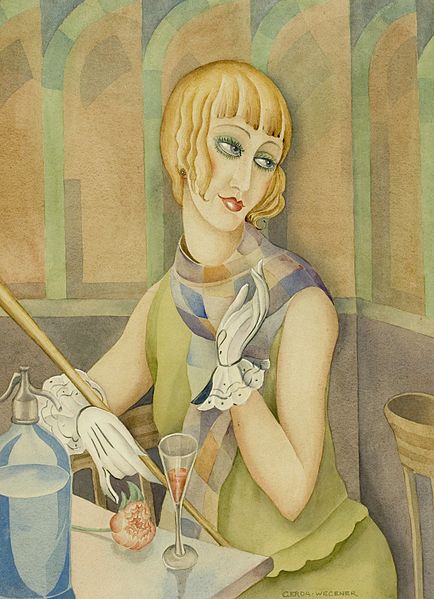
Lili painted by Gerda

Gerda became famous for her paintings of women, and it was later discovered that most of them were actually of Lili. In 1924, Einar, on a trip back home, was interviewed by the København newspaper, and spoke about dressing as a woman during Paris Carnival.
 
Through the 1920s Einer was increasingly Lili. She attended public events, entertained at home as Lili, and went on trips to the countryside. She passed well and men even proposed to her. Gerda introduced her as Einar’s sister. Einar was often depressed and suffered from coughing spells; however Lili was bright and happy: Gerda came to prefer the company of Lili. Einar in male clothing was several times taken as a woman in trousers.


One day Einar said:
"Really I cannot imagine what existence would be like if Lili should one day vanish for ever, or if she should no longer look young and beautiful, Then she would no longer have any justification for living at all."
Gerda replied:
"In recent months I have felt prickings of conscience because I was, to a certain extent, the cause of creating Lili, of enticing her out of you, and thus becoming responsible for a disharmony in you which reveals itself most distinctly on those days when Lili does not appear." (p92).
and she continued:
"It often happens thatwhen she poses for me as a model a strange feeling comes over me that it is she whom I am creating and forming rather than the girl whom I am representing on my canvas.  Sometimes it seems to me that here is something which is stronger than we are, something which makes us powerless and will thrust us aside, as if, indeed, it wanted to be revenged on us for having played with it." (p93)

Later Einar wrote:  "Formerly I had found distraction in reading.  Now I never opened a book or journal.  What were the fates of strange persons to me, unless I could find consolation in reading about a person of my own kind?  But of such a person no author had been able to able to write, because it had never occurred to any author that such a person could ever have existed."  (p110-1)  (This was 20 years after the publication of Magnus Hirschfeld's Die Transvestiten, and 2 years after Havelock Ellis' Eonism and Other Supplementary Studies.) 


 Paintings by Einar Wegener     Paintings by Gerda Wegener  
 __________________________________________________________________________

Do click through to see paintings by both Einar and Gerda.   In Part III Louise Lassan will describe  Einar’s paintings as ‘virile’ but I do not see them as so.  They strike me as ordinary landscapes.   To my eye Gerda was obviously the more adventurous painter.

Some sources claim that Gerda was lesbian.   I found no confirmation of this, and of course she will re-marry to a man as soon as her marriage to Einar is annulled in Part II.

Presumably Einar and Gerda were in Paris during the Great War.  However there is no mention of it in Man into Woman.  

Anna Larssen was a popular actress in the 1900s.   Surprisingly, she quit acting in 1909 and became a Pentecostal minister, and with her second husband founded the Danish Apostolic Church.  No date is given for when Anna named Einar as Lili, but 1907 must be a terminus post quem and 1909 a terminus ante quem.  Thus it must have been only months before her abandonment of her acting career to dedicate her life to God.

The poem published on the departure of Einar and Gerda from Copenhagen in 1912:.

[...] Jolies Popo’s – petites Nichon’s
kan ingen som Fru Gerda tegne –
og ganske ligegyldigt hvor –
for sligt ser ens ud allevegne! [...]

Med Kunstens Store du i Slægt er,
hvis vi kan tro, hvad Saga fortæller,
som Michelangelo og Zahrtmann
du bru’r kun mandelige Modeller!

Den Ting har saare mig bedrøvet
og din er Skylden, skønne Tegner!
Tænk! Jeg har glædet mig ved Former,
Der rim’ligvis har tilhørt Ejnar! [...]

[...] Pretty butt - small breasts
no one like Mrs. Gerda can draw,
and no matter wherever -
as such looks the same everywhere. [...]

The Great Art thou art related,
[and] if we can believe what the story tells
you used such as Michelangelo and Zahrtmann male models!

The thing I was extremely saddened
and yours is the guilt, beautiful illustrator!
Imagine that! I'm pleased me to forms
that have probably heard Ejnar! [...]
  •  "Afrelius, Vigge:" Ved en Bortrejse ". In: Ekstra Bladet, 04.03.1913; 2.

06 January 2015

4 trans mayors in India

Kamla Jaan (1954 – ), although illiterate, was elected mayor of Katni, Madhya Pradesh, in 1999. She won 28 of 45 wards, finishing 1,897 votes ahead.  She sank wells, fixed the drains and renovated the bus station, and dismissed the advisory council. In 2003, the High Court upheld that Kamla Jaan was not a "woman" and hence she was asked to step down from the post of mayor, reserved for female candidate.  NYTimes

Asha Devi (1952 – 2013) in 2000 ran for the post of mayor in Gorakhpur, eastern Uttar Pradesh, a post reserved for a woman.   The pradesh Election Commission ruled that her sex was to be decided by how she was enrolled in the voters’ list.   She won over one lakh (1,09,849) votes. Every other candidate including the one from Bharatiya Janata Party lost her deposit.  During her tenure she concentrated on the construction of roads and drainage.  In May 2003 her election was declared invalid on the grounds that the post was reserved for a female, and that Asha is not female. This was in response to a petition by from the Samajwadi Party candidate, who had had come second but received over 60,000 fewer votes.


Kamla Kinnar (1954 – ) was elected mayor of Sagar, Madhya Pradesh in 2009.  She ran independent candidate with a margin of over 43,000 votes defeating her nearest BJP rival Suman Ahirwar.  Two years after the election, the Sagar district court declared Kamala Kinnar's election as "null and void" because the mayor's seat was reserved for a 'woman' belonging to scheduled caste category.


Madhu Kinnar (1979 – ) who previously worked as a singer/dancer on trains, was elected mayor of Raigarh, Chhattisgarh in 2015 by 4357 votes on 4 January, beating the Bharatiya Janata Party’s candidate.
 

__________________________________________________________________________

Let us hope that unlike Kamla, Asha and Kamla, Madhu is allowed to complete her term of office.

05 January 2015

Jo Shanley (1936 - ) machinist

Joseph Shanley of Billerica, Massachusetts, had felt since childhood that he was the wrong sex. In 1969, at age 33, Shanley went to Casablanca and had surgery with Dr Burou.

However on return Shanley continued dressing as a man to keep his job as a machinist. Shanley dressed and lived as Jo outside work.

Shanley retired in 2001, and with her sister, Ann Cavanaugh, bought a house in Claremont, New Hampshire. After a few weeks, it was apparent that the arrangement was not working, and the house was put back on the market. On October 4th three real estate agents and two prospective buyers heard gunshots, found Shanley apparently intoxicated, and Cavanaugh dead on a bedroom floor.

Joseph Shanley was arrested, pleaded guilty to second-degree murder, and was sentenced to 22 years to life. Shanley also filed a motion to be declared a woman. The state attorneys objected to the motion on procedural and jurisdictional grounds in that the court had no power to make such a ruling.

However, after Shanley's physical state was confirmed, the prosecutors were agreeable that she be placed in a Connecticut prison with a special transgender unit. A year later she was transferred to the Correctional Center for Women, in Purdy, Washington.
__________________________________________________________

There are unanswered questions.   Was the sister unaware of Jo’s womanhood?   If not, what was Jo thinking in agreeing to share a house?  Shanley was presenting as male at the time of arrest, even though she had retired and moved to another town.

30 December 2014

2014 and other stuff: comments


In the 1980s when Thatcher was UK Prime Minister, and perhaps in reaction to her predecessor as Conservative leader whose homosexuality was an open secret,  she caused to be enacted Section 28 of the Local Government Act 1986 to inhibit positive statements about homosexuality, and without saying so transsexuality.  This was not the only similarity of Thatcher to Putin, and it not the only homophobic action of the Thatcher government.  At the same as this opposition to adults joining in consensual loving, there was, we now know, an acceptance or at least a looking the other way with regard to predatory paedophilia.   1) Jimmy Savile, now posthumously openly revealed as such a paedophile, was a close friend of Thatcher, and she tried and tried again against official advice, based on reports of his sexual activities, until she obtained a knighthood for him, and he was a frequent guest at Chequers, the official residence of the Prime Minister, especially at New Year’s Eve.  2) Peter Morrison, scion of a dynasty connected to the Conservative party for many generations, inherited the Isle of Islay in the Hebrides where the Thatchers were invited guests year after year.   Peter became MP for Chester, and after Thatcher became PM he was given various government jobs,  became deputy chairman of the Conservative Party, was given a knighthood and became Thatcher’s Parliamentary private Secretary.  By then his interests in young boys were known and now (he died in 1995) he is regarded as a central figure in the North Wales child abuse scandal.  C) Now the story is coming out that a VIP sex party ring, which included a yet unnamed Conservative minister, actually killed at least 3 boys in the 1980s.    We knew at the time that the Thatcherites were a bunch of hypocrites but it is still surprising how far it went.

___________________________

In my article about Catherine McGregor I mentioned the support that she got from Prime Minister Tony Abbott.  This does not mean that Abbot is supportive of transsexuals.   In fact he is known for his fierce opposition to equal marriage despite his sister being lesbian.  And in his Australia, Tori Johnson, the heroic cafe manage in Sydney who lost his life in December’s siege, was a second-class citizen in that he was unable to marry his partner of 14 years.   Abbott is supportive of Catherine because she is a mate going back many years.   There is something similar in the position of Ayla Holdom in Britain’s RAF.  While trans persons are permitted in all the UK’s services, Ayla Holdom does seem to get special attention because she is a mate of William Windsor, an hereditary prince.

___________________________

Articles continue to pop up in the press and on-line re persons who transition and then regret and even detransition (change back).  While many of such articles attempt to spin the facts to suggest that transition is not a good idea, it is interesting that so many mention Alan Finch who reverted 17 years ago, and who has long since dropped out of the public eye.  Example, another.  The reason that Finch is mentioned again and again is that the percentage of transsexuals who revert is actually rather low, and it is difficult for the anti-transsexual polemicists to find recent examples.   As is true of so many aspects of the history of transgender, the most comprehensive list of persons who reverted is found on this site which lists 32 such, persons who reverted for quite a variety of reasons.   Given that over 1000 persons are discussed in some detail, this suggests that less than 3% do in fact revert.
Charles Kane reverted in 2004 giving a sort-of reason:
"In fact, I found being a woman rather shallow and limiting. So much depends on your appearance, at the expense of everything else. I wasn't interested in shopping. My female friends would spend hours shopping for clothes, trying on different outfits. But having been a man I knew exactly what would suit me and appeal to men. I could walk into a shop and be out again in five minutes with the right dress. Nor have I ever been interested in celebrity magazines or the things that interest other women, but when I tried to talk to men about blokey things they didn't take me seriously.”
Which leaves some of us appalled about his conception  of womanhood.  There are loads and loads of women who are not at all described by that, and in fact it would be an insult to describe them in such terms.  I included a person in my Year End Part 2 this year who wants the NHS to pay for a reversal because she finds heels and make-up exhausting.   She, like Kane, should explore some the intriguing and delightful ways of being a woman that do not include high heels or make-up or stereotyped behaviour. 
________________

It is with chagrin that I note that The Danish Girl film has been resurrected.  They have switched from a cis-female to a cis-male actor for the part of ‘Lili Elbe’  - the very idea of using a trans actor seems to be totally alien to the production.  Likewise the idea of using a trans writer.   The following is the first line of the story description from IMDB: “Inspired by the true story of Danish painter Einar Wegener and his California-born wife”.   Gerda Wegener was Danish.   The story cannot be true if she is anything else.   The film is fact-free and transsexual-free.   It will be a film to avoid.

What is that you say:  Gerda was from California in the novel by David Ebershoff.   Yes I know that.  He also has her have a first husband and child before meeting Wegener.   In the true story, she was a pastor’s daughter and married Wegener at age 18.   Hardly time to get in a first marriage.   There is a tradition of filming trans stories by filming a novel ‘inspired’ by the story instead of using the original story – examples: Psycho, M Butterfly.    This is not a good tradition.  If they had in fact filmed the ‘true story’ they could have saved paying a fee to Ebershoff.

Charlotte Goiar, whose instincts about what is good for transsexuals are always somewhat askew, was excited when Nicole Kidman was announced for the part, and is still proclaiming “Nicole Kidman will reportedly play the world's first reported case of a woman born with Harry Benjamin Syndrome  … based on the true story”. !!!

___________________

I put together the list of books in Part 10 partly by going to Amazon and entering ‘transgender’ as a subject.   This was dispiriting in that for every book of interest there were at least 10 that treat trans topics as if they are a fetish: forced femininity etc.   While such books are an established tradition going back to the 1950s and earlier, one would have hoped that with the present-day opportunities for real life transgender such books would be no longer required.   I suppose that the existence of the books is an indication that many, maybe most, trans people remain crossdreamers, and maybe other terms are required.

____________________

Let us return to the quote from Sheila Jeffreys on ABC Radio’s Sunday Night Safran which I mentioned in Part 5:
“Transgenderism for men is about the right to imitate and pretend to be members of the subordinate class even though they are members of – biologically and were brought up in – the superior class. That was problematic for the black and white minstrels. It’s problematic generally when a group of people claim to be another group of subordinate people.”
Whilst this is an Australian academic speaking on Australian radio, this does not seem to address the Australian experience at all.  Without saying so, it seems to be addressing the tradition of blackface in the US.   However in the middle is a reference to the “black and white minstrels”.   The Black and White Minstrels was sing-a-long show on BBC television from 1958-78.  An academic should know better than to mix up cultures like that.   There is the same mishmash on p37 of her new book.   (It is just as well that she is ignorant of the part that US minstrels shows played in the evolution of glamour drag – as I have commented about Janice Raymond’s comments on Jan Morris, the quality of research in transphobic books is usually rather low.)

27 December 2014

Some Events of 2014: Part 10: Archives, Theses, Books


Part 1: Organizations & Activists, Equal marriage, Other Legislation.
Part 2: Persons,
Part 3: Marriage, Lovers and Family, Trans & Intersex Kids.
Part 4: Politics & Government, Celebrities, Sports, Festivals,
Part 5: Schools, Universities & Colleges, Cops & Military, Imprisonment, Homeless Shelters, Nemeses.
Part 6: Doctors & Sexologists, Medicine, Genetics, Legal, Deaths
Part 7: Dress Reform, Homeogender Surgeries, Fashion, Beauty Pageants, Music & Performance,
Part 8: Internet, Art, Radio, Television, Adverts, Theatre, Cinema
Part 9: Jargon, Magazines & Newspapers, Journal Articles & Studies,
Part 10: Archives, Theses, Books.

Archives


Moving Trans* History Forward, University of Victoria, March 21 to 23. Newsarticle.

The Sexual Minority Archives, Northampton, Massachusetts, curated by Bet Power, is fundraising to buy the house where it is located. It gained a University of Massachusetts Creative Economy Initiatives Fund grant and also gained Federal Non-profit status. It will be the home of the Leslie Feinberg Library.

Renée Richards' wooden racket and the original transgender pride flag among other items donated
to the Smithsonian's National Museum of American History.

Theses


  • Ronnie M. Ali. A transpositive approach to therapy with transgender clients: An exploration of therapists' subjective experiences. MA Thesis. University of Western Ontario, 2014. Abstract. PDF.
  • Abby Marie Haak. The Embodiment of Masculinity among Trans* Identified Men. MA Thesis Minnesota State University, 2014. Abstract.
  • Austin Haney Johnson. Doing cisgender vs. doing transgender: An extension of 'doing gender' using documentary film. MA Thesis, Kent State University, 2014. Abstract. PDF.
  • Marie Margaret Keller. Salmacis' alchemical pool: Gender diversity and the transformation of culture. Phd Thesis, Pacifica Graduate Institute, 2014. Abstract PDF
  • Sergio I. Lagman. "Je suis une Schtroumpfette!": Reading Transgender and Transsexual Identities in Children's Comics: Peyo's "Smurfs" and "La Schtroumpfette". PhD Thesis, University of Lousiana at Lafayette, 2014. Abstract. PDF.
  • Jessica Magallanes. Experiences with formal and informal support: A case study of a female-to-male transgender individual. Psy D thesis, Pepperdine University, 2014. Abstract PDF
  • Andrew Smith. A neuropsychological exploration of autistic traits in a transgender population. D Clin Psy thesis, University of Glasgow, 2014. PDF.
  • Emylia N. Terry. An Exclusionary Revolution: Marginalization and Representation of Trans Women in Print Media (1969 – 1979). BA Degree, University of Nevada, Las Vegas. 2014. Abstract.
  • Jaime F. Veale. Biological and Psychological Correlates of Gender-Variant and Gender-Typical Identities. PhD Thesis, Massey University, Albany, NZ. Abstract PDF

Books


$£¥ €=Excessively overpriced books.
  • Niko Besnier & Kali Alexeyeff. Gender on the Edge: Transgender, Gay and Other Pacific Islanders. University of Hawaii Press, 2014.
  • $£¥ € Thomas Edward Bevan. The Psychobiology of Transsexualism and Transgenderism: A New View Based on Scientific Evidence. Praeger, 2014.
  • Joanne Borden. The Transgender Monologues: Gender, Sexuality, and LGBT Life. Kindle, 2014.
  • Sara Collins. The History of Transgender People in America. Lulu, 2014.
  • Kirstin Cronn-Mills. Transgender Lives: Complex Stories, Complex Voices. Lerner Publishing Group, 2014.
  • Paisley Currah & Susan Stryker (eds). Postposttranssexual: Key Concepts for a 21st Century Transgender Studies. Duke University Press, 2014.
  • Paisley Currah & Susan Stryker (eds). Decolonizing the Transgender Imaginary. Duke University Press, 2014.
  • Aaron Devor. The Transgender Archives: Foundations for the Future. University of Victoria Libraries, 2014. PDF.
  • Laura Erickson-Schroth (ed). Trans Bodies, Trans Selves: A Resource for the Transgender Community. Oxford University Press, 2014. Covers topics like the gender spectrum, US trans history, health, cultural and social topics, and gender theory.
  • Karine Espineira, Maud-Yeuse Thomas & Arnaud Alessandrin. La Transyclopedie : Tout Savoir Sur Les Transidentites. Lulu, 2012.
  • Olivia Garson. Rencontrer des trans: rencontres du 3° sexe. Kindle, 2014.
  • $£¥ € Dan Irving & Rupert Raj (eds). Trans Activism in Canada: A Reader. Women's Press, 2014. Review
  • Todd Kachinski Kottmeier & Robyn Walters. CommUnity In Transition: I am greater than a sign, More important than an emblem. Lulu, 2014.
  • Zander Keig & Mitch Kellaway (eds). Manning Up: Transsexual Men on Finding Brotherhood, Family, and Themselves. Createspace, 2014.
  • $£¥ € Helen King. The One-Sex Body on Trial: The Classical and Early Modern Evidence (The History of Medicine in Context). Ashgate Pub Co, 2014. A re-evaluation of Thomas Laqueur's Making Sex: Body and Gender from the Greeks to Freud.
  • Nia King, Jerssica Glennon-Zukoff & Terra Mikalson. Queer and Trans Artists of Color: Stories of Some of Our Lives. CreateSpave, 2014.
  • Brigitte Marcoux. Récits transgenres, Kindle, 2014.
  • Jenny Nordberg. The Underground Girls of Kabul. Virago, 2014. Newsarticle. Afghan families turn a girl into a boy for fear of being shunned thanks to their inability to have sons and to create a useful pair of extra hands in a society where girls are kept behind closed doors at all times.
  • Luise Richter. Transsexualität. Ein gesellschaftliches Phänomen im Wandel. Grin Verlag Gmbh, 2011.
  • Kristen Schilt. Just One of the Guys?: Transgender Men and the Persistence of Gender Inequality. University of Chicago Press, 2011. Newsarticle
  • Hélène Soumet. Les Travesties de l'Histoire: Portraits de ces femmes qui ont choisi de vivre en homme pour rester libres. First, 2014.
  • $£¥ € Jami Kathleen Taylor & Donald P. Haider-Markel. Transgender Rights and Politics: Groups, Issue Framing, and Policy Adoption. University of Michigan Press, 2014.
  • Isaac West. Transforming Citizenships: Transgender Articulations of the Law (Sexual Cultures). NYU Press, 2013.
  • $£¥ € Chantal J. Zabus & David Coad (eds) . Transgender Experience: Place, Ethnicity, and Visibility. Routledge, 2014.
  • Naval Postgraduate School. Transgenders in the U.S. Military: Policies, Problems, and Prospects. Createspace, 2014.

Spiritual


  • Naomi Zeveloff (ed). Transgender & Jewish. Kindle, 2014.

Legal


  • $£¥ € Ally Windsor Howell, with a forward by Phyllis Frye. Transgender Persons and the Law. American Bar Association, 2014.
  • $£¥ € Jens M Scherpe (ed). The Legal Status of Transsexual and Transgender Persons. Intersentia Uitgevers N V, 2014.

Health


  • WHO Regional Office. Regional Assessment of HIV, STI and Other Health Needs of Transgender People in Asia and the Pacific. WHO Publications, 2014.

Guidebooks


  • Joanne Borden. Transgender Complete,: A Virtual Handbook. Kindle, 2014.
  • Jennifer Corbett. On Becoming a Woman: A Transsexual and Transgender guide for transitioning from male to female. Kindle, 2014.
  • $£¥ € Christine Michelle Duffy. Gender Identity and Sexual Orientation Discrimination in the Workplace: A Practical Guide.
  • Jenny Husk. The Ultimate Transgender Before and After Transgender Surgery Survival Guide for Transgender People with Transgender Issues about Transgender Equality. Kindle, 2014.
  • Robyn Kelly. One Woman's Story: A Trans-Activist Sourcebook. Kindle, 2014.
  • Taline Mare. A Trans Popstar's World: When Life Dreams and Being Transgender Collide. Kindle, 2014.
  • Snow McNally. The Transition Process. Kindle, 2014.
  • Carollyn Olson. More Tricks of the Trade -- A Beginners Guide To Cross Dressing. Kindle, 2014.
  • Michelle Spicer. The Transgender Handbook, Lulu, 2014.
  • Dean Thornton (ed). Letters for my Sisters. Transgress Press, 2014. "If you could write just one letter to someone who is beginning their gender transition or to your younger, pre-transition self, what would you say?" 35 trans women answer.
  • Isabella van Vence. Frau sein kann Mann lernen: Das Crossdressing Handbuch. Kindle, 2014.

    Spouses & Family


    • Terri & Vince Cook. Allies & Angels: A Memoir of Our Family's Transition. Hallowed Birch Publishing, 2013.
    • Laurence Hérault. La parenté transgenre. Université de Provence, 2014.

    Transphobic


    • $£¥ € Sheila Jeffreys. Gender Hurts: A Feminist Analysis of the Politics of Transgenderism. Routledge, 2014. Review.
    • Joan Rivers. Michelle Obama "America's First Transgender Lady". Kindle, 2014.

    (Auto)Biography


    • Nora Alex. De haut en bas: TG transformation & more! Kindle, 2014.
    • Diane & Jacob Anderson-Minshall. Queerly Beloved: A Love Story Across Genders. Bold Strokes Books, 2014. Advocate editor Diane whose wife became her husband over 16 years.
    • Arin Andrews. Some Assembly Required. Simon & Shuster, 2014. Joint publication with Katie Hill.
    • S. Bear Bergman. Blood, Marriage, Wine and Glitter. Arsenal Pulp Press, 2013.
    • Catherine Burns (ed). The Moth: This Is A True Story. Serpent's Tail, 2014. Includes a chapter by Kimberly Reed.
    • Christine Burns. Pressing Matters: Volume 2. Amazon Digital, 2014.
    • Julie Clarke. Becoming Julie. Fledgling Press, 2014. Newsarticle. Webpage.
    • Lovemme Corazón. Trauma Queen. Biyuti publishing, 2013.
    • Elliott Deline. Show Trans: A nonfiction Novel. Createspace, 2014. About trans male sexuality and how trans people are pushed to become 'spectacles,' examining DeLine's experiences with sex addiction, sex work, and navigating the MSM scene
    • Suzanne Falkiner. Eugenia: A Man. Xou Pty Ltd, 2014. The life of Harry Crawford, who was convicted in 1919 of his wife's murder, and demonized as a 'man-woman'. There has previously been a film I, Eugenia, and a play, Eugenia, but that is not reason to continue putting his pre-transition name in the very title of the book.
    • Sophia Maria Flores. Überschreitung der Grenzlinie: Ein Transgender-Leben in Deutschland. Selbstbeschreibung. Kindle, 2014.
    • Natalie Rachel Gale. Being Tom. Kindle, 2014.
    • Katie Hill. Rethinking Normal. Simon Shuster, 2014. Joint publication with Arin Andrews.
    • Dominique Jackson. The Transsexual from Tobago: Where I've Been and Where I'm Going. Createspace, 2014.
    • Mar Cambrollé Jurado. Mar cambrollé, una mujer de verdad. La Calle, 2014.
    • Bobbie Lang. Transgender Christians in Chains. Createspace, 2014.
    • Thomas Page McBee. Man Alive: A True Story of Violence, Forgiveness, and Becoming a Man. City Lights, 2014.
    • Janet Mock. Redefining Realness: My Path to Womanhood, Identity, Love & So Much More. Atria Books, 2014.
    • Parker Marie Molloy. My Transgender Coming Out Story. Thought Catalog, 2014.
    • Marie-Pierre Pruvot. La Chanson de Bac (Tome 4 de J’inventais ma vie). Ex-Aequo, 2014. Webpage.
    • Marie-Pierre Pruvot. Le Gai Cimetière (Tome 5 de J’inventais ma vie). Ex-Aequo, 2014. Webpage.
    • Kelly Rockhart. Life of a Punk Rock Transsexual from England 1: The Innocent Years. 2: Breaking Chains. Kindle 2014.
    • Judith Rudakoff. TRANS(per)FORMING Nina Arsenault: An Unreasonable Body of Work. Intellect Ltd, 212.
    • Christian Seidel. Die Frau in mir: Ein Mann wagt ein Experiment. Heyne Verlag, 2014.
    • Rae Spoon & Ivan E. Coyote. Gender Failure. Arsenal Pulp Press, 2014. Explores the lived realities of nonbinary masculinity and "failing" at gender expectations -- both within and without trans communities.
    • Tenika Watson with Jennifer Daelyn. My Life is No Accident. Kindle, 2014.
    • Danièlle Weiss. Die vergessene Königin: Leben in Transidentität. Pomaska-Brand, 2013.
    • Cary Wilson as told to Sunny Cook. I Am Cary: A Transgender's Life Story. Kindle, 2014.

    GLB history with Trans Content


    • Robert Beachy. Gay Berlin: Birthplace of a Modern Identity. Knopf, 2014. Newsarticle.
    • Ralf Dose. Magnus Hirschfeld: The Origins of the Gay Liberation Movement. Monthly Review Press, 2014 (English translation by Edward H Willis)
    • $£¥ € Genny Beemyn. A Queer Capital: A History of Gay Life in Washington D.C. Routledge, 2014.
    • Sam Carroll & Maeve Devine (eds). Brighton Transformed. Gemini Brighton, 2014.

    Graphic


    • Sam Orchard. Family Portraits: Stories about who we are and how we love. 2014. Queer and trans in New Zealand. Newsarticle.

    Fiction


    • Alyssa Brugman. Alex as Well. Henry Holt & Co, 2015. Newsarticle.
    • Lizzie Crowdagger. Une autobiographie transsexuelle (avec des vampires). Dans nos histoires, 2014.
    • Tenzin N. Gentso. Two Sides of a Coin: A Story of a Transgender's Emotional Struggle. Outskirts Press, 2014.
    • Rachel Gold. Being Emily. Bella Books, 2012.
    • Armistead Maupin. The Days of Anna Madrigal. Harper, 2014. Digest.
    • Alex Myers. Revolutionary. Simon & Shuster, 2014. About his distant ancestor Deborah Samson/Robert Shurtliff. Review.
    • J W Stextellton. Jane's Intersex Struggle, Kindle, 2014.
    • Irina Theisen. Transberlin. Homo Littera, 2014.