This site is the most comprehensive on the web devoted to trans history and biography. Well over 1800 persons worthy of note, both famous and obscure, are discussed in detail, and many more are mentioned in passing.

There is a detailed Index arranged by vocation, doctor, activist group etc. There is also a Place Index arranged by City etc. This is still evolving.

In addition to this most articles have one or more labels at the bottom. Click one to go to similar persons. There is a full list of labels at the bottom of the right-hand sidebar. There is also a search box at the top left. Enjoy exploring!

31 October 2021

Woman in Black

In April 1870 the Wexford Independent, Wexford, Ireland ran the following which was quickly repeated in the Carlow Post.


Women in Black is a name given to a largely US phenomenon from the 1860s through to World War I.

Woodyard writes: 

"The Victorian widow, swathed in her 'habiliments of woe,' was a familiar figure on the streets of the nineteenth century. The dull fabrics, the crape, the veil: all marked the wearer as one touched by Death and entitled to special consideration. Mourning garb both protected the wearer from the public gaze and elevated societal expectations for the widow. This made it all the more shocking when mourning dress was used as a criminal disguise. 

Let us look at the rogues’ gallery of crimes committed in the United States from about 1860 to 1929 under the cover of crape. The list is a long and distressing one: Assault, inducing panic, menacing threats, armed robbery and pickpocketing, burglary, kidnapping, arson, murder, and most heinous of all to a 19th century audience: transvestism."

The different appearances were, of course, different.   The "woman in black" could be or could be taken as:

a) a genuine widow

b) a woman using the guise to commit a crime

c) a transvestite

d) a supernatural apparition

Woodyard points out: 

"A widow’s garb was the perfect cover for a transvestite, who, given the usual domestic organization of a 19th-century working-class household, had little privacy or time for cross-dressing. It allowed him to walk abroad publically, dressed as a woman; hiding in plain sight. The act of wearing widow’s weeds was, for transvestites, both a criminal act and the concealment of that criminal act.

In addition, mourning clothing was readily accessible. A man might borrow the weeds his wife had at home. Mourning goods could be purchased second-hand or through the mail. And security was guaranteed by the fact that few persons would have the courage or the impudence to walk up to a veiled widow in the dark and remove her veil. I found only a single case among hundreds of spectral Women in Black sightings, where a young Connecticut woman pulled the veil from the face of what turned out to be a well-known young man in widow’s weeds. His motive for doing so was elided by the newspaper."

In 1848 Columbus, Ohio became one of  the first US cities to pass a law against transvesting.  40 other cities soon did the same.  So some degree of subterfuge became required.

The Women in Black disappeared during the Great War.  Authorities introduced a ban on deep mourning for considerations of morale, and anyway hemlines began to rise.  Soon the Women in Black were forgotten. 

  • Chris Woodyard.  "The Woman in Black – Victorian Mourning as Criminal Disguise".  Haunted Ohio, March 25, 2017.  Online
  • Beach Combing.  "British and Irish Women in Black Spirits ".  Strange History, October 31, 2021.  Online


27 October 2021

Eleazar ben Jair, sicarius, Masada, CE 74

Masada

After the Roman destruction of Jerusalem in CE 70 (Roman Date: AUC DCCCXXIII; Hebrew Year 3831) , the sicarii/zealots maintained a last redoubt in Masada ( מצדה‎ metsada, "fortress") led by Eleazar ben Jair. It was besieged by Roman forces 73-4. Those within chose to die by their own hand rather than submit to the Romans.

However we read in Josephus, The Jewish War (William Whiston Translation, 1737), VII, 9, 1. Online.

“Yet was there an ancient woman, and another who was of kin to Eleazar, and superior to most women in prudence and learning, with five children: who had concealed themselves in caverns under ground; and had carried water thither for their drink; and were hidden there when the rest were intent upon the slaughter of one another.

Those others were nine hundred and sixty in number: the women, and children being withal included in that computation.”

John Allegro (The Chosen People: A Study of Jewish History from the Time of the Exile Until the Revolt of Bar Kocheba. Hodder and Stoughton, 1971: 240-1) comments:

“It might be considered ungracious to speculate on the identity, or even true sex of the ‘old woman’. described as ‘a relative of Eleazar’s’. and as being ‘superior in prudence and training (phronesi kai paideia) to most women’, who hid her female companion and accompanying five children underground during or after the mass slaughter of their fellow-Zealots above. Perhaps, too, we should not enquire too closely how that prudent person could so ‘lucidly report both the speech (of Eleazar) and how the deed was done’, if she were in hiding the whole time.

Nevertheless, one cannot help wondering if Josephus did not come by his remarkably complete knowledge of these last dramatic days and hours of Masada’s resistance through the first-hand report of Eleazar himself. Does Josephus know more about the ‘relative of Eleazar’ and her ‘prudence’ than he cares to divulge? Certainly, if Eleazar had felt no guilt in escaping the suicide pact disguised as an old woman, and was thus enabled to usher perhaps his wife and family from this tomb of Zealot hopes, he would have had some sympathy from Josephus, who had done much the same thing earlier on in the war.”

Certainly an interesting hypothesis. Almost all other writers neither repeat this hypothesis, nor refute it. It is of course a problem that the only evidence either way is the account by Josephus.

Eleazar would of course have worn a beard, and to pass as an old woman would need to have shaved. Shaving technology at this period was rather primitive - it was probably done simply with a sharp knife, and would leave cuts on his face. However the Romans might have respected an old woman enough not to have removed her veil.

25 October 2021

John of Gischala during the Jewish uprising 69-70

John (יוחנן מגוש חלב‎ Yohanan mi-Gush Halav) after defying Vespasian’s forces in Galilee, took his followers to Jerusalem in CE 69 (Roman Date: AUC DCCCXXII; Hebrew Year 3830)

We read in Josephus, The Jewish War (William Whiston Translation, 1737), IV, 9, 10. Online.

“Now this Simon, who was without the wall, was a greater terror to the people than the Romans themselves: as were the zealots who were within it more heavy upon them than both of the other. And during this time did the mischievous contrivances and courage [of John] corrupt the body of the Galileans. For these Galileans had advanced this John, and made him very potent. Who made them suitable a requital, from the authority he had obtained by their means. For he permitted them to do all things that any of them desired to do. While their inclination to plunder was insatiable: as was their zeal in searching the houses of the rich. And for the murdering of the men, and abusing of the women, it was sport to them. They also devoured what spoils they had taken, together with their blood; and indulged themselves in feminine wantonness, without any disturbance, till they were satiated therewith.

While they decked their hair, and put on women’s garments, and were besmeared over with ointments: and that they might appear very comely, they had paints under their eyes; and imitated not only the ornaments, but also the lusts of women: and were guilty of such intolerable uncleanness, that they invented unlawful pleasures of that sort. And thus did they roll themselves up and down the city, as in a brothel house; and defiled it entirely with their impure actions. Nay while their faces looked like the faces of women, they killed with their right hands; and when their gait was effeminate, they presently attacked men, and became warriors: and drew their swords from under their finely dyed cloaks, and ran every body through whom they light upon.

However Simon waited for such as ran away from John: and was the more bloody of the two. And he who had escaped the tyrant within the wall, was destroyed by the other that lay before the gates. So that all attempts of flying and deserting to the Romans were cut off, as to those that had a mind so to do.”

John was finally captured by the Romans in CE 70. He was star attraction in Titus’ victory march in Rome, and presumably died in a Roman prison.

Neither EN.Wikipedia nor the Jewish Encyclopedia mention the transvesting.

18 October 2021

Walt Heyer (1940 - ) manager, counselor, writer, changeback

Walt Heyer, raised in Los Angeles, had a grandmother who loved to dress him as a girl, and an uncle who sexually abused him. He married in 1965 and they had children. His wife knew about his cross-dressing. He became national manager of port operations for American Honda Motor Company, a job that required frequent travel to ports around the US. 

Since childhood his inner woman, who named herself Christal West, had expressed herself in his cross-dressing. Walt moved his family to Sonoma, north of San Francisco so that he would have easy access to the city’s Tenderloin area. At first he went to the drag bars, particularly the Roadrunner, in male guise, until he found a friend who let him change, and then in female guise. 

From there he was given the name of a doctor in Beverly Hills who prescribed female hormones, and then a plastic surgeon for top surgery. At this point his sex life with his wife had ended. In 1981 Heyer obtained the name of gay psychologist Paul Walker from the grapevine. Walker was building a practice catering to transsexuals, and was located on nearby Union Street. Heyer enrolled as a patient. Walker recognized Heyer, having seen his female persona in the Roadrunner. According to Heyer’s account, at the end of the first session Walker diagnosed gender dysphoria, and in the third session gave Heyer a letter recommending trans surgery. This despite the 1979 Harry Benjamin International Gender Dysphoria Association Standards of Care (of which Walker was the major co-author) requiring two such letters and at least one year of cross-living before surgery. 

Heyer actually went to Trinidad, Colorado and saw Dr Biber. His intention was to have a surgical sex change without telling his boss, his wife or anyone else. The choice of Biber was almost unavoidable he recalled: 

“He was the only one anyone talked about. At the time he was the only one doing the surgery. I had tried to get into UCLA and other places, but everyone had shut down their clinics. There was nothing left. You had one choice.” (Smith p 15) 

Biber read the letter from Walker and asked his usual questions. Heyer gave a check for $7,500, and agreed to the additional hospital fees. He went then to the hospital, felt bad about what he was doing, and returned to Biber’s office with a change of mind. He got a 50% refund. Back home Heyer finally told his wife. Divorce proceedings were started. 

In 1983 Heyer again gained approval from Walker, and again went to Trinidad. Some things had changed. Heyer had started using the name Andrea West. Andrea had had buttocks implants, a nose job and electrolysis. However her resolve had wavered, and she had had her breast implants removed, but later had them replaced. As Walt she was still working for Honda and had been transferred to southern California. Walt’s drinking had become more intense. On return to Trinidad it was Andrea West who signed the papers, but then the name Laura Jenson popped into her head and that is who she became. It was still her intention to continue to work as Walt, and to be Laura out-of-work. She finally told her mother what she was doing. She actually continued to work as Walt. However her attorney maintained that she could not legally continue to work using the name Walt. She procrastinated for several months, until October 1983 when during a business meal and appearing as Walt, she explained that she had already had the surgery. The stunned boss took the issue to the president. Two weeks later she was offered six months severance pay, and she was to disappear and not discuss the termination with anyone.

Laura
Laura Jensen could not find another job, but still had alimony, child support and mortgage to pay. She was still drinking, and started taking cocaine. Most of her friends had disappeared, but one offered to help get her sober and took her to an Alcoholics Anonymous (AA) meeting. One AA member offered a garage to sleep in, and others offered odd jobs, but one of the others, also trans, took her to a bar, and she relapsed into alcohol and cocaine. AA again helped her out of that. Her son was the only family member still in contact, although she dressed as a man to meet him. 

Laura’s break came when she was taken in by a Christian family, with a father who was a psychologist with a masters in theology. Laura ended up staying nine months, and returning often over the next twelve years. The family led her to accept Jesus as her savior, and helped her to decide to return to being Walt. Walt obtained a job in an auto body shop owned by a Christian man who also convinced him to start attending Bible classes. However, as Walt later wrote: 

“Laura tormented Walt’s thoughts, enticing him to switch back. I began feeling more and more fragile, slowly crumbling under the weight of wanting relief from the intense emotional pain.” (Smith p 91) 

It was Laura who climbed onto the roof of a restaurant and shouted that she wanted to die. This led to Walt losing his job and a court ordered recovery treatment. It was Laura who was admitted into a residential Women Recovery Association program. She began attending a local church in Foster City, south of San Francisco, where the pastor, while admitting that he had no experience with trans persons, welcomed her and they met regularly. 

Laura took courses to become a counselor for people in drug or alcohol recovery - this at the same time as working a job, and working with her church and with AA. She began noticing differences between her two personas. Laura preferred healthy food; Walt was a junk-food fan. Walt’s voice was lower, while Laura’s was pitched higher. Their handwriting and opinions often were quite different. She remained Laura at school and at work, rather than risking discovery by changing whenever the impulse to do so struck. She attended men’s AA group meetings as Walt, and women’s AA group meetings as Laura. She knew that the major imperative was to stay sober. She did and she graduated in 1989 with an advanced certificate in drug and alcohol studies. Working with her pastor, Laura asked if it would be okay to come to church as Walt. After discussion and prayer it was arranged that the pastor gave a sermon on the theme of a sinner saved by repentance, and then told of Walt’s journey, and then Walt in person was well received.

Walt began working at CityTeam, a non-denominational Christian non-profit in San Jose. But at weekends she was still Laura. Walt was baffled by this as were friends and psychologists. Walt/Laura made a follow-up appointment with Paul Walker who had diagnosed gender dysphoria in 1981. By Heyer’s account, Walker responded to her claim of four years of sobriety, by admitting that he too was in a 12-step program, that he had been addicted to drugs and alcohol after a ski accident, and that he was HIV+. Before he died in 1991, Walker wrote to her that therapists should address alcohol and drug issues before moving on to gender issues. He assured Jensen/Heyer “that I share, as best I can, some of the pain that this mistake has caused you”. Heyer seized onto the word “mistake”. 

Walt’s 12-month contract with CityTeam also ended in 1991, and he applied for a position as a counselor in a psychiatric ward in southern California - but as Laura, as all his papers were in that name. The job required working with severe psychological disorders, including self-mutilation and schizophrenia. The psychiatrist who oversaw her work took note of her as a person, and proposed clinical meetings in his free time. After three weeks he had her consult with another colleague, who used a term to explain Laura’s condition: Dissociative disorder (more popularly known as Multiple-Personality disorder). Laura sought a third and fourth opinion. Both confirmed: Dissociative disorder. A Dissociative disorder specialist used hypnosis, and identified 13-15 separate personalities. Penmanship varied according to which persona was active: Andrea’s signature was tight, small, and slanted left; Laura’s was bold and slanted right. If Walt/Laura had Dissociative disorder, it explained why transition had not solved her problems. 

Laura returned to the San Francisco Bay area to be close to those who supported her best. She restarted at AA, and after an initial hesitancy, was welcomed back to the Foster City church. A new therapist advised that working a job interfered with the required therapy: Laura couch surfed, ran errands for a restaurant in exchange for meals and applied for permanent disability income. Whilst praying with her therapist, she had a religious experience, a vision of Jesus who took her into his arms. For the next few years Walt and Laura alternated. A friend who had taken in Laura some years before was dying of cancer at age 46. Walt became part of her support network, and got to know a woman named Kaycee who was doing the same. They started to meet in addition to supporting the friend. Kaycee accepted him while knowing his past. He had his breast implants finally removed and changed what documents he could. After five years Walt and Kaycee were formally dating. They married in May 1997. The gender switching stopped.


In 2006 Heyer published his first autobiography, Trading My Sorrows, in which he discusses his diagnosis of Dissociative Disorder. In 2008 he set up sexchangeregret.com. At first response was small. However in 2015, when Caitlyn Jenner was front-page news, Heyer was suddenly in demand. “I did forty radio and TV shows in five days”. He appeared at events with Paul McHugh and Ryan T Anderson, both of whom have also written books decrying transsexuality. Heyer endorsed both McHugh’s and Ray Blanchard’s ideas. He repeats conspiracy ideas that George Soros and Barack Obama have respectively financed and appointed activists to push a transgender agender: 

“They want to destroy the moral fabric of society, of the Church, and if you can destroy gender, then you can destroy the basis of man-woman marriage, and then in due time destroy the foundation of society, which is the male-female family and spawning of offspring. So George Soros is totally against God and family.” (Smith p 145) 

In 2018 Heyer edited an anthology of accounts by 30 others who detransitioned.

By Heyer:

  • Trading My Sorrows: A True Story of Betrayals, Bad Choices, Love, and the Journey Home.  Xulon Press, 2006. Reissued as A Transgender’s Faith. CreateSpace, 2015.
  • Perfected with Love. Xulon Press. 2009.
  • Paper Genders: Pulling the Mask Off the Transgender Phenomenon. Make Waves Publishing, 2011.
  • Paper Genders: Pulling the Mask Off the Transgender Phenomenon.Make Waves Publishing, 2011.
  • Gender, Lies and Suicide: A Whistleblower Speaks out. CreateSpace, 2013.
  • Kid Dakota and the Secret at Grandma’s House. CreateSpace, 2015. A novel based on Heyer’s childhood.
  • (ed)Trans Life Survivors. Bowker Identifier Services, 2018.
  • Articles of Impeachment against Sex Change Surgery. Walter Heyer, 2020.

www.tradingmysorrows.com

www.sexchangeregret.com

https://waltheyer.com

https://www.thepublicdiscourse.com/author/walt-heyer/

https://www.dailysignal.com/author/walt-heyer/

https://www.focusonthefamily.com/contributors/walt-heyer/

https://thefederalist.com/author/walt-heyer/

Other:

  • "Walt Heyer". TransChristians, February 21, 2010. Online.
  • "Walt Heyer?" Maple Centers, October 2, 2011 – January 25, 2012. Online.
  • Jeff Schapiro. "Transsexual Returns to Original Gender After Relationship With Christ". Christian Post, January 11, 2012. Online.
  • Sheila Jeffreys. Gender Hurts: A feminist analysis of the politics of transgenderism. Routledge, 2014: 73-4.
  • Jay Akbar. “The man who's had TWO sex changes: Incredible story of Walt, who became Laura, then REVERSED the operation because he believes surgeons in US and Europe are too quick to operate”. The Daily Mail, 26 January 2015. Online.
  • Zinnia Jones. “Walt Heyer and ‘sex change regret’ ”. Gender Analysis, July 31, 2015. Online.
  • Ryan T Anderson. When Harry Became Sally: Responding to the Transgender Moment. Encounter Books, 2018: 87-91.
  • Martin J Smith. Going to Trinidad: A Doctor, a Colorado Town, and Stories from an Unlikely Gender Crossroad BowerHouse, 2021: Passim.

EN.Wikipedia     Conservapedia    Susan’s Place

------------------------

Ephilei at TransChristians wrote in 2010: 

“Walt Heyer was never transgender, yet underwent SRS. Distraught that he was approved for surgery, he hopes to make the psychological community stop SRS.

Walt has a unique circumstance. Walt was eventually diagnosed with dissociative identity disorder, archaically called multiple personality disorder. One of his identities happened to be a woman and that identity gradually came into dominance. Not realizing this, he interpreted his feelings as transexual and had SRS. Eventually counselors gave him an accurate diagnosis which provided the proper treatment to eliminate his other false identities. Heyer's situation is undoubtedly tragic.”

Walt Heyer is probably the best known detransitioner or changeback although of course there are many who have done so. Like Alan Finch he set up a webpage and advocated against other people choosing to transition. Some revert to their original gender and admit to a personal mistake. However others go on a crusade to decry that others may decide to do what did not work out for them personally. Back in 2014 I estimated detransition as around 3% based on the data in this encyclopedia. Most other estimates are roughly the same. This Wikipedia article summarizes various studies and concludes: “It is estimated that the number of detransitioners ranges from less than one percent to as many as five percent”. As others have pointed out a 95% success rate makes sex-change surgery one of the most successful branches of medicine.

Heyer claims that 40% of trans persons attempt suicide. He does not differentiate between those who so attempt because they are not able to transition, those who are oppressed by others for being trans and those who actually regret transition.

Heyer is of course right that trans persons with substance abuse/alcoholism should get that sorted out before proceeding with transition. He is also right that those with a Dissociative disorder should get that sorted out first. The persona who becomes the final dominant persona may not want to transition.

There is a divide among trans persons between those who regard therapy as essential and those for whom such a requirement is at best an irritant. I was never offered nor ever wanted professional counselling. I was accepted after one session with Russell Reid. By that time I was working as female, and living so 24/7. I had several years in trans support groups and had talked with, even counselled, many others. I knew what I was doing, and 35 years later have no regrets. Apparently the only trans women that Heyer had met by 1981 were those in the Roadrunner bar. He was on the down-low, and had definitely not done a social transition prior to surgery.

If it actually was as Heyer tells it, Paul Walker did indeed make a serious mistake.

Heyer credits his destiny to grandma's purple dress, father's chastisement and uncle's sexual abuse.  However many children experience worse and become neither trans nor dissociative.   It is not that simple.


30 September 2021

Ernest Hemingway (1899-1961) and cis gender play


The fictions of Ernest Hemingway had from way back induced skepticism re his machismo and bravado. This took a more interesting turn in the late 1980s with the posthumous publication of his Garden of Eden in 1986 with its gender play and gender swapping, followed the next year by Paul Hendrickson's article for the Washington Post (which was reprinted in other publications) which interviewed Hemingway’s three sons and how they coped with his image. This was the first time that the reading public became aware that the third child, Gregory was a conflicted trans woman better known as Gloria. In 1988, Kenneth Lynn’s seminal 600-page biography opened up the field with some anecdotes to which the word ‘androgyny’ was applied, but he did not incorporate Hendrickson’s findings.

In the 30+ years since, there has been a slew of books on Hemingway’s life and works with particular attention to sex and gender. Critics and some other readers have found homoeroticism, homophobia, repressed femininity, misogyny, fetishism, sodomy, transvestity and masochism.

The Ken Burns & Lynn Novick 2021 PBS documentary, Hemingway, taken by some as revelatory, actually does not contain anything re sex or gender that was not known in the 1980s and 1990s, but does fill out the images with old newsreels and photographs.

-------------------------------

Some comments on aspects of Hemingway’s life that have been proposed by critics as Androgyny or Pseudo-Androgyny.

Baby clothes

For the first few years of his life, young Ernest was kept in dresses. This was not unusual for his generation. If this somehow had a lasting impact, we would expect most young men in the 1920s to be closet cross-dressers.

From the 16th century and into the 20th, young boys wore skirts or dresses until roughly the age of reason (seven or so). One reasons given was toilet training. The Breeching, the first wearing of trousers was an important rite of passage, often celebrated with a small party.

Gender swapping with sister

Ernest and his sister Marcelline were 18 months apart. Their mother Grace apparently had a fantasy of having had twins. She paired them. She dressed them alike, and Marcelline was held back a year so she and Ernest could go through school in the same class.

An unusual practice. However there is no indication that this affected Marcelline’s gender identity. She married at age 25 and had three children. She had a career as a lecturer on literature and the theatre, and wrote a book about her family.

The Sun Also Rises, 1926

The word ‘androgyny’ has been used by several critics in relation to this novel.

Two characters are relevant.

Jake Barnes suffered an unstated injury in WWI and was rendered impotent. So he is a sort of eunuch. There is a traditional attitude which regards eunuchs as somehow androgynous, despite their condition being an involuntary mutilation, despite which the majority remain gynephilic with a male gender identity.

Brett Ashley is more seriously described as ‘androgynous’ although it is still androgyny light. She keeps her hair short in a masculine fashion, and is regarded as having a masculine attitude to sex in casually taking and leaving her male sex partners. She is not lesbian; she does not wear masculine clothes (in 1926 this means that she does not wear trousers). Doing things in masculine fashion was considered feminist at that time and was sometimes regarded as androgynous.

I have written an entry on trans men in the late 1920s. They were all much more androgynous and/or masculine than Brett Ashley.

The Garden of Eden, 1986

The posthumously published novel by Hemingway in which the two protagonists, David and Catherine, get the same short haircut and play games of both being the other gender.

This is apparently based on games that Ernest played with his fourth wife, Mary Welsh. They did this for a while and then desisted. It did not develop into transgender changes for either of them. Such gender play by heterosexual couples is more common than generally admitted.

Father of Gloria

It is now well known that Ernest’s third child transitioned after four wives and eight children and took the name Gloria. There are very few recorded examples of a trans woman having a trans (or trans inclined) father. Virginia Prince and her father Charles Lowman are the best known.

Meyers alone reported in 1999 of Gloria: ‘Transposing his own fantasies onto his father, he claimed that Hemingway couldn’t sleep at night because he dreamed he was a woman”.

Stoller’s concept of a toxic family

Eby draws a parallel between Grace Hemingway and her son, Ernest, and the mother-son dyads discussed in Robert Stoller’s two books called Sex and Gender. In these dyads the son becomes the mother’s “feminized phallus”. Stoller partially based his ideas on the Agnes and the Lance cases, and found a few others who fit his pattern, but they all involved childhood or teenage trans gender expression quite different from what is found in Hemingway. While Eby rewrites the Grace-Ernest dyad to approximate Stoller’s pattern, the gender expression by the boy is missing.

Conclusion

Fantina writes (p76)

 “If we can identify Hemingway as heterosexual but not quite straight, we can do worse than refer to him as a queer heterosexual or as transgendered even if he never cared to or dared to admit it himself” and “What Hemingway does in The Garden of Eden and elsewhere is to affirm the patriarchal social mandate while undermining it in sexual relationships. Hemingway’s male characters often engage in subversive sexual practices but they usually reaffirm other patriarchal values and always reject homosexuality. … Hemingway’s ideological identification conforms to the compulsory heterosexuality demanded of men (and women) in twentieth-century America, while his desire integrates more fluid notions of sexuality. While homosexuality can never present a viable option to Hemingway, it is too facile to call his stance a simple denial. Even if Hemingway felt homosexual desires but willed himself straight, we have to accept the results of his own personal project.”

I do not agree with Fantina, or with most of the writers listed below. 

Was Hemingway a Dark Dreamer as defined by Jack Molay: “people who have managed to suppress their transgender side completely. They are not even aware of splitting (i.e. a mental compartmentalization of their other side)”. Well, no, because of the queer suggestions that pop up in his fiction. But it is not at all clear that he was a CrossDreamer either because cross-gender dreams were only a sometime focus. We can certainly rule out negative concepts like Autogynephilia which has a historical association with the concept of CrossDreaming but is now quite distinct, in that (despite the title of Eby’s book) there is no record of anything deeper than gender play within heterosexual relationships - nothing that could seriously be designated fetishism (either the psycho-analytical usage or fetish subculture usage).

Charlotte Bach proposed that all persons, cis and trans, gynephilic, androphilic and asexual, feel a pull to be be the other sex, to attain complete individual integrity as a member of the species. This can be denied or, as she put it, asseverated. Hemingway dabbled, he indulged in gender play sometimes, but he never asseverated his potential femininity. More often he denied, and asserted his masculinity, often to the point of bombast.

To dabble is to do something intermittently or superficially, without full commitment. A trans dabbler may transvest once or twice and then desist, or write about it only a bit. Some, but by no means all, dabblers - when presented with the example of a committed trans person - will turn transphobic, as Radclyffe Hall did re Victor Barker.

We should also point out that many cis persons who are not writers will also dabble in gender play as much as Hemingway did, but not being writers do not leave a paper trail. We sometimes know of them via anecdotes and gossip, as we do with Virginia Prince’s father, the renowned orthopedic surgeon Charles Lowman. If we did not have Hemingway’s writings, anecdotes and gossip in other persons’ biographies is all that we would have, and the proposal that he was somehow trans would not have received attention.

We should also mention that trans persons often - especially in earlier years - dabble in gender play attempting either to fit in or to deconstruct the heteronormative sex-gender. Like cis-het persons dabbling in queer play, gay and trans persons do straight gender play but desist, finding that they do not fit in that role.

  • Ernest Hemingway. The Sun Also Rises. C. Scribner’s, 1926.
  • Henry King (dir). The Sun Also Rises.Scr: Peter Viertel, based on the novel by Ernest Hemingway, with Tyrone Power as Jake Barnes and Ava Gardner as Brett Ashley. US 130 mins 1957.
  • Ernest Hemingway. The Garden of Eden. C. Scribner's, 1986.
  • Paul Hendrickson. “The Hemingway Heritage: Papa's three sons are still living in conflict with the powerful image of that famous and macho writer” The Washington Post, August 23, 1987.
  • Kenneth s Lynn. Hemingway. Fawcett Columbine, 1988.
  • Mark Spilka. Hemingway’s Quarrel with Androgyny.University of Nebraska Press, 1990.
  • Nancy R Comley & Robert Scholes. Hemingway’s Genders: Rereading the Hemingway Text. Yale University Press, 1994.
  • Carl P. Eby. Hemingway’s Fetishism: Psychoanalysis and the Mirror of Manhood.State University of New York Press, 1999.
  • Jeffrey Meyers. “The Hemingways: An American Tragedy”. Virginia Quarterly Review, Spring 1999. Online.
  • Lynn Conway (ed). "The Strange Saga of Gregory Hemingway", 2003. Online.
  • Richard Fantina. Ernest Hemingway: Machismo and Masochism. Palgrave, 2005.
  • Mauricio D Aguilera Linde. “Hemingway and Gender: Biography Revisited”. Atlantis, 27,2 December 2005.
  • John Hemingway. Strange Tribe: a Family Memoir.The Lyons Press, 2007.
  • Jacob Michael Montie. Couples Therapy: Gender and Sexuality in the Sun Also Rises. MA Thesis Portland State University, 2011. Online.
  • Paul Hendrickson. Hemingway's Boat: Everything He Loved in Life, and Lost, 1934-1961. Alfred A. Knopf, 2011.
  • Zagria, “Gloria Hemingway (1931-2001) writer, doctor”. A Gender Variance Who’s Who, 5 November 2011. Online.
  • Philip Kaufman (dir). Hemingway & Gellhorn. Scr: Jerry Stahl & Barbra Turner, with Clive Owen as Ernest Hemingway and Nicole Kidman as Martha Gellhorn. US 155 mins 2012.
  • Brittany J Barron. “I’ve Never Felt Such a Bitch”: Lady Brett Ashley’s Trauma and Androgyny in Ernest Hemingway’s The Sun Also Rises”. Anastamos, April 2019. Online.
  • Richard Bradford. The Man Who Wasn't There : A Life of Ernest Hemingway. Tauris Parke, 2020.
  • Ken Burns & Lynn Novick (dir). Hemingway. Scr: Geoffrey C Ward. US 320 mins 2021. Webpage.
  • Mary Katherine Tramontana. “Ernest Hemingway: The Old Man and the Androgyny”. Esquire, 05/04/2021. Online.
  • Jack Molay. “Yes, Ernest Hemingway was Transgender”. CrossDreamers, April 5, 2021. Online.

20 September 2021

Trans London in the 1970s - Ruminations

 See also:


Part 1: 1971-5
Part II: 1976-80
Ruminations


David Bowie and Androgyny

The 1970s are, of course, when the images of David Bowie were said to be androgynous. While he presented a multitude of images of himself, none are to my mind androgynous. He broadened what was acceptable as male wear, a relief after the compulsory suit and tie look that had repressed male fashion almost until the end of the 1960s - although sartorial variation had started in the later 1960s with the Beatles and Elton John, and with the long-haired ‘hippy’ look.


Bowie drew on Camp, and is much commented on for the cover of The Man Who sold the World, 1970 where he wore a rather masculine dress (but not for the US release). But the proper sense of ‘androgynous’, a mixing of male and female, is not there. It was more Gender Appropriation in that it was done in such a way that it was signalled that the person was actually male or female, and that the supposed Androgyny was merely performance.

Some 1970s feminists dismissed Androgyny as “patriarchal pseudo-wholeness”. And, ironically, at the same time they were actually androgynous in their own lifestyle, clothing and in asserting themselves in what had previously been professions restricted to men. However given what had been presented in the media as Androgyny, their criticism is understandable.


Glam Rock

Glam rock acts dominated the UK charts 1971-5. Again, it was more gender appropriation than androgyny. Acts included T Rex, Mott the Hoople, Sweet, Slade and Roxy Music.


The Pink Fairies

The Pink Fairies pop up a few times. Some members of the group had previously been in The Deviants, and others in The Pretty Things - all three names having a somewhat queer connotation. One member used the stage name of Twink. In the 21st century a ‘twink’ is a young and pretty man, new on the gay scene. However the word was not used like that back in the 1970s.

However their members were apparently not queer at all, neither gay nor trans. But they were gay positive in that they were quite willing to play at gay events.

On their third album, Kings of Oblivion, they had a track actually entitled “I Wish I was a Girl”:

As a street fighter I don't make it

When the boys cut loose I can't take it

The sight of Blood don't turn me on

When the trouble starts I'm long gone

Oh, I wish I was a girl.

Guitarist Larry Wallis was quoted,

“Well, everybody thought I was saying, “I’m a homosexual [sic]. I’m a girl trapped in this man’s body.” Well I wasn’t. I was just saying, “I wish I was a girl ’cause they get it so easy. Any girl can go home with a chap seven nights a week if she wants. That’s why I wished I was a girl.”

Neither of which implies an understanding of the transgender yearning

On the other hand the drummer Russell Hunter performed in drag and makeup, and was in the 1971 zap against the anti-sex Festival of Life. But if he went any further, it is not recorded.


Numbers of activities & GLF

Reading my time-line it is noticeable that the number of activities drops off in the second half of the decade once GLF has run its course. This is because GLF, of its nature, was into street theatre and zapping. CHE endured and did good work, but it did not have the radicalness and colour of GLF.


Lifelong bachelors

In the 1970s and earlier, lifelong bachelors were often taken to be gay but secretive.

Danny La Rue, drag star, for many years, insisted that he was a “normal heterosexual”. However he had met his life partner Jack Hansen in 1947. Hansen became his manager, and they lived together for many years before Hansen’s death in 1984.

Cliff Richard, one of the best-selling music artists of all time, left behind his early image as a rebellious rock-and-roll singer and became mainly known as a Christian singer. He was associated with various women but never married. Rumours that he was gay persisted, but were never confirmed. For many years he shared his home with manager Bill Latham, and Latham’s mother and Latham’s girlfriend. When Latham moved out after 30 years in 2008, he was replaced by John McElynn, a Catholic priest. More.

Edward Heath, Conservative Prime Minister 1970-1974, never married and never lived with anyone. His biographers disagree as to whether he was closeted gay or asexual. The previous bachelor Prime Minister was Arthur Balfour 1902-5.


Change of generations

With the coming of the 1970s, the Boomer generation (born 1945 onwards) had come of age. Members of the previous two generations often did not know how to deal with them.

Ernest Marples (born 1907) and Arthur Corbett (born 1919) had expressed their transvestity with prostitutes. Kenneth Tynan (born 1927) went to parties cross-dressed, but nothing more.

Gladys Shufflewick (born 1924) became a fixture of the thriving gay scene of the 1970s. He gave an interview to Gay News in 1973, and was now open about his own sexuality. He did not seem to understand what the Gay Liberation Front was about, but twice Shuff was on a prominent float in the Gay Pride march.

Danny La Rue (born 1927) and Jack Hansen were more candid about their private life in later years.

Georgina Somerset (born 1923) who had earlier written that trans persons were “ within a reasonable scale of variation, really physically normal people, and not like me at all”. She allied herself with Justice Ormond after the Corbett v Corbett case, sued for libel when compared to Christine Jorgensen and continued throughout her life to differentiate herself from trans women.

Betty Cowell (born 1918) when interviewed by The Sunday Times in 1972 disapproved of the Permissive Society and Women’s Lib. “I was a freak. I had an operation and I’m not a freak any more. I had female chromosome make-up, XX. The people who have followed me have often been those with male chromosomes, XY. So they’ve been normal people who’ve turned themselves into freaks by means of the operation.”


Kimber in Sunday Mirror, compared to Ashley in News of the World

April Ashley told her story - as dictated to Noyes Thomas - in The News of the World each Sunday 6 May - 10 June 1962.

Bobbie Kimber - without a ghost writer - told her story in The Sunday Mirror 13-27 February 1972.

While both accounts ran in Sunday tabloids, both by show-biz performers, both told of their trip to Dr Burou in Casablanca, the former is well known while the latter was largely forgotten.

However the differences were greater than the similarities:

April was an attractive young woman of 27 in 1962 while Bobbie was a middle-aged 54 in 1972.

April became embroiled an major divorce case that altered the law for transsexuals.

April - with ghost writers - published two autobiographies, 1982 and 2006.

Still, the fact that Bobbie died during the 17 years of Thatcherism and thus did not also get an MBE.


Ackroyd & Raymond - books for the 1980s

The last years of any decade foreshadow the coming decade. Margaret Thatcher became Prime Minister in May 1979, and stayed until November 1990. This of course - despite (or indeed because of) her friendship with paedophiles like Jimmy Savile - prevented any advances on LGBT rights in that decade.


There were two influential book on trans topic in 1979: Peter Ackroyd’s Dressing Up: Transvestism and Drag, the History of an Obsession, and Janice Raymond’s The Transsexual Empire. Both books were noted and cited in almost every book on the topic for the next decade, despite their different messages.

13 September 2021

Trans London in the 1970s - Part II: 1976-80

 See also:


Part 1: 1971-5
Part II: 1976-80
Ruminations
 

1976

April Ashley retreated to the book-shop town of Hay-on-Wye on the Welsh border. She reconnected with Duncan Fallowell, and they worked together on her first autobiography. YouTube.

Alice Purnell became Vice-President of the Beaumont Society.

Rachel Pollack, after the demise of the Gay Liberation Front TV, TS and Drag Queen Group had moved to Amsterdam, where she started on hormones and then had surgery from Philip Lamaker..

Anita Verig Sandor, from Hungary, a cinema usherette met 17-year-old Peter, a building labourer. They socialised and went on holidays with the other building workers. The major problem was his parents who objected to Anita being so much older. She had applied for a sex-change operation as it was then known. Peter accepted this and they were able to get a council flat in Islington, north London. In 1976 they decided to get married at an Anglican church in Hackney. She explained that she had lost her birth certificate in flight from Hungary. So they had to go to a solicitor and swear a declaration that she was Anita Verig Sandor born in 1940 (removing 6 years from her age).

Judith Halberstam, the future academic who will specialise in female masculinity, was at school in Nottingham. She was frequently taken to be a boy: "Nearly every day. I didn't go around correcting people. … [I] just though I was a boy. I thought that eventually somebody would figure that out." This created problems with school classmates. She kept her hair as short as possible and fell into the punk rock scene.

Genesi P-Orridge was condemned by the then Arts Minister Harold Lever as a ‘wrecker of civilization’ following the show ‘Prostitution’ at the Institute of Contemporary Arts (ICA).

David Palmer, the future Dee Palmer, having scored arrangement for the band Jethro Tull for several years, became a full member as keyboardist and arranger.

Kenneth Tynan, theatre critic and transvestite, had modelled himself on Louise Brooks in the 1929 film Pandora’s Box.


The London TV/TS Group (sometimes called Friend TV/TS Group) started in 1976 as an offshoot of London Friend, which in turn was an offshoot of the Campaign for Homosexual Equality. London Friend sublet space at 274 Upper St. Soon Yvonne Sinclair took over the running, supposedly for a month at first. Any trans person could just turn up for a small admission fee (at first £2.00), no questions asked, and the doors were open every weekend. The premises consisted of two small rooms and a single toilet on the first floor and a changing room on the top floor. Food and drink were provided, but more importantly advice, straight talking and the chance to meet other trans people. There was of course a telephone support line.

21 April: South London Gay Community Centre - finally the legal owners asserted their position and bailiffs and police arrived to take the property so that it could be sold to Lambeth Council for £25,000 for redevelopment.

3 June. Gay News published a poem about Jesus and gay sex. Mary Whitehouse, the anti-sex campaigner, brought a private prosecution alleging Blasphemous Libel.

The US idiosyncratic female impersonator Divine was In London to star in Tom Eyen's Women Behind Bars.


1977

Rachael Padman arrived from Australia to do an astronomy PhD at Cambridge’s all-male St John College, and also got a referral to the Charing Cross GIC, where was started on oestrogens.

Alice Purnell became President of the Beaumont Society. She also trained as a nurse,

Jayne County – as she was becoming – arrived in London in March. County’s band played the Roxy. She renamed the band to The Electric Chairs. New Musical Express journalist Julie Burchill (who in later years would express anti-trans opinions) was very supportive of the band. They were the only punk act at the Reading Festival that year and played to an antagonistic audience. 

County was cast as a transvestite rock star in the film Jubilee.

4-7 July: Whitehouse v. Lemon. Private prosecution of Blasphemous Libel for the poem, The love that dares speak its name. This was the first prosecution for the offence since 1922. It was also the last successful prosecution for the offence ever. By a 10-2 majority, the jury found for Whitehouse. Both Gay News and editor Denis Lemon were fined and ordered to pay 80% of Whitehouse’s legal costs, and Lemon received a 9-month suspended sentence. No evidence was called re the merits of the poem as literature or as theology. The 9-month sentence was quashed on appeal in 1978, but the convictions otherwise stood. The Law Lords concurred by 3 to 2. The European Court of Human Rights declined to hear the case in 1982. Blasphemous libel ceased to be a common law offence in England and Wales with the passing of the Criminal Justice and Immigration Act 2008.

Arthur Corbett, the ex-husband of April Ashley, became 3rd Baron Rowellan.

Ernest Marples made a payment of £7,600 to the British government and was able to return to England.

Sam Winter, who would later become a prominent sexologist in Hong Kong and then Perth, Australia, working with trans women, had done a BSC in Psychology at the University of Southampton in 1973, a post-graduate certificate in Education at Coventry College of Education, 1974, and an M.Ed at the University of Exeter in 1977.


Angels Carter’s new novel was set in a future dystopic New York and western US desert. English male chauvinist academic Evelyn is writing about Tristessa de St Ange, silent film star. After abandoning a lover whose abortion went wrong, he moves to the desert and is captured by a feminist cult and surgically converted to female. Taking the name Eve, she tries to adapt to her new body. Tristessa turns out to be a non-op trans woman.  Wikipedia.

  • John B. Randell. “Transsexualism and its management”. Nursing Mirror, 24 March 1977,:45-47.. Randell’s last publication.
  • Mark Rees writing as 'John'. 'Rebirth', Nursing Mirror, 24 March 1977: 48 - 9.
  • Angela Carter. The Passion of New Eve. Victor Gollancz, 1977. Wikipedia.
  • Philip Casson (dir). Come Spy With Me,Scr: Bryan Blackburn with Danny La Rue and Barbara Windsor. A TV movie version of the West End stage musical. La Rue as an MI6 agent in a series of female disguises so as not to be recognised.

1978

The third volume of Jan Morris’ Pax Britannica, Farewell the Trumpets: An Imperial Retreat, came out in 1978, again with 'James Morris' on the title page for consistency.

Charlotte Bach had sent the 521 page version of Homo Mutans, Homo Luminens, all in capitals and on orange paper, to the writer Colin Wilson, who eventually read it, and became an enthusiast. Her theory assumes that all persons have an attraction to be the other sex. However some deny this and fight against it, while others ‘asserverate’ it, that is embrace it and go with it. Wilson interviewed Bach for the magazine Time Out, and featured her prominently in his book, Mysteries.

Brian Lewis, a professor at the Open University used his research budget to print 100 copies of Bach’s book, and she sold it at her weekly meetings. She was invited to give seminars at a few universities, and she upstaged the featured speakers at a debate at the Royal Institution. A wealthy doctor, Michael Kirkman, endowed the Kirkman-Bach College of Human Ethology, and Charlotte wrote to the eminent ethologist Desmond Morris to be a patron, but Morris was quite puzzled by the approach.

Royal Victoria Infirmary, Newcastle: Surgery on intersex and trans persons ceased in late 1978 when the surgeon, Mr Edwards, retired and was not replaced. This was to the chagrin of Mark Rees who had just been accepted as a patient.

Bobbie MacKenzie was diagnosed with Huntington’s Chorea.

When the second marriage finished in 1978, Rachael Webb was prescribed hormones by his family doctor in King’s Lynn, and saw Dr Randall at Charing Cross Hospital and started transition. Female long-distance lorry drivers were not permitted at that date. Rachael became an active feminist, and was a member of the Militant Tendency in the Labour Party. She moved to London and worked as a housing officer with the Borough of Southwark.

Jayne County had had a nose job in Berlin, but when she returned to England press reports suggested that she had had the full sex change, but she tired of explaining and let people assume as they liked. "It bothered people. There was a distinct cooling of attitude, even among the fans; underneath that liberal attitude exterior, a lot of punk fans were really straight-down-the-line conservatives, and they hated the fact that I was actually living out the implications of my songs. Some of them even said 'You've betrayed your sex'." (p131) Late in the year the band went to a farm in Wales to write the third album. Things Your Mother Never Told You came out to good reviews and was followed by a gruelling tour of Europe.

Keith Moon, drummer with The Who, flamboyant drag queen, died at age 32 from an overdose of Clomethiazole (Heminevrin), a medication taken as part of a programme to wean him off alcohol. He died in the same apartment that Mama Cass Elliot had died in four years earlier.

Ernest Marples had spent his final years in France, and died in hospital in Monte Carlo in July age 70.

 Gluck, artist and aging trans man, died age 82. 

Danny La Rue another Royal Command Performance.

Gay serial killer Dennis Nilsen started to pick up victims at The Black Cap, Camden, the Palladium of drag.


  • James Morris. Farewell the Trumpets: An Imperial Retreat. Faber and Faber, 1978.
  • Ruth Rendell. A Sleeping Life. Hutchinson, 1978. A woman is murdered and eventually found to be the same person as a younger male novelist. The mystery is more about the victim rather than the killer who is treated sympathetically.

1979

An episode of the BBC Inside Story documentary series was “George”, directed by David Pearson, about a pre-op transsexual, later to be known as Julia Grant.

The refusal from the Church of England spurred Mark Rees to consider a challenge through the legal system. A friend told him of Daniel van Oosterwijck who had applied to the European Court of Human Rights (ECHR) on the same issue. In 1979 he found a lawyer, David Sonia Burgess (1947 – 2010), also transgender, who would take the case.

The News of the World was told of Anita Verig Sandor’s wedding, three years previously. However even the article in that paper finished on a positive note with Peter declaring “But whatever happens in the future our ambition is to continue to be as happy as we are now. If anything ever happens to Anita, I know that I’d never marry again.”

First known usage of the word ‘transgender’ on BBC Radio. Agony aunt Clare Raynor  from The Sun Newspaper interviewed on the radio one MTF transsexual, one FTM transsexual and one male transvestite (a part-time cross-dresser) including them all under the term ‘transgenderist’. As the Radio Times (6 June, 1979: 5) put it: ‘It is estimated that about one person in 2,000 is a transgenderist; someone who feels an overwhelming need either to dress in the clothes of the opposite gender, or … to “change sex” completely.’

Jayne County’s transition can be seen on the album covers of the first three albums. On The Electric Chairs, 1978, Wayne has a masculine appearance; on Man Enough to be a Woman, 1978, the two personae are juxtaposed; on Things Your Mother Never Told You, 1979, there is only a feminine version.

The future Jane Fae was Britain’s youngest parliamentary candidate at age 21 in 1979 standing as the unsuccessful Liberal candidate in Newham South in London.

Jeremy Thorpe, the ex-leader of the Liberal Party and three others were charged with conspiracy to murder Norman Scott, Thorpe’s ex-boyfriend. Actually only Scott’s dog had been shot. The judge pushed the jury to dismiss the witness accounts (including that of the gunman and the intended victim) as unreliable. The defendants were acquitted on all charges. Thorpe lost his seat in the election later that year. Wikipedia.

Anthony Blunt, Surveyor of the Queen's Pictures, gay, outed as Soviet spy and stripped of his knighthood.

Harry Brierley’s Transvestism: A Handbook with Case Studies for Psychologists, Psychiatrists, and Counsellorsregards itself as enlightened, but still regards Transvestism as a disorder to be treated by professionals. He consulted with the Beaumont Society and the Beaumont Trust.
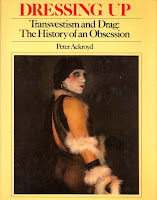

Peter Ackroyd’s first non-fiction book was Dressing Up, a study of transvesting and drag. While openly gay, he describes himself as an outsider to this subject. “Some transvestites are exclusively fetishistic; they dress, in other words, to obtain some kind of sexual arousal. Psychoanalysts believe this to be the dominant mode of transvestism and, indeed, many transvestites remain fixed at this stage, assuaging their obsessions by frequent or intermittent cross-dressing. But there are other transvestites who move out of the fetishistic stage; they cease to be sexually excited by the act of cross-dressing itself, and go on to a more comprehensive form of feminine ‘passing’.” This book was in the bibliography of almost every book on trans in the 1980s alongside Janice Raymond’s The Transsexual Empire. 

  • Harry Brierley. Transvestism: A Handbook with Case Studies for Psychologists, Psychiatrists, and Counsellors. Pergamon Press, 1979.
  • Colin Wilson. Mysteries: An Investigation into the Occult, the Paranormal and the Supernatural. Putnam, 1978, Grafton Books 1979. Section on Charlotte Bach pp 514-523.
  • Peter Ackroyd. Dressing Up: Transvestism and Drag, the History of an Obsession. Simon and Shuster. 1979.
  • Bob Mellors (ed). Extracts from an unpublished Work: An Outline of Human Ethology by Charlotte M. Bach. 4 Pamphlets London: Another Orbit Press. n.d.
  • Ray Chapman. “Secret of the bride in white: she’s the father of two sons”. The News of the World, 25 March 1979. Online.re Aita Verig Sandor.
  • Amanda Lear. “Fabulous (Lover, Love Me)”. 45 single, 1979. “the surgeon made me so well that you could not tell that I was not somebody else".

1980

Carol Riddell wrote a critical pamphlet reviewing Janice Raymond’s 'The Transsexual Empire' criticizing its factual errors, its betrayal of feminist ideals and its use of masculinist ideas. This was well received and much reprinted.

Judy Cousins, sculptor and the inventor of the Shattaline process, established SHAFT (Self-Help Association For Transsexuals) in 1980 and ran it for many years. It was the major UK group for transsexuals for the next decade

The BBC episode about Julia Grant in 1979 had generated sufficient interest that this was expanded into a ground-breaking documentary, A Change of Sex, which followed the social and medical transition of Julia Grant (George) and also provided a snapshot of the Charing Cross Hospital Gender Identity Clinic. John Randell is the unnamed doctor who shocked most reviewers by his attitude to his patients.

The News of the World (12/10/80) claimed that Randell and his surgeon, Peter Phillip, had made London the ‘sex-change capital of the world’.

Kenneth Tynan died of pulmonary emphysema.

Ron Storme opened a nightclub, Club Travestie Extraordinaire, in Stepney. This became an east-end institution, attracting both gay and straight trans persons, and as it lasted into the 21st century is arguably the UK’s longest lasting gay night spot.

In 1980 a high-level police report re the Michelle Confait murder finally identified her prison cell-mate Douglas Franklin as the killer. It also confirmed that the time of death was 48 hours earlier than stated at trial. It had been assumed that rigor mortis started after the discovery of the fire. In fact, Confait had been dead for 48 hours and rigor was wearing off. The report concluded that had the three boys not been arrested, Douglas Franklin would probably have become a suspect at an early stage of the original murder enquiry. Franklin committed suicide shortly afterwards.

  • Carol Riddell. “Divided Sisterhood : A Critical Review of Janice Raymond's 'The Transsexual Empire' “. Liverpool: News from Nowhere, 1980.
  • Della Aleksander. Theocratic Socialism Is Here! 1978-1979. A New Day Publication 1980.
  • Aubrey Walter (ed). Come Together: The Years of Gay Liberation, 1970-73.Gay Men's Press, 1980: 164-7.
  • David Pearson (dir). A Change of Sex. With Julia Grant. BBC TV. 1980.