This site is the most comprehensive on the web devoted to trans history and biography. Well over 1800 persons worthy of note, both famous and obscure, are discussed in detail, and many more are mentioned in passing.

There is a detailed Index arranged by vocation, doctor, activist group etc. There is also a Place Index arranged by City etc. This is still evolving.

In addition to this most articles have one or more labels at the bottom. Click one to go to similar persons. There is a full list of labels at the bottom of the right-hand sidebar. There is also a search box at the top left. Enjoy exploring!

Showing posts with label Benjamin patient. Show all posts

27 January 2025

Claire Elgin (1905 - 1976) – Part II: business woman

Part I: beginnings
Part II: business woman
Part III: bibliography and comments

In 1962 Claire encountered Yugoslavian immigrant Franz Kolterer who founded Micro Science Associates, a precision etching firm. Claire provided skill in micro-photography, and was manager of the art and photo department and a director of the company until 1967.

Claire in Benjamin's book, 1977
October 3rd, 1963 Claire was admitted to Stanford Hospital with an incarcerated hernia. Her doctor there was Donald Laub (1935-2024), then an intern but who later became known for transgender surgery. She told him that she herself had removed her penis. She also gave him an alternate autobiography:

“She explained it to me. She told me further that she was born in Arabia, the son of a Scottish trader who ran a ship between Arabia and England, and was educated aboard ship by specialized tutors. She was genetically XY, a male born with a grade 3 hypospadias, a birth defect in which the urine comes out just above the scrotum. The mistake was made that Clair was a female because the genitalia resembled a clitoris and labia in appearance. The diagnosis was plausible, since no genetic karyotype was available in Arabia in 1900. When puberty came along she developed an ample penis, which was upsetting to her, having been raised for 15 years as a female. For many years, she sought medical advice but there was no one who would help her. Unable to live as the woman she felt she was, she removed the penis and the rest of the male apparatus with a sharp knife and presented herself at the University of California emergency room. She was taken care of there by urologist Dr. Goodwin, who was sympathetic to her plight and fixed her up as well as possible at the time.” … “I asked her about her body art, and she told me she’d once traveled with a circus as a tattooed lady and sword swallower.”

The surgery to fix the hernia went well. However follow-up tests revealed adenocarcinoma of the kidney cells, and the left kidney had to be removed. Again the surgery went well.

Dr Laub got to know Claire as a person:

“Well, Clair had some idiosyncrasies, as you might have suspected by now. Having been raised Muslim, she had good habits; she abstained from drinking coffee or alcohol. Despite being female, Clair had retained some of her male spirit, owning a motorcycle, a gull-wing Mercedes, and a 300 Savage telescopic rifle. She had a fondness for Japanese architecture. Her profession was photography, which she had been taught on the ship during her schooling years, and during the birth of Silicon Valley she was able to make microphotography negatives of the plans for a computer chip; the manufacturing process utilized silver salts in the negatives of her microphotos to etch silicon into chips.

“Clair was rewarded for her efforts and gained a large number of shares in one of the more prominent laser and computer companies in the Silicon Valley. With her money she built a Japanese home, a five-sided pagoda on the top of one of the highest hills in a most exclusive suburb, Los Altos Hills. She included koi fish tanks where the fish were able to swim from outside the home into the inside for Clair’s pleasure. The five alcoves of the pagoda each had a wind-generated musical organ, insulated so that there was no sound of blowing air during the playing of the pipes.”

Harry Benjamin’s seminal book on Transsexuals came out in 1966. He condensed his three years of meetings and correspondence 1953-5 and described Claire in three paragraphs, but, as she requested, without giving a reference name. No photographs were included in the book, but medical and other professionals could request them if they wrote in on medical stationary. Black stripes were placed over Claire’s face to prevent recognition.

“One patient who is now, several years after the operation, a decidedly masculine-looking 'woman,' with tattoos all over her body, is getting along well in an active business and is unrecognized as a former male. She is merely considered eccentric by her associates.

“Under no circumstances, she assured me repeatedly, would she ever go back to living as a man. 'This way I am at least myself and can relax,' were her own words.

“A couple of times she was arrested under the suspicion of 'impersonating.' When she was taken to a police station, examined and declared to be a woman, the arresting officers apologized and in one instance, bought her a dinner. Not all patients in such situations fared equally well”.

In his introduction to the 1969 anthology, Transsexualism and Sex Reassignment edited by Richard Green and John Money, Benjamin wrote, probably with Claire in mind:

“These few instances of attempted self-castration by definitely non psychotic individuals impressed me greatly. Their desperation as well as the entire clinical history with their vain search for help, often from childhood on, made me realize that the medical profession truly treated these patients as ‘stepchildren’. Educational and medical lectures and scientific publications were urgently needed.”

In 1967 Micro Science had merged with Alloys Unlimited. That was the year that one of the company’s acid tanks sprang a leak in March, and a fire captain had to be rushed to hospital. There was a further incident in October 1971 when there was fire in a tank of nitric acid.

The firm was sold to the British Plessey Group and became Plessey Micro Science Inc in 1974, and then Kolterer set up Koltron Corp. By now Claire was no longer involved, but she had invested in shares of Micro Science Associates, Alloys Unlimited and then Plessey Micro Science Inc, and had become a millionairess.

However, by the end of the 1960s, with age, the many lines in her face made her look more male than female. Laub and his team did a face-lift, which went very well. By this time, Dr Laub had started doing transgender surgeries – his first trans patient (other than Claire) was Ella in 1968. In 1969 Donald Laub founded Interplast to provide necessary reconstructive surgery for persons in developing countries. Claire became the official Interplast photographer, and travelled to central and south America and chronicled surgeries for cleft lip, cleft palate, and burn scar deformities. She was greatly appreciated for the excellence of her photography and her compassion toward patients, even though she was not passing that well. The patients – affectionately – referred to her as “Señor Clair”.

Vernon Gregory, an organist who played the mighty Wurlitzer organ, took over the Avenue cinema in Oakland to install the Wurlitzer that his son had found in Chicago. They moved it to Oakland, installed it and started a program of films accompanied by the organ, but were deeper and deeper in debt until Claire – who played a smaller organ at home – came in to rescue the project in 1972. She also bought a plane that year and learned to fly.

Claire lost most of her money in the recession of the 1970s, and was for a while bankrupt. She developed a working 3-D television and patented it, but it was the alternate model by Matsushita Electric (now Panasonic) that was more successful.

Claire in later years
In 1976, Claire called Dr Laub complaining of severe pain in the rib when she coughed. After a preliminary examination, Claire was admitted to the Stanford Hospital oncology medical service. X-rays showed that her lung cancer had metastasized to the rib. Claire asked how long she had left and was told about six weeks. She asked for a glass of water, and took one of the cyanide pills that she had in her purse.

The next year Benjamin’s The Transsexual Phenomenon was reprinted as a Warner Books Paperback. This time the photographs were included within the book, and the black strips hiding Clair’s face were removed.

Joanne Meyerowitz. How Sex Changed: A History of Transsexuality in the United States, 2002, included 5 short mentions of Claire disguised under the pseudonym of Caren Ecker. These mentions were based solely on documents in the Kinsey archives, mention her auto-castration and surgery in 1953, her contact with Louise Lawrence and with Worden and Marsh, but say nothing about Claire’s subsequent career as a business woman and photographer.

Both Claire’s only son, age 82, and her business partner, Frank Kolterer, age 76, died in 2007.

26 January 2025

Claire Elgin (1905 - 1976) – the first trans woman millionaire - Part I: beginnings

Part I: beginnings 
Part II: business woman 
Part III: bibliography and comments

Clair(e) Elgin was this woman’s real name, however Joanne Meyerowitz calls her Caren Ecker; Annette Timm calls her Carla Erskine (the convention of pseudonyms with the same initials); and Connie Christine Wheeler & Leah Cahan Schaefer called her at first Janet, but in their revision for Randi Ettner’s Confessions of a Gender Defender, they call her Claire; Benjamin, at her request, does not give her any name, and some refer to her in his book as the ‘tattoo woman’; Laub uses her real name, although he spells Clair without an ‘e’. When in Mexico, Claire used the name Marie Ciel Campbell. Like some other trans persons, Claire’s pre-transition and post-transition names are almost identical.

Original version: Archive.

Part I: beginnings

Clair Elgin, a seventh generation American Moslem, was born in Casper, Wyoming. By her own account she left home in 1923. Clair’s mother died in 1927, and the father in 1936.

The 1940 US census records Clair Elgin still living in Wyoming, with a wife Ruth (1899-1949) and a 15-year-old son. However on registering for the draft in October that year, Clair gave a San Francisco address. Clair apparently was a radar technician during the Second World War, and later she said that she was serving on a submarine when it was attacked by friendly fire. This so unnerved Clair that it led to a medical discharge. Either while in the navy, or subsequently working in a carnival, Clair became heavily tattooed on the body, but not on the face.

Clair’s (first) wife Ruth died in early 1949.

Clair first lived as a woman in Mexico City using the name Marie Ciel Campbell, until one night a drunk touched her in just the wrong place. She then moved to the San Francisco area. She reverted to Claire, now with an ‘e’ at the end. As part of her transition, she volunteered to give a talk to the Mattachine Society on “What is Transvestism?”

At the age of 48 in August 1953, Claire, then working as female nurse in Palo Alto, using a local anesthetic, succeeded in removing her own testicles – an operation that no doctor would consent to do. However she was unable to staunch the bleeding, and took a taxi to the hospital, where she was treated for shock and loss of blood. A few of the local papers carried the story, giving Claire’s first and last names. The journalist for the San Francisco Examiner commented that she declined to give a male forename.

Herb Caen in The San Francisco Examiner

Dr Karl Bowman, at San Francisco’s Langley Porter Clinic, took over the case and recommended further surgery to remove the penis - this was done 30 December 1953 at the University of California in San Francisco by Dr Frank Hinman, chief of urology services at San Francisco General Hospital – apparently this was the only such operation that Hinman ever did. A few newspapers heard rumors of the operation, but the hospital refused details, and gave out that her initials were L.C. One doctor was quoted as saying “A much truer case than Christine’s”. While recovering she gave offprints to the medical staff of Harry Benjamin’s "Transsexualism and transvestism as psychosomatic and somatopsychic syndromes". A diagnosis of ‘hermaphroditism’ had been used on the hospital entrance form.

Annette, Louise, Janet, Claire
Through Bowman, and from having had her name in the local newspapers, Clair met and/or was introduced to Louise Lawrence, Alfred Kinsey and Harry Benjamin. She had a four-hour interview with Kinsey “in hopes that any information … may in its small way eventually be of help to others of my kind”. She took photographs of other trans women whom she met through Louise Lawrence, and mailed them in batches to Harry Benjamin. Some of the other trans women meeting with Lawrence were Annette Dolan (who also did a self-castration), Janet Story, Dixie MacLane.

Over three years, she and Benjamin exchanged almost 100 letters. She told Benjamin that she had a genital anomaly (which Benjamin diagnosed as hypospadias), and had been raised as a girl for some years before a doctor explained to the parents that she was a boy. She had left home in 1923, and worked as a sailor for two years. She worked with a circus for a while, and then lived in Mexico City as female. Only after that did Clair marry Ruth - in Milwaukee, and they had a son. Clair divorced Ruth and moved to California, and served in the US Navy 1941-3 until discharged because of morphine addiction.

Claire pressed Benjamin to describe her as ‘pseudo-hermaphrodite’, as several trans women at the time such as Betty Cowell and Georgina Turtle were doing. Benjamin declined as that was not actually the case. Claire wanted this as a term to give to her son who had not accepted her transition. Claire argued

 “I realize my own condition perfectly but to quite some few people who have to know of this change, the idea of hermaphroditeism [sic] is easier to explain and understand than is transvestism”. 

The son was not heard of again afterwards.

Claire and Christine Jorgensen did meet once, around this time. Claire did not want to go public as Christine Jorgensen had, in that she had no intention of being a performer. Her preference was to continue as a nurse. However she lost her nursing job, and she suspected that rumors had been passed to her employer.

In 1954 Frederick G Worden, psychoanalyst, and James T Marsh, clinical psychologist, both at the University of California, Los Angeles (UCLA) Medical Center, interviewed and tested five “physically normal men” (that is trans women): three of whom had already had transgender surgery, Claire, Annette, and Janet, and two hoping for it, Dixie Maclane and Carla Sawyer. They administered psychological tests, but did not actually listen to the five trans women as persons. Worden and Marsh published their paper in the Journal of the American Medical Association in April 1955. Their subjects, they wrote, had “an extremely shallow, immature, and grossly distorted concept of what a woman is like socially, sexually, anatomically, and emotionally”. They depicted them as attention-seeking, and even held their co-operation with the study against them as a “need for recognition”. Worden and Marsh were irritated by the two subjects who wanted surgery, and criticized their refusal to acknowledge “the possibility that the wish for surgery might be symptomatic of a disorder within themselves”. They, of course, did not provide the desired recommendations for surgery. Harry Benjamin immediately wrote to the journal to object that Worden and Marsh had “badly misunderstood or misinterpreted” his work. Four of the five interviewees wrote to Benjamin expressing outrage.

Bowman wrote up his 1953 experience with Elgin as Case 4 in his 1956 paper:

“CASE 4-In one case penotomy was performed. A man of 43, twice married, was referred because of a request for penotomy; a few months previously he had anesthetized and castrated himself. Although tall and ungainly, he worked as a female practical nurse; he stated that he felt his penis to be inconvenient, with his female dress, and most distasteful. He had been impotent in both marriages and spoke of homosexual wishes. He threatened further self-mutilation if penotomy was refused. Because the patient had no testicles, was wholly impotent and did not ask for a plastic vagina it was decided reluctantly to accept the patient’s legal right to request amputation of the penis. It was feared that the patient might again try self-emasculation and harm himself more seriously. Two years after penotomy the patient seemed more comfortable and was making a fair adjustment.”

16 September 2024

A review of Alison Li’s biography of Harry Benjamin

  • Alison Li. Wondrous Transformations: A Maverick Physician, the Science of Hormones, and the Birth of the Transgender Revolution. University of North Carolina Press, 2023.

There are four biographies of Magnus Hirschfeld (by Charlotte Wolff, Ralf Dose, Elena Mancini and Heike Bauer), an autobiography and three biographies of Havelock Ellis (by Phyllis Grosskurth, Chris Nottingham, Arthur Calder-Marshall, John Stewart). Why has there been no book length biography of Harry Benjamin previously?

Li did a BSc in Biochemistry at McGill University and a PhD in History and Philosophy of Science at University of Toronto supervised by historian Michael Bliss, with the thesis J.B. Collip and the Making of Medical Research in Canada, which included Collip’s work 1921-2 contributing to the refinement of insulin and thereby saving the lives of many diabetics. Li taught at Toronto’s York University and more recently has been an independent historian and writer. She specialises in the history of hormones, their discovery and applications. She published a book based on her thesis, the biography, J.B. Collip and the Development of Medical Research in Canada, 2003. She was also a co-editor of Women, Health, and Nation: Canada and the United States since 1945, 2003, to which she contributed an essay on the hormonal product Premarin. In 2008 she was a co-editor of Essays in Honour of Michael Bliss: Figuring the Social, in which she contributed the essay “Wondrous Transformations: Endocrinology after Insulin”. This essay covers Harry Benjamin and his rejuvenation treatment of the novelist Gertrude Atherton, her 1922 novel based on the experience and the subsequent film. This last is redone in the 2023 book.

Li did research in quite a lot of academic archives, including the Kinsey Institute in Indiana, the New York Academy of Medicine, the Haeberle-Hirschfeld Archives at the Humboldt-Universität in Berlin. She read Benjamin’s diary, his correspondence and his unpublished book The Winter of Our Discontent, 1941. Hence she is able to relate details not found in other accounts: what happened to his brother and sister; how his wife Greta became involved in his clinic as secretary and as nurse; how the mothers of both Harry and Greta came to stay. She also tells anecdotes about Benjamin’s sex life:

“He continued to be attracted to actresses and chorus girls. For a time, he saw patients in Los Angeles and mixed with the rich and famous. Jean Harlow’s initials appear in his address book, and colleagues would recall that he later reminisced about ‘dating’ her.” (p135)

However, a few matters must be discussed. 

On p112, Li repeats the most well-known accounts of Hirschfeld’s trans patients. One she names as Carla Van Crist. This is a name she found in Meyerowitz’ How Sex Changed, 2002. The problem is that most of us know, since Raimund Wolfert’s 2021 biography, that Crist was a pseudonym for Charlotte Charlaque. And Li apparently knows nothing of Charlotte as receptionist at Hirschfeld’s Institute, and acting as his translator in London, of her involvement with Toni Ebel, another of the well documented trans patients of Hirschfeld who had completion surgery, and their attempted escape from the Third Reich into Czechoslovakia. Li quickly mentions the two-patient surgery account (archive) by Felix Abraham, tells us that one of these was Dorchen Richter, but is mute about the fact that the other was Ebel. There is of course a detailed account of Ebel in Rainer Herrn’s Schnittmuster des Geschlechts, 2005. However neither Wolfert nor Herrn are in Li’s bibliography – she relies on Meyerowitz only. Meyerowitz’ book was groundbreaking 20 years ago, but trans history and biography have moved on.

Incidentally, Charlotte, back in the US in the 1950s, corresponded with Benjamin using the name Charlotte Von Curtius. Neither Meyerowitz nor Li, despite their reading of Benjamin’s correspondence at the Kinsey Institute realize that this is the same person, nor even mention a Von Curtius.

Li next gives a very ordinary account of “Lili Elbe”. Li made a decision to not include any accounts of Benjamin’s associates – such as Leo Wollman – and their trans patients – so why does she include Elbe, who was Kurt Warnekros’ patient? She does briefly mention Pamela Caughie in an endnote, but does not seem to have read the books and the extensive website by Caughie, Sabine Meyer and their team, not even to note that Lili’s post transition name was Lili Elvenes

In New York in the 1960s and 1970s, if you were trans and had money or contacts or were lucky, you went to Dr Benjamin. For less money you could go to Dr Leo Wollman located close to Coney Island. And if Wollman was too expensive, there were Drs David Wesser and Benito Rish at the Professional Hospital in Yonkers. Benjamin and Wollman sent patients to Wesser and Rish for surgery, but Wesser and Rish are mentioned not at all by Li. 

Wollman is mentioned only once – in a list of the members of the Harry Benjamin Foundation. Li three times mentions the Harry Benjamin Foundation, but fails to mention its major accomplishment, the 1969 anthology book Transsexualism and Sex Reassignment edited by Richard Green and John Money.

On p116, Li writes “A few years later Benjamin wrote Hirschfeld in alarm that an unauthorized, abridged translation of the first volume of Hirschfeld’s Sexualpathologie had been published by Julian Press in 1932 with ‘a most atrocious translation, utterly impossible”. Why not name the book? By the date and publisher, she is referring to Sexual Pathology: A Study of Derangements of the Sexual Instinct, translated by Jerome Gibbs, Julian Press, 1932. However, most readers will assume the much better-known Sexual anomalies and perversions, a compilation from Sexualpathologie by Arthur Koestler, revised for the English version by Norman Haire, an associate of both Hirschfeld and Benjamin, which came out a few years later. The Koestler-Haire book actually is not mentioned at all.

Benjamin and Virginia Prince were associated across several decades, he prescribed hormones to her, and whenever Prince was in New York they would have a meal together. In Transvestia # 12, December 1961, p14. Prince wrote: “I was chauffeured over to Dr. Benjamin's office for a nice but too brief visit and dinner with him. Those of you who have never met Dr. Benjamin have missed a real treat. People of our persuasion have no better professional friend.” It was from Prince that Benjamin adopted the expression: “Gender is located above, and sex below the belt”.

Prior to 1962 Prince’s magazine Transvestia frequently featured reprints and new articles by Benjamin, she is mentioned several times in The Transsexual Phenomenon (unlike Louise Lawrence who is surprisingly not mentioned at all) and most significantly Prince had a significant effect on Benjamin’s scale in that in accordance with her views it erases gay and female transvestites and gynephilic transsexuals. 

Li mentions Prince once only (p148): “Benjamin also began to work with Virginia Prince, a chemist, transvestite, researcher”. Her footnote chp9n49 shows that her one and only source is Meyerowitz (again) p181-2. She does not note the mentions in The Transsexual Phenomenon, and ignores the biographies by Richard Docter and myself.

The ongoing interaction between Benjamin and Prince is only partially documented. I was hoping that Li’s reading of Benjamin’s diary and correspondence would have provided more detail.

As Li says of The Transsexual Phenomenon: “At a dense 286 pages, the book ranged over the entire field of study”. My A critical rereading of Harry Benjamin’s The Transsexual Phenomenon required 56 pages. Li devotes only two pages to it, only one page to its contents (p178-180). She gives only the 1966 Julian Press hardback in her bibliography, and in the text mentions that the 16 pages of photographs were withheld but could be requested by medical and psychological professionals. However most of us who have read the physical book, read the 1977 Warner Books paperback which did include the photographs. And of course most readers today use the PDF version which is available online. With such a short summary she is not able to discuss the Benjamin Scale, Benjamin’s inconsistencies, his ambivalences, his anticipations of future debates or of course the Virginia Prince impacts. Both Ray Blanchard with autogynephilia, and Charlotte Goiar with Harry Benjamin Syndrome later found a basis in The Transsexual Phenomenon but their applications deny his moral legacy. (See my A Critical Reading p10, 30-1)

She says that it was “the first major text” on the topic. “Major” is of course an equivocal term, but there had been three previous books specifically about transsexuality, the first two, as it happened, by persons themselves transsexual: Self: A Study in Ethics and Endocrinology, 1946, by Michael Dillon, and Over the Sex Border, 1963, by Georgina Turtle. The third was Eugene de Savitsch’s Homosexuality, Transvestism and Change of Sex, 1958 which discussed the transition of the Swiss trans woman Arlette Leber who had surgery in 1941-2 . None of these are mentioned by Benjamin, although the latter two are included without comment in Richard Green's bibliography at the end of the book. And none of them are mentioned or are found in Li’s bibliography.

Charles Ihlenfeld was Benjamin’s assistant from 1969 to 1976 and had been expected to take over the practice, but chose otherwise. Li tells this, but does not tell of Jeanne Hoff who did take over, and was herself in transition. 

Obviously the strength of the book is in the history of endocrinology, and the reading in various archives of Benjamin’s diary and his correspondence with patients and associates provide interesting anecdotes of them as people. It would be a better book if she had not mainly retold the stories that we know so well from Meyerowitz, and had told of some less-well-known patients instead. However it is a book that will be an essential reading for future biographers of Harry Benjamin.

25 March 2024

Lyn Raskin: Part II - transition

Part I: life until first visit to Benjamin clinic 

Part II: Transition

Part III: comments

Raskin was looking for a writer to write her biography, and a friend suggested Irmis Johnson, a noted journalist whom the Hearst company had sent to Copenhagen in 1953 to meet Christine Jorgensen. This had resulted in five consecutive weekly articles in the the American Weekly, actually written by Johnson but attributed to Jorgensen. Johnson expressed interest and even gave Jorgensen’s contact details. Raskin as Edward phoned several times starting the next day, and Christine told Raskin that her autobiography was being filmed. During this period Raskin continued attempting his theatre career as Edward. Wollman told Raskin that she should start to live in female clothes

In May Raskin got a reply from Dr Money at Johns Hopkins. Money said that “I had to prove my capacity to earn, dress and live as a female before undergoing irrevocable surgery” (May 3, 1969). Raskin and Wollman dismissed this as ridiculous as thry thought that drag was illegal in New York State (unlike Maryland – where Johns Hopkins is – where it was legal).

After feedback from possible publishers re an advance or not, Irmis Johnson bowed out from the project.

The next appointment at the Benjamin clinic was with Dr Benjamin himself, as Wollman would in future be seeing his patients at his Coney Island practice – although Raskin did visit him there to have a mole removed. Benjamin revealed that a) Wollman had her down as a “Type 4 – Transsexual, nonsurgical” b) the pills that Wollman had prescribed were not estrogen but Dilantin. In Jan Wälinder’s 1967 Transsexualism: a study of forty-three cases, he had reported finding an abnormal EEG in 28% of a group of transvestites and transsexuals, and that an anti-convulsive drug had led to a cessation of the desire to cross-dress in some cases. Benjamin had tested this on a few volunteers, but Wollman had prescribed surreptitiously. 

Raskin asserted strongly that she was a “Type 6 – Transsexual, true, high intensity” and that the Dilantin had not decreased her urge to transition. Benjamin asked whether Raskin would still want to become a woman if she could not have sex afterwards. Raskin replied: “I said I wouldn’t but I understand once the vagina is created you can have fulfilling sexual relations”. Benjamin gave a subscription for real estrogen. (May 3, 1969)

The visits to Benjamin were $20 and the estrogen was $3.75 for fifty capsules.

At a final visit to Wollman’s office in Coney Island to finish the warts treatment Raskin expressed her displeasure at being classified as a Type 4, and over the Dilantin.

Benjamin transferred Raskin to his new associate Charles Ihlenfeld, and Raskin went in for hormone shots every second week. Benjamin wrote a letter to excuse Raskin from jury duty. Raskin finally started electrolysis having found an electrolysist who would do it for $10 per hour (most charged $20), and also started to let her hair grow. In September she bought dresses for the first time, and tried wearing them in the apartment. She finally had her nose job with Dr Rish. She spoke to Rish re sex change operations, and he claimed that he did not do them, but mentioned a Dr Jones who required a record of cross-living. A week later she wrote to Dr Burou in Casablanca to ask his prices.

In her diary she wrote: “I have definitely decided against having any New York doctors perform the sex operation on me. They require you to come to their office and have a castration done there — with only a local anesthetic. Then a month later they complete the surgery in a hospital.” (October 8, 1969). 

Two weeks after her letter, she received an answer from Dr Burou: 

“I received your letter of October 9. The cost of surgery and 15 days of hospital is $4000. You must send it before you arrive to the enclosed address. [It was a Swiss bank.] If you can come with another patient I can do the two operations for $7000. I have not a brochure or the itinerary for transportation, but you can find that in any travel office in New York City. You have not need to bring many things. Only your clothes. You can make operation of breast implant here, but is necessary that the Doctor see you before — and difficult for me to tell you what is the cost of the operation.

                                            Sincerely yours,

PS. Please if you think coming in April send to me a confirmation for reservation.” (October 20, 1969). 

In November Raskin wrote back and said that she could afford only $2000. 

For the first time, through a common friend, Raskin met with another transsexual, and compared notes. In January 1970 Look Magazine had a feature on transsexuals. Raskin felt chagrin in that she had approached them a year previously – however Look specifically featured transsexuals who had already transitioned.

Finally Raskin started wearing female clothing outside, but only after make-up sessions and shopping with female friends. Edward told the building superintendent that his sister Lyn would be staying in the apartment. Lyn met several transsexuals at a party given by her electrolysist. She was doing electrolysis as much as six hours a week. A friend suggested Maurice GirodiasOlympia Press to publish Lyn’s autobiography. Girodias was in New York after being pressured out of Paris in 1963. Lyn presumably did not know of his practice of not paying his writers.

Both Lyn and Edward had a joint bank account, and the manager, citing a possible discrepancy, insisted that both Lyn and Edward come in together. (May 7, 1969)

Edward had met Zelda Suplee twenty years earlier in the town of Homestead, Florida. Lyn encountered her again as she was now the director of the Erickson Educational Foundation (EEF). Zelda was due to return to Florida, and said that she would visit Lyn’s father and explain things – although when there she was unable to do more than phone him. Zelda, Lyn, Dr Wollman, Constance (who had met Lyn at their electrologist, and had recently returned from completion surgery in Casabalanca) and cis actress Pamela Lincoln (who was purportedly seeking information about transsexuals and ten years later would be in the film Tootsie) were in a 28 minute filmed discussion sponsored by EEF. By this time Raskin had a job as Lyn, working from home doing sales promotion for a music company.

Constance had reported unhygienic practices at the clinic in Casablanca. However she had a history of lying; Zelda introduced Lyn to Bonnie, also back from Casablanca, who gave a much more positive account, and had negative accounts of three friends who had had problems after gender surgery in New York.

In June one of Lyn’s aunts supplied a check for $2500 (which Lyn suspected actually came from her father). She wrote to Dr Burou saying that she could afford only $1500, and that a flight was booked. This was accepted. Only then did Raskin apply for a passport – as Edward as stated on her birth certificate.

Lyn Raskin arrived in Rabat, Morroco and then Casablanca July 7, 1970. Three days later all was complete. She returned to her apartment in New York. She still had appointments with Dr Ihlenfeld, and also with Dr Rish as she wished to increase her vaginal depth. Rish sent her to Dr Roberto Granato, who found the urethra and vagina infected. She was in Rish’s Yonkers Professional Hospital several times: for an operation on the urethra, to have her ears pinned, breasts implanted and a facial skin-peel. She started having sex with straight men, usually without mentioning her past.

Lyn’s book, Diary of a Transsexual, was published by Olympia Press in 1971. We don’t know if Maurice Girodias did pay any royalties. 

Later that year the agony aunt Ann Landers was on the tail-end of the Dick Cavett television show following a pre-op trans woman enthusing about designing her wedding dress. Landers felt that that particular trans woman was inauthentic, and resented having to comment on her performance. When Patrick M McGrady, Jr wrote this up in his 1972 book, The Love Doctors, he added a comment from Raskin as a footnote: “They should not have had that sort of person. Ann Landers had a perfect right to be upset. It was like having a guy in drag.”

Nothing is known of Lyn Raskin after that.

  • Roland Berg. “The Trans-sexuals: Male or Female”. Look Magazine, January 1970. Online.
  • I Am Not This Body, with Zelda Suplee, Leo Wollman, Lyn Raskin, Constance and Pamela Lincoln. EEF, US 28 mins 1971.
  • Lyn Raskin. Diary of a Transsexual. The Olympia Press, 1971.
  • Patrick M McGrady, Jr. The Love Doctors. Macmillan, 1972: 165-6, footnote.

30 March 2023

Benjamin's Newer Aspects of the Transsexual Phenomenon

Harry Benjamin published The Transsexual Phenomenon in 1966. Two years later he presented a paper at the American Psychiatric Association meeting in Boston, May 1968., in which he gave some afterthoughts.

At that time, he was able to say (using the old system of genderizing a person by birth sex): 

“My observation of transsexual patients dates back more than sixteen years. Their total number now stands at 439: 387 males, 52 females”.

On the issue of etiology, he said: 

“I am in full agreement with those who believe in a multiplicity of determinants for cross-gender identity, be it in the field of psychology or biology. To my clinical sense, however, a prenatal, neuro-endocrine disorder appeals most for the majority of cases. It offers to me the most likely explanation why psychotherapy cannot cure the transsexual, why the emotional distress goes to such depths as to demand surgery, and why endocrine therapy often brings such dramatic relief. This relief, however, is palliative only. None of our present therapeutic efforts are curative in a sense that the psychological sex will be brought to conform with the anatomical. Until the future can provide new psychiatric or chemical weapons, symptomatic treatment with more or less effective alleviation is all we can offer at present to these often tormented people.

“In spite of poor prognosis, I feel that an attempt should always be made, with the help of psychotherapy in whatever form, to induce the patient to accept himself (or herself) in the role of his anatomical sex. Usually the patient will resist all such attempts because they ‘go against the grain of the inner self’.”

He then mentions use of the anti-epilepsy drug Dilantin based on findings by Swedish sexologist Jan Wälinder who had found an abnormal EEG in “28% of a group of transvestites and transsexuals”. Wälinder gave an anti-convulsant drug to in a patient who had developed “transvestitic and transsexual tendencies” together with epileptic seizures after a brain injury, with the result that the obsessive desire to dress was abolished. Benjamin tried Dilantin with a few transvestites who wanted to be cured, and to two transsexuals who were willing to experiment. This apparently worked for some of the transvestites who desisted [for a while at least] but it had no effect on the transsexuals.

Benjamin does not mention this, but Lyn Raskin, who published a rather racy Diary of a Transsexual a few years later, was given a prescription of Dilantin by a deceitful doctor – and it had no effect at all on her yearning to be a woman.

Benjamin continued by noting that there are three types of relief for a ‘male transsexual’: dressing, endocrine therapy and surgery. 

“But neither dressing nor hormone therapy can be depended upon to accomplish enough for the true transsexual. It can allay but rarely replace the demand for the third alternative, which is sex-reassignment surgery. It is hardly necessary to emphasize its radical, irrevocable and controversial nature. Its pros and cons can tax the physician's conscience to the utmost.” 

He admits to two nightmares: 1) self-mutilation or suicide when transgender surgery is denied or otherwise unavailable 2) post operative regret. Both had occurred. On regret: 

“Actually, there was hardly ever admission to that effect, but that means little. It would be difficult to admit to such a mistake. In possibly 4 to 5% of the operated male transsexuals (and in one female), I have a lingering suspicion that there is a degree of remorse and they would undo what was done, if it were possible.” 

He suggests that psychiatric evaluation with a “prolonged period of observation, up to a year”. He continues: 

“Alas, such is more often a pious wish than a clinical reality. Too often, transsexuals make their own decisions, find their surgeon and, under the driving and blinding force of their sex and gender confusion, act without anyone's consent or recommendation.”

He criticizes the lack of support by doctors: 

“Among them are puritanical and other prejudices, politics, a too dogmatic adherence to psychoanalytic theories”.

He also criticizes: 

“The selfishness, unreliability and questionable ethical concepts of some male and female transsexuals have undoubtedly deprived many of them of the otherwise fully deserved interest and sympathy on the part of the medical profession. Fortunately, there are also those whose touching gratitude and loyalty make up for the deplorable defects of the others.” 

He mentions a scare in 1968 when the British Medical Journal reported the cases of two transsexuals who had conversion operations, had also received breast implants and unknown but probably large doses of estrogen by various methods of administration. Both died of breast cancer. This was publicized by the New York Times. However Benjamin was able to report from his own files: 

“Among more than 300 patients under estrogen medication, not a single case of malignancy was observed in sixteen years. Common sense must tell us that, since a small number of the male population does develop breast cancer, a male transsexual, treated or not, may well be among them.”

He regrets to inform us that although the number of post-operative transsexuals in New York State had significantly increased, applications for legal change of status continued to be denied on the grounds that “the ‘chromosomal male’ is more important than an ‘ostensible female’."

In conclusion he says:

“Transsexuals can be diagnosed by their life's history, showing cross-gender identity from earliest childhood on, by their pronounced emotional rejection of their genitalia and their secondary sex characters, and also by their insistence upon a surgical transformation.

Transsexuals, as a rule, are definitely not psychotic, but often show mental peculiarities aside from their sex and gender role disharmony, peculiarities that can contain neurotic, depressive, paranoid, schizoid, or merely sociopathic and eccentric features. Asexuality is by no means rare. There can also be an unfortunate character defect which I have come to think of as the "transsexual character."

Gender role disorientation has been observed in several schizophrenics.

Transsexuals are deeply disturbed, unhappy people who deserve more sympathy and attention than they have so far received.

Psychotherapy in presently available forms is without value.

Endocrine therapy is usually of sufficiently great benefit as to be indispensable. Oral medication is adequate for the majority of patients, although injections are more effective.

Liver function tests are advisable from time to time under estrogen therapy, especially if there is a history of hepatitis. Thrombophlebitis is a contraindication for large doses.

Sex reassignment surgery is requested by almost all true transsexuals. It is fully indicated in some, and not indicated in others (as too much of a gamble). Patients' families have to be earnestly considered. It is just as wrong to reject the operation as a matter of principle as it is to grant surgery for everyone who wants it and can pay for it. Sometimes, however, the question arises what may be the lesser evil.

The results of the operation are favorable, to a greater or lesser degree, in more than 75% of the patients that I have observed. Their lives have been made more contented, although by no means free from emotional and social problems and complaints. After all, they are still the same individuals, yet sufficiently improved in their ad-justment to life and less troubled so that they have a better chance to be productive and to pursue happiness.”

--------------

Benjamin’s paper was printed in The Journal of Sex Research, 5,2, May 1969.

  • Jan Wälinder.  Transsexualism: a study of forty-three cases. Goteborg Akademiforlaget, 1967.
  • W St C Symmers. “Carcinoma of Breast in Trans-sexual Individuals after Surgical and Hormonal Interference with the Primary and Secondary Sex Characteristics”. British Medical Journal, 2, 1968: 83-85.
  • New York Times, April 11, 1968.
  • Lyn Raskin. Diary of a Transsexual. The Olympia Press, 1971: 38.

14 February 2022

Charlotte Charlaque (1892 - 1963) actress, translator, Hirschfeld patient

Charlaque was born in Berlin-Schöneberg and raised with the name Curt Scharlach. There was a brother Hans, seven years older. The family, who were Jewish, emigrated to the US at the turn of the century and settled in San Francisco, where Edmund Scharlach worked as a sales representative in textiles. However the mother, Jenny, returned to Germany in 1910. Edmund, who had become a US citizen stayed and remarried in 1916. 

Hans returned to Germany shortly after the start of the Great War in 1914. After 1919 he worked as an independent banker, until he sold his business in the mid-1920s. Curt worked briefly as a female impersonator, and consulted Harry Benjamin who suggested Magnus Hirschfeld in Berlin.  Curt moved to Berlin in 1922 when Jenny was seriously ill, and lived with Hans for a while, but also spent time in France and became proficient in the language. 

Increasingly Curt was rather Charlotte, and obtained a Transvestitenschein, to legally dress as the woman that she felt she was. She had completion surgery at the Am Urban hospital in Berlin-Kreuzberg in 1929-30, under the aegis of Magnus Hirschfeld’s Institut für Sexualwissenschaft. The surgery was done by Erwin Gohrbandt, and Felix Abraham paid the required 50 Reichsmarks. Like Dörchen Richter, Charlotte worked at the Institute, Dörchen as a maid, Charlotte as a receptionist. Her formal name was now Charlotte Curtis Charlaque. 

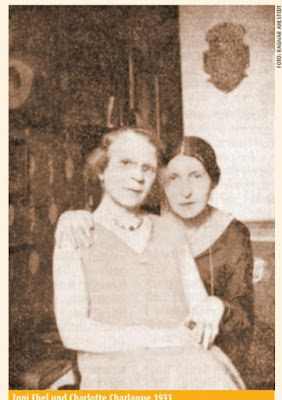
Charlotte met Toni Ebel and introduced her to Hirschfeld who accepted her into the surgical program.  Toni had completion surgery in several operations in 1932. By that time Charlotte and Toni had become lovers. The Swedish journalist Ragnar Ahlstedt visited them at their flat at Nollendorfstraße 24 in Berlin-Schöneberg, and wrote about them in his Män som blivit kvinnor, 1933. They lived cheaply: Charlotte said that she was an actress and Toni was able to sell some paintings and drawings. 

Under Charlotte’s guidance, Toni converted to Judaism. In addition Toni had previously been a member of the Socialist USPD. After the Nazi takeover, one of Toni’s half sisters warned them that they were under observance, and they fled to Karlovy Vary (Karlsbad), in Czechoslovakia’s Sudetenland, the largest spa town in Europe, in May 1934. Charlotte gave English and French lessons, and Toni painted pictures for guests at the spa. The next year they moved to Prague and then to Brno. However they had to report to the police every fortnight and were advised to leave. 

So they returned to Prague in 1938. Charlotte taught English and French and also gave acting courses and worked as a translator. She translated at least three stage works by the Czech writer Olga Scheinpflugová (1902-1968) into English. These are the dramas Chladné světlo (The Cold Light) , Láska není všecko (Love is not everything) and Pan Grünfeld a strašidla (Mr. Greenfeld and the Ghosts). 

In March 1942 Charlotte was arrested by the Czechoslovak Aliens Police and jailed for being a Jew. Toni managed to persuade the Swiss consul that Charlotte was a US citizen, that she had submitted her documents to the US consul in Vienna and was waiting for a new passport. This resulted in Charlotte being sent to an “American camp” and later deported to the US. She sailed from Lisbon 2 July 1942. Toni attempted to follow but was not approved as Reichsdeutsche, and was not allowed to travel to Lisbon.

In New York Charlotte had to endure an extended medical exam. She was taken in by the Red Cross who housed her in a poor house in Leroy Street, Manhattan. She did some translations but suffered in her gallbladder and she had a stomach ulcer. She corresponded with Toni who settled in East Germany. She could not afford to return to Germany, and as a Jew was reluctant to do so. Later she made a living coaching young actors in “English diction”, and she also acted in several Off-Broadway productions, and was known for a while as the Queen of Brooklyn Heights Promenade. In December 1952 she wrote to Christine Jorgensen’s parents to explain that she too was transsexual.

  • Ragnar Ahlstedt. Män som blivit kvinnor. Två fall av könsväxling på operative väg. En study of transvestitism. Tranås: mountain, 1933: 4.
  • Joanne Meyerowitz. How Sex Changed: A History of Transsexuality in the United States. Harvard University Press. 2002: 30, 48, 294n53.
  • Raimund Wolfert. “ ‘Sage, Toni, denkt man so bei euch drüben?’ Auf den Spuren von Curt Scharlach alias Charlotte Charlaque (1892 -?) und Toni Ebel (1881-1961)”. Lesbengeschichte, 3/2015. Online. And also at issuu.com   Online.
  • Raimund Wolfert. Charlotte Charlaque: Transfrau, Laienschauspielerin, „Königin der Brooklyn Heights Promenade“. Hentrich & Hentrich, 2021.
  • Rivka Wolf. “Finding My Queer Heritage: My great-aunt Charlotte was trans and queer. Her story was lost to my family: until now”. Medium.com, Sep 14, 2021. Online.

DE.Wikipedia(Toni Ebel, Charlotte Charlaque)  

-----------

Two Nazi-era German films, Liebe geht - wohin sie will, 1935 and Junges Blut, 1936 feature an actor Hans Scharlach. It is not known whether this is Charlotte’s brother.

Wolfert says of the ‘American camp’ that it was “probably the Liebenau internment camp, which was set up in 1940 in a former sanatorium near Tettnang (Lake Constance district) in southern Germany. Foreign women and children from the entire German Reich or interned in areas occupied by the Wehrmacht, which were intended for exchange with Americans and British of German origin.”

Meyerowitz discusses Charlotte Charlaque under the pseudonym of Carla van Crist.

There is no mention of any Charlotte or ‘queen of Brooklyn Heights’ in Hugh Ryan’s When Brooklyn was Queer.

18 November 2021

Elke Mackenzie (1911 - 1990) lichenologist

Elke Mackenzie was born in London and raised in Scotland, and was given the name Ivan Mackenzie Lamb. Lamb did a B.Sc. in Botany at Edinburgh University and, with a scholarship from the Deutscher Akademischer Austauschdienst, did further research at the universities of Munich and Würzburg. 

Lamb was employed as an assistant keeper at the British Museum in 1935, and was mentored by the recently retired pioneering lichenologist Annie Lorrain Smith who had worked in the museum’s cryptogamic herbarium 1892-1933, but who had to be paid from a special fund because officially the museum did not employ women. Lamb became especially interested in the lichen flora of the Antarctic, as it was comparatively unknown, and began studying early British, French, and Belgian Antarctic collections in Turku, Finland and Paris. While in Finland Lamb met and married a Finnish woman. Their first child was born in London during the Blitz, and Lamb was granted the degree of Doctor of Science from Edinburgh University in 1942 with a monographic thesis dealing with the hypothesis of the previous movement of the continents of the southern hemisphere based on studies of the Antarctic lichen flora. 

Lamb took a leave of absence from the British Museum in 1943 to join Operation Tabarin, a secret Antarctic expedition organized by the Admiralty on behalf of the Colonial Office to assert British sovereignty in the Antarctic Peninsula and the Falkland Islands Dependencies against Chilean and Argentinian claims, and against possible German naval actions. Lamb served in Antarctica from 1944 to 1946 as a cryptogamic botanist, but he assisted in the construction of bases at Port Lockroy and Hope Bay, which involved person-hauling and dog-sledging 800 miles.

Andrew Taylor in his account of the years in the Antarctic writes: 


“Dr. I. Mackenzie Lamb … in my opinion, possessed the best scientific mind of any of us. Subsequent events probably threw me into closer contact with Lamb than any other individual in our party. A diligent worker as well as a modest and courteous gentleman, he was one of the most unselfish characters I have ever met. It was a privilege to know him so well. Possessing a humour that at times approached elfishness, he was a most sincere and earnest person. Both logical and imaginative, he possessed a realism that did not allow any histrionics or dramatics to warp his steady judgment.” (p24)

Taylor comments on Lamb’s scientific studies, done in addition to the other duties at the base. 

“To most people, for example, the study of the botany of such a region would seem a most uninspiring prospect. To Lamb, a specialist in the study of mosses and lichens, it was an exciting challenge. All can recognize the moss that carpets the forests and climbs up the bases of the trunks of the trees in temperate regions. Perhaps few of us have noticed the lichen—or we pay scant attention to it. Prior to my meeting Lamb, I confess that I never more than casually noticed them, (p113) …Lamb’s diligence and persistence rewarded him with a large collection of lichens gathered from the various localities we visited on Wiencke Island, as well as those collected in the course of his ecological studies of Goudier Islet. Many of the species he collected were new to the Graham Land area, others were new to the Antarctic, and he found a few which were new to science. In addition, he highly prized a few blades of grass that he discovered in a crevice between the rocks of the rookery. His interest also included mosses as well as a variety of marine algae and flora. These specimens were not easily found, but one is amazed at the diversity and luxuriance of some of the growths that the cold rock-faces of the country support. (p114)”

In 1947 Lamb, with wife and child, took a teaching position at the Instituto Miguel Lillo at the Universidad Nacional de Tucumán in northwest Argentina. Lamb built up a collection of lichens, adding Argentinian and Brazilian specimens to those from Antarctica. One field trip ended in disaster when on returning via a mountain pass the wind was so intense that the strings came untied and the new specimens and their annotations were scattered over the mountain. 

In 1950 Lamb was offered a position as cryptogamic botanist at the National Museum in Ottawa. Perhaps because of the cost of moving it from Argentina, Lamb sold the herbarium (3,200 specimens with annotations) to the Museum, and either sold or donated an annotated library on the subject. 

Lamb left Ottawa on short notice in 1953 when  offered the Directorship of the Farlow Library and Herbarium at Harvard University. Unfortunately the Farlow had been inoperative for some time, there was no staff, not even janitorial, and there was a large backlog of unanswered correspondence. However the collection did include 1,400,000 specimens, including approximately 75,000 types, of lichenized and non-lichenized fungi, bryophytes, diatoms and algae. Mrs Lamb helped out with work at the Farlow. Lamb directed the Farlow Library and Herbarium for almost twenty years, extending an interest to algae and marine phycology as well as lichens, and trained in scuba diving for a return to the Antarctic to obtain marine specimens.

In the 1960s the Lambs experienced family and personal crises possibly resulting from feelings of gender incongruence. Mrs Lamb ran up debts in her husband’s name. Lamb started living in the Farlow, and at one point was taken to the University Infirmary with a stay of three weeks. Afterwards Lamb obtained a legal separation from Mrs Lamb. A psychiatrist advised a consultation with “a specialist in New York City in resolving a torment that left him uncomfortable with his gender” (presumably Harry Benjamin).

This was during the final stages of the Antarctic project. Lamb decided on transition, and also dropped her surname, taking her middle name, Mackenzie as her new surname and Elke as her personal name. She applied for a legal name change, new social security number and passport. Publications by Lamb started to acknowledge the technical assistance of Miss Elke Mackenzie. Elke also joined a theatre troupe directed by Laurence Senelick, the historian of theatre and drag performance.

Harvard arranged sabbatical leave in 1971 followed by a total disability retirement (Elke was only 60). Mackenzie turned to translating German botanical text books into English, and for some years lived in Costa Rica, building a house there. She returned to Boston in 1980, living for a while with her daughter. She took up carpentry and started to make furniture. However in 1983 she experienced weaknesses in her legs and was diagnosed with Lou Gehrig’s disease (Amyotrophic lateral sclerosis). She died age 78.

Laurence Senelick’s The Changing Room, sex, drag and theatre has the following dedication: 

“This book is dedicated to Elke Mackenzie, whose transformation taught many who enjoyed transvestism on stage to appreciate transsexualism in life”.

Mackenzie’s original surname was assigned to two genera, Lambia and Lambiella, and several species.

The list of species includes:

Buellia lambii

Neuropogon lambii

Parmelia lambii

Placopsis lambii

Verrucaria mackenzie-lambii

The name was also assigned to Cape Lamb on Vega Island, close to the most northerly point in Antarctica.

-------------------------

Note: Cryptogams are algae, lichens, fungi, mosses, and ferns. They differ from trees and plants in not having flowers or seeds. Their reproductive apparatus is hidden.

Some comments on other accounts:

Turku, Finland is not Turkey. Mrs Lamb was Finnish.

Lamb/Mackenzie could not be “diagnosed” with “gender dysphoria’ before 1971, because Norman Fisk did not propose the term until 1973. She was probably told she was Transsexual.

Surely “Disfonia Syndrome” is a misprint.

While Lamb met and was influenced by Annie Lorrain Smith, she did not direct or supervise him, as she retired in 1932 (age 77) and Lamb did not start at the British Museum until 1935.

There is no Instituto Lilloa in Tucamán or anywhere else. There is there the Instituto Miguel Lillo, and its journal is named Lilloa, to which Lamb frequently contributed.

After transition Mackenzie continued publishing as I M Lamb (for consistency).   Where she is referenced on other lichenologists' work it is as I M Lamb.   WorldCat has changed her name to Elke Mackenzie in its catalogue, but not of course in the actual publications.   Any lichenologist reading up on her work needs to know both names.  

Many trans persons retain the same surname.   The decision to change it is in addition to transitioning.  To refer to her as Mackenzie is ironically to use one of her male first names.

___________________________

Publications by Lamb/Mackenzie:

  • “Lichenological notes from the British Museum herbarium.-I”. Journal of Botany74, 1936.
  • “Lichenological notes from the British Museum herbarium.-II”. Journal of Botany76, 1938.
  • “A new cephalodiate Lecidea from Japan”. Journal of Japanese Botany14,1938.
  • “Lichenological notes from the British Museum herbarium.--III “.Journal of Botany 77, 1939.
  • “What is Lecidea pringlei Tuckerman?”. The Bryologist, 42, 1939.
  • “A review of the genus Neuropogon (Nees & Flot.) Nyl., with special reference to the antarctic species”. Journal of the Linnaean Society of London, Botany52, 1939.
  • “Lichens from east Greenland collected by the Wager Expedition, 1935-36”. Nyt Magazin for Naturvidenskaberne 1940.
  • “The lichen genus Placopsis in Tristan da Cunha. Results of the Norwegian Scientific Expedition to Tristan da Cunha, 1937-1938”, 3, 1940. Norske videnskaps-akademi, Oslo.
  • “Lichenological notes from the British Museum herbarium.-IV. Rhizocarpon sect. Catocarpon in the British Isles”. Journal of Botany 78, 1940.
  • “Lichenological notes from the British Museum herbarium.--V”. Journal of Botany 79, 1941.
  • “A lichenological excursion to the west of Scotland”. Transactions of the Botanical Society, Edinburgh33, 1942.
  • “A monograph of the lichen genus Placopsis”. Lilloa13:1947.
  • “Further data on the genus Neuropogon”. Lilloa 14, 1948.
  • "New, Rare or Interesting Lichens from the Southern Hemisphere". Lilloa 14,1948.
  • “Antarctic pyrenocarp lichens”. Discovery Reports25, 1948.
  • “La importanciade los liquenes como indicadores fitogeographicos en el hemisferio austral”. Lilloa 20, 1949.
  • “On the morphology, phylogeny, and taxonomy of the lichen genus Stereocaulon”.Canadian Journal of Botany, 29, 1951.
  • “Biochemistry in the taxonomy of lichens”. Nature, 168, 1951.
  • “New, rare or interesting lichens from the southern hemisphere. II.” Lilloa, 26, 1953.
  • “Lichens of Cape Breton Island, Nova Scotia” Annual Report of the National Museum of Canada, Bulletin, 132, 1954.
  • “Studiesin frutescent Lecideaceae (lichenized discomycetes)”. Rhodora, 56, 1954.
  • “New lichens from northern Patagonia, with notes on some related species”. Farlowia, 4, 1955.
  • “Codex Lichenum”. Taxon, 5, 1956.
  • “Compsocladium, a new genus of lichenized ascomycetes”. Lloydia 19, 1956.
  • “Symbiosis: Part II. The remarkable lichens”. Natural History,47, 1958.
  • “La vegetaci6n liquénica de los Parques Nacionales Patag6nicos”. Anales de Parques Nacionales, 7, 1959.
  • “Lichens”. Scientific American,201(4), 1959
  • “Two new species of Stereocaulon occurring in Scandinavia”. Botaniska Notiser 114, 1961.
  • with Alexander Zahlbruckner. Index nominum lichenum inter annos 1932 et 1960 divulgatorum. Ronald Press Co, 1963.
  • "Antarctic Lichens. I. The Genera Usnea, Ramalina, Himantormia, Alectoria, Cornicularia". British Antarctic Survey Scientific Reports,38, 1964.
  • “The Stereocaulon massartianum assemblage in East Asia”. Journal of Japanese Botany,40, 1965.
  • “Die Gattung Stereocaulon, Lichenes, Stereocaulaceae. (Flechten des Himalaya 3)”. Khumba Himal: Ergebnisse des Forschungsunternehmens Nepal Himalaya 1,
  • Chemotaxonomy in the lichens. International Lichenological Newsletter 1(3), 1967.
  • with A. Henssen. “The Genera Buellia and Rinodina”. Antarctic lichens, 2.; Scientific reports (British Antarctic Survey),61, 1968.
  • “The species of Stereocaulon with protosacculate cephalodia”. Journal of Japanese Botany,43, 1968.
  • Antarctic terrestrial plants and their ecology, pp. 733-751. In M. W. Holdgate (ed.), Antarctic Ecology, 1970.
  • “Stereocaulon arenarium (Sav.) a hitherto overlooked boreal-arctic lichen”. Occasional Papers of the Farlow Herbarium of Cryptogamic Botany2, 1972.
  • With W. A. Weber, H. M. Jahns& S. Huneck. “Calathaspis, a new genus of the lichen family Cladoniaceae”. Occasional Papers of the Farlow Herbarium of Cryptogamic Botany4: 1972.
  • Stereocaulon Sterile (Sav) and Stereocaulon Groenlandicum (Dahl) Two More Hitherto Overlooked Lichen Species.Harvard, 1973.
  • “Further observations on Verrucaria serpuloides the only known permanently submerged marine lichen”. Occasional Papers of the Farlow Herbarium of Cryptogamic Botany6, 1973.
  • “The lichen genus Argopsis”. Fr. Journal of the Hattori Botanical Laboratory, 38, 1974.
  • With A. Ward. “A preliminary conspectus of the species attributed to the imperfect lichen genus Leprocaulon”. Journal of the Hattori Botanical Laboratory, 38, 1974.
  • With S Huneck. “I'-Chloropannarin, a new depsidone from Argopsis friesiana: notes on the structure of pannarinand on the chemistry of the lichen genus Argopsis”. Phytochemistry, 14, 1975.
  • With D J Galloway & G C Bratt. “Two new species of Stereocaulon from New Zealand and Tasmania”. . Lichenologist, 8, 1976.
  • “Structurally unusual types of cephalodia in the lichen genus Stereocaulon (subgen. Holostelidium)”. Journal of Japanese Botany51, 1976.
  • “A conspectus of the lichen genus Stereocaulon (Schreb.) Hoffm”. Journal of the Hattori Botanical Laboratory, 43, 1977.
  • “Keys to the species of the lichen genus Stereocaulon (Schreb.) Hoffin”. Journal of the Hattori Botanical Laboratory44, 1978.
  • edited by S. Haddelsey & R. Lewis-Smith, The Secret South: A Tale of Operation Tabarin, 1943–46. Greenhill Books, 2018.

By Others:

  • David James. That Frozen Land.The Falcon Press, 1949.
  • Andrew Taylor, . “Dr. Ivan Mackenzie Lamb.” Polar Record26, 159, 1990: 343.
  • Geirge A Llano. “I. Mackenzie Lamb, D.Sc. (Elke Mackenzie) (1911-1990)”. The Bryologist,94, 1991.
  • Vernon Ahmadjian. “Obituary: Ivan Mackenzie Lamb (Elke Mackenzie) (1911-1990)” Lichenologist, 23,1,1991.
  • “Lamb, Ivan Mackenzie (1911-1990)”. JSTOR Global Plants. Online.
  • Geoffrey C Ainsworth edited by John Webster & David Moore. "Lamb (ivan Mackenzie (Elke Mackenzie Lamb)" Brief Biographies of British Mycologists.  British Mycological Society, 1996. Online.
  • Laurence Senelick. “Dedication”. The Changing Room: sex drag and theatre. Routledge, 2000.
  • Andrew Taylor edited by Daniel Heidt & Whitney Lackenbauer. Two Years Below the Horn: Operation Tabarin, Field Science and Antarctic Sovereignty, 1944-1946.Universiy of Manitoba Press, 2017.
  • Sabrina Imbler. “The Unsung Heroine of Lichenology”. JSTOR Daily,Sepember 26, 2020. Online.
  • Isabel Douglas. “LGBT History Month: Elke Mackenzie”. Royal Botanic Garden Edinburgh, February 1, 2021. Online.

Wikipedia(Elke Mackenzie)

Wikipedia(Operation Tabarin)

29 February 2020

Judy Bowen (1944 - ) business woman, activist

Judy Bowen was assigned male and so raised in Virginia and Tennessee despite feeling otherwise.  The family was religious – church three times a week – and Bowen was a teenage reporter for the local evangelical paper, The Daily Beacon.

This led to a journalism scholarship at the University of Tennessee. Bowen became involved with the civil rights movement where she found greater acceptance as a trans woman. There were several transsexuals at a racially mixed party when three white men came in and started stabbing people. Judy escaped through a window. However they could not call the police because racial mixing was then illegal in the State, and those who were stabbed had to be taken to hospital in separate cars.

A male friend was moving to New York to be a teacher, and Judy went with him. They lived on Long Island. Judy started going to transsexual clubs and one night won a contest at the Queen of Hearts club in Garden City, Long island, when it was raided and they were all arrested. As her friend was a teacher, he would have lost his job if seen with her.

She and three others found a third floor studio apartment at Christopher Street and Gay Street in Greenwich Village, a short walk from the Stonewall tavern. In 1967 Judy became a patient of Harry Benjamin. For a while she worked, as a bookkeeper in male guise, always keeping her jacket on to hide her newly grown breasts. Then she found that she could make good money as a taxi-dancer in the Times Square mafia establishments.
“I started in the dance clubs, like the Tango Palace. It was usually 60/40; 60 percent cis female and 40 percent trans. It was a place where lonely men with problems would go, and they would pay to sit with a girl for an hour. They had to buy champagne and we’d drink water. From there, I graduated to a gentleman’s club in the Times Square area. I was the only transgender person, that I knew of, who worked in that place.” 
She also had a wealthy benefactor.

Judy was not at the Stonewall riots in July 1969 because she was working, but she was part of the Christopher Street Liberation Day Parade a year later. Afterwards she organized two short-lived groups. Transvestites and Transsexuals (TAT) was formed in 1970 but lasted only a couple of months. Bowen was quoted as saying that she found the transvestites “too politically radical”. Transsexuals Anonymous had its inaugural meeting in the office of surgeon Benito Rish in early 1971. About twenty attended, the most prominent of whom was Deborah Hart.
“I started Transsexuals Anonymous because we needed to talk and we had to be anonymous or we might be murdered if someone found out. As transsexuals we were motivated to become as close to genetic females as possible. Transsexuals were living, working, and transitioning into female roles. That's what made us different from transvestites. Some transsexuals go through with the surgery, and some don't. In that group [TA] we basically gave each other confidence. We helped each other with jobs and school. That sort of thing. Sylvia Rivera and Marsha P. Johnson had STAR. They had no desire to become female.” 
Judy had surgery from Drs George T Whittle and John Clarke at the Jersey Shore Medical Center in 1971. There were complications and then litigation that continued for many years. The Jersey Medical Center discontinued transsexual surgery in response.

Judy in 1974
In 1974 the Gilded Grape announced a Miss Gilded Grape Contest. The most sensational contestant was Judy who spoke for ten minutes about her operations. However her operations seemed to count against her. Drag Magazine commented that rules against surgery should be spelt out clearly in advance. The winner was Eddie, a bartender at the Grape, in drag for the first time.

The FBI were going after the mafia dance halls, and Judy was warned by a lawyer to get out. She had been buying property since before Stonewall:
“I ended up owning an Italian restaurant in Queens for 35 years. I added an art gallery. Eventually I had four buildings on the block and started publishing the Western Queens Gazette, a community-based paper which is still going today, and the Long Island City News. I raised money for youth and senior programs and I got appointed to the community board. I worked to get a gymnasium converted into a youth center to keep the kids off the street. I was and am very community minded.” 
During this period she was mainly non-disclosing of her gender history.

In the late 1970s Judy became a regular at Studio 54, and met Andy Warhol, and was an extra in a couple of Woody Allen films. In the mid-1980s she met the man who became her husband.

In 1998 Judy’s mother passed on, and Judy and her husband decided to move to Las Vegas.

Today, in her 70s, she is an active member of The Center in Las Vegas, which supports the needs of LGBTQ people, as well as a champion of the Safety Dorm for transgender individuals at The Salvation Army, which houses and provides professional support for homeless transgender people in Las Vegas.
  • “Drag Drops in on New York’s Drag Oasis: Beauty at the Gilded Grape”. Drag: The International Transvestite Quarterly, 4, 14. 1974: 32, 38. 
  • “Transsexual nears trial in malpractice suit”. Drag: The International Transvestite Quarterly, 7, 26. 1978: 4. 
  • Joanne Meyerowitz. How Sex Changed: A History of Transsexuality in the United States. Harvard University Press, 2002: 236.
  • Brendan Zachariah O’Donnell. Definition and Redefinition: Alliance and Antagonism in Homosexual and Trans Communities in the U.S. BA Thesis, Wesleyen University, 2014: 59. Online
  • Owen Keenen. “Trans pioneer Judy Bowen looks back at community changes”. Windy City Times, 2016-11-30. Online
  • Zackary Drucker. “Transgender Activist Judy Bowen Recalls the Stonewall Riots”. Vice: Identity, Nov 29 2018. Online.
  • Daniel Villarreal. “This trans activist recently shared her memories of the Stonewall uprising and early life in NYC” LGBTQNation, December 2, 2018. Online
  • Enzo Marino. “Local transgender woman recounts experience during Stonewall Riots”. Fox5Vegas, Jun 28, 2019. Onine
  • “Judy Bowen: Center Legacy Award”. The LGBTQ Center of Southern Nevada, 2020. Online.

19 January 2019

Who was Dixie MacLane?

On page xxii of C Jacob Hale’s introduction to Richard Docter’s biography of Christine Jorgensen, we find:
“During the 1950s, others who claimed to be seeking or to have obtained surgical alteration of the genitals – Ray/Rae Bourbon, John ‘Bunny’ Breckenridge, Dixie MacLane, Charlotte McLeod and Tamara Rees, for example – were in the news”.
Bourbon, Breckenridge, McLeod and Rees are well documented and are found in this encyclopedia. But who is Dixie MacLane? There is no mention of her name in Joanne Meyerowitz’ How Sex Changed, which is a thorough account of transsexuality in the US in that period.

On page xxiv, Hale tells us a bit more. She was one of the trans women included in the Worden & Marsh project.
“Dixie MacLane, who had been inspired to seek surgical transformation by the news about Jorgensen, had a more pragmatic goal: she hoped that her participation might lead to surgery at UCLA.”
Meyerowitz admits that the five names that she gave for the participants in the Worden & Marsh project were all pseudonyms. It is quite likely that Dixie MacLane is the real name of Meyerowtz’ Debbie Mayne: same initials, both waiting for surgical approval that never came.

Hale says that Dixie was in the news.   This was in February 1956, when she was 32, two years after the Worden & Marsh project.   Apparently she had obtained completion surgery in Mexico, and successfully applied for a legal name change. The Los Angeles Times reported that a Los Angeles police officer, G.H Nelson of the Pershing Square beat, took her existence as a personal affront. He made threats and made sure that she lost her office job. He then charged her with masquerading as a man, masquerading as a woman and outraging public decency. In a hearing at a municipal court, the judge accepted written testimony from Dr Harry Benjamin of New York, Dr Lyman Stewart of the Elmer Belt Medical Group and Dr Marcus Crohon of the LA County Jail. The judge refused attempts to determine Dixie’s actual sex, and dismissed the charges.

--------------

This was 1956, so Dixie was lucky to get a reasonably enlightened judge.   However justice would have required that Officer Nelson be sanctioned for unprofessional conduct, and that Dixie be re-instated in her job.

  • “Office Clerk Cleared of Charge of Masquerading”. Los Angeles Times, February 15, 1956.
  • Dal McIntire. “News & Views”. One: the Homosexual Magazine, 3/1/1956. Online.
  • C. Jacob Hale. Introduction to Richard F Docter. Becoming a Woman: A Biography of Christinr Jorgensen. The Haworth Press, 2008: xxii, xxiv.
  • Scott De Orio. Punishing Queer Sexuality in the Age of LGBT Rights. PhD Thesis University of Michigan, 2017: 59. Online.