Gregory Hemingway (Gigi) was born in Kansas City, Missouri, the youngest son of Ernest Hemingway (1899 – 1961), the novelist. Gigi was raised by a nursemaid until he was twelve, as his mother, Pauline Pfeiffer (1895 – 1951), Ernest’s second wife, showed little interest.
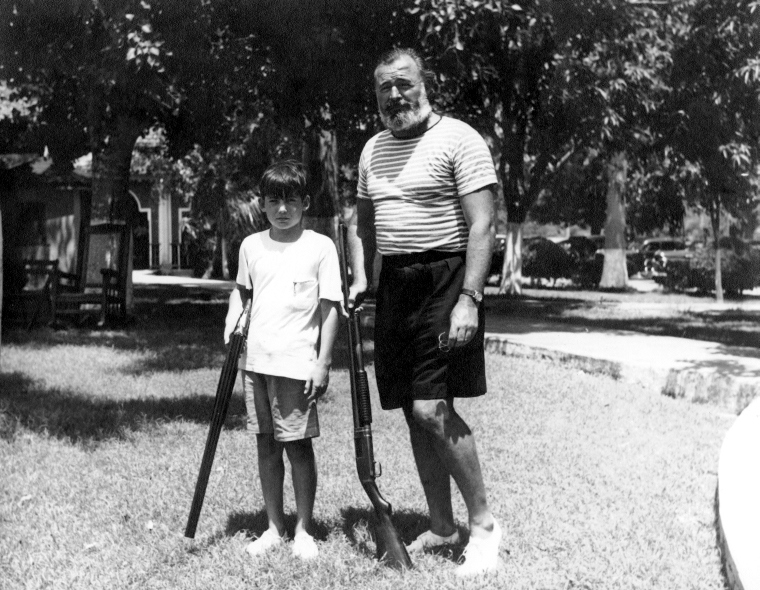
He was trying on his mother’s clothes from age four, but it wasn’t until age ten, on a trip to Cuba, that Ernest walked in and discovered him. He stood there frozen and then turned and left. That was the same year that Ernest started encouraging him to get drunk daily on hard liquor. A few months later when the boys had returned to their mother, Ernest wrote to his ex-wife about Gigi that
“He has the biggest dark side in the family except me and you and I’m not in the family. He keeps it so concealed that you never know about it and maybe that way it will back up on him”.
father and son in Cuba
In 1950 Gregory dropped out of college, and briefly took up Dianetics. In 1951, aged 19 he married Jane, and was working in an aircraft factory in Los Angeles. He sometimes borrowed Jane’s things, and in the evening of September 29, due to become a father in two months, he was arrested en femme in the women’s restroom of a movie theater (in his 1976 book he described it as a drug arrest).
His mother, Pauline, flew down from San Francisco and stayed with her sister, Jinny Pfeiffer and her lover Laura Archera, the violinist and film producer (they would later enter into a polyamory arrangement with Aldous Huxley). Pauline already had a stomach pain. She failed to get Gigi out of jail, and had a very emotional phone call with Ernest. She was rushed to hospital a few hours later and died on the operating table, on October 1.
Gigi was then released. Ernest told Gigi re his arrest: “Well it killed mother”. This caused a rupture between father and son. However Gregory started to write again after Ernest had two back-to-back airplane crashes in east Africa in 1954, and sent a congratulatory wire when he won the Nobel Prize later the same year.
Gregory drank a lot throughout most of the fifties, he could not hold a job, and he lost his wife after a disastrous trip to Africa. He joined the army on the fifth anniversary of his mother’s death, October 1, 1956, but was soon sent home for psychological instability. He was diagnosed and hospitalized with schizophrenia, and had electroshock treatments. In between treatments, Gigi and Ernest drove down to Key West, their last time together.
Yet he also completed pre-med at ULCA, and in 1960, at the age of 29, was accepted at the University of Miami Medical School. He requested a copy of the autopsy on his mother, and found that she had a pheochromocytoma tumor on an adrenal gland. The phone call with Ernest caused the tumor to secrete large amounts of adrenaline, and then to stop. Her blood pressure went up to 300, and then dropped to zero, and she died of shock.
Gigi wrote to his father to explain, and to transfer the blame. Ernest committed suicide nine months later. Gigi attended his father’s funeral and met Valerie Danby Smith (1940 – ), who had been Ernest’s last secretary. They married in 1966, even though he was still married to Alice, his second wife who had just given birth to his fourth child, and though Valerie had had a child by Irish playwright Brendan Behan in the meanwhile. Gigi and Valerie married again the next year when a divorce had been sorted out, and remained married for 20 years.
For a decade they lived mainly in New York. Gregory was a physician, but without enthusiasm, at Standard Oil, General Motors and McGraw-Hill publishers. Sometime he was hospitalized and had more shock treatments. He would buy female clothing at Saks Fifth Avenue, wear them once and dump them. He also borrowed his wife’s things, but she said, in the Colapinto Rolling Stone article, that she never saw him cross-dressed. However in 1974 he read Jan Morris’ Conundrum and talked to Valerie about having the same surgery. Valerie wrote:
"I never had it in my heart to be angry with Greg, except momentarily, for he suffered far more than anyone I have known. (Running: 294)”Gregory published an autobiography in 1976 with a preface by Norman Mailer. It was a critical success but did not discuss his gender problems.
He was then 44. He became a general practitioner in Fort Benton, Montana (population 1500), and stayed for a year. From 1978-83 he was a country doctor in Jordan, Montana (population 600), the sole MD for an area the size of Connecticut. The population appreciated his hard work and dedication.
Valerie and their two children came west in 1980 and settled in Bozeman, 320 miles away. Gregory was expected every other weekend. He would often stop in a motel to dress. He even appeared in the cowboy bar in Jordan in drag. The locals pretended not to notice. In the Spring of 1983 Gigi was arrested after trying on clothes in a boutique and smearing them with makeup. He’d ruined over $1,000 of merchandise.
Later that year he took leave to run in the Boston Marathon, but didn’t show up, didn’t return when expected. He then got a job in Missoula, Montana, and started divorce proceedings. He was going out en femme more and more, and was so when his son John (his second child with Jane) came to visit in 1985. Gigi demanded entrance to a women’s exercise class and then kicked in the door at a restaurant when they wouldn’t serve him. He was sentenced to six months, and served two weeks. Nine months later, again in drag, he kicked in another door and threw a rock though a window. He was referred for psychiatric treatment and later lost his license to practice medicine in Montana.
He managed to escape to Florida. He studied for the Florida medical license, but then dropped out. In 1987 Gigi first met Paul Hendrickson.
“I’ve spent hundreds of thousands of dollars trying not to be a transvestite. It’s a combination of things. The problems are twofold - no, they’re threefold. First, You’ve got this father who’s supermasculine, but who’s somehow protesting it all the time, he’s worried to death about it, never mind that he actually is very masculine, more masculine than anyone else around, in fact. But worried about it all the same--and therefore worried about his sons and their masculinity. Secondly, you start playing around with your mother’s stockings one day when you’re about four year’s old . Maybe it all starts with something as innocent as this. And why do you do this? Who knows? But it must have something to do with the fact that your mother doesn’t seem to love you enough. Or that’s your perception of it . Her maternal instincts just aren’t very strong .... You think that she loves your older brother Patrick more. So maybe you’re putting on her clothes in the first place because you somehow think that you’ll be able to win her that way, get close to her. But then, you see, it starts to feel sexy for its own sake, just to have those things on. It’s erotic, it arouses you. The third thing is your own heightened awareness to everything around you. You’re a writer’s son, after all. You take in a lot more. (Hendrickson, 2011: 383-4)”.In 1987 Paul Hendrickson’s articles on the Hemingways in The Washington Post revealed Gigi’s semi-secret for the first time in a national publication. As this was shortly after the drastically cut-down posthumous first publication of Ernest’s The Garden of Eden, in which a male-female couple exchange clothes and identities, questions were raised in the press re how much of the father was in the son. Gloria played to this when in an interview with the short-lived magazine, Fame, she asked the rhetorical question:
“What’s wrong with the family? My God! Is he doing this too?”.
 |
| Gloria and Ida two years after Gloria's surgery |
In 1995, Gregory and Ida divorced; Gregory, now Gloria, had surgery with Stanley Biber; as Gregory attended the First International Hemingway Colloguium in Havana; and back in Coconut Grove, Gloria made a scene on a bus and resisted arrest.
Gregory, and Ida remarried in 1997 in Washington State. It was more frequently Gregory rather than Gloria who appeared in public.
 |
| mugshot after last arrest |
Gloria left $7 million to Ida, but the children challenged the will on the grounds that same-sex marriage is not legal in Florida. The parties eventually reached an undisclosed settlement.
- Gregory H. Hemingway. Papa: A Personal memoir. Boston: Houghton Mifflin. 1976.
- Ernest Hemingway. The Garden of Eden. New York: C. Scribner's, 1986.
- Paul Hendrickson. “The Hemingway Heritage: Papa's three sons are still living in conflict with the powerful image of that famous and macho writer” The Washington Post August 23, 1987.
- Kenneth Lynn. Hemingway Harvard University Press 1987: 403,418-9,499-502,561-4.
- Gerald Clarke, "The Sons Almost Rise". Fame, September 1989: 108.
- Lorian Hemingway (G’s first child). Walk on Water: A Memoir. New York, NY: Simon & Schuster, 1998.
- John Colapinto. “The Good Son.” Rolling Stone 5 September 2002: 60–65.
- Valerie Hemingway (G’s third wife). Running with the Bulls: My Years with the Hemingways. New York: Ballantine Books, 2004.
- John Hemingway (G’s second child). Strange Tribe: a Family Memoir. The Lyons Press, 2007.
- Lynn Conway (ed). "The Strange Saga of Gregory Hemingway". http://ai.eecs.umich.edu/people/conway/TS/GregoryHemingway.html#anc.
- Paul Hendrickson. Hemingway's Boat: Everything He Loved in Life, and Lost, 1934-1961. New York: Alfred A. Knopf, 2011: 15, 297-9, 382-5, 386, 390-2, 397, 400, 403-53, 493, 496, 498.
I previously, in June 2008, published a much shorter version. My first draft had been based mainly on Paul Hendrickson’s Washington Post article. I recently noticed reviews of Hendrickson’s new book, and realized that it went into a lot more detail about Gloria. I was one of the first to borrow the book from my local library, and it is the major basis of this revised version. I did not realize that Hendrickson was the same writer as the Washington Post article until part way through the book.
None of the Wikipedia articles on the three towns in Montana where Gregory worked mention him among the notable residents. The Wikipedia article on Pauline Pfeiffer says nothing about her unusual death. The Wikipedia article on Laura Archera completely fails to mention her long-time lover Jinny Pfeiffer – which is outrageous. The Aldous Huxley article does not mention her either. If I were doing a blog on polyamory, I would certainly do an article on the three of them.
I failed to find any mention in Hendrickson’s book of electrolysis or female hormones. From this I assume that Gloria did not do either, even though as a doctor she could have self prescribed hormones. It is quite possible that if Gloria were on estrogen she would not have been arrested so often.
The discussion in Hendrickson of Gloria's visit to Dr Biber is very brief, and the others don't even name the surgeon. Hendrickson doesn't ask the questions that those who know of sex-change surgery would ask. There is no mention of psychiatrists' letters, nor of Biber's reaction to her not being on estrogens. What does he mean by 'a series of operations'?
Of Ernest’s three sons, Gregory was the only one to have a career, and he had the most children: eight if you included Brendan, who was named after his father. His two brothers had one and three children respectively.
Pauline Pfeiffer was Catholic. Ernest Hemingway converted to Catholicism (but not to the Catholic notion of marriage for life) in order to marry her in 1927. While Ernest supported the elected government in the Spanish Civil War, Pauline’s Catholicism led her to support the fascist insurgents. Her reward for this was, because she was divorced, to be denied both a Catholic Mass and burial in a Catholic cemetery.


