This site is the most comprehensive on the web devoted to trans history and biography. Well over 1800 persons worthy of note, both famous and obscure, are discussed in detail, and many more are mentioned in passing.

There is a detailed Index arranged by vocation, doctor, activist group etc. There is also a Place Index arranged by City etc. This is still evolving.

In addition to this most articles have one or more labels at the bottom. Click one to go to similar persons. There is a full list of labels at the bottom of the right-hand sidebar. There is also a search box at the top left. Enjoy exploring!

Showing posts with label state honours. Show all posts

02 July 2015

Viktor Kalnberz, Виктор Калнберз (1928 - ) trauma surgeon

Viktor Kalnberz, of Latvian descent, was born in Moscow. Both his parents graduated from the Medical Faculty of the Moscow State University. They were sent to practice in Kyzyl, the capital of the Tuva People's Republic.

They returned to Moscow in 1936, and in 1941 to Riga, Latvia as the Great Patriotic War opened. The parents worked in an evacuation hospital. Despite these disruptions Viktor graduated high school and studied at the Medical Faculty of the University of Latvia 1945-51. From 1951 Kalnberz worked at and then led the Riga Institute of Traumatology and Orthopaedics.

He became internationally famous for transplanting fingers from dead persons onto live persons who needed them. He pioneered penis prosthesis technology at a time when Soviet orthodoxy was at best disinterested in treating impotence. He was a deputy of the Riga City Council 1963-7.

He had already performed four sex correction operations on intersex patients, when in the winter of 1968 he was approached by a 29-year-old trans man, an engineer who had already attempted suicide three times, whom we know only by his female name of Inna. Kalnberz treated him over the next four years.
“A medical council was convened; there was an endocrinologist, a sexopathologist, a gynaecologist, and a psychiatrist on the panel. They all agreed that conservative treatment methods were very unlikely to succeed in this case. The head of the Latvian republic’s health ministry had the last word. He gave us the permission, but did not actually sign any papers."
In September 1970 the operation was approved, and it was done in stages.
“He was very afraid that people would learn about the operation. That is why when they gave him his new ID and other documents, I asked him not to give me his surname or address. I don’t even know his phone number. The only thing I asked of him was to give me a ring every now and then, and tell me about his condition. The last time I heard from him was more than five years ago. He was just under 70 at the time."
Inna continued as an engineer. He married twice, and explained his scars to his wives as resulting from a car accident. Dr Kalnberz was summoned to several inquiries, but got off with a stern reprimand. The surgery on Inna was kept secret for 20 years.

In 1974 Kalnberz was issued a US patent for his penile implant using polyethylene plastic rods – in all he held 23 patents in different countries. He did a further five sex-change operations. He was a member of the Supreme Soviet 1975 – 1990. He treated Soviet cosmonauts, made a women's shortened leg longer by 60 cm, was a consultant to trauma teams across the USSR, in Tokyo, Munich, Moscow and at the Montreal Olympics. He worked with the army in Afghanistan where he developed an external fixation device to treat complex gunshot fractures.

He became a Hero of Socialist Labour and an Academician of the Academy of Medical Sciences in 1988 and was given many other rewards.

He retired at age 80.
Peoples.ru    WorldCat    Patents
__________________________________________________________________________

Kalnberz is admirable enough as is.  Why does Gnedinskaya spoil it with the false claim of Inna's operation being a world's first?

24 November 2014

Catherine McGregor (1956–) soldier, cricketer, sports writer, political aide.

Malcolm grew up in Toowoomba, Queensland, in a Catholic family. He was eight when his father died, and shorty afterwards he tried on his mother's clothes. He was a successful boy, at humanities and at cricket, at a Christian Brothers high school. He always wanted to be a soldier.

He enlisted at 18, and chose to go into the infantry, where he met David Morrison. He was known for his drinking and getting into fights.

However after a promotion, he left and joined the New South Wales Labor Party, and became press secretary to Bob Carr, then leader of the opposition. At this time Malcolm encountered Tony Abbott, who was making a name for himself in the Liberal Party, on a rugby field. In 1985 McGregor sought medical help and was offered a diagnosis of being transgender. He started going out as a woman, but lost his nerve and drank instead. He managed to stop, but had a major falling out with the Labor Party.

Malcolm went to work with the Federal Liberal Party for the 1993 election where John Hewson lost, despite expectations, to Labor's Paul Keating. 18 months later McGregor was involved in the leaking of internal polling that showed how unpopular Hewson was, and this led to Hewson being replaced.

Malcolm "having burnt my bridges with both political Parties" then became a media political commentator, and also joined the Army Reserve. After 911 he rejoined the Regular Army.
At this time Malcolm found a woman that he loved, and they married. He rose to the rank of Lieutenant Colonel and was working as advisor and speechwriter for Lieutenant General David Morrison, who was now the Chief of the Army.

He had a second career as a cricket commentator for The Spectator.

In October 2011, McGregor read a magazine article about Westerly Windina in The Sun Herald, and this enabled him to tell his therapist that he was transgender.

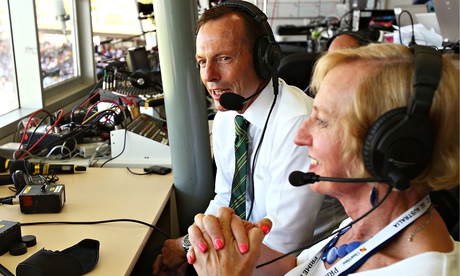
In 2012 McGregor was awarded the Order of Australia, and discussed his gender issues with the chief, who refused twice to accept a resignation. McGregor's book, An Indian Summer of Cricket, came out under Malcolm's name, and in the final chapter she announces her impending transition. Tony Abbott reviewed it, and lauded her courage. She separated from her wife and transitioned as Catherine (Cate) "rhymes with mate'.


Cate & Tony in the ABC Radio commentary booth
In general both army and cricket associates were supportive, but there were a few negative remarks, which led to spats on social media until Morrison counselled her that such was not to happen again.

In 2014 Catherine was featured on ABC's Australian Story, introduced by her old mate Tony Abbott, now Prime Minister. Catherine transferred to the Air Force. She now writes about cricket for the Australian Financial Review. She is senior delegate for women’s cricket in the armed services, and helps select the Australian prime minister’s sides, as his representative, that play touring teams. Catherine is on good terms with her ex-wife.

*Not the academic at UVic, nor the NZ journalist, nor the actress.
EN.WIKIPEDIA     Pinnacle

09 January 2014

Joanne Cassar SG (1981 - ) hairdresser, activist

Cassar, a hairdresser resident in Cospicua, Malta, achieved transgender surgery in January 2005. In June 2006 she successfully applied under Article 257A of the Maltese Civil Code and her sex and name were changed on her birth certificate.

Subsequently Joanne and her boyfriend, T. applied for a marriage licence. However they were refused in that the Marriage Act prohibited unions between persons of the same gender.

Joanne sued and in February 2007, a Justice noted that the proposed union did not contravene any provision of the Marriage Act. He upheld her request and ordered the director of Public Registry to issue the marriage banns. The marriage registry appealed. In May 2008, another Justice observed that Maltese Law offered no legal definition of either gender, but took into account an affidavit by the former chairman of the parliamentary bio-ethics committee, Dr Michael Axiak, who wrote: "after gender reassignment therapy, a person will have remained of the same sex as before the operation".

In 2010 Joanne was assaulted and had her bag stolen as she left the dance floor at a carnival party. She was frequently insulted and pushed around by strangers.  

Joanne then opened a case in the First Hall of the Civil Court in its constitutional jurisdiction, claiming a breach of human rights. She won in April 2011, but then lost on appeal a month later.

Joanne, at some financial cost filed a case against Malta in the European Court of Human Rights in Strasbourg. The then Attorney General filed submissions arguing that the reassigned gender on Cassar's State-issued identity card was intended only to "spare her embarrassment", and was not meant to entitle Cassar to legal privileges associated with the female gender.

The Maltese General Election of 2013 returned the Labour Party after 15 years of rule by the Nationalist Party.

The new government then relinquished the case in the European Court and presented amendments to the Civil Code under which transgender people re now considered as individuals of the acquired sex with full rights, including the right to marry. Furthermore Joanna Cassar was awarded compensation and also honoured by being accepted into the Xirka Ġieħ ir-Repubblika Society which is limited to 20 members.

* Not the academic at the University of Malta

02 January 2014

Alice Purnell (1943 - ) chemist, activist, nurse, counsellor, poet

++February 2015 - revised after feedback from Alice.


Purnell was conceived in a haystack in the Wirral during an air-raid. He was sexually and physically abused at prep school by the headmaster who was later convicted. His parents had a 'messy horrid' divorce when he was doing his O-level examinations.

He felt confused in that he felt that he should be a girl but was not attracted to men. He developed an alternate identity as Anne who, by the age of 15, socialized only with people who knew nothing of Purnell's male life.

Purnell did a degree in chemistry. He found love with a woman to whom he explained about Anne. She accepted this side of him, but asked that Anne change her name as her sister was also Anne. Purnell had been called Dormouse at school, and, in homage to Lewis Carroll, became Alice.

They were living in Sussex. One evening on the way home from work as a research chemist, Purnell encountered, before the police arrived, a trans girl who had hanged herself in a tree. Her father showed up and expressed anger but not sorrow. Purnell felt that he could easily have been that trans girl, and this led to becoming a volunteer with the Samaritans, the advice line for those at risk of suicide. She found that a third of calls on the line featured gender difficulties.

Alice did not know how to express her femininity until she found a a copy of Virginia Prince's Transvestia in a sex-book shop in London's Soho. She used the Transvestia contact system to find like-minded persons, and became a member of the European Chapter of Virginia Prince's FPE.


Alice, Alga Campbell from Dublin, Giselle, a US expatriate, and Sylvia Carter, met in 1965 and agreed to found the Beaumont Society (named after the 18th century transvestite pioneer). The membership numbering was started at 100 (which was assigned to Alice, and then issued back and forth from that to give the impression of greater membership. Initially there were almost as many overseas members as in the UK, with some in Malaysia, Kenya and other parts of the Commonwealth. Alice became the overseas contact person because of her French. Regional contacts were appointed but were often the only member in their region.

After an initial meeting in Hampstead, the first full meeting was held in Southampton in 1966 with 12 in attendance including two wives.

Purnell had been attending the Charing Cross Hospital Gender Clinic under the care of Dr Randell, and that same year was offered surgery.  However Purnell married his lover instead after five years together. They had two daughters and a son.

Following the practice of Prince in the US, new members had to be vetted, and the application form explicitly stated that no hint of overt gayness would be tolerated.
"It was also risky meeting others to sponsor them. I remember a character from Gibraltar who was very cagey indeed, who I arranged via the contact system to sponsor so she could attend meetings when in the UK; (you could not do so if not sponsored as they were often in people's homes). At the meeting in a car park this person told me my date & place of birth, schools and University, bank balance and workplace. I was horrified. He had discovered all this via our Secret Service for whom he worked in the Colony. He said he did this to secure his own confidentiality in case we breached his. I felt disinclined to sponsor him and was really horrified that even then governments held so much info' on all of us. I did sponsor him after discussion with Alga. It was a bit of a mutual standoff, but what an invasion of my own privacy!"
Alice, Alga, Virginia, Sylvia - 1971
In 1969 Virginia Prince visited the Beaumont Society in London, Leicester and Scotland. On her return in 1971 she stayed with Alice.

Alice was on BBC Radio 4 with agony aunt Claire Raynor. She attended the TV/TS conferences at Leeds University in 1974, and Leicester University in 1975 – the latter was organized by the Beaumont Society. Also in 1975, Alice was a co-founder of the Beaumont Trust, a registered charity, which separately from the Beaumont Society, set up a helpline and published educational booklets on transgender topics. In 1976 Alice became Vice-President of the Beaumont Society, and President a year later.

In 1977, Alice trained as a nurse, specializing in geriatric services. She then worked as such for 26 years, at one time becoming a matron, ++including nursing support for transgender surgery.

She ++finally had surgery in 1982 after the dissolution of her marriage, and remained President of the Beaumont Society until 1984. She also worked with Judy Cousins at SHAFT. She researched the then literature on trans topics and was disappointed. She joined HBIGDA (now WPATH) and attended its European meetings. She found that they were dominated by US concerns and that the Standards of Care were mainly to protect the surgeons, and that the emphasis was on psychiatry rather than on psychology/counselling. Using the contacts that she had made she organized the first of the GENDYS conferences which was held at Manchester University in 1990. This was intended as a British conference, and deliberately brought together each type of professional who deals with trans persons, and each type of trans person. There were a further seven GENDYS conferences held every two years. Alice edited all the GENDYS Conference Reports and often contributed papers.

Alice in 2011
After obtaining a masters degree in counselling and psychology, she co-founded Gender Trust and subsidized it in its first year. It was intended to help transgender rather than transvestite persons, and was, like the Beaumont Trust, a registered charity. However after a year the legal counsel to the Gender Trust was insisting that the trustees were to view her counselling notes. She regarded this potential breach of confidentiality re those she had counselled to be outrageous and resigned from Gender Trust. She also took them to court to establish that the copyright to the 2005 book was hers, and was not held by the Trust.  ++She estimates that she has counselled around 500 trans persons.  

She is also a poet, a dog lover and a fossil collector. She has lived most of her life in Sussex.

Alice Purnell was made an OBE in the 2012 New Years Honours List: "For services to Transgender People".
  • Alice Purnell. "Why does transexuality exist?" and "TV, TG, TS – What's in a label?" in Michael Trevor Haslam. Transvestism: A Guide. Beaumont Trust, 1993.
  • A. Purnell (ed.). Conference Report of the 1st International Gender Dysphoria Conference. London: BM Gendys, 1991.
  • A. Purnell (ed.). Conference Report of the 2nd International Gender Dysphoria Conference. London: BM Gendys, 1993.
  • A. Purnell (ed.). Conference Report of the 3rd International Gender Dysphoria Conference. London: BM Gendys, 1995.
  • A. Purnell (ed.). Conference Report of the 4th International Gender Dysphoria Conference. London: BM Gendys, 1996.
  • A. Purnell (ed.). Conference Report of the 5th International Gender Dysphoria Conference. London: BM Gendys, 1999.
  • A. Purnell (ed.). Gendys 2K: Sixth International Gender Conference Report. London: BM Gendys, 2001.
  • A. Purnell (ed.). Conference Report of the 7th International Gender Dysphoria Conference. London: BM Gendys,2002.
  • A. Purnell (ed.), Conference Report of the 8th International Gender Dysphoria Conference. London: BM Gendys, 2004.
  • Alice Purnell. Transexed and Transgendered People: A Guide. Gendys Conferences, 2005.
  • Alice L100. "A History of the Beaumont Society". Beaumont Magazine, 13,4, 2005. Online at: www.yumpu.com/en/document/view/6971183/a-short-beaumont-history-the-beaumont-society.
  • Alice Kelly Purnell. Be the Flame Not the Moth: An Anthology of Poems (and Some Prose). Golden Flower Press, 2010.
  • Alice Purnell & Jed Bland (ed). Trans in the Twenty First Century: Concerning Gender Diversity. Beaumont Trust, 2011.
  • "New year honours for Brighton and Hove LGBT supporters". Brighton and Hove News, December 31st, 2011. www.brightonandhovenews.org/2011/12/31/new-year-honours-for-brighton-and-hove-lgbt-supporters/12027.
  • email from Alice Purnall, 7 Feb 2015

Christine Burns interviewed Alice Purnell,20 May 2013


_________________________________________________________________________________

We have a list of the 4 founders of the Beaumont Society, but we still don't have a list of the 12 founders of the Hose and Heel Club.

Alice says that the Beaumont Society was never really anti-gay, merely obliged to distance itself from being perceived as gay because of the laws at the time.  Whether you buy this or regard it as a post-facto PR position, the Beaumont Society has grown away from its Princian origins.  The interview with Christine Burns contains none of the mean spirited rhetoric that Prince herself retained till the end.

Note that Alice uses 'transgender' as a umbrella term apart from transvestites.  You find the same usage with Katherine Cummings, the Australian FPE alumna.   The sterile debate re transgender=heterosexual transvestite is mainly a US hangup.

++In the initial verion of this article I had assumed that Alice was non-op because a) she was president of a Princian organization and b) there was no statment to the contrary.   However it has now been clarified that the assumption was not so, and statements have been added in the narrative above.


Dallas Denny has an essay, Consumer relations: WPATH’s evolving relations with those it serves, in which she mentions that as late as 1989 she was still getting a run-around attempting to join HBIGDA. Alice had joined a few years earlier, but apparently in stealth.

07 November 2013

Jan Morris (1926 - 2020) Part 3: travel writer.

Part 1: youth and journalism.
Part 2: transition and empire.
Part 3: travel writer.

Jan resigned from the all-male Travellers' Club, gave away James' dinner jacket and wrote to Who's Who to change her entry. At her own pace she changed her public identity.
"Presently I took to signing articles and reviews as Jan: also letters to The Times, whose letters editor imperturbably printed them, through the sequence of male to female, without comment."
She commented:
"Few people understood it. I did not expect them to understand the cause, since it was a mystery even to me, but I had supposed more people might understand the compulsion. I had once surmised that it might be an impulse common to all male persons, and though friends of both sexes vehemently deny it, it still seems to me only common sense to wish to be a woman rather than a man – or if not common sense, at least good taste."
The second volume of Pax Britannica, Heaven's Command: An Imperial Progress, came out in 1973, with James' name on the title page.

Morris' colleague, David Holden, wrote an essay, "James & Jan", on his experience of Jan's transition and it appeared in The Sunday Times, 10 March 1974.  Jan's account of her transition, Conundrum, was serialized for four weeks in the same newspaper in April, and then published as a book. As she was a well-regarded and famous journalist, her autobiography was much reviewed, although the reviews were uncomprehending at best, and some were vituperative.

The review in The Times Literary Supplement by Russell Davies was particularly cutting: He asked
"Is it not just a token immersion in what may always have been a shallow, impressionistically received idea of womanhood?"
and cites her anecdotes of gossiping at the shops as having nothing to do with womanliness. Jan was sufficiently hurt that she wrote to the editor to specify that Davies' review was just one in a wide range of "love and bitterness, hope and sorrow".

Rebeccca West wrote for The New York Times and said:
"She sounds not like a woman, but like a man's idea of a woman, and curiously enough, a man not nearly so intelligent as James Morris used to be.”
V.S. Prichett in The New Statesman wrote:
"A woman? The handbag swings and the muscles are softening. Women's chats, a woman's interest in clothes, finding men attractive, pleasure in the fact of being socially cosseted, are coming on. But essentially, Jan is an invented woman, for she has not been formed by the psychic-physical fate and surprise of menstruation or the power-giving possibility of child-bearing".
Nora Ephron was appalled by Morris' notion of what it is to be a woman:
"I always wanted to be a girl, too. I, too, felt that I was born into the wrong body, a body that refused, in spite of every imprecation and exercise I could manage, to become anything but the boyish, lean thing it was... I wanted more than anything to be something I will never be – Feminine and feminine in the worst way. Submissive. Dependent. Soft-spoken. Coquettish. I was no good at all at any of it, no good at being a girl; on the other hand I am not half bad at being a woman. In contrast Jan Morris is perfectly awful at being a woman; what she has become instead is precisely what James Morris wanted to become all those years ago. A girl. And worse, a forty-seven-year-old girl. And worst of all, a forty-seven-year-old Cosmopolitan girl."
Despite these reviews Conundrum became one of the best selling and most discussed transsexual autobiographies. Jan and Elizabeth did later divorce, but keep on living together as a couple.

The third volume of Pax Britannica, Farewell the Trumpets: An Imperial Retreat, came out in 1978, again with 'James Morris' on the title page for consistency.

Janice Raymond published her The Transsexual Empire in 1979. She was delighted to find examples of a transsexual embracing the gender stereotypes that feminism was rejecting. However the only negative review that she quoted was that by Rebecca West.

Jan and Elizabeth live mainly in Wales.

Jan was shortlisted for the Booker Prize with her first novel, Last Letters from Hav in 1985.

She returned to autobiography with Pleasures of a Tangled Life, 1989, which is a collection of her essays. Only in the essay "As to Sex" does she discuss how she is famous to people who never read her books.


She was elected to the Welsh Gorsedd of Bards in 1993.

She was offered a CBE in 1999, and despite being a Welsh republican she accepted it.

Jan and Elizabeth were formally re-joined in a civil union in 2008, after living together for nearly 60 years.

She is a noted travel writer, and the author of over 40 books. 

++She died age 93.
  • James Morris. Coronation Everest. Faber and Faber, 1963.
  • James Morris. Pax Britannica: The Climax of Empire. Faber and Faber, 1968.
  • James Morris. Heaven's Command: An Imperial Progress. Faber and Faber, 1973
  • David Holden. "James & Jan". The Sunday Times, 10 March 1974. Reprinted: The New York Times, March 17, 1974. http://www.nytimes.com/books/97/11/23/home/morris-interview.html.
  • Jan Morris. Conundrum. London: Faber and Faber. xi, 148 pp.1974. New York: Harcourt Barce Jovanovich 1974. London: Coronet Books 1975. New York New American Library 1975. Harmondsworth: Penguin 1987.
  • Rebecca West. "Male and Female He Made Them". Review of Conundrum by Jan Morris. New York Times Book Review, April 14, 1974: 5.
  • Russell R. Davies. "Mr Morris Changes Trains". Review of Conundrum, The Times Literary Supplement, 26 April 1974, 431.
  • V.S. Pritchard. "Clouded Conundrum". New Statesman, 26 April 1974: 596.
  • Nora Ephron. "Conundrum", Esquire, 1975 reprinted in Crazy Salad & Scribble Scribble: Some Things About Women & Notes on the Media. 2012: 242-8.
  • James Morris. Farewell the Trumpets: An Imperial Retreat. Faber and Faber, 1978.
  • Janice G. Raymond The Transsexual Empire: The Making of the She-male. Boston: Beacon Press. 1979: 78,83, 86-90, 126, 143, 166, 184.
  • Mark Morris. 'My Father's Life: that my father is now a woman is besides the point' Esquire November1984.
  • Jan Morris. Pleasures of a Tangled Life. London: Barrie & Jenkins. 209 pp1989. New York: Random House 1989. New York: Vintage Books 1990.
  • Kevin Allman. "Jan Morris Finds Peace in 'Pleasures'". Los Angeles Times, October 20, 1989. http://articles.latimes.com/1989-10-20/news/vw-210_1_james-morris/2.
  • Sandy Stone. “The Empire Strikes Back: A Post-transsexual Manifesto”. In. Straub, K. and Epstein, J. (eds), Body Guards: The Cultural Politics of Gender Ambiguity. Routledge. 1991. Also online at http://sandystone.com/empire-strikes-back.
  • Bernice L.Hausman. Changing Sex: Transsexualism, Technology, and the Idea of Gender. Durham: Duke University Press, 1995: 142, 162-4, 166, 235n95.
  • Pat Califia. Sex changes: the politics of transgenderism. San Francisco: Cleis Press 1997. Second edition by Patrick Califia 2003: 7, 29-37, 48, 163, 196, 198.
  • Jay Prosser. Second Skins: The Body Narratives of Transsexuality. New York: Columbia University Press, 1998: 68, 99-100, 116-8, 124, 130-1, 245n2.
  • Don George. “Writers we love: Jan Morris”. Salon.com. 1999. www.salon.com/travel/bag/1999/08/18/morris.
  • Dr Georgina Somerset. "Re: Saddest part of the syndrome". Letter to the Daily Telegraph, 23 Nov 2003. Online at: http://groups.yahoo.com/group/TNUKdigest/message/7388.
  • Paul Clements. Jan Morris: around the world in 80 years. Writers of Wales. Cardiff: University of Wales Press, 175 pp1998. Seren Books 2006.
  • Alan Rusridger. "Courage under fire". The Guardian, 10 July 2006. www.theguardian.com/media/2006/jul/10/pressandpublishing.egypt.
  • Daniel J. O'Connor. Sex Signs: Transsexuality, Autobiogrpahy, and the Languages of Sexual Difference in the United Kingdom and United States of America, 1950-2000. History PhD Thesis, University of Warwick, 2006: 1, 6, 15, 2-5, 27, 28, 30, 33, 35, 39, 45-51, 54, 58, 67, 76, 92-4, 96, 106, 117-120, 127-130, 138-9, 141-171, 253-4 .
  • Andy McSmith. “Love story: Divorce, the death of a child and a sex change... but still together”. The Independent. 4 June 2008. www.independent.co.uk/news/uk/this-britain/love-story-divorce-the-death-of-a-child-and-a-sex-change-but-still-together-839602.html.
  • Gillian Fenwick. Traveling Genius: The Writing Life of Jan Morris. Columbia: University of South Carolina press, 2008.
  • Mike Conefrey. Everest 1953: The Epic Story of the First Ascent of Everest. Oneworld Publications, 2013: 223-4230, 239, 251, 272, 283, 291, 300.

____________________________________________________________

Raymond quotes Rebecca West but does not say where she got the quote from.  She certainly does not quote the male reviewers.  She could have made a much better job making her point - this  illustrates well that even if you were to agree with her position, she is still not a good scholar.

Patrick Califia follows Morris in referring to Dr B-- and does not identify him as Georges Burou.

I have listed only the most relevant of Morris' books above. See Worldcat or Amazon for a fuller list.

Unlike for Femke Olyslager, the editors at Worldcat have revised James Morris' books to be by Jan, even when the edition is question was issued as by James.

David Holden was a colleague of Morris whose article "James and Jan" preceded the serialization of Conundrum in The Sunday Times. He was working for the newspaper in Cairo three years later when he was killed execution-style. Sunday Times editor Harold Evans used three of his top journalists to investigate but no group ever claimed responsibility and the murder remains unsolved.

It seems that Jan never did engage with the dialectic of feminism beyond the facile dismissal quoted in part 2.

The Traveller's Club is still a 'gentlemen's club': that is no female members.  Unlike say Stephanie Anne Booth who used her legal masculinity to attend the Lancashire Cricket Club AGM, Jan made no attempt to open up The Traveller's Club to female travellers.

Neither does she discuss her class entitlements beyond mentioning them as natural.  She does not tell us what her father did, but implicitly he was so placed and had the financial means to send James and his brothers to Public School (that is: expensive private schools).  Today 7% of the UK has been educated in Public Schools, so I will assume the same percentage in the 1940s.   James left Lancing after only three years which should not have enabled him to get into any university, let alone Oxford.  When he volunteed to join the army he was sent to officer school.  My father and my uncles volunteered in the same war with no such offer, but then they were in the bottom 93%.  The two-year degree at Oxford was intended for veterans, but only for those with the right background.   The degree at Oxford led to an introduction to the editor of The Times: a foot in the door that most of us never get.   Morris was initially resented by the Everest climbing team, but managed to overcome that resentment - which is to his credit.  He "trod the long well-beaten, expensive and fruitless path of the Harley Street psychiatrists and sexologists".   That is, he did not use the NHS like the rest of us, although he did end up at the same Charing Cross gender clinic, and the same clinic in Casablanca that many transsexuals of limited means were able to save up and access.

16 June 2013

The UK Honours system


The Order of the British Empire is multi-faced creation given more often to our enemies than to gender variant people.   However there is a short and interesting list of those who have received such honours. 

Olave Baden-Powell GBE 1932
Robert Stephenson Baden-Powell  Order of Merit 1937 (also GVMG, GCVO, KCB)
Dudley Clarke Companion of the Bath 1945
Herbert Hoover KBE 1950
Ernest Thesiger  CBE 1960.
Lynne Braithwaite British Empire Medal 1976.
Jan Morris CBE 1999
Danny La Rue OBE 2002
Rudy Giuliani KBE 2002
Peter Ackroyd (Author of Dressing Up, possibly a crossdreamer) CBE 2003
Stephen Whittle (Press for Change) OBE 2005
Christine Burns (Press for Change) MBE 2005
Barry Humphries/Edna Everage CBE 2007
Paul O’Grady/Lily Savage MBE 2008
Bernard & Terry Reed (GIRES, parents of a trans woman) OBE 2010
April Ashley MBE 2012
Grayson Parry CBE 2013

See also Royal Command Performances by gender impersonators.
And also State Honours.

09 September 2012

Vita Sackville-West (1892 - 1962) writer, aristocrat.

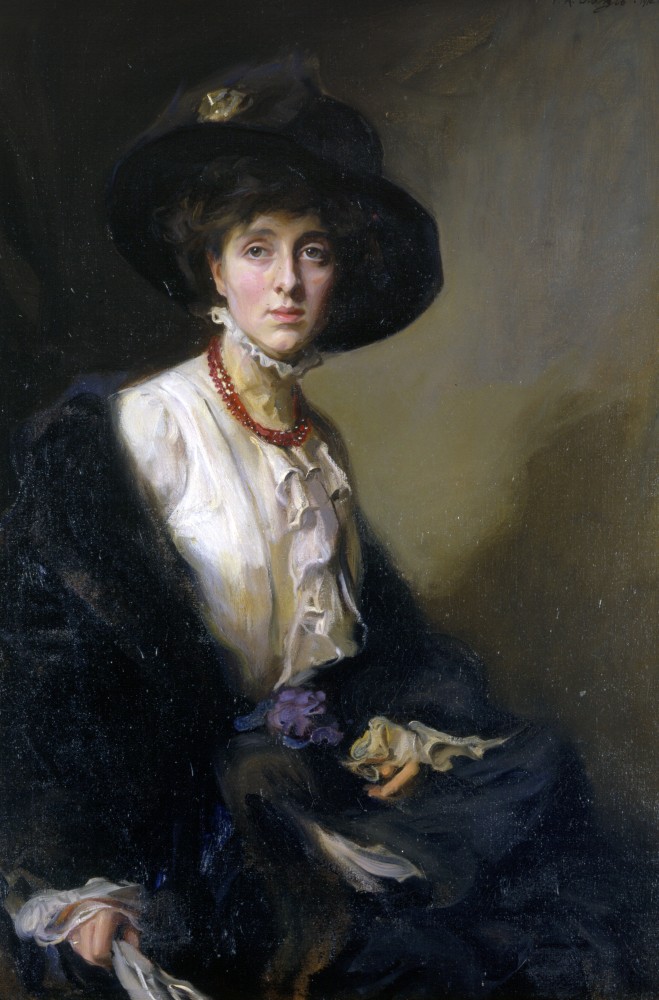
Vita Sackville-West by Philip de László, 1910
Victoria Mary Sackville-West was born at Knole House in Kent, the only child of Lionel Sackville-West, and his cousin Victoria, the daughter of his uncle, also Lionel, the 2nd Baron Sackville and Pepita, a Spanish dancer. Victoria Mary was usually known as Vita, to distinguish her from her mother. In 1908 the elder Lionel Sackville-West died, and his eldest son, Ernest claimed the Barony, but the English courts declared that he and his siblings were all illegitimate. The younger Lionel thus became the 3rd Baron Sackville.

In 1913 Vita married Harold Nicolson, the 3rd son of the 1st Baron Carnock, of HM Diplomatic Service, which made her the Honourable Lady Nicolson. It was Nicolson’s duty in August 1914, to hand Britain’s declaration of war to the German ambassador. He served at the 1919 Paris Peace Conference and was appointed Companion of the Order of St Michael and St George.

In the closing months of the Great War and for some years afterwards Vita conducted a passionate affair with her childhood friend Violet Keppel, daughter of the old king’s mistress.  Violet would soon marry Denys Trefusis. Vita took the name Julian, and put a khaki bandage around her head, which in the immediate aftermath of war was not uncommon, and browned her face and hands. She was successful in this persona - being tall was an advantage. Julian and Violet travelled to Cornwall, Paris and southern France. The two husbands pursued in a private plane, and the press picked up on the story.

In 1924, Vita published Challenge, a novel, based on their affair, with herself as Julian Davenport the leader of a revolution on a Greek island. His cousin Eve (Violet) joins him as his lover but becomes jealous of his attachment to the island. The book was published in the States only, for Vita’s father found the portrayal obvious enough to identify his family. In the real world, Julian and Violet broke up because the latter had sex with her own husband.

Vita and Harold remained in a loving marriage relationship despite, or because, they both conducted same-sex relations with others. They had two sons. Both their fathers died in 1928. Knole and the Sackville Barony went to Lionel’s brother Charles.

Vita as Orlando, 1928
In the late 1920s, Vita had an affair with Virginia Woolf, who immortalized Vita by imagining her as the gender-switching protagonist of the novel Orlando, 1928.

In 1926 and again in 1933 Vita won the Hawthornden Prize for her long narrative poems. She is the only person to win the prize twice.

In the early 1930s Vita had an affair with Gwen St Aubyn. In the novel, Dark Island, she wrote herself into both the jealous husband, Venn, and his secretary, Christina, as they compete for Shirin, Vita’s real-life name for St Aubyn.

In the 1930s Vita and Harold acquired Sissinghurst Castle in Kent. Sissinghurst is now owned by the National Trust and its gardens are the most visited in England. Gordon Langley Hall, the child of servants on the estate later emigrated to the US where she made a very public transition as Dawn Langley Simmons.

Vita at Sissinghurst 1955
In 1947 Vita was made a Companion of Honour for her services to literature. The same year she began a weekly column in The Observer called “In your Garden”. In 1948 she became a founder member of the National Trust's garden committee. She also published books on travel and literary topics.

In her last novel, No Signposts in the Sea (1961), she denies what we now know her for by having the main character, Laura, muse:
“Perhaps a relationship between two women must always be incomplete--unless, I suppose, they have Lesbian inclinations which I don't happen to share. Then, or so I have been given to understand, the concord may approach perfection.”.
Her fifty-five books include seven collections of poems and stories, twelve novels, and twenty-two works of nonfiction.

She died of stomach cancer in 1962. Harold died six years later.
  • Vita Sackville-West. Challenge. New York: George H. Doran 1924. London: Collins 1974
  • Virginia Woolf Orlando: A Biography. London: Hogarth Press 1928.
  • Vita Sackville-West. The Dark Island. Hogarth Press, 1934.   
  • Nigel Nicolson. Portrait of a Marriage. New York: Atheneum, 1973.
  • “Virginia Woolf and Vita Sackville-West”.  http://kaykeys.net/passions/virginiawoolf/virginiaandvita.html


 GLBTQ    EN.WIKIPEDIA  WORLDCAT  AMAZON.CO.UK


____________________________________________________________

The Wikipedia article comments “The Sackville family custom of following the Salic rules of agnatic male primogeniture prevented Vita from inheriting Knole on the death of her father”.  It was hardly a family custom, it was standard practice. The Wiki authors imply that she would have inherited Knole and the barony otherwise.  However if the custom were not observed,  Pepita’s son, Ernest would have been the 3rd Baron.

Like Dorian Gray, Vita kept the 1910 portrait by Philip de Laszlo in her attic, although not with the same results.

Vita dabbled with transvestity in her 20s but then gave it up.  If she were not so famous in literary circles we would not be considering her as a transvestite.

Dawn Langley Simmons used the name Pepita, precisely because it was the name of Vita's grandmother.

15 June 2012

14 November 2011

Dudley Clarke (1899 - 1974 ) secret agent.

Dudley Wrangel Clarke was born, with the caul, in Ladysmith, Natal, during the four-month siege that was an early engagement in the Second Boer War. As an adult he spent several years lobbying the War Office that he was entitled to the Boar War campaign medal.

He was educated at Charterhouse School for three years, and then joined the Royal Horse Artillery in 1916, and a month after his 17th birthday was at the Royal Military Academy at Woolwich. He was too young to go to France, so he applied to join the Royal Flying Corps and was posted to Egypt, where he got his wings.

He had the knack of being in the right place and knowing the right people. He had many friends in the 11th Hussars, one of the snootiest regiments, despite being a mere artilleryman himself. He liked to enter and leave rooms silently and without being noticed.

Between the wars he was involved in various Middle East crises and rose through the ranks. He also put on the Royal Artillery display for the 1925 Royal Tournament, and wrote and directed Christmas pantomimes at the Staff College at Camberley in 1933-4, and the Silver Jubilee Display in Aden in 1935. From 1936 he was a Brigade Major in Palestine.

During the Second World War Lieutenant Colonel Clarke ran a deception section in Cairo under MI6 whose job was to deceive the Axis about Allied troop movements. For a flight to Egypt, which took six days during the war as they had to go via the Canary Islands, Lagos and Khartoum, he impersonated a US war correspondent and wore a loud pair of black-and-white plus-fours. He recruited a double of General Montgomery who spent time in the Mediterranean while the real Montgomery was in England; he created a fictitious First United States Army Group in Kent to fool the Germans that Calais would be invaded. He created a fake Special Air Service paratrooper regiment, and when such a troop was really created he arranged for it to have the same name.

Photographs taken by the Madrid police
In October 1941 Clarke travelled to Lisbon and Madrid under the guise of being The Times war correspondent, Wrangel Craker. He was arrested in the latter city in women’s clothes. He tried claiming that he was a novelist studying men’s reactions, and then that he “was taking the feminine garments to a lady in Gibraltar and thought that he would try them on for a prank”. The police considered him to be a ‘homosexualist’, but a German agent who believed that he would assist the Germans arranged Clarke’s release.

This allowed Alan Hillgarth, the British naval attaché, to get him away, and then to Gilbraltar, where he joined a convoy for London. German agents in Ceuta and Algeciras signalled its departure, and U-boats were able to sink several of the ships, including the Aristo where the crew and passengers had five minutes to get to the lifeboats and rafts. Six died and 45 including Clarke escaped.

Hillgarth sent the police photographs to London, where they were shown to Prime Minister Churchill. The cross-dressing caused short-term embarrassment to Clarke, but did not affect his career.

After the war Clarke was made a Companion of the Bath. He retired from the Army and worked for the Conservative Party, and was on the board of Securicor, Ltd. He wrote and published an account of his early military career, and a second volume that was never published. He wrote a history of the 11th Hussars. He then approached the authorities to do a book on the wartime deceptions, but got nowhere. Books on the topic did not appear until the 21st century.

In 1955 he wrote a thriller, Golden Arrow in which he pays a lot of attention to the women’s clothes.
“With all her natural beauty she seemed sadly incapable of acquiring a proper flair for dress ... superbly endowed with grey-green eyes and Titian Hair, with the long slim legs and the gently-curved figure of a model, she could usually be relied upon to ruin the effect of the most exquisite outfit with some shocking misalliance ... As she swung proudly into the hall of the hotel, his first glance went straight to the revolting little hat in exactly the wrong shade of mustard”.
Clarke never married and died at age 75 with an obituary in The Times.
  • Dudley Clarke. Seven Assignments. London: J. Cape, 1948.
  • Dudley Clarke The Eleventh at War, Being the Story of the XIth Hussars (Prince Albert's Own) Through the Years 1934-1945. London: M. Joseph, 1952.
  • Dudley Clarke. Golden Arrow. Hodder & Stoughton, 1955.
  • Thaddeus Holt. The Deceivers: Allied Military Deception in the Second World War. London: Weidenfeld & Nicolson, 2004:12-4, 791.
  • Guy Maynard Liddell, edited by Nigel West. The Guy Liddell Diaries Volume 1, 1939-1942. London: Routledge, 2005: 180-1, 185, 192, 200.
  • Nicholas Rankin. Churchill's Wizards: The British Genius for Deception 1914-1945. London: Faber and Faber, 2008: 255-67, 479-80, 493-503, 549-50, 593. Reprinted as A Genius for Deception: How Cunning Helped the British Win Two World Wars. Oxford: Oxford University Press, 2009.
  • Piers Brendon. “Dark arts and self-delusions”. The Guardian, 4 Oct 2009. www.guardian.co.uk/books/2008/oct/04/history
  • Ben Macintyre. Operation Mincemeat: How a Dead Man and a Bizarre Plan Fooled the Nazis and Assured an Allied Victory. New York: Harmony Books, 2010: 38, 153-4.
  • Duncan Gardham. “MI6’s cross-dressing spy”. The Telegraph, 22 Sep 2010. www.telegraph.co.uk/news/uknews/defence/8017042/MI6s-cross-dressing-spy.html
  • Jeffery Keith. MI6: The History of the Secret Intelligence Service, 1909-1949. London: Bloomsbury Publ, 2011: 406-7.
  • “Dudley Clarke”. Wikipedia, the free encyclopedia. en.wikipedia.org/wiki/Dudley_Clarke
____________________________________________________________

Holt’s The Deceivers, 2004, says a lot about Clarke, but nothing about the incident in Madrid. The first public discussion is in Guy Liddell’s Diaries, published 2005: “At the time he was dressed as a woman complete with brassière etc. Why he wore this disguise nobody quite knows. ... It may be that he is just the type who imagines himself as the super secret service agent”. Bits and variations on this are quoted in most of the subsequent books. The other secret agents could understand disguise, but not why he would also wear the underwear.

The caul was believed to protect from drowning.  That is why good money for paid for the caul of another.   It worked in that Clarke did not go down with the Aristo.

Noël Coward coined a term for leaving without being noticed: exsinuate.

Trivia: there are several movie connections:
  1. While the full tale of the deception departments was not allowed to be told until the 21st century, two of their successes became best-selling books and then films: The Man Who Never Was, 1956, and I Was Monty’s Double, 1958.   The 1981 film, Eye of the Needle stars Donald Sutherland as a German spy who discovers and photographs the fake US Army Group.
  2. Dudley’s brother, T.E.B. Clarke was a film script writer.  He was awarded an Oscar for The Lavender Hill Mob, 1951, and Sons and Lovers, 1960.  He also wrote Passport to Pimlico, and The Blue Lamp.

25 March 2011

Roger Ormrod – part 3: the aftermath

Continued from Part 1: Roger Ormrod (1911- 1992) barrister, doctor, judge.
                         Part 2: Corbett v. Corbett


The draft version of the Nullity Of Marriage Act, 1971, did not mention the sex of the parties, but such a clause was added during the report stage. This was the first time in British law that marriage was defined as being between a man and a woman. This was carried over into the Matrimonial Causes Act 1973 and into The Marriage (Scotland) Act, 1977, and The Marriage (Northern Ireland) Order, 2003, all of which are still in force.

In her 1973 book, Rules and Meanings, anthropologist Mary Douglas uses Ormrod's ruling as an example of the social construction of reality.

In 1974 Ormrod became a Lord Justice of Appeal, and was appointed to the Privy Council. He was also a governor of Barts and Maudsley and Bethlem Hospitals, Chairman of the Institute of Psychiatry, a honorary professor of legal ethics at Birmingham University and chairman of the Notting Hill Housing Trust

++In 1981 he was the Appeal Court judge in the case of G v G where a trans woman had had conditions imposed re access to her daughter, that she not be accompanied by her 'male friend', and that she was to wear 'male-oriented attire without jewellery or cosmetics".   The Court of Appeal refused to disturb the first condition but deleted the second on the ground that it would be too difficult to enforce. Ormrod maintained that the father's duty was to help the child understand the events which had occurred and which had left her confused. He said:  "if [the father] does go down to visit the child dressed in a way which is bizarre or aggressively feminine, or anything of that kind, it will show that his appreciation of the child's welfare is defective". If this were to happen, Ormrod LJ thought it would prove that the father was unable to show "some real under standing of the problem which he has created" and the whole question of access would have to be re-opened. 

In 1982 Ormrod retired from the bench, but continued to sit part-time in the Court of Appeal. He died at age 80.

Not until the Gender Recognition Act of 2004 was there created a legal structure whereby transsexuals are recognized legally in their new gender, and thus able to have their birth certificates corrected and to marry heterosexually under the Matrimonial Causes Act.

18 March 2011

Dietrich Graf von Hulsen-Haseler (1852 - 1908) German chief of the military cabinet.

Hulse-Haesler was the son of a Prussian General. At 18 he became a lieutenant in the Grenadiers. He attended the German War College, and was then attached to the General Staff. In 1889 he became chief of the military cabinet for Kaiser Wilhelm II of Germany.

He was also an avid ballet dancer and for the pleasure of the court would dance attired as a ballerina.

He organized the cover-up in the Harden-Eulenburg Affair of military and civilian trials where prominent members of the Kaiser's entourage were accused of homosexuality.

This was hardly over when, one night in 1908, he overstrained his heart while doing his ballet act, and he died. The details of his death were kept from the public.
  • Magnus Hirschfeld. Sexual Anomalies: the Origins, Nature, and Treatment of Sexual Disorders Emerson Books. 1948: 166.
  • Modris Eksteins. Rites of Spring: The Great War and the Birth of the Modern Age. Boston Houghton Miffin 1989: 88.
  EN.Wikipedia   

15 February 2011

Olave Baden-Powell (1889 - 1977) Chief Guide.

Olave St Clair Soames was born in Chesterfield. She was called Olave in that her father, a brewery owner, strongly anticipating a son, had decided on the name 'Olaf'. She was the third child, home-schooled, rejected by her mother, but close to her father with whom she would hike and shoot and whom she partnered in tennis matches. She also played the violin. They lived in 17 different homes in the first 23 years of her life.

Until her mid-teens she wore her hair cut short like a boy's, and by her late teens had articulated a dislike for conventional female clothing. She was much influenced by a family friend, the masculine Sybil Mounsey-Heysham who gave her a model of indifference to etiquette and fashion and a preference for uniforms. She adopted the twenties' fashion of flattening her breasts, and would use a handkerchief to conceal all hint of cleavage.

Robert Baden-Powell, the founder of scouting, then 55, on meeting the 23-year-old Olave on an Atlantic crossing, recognized her purposeful walk as one that he had noted in Hyde Park two years previously. He was attracted by her sporting prowess, and by the fact that the had the same birthday, 22 February. He was able to marry her whereas he had been uncomfortable with the femininity of other women, although he still had severe headaches from shortly after their marriage until he stopped sleeping with her after the birth of their third child.

As Lady Baden-Powell Olave enthusiastically took to dressing in the scout uniform, but not that of the girl-guides. However she was acclaimed Chief Guide in 1918, and World Chief Guide in 1930. She built up the world membership of the Guides to over 6 million.

She was made Dame Grand Cross of The Most Excellent Order of the British Empire (GBE) 1932. In addition Finland awarded her the Order of the White Rose, and Peru the Order of the Sun.
  • Tim Jeal. The Boy-Man: The Life of Lord Baden-Powell. William Morrow and Company, Inc. 1989: 85, chp 11.
EN.Wikipedia

22 July 2010

Lynne Janine Braithwaite (1934 - 2008) Flight Sergeant, aircraft engineer.

Lawrence James Braithwaite was born in one of the Beatrix Potter Houses, and raised on the shore of Lake Windermere in the Lake District.

At age 15 he joined the Royal Air Force as a ‘Boy Entrant”. He was trained as an airframe mechanic. He married and he and his wife had two daughters and a son. He served 40 years in the RAF rising to Flight Sergeant. He served a year at RCAF Goose Bay in Labrador and three years with the USAF near Omaha, Nebraska.

His speciality was the maintenance of Vulcan bombers. In 1976 he was awarded the British Empire Medal. He left the Air Force in 1989, and was divorced three days later.

He remarried the same year and started a business making silver model aircraft which survived until the recession of 1992.

His second marriage ended in 1993, and in 1994, after consultaion with Russell Reid, Lawrence Became Lynne. She worked with Press for Change, and became the lay advisor on transgender issues to the Lancashire Constabulary. She was a consultant on rebuilding a Vulcan XH558 aircraft.

She died peacefully at age 74 at her home in Morecambe.

03 May 2010

Mary Edwards Walker (1832 – 1919) doctor, suffragette.

Mary Walker was born and raised in Oswego, New York, the youngest of five daughters. In the early 1850s she adopted the new pants outfit associated with the name of Amelia Bloomer. She became one of the very first women doctors in the US when she graduated from Syracuse Medical College in 1855, the only woman in her class. She married in 1856, wearing men’s cloths, and she did not take her husband’s name. They set up a joint practice in Rome, New York, but separated in 1859.

With the start of the US Civil War in 1861, she volunteered on the Union side, but was only allowed to be a nurse, but after working as an unpaid field surgeon near the front lines, she became the second ever US Army Surgeon in 1863. In 1864, while treating civilians, she was captured by Confederate troops and charged as a spy. She was released as part of a prisoner exchange. In 1865 she was awarded a Congressional Medal of Honor, the only women to ever receive one.

She was an advocate for women’s dress reform and in 1866 was elected president of the National Dress Reform Association, and made speaking tour of England. In 1869 she finally obtained her divorce. She became a persistent wearer of trousers, switching from an androgynous mix to strictly male clothing later, although at all times insisting on being treated as a lady, and she never attempted to pass as male. She stood by the earlier suffrage position that the US Constitution gave women the vote, and she opposed the majority of suffragists who switched tactics to campaign for a female suffrage law.

She argued that women’s clothes kept them “unnaturately excited, or in a condition to be excited sexually”. Her solution to the sexual double standard was for men to be continent. She condemned all anal and oral sexual acts, and also masturbation.

In 1887 she began the first of several mid-western tours in dime-museum sideshows. She built up a collection of over 1000 pictures and letter of cross-dressing individuals. She corresponded for many years with the German transvestite Otto Spengler.

In 1902 a medical journal article referred to “Dr. M- W--, of Washington" as “the most distinguished sexual invert in the United States".

In 1917 the US Congress revoked her Medal of Honor (along with 900 others) as she had not been in ‘actual combat with an enemy’, but she refused to return it and continued to wear it until her death. She died of old age at 86, and was buried in her black suit.

A Liberty ship was named after her in the Second World war. US President Carter restored her medal in 1977. The US Postal Service issued a 20¢ Mary Walker stamp in 1982. The medical facilities of SUNY Oswego are named for her as is a US Army Reserve center in Walker, Michigan.
  • Mary Edwards Walker. Hit. New York: American News, 1871.
  • Mary Edwards Walker. Unmasked, or The Science of Immorality. To Gentlemen. Philadelphia: Wm. H. Boyd, 1878.
  • R. W. Shufeldt, "Dr. Havelock Ellis on Sexual Inversion," Pacific Medical journal (San Francisco), vol. 45 (1902), p. 201.
  • Charles McCool Snyder. Dr Mary Walker: the Little Lady in Pants. Arno Press, 1976
  • Allison Lockwood. 'Pantsuited pioneer of women's lib, Dr. Mary Walker'. Smithsonian. 7 March 1977.
  • Leslie Feinberg. Transgender Warriors: Making History from Joan of Arc to Rupaul. Beacon Press, 1996: 111.
Women in History    EN.WIKIPEDIA     FTM Contributions to Medicine, Psychology, Science and Engineering     OutHistory. ____________________________________________________________

The FTM page implies that she was a trans man, but limited by the technology of the time.  I don’t see this.  While she liked men’s clothing, there is no implication that she wanted to be a man.  Unlike many female-born persons in the 19th century she did not attempt to pass as male.  Had she done so, she would have been able to vote.

04 April 2010

Sarah Parry (1945 – ) ship’s captain.

Brian Parry served with the Australian forces in Vietnam. He qualified as a ship’s captain.

He had two marriages, and two children from the first marriage. He then met a new female partner who stayed with him during and after transition.

Brian was recognized as Hobart’s Citizen of the year in 1998 for his work building square riggers and involving local disadvantaged youth, but by then had transitioned to Sarah.

In 2002 Sarah captained the ship she had built to re-enact the Matthew Flinders 1802 Round Australia voyage, which produced the first detailed maps of Australia, and was featured on the Australian Story television show. The trip became controversial as crew jumped ship complaining about the facilities.
Sarah: "I tend to see myself as a third gender. I live as a woman. I'm known as a woman, legally I am. However I'm able to use all those things that I learned as a male & put them to good use in my life now. I don't reject my previous life”.
Sarah was still captaining the ship in November 2007 when it was in the news for rescuing a crayboat.

*Not the sociology lecturer.