This site is the most comprehensive on the web devoted to trans history and biography. Well over 1800 persons worthy of note, both famous and obscure, are discussed in detail, and many more are mentioned in passing.

There is a detailed Index arranged by vocation, doctor, activist group etc. There is also a Place Index arranged by City etc. This is still evolving.

In addition to this most articles have one or more labels at the bottom. Click one to go to similar persons. There is a full list of labels at the bottom of the right-hand sidebar. There is also a search box at the top left. Enjoy exploring!

Showing posts with label Stanford Gender Clinic. Show all posts

06 October 2024

Phillips vs Brown, 1979 - a trans patient sues

Phillips, who then had a different name, grew up in Pennsylvania, where he was raped by his father and others, and placed in foster homes from age 13.

After moving to California, she met John Phillips, and, she living as female, they were married in Nevada in 1970, where she became Mrs Phillips.

February 2-4, 1973, was the occasion of the Second Interdisciplinary Symposium on Gender Dysphoria Syndrome sponsored by the Divisions of Urology and Plastic and Reconstructive Surgery at the Stanford School of Medicine. A highlight was Dr Georges Burou‘s presentation of his techniques; John Brown made a presentation, which was also well received, doctors at that time not being aware of the idiosyncrasies of his practices. Vern Bullough later commented: “the case of John Brown, whom Zelda Suplee, my wife Bonnie, and myself at least halfway encouraged to do transsexual surgery, a recommendation we quickly regretted”.

In October Brown’s work was mentioned sarcastically in Herb Caen’s column in the San Francisco Chronicle.

John Brown had set up business as a doctor-surgeon in San Francisco. His assistant was James Spence who had served time for fraud in San Quentin, and had no medical training. He was mainly responsible for the business aspects of the practice.

Word of mouth in San Francisco’s gay community told Julie about Dr Brown. She was considering breast implants as a Christmas present for her husband.

Julie Phillips approached Brown and Spence about breast implants, and they, assuring her that she would be a ‘perfect woman’, talked her into three operations: breast enlargement, castration and then vaginoplasty, which were done December 1973-January 1974. They charged her $5,000 (approximately $36,000 today). This was one of Brown’s first vaginoplasties; he was assisted by Spence. Brown at this point did not have enough surgical experience and he certainly did not have operating room privileges. Brown also used her once to assist in a nose-reconstruction operation on another patient.

The vaginoplasty led to pain and infection, and she sought help at Stanford Hospital. She was working as a waitress when she filed a civil suit in July 1977.

Brown’s California medical license was revoked in December 1977 on a recommendation from the Board of Medical Quality Assurance. He was accused of violating medical standards, employing patients as medical assistants, and performing sex-change operations ‘on-demand’ without psychological evaluations. He was also found guilty of gross negligence in the cases of Mrs Phillips and three others.

 Later Brown began practicing in Mexico.

In February 1979 Phillips’ case came to court. She was suing for $5 million in punitive damages and $2 million in general damages ($7 million then is about $30 million today). The jury was of eight men and four women. Phillips was represented by the noted lawyer, Melvin Belli, who specialized in medical malpractice cases. Brown had engaged noted young lawyer Duncan Barr.

Julie

Belli described his client as a “homosexual male” who had been in a happy union with John Phillips. However, Brown’s surgery led to her suffering “profound and permanent physical and psychological injuries and damages and irreparable injury to her relationship”. He claimed that tests had found that Phillips was “psychotic and feeble-minded and can’t truly give any consent”. Brown was said to have separated the castration and vaginoplasty by a few weeks, not for medical reasons, but to defraud insurance companies which would not pay for sex-change operations.

Defense attorney, Barr, replied that Phillips had wanted a sex-change operation for years and “got it because she wanted it”, and had cancelled corrective surgery at Stanford because of the lawsuit.

Phillips wept on the stand as she described her life after Brown’s surgery. Under cross-examination she testified that she was confused after the unsuccessful operation and was afraid of undergoing another one. “I’m not ready. My doctor says I’m not mentally ready. I’m scared of the table. If you had someone cut you up the way they experimented with me, you’d be afraid too.” She said that the operation had left her neither male nor female.

Brown testified, under sharp questioning by Belli, that he was inexperienced “in the development stages” when he operated on Phillips.

Spence told the jury that the case was a farce, in that he had set it up to expose John Brown. Brown and Spence had fallen out in 1973. Spence’s wife Janie testified that she had helped talk Phillips into filing the lawsuit.

Psychiatrist Kathleen Unger testified that the patient would be a mental cripple for the rest of her life.

After Unger’s testimony, the parties settled out-of-court for significantly less than $7 million. The trial had lasted 3½ days. The judge approved the settlement – although the amount of compensation was not revealed.

Belli said that it was “enough for psychiatric care help for the rest of Julie’s life and a new operation”

– which was later performed at Stanford Hospital. 

Barr said that the settlement was well below $1 million. He also said that his client was adamant that he had done nothing wrong.

After the trial Brown was arrested and jailed on a complaint by the state Department of Consumer Affairs on 12 counts of issuing prescriptions in Los Angeles without a license and three warrants for traffic citations. Bail was set at $25,000.

* Not Julie Phillips the actress active in the 1970s and 1980s, nor the writer who wrote a biography of Alice Sheldon/James Tiptree Jr.

  • Herb Caen. “Plastic, Cosmetic and Reconstructive Surgery”. San Francisco Chronicle, 26 October 1973.
  • Jack Schreibman. “Sex change ‘neuter‘ suing“. Associated Press, Feb 21, 1979.
  • “$7 million sought in sex change trial”. San Francisco Examiner, Feb 21, 1979.
  • “Sex change operation a failure”. Associated Press, Feb 21, 1979.
  • “Woman claims sex-change operation left her neuter”. Associated Press, Feb 22, 1979.
  • “Sex change suit: Belli calls client ‘boy’ and ‘freak’ ”. San Francisco Examiner, Feb 28, 1979.
  • “Sex change Medic Slated to Testify in his defense”. Santa Cruz Sentinel, Feb 28, 1979
  • “Doctor Defends Decision to Perfoem Sex Change”. Los Angeles Times, Mar 1, 1979.
  • “Witness in sex change cas admits she lied”. Camarillo Star, Mar 1, 1979.
  • “Sex-Change Doctor Admits His and Aide’s, Inability. Sacramento Bee, March 1, 1979
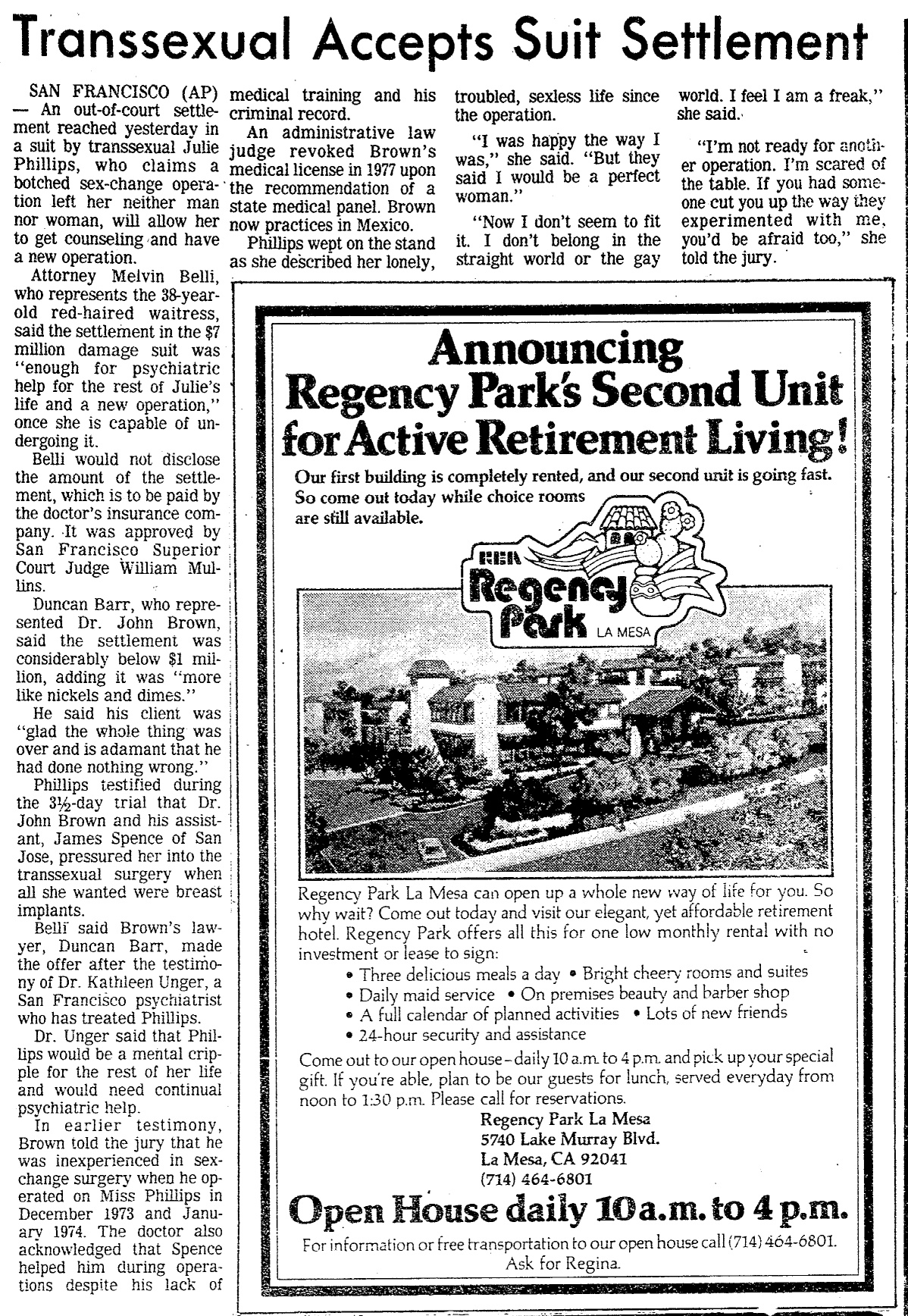
  • “Transsexual Accepts Suit Settlement”. San Diego Union, March 2, 1979. Online.
  • “Case Settled in Sex Change”. The Town Talk, Mar 3, 1979.

------------

Melvin Belli’s clients included Mae West, Errol Flynn, Lenny Bruce, Zsa Zsa Gabor, Muhammad Ali, Jim Bakker, Sirhan Sirhan, Jack Ruby. He specialised in representing individuals in personal injury cases and in raising personal injury awards to then-unprecedented heights that earned him the title of “The King of Torts” by Life Magazine writer Robert Wallace in a 1954 profile. 

None of the newspaper accounts said so, but I assume that Belli was working on a no-win, no-fee basis.

Duncan Barr was the youngest person (32) ever to join the American Board of Trial Advocates. He became notorious in the 1980s when he defended a blood bank against hemophiliacs who had cought AIDS through blood transfusions.

26 July 2021

Paul Walker psychologist - Part II: San Francisco

Continued from Part I.


In 1980 Paul Walker resigned from the UTMB and moved to San Francisco. He lived on Castro Street, and had an office at 1952 Union Street. He was now openly gay, and specialized in helping trans patients. His official diagnosis for trans patients was usually "anxiety" to keep it private and confidential until the patient began the real life test.


The Janus Information Facility (JIF) moved with him. One of the volunteers at JIF was Lou Sullivan - JIF’s first and only FTM member who did peer counselling and answered correspondence. There were very few out androphilic trans men at that time, and to Walker Sullivan could talk about his sexuality. They would also flirt with each other. Sullivan’s 1980 guidebook, Information for the female to male cross dresser and transsexual, and its later editions were distributed by JIF. Walker was added to the Board of Directors for the Stanford Gender Dysphoria Program, where he learned that Norman Fisk had once made a public announcement that he would never approve a gay FTM for surgery.

The sex offender treatment program in Galveston had been privatized after Walker left. The University of Texas Medical Branch continued its gender program - 121 trans women were operated on 1972-1992, and it is still in operation. The clinic embraced the HBIGDA Standards of Care when they were published in 1979, although they rejected candidates whom they regarded as ‘homosexual’ despite the SoC saying such are not to be excluded. It published a summary of its work in 1995.

In 1981 Walt Heyer, 40, a married transvestite on the down low and a regular at the Roadrunner Bar in San Francisco’s Tenderloin, gained Walker's name from the grapevine and came as a patient. Walker recognized Heyer, having seen his female persona in the Roadrunner.  According to Heyer’s account, at the end of the first session Walker diagnosed gender dysphoria, and in the third session gave Heyer a letter recommending trans surgery. This despite the Walker co-authored Standards of Care which required two such letters and at least one year of cross-living before surgery. Heyer actually went to Trinidad, Colorado and saw Dr Biber, but chickened out. In 1983 Heyer again gained approval from Walker, and again went to Trinidad. This time she went through with it and became Laura Jensen.

Walker was interviewed for the 1985 HBO documentary What Sex Am I?. He mentioned that for some, “It is better to have a medical problem than a moral or psychological problem”.


Dr Walker was recommended by the syndicated newspaper agony aunts, Anne Landers and Abigail Van Buren, and that is how airline pilot Sarah came to him for counselling in the mid 1980s. She commented: 

“I unfolded the grimy column, and he ruefully said that whenever she did that he was flooded with two or three thousand phone calls. Glad I had my dime handy early. Dr. Walker was indeed a recognized expert in the field of gender, but it still took three or four years for him to dismantle the straw man the military had done so much to create. When I first dragged myself across his threshold, I had never met anyone who had so much as contemplated gender reassignment, much less undergone it, and I was about as inclined to embrace the idea as nuclear waste. What I had imagined was some secret shrink voodoo that would excise this strange zit on my psyche, and restore me with a spasm of relief to the self I imagined myself to be. Instead, most of that lengthy therapy was spent slowly hammering down walls of guilt and shame. It’s remarkable how little attention was required to resolving the question of gender once that was done. I’m sure it’s always like that, and how I hope that some young teen reads these stories and has the sense to sidestep those twin distractions.”

In 1985 Sullivan asked Walker to help get him approved at Stanford, but he was rejected anyway. There were intimations that Walker would give a paper on gay FTMs at an HBIGDA convention but it never happened. Sullivan was disappointed in Walker’s reluctance to advocate on the issue. 

“Walker still felt that the homophobia of his fellow gender professionals needed to be challenged, but claimed that what they needed was a “squeaky clean” test case—and that Lou would not do because of his sexual history. Lou argued that he had “felt and acted consistently as a gay man,” regardless of those with whom he had had relations. But Walker wanted a gold star fag, or an FTM who had only ever had sex with cisgender men, and preferably no vaginal sex.” (Brice: 144)

Surgeon Michael Brownstein had been operating on trans men since 1978. He knew nothing of any Standards of Care - he simply provided plastic surgery as requested by his patients. Sullivan contacted Brownstein in 1986 and was arranging for a metoidioplasty. Walker contacted Brownstein and “scared the hell out of him for not following protocol”. After that he required referrals for his trans patients. Walker finally came through for Sullivan by providing a referral.

In 1987 Walker returned from the 10th HBIGDA convention which was held in Amsterdam with the news that Louis Gooren had reported gay FTMs at Amsterdam support groups. This opened a door and other sexologists finally admitted that they too had met such mythical creatures.

Shortly after, Sullivan was diagnosed as HIV+. Walker responded compassionately and their friendship was renewed. Walker’s husband was likewise diagnosed the following year, and Walker himself shortly afterwards.

Laura Jensen, now five years after her transition, having accepted Jesus Christ and become involved with Alcoholics Anonymous (AA), increasingly felt that she had made a mistake. Jensen made an appointment with Walker. Walker responded to her claim of four years of sobriety, by admitting that he too was in a 12-step program, that he had been addicted to drugs and alcohol after a ski accident, and that he was HIV+. He later wrote to Jensen (who was returning to being Walt Heyer) that therapists should address alcohol and drug issues before moving on to gender issues. He assured Jensen/Heyer “that I share, as best I can, some of the pain that this mistake has caused you”. Heyer seized onto the word “mistake”, and has since built a career as a campaigner against transgender surgery.

Christopher Barrett was a patient at the Stanford Gender Identity Clinic in the late 1980s, and the co-ordinator, Judy van Maasdam, arranged an appointment with Walker 

“who I found to be a very sincere, likable man. As it turned out, he was winding down his consultative services with that program, yet I was lucky enough to meet with him before he left.”

Both Paul Walker and Lou Sullivan died in 1991 of AIDS complications. The work of the Janus Information Facility was picked up by J2CP Information Services run by Jude Patton and Joanna Clark/Sister Mary Elizabeth.  1991 was also the year that Walt Heyer completed detransition. 

*Not the actor nor any of the footballers, nor the judge.

--------------------

In the 1950s and 1960sh, there was a much repeated typology of homosexual, transvestite, transsexual.  It seems to have been implicit that the three types were mutually exclusive.   In particular several GICs and surgeons rejected 'homosexuals'.    Stanley Biber as late as the 1970s was quoted: 

"First, patients must pass at least two psychiatric evaluations ensuring that they're not homosexuals or transvestites or simply people seeking fame and fortune on the talk-show circuit. True transsexuals, Biber says, are not attracted to members of the same sex and do not become aroused by wearing clothes of the opposite sex. True transsexuals consciously and subconsciously believe they are members of the opposite sex, trapped in the wrong body. "

 Above we mentioned that the  The University of Texas Medical Branch also rejected 'homosexuals'.

Against this, Benjamin's Scale, 1966, had specified that a High Intensity Transsexual, Type VI was a Kinsey 6 which means Androphilic, which means 'homosexual' while still pre-op.  Now in his actual chapter, "The Male Transssexual', Benjamin did not stick to his scale said, and allowed Kinsey 4 persons to be a Benjamin VI.  

Robert Stoller declared Primary Transsexuals to be 'homosexual'.

More definitive was the HBIGDA SOC, 1979, clause 4,3,1:

"This definition of transsexualism is herein interpreted not to exclude persons who meet the above criteria but who other­wise may, on the basis of their past behavioral histories, be conceptualized and classified as transvestites and/or effeminate male homosexuals or masculine female homosexuals."

GICs and surgeons continued to reject androphilic trans women. 

The general practice among psychiatrists and sexologists was to use the expression 'homosexual transsexual' for a heterosexual trans woman.   Presumably a heterosexual trans man should also have been so designated, but in practice was not.

I presume that the UTMB GIC  and Biber meant pre-op-androphilic trans women when it said that it rejected candidates whom they regarded as ‘homosexual’.     

Lou Sullivan, contrarywise, was an androphilic trans man.   He had not been a lesbian.  There is a confused logic operating here.  In the sense that Sullivan was gay, so was Laura Jensen/Walt Heyer - who was gynephilic.  So - in this post-op sense - why were gay trans men rejected and gay trans women accepted?   I suggest it was the same reason that female couples but not male couples are found in heterosexual pornography.  And why most law codes in decades past criminalised gay men but not gay women.   Trans women who have a male lover before transition are 'homosexual', and trans men who have a male lover after transition are both considered 'homosexual', and both are rejected.   Trans women who have a wife before and a girlfriend after are somehow not regarded as 'homosexual'.   Trans men who transition and get a girlfriend are also not 'homosexual' - but doing what the doctors expect them to do.

---

No explanation has been offered for why Walker abandoned his own SoC for Heyer, other than that he had seen Heyer in a queer bar.  It was a standard complaint of trans women who had been living as female for - in some cases - multiple years, that the clock on the "Real Life Test" did not start until they were registered at a GIC.   In such cases it was reasonable to not require a further "Real Life Test".   But that did not apply at all to Heyer.   Oscillation, especially if done on the down low does not apply.  

None of the sources that I read tells whether Heyer arrived for the appointment with Walker in female clothing.   I suspect not.  In which case Walker's diagnosis is all the more strange. 


  • “Can the Army Tolerate a Soldier Married to a Transsexual?”. The Dispatch, Jun 18, 1977. Online
  • “Uncommon Marriage”. Pensacola News Journal, 26 June 1977: 18. Online.
  • Nicholas Ghosh. “Tribute to Paul A. Walker”. Gender Review, December 1978. Online.
  • Jane Brody, J. “Benefits of transsexual surgery disputed as leading hospital halts the procedure”. New York Times. October 2,1979. Online.
  • Kathy Thomas. “Psychologist says no cure exists for habitual rapist”. Galveston Daily News,April 20 1981.
  • Lee Grant (dir). What Sex Am I?. With Christine Jorgensen, Paul Walker. US HBO 60 mins 1985. Review.
  • Lou Sullivan, “Dr. Paul Walker Returns to Address the TV/TS Community,” FTM 12 (June 1990).
  • Dallas Denny. “Paul A. Walker”. Chrysalis. Online.
  • Lawrence Wright, “The Case for castration”. Texas Monthly, May 1992.
  • Gordene Olga MacKenzie. Transgender Nation. Bowling Green State University Popular Press, 1994: 20, 68, 78.
  • Susan Stryker. “Portrait of a Transfag Drag Hag” in Stephen Whittle & Kate More (eds). Reclaiming Genders: Transsexual Grammers at the Fin de Siecle. Cassell, 1999: 72, 76.
  • Joanne Meyerowitz. How Sex Changed: A History of Transsexuality in the United States. Harvard University Press, 2002: 257-8.
  • Deborah Rudacille. The Riddle of Gender: Science, Activism, and Transgender Rights. Anchor Books, 2005: 176.
  • Christopher Barrett. “A Committed Journey” in J Ari Kane-Demaios & Vern L Bullough (ed). Crossing Sexual Boundaries. Prometheus Books, 2006: 108
  • Walt Heyer. Trading My Sorrows.Xulin, 2006: x, xi, 56, 62, 86, 117 .
  • Walt Heyer. Perfected With Love. Xulon, 2009: 28, 75.
  • Brice D Smith. Lou Sullivan: Daring to be a Man Among Men.Transgress Press, 2017: 68, 97, 111, 124, 138, 140, 144-7, 150, 157, 159, 164, 185, 197-8, 216.
  • Ryan T Anderson. When Harry Became Sally: Responding to the Transgender Moment.Encounter Books, 2018: 87-91.
  • Martin J Smith. Going to Trinidad: A Doctor, a Colorado Town, and Syories from an Unlikely Gender Crossroads.BowerHouse, 2021: Passim.
  • Oakleigh Marshall Reed. Evaluating the effectiveness of a transgender-affirmative care training on healthcare workers’ and trainees’ attitudes toward and knowledge of routine care and transition support for transgenderindividuals. PhD Thesis, University of Montana, 2021: 23, 24, 28.

PipiWiki               EN.Wikipedia

22 April 2018

Charlotte McLeod (1925 - 2007) Part II: fame and marriage

Part 1: Youth and Copenhagen
Part II: fame and marriage
Part III: The geography of Charlotte McLeod in New York, 1957

Charlotte was offered night-club appearances. A reporter, who worked at the National Press Club and normally wrote religious articles, proposed to do a book on her, and put her up in a hotel in Washington, DC while they worked on it, but it was never finished, and he ran out of money.

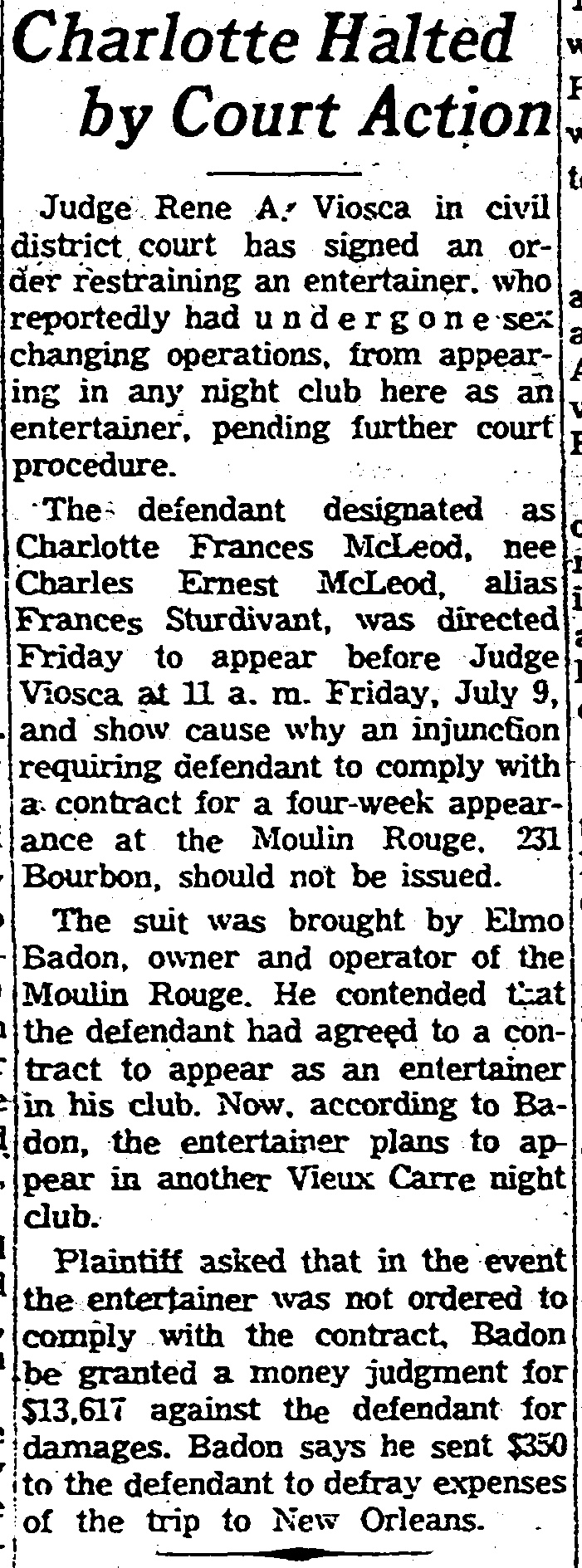
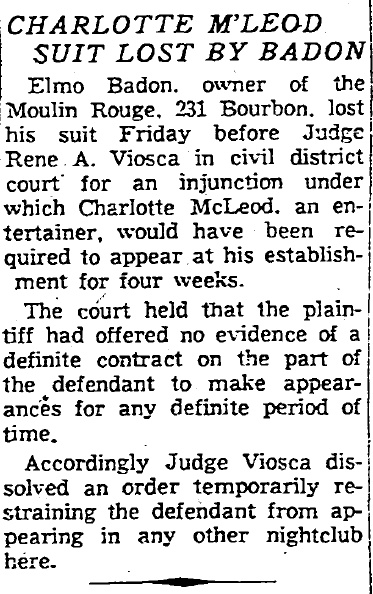
She took a gig in New Orleans, but found that the contract was with a strip club.
“And right across the street was a very, well the nicest club on the street. No hard bumps and grinds and strips and all that kind of thing. And to get me out of the verbal contract the owner paid for me going to court. And the next thing I am sitting up in front of the judge. I never will forget, I had a great big felt cart wheel hat on. Couldn’t sit on the seat because the cart wheel hat hit the back and I had to take my hat off. I don’t know why I should remember that. In that day and time ladies wore their hats. And he released me from the contract and I went across to the Show Bar, which was the nicest club on the street.” (Stryker:26)

A dancer-comedienne called Cupcake wrote material for Charlotte:
“ I’ve been to many places, environments strange, and then I went to Denmark, just for a little change”.
Then she moved on to the Casino Royal in Washington where she was backed by a band. She had become a member of the American Guild of Variety Artists, and was represented by Miles Ingles who was also the agent for Cyd Cherise and Polly Bergen. One time she appeared on stage in between Gypsy Rose Lee and Mae West. She also did modeling. Charlotte met Christine Jorgensen once when they were both appearing in New Orleans.

In August 1955, Charlotte had breast implants with New York plastic surgeon, Else La Roe (1918 – 2006).

In 1956 she wrote a brief autobiography for the Mr Annual, in which she claimed that her condition was physically caused, and that 95% of transsexuals should have psychiatric treatment.

Dorothy at the all-night beauty salon
Charlotte worked as a secretary and then as a receptionist at an all-night beauty counter.

She was becoming annoyed by star reporter and television personality, Dorothy Kilgallen.
“I got tired of Dorothy Kilgallen chasing me around and writing things about me that I have never thought of doing. And I went to her house [45 E 68th Street] one day and knocked on her door and the butler recognized me, it was strange, he said, ‘aren’t you Miss Charlotte?’ And I said, yes. And he said, don’t go away. I said, well I have no intention, that’s why I’m here. So I met Dorothy. And I said, well Dorothy, I’m tired of this, this business and I need a job. If you’ll help me get a job, I’ll tell you anything you want to know. Her husband is Dick Kollmar a Broadway producer, and he owned the Left Bank Club. He owned a little French restaurant and bar right across the street from Madison Square Garden. And in that day and time, the hat check and cigarette concession could make you a decent living. So they were most pleased to get me to be the hostess and hat check girl. The main thing that’s fun, I met everybody that ever was in show business.” (Stryker: 28)
This was 1957. It was while working at the Left Bank Club that Charlotte met Harry Benjamin, who came in as a customer. He became her physician, and also would take her out to lunch and introduce her to such conservative activists such as William Buckley as well as film stars.

Charlotte was living at the Washington-Jefferson Hotel on West 51st Street.  Ralph Heidal, whom she had met in Bergen, had stayed in touch by mail. They ran into each other in Maxie’s, a bar close by. He offered to take her away.

In 1959, Christine Jorgensen had been denied a marriage license by a clerk in New York City, on the basis that her birth certificate listed her as male; Jorgensen did not pursue the matter in court.

Charlotte in Miami 1959
Charlotte had been working in Miami, first as a secretary, then demonstrating cosmetics. After some months, Charlotte and Ralph, having become regulars at a Miami church, were married there in November. She did not mention her birth gender, however, or the fact that she was still legally a male. Press interest was aroused, but the Florida authorities confirmed that the marriage was not in violation of state law.

Dorothy Killgallen had contacts in Miami as everywhere, and their wedding was featured in her column.

A few months later, Mr and Mrs Heidal moved to California. They lived in Berkeley, then Oakland and then Marin County. Charlotte reconnected to Harry Benjamin who spent his summers in San Francisco. He introduced her to trans women Aleshia Brevard and Kathy Taylor who had been friends since their days at Finocchio’s nightclub, where Kathy performed as Stormy Lee.

Mrs Heidal’s marriage to her husband lasted seven years.
“And bless his heart, he couldn’t do a darn thing but drive a steamship around the world. Never did teach that rascal to drive a motor car. In fact, that’s why we broke up. I had visions of a little cottage on the side of Mt. Tamalpias. And oh how we did love it. But Ralph didn’t find a job. Everything he knew was diesel, whatever made steamboats run. I took him to every plant in Northern California trying to find a job for him. And finally, I got the proverbial Dear John letter. He said it was how it is every year we had to write but unless I was willing to go back to New York, where he was perfectly happy. And we would have to part company and I wouldn’t go back to New York.” (Stryker:31)
Dorothy Kilgallen died in November 1965 at age 52 after ingesting alcohol and barbituates. Some say that she was murdered (more) for digging into the Kennedy assassination – her folder of documents on the case had disappeared and was never seen again.

After her divorce, Charlotte moved to Laguna Beach, south of Los Angeles, because she had friends there. She got a job as a receptionist at a beauty salon. Charlotte arranged to have vaginoplasty:
“I was living at Laguna Beach. And a little Japanese doctor did it. And there was some instrument that he had to have, I think. He was under the impression that he could use the same instrument on me that he could on a normal woman that needed that surgery done. Well he did and perforated my colon. And I had to go to Stanford to have the colostomy to repair his work and while I was there I stumbled on Dr. Donald Laub [head of the Sexual Identity Unit]. Oh, me. What a to-do that was.” (Stryker:22)
One of the beauticians mentioned that her brother-in-law had lost his wife to suicide. They were introduced and started dating. He was a military officer with two children, eleven and twelve. The kids started calling her Mom.

On 8 August 1969 she was visiting Kathy in Los Angeles where they could see a commotion across the canyon that turned out to be the aftermath of the murder of Sharon Tate and 3 others by members of the Manson Family.

The military officer asked Charlotte to marry him, but something had to be explained first.
“In fact, it was Cathy who went to him and explained to him the situation because we had debated. He hadn’t the vaguest idea. And I knew, if he hadn’t already asked me to marry him, Cathy said, let me see if I can help. And she went and talked to him. And Cathy’s husband did not take it so well. In fact, he was very belligerent when he did find out.” (Stryker:41) [Cathy=Kathy of course.  Aleshia Brevard, who knew her, spells it with a 'K'.   The transcription of the interview spells it with a 'C'.]
Charlotte and the military officer were married in Las Vegas in 1970 – this time with no press attention. Again the marriage lasted seven years.

Return visits to the Stanford clinic and Dr Laub created problems when her husband went with her.
“And that really ruined my marriage with my second husband. We were going up and stopped by for a chat with him. And we went in and Donald had started, he was so very selective, very selective. He had a Gorgeous George sitting in there with tattoos all over him.” (Stryker:44) “He did ruin my marriage. My husband saw me in a different view from what he had in mind.” (Stryker:45)
After the end of her second marriage Charlotte moved back to Dyersburg, Tennessee to look after her ageing mother. She stayed in touch with her step children. The son died in middle age without finding out about Charlotte’s past; at the turn of the century, Charlotte was very sick and wrote to tell the daughter on her own terms in that it would come out if she died.  That daughter has had children, and thus Charlotte became a grandmother.

++Charlotte remained in Dyersburg, and died at age 82.   Her passing was not noticed by the press, which probably would have been to her liking.

*Not the mystery writer, nor the character in the television show, McLeod’s Daughters.
_________

The Washington-Jefferson Hotel is still in business. Its rooms are now $126 a night and up. Charlotte says: it “was a place for retired show people who lived there” which probably means that even after adjusting for inflation it was cheaper in 1957, particularly if you paid by the month.

Aleshia Brevard in The Woman I Was Born to Be, 2010, p48 writes:

This is quite different to what Charlotte said, whereby the wedding was after the confrontation at Kilgallen’s apartment, and the husband was certainly aware of Charlotte’s past before he married her.

Tina Thranesen gives the name of the New York plastic surgeon as Rachael LaRoe; Joanne Meyerowitz gives it as Else La Roe. I have gone with the latter.

In the Stryker interview it sometimes becomes confusing about when things are happening. I have placed the vaginoplasty operation just before Charlotte met her second husband because she says that she was living in Laguna beach at the time, and Donald Laub was not at the clinic at Stanford until 1968.

Charlotte says that she was already married when she observed the Tate killings from a distance, but that happened in August 1969, and she also says that the wedding was in 1970. Time does affect our memories. (Stryker: 38-9)

The Wikipedia page on Dorothy Kilgallen says nothing at all about Charlotte. Likewise Lee Israel’s 1979 biography, Kilgallen. Likewise Mark Shaw’s The Reporter Who Knew Too Much: The Mysterious Death of What's My Line TV Star and Media Icon Dorothy Kilgallen.

There is something missing from the source documents:  Dorothy Kilgallen's articles about Charlotte are not online.  The collection of newspaper articles found at TransasCity is very good, but does lack this component.

Trivia: Dorothy Kilgallen was at 45 E 68th Street; Harry Bemjamin’s office was only a block away at 44 East 67th St.


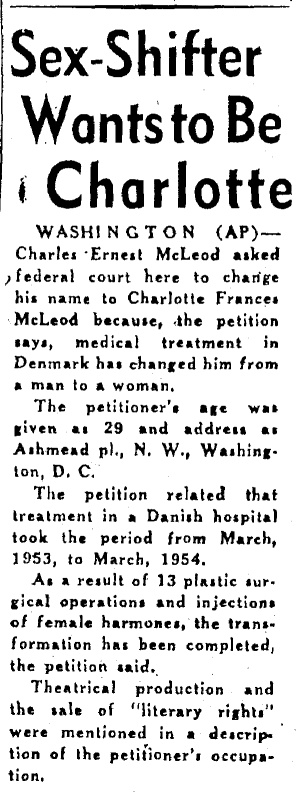
  • “Sex-Shifter Wants to be Charlotte”. Boston Daily Record, June 15, 1954: 4. Online.
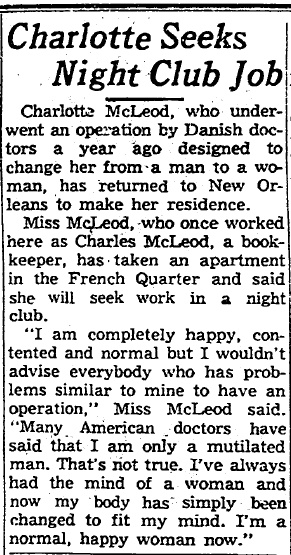
  • “Charlotte Seeks Night Club Job”. New Orleans Times Picayune, June 24, 1954: 8. Online.
  • “Charlotte Halted by Court Action”. New Orleans Times Picayune, July 4, 1954: 11. Online.
  • “Charlotte M’Leod Suit Lost by Badon”. ”. New Orleans Times Picayune, July 10, 1954:1. Online.
  •  Charlotte Mcleod.  “I Changed My Sex”. Mr Annual. Winter 1956. 
  • “Sex-Changed Ex-GI Becomes Miami Bride. UPI, Nov 13, 1959. Online.
  • “Bride Revealed as Forner GI”. San Diego Union, 11/14/1959: A3. Online.
  • Joanne Meyerowitz. How Sex Changed: A History of Transsexuality in the United States. Harvard University Press, 2002: 82-3, 84, 89, 91, 148, 304n93.
  • Susan Stryker interviews Charlotte McLeod, transcribed by Loren Basham. GLBT Historical Society, August 22, 2002. PDF.
  • Aleshia Brevard. The Woman I Was Born to Be. A Blue Feather Book, 2010: 5, 48.
  • Brittany Shammas.  “Five Moments in Miami’s LGBTQ History, From 1937 to 2015”.  Miami New Times, March 12, 2019.  Online.  

TransasCity Collection       Vidensbanken om konsidentitet

23 August 2016

Alice Lyman Miller (1944 - ) intelligence analyst, academic

Harold Lyman Miller grew up in rural western New York state, where as a young teenager he would take a dress when fossil hunting in the wild.

Then he put away childish things and set out to prove his manliness. He played high-school basketball, chased girls, did a BA in Oriental Studies, 1966 at the then all-male Princeton University, and a PhD in history at George Washington University, DC, 1974, and married.

A fluent Mandarin speaker, Miller worked as an analyst of Chinese foreign policy at the Central Intelligence Agency 1974-1990. His second wife was also a CIA analyst. They had a son and a daughter.

From 1990-2000 he worked as professor of China studies and for most of that period, director of the China Studies Program at the School for Advanced International Studies, Johns Hopkins University (which, unlike the rest of Johns Hopkins, is located in Washington, DC).

Not until he was 52 did Miller catch an episode of the Phil Donahue show on TV about transsexuals and realize that was what he was. He also discovered the book True Selves: Understanding Transsexualism by Mildred Brown. Miller discussed his feelings with his second wife, and started wearing female clothes.

Approaching 60, Miller got a new position as a visiting fellow at the conservative think tank, the Hoover Institute at Stanford University, Palo Alto, California, and also as senior lecturer at the U.S. Naval Postgraduate School in Monterey, California.

At the urging of the wife, Miller consulted local gender counselor Judy Van Maasdam, the co-ordinator at Stanford’s Gender Dysphoria Clinic. Alice, as Miller became, underwent 250 hours of electrolyis and in total spent over $100,000 transitioning. She was able to transition on the job in both positions. Both institutions had had previous employees transition.

Alice had surgery at the Sequoia Hospital in Redwood City, California in August 2007.

In May 2015, Alice gave a talk on transition at the TEDx event at Stanford University.

*not Alice Miller the child psychologist
  • Harold Lyman Miller. Factional Conflict and the Integration of Ch'ing Politics, 1661-1690. Phd thesis, George Washington University,1974.
  • H. Lyman Miller. Science and Dissent in Post-Mao China: The Politics of Knowledge. University of Washington Press, 1996.
  • Alice Lyman Miller. "Some Things We Used to Know About China's Past and Present (But Now, Not So Much)". Journal of American-East Asian Relations. 16, 1, 2009: 41-68.
  • Alice Lyman Miller & Richard Wich. Becoming Asia: Change and Continuity in Asian International Relations Since World War II. Stanford University Press, 2011.
  • Tracie White. “Transition Point: The Unmet Medicak Needs of Transgender people”. Stanford Medicine, Spring 2012. http://sm.stanford.edu/archive/stanmed/2012spring/article7.html.
  • Stacy Trevenon. “The importance of being Alice: Moss Beach woman embraces transition”. Half Moon Bay Review, June 24, 2015. www.hmbreview.com/community/the-importance-of-being-alice/article_2a66a04c-1aa9-11e5-af30-af09569bfe4b.html.
EN.Wikipedia     HooverInstitute    
_____________________________

The EN.Wikipedia article on Alice has no mention at all of her gender change despite the fact that she is quite open about it. Nor does it list her first two books.  The page was written by the now blocked author Occultzone

Amazon has H Lymon Miller and Alice Miller as two separate authors.

It is ironic that Miller spent 10 years at Johns Hopkins University without being aware of its pioneering gender clinic.


05 April 2014

Joan Roughgarden (1946 - ) evolutionary biologist.

Jonathan Roughgarden was raised in New Jersey. He did a BSC at the University of Rochester, and a PhD at Harvard, both in Biology. He taught at Stanford university from 1972, and did field work studying Caribbean lizards.

The last book as Jonathan was Primer of Ecological Theory, 1997. In 1998, at the age of 52, Jonathan came out as transsexual.
"It became clear to me that I wasn't ever going to figure out how to do the guy thing. Imagine as a woman if you'd set out to be a man, to learn how to live as a man. Could you do it? I couldn't. It's like asking a fish to fly."
She took a sabbatical and returned as Joan. She soon noticed how she was now much more frequently interrupted, ignored and condescended to by men.   At a meeting of the Ecological Society of America in Minneapolis a prominent expert jumped up on the stage after her talk and started shouting at her. Once every month or two, she said, ''I will have some man shout at me, try to physically coerce me into stopping …When I was doing the marine ecology work, they did not try to physically intimidate me and say, 'You have not read all the literature.' “

Undeterred by this, she ran for San Francisco's District 6 Supervisor in 2000.

In 2003 gay neurobiologist Simon LeVay had a temporary position at Stanford, and invited both Roughgarden and North American Man Boy Love Association to address the same class under the title 'minority sexualities'. She declined in that "being transgendered was not an expression of sexuality". He rescheduled her but spoke for 45 minutes giving what she could only regard as "an appallingly incorrect account of presumed biological bases to gender differences".

Roughgarden was one of many trans academics who was appalled by Michael Bailey's The Man who Would be Queen, 2003, and wrote a critique of it:
"From a transgender perspective, Bailey's claim that all transgendered women match one of these two profiles is clearly counterfactual. Many transgendered women come out late in life and yet are sexually oriented to men, many come out early in life and yet are oriented to women, many who are oriented to women are attractive nonetheless, many have changed direction of sexual orientation when they transitioned, many are bisexual, and many are not sexually active. Transgendered women also encompass heterogeneity in occupation, presentation, temperament, sexual history, and ethnicity. Furthermore, transgendered people are not as fixated on sex as Bailey evidently is. The need to locate in the social and occupational space of one's gender identity, to live as a woman, is a stronger motivation for many transgendered women than is attaining sexual pleasure. … Bailey has no data, none at all. He offers no surveys, no data tables, no statistics, nothing. He doesn't give the sample size for the 'study' he refers to occasionally. No references are offered to primary literature either. Six transgendered people are mentioned by name (pseudonym). Bailey did not take detailed and rigorous notes when interviewing these subjects, and relies on his recollection of their meetings. This sample is highly non-representative because the women he interviewed he met while 'cruising' (p. 141) in 'the Baton, Chicago's premier female impersonator club,' (p. 186) leading to an occupational and socio-economic bias."
Roughgarden's next book was to be published by Princeton University Press, but she found that they were using LeVay as a reviewer and that he wanted the critical material about the search for a gay gene removed and in fact that he wanted "to reduce my book into a David-Attenborough-like nature book about gay animals, related by a transgendered woman". She moved her book to the University of California Press where it came out in 2004 as Evolution’s Rainbow. It argues for a correction to Darwin’s theory of sexual selection taking into account the varieties of gay and trans behavior found in most species. It also puts transgender behavior in the context of traditional alternate gender roles in traditional societies, and evaluates the estimated statistics. It argues for social selection rather than the Darwinian sexual selection oriented on the selfish gene, competition and deception. She further developed this approach in The Genial Gene, 2009.

Roughgarden is also a Christian and has written on the relationship between Christianity and evolution.

She retired Emerita in 2011, and moved to Hawai'i where she became an adjunct professor at the Hawai'i Institute of Marine Biology.
  • Carol Kaesuk Yoon. “A Theorist With Personal Experience of the Divide Between the Sexes” The New York Times, October 17, 2000. www.nytimes.com/2000/10/17/science/17ROUG.html.
  • Joan Roughgarden. "Making connections re psychologist Simon LeVay". Email to Lynn Conway, 11 Jul 2003. http://ai.eecs.umich.edu/people/conway/TS/Bailey/Joan-re-LeVay.html.
  • Joan Roughgarden. The Bailey Affair: Psychology Perverted. February 11, 2004. Online at: http://ai.eecs.umich.edu/people/conway/TS/Reviews/Psychology%20Perverted%20-%20by%20Joan%20Roughgarden.htm.
  • Joan Roughgarden, Evolution's Rainbow: Diversity, Gender, and Sexuality in Nature and People. University of California Press, 2004. Awarded 2005 Stonewall Prize for nonfiction from American Library Association. Chapter 1 online at www.ucpress.edu/books/pages/10139/10139.ch07.html
  • Steven Kotler. “Oh So Natural: Sexual selection, the Good Book and why gay is good”. LA Weekly: Art + Books. April 15. 2004.
  • Antony Thomas (dir & scr). Middle Sexes: Redefining He and She. With Louis Gooren, Anne Fausto-Sterling, Milton Diamond, Alice Dreger, Joan Roughgarden, Calpernia Addams, Andrea James. USA/UK 74 mins 2005.
  • Joan Roughgarden, Evolution and Christian Faith: Reflections of an Evolutionary Biologist. Island Press. 2006.
  • Joan Roughgarden. The Genial Gene: Deconstructing Darwinian Selfishness. Berkeley: University of California Press, 2009.
  • Shankar Vedantam.  “How the sex bias prevails”.  The Age, May 15, 2010. 
EN.WIKIPEDIA   IMDB   WORLDCAT   AMAZON


___________________________________________________________________________

Joan's website used to be http://joandistrict6.com.  However that is now a site in Japanese.

The history/anthropology chapters of Evolution's Rainbow are perhaps not as good as the biology chapters.   For example the section on ancient Greek/Roman sexuality is based on Kenneth Dover alone.   This is a very large topic and Dover's major virtue is merely his early date.

For some reason LeVay is not mentioned in Evolution’s Rainbow.

In WorldCat Jonathan's books are listed as by Joan, but in Amazon they are treated as two different people.

Ben Barres, a physicist, also at Stanford, transitioned in the other direction at around the same time.  He commented on how he was interrupted, ignored and condescended to by men less often.   The contrast was explored in several newspaper articles.

11 November 2013

Holly Ahlberg (1934–) photographer, artist.

Ahlberg was born in Riga. The family lived in German-occupied Poland 1939-45, and then in West Germany until 1952.

After emigration to the US Ahlberg served in the US Army, and lived in New York and Los Angeles, married and became an advertizing photographer.

In the early 1970s, Ahlberg became Holly, divorced, and was accepted at the Stanford University Gender Clinic. However she chose not to have the operation. In 1975 she informed her clients of her change, and lost only a few of them.

She retired in 1985 and has become an artist. In 2013, using Google Earth, she found a previously unknown archaeological site in the Atacama Desert, which has provisionally been named Nuevo Albergis.

03 November 2009

Steve Dain (1940 – 2007) gym teacher, FTM pioneer.

Doris Richards attempted marriage as a woman, but it did not work.

Later, while working as a girls’ gym teacher in Union City, California, he transitioned to male at age 35, with surgery from Dr Donald Laub at Stanford Gender identity Clinic.

Steve lost his job and went to court. He was briefly a media topic, but the very next day the Renée Richards story pushed him off the front page.

Eventually he won a court ruling that he could teach again, but was not able to find a school that would hire him.

He worked setting ceramic tiles. He became a focal point for trans men in the San Francisco area, and helped other to follow him including Lou Sullivan, Jamison Green and Max Valerio.

He did eventually teach again in a community college.

He died of cancer at age 67.