This site is the most comprehensive on the web devoted to trans history and biography. Well over 1800 persons worthy of note, both famous and obscure, are discussed in detail, and many more are mentioned in passing.

There is a detailed Index arranged by vocation, doctor, activist group etc. There is also a Place Index arranged by City etc. This is still evolving.

In addition to this most articles have one or more labels at the bottom. Click one to go to similar persons. There is a full list of labels at the bottom of the right-hand sidebar. There is also a search box at the top left. Enjoy exploring!

Showing posts with label Le Carrousel. Show all posts

29 June 2023

Dolly Van Doll (1938 - ) performer

Dolly was born and raised in Turin. When she grew up she went to Paris, and eventually got taken on at Madame Arthur and then Le Carrousel. Her first love was with a man who told her that he was a baron. After he found that she was pre-op, he left her, but came back after a few days, and the affaire continued for almost five years. Also in Paris, she came to know Josephine Baker and Amanda Lear. Salvador Dali, a frequent visitor to Madame Arthur, especially liked to see a Dolly Van Doll show.

She had completion surgery from Dr Burou in Casablanca in 1964. She arrived without an appointment. The price was 1,200 Francs, but she had only 600. “I cried and despaired so much that they gave me the missing half.” (Barba p 364). Her off-stage name became Carla Follis. She was the first known Italian to have had the operation, and as with Coccinelle the Church re-issued her baptismal certificate in her new name. However it took another year to get all her papers changed.

She did six years in cabaret in Berlin. In 1969 she fell madly inlove with a man who worked at Siemens.  When the affair ended in 1971, she was hurt and took the first contract that came along – six months in Barcelona, even though she did not know where Catalonia was.


She arrived in Spain during the final years of the Franco dictatorship. Despite initially not speaking Spanish, and being assigned to a rather dingy nightclub, her talent and beauty filled the place every night. She was soon transferred to Barcelona de Noche, and became treated as a star. In 1973 Coccinelle came from Paris to perform with her. In 1974 she put on a show called Travesti with renowned comedian Alfonso Lusson.

She met the love of her life, Fernando. He took her all over Catalonia. They became partners.

Under the Franco dictatorship, sexual expression was repressed. “A vedette [star] would show a little piece of nipple and men would flock like flies; if two little hairs stuck out of the top of her panties, people would run to see her”. (Barba p368)


When Franco died in November 1975, Carla and Fernando were starting a month’s vacation in Sri Lanka. When they returned, things were already changing. Drag and even nudity were becoming visible, and Dolly realised that her act had become old-fashioned and it had to be revamped. She did so and then did a tour all over Spain. 

In 1976 she and her partner Fernando moved to Valencia to open their own venue, Belle Époque. They married shortly afterwards, and she stayed in Catalonia the rest of her life. Dolly was a businesswoman as well as a performer. She travelled to Tokyo, Paris and Berlin, observed kabuki, cabaret, lyric theatre and incorporated them into her show. In 1982 they opened a second Belle Époque in Barcelona. Her shows were broadcast on Catalan television as part of the New Year’s Eve gala. In 1988 she was in the film Entreacte, which was partly filmed at the Belle Époque. Shortly afterwards the Valencia venue was closed. The Barcelona one ran until 1995.

Carla and Fernando later divorced, but remained good friends.


In 2007 her biography, From a boy to a woman, by Pilar Matos was published.

  • Pilar Matos. De Niño a Mujer. Biografía De Dolly Van Doll. Arcopress Ediciones, 2007.
  • Stan Lauryssens. Dali & I: The Surreal Story. Thomas Dunne Books, 2008: 31.
  • Dolly Van Doll. “Dolly Van Doll, Turin, 1938” in David Barba. 100 españoles y el sexo. epublibre, 2009: 364-370.
  • Valeria Vegas. “Dolly Van Doll” in Liberate: La Cultura LGBTQ que Abrio Camino en España. epublibre, 2020: 91-4.
  • Luis Fernando Romo. “Dolly Van Doll: ‘Lo peor que me ha pasado es ser vecina de los Pujol’ ”. El Mundo, 26 enero 2020. Online.
  • “Dolly van Doll, pionera de la transsexualitat”. Betevé, 3 de maig del 2021. Online.

IMDB

------------

Most sites translate De Niño a Mujer as From a child to a woman.  While the Spanish word for a boy is chico, the word Niño is a male child and Niña is a female child. Surely the point of the book title is a boy becomes a woman, not that a child becomes an adult. 

Dolly gives the name of the 'baron' in Paris.  I googled it to no effect.  


26 May 2022

Pre-Stonewall Trans peer-support groups

Outside of Europe and the Americas peer-supporting trans groups have thrived for millennia, the Hijra in India and the Kathaoy in Thailand being the best known. Many of the First Nations across the Americas had two-spirit roles with community support, but were repressed by European colonialism. The major trans community in the Roman Empire was the Cybele worshipping gallae, but they were repressed in the 4th century with the Christianisation of the Empire.

This account is of the recovery of trans communities in Europe and North America.

Peer-support groups as we know them do not appear until after WWII, but earlier trans persons sought out each other at clubs and balls and in select publications, and also found each other in unexpected places like POW camps. The major Female Impersonation nightclubs are also listed here, even where cross-dressed customers were discouraged, in that there was often back-stage peer support and information exchange for the performers re clothing and makeup, and later hormones and surgeries.

See also Three Centuries of Police raids.

1709 onwards Molly Houses

A new development in the early 18th century was that of houses where queers, some of them transvesting, sought their own kind. Their dressing was distinctly different from the cis cross-dressing found in the masquerade balls, and their gender-role sexual activities were very different from the heteronormative sodomy that had been common until that time. 

1860s Fanny and Stella

Fanny and Stella were the best known of a circle of trans women who frequented fashionable places in and around London, until Fanny and Stella were charged with 'conspiring and inciting persons to commit an unnatural offence'. Sodomy was not proved, and their acquittal established that transvesting was not a crime in England. GVWW

1897 - 1917 Storyville, New Orleans

The District, a 38-block area, was designated as the part of the city in which prostitution would be tolerated. This had been proposed by Alderman Sidney Story and the area became known as Storyville. Miss Big Nelly was the Madam of a gay brothel. The Frenchman’s was a small jazz club which was popular with trans women. The District played an important part in the evolution of early jazz, and was an area where queer persons were more comfortable.

1914 - 1918 Prisoner-of-war camps

All-male POW camps had theatricals and needed persons to play female roles - some of whom stayed in role off-stage. A major example was the German officer Emmerich Laschitz held in the Siberian camp of Achinsk until 1920.

1919 - 1933 Institut für Sexualwissenschaft, Berlin

In addition to Magnus Hirschfeld’s general support for trans persons, some also lived at the Institut, of whom the best known are Dörchen Richter, Toni Ebel and Charlotte Charlaque.


1920s Club D’Eon in Berlin

A transvestite social club. Hirschfeld’s associate Felix Abraham was on the committee.

1922 - 1923 Eldorado, Berlin

Three dance halls opened sequentially and run by Ludwig Konjetschni, where trans persons were welcome. GVWW.

1923 - 1941 London Life

The major British publication between the wars that paid attention to cross-dressing and similar topics and printed readers’ letters on such. Google Books.


1923 - 1938 the Faggots’ Ball or the Dance of the Fairies at the Hamilton Lodge, Manhattan.

This became the most popular gay event in town, attended by both black and white queers, and also artists and writers. About 800 attended in 1925 and fifteen hundred in 1926. Growing numbers of spectators attended not to dance but just to gawk, particularly at those in dresses. Three thousand spectators in 1929 watched two thousand dancers, and in the next few years a total of up to seven thousand spectators and dancers attended. GVWW.

1926 DamenKlub Violetta, Berlin

Run by female transvestite Lotte Hahm.

1929 Transvestitenvereinigung D`Eon, Berlin

Founded by Lotte Hahm for both male and female transvestites. This was so successful that a few weeks later they had to find a larger meeting place. Later the Association had its own dance events at Violetta. Its events were reported in Die Freundin.

1930s - The Lady Austin Balls, London

Mainly “Hotel Staff Dances” in private ballrooms attended by domestic servants and hotel staff, mainly men, but many cross-dressed. In 1932 it was raided and 33 men and 1 woman were arrested. GVWW,

1933 - 1940 La Paloma Club, outside Miami

A club of which it was said that the clientele included “homosexuals in evening gowns, trousered lesbians, and prostitutes”. It acquired nationwide fame in1937 when it was raided by the Ku Klux Klan. It was finally closed on charges of under-age heterosexuality. GVWW.

1933 - 1999 Finocchio’s, San Francisco

The most glamorous of the US Female Impersonation clubs, popular with celebrities and with tourists. It ran for 66 years, and most professional drag artists appeared there. GVWW.


1935 - 1950s. The Finnie Balls, Chicago

Following the raid on the Cabin Inn, Alfred Finnie organized a small extra ball on the South Side at 25¢ to get in, mainly attended by blacks. Each year it grew, and by the 1950s Finnie’s Balls attracted thousands both gay and straight, black and white, and was featured in Jet and Ebony magazines. Apart from the balls, Alfred worked as a club doorman and street hustler. He was killed in a gambling brawl in 1943, but the balls continued in his name. GVWW.

1939 - 1945 WWII Prisoner-of-war camps

As in WWI, all-male POW camps had theatricals and needed persons to play female roles - some of whom stayed in role off-stage. A major example was Bobbie Spong in Changai camp, Singapore.

1939-1972 The Jewel Box Revue, touring US

The Revue toured for 30 years, was racially integrated and was the best known drag show of its kind in the US. GVWW.

Mid 1940s - 1975 The Phil Black Funmaker Balls, Manhattan

The precursor of the later Voguing balls. GVWW.

1944 - mid 1950s Soldiers-in-Skirts Revues, England touring

About the only option in England at the time where assigned males could wear female clothes outside their homes. You had to have some inclination, if not actual talent, towards singing and dancing, although you did not have to have actually served in the forces. The first such show was actually a US import, Irving Berlins' This is the Army, which played the London Palladium for four nights in 1944. The initial idea had been to put men into dresses to make them look dreadful, but that soon started to change because the audience liked the prettiest ones best - which much suited the performers.  GVWW.

1947 - 1985 Le Carousel and Madame Arthur, Paris

Two clubs owned by Marcel Ouizman. While originally the performers had been the type who changed to male clothing before leaving, increasingly they were replaced by trans women who lived as women full time, took hormones and went to Casablanca for surgery. They were a community that shared advice and support, and exchanged addresses of doctors and electrolysists. Hormones were available in pharmacies without a prescription at that time. They also toured five continents, bringing an inconceivable example to countries where transgender surgery was not at all available.

1946 - 1956 The Garden of Allah, Seattle. 1946-1956

Seattle's most popular gay cabaret and one of the first gay-owned gay bars in the US. Local talent was encouraged. Unlike Finocchio’s in San Francisco, local queers were encouraged to attend, and amateur night contestants were often encouraged to become performers. GVWW.

1945 - 1981 Marie Schwidenhammer, Paris

After release from a German concentration camp and a forced resignation from the French Army, Schwidenhammer started living as female. She obtained diplomas in para-medical specialities and practiced as a masseuse therapist nurse, mainly in Paris. She was in contact with most French transsexuals and transvestites. It was she who happened to meet La Carousel star Coccinelle by chance on a train, and informed her of hormones, and of the possibility of transition. GVWW.

1944 - 1978 Louise Lawrence, San Francisco

The mother of trans organizing in the US. She networked with the performers at Finocchio’s, the homophile Mattachine Society, and educated professionals Karl Bowman, Alfred Kinsey and Harry Benjamin, and put trans women in touch with each other. GVWW.

1949 -1972 Club My-O-My, New Orleans

A performance venue in the West End of the city on the edge of Lake Pontchartrain. This was far enough out to avoid city rules and police harassment. For several decades it was a popular tourist stop. In 1972 the building was destroyed in a fire.  White performers and audience only. 

1945 -1969 the Dew Drop Inn, New Orleans

Renowned for music, drag and cross-dressing by performers, bar staff and customers. Patsy Vidalia hosted the Gay Halloween Ball each year. Unlike Club My-O-My not racially segregated.

1946 - 1973 Justice Weekly

A Toronto Tabloid that was published weekly with accounts of international criminal trials, but also accounts of and letters from readers re homosexuality, cross-dressing and fetishism.


195? - 1963 Chevalier D’Eon Resort, NY State

A country home in the Catskills, owned by Susanna Valenti and her wife Marie. It was an isolated 150 acres with a main house, a barn and several snug but unheated bungalows. For $25 ($200 in 2022 money) a weekend visitor from the city got food and board and lessons in passing as female. Of particular note is the gathering there of 71 transvestites at Halloween 1962 dominated by Virginia Prince. GVWW.

1958 - 2008 Chez Nous, Berlin

A nightclub at Marburger Straße 14 in Charlottenburg, the oldest surviving Travestietheater in West Germany. It was featured in the Michael Caine/Harry Palmer espionage film Funeral in Berlin, 1966. GVWW.

1959 - 1967 National Pageants, 1959, US touring

Jack Doroshow/Flawless Sabrina, drag performer and organizer of pageants. Through his company, The Nationals Academy, Jack organized 46 pageants a year from 1959-1967. As local laws almost always prohibited cross-dressing, he would meet with officials and propose a charitable donation, and in return the town would pass a variance to permit the pageant. Usually the town officials did not understand that local people would be performing. The 1967 finals held in New York was a much bigger affair. The Muscular Dystrophy Association was announced as the charity, and Lady Bird Johnson, the President’s wife, and Robert Kennedy as co-sponsors, but they quickly dropped out as the nature of the event became clearer. The event was filmed as The Queen, 1968, which was a sensation at the Cannes International Film Festival. GVWW.

1959 - 1986 Transvestia Newsletter

Published by Virginia Prince and sold by subscription and later in adult book stores. It would become influential in introducing heterosexual transvestites to each other.

1960 Hose and Heels Club, Los Angeles

The first group organized by Virginia Prince.

1962 Full Personality Expression (FPR), Los Angeles and then nation wide.

Virginia Prince attempted to organize Transvestia's readership into a nationwide group. FP (from FemmePersonator) also stood for Full Personality. What was needed was Full Personality Expression (FPE). That was Hellenized into Phi Pi Epsilon in the fashion of university sororities. The Hose and Heel Club became the Alpha Chapter. Homosexuals, transsexuals and fetishists were not admitted. Soon afterward there were three other FPE chapters: Beta in Chicago, Delta in Cleveland, and Theta in Madison, Wisconsin. GVWW.

1960s Stella Minge was running the last Molly House in Silvertown, London.

A queen herself, she often encouraged younger queens. GVWW.

1964 - 1969 Casa Susanna, NY State

In 1963, Susanna and Marie sold their resort property as it was unprofitable. In early 1964 they bought another 150 acre property with a large house, close to Hunter, New York. This became Casa Susanna, and like the Chevalier D’Eon Resort was frequented by the transvestite crowd. GVWW.


1964 - 1977 Erickson Educational Foundation (EEF)

Reed Erickson, trans man, scion of wealth, philanthropist, founded the Erickson Educational Foundation (EEF), financed entirely by himself. He employed Zelda Suplee to run the EEF. She met with transsexuals and others who asked for help, and Erickson made the final decision whom to donate to. The EEF financed gay and trans organizations, and research into New Age activities such as acupuncture, homeopathy, dolphin communication and altered states of consciousness. The EEF published booklets on various aspects of transsexuality, sponsored addresses to various professionals, and sponsored two of John Money’s books, and three of Vern Bullough’s. It donated money to the Harry Benjamin Foundation, until Erickson fell out with Benjamin in 1968. It subsidized the transsexuality program at the Johns Hopkins Gender Identity Clinic. It sponsored three symposia that grew into the Harry Benjamin International Gender Dysphoria Association (HBIGDA).         GVWW.

1965 l'Aide aux Malades Hormonaux (Amaho), Paris

Marie Schwidenhammer managed to register under the French law re voluntary associations.

1965 Dewey’s Coffee Shop, Philadelphia

Dewey's was a Philadelphia chain restaurant. The Dewey's at 208 S 13th St was the 'fag' branch where drags queens, hustlers, lesbian and cops ate and drank side by side. The other branches, especially the 17th St branch wanted it that only the 13th St branch be so. They started refusing service to known homosexuals and "persons wearing non-conformist clothing". 150 protesters staged a sit-in and the police were called. 3 protesters were arrested. At a second sit-in a week later the police declined to take any action, and the management agreed to end discrimination.

1965 onwards. Beaumont Society, England

Alice Purnell, Alga Campbell from Dublin, Giselle, a US expatriate, and Sylvia Carter, met in 1965 and agreed to found the Beaumont Society which was initially much the same as Prince’s FPE.

1966 Compton’s Cafeteria, San Francisco

This branch of Compton's was one of few places in the city where trans persons could go. However the staff started calling the police to arrest trans persons. By August a picket was launched. One night friction exploded into riot, dishes were smashed and the windows were smashed. The next night was a repeat.


1967 Change: Our Goal

A peer-support group in San Francisco. However it lasted only a year or so.

1968-1973 National Transsexual Counseling Unit

A peer-run counseling service established in San Francisco. Funded by EEF.


--------------------


Of course, after Stonewall, many peer support groups were founded. 

02 December 2019

Barbara Buick (1928 - ?) performer, factory worker

Buick was the child of Colonel and Madame Gaston Joly of Paris. At the end of the Second World War the child went with the parents to Bad Ems, Germany as part of the army of occupation, but then returned to Paris alone to pursue a theatrical career. A manager commented on her beauty and delicacy of features and suggested working as a female impersonator. She  was pleased with the observation and took the name Barbara Buick.

She was working at Le Carrousel in 1949 when the Prefecture of Police banned, temporarily as it turned out, wigs, fake breasts, high heels and dresses. The artists of course circumvented this by growing their own hair, taking hormones and wearing flat heels with feminine trousers. In all Buick stayed ten years at Le Carrousel, often working alongside lesbian singer Suzy Solidor. In the late 1950s she went for surgical confirmation from Dr Burou in Casablanca.

By this time her father, Colonel Joly had left his wife and disowned his daughter. While holidaying with her mother in Avignon, Barbara met Monsieur H, a French aristocrat. She told him of her past, and he was in shock, but he came round and still wanted to marry her. However she ran into problems trying to get her birth certificate re-issued.  In the early 1960s Barbara was sufficiently well known that she was featured in the English-language press as an epitome of a trans woman.

Later she  worked in the factory where her mother worked. This went well until a serious accident put her in hospital with first and second degree burns. After a month in hospital, Barbara returned to the factory and was summoned to see the boss – who had not visited her in hospital even once. He had become aware of the gender on her official papers. While the authorities had also become aware of her situation, they had decided on discretion and not interfered. The employer decided differently, and she was dismissed.

Barbara published her autobiography in 1971. Afterwards she disappeared from public view.

  • “Sex-Change Girl Barbara Plans Gretna Wedding”. The News of the World, 13 August 1961. Online.
  • Arnold Wells. “Exclusive! MD Reveals The Fourth Sex! Not Male, Not Female, And Not Homosexual”. The National Insider, 5, 3, July 19, 1964. Online.
  •  Barbara Buick. L’Eiquette. La Jeune Parque, 1971.
  • Annette Runte. Biographische Operationen: Diskurse der Transsexualität. Wilhelm Fink Verlag, 1996: 22, 114f., 117, 128f., 218, 239, 242,275,294,314,444,450,479,490,492,495, 502,553,619.
  • Maxime Foester. Histoire des transsexuels en France. H&O éditions, 2006: 86, 92, 93.

16 February 2016

Capucine (193?–) performer

Original March 2007.

Capucine was a performer at Le Carrousel and was frequently mentioned along with Coccinelle and Bambi.

Capucine and Coccinelle

April Ashley comments:
"Anyway, Capucine's heart was pierced by a conflict: the ancient sugar-daddy and luxury, or the young blades and penury?  Of course the luxury always won in the end because Capucine's keeper was a very famous millionaire, enabling Capsy to compete with and overtake Coxy's mink collection.  But unlike Coxy, Capsy wanted to be 'a lady' as well.  This put him into agonising quandries when he fell for a bricklayer or a road-digger (which was frequently, because Capsy couldn't resist the boue)."
In 1960, the same year as Bambi and April, Capucine went to Dr Burou clinic in Casablanca for surgical completion.

In 1961 she starred in the Amsterdam extension of Madame Arthur. In 1963 she was part of the first Le Carousel tour of Japan. She also performed at Le Boeuf sur le Toit in Paris.

*Not the French film actress.
  • Vittorio Sala (dir).  I don giovanni della Costa Azzurra.  With Curd Jurgens, Coccinelle and  Capucine.  Italy 98 mins 1962.  IMDB
  • “Capucine”. Female Mimics,1,6, August 1965: 27-37. Online.
  • Duncan Fallowell & April Ashley. April Ashley's Odyssey. Jonathan Cape, 1982: 67-8. Arrow 1983. Online.
_________________

Capucine is the French word for the nasturtium flower.

Unlike Coccinelle, Bambi and April Ashley, Capucine never published her autobiography. We don't even know where she came from. Is she Parisian? Nor, what happened to her after the mid 1960s. The Female Mimics article is mainly photographs with content-less text. There is an obvious comparison to Hans Crystal who was in also a star female impersonator at the 82 Club, had her surgical completion in the mid 1960s, and likewise disappeared from view.

There is a confusing tradition among drag performers of taking the name of an established cis star. Germaine Lefebvre (more) was an established French film star from the early 1950s using the name Capucine. Other drag performers to take an established name include Lynne Carter who took his name from the 1940s actress; Murry Pickford , was not Mary Pickford); Gloria Swanson (who was a big name in Chicago and New York drag circles in in 1920s, but not the Hollywood actress): Jean Malin who performed drag under the name of Imogene Wilson, one of the most famous of the Zeigfeld Follies showgirls otherwise known as Mary Nolan; Helen Morgan who used the name of the famous torch song singer; Brenda Lee the Brazilian activist who was not the country singer; and Bibíana Fernández, the transgender actress who used to be known as Bibí Andersen, only two letters away from the name of the Swedish actress Bibi Andersson.

Both IMDB and EN.Wikipedia claim that the Capucine in I don giovanni della Costa Azzurra (Beach Casanova) is the other Capucine, Germaine Lefebvre (1928 – 1990). This conflation went so far that after Lefebre took her life in 1990 by jumping from her eighth-floor Lausanne apartment, some actually said that she did so because she was transsexual.  !!!

---------

For some reason, Capucine is not mentioned at all in April Ashley's second autobiography, The First Lady.

17 November 2015

Le Carrousel and Madame Arthur: Part III: 1962 and after

Part I: before 1945. 75, rue des Martyres et 40, rue Pierre Fontaine
Bibliography
Part II: 1945 – 1961 40, rue du Colisée  et Juan-les-Pins
Part III: 1962 and after, 22, rue Vavin, and Korte Leidsedwarsstraat nr. 45

Part III: 1962 and after, 22, rue Vavin (map) and Korte Leidsedwarsstraat nr. 45 (map)

Le Carrousel reopened less than a year later at 22, rue Vavin, which is a prestigious address between Montparnasse and the Jardin de Luxembourg, but it was a smaller place and with an orchestra of only four musicians.

Police regulations were less enforced, and artists were allowed to mingle with the customers. There was no longer space for organized acts such as had been done before. There were now several numbers interrupted by dancing, but no finale. The costumes were less impressive, and striptease acts were introduced, and eventually became the majority of the program. This approach was successful, but 15 years later it was becoming tired.

Madame Arthur, Amsterdam by Jon Lister
In 1961 Monsieur Marcel had opened a Madame Arthur at Korte Leidsedwarsstraat nr. 45 in Amsterdam.  Rita del Ora and Capucine were among the performers who went from Paris to Amsterdam, but local talent such as Colette Berends were also recruited.

Ouizman also opened a lesbian/FTM cabaret, Elle et Lui, next door on rue Vavin, where even the waiters dressed as men, and women stripped for a female audience. They had a common backstage with Le CarrouselLe Carrousel artists appeared at Elle et Lui , but rarely the opposite, except that star male impersonator Micky Mercer played both clubs

The general practice was that a performer started at Madame Arthur where Madame Germaine made the selection, and only the best performers moved on to the Le Carrousel. An exception was Manon (Jacquie Sarduy) who worked at Madame Arthur from 1959, but had a bad reputation at Le Carrousel, and did not work there until meeting Monsieur Marcel personally in 1969.  Exceptions were also made for foreign performers who arrived with a reputation.

The exchange of artists between Madame Arthur and Le Carrousel, and the proximity of Elle et Lui, enabled a community that shared advice and support, and exchanged addresses of doctors and electrolysists. Hormones were available in pharmacies without a prescription at that time. Although of course there were also jealousies and rivalries among the performers.

They also shared information with some customers: Renée Richards visited Le Carrousel in the mid 1960s and requested to speak with Bambi:
"She was touched, but she played her role without apology and with a clear sense of style. When I explained that I wanted to have the operation, she didn't bat an eyelash in spite of my unpromising appearance. On the contrary, she was supportive. After looking me up and down she commented that my body seemed plastic enough to accept the change and provide me with an acceptable vehicle in which to live out my life as a woman. This was encouraging since she had been through the experience and her word stood for something. At least I felt that I was talking to someone who knew some­thing. She provided me with the names of people who could provide the hormones for the long process of chemical prepara­tion necessary before surgery could be possible. She stressed the necessity of electrolysis ... . Finally, she confirmed that the necessary surgery was being done regularly at a facility in Casa­blanca. Our conversation lasted for about twenty minutes and was packed with information. I was left with the feeling that it was all within reach, that it could be done if I wanted it badly enough." (Second Serve: 148)
Le Carrousel also toured five continents, bringing an inconceivable example to countries where transgender surgery was not at all available.

Coccinelle, Bambi and Capucine were in various French and Italian movies in the 1960s, most noticably Alessandro Blasetti's Europa di notte, 1959, which includes a segment of Coccinelle performing at Le Carrousel.

Europa di notte led to Le Carrousel being invited to do a Japanese tour in 1963, and again in 1964 and 1965. The discussions in the Japanese media where the performers were referred to as "buru boi" (blue boys) led to a break with traditional Japanese female impersonation, kabuki and gei boi, and Japanese Buru boi started taking hormones and considering surgery. The atmosphere is captured in Taiwanese author Wu Jiwen's "Rose is the past tense of rise" where Seikei, working as a gei boi in an Osaka bar, sees the Carrousel show and then visits a member of the troupe in her hotel room where she is given Dr Burou's card, and commits to gender transformation.

Unfortunately in 1966 Sonne Teal and four other members of the Le Carrousel Japanese tour died in a freak accident flying over Mount Fujiyama.

In the 1970s international stars such as Rogéria (who had met Coccinelle when she was on tour in Rio de Janeiro) and Yeda Brown were contracted to appear at Le Carrousel.

Le Carrousel closed in 1985 when Marcel Ouizman retired.

Madame Arthur closed as such in 1994, but re-opened under different management. It shared the address with Le Divan du Monde, which features world music. A recent listing for Madame Arthur from ParisInfo was “Spectacle de transformistes (Mylène Farmer, Betty Boop...) dîner-spectacle à 20h30 = 85€, 125€ et 195€ (boissons comprises) spectacle seul : 36€ (avec une consommation)”. It has recently closed, and the entrance is covered with fly-posting and grafitti.

The original Carrousel de Paris at 40, rue Pierre Fontaine is still in business, although may be closing soon.

40, rue du Colisée is now a jeweller's.

22, rue Vavin is now a real estate agency.

Korte Leidsedwarsstraat nr. 45, Amsterdam is now the Heineken Music Hall.

Bambi writes: On ne peut nommer tout le monde. Je n’y parviens même pas dans mon livre «Carrousel, ou J’inventais ma Vie 3». A partial list of the performers is:

Coccinelle (Jacqueline Dufresnoy), April Ashley, Bambi (Marie-Pierre Pruvot), Peki d'Oslo (Amanda Lear), Guilda, Sonne Teal, Holly White, Rogéria, Les Lee, Zaza, Bettina, Rita del Oro, Capucine, Fetiche, Dolly, Caprice, Karina, Miriame, Wanda Paris, Hulla, Fifi Pervenche, Violetta, Rubis, Kiki Moustic, Zarah, Pussy Katt, Dominot, Yeda Brown, Colette Berends, Poppy Cooper, Tommy Osborne, Tobi Marsh, Manon (Jacquie Sarduy), Chery Parker, Gina Ginn, Ricky Renée, Barbara Buick, Chantal Chambord, Wanda, Claude Carol, Lucrèce, Lola Chanel, Zambella, Tanya, Rita del Ora, Micky Mercer, Nanny (Aaïcha Bergamin), Wanda Paris, Fifi Pervenche.
___________________________________________________________

Major films featuring Le Carrousel/Madame Arthur performers:
  • Vittorio Sala (dir). Costa Azzurra. With Alberto Sordi as Alberto, and Bambi in one of the four tales. Italy/France 84 mins 1959.
  • Federico Fellini (dir) La Dolce Vita. With Marcello Mastroianni, Anita Ekberg and Dominot.  Italy/France 174 mins 1960.
  • Alessandro Blasetti (dir) Europa di notte, 1959, which includes a segment of Coccinelle performing at Le Carrousel.  Italy/France 102 mins 1962. 
  • Vittorio Sala (dir).  I don giovanni della Costa Azzurra.  With Curd Jurgens, Coccinelle and  Capucine.  Italy 98 mins 1962.  
  • Norman Panama (dir).  The Road to Hong Kong.   With Bob Hope, Bing Crosby, Joan Collins and an uncredited cameo by April Ashley.    UK 91 mins 1962
  • Mino Loy (dir). 90 notti in giro per il mondo. Scr: Guido Castaldo & Nico Rienzi, narrated by Nico Rienzi, documenting Bambi’s show, amongst others. Italy 88 mins 1963. 
  • Antonio Margheriti (dir)  Il pelo nel mondo.   With Coccinelle.  Italy 1964.   
  • Enrique carreras (dir)  Los viciosos. With Coccinelle. Argentina  1964. 
  • Day of a stripper.   With Bambi.  US 1964.
  • Jacques Baratier (dir).  La Poupée. With Sonne Teal as Marion Moren / La Poupée.  Italy/France 95 mins 1962.   
  • Pedro Olea (dir)    Días de viejo color.  With Coccinelle.  Spain 1968.
  • Adolfo Arrieta (dir).  Les intrigues de Sylvia Couski.  With Hélène Hazéra, Jacquie Sarduy.  France 90 mins 1975.
  • Adolfo Arrieta (dir).  Tam Tam. with Jacquie Sarduy.  France 85 mins 1976.
  • José Jara (dir).  El Transexual. With Eva Robin's, Yeda Brown.  Inspired by the story of Lorena Capelli who died of peritonitis after an illegal sex change (the only kind in Spain at that time). Spain 1977. 
  • Michiel van Erp (dir).  I Am a Woman Now.  With April Ashley, Marie-Pierre Pruvot, Colette Berends, Jean Lessenich, Corinne van Tongerloo. Netherlands 80 mins 2011. 
  • Clara Vuillermoz (dir).  Le sexe de mon identité.   With Bambi, Maxime Foerster.  France  52 mins 2012.
  • Sébastien Lifshitz (dir).  Bambi.  With Bambi.  France 58 mins 2013.   

The incidents recounted by Kirk (England) and McLelland (Japan) are not found in either Foerster or Bambi.

Accounts of the 1966 air crash usually mention Sonne Teale, but I could not find the names of the others.

The teenage me got to Paris in 1964 on a school trip. However at that time, I had never heard of Le Carrousel or Madame Arthur, and for some reason the teachers did not suggest it. Perhaps just as well in that I don't think that I could have afforded a visit.

12 November 2015

Le Carrousel and Madame Arthur: Part II: 1945 – 1961

The glory years for Marcel Oudjman's Ouizman's clubs were 1945-1960, when Le Carrousel was located at 40, rue du Colisée, near the Champs-Elysée.


Part I: before 1945. 75, rue des Martyres et 40, rue Pierre Fontaine
Bibliography
Part II: 1945 – 1961 40, rue du Colisée  et Juan-les-Pins
Part III: 1962 and after, 22, rue Vavin, and Korte Leidsedwarsstraat nr. 45

Part II: 1945 – 1961 40, rue du Colisée (map) et Juan-les-Pins (map)


After 1945 Floridor and Marcel Ouizman converted the former Divan Japonais into a nightclub. They named it Madame Arthur after the song that Yvette Guilbert (who had recently died) had sung there. They were co-owners: the arrangement was a tontine, and when Floridor, who acted as host there, as he had at Binocle, died after a few months, Ouizman became the sole owner.


The clientele at the bar seemed to be gay, but it was otherwise in the salon. The show was so popular that it was put on five times from 23.00 till dawn. At this time the performers were 1930s style travestis who parodied women but did not openly identify as such, and arrived and left dressed as men.

The new host, Loulou, was a former priest who had abandoned his orders. He had an oratory in his apartment, and lived for 55 years with his lover, Hulla, who performed at the club. Loulou was also an award winning poet.
Maslova

The first star was Maslova, a former ballet dancer, who at first performed under the name "Madame Arthur". He dominated the show for nearly 30 years. Other performers were Wanda Paris and Fifi Pervenche.
 
Ouizman was known at the club as Monsieur Marcel. He found a remarkable woman in Germaine Cartan.   ++Foester says that he cohabited with her, put her in charge at Madame Arthur, but they never formally married.  However they had three children, and other sources say that they were married.


Coccinelle later wrote:
"There was also the manager, Madame Germaine who, at that time, impressed me greatly. Tall, red-haired, still very bécébégé with strict tailoring and hair pulled back, I must admit it really did not look comfortable! In fact, it was only a facade, as I would discover later, when she invited me on several occasions to the sumptuous villa she and her husband owned in Sainte-Maxime. However, at Madame Arthur, she could be harsh, but in private, she proved simple, charming, generous." (Coccinelle par Coccinelle:51)
Encouraged by the success of Madame Arthur, Marcel took over Le Carrousel, in October 1947, and moved it to 40, rue du Colisée, near the Champs-Elysée, initially in the basement. The proximity to the Palais de L'Elysée was considered scandalous at the time. The decor was luxurious but intimate, and circular in the style of ancient theatres. Zambelli, Maxi and Mado were the initial stars.

An early visitor, in March 1948, was the US playwright Tennessee Williams who enthused about the 'most beautiful male whores' but ignored the travestis.

An association of neighbouring businesses initiated legal action and actually forced Le Carrousel to close, but M. Marcel was able to get around this, and when he re-opened in 1951, it was on the street floor.

It should be mentioned that the nightclub was not strictly legal. In 1907, Paris Prefect of Police Louis Lépine had signed an order prohibiting transvestism outside of the Sunday, Monday, Mardi Gras and Thursday of Mid-Lent except with special permanent permission, and banned drag shows at dances and places where alcohol is sold. However these rules were only intermittently enforced.

1947 – 1961 were the years of "Le Grande Carrousel", when the nightclub was one of the most expensive clubs in Paris. April Ashley described the club:
“Through the foyer, through the Long Bar, to the tables and chairs for about a hundred. The Interior was Parisian red plush and gilt, with a small stage and band at one end.” (Odyssey: 50)
There were 14 different shows, one each year, changed in January. They consisted of tableaux, and ended with a grand finale with singing and feathers. Micky Mercer was the token male impersonator. There were also intermissions when heterosexual dancing was encouraged.

In 1949, the Prefect of Police Roger Léonard signed an order that men were not allowed to dance with each other in public places. All contact between artists and the public was prohibited by the police: only special customers like Maria Callas, Josephine Baker and Marlene Dietrich had permission to go backstage to congratulate the artists.

In 1951 Coccinelle, aged 20, presented herself to Madame Germaine at Madame Arthur, and a year later she was a star at Le Carrousel. Press agentry spread the canard that Coccinelle was really a cis woman, which resulted in the rejoinder that "A woman as beautiful as Coccinelle can only be a man". Her looks were compared to those of Brigitte Bardot who was breaking into a film career at the same time.

Coccinelle was part of one of the earliest Carrousel tours – to the Casino de la Corniche, 9 km outside Algiers in 1952, where the future Bambi was in the audience. Just over a year later, Christmas 1953, Bambi debuted at Madame Arthur.

The programmes at Le Carrousel usually included a head shot of the performer's male persona in the corner of the glamour photograph – even for Coccinelle and Bambi.

Coccinelle and Bambi were the first of a new type of performer, in that for them performance was a way to achieve womanhood, a womanhood that was continued offstage.

Similar performers began to arrive from other countries such as Pussy Katt (the first surgical transsexual in the US);  Aaicha Bergamin from Amsterdam who was known as Nanny; and the Tunisian Dominot who used her earnings to pay for studies at the Comedie Francaise.

It became the practice that performers either purchased or made their own costumes in that the club-supplied ones were not so good. Some boosted their income by having a sugar daddy or by earning a percentage when they took customers to other bars after hours.

Old-style performers, transformistes, still arrived – that is those who changed to male clothing off-stage and were not working towards a sex change. Even these performers were different from those of the 1930s, many of whom had done what the English called 'cod drag', that is exaggeration and playing for laughs. The new performers aimed for glamour.

One of the transformistes was Les Lee, who arrived from Quebec in 1954. He was later able to translate when artists arrived who did not speak French.

Coccinelle with US comedian Bob Hope
1954 was also the year that, under Police duress, Le Carrousel was closed for three months, and even Madame Arthur was banned from permitting 'men' wearing female clothes. This was following the French defeat by the Vietnamese at Dien Bien Phu, right-wing and anti-Semitic abuse aimed at and an attempted assassination of the new Jewish Prime Minister, Pierre Mendès France, and turmoil over the North African colonies.

Madame Germaine sent Bambi to star in a Le Carrousel tour of Algeria during the closure, and this time it was Nana in the audience. Nana, like Bambi, moved to Paris, and worked in cabaret, but never at Madame Arthur nor at Le Carrousel.

Poppy Cooper, who did not transition to womanhood until the 1970s, was one of the British performers who had been in soldiers-in-skirts revues after World War II which had run their course. Cooper found employment at Le Carrousel by the mid 1950s and was taken to be an old-style performer. She commented:
"There was more freedom there and you could go out onto the streets in drag if you wanted to, or go out with men to a restaurant after the show. …. French, Belgiums, Germans – they loved the travesti. The English seem different." (Kirk: 31)
Another such British performer was Dolly/Tommy Osborne who commented:
"I liked Paris, but I wasn't too happy in the show. I was a singer and I used to go out there and belt out the numbers big and loud and forget about being in drag, but most of the audience was there purely for the sensation of seeing boys with tits. The boys were all incredibly beautiful. But they just couldn't do anything, bless them." (Kirk: 31)
Toni April (April Ashley) arrived in 1956, and Peki d'Oslo (Amanda Lear) in 1958. Toni described the back stage:
“The dressing-room was divided in half by a row of back-to-back dressing-tables. On one side were the stars like Coccinelle and Bambi and on the other the polloi: two rows of narcissists transported in mirrors. Fortunately for my savoir-faire as well as my amour-popre I was seated with the stars, who were to instruct me in the techniques of make-up and presentation.” (Odyssey: 53)
Only Coccinelle and Bambi addressed the patron as 'Marcel' rather than 'Monsieur Marcel' until Toni started doing so also.

In 1956 Coccinelle had found out about female hormones after meeting trans activist Marie André Schwidenhammer by chance on a train, and then in 1958 she was approached by Jenny, Dr Georges Burou's first transgender patient. Later that year Coccinelle also became a patient of Dr Burou.


Toni & Bambi at Juan-les-Pins

Ouizman opened another Le Carrousel in Juan-les-Pins on the Côte d'Azur between Nice and Cannes. Toni and Bambi were to be seen in the best places on the Côte d'Azur so that people would say “It can't be true – surely they're girls" and then attend the show.

Over the next few years several of Monsieur Marcel's performers followed Coccinelle to Dr Burou's clinic in Casablanca, although Coccinelle was selective in whom she gave the details to.  Bambi, April Ashley, Amanda Lear and Capucine are the best known of those who went.

By the late 1950s there was already a gay bar in Osaka, Japan named Carrousel in homage to the Parisian nightclub. The performer Karūseru Maki named herself from the Osaka bar. (Karūseru = Carrousel)

In 1959 Salvador Dalí came and wanted to paint Toni in her half-way state, which she declined. He did become a long-term friend of Peki/Amanda.

However problems were building at 40, rue du Colisée. Initially it was the basement and then the street floor of a block of offices. However these had now been turned into flats, and the new residents objected to the noise and tone of the club. Ouizman also went to court to object to the police regulations that made his business illegal, and he won the case. However the lease was not renewed, and he was forced to close Le Carrousel 31 December 1961.
___________________________________________________________

Both EN.Wikipedia and FR.Wikipedia have an article on Le Divan du Monde which is the name of the nightclub that is now at 75, rue des Martyrs. While they discuss Saint-Flour Musette, Brasserie des Martyrs and Divan Japonais, they are completely silent about Madame Arthur, both the song and the club. "In 1901, the Divan became the Théâtre de la Comédie Mondaine. It was later replaced by an erotic theatre. In 1994, it was reopened as Le Divan du Monde."

The FR.Wikipedia article on Le Carrousel has no mention of Marcel Ouizman (under any spelling), nor of Madame Arthur as a nightclub, and of course no link to its own article on Le Divan du Monde.

The list of notable pieds-noir on the EN.Wikipedia page and on the FR.Wikipedia page does not include Marcel Ouizman, Bambi or Nana.

Neither the EN.Wikipedia nor the FR.Wikipedia pages on Juan-les-Pins mention that Le Carrousel had a branch there.

The Casino de la Corniche is infamous in retrospect for the bombing on 9 June 1957 which killed the band leader, Lucien Seror, known as Lucky Starway, the heart-throb of the Bab el Oued. Eight or ten others were killed and eighty-five wounded, many with loss of limbs. This and the resulting pied noir ratonnade were major events in the second phase of the Battle of Algiers 1956-7.

1961 was not an easy year in Paris.  The Algerian Independence War was drawing to a close, and Algeria became independent in 1962.   A particularly savage event was the October Paris Massacre directed by police chief Maurice Papon.   A peaceful, but unauthorized, demonstration by Algerians was attacked by the police.  Some Algerians were beaten unconscious and then thrown into the river Seine to drown; others were killed within the courtyard of the Paris police headquarters.   The death toll is estimated as over 200.   Papon had earlier been active in deporting French Jews to German concentration camp during the occupation.   Also in 1961, Papon was personally awarded the Légion d'honneur by President Charles de Gaulle. 

Bob Hope visited Le Carrousel de Paris.   In Juan-des-Pins he took Toni April out to breakfast.   However apparently he did not recognise her on the set of Road to Hong Kong, 1962.

10 November 2015

Le Carrousel and Madame Arthur: Bibliography

Part I: before 1945. 75, rue des Martyres et 40, rue Pierre Fontaine
Bibliography
Part II: 1945 – 1961. 40, rue du Colisée  et Juan-les-Pins
Part III: 1962 and after.  22, rue Vavin, and Korte Leidsedwarsstraat nr. 45


For photographs of the performers, the best site is Queer Music Heritage.
  • E Carlton Winford. Femme Mimics. Winford Company, 1954. Online.
  • "Les Boys of Paris". She: The Man's Picture Magazine, 1, 11, December 1957: 22-5. Online
  • Alessandro Blasetti (dir) Europa di notte. With Coccinelle. Italy/France 201 mins 1959,
  • " 'French fooler' Bambi". Femme Mimics, 1, 6, 1963.
  • "Dutch Treat". Boys will be Girls, 1,2, 1963. Online.
  • "Merry Madhouse ... le Carrousel". Female Mimics, 8, 1967. Online
  • Roger Baker. Drag: A History of Female Impersonation on the Stage. Triton Books, 1968: 190-1.
  • Jacques-Louis Delpal. Les travestis. Éditions Jacques Chénot, 1970: 135-7.
  • Barbara Buick. L’Eiquette. La Jeune Parque, 1971.
  • "Amsterdam's Mme Arthur's". Drag, 4, 13, 1973.
  • Tennessee Williams edited by Donald Windham. Tennessee Williams' Letters to Donald Windham, 1940-1965. Holt, Rinehart and Winston, 1977: entry for 9 March 1948, p212.
  • Duncan Fallowell & April Ashley. April Ashley's Odyssey. Jonathan Cape, 1982: 49-72, 79-80, 91-6.
  • Renée Richards & John Ames. Second Serve: The Renée Richards Story. Stein and Day, 1983: 148.
  • Kris Kirk with photographs by Ed Heath. Men In Frocks. London: Gay Men's Press 1984: 29-31. Review
  • Coccinelle. Coccinelle. Filipachi, 1991.
  • Lawrence Senelick. The Changing Room, Sex, Drag and Theatre. Routledge, 2000: 389-90, 392.
  • Wu Jiwen translated by Fran Martin, “Rose is the Past Tense of Rise,” in Angelwings: Contemporary Queer Fiction from Taiwan. University of Hawaii Press, 2003: 221-245
  • Mark McLelland. Queer Japan from the Pacific War to the Internet Age. Rowan & Littlefield Publishers, 2005: 111-6. 109
  • Martin Pénet. "L'expression homosexuelle dans les chansons françaises de l'entre-deux-guerres: entre dérision et ambiguïté". Revue d’histoire moderne et contemporaine 4, 53-4, 2006: 106-127. Online.
  • Maxime Foerster. "Paris et l'âge d'or de la culture cabaret transgenre". Chp 4 in Histoire des transsexuels en France. H&O éditions, 2006:69-84.
  • Maxime Foerster. "On the History of Transsexuals in France". In Cantal Zabus & David Coad (eds) Transgender Experience: Place, Ethnicity, and Visibility. Routledge, 2013.
  • Bambi. "Cabaret". In Karine Espineira, Arnaud Alessandrin & Maud-Yeuse Thomas (eds). La Transyclopédie : tout savoir sur les transidentités. Paris: Des Ailes sur un tracteur, 2012.
  • Marie-Pierre Pruvot. J'inventais ma vie Tome 2 : Madame Arthur. Ex aequo, 2013.
  • Marie-Pierre Pruvot. J'inventais ma vie Tome 3 : La Carrousel Ex aequo, 2013.
www.bambi-officiel.com      CarrouseldeParis       FR.Wikipedia(Le Carrousel)     QMH(Le Carrousel)     QMH(Madame Arthur)    QMH(Madame Arthur – Amsterdam)    EN.Wikipedia(Le Divan du Monde)     GayHexagon(Madame Arthur)

QMH=Queer Music Heritage

08 November 2015

Le Carrousel and Madame Arthur: Part I: before 1945.

Part I: before 1945. 75, rue des Martyres et 40, rue Pierre Fontaine
Bibliography
Part II: 1945 – 1961. 40, rue du Colisée  et Juan-les-Pins
Part III: 1962 and after.  22, rue Vavin, and Korte Leidsedwarsstraat nr. 45


75, rue des Martyres (map) et 40, rue Pierre Fontaine (map)

In 1861 the ballroom Sant-Flour Musette at 75, rue des Martyres, Paris was turned into the Brasserie des Martyrs which was patronized by the poet Charles Baudelaire. In 1871 it became the concert-café Divan Japonais. The painters Toulouse-Lautrec and later Pablo Picasso were frequent visitors, and the cabaret singer Yvette Guilbert became famous there, where she was sketched by Toulouse-Lautrec. One of her best known songs was "Madame Arthur" (a name that would later become that of the nightclub). In 1901 it became the Théâtre de la Comédie Mondaine.

In the 1920s and 1930s Parisian travestis were found at La Petite Chaumière, 2, rue Berthe beneath Sacré-Coeur, (run by Monsieur Tagada and where one could find Zigouigoui) and at Chez Bob et Jean where one could find the transformiste Jean D'Albret, and of course at the balls at "Magic City", 188, rue de l'Université, that were photographed by Brassaï in 1933.

The nightclub Chez Josephine, at 40, rue Pierre Fontaine, near the Moulin Rouge, was founded in 1926 by Giuseppe Pepito Abatino, a Sicilian former stone mason who passed himself off as a count, for his wife, the US dancer, Josephine Baker, and some years later the nightclub was renamed Carrousel de Paris. Through the 1930s it was a fashionable restaurant-nightclub and the likes of Baker, her sometime lover Violette Morris, Jean Cocteau, Colette, and later Edith Piaf were frequently seen there.

For masculine women there was the Monocle on Edgar-Quinet Boulevard in Montparnasse, and from 1938 Chez Frede (which managed to stay open during the German occupation).

Also in 1938 there was the club Le Binocle (named in homage to the Monocle), down a bleak alley close to the Moulin Rouge. Marcel Ouizman (sometimes  Oudjman, Ouissmann or Wutsman), a Jewish pied noir from Algeria, was the owner; Floridor was the host; Zambelli was the featured performer. Le Binocle was known for its black musicians and female dancers, but the men preferred to dance together. Every month there was a big transvestite night when contestants dressed according to an announced theme: la Belle Epoque, 1880, and so on.  A jury, chaired by the popular singer, Mistinguett, elected the most beautiful transvestite, to acclaim from the audience. However the police closed the club after a year and a half, in the austerity period that preceded the coming war.

Ouizman survived the war working as a bartender.  He managed to avoid the mass roundups and deportation of Jews from Paris, especially that of 16-17 July 1942.

__________________________________________________________________________

Part of this information is from Jacques-Louis Delpal's Les travestis, 1970, which is quoted in Foerster's Histoire des transsexuels en France. Apparently Delpal's book was quickly banned (see the FR.Wikipedia page). The book was translated into Spanish, but no other language, and has become a rarity. Foerster describes his book as "well informed but curious".

There are inconsistencies. Foerster quotes Delpal on Le Binocle but Delpal does not mention Ouizman by name. Foerster simply says that Ouizman arrived in Paris before the war and worked as a barman. Which raises questions about how he ended up as the owner of Madame Arthur as we will see in Part II. However Bambi (2012) specifies that he was the owner of Le Binocle.


Other Madame Arthurs:
  • There was Madame Arthur(Modesto Mangas), the major Spanish female impersonator during Franco's dictatorship.
  • Eduardo Gion made a documentary about Modesto Mangas in 2011 called Madame Arthur.
  • There was a 1967 Spanish film called Madame Arthur, directed by Carlos Serrano..
  • The Italian musical-comedy film, Totò di notte n. 1, 1962 lists a Madame Arthur as an actor (this is probably Modesto Mangas)
  • There was a male-run lesbian bar in Montréal called Chez Madame Arthur at 2170 rue Bishop, in the 1970s. There was a call for a boycott in 1974.  It is probably the bar featured in Marie-Claire Blais' 1978 novel Les nuits de l'Underground
  • There is a band called Madame Arthur
  • There is a play by Isabelle Sojfer, Le voyage de Madame Arthur, which features Yvette Guilbert. Trailer
  • Aaïcha Bergamin ran a short-lived club in Amsterdam in the 1980s.

The song by Yvette Guilbert (1865 - 1944) IMDB.
Madame Arthur est une femme
Qui fit parler, parler, parler, parler d'elle longtemps,
Sans journaux, sans rien, sans réclame
Elle eut une foule d'amants,
Chacun voulait être aimé d'elle,
Chacun la courtisait, pourquoi ?
C'est que sans être vraiment belle,
Elle avait un je ne sais quoi !
(Madame Arthur is a woman
That one talks  talks, talks, talks, talks about for a long time,
Without newspapers, without anything, without advertising
She had many lovers,
Everyone wanted to be her friend,
Everyone courting her, why?
It's that without being really beautiful,
She had a special something!)


Full text    YouTube

06 November 2015

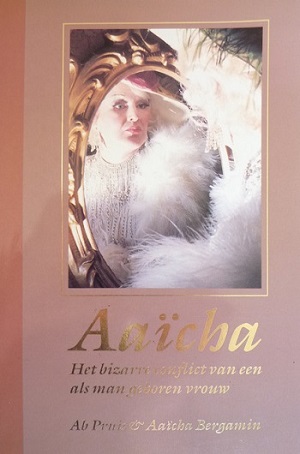
Aaïcha Bergamin (1932 – 2014) performer, sex worker, drug smuggler

Leonhard Meisjes was raised in Amsterdam with three sisters.

At age 19 Leonhard was sent to a psychiatric hospital after being found by mother in bed with a Jamaican dancer, but escaped and fled to Paris, where, known as Nanny, she found work as a performer in Le Carrousel, and elsewhere. She became known for her Marlene Dietrich impersonation.

After more wandering in Nice, Berlin and Antwerp, Aaïcha returned to Amsterdam, acquired black-market female hormones and made a living as a prostitute, despite police harassment. They would confiscate the clothes that she was wearing, even underwear, even trousers without a fly, on the grounds that such clothes were forbidden to men, and send her home naked. She had repeatedly to buy replacement clothing and to pay fines.

Nanny had confirmation surgery in 1972.
“Veel later zag ik foto's van een dergelijke operatie. Ze joegen me de stuipen op het lijf.” (Much later I saw pictures of such an operation. They filled me with fear.)
She closed up after the first operation in Amsterdam, and was operated on again in England two years later. She then changed her name to Aaïcha Bergamin.

She went on to marry four times, the last, when she was in her 60s, the husband being a Moroccan 42 years younger.

She worked in De Wallen, Amsterdam's red-light area, but initially the police refused to let her hire a window, despite her anatomy, in that she was registered as a man. After several appearances in court, she was examined by a sexologist, Dr Van Emde Boas who said:
“Wat ze van tevoren had, gaat ons niet aan. Ik raad u aan deze mevrouw als vrouw te beschouwen.” (What she was before, does not concern us. I advise you regard this lady as a woman.)
With this and her passport finally changed, the vice squad finally left her alone to practice her profession. She became the first trans madam in the city.

Later she opened a club, initially called the Bar Oporto, but then Madame Arthur, at de Warmoesstraat 131 at the corner of de  St. Annastraat ( map), where she repeated her Marlene Dietrich act. But after two years the building was demolished.

A Chilean trans woman, who had danced in her club, fixed it for her to smuggle cocaine from Brazil.
“De eerste keer smokkelde ik zes kilo. Dat ging goed, dus ik vroeg of ik wat meer kon meenemen, want ik kreeg per kilo betaald. Twee jaar lang landde ik om de paar maanden op Schiphol met 45 kilo coke. Ik had een peperdure nertsmantel aan, zo een waarin Wilhelmina heeft gelopen. Dan loop je niet direct in de armen van de douane.” (The first time I smuggled six kilos. That went well, so I asked if I could bring some more because I got paid per kilo. For two years I landed every few months at Schiphol with 45 kilos of cocaine. I had an expensive mink coat on, such as [Princess] Wilhelmina would wear. Then I walked directly into the arms of customs.)
Aaïcha spent five years in prison.

Afterwards she lived in her parents' home in Amsterdam Oud-West. In 1991 she published her autobiography, Aaïcha: het bizarre conflict van een als man geboren vrouw.

She died age 82 of lung cancer, and was buried anonymously. However trans activists raised funds to buy her a tombstone.
Facebook

________________________________________________________________________________

 "Much later I saw pictures of such an operation. They filled me with fear."  Just as well that Aaïchadid not go to Dr Burou.  April Ashley tells us that he showed such photographs of previous patients as part of deciding whether a prospective patient was serious.

Do not confuse Aaïcha's Madame Arthur with that of  the same name, also in Amsterdam but at Korte Leidsedwarsstraat nr. 45 whuch was opened in 1961 by Marcel Oudjman, the owner of the Paris Madame Arthur and Le Carrousel.