This site is the most comprehensive on the web devoted to trans history and biography. Well over 1800 persons worthy of note, both famous and obscure, are discussed in detail, and many more are mentioned in passing.

There is a detailed Index arranged by vocation, doctor, activist group etc. There is also a Place Index arranged by City etc. This is still evolving.

In addition to this most articles have one or more labels at the bottom. Click one to go to similar persons. There is a full list of labels at the bottom of the right-hand sidebar. There is also a search box at the top left. Enjoy exploring!

Showing posts with label youthful phase. Show all posts

16 June 2015

Pete Burns (1959–2016) performer

Burns was born in Cheshire to a father from Liverpool and a German Jewish mother who had fled from the Nazis.

He later told journalist Kris Kirk:
"When I was 13 I heard about April Ashley's sex change and I thought 'Bloody hell, that's what I have to do', 'cos I was really enjoying putting on make- up and stuff. But after a while I realised you didn't have to be a 'she' to do it".
At 14 he dropped out of Catholic school after it was clarified that his appearance/actions were not in line with the rules. Shortly afterwards Pete met hairdresser Lynne whom he married in 1980.
"The only thing that spoiled it was that the man in the registry office had to go and make a feeble joke by asking which one of us was the bride".
They remained married until 2006.

After working in a Liverpool record shop, Burns was able to perform with a band, and after personnel changes they became Dead or Alive, who had a number one single with a cover of "You Spin Me Round" in 1985. Pete fronted the group and was known for his androgynous look.

After his friend InternationalChrysis died in 1990, he put out a cover version of David Bowie's "Rebel Rebel" under her name in 1994:
"You've got your mother in a whirl /She's not sure if you're a boy or a girl ".
Burns became a media personality, swearing on the BBC, a contestant on Celebrity Big Brother. He became famous for his feminizing plastic surgeries, and appeared on television programs on the subject.

In 2006 Pete and Lynne were divorced; shortly afterwards he entered a civil union with Michael Simpson.

He published an autobiography in 2007. In 2010, Burns won £450,000 in damages from cosmetic surgeon Dr Maurizio Viel, who, the singer claims, left him 'suicidal' after his lip implant operations went wrong.

However by 2015, and more plastic surgery, he was bankrupt.

Pete died of cardiac arrest, aged 57.   
EN.WIKIPEDIA(Pete Burns)   IMDB   EN.WIKIPEDIA(Dead or Alive)    Transgender-Net


30 November 2014

Berlin, 1898

In Robert Beachy's Gay Berlin: Birthplace of a Modern Identity, p69 we find (he is paraphrasing the Tägliche Rundschau, 79, 20 March 1898):

"A gang of eight thieves arrested in March 1898 embodied this all-purpose deviancy.  Employed as house servants, butcher's apprentices, grill cooks and barkeeps, according to one newspaper report, these youths appeared to earn their pocket money as rent boys and shoplifters, and they spent much of their free time dressed in women's garb.  They were apparently successful passing themselves off as women, for they descended on department stores, en masse, where they stole large quantities of merchandise, which was later recovered from the ringleader's apartment.  In drag they used nicknames line Die Schöne (the pretty one), Schminkjuste (Juste in makeup) and Seiden-Guste (Guste in silk), and solicited sex at the Katzenmutter."

24 April 2014

Logan Carter (1954 – 1988) model, performer.

Robert Logan Carter was raised in Florida by his great-grandmother and then his grand-mother after his mother committed suicide when he was 3 months old. At 11 he discovered Marilyn Monroe. He neglected his school work:
"I wasn't meant to study arithmetic, and I wasn't meant to study history. I was meant to be a blonde!".
He ran away at 13 and became a kept boy, boy hooker and transy hooker in Hollywood. In 1971, booked on prostitution charges, he fled back to Tampa. He débuted in Florida’s nightclubs as Roxanne Russell, working with Paul Wegman. He won the 1974 Miss Florida title.

Off-stage he was masculine. As did British impersonator David Dale, Logan made Charles Aznavor’s ‘What Makes a Man a Man?’ his theme song, in which he stripped as female, and ended up as male. Filmmaker Derek Calderwood recorded the act as a 6-minute film, which later became a tool for classroom debates on what is gender.

Logan shot to fame as a drag performer, and also as a male model. In Manhattan, photographers would stop him on sight asking him to pose. In male clothes he posed for a punk-rock store. Italy’s Harper’s Bazaar and Mode International ran an avant-garde spread of Logan as both male and female.

His lover was Jack Nichols (1938 - 2005) gay activist and author of Men’s Liberation, 1975.

Logan performed regularly at La Cage, in Hollywood. He was on the cover of The Advocate.

He had a small trans parts in Second Serve, 1968, Down On Us, 1984, and Love Streams, 1984. He played a wife on Repo Man, 1984, and a hooker in Hollywood Vice Squad, 1986. In 1985 he, and several other impersonators, did part of their stage act in the film Dream Boys Review.
 
Logan died of Aids at 33.
  • Derek Calderwood (dir). Gender. With Logan Carter. US 6 mins 1978.
  • Howard Schwartz & John Moriaty (dir). Dream Boys Revue. Hosted by Lyle Waggoner & Ruth Buzzi, with Logan Carter and other female impersonators. US 74 mins 1985.
  • Jack Nichols. “Logan Carter Remembered: Starting as Florida Teen, He Danced Across International Stages”. Badpuppy Gay Today. 19 May 1997. http://gaytoday.badpuppy.com/garchive/people/051997pe.htm.
  • James T. Sears. Rebels, Rubyfruit, and Rhinestones: Queering Space in the Stonewall South. Rutgers University Press 421 pp 2001: 41-7, 73-5, 84-5,128-130, 154-6, 160-2, 287, 309.
  • J. Louis Campbell. Jack Nichols, Gay Pioneer: "Have You Heard My Message?". New York: Harrington Park Press, 2007: 156-170, 176, 189, 191, 237
IMDB.

11 January 2014

Kim Christy (1950 - ) performer, editor, adult film producer

Kim was raised in the Bronx, New York. By age 14 he was going out in semi-drag. He took up with the young Billy Schumacher (later to become International Chrysis). They were photographed fooling around outside the Astor in Manhattan when Elizabeth Taylor and Richard Burton were staying there, and the picture appeared in a Life Magazine article on teenage delinquents.


The photograph in Life Magazine: Kim with back to camera, Chrysis at front
Kim and Chrysis each left home and shared a tiny apartment in the area that later became New York's SoHo. They met sex magazine pioneer and editor of Exotique magazine, Lenny Burtman who arranged photo-shoots and other favors. Kim had a boyfriend who worked with her to soften her Bronx accent. She got to know New York female impersonators such as Tammy Novak, and performed at Club 82 as a stripper and as a showgirl. Her song was the theme music from A Man and a Woman. She toured North America as a female impersonator.


Kim and Chrysis had uncredited roles in the chorus line in the 1967 contest that became the film, The Queen. In 1968 a photograph of Kim and Chrysis appeared in Female Mimics. By 1969 Kim was being kept by an oil tycoon.

Kim with her mother
She also starting doing photography for Eros Publishing Company, which published Eros, Mode Avantgarde, Hooker and Exposé. When Female Mimics was relaunched in 1973, the first issue featured Kim winning a Los Angeles beauty contest. In 1979 Kim became editor of Female Mimics,which was owned by Jennifer Jordan, one of Lenny Burtman's ex-wives, and the name was changed to International Female Mimics. The transsexual content was increased and eventually explicit photographs were introduced. Kim also became editor of Exotique, a revival of Burtman's pioneering fetish magazine from the 1950s.

Also in 1979 Kim was in Los Angeles doing a photo-shoot when he discovered Sulka in the audience. The next year he put her in the film Dream Lovers, and then after her surgery, in The Transformation of Sulka, 1981, and Sulka's Wedding, 1983. He became a major producer of she-male and fetish porn – spanning 8mm, VHS and DVD. He also made straight porn.
In FMI, 11,1, 1980

++Kim had reverted to male as Ken Olsen.  He met and married a woman. Their marriage has lasted: they now have grandchildren.

In 1998 Kim/Ken won an award as Best Fetish Producer. The same year he edited the original run of Exotique in book form. In 2001 he edited The Christy Report, a historical survey of sex and fetish images. He was inducted into Adult Video News (AVN) Hall Of Fame in 2004, the first transgender person to be so.
“I am married to my wife. I am with her. Something I learned from all my years working with clients all over the world: Men and women can both be very fluid in their sexuality. Plus things like certain sexual scenarios can engage a person deeply for a time. Sometimes it’s same-sex activity. Some people stay attracted to one gender or another all their lives. I was with men — when I lived as a woman — who never would have called themselves gay, but they were not unhappy about my extra parts at all. Like I said, back then we did not name things so much. I never thought of any of the things I did as who I was. They were things I liked. Things I did.”
*Not the horse exhibitor.  Not Ken Olsen the sound engineer.
IMDB   IAFD
________________________________________________________

The Internet Adult Film Database (IAFD) entry on Kim is a bit dubious.   See Jim Beaux’ comments.  The image supposedly of Kim is actually of Carnal Candy in a 1984 film.  It lists Kim’s years active as performer: 1984-2001 – except that Kim never performed in any adult films.

Ms Bob wrote a 3-part history of Female Mimics for TG Forum.  Bob lists Kim as appearing in the magazine, but says nothing at all about Kim becoming the editor.

I couldn’t find any photographs of Kim after the early 1970s. 

In the Advocate  article, Kim says that her aunt and then her mother recognized her in the Life Magazine photograph.  As she has her back turned, how could they be sure?

12 May 2013

F. Scott Fitzgerald, author of The Great Gatsby

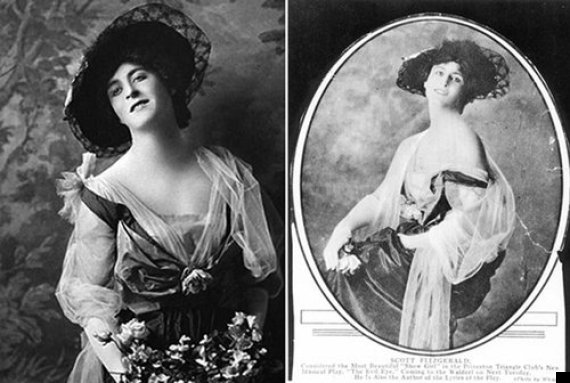
Princton was an all-male university in 1916 and for decades afterwards.   F. Scott Fitzgerald was in the Triangle Club which put on plays.  


He posed for a publicity photo for a production of The Evil Eye, which he co-wrote, which was printed in The New York Times on January 2, 1916. The newspaper called him "the most beautiful" show girl in the production.  However having failed his exams he was not allowed to perform.

17 February 2013

John Herbert Brundage (1926 – 2001) playwright.

John Brundage was raised in Toronto. He was writing fiction from the age of 14.

By 18 he was a accomplished drag queen. He was able to pass as a female model at a fashion show. However his male persona was obviously gay, and was subjected to taunts and jeers.

In 1947 John was mugged, and his attackers accused him to the police as trying to hustle them. It was Brundage was was charged, convicted and sent to Guelph Reformatory for six months. There he was beaten and raped, but he was also able to wear drag and curl his hair. On release he continued in drag. However a few years later he was recognized by one of the cops who had arrested him before. This time he was sent to the Mimico Reformatory.

In 1953 John toured Canada as a female impersonator with Allan Maloney in Paris After Midnight.

He then attended both ballet and theatre school. He decided on the theatre. He used his middle name as one of his sisters was also in theatre. In the 1960s John Herbert was artistic director of three Toronto companies in succession.

For Halloween 1962, John joined Katherine Cummings and others to run the spectator gauntlet into Letros Tavern for its annual drag event.

In 1964, Canada's centennial year, Herbert wrote Fortune and Men's Eyes, based on his two terms in prison. It was rejected by the Toronto Workshop Productions. It was announced for the 1965 Stratford Festival, but then forbidden by the Board of Directors for public performance, although it was performed privately for the Stratford actors. Herbert produced and directed Jean Genet’s The Maids. This was the first Genet play in Toronto. Critic Nathan Cohen of the Toronto Star attended, and later sent Fortune and Men's Eyes to David Rothenberg in New York.

Rothenberg opened the play Off-Broadway and it ran for a year. This was two years before homosexuality was decriminalized in Canada, and two years before Stonewall. The play was performed to great acclaim, but also controversy, in Los Angeles, London and Paris. It was filmed by MGM in 1970 in a former Quebec City prison with US actors.

Also that year, John was at the televised opening of Toronto's new St Lawrence Centre, in drag of course. He was pissed off that a government-subsidized theatre had opened with a shallow US comedy (Jean Kerr’s Mary, Mary). He was asked on television what he thought of the play, and dismissed it as "dreadful!".

The film version of Fortune and Men's Eyes came out in to great success in 1971.

In 1998, Herbert wrote Marlene Richdiet, a comic monologue in one act about a drag artiste coming to terms with middle-age and food. He wrote 24 plays in total, of which half reached some degree of production.

John Brundage died at 74 after prostate cancer problems.

09 September 2012

Vita Sackville-West (1892 - 1962) writer, aristocrat.

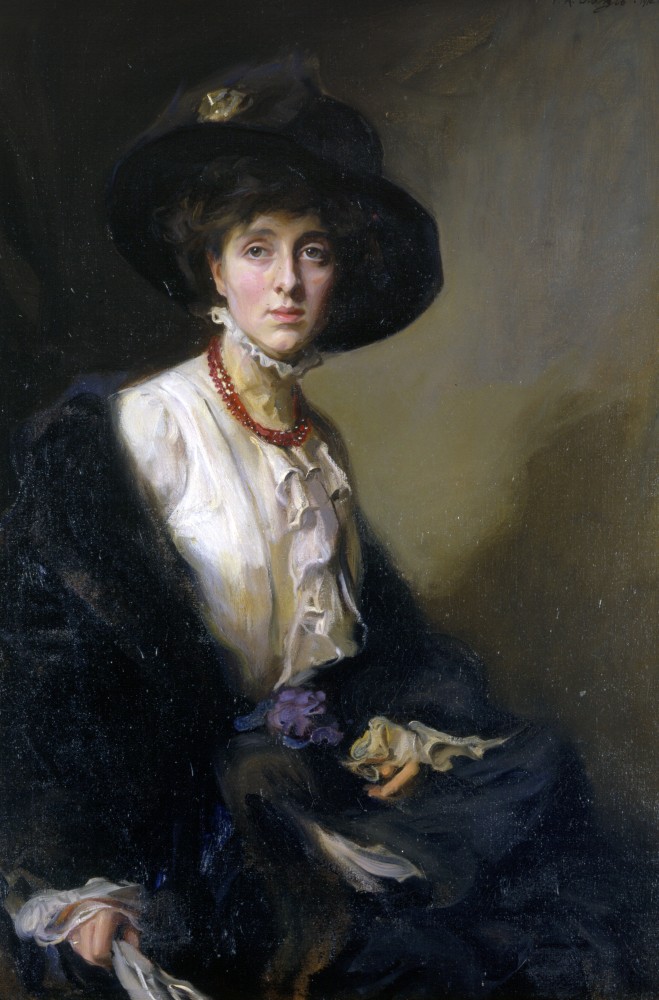
Vita Sackville-West by Philip de László, 1910
Victoria Mary Sackville-West was born at Knole House in Kent, the only child of Lionel Sackville-West, and his cousin Victoria, the daughter of his uncle, also Lionel, the 2nd Baron Sackville and Pepita, a Spanish dancer. Victoria Mary was usually known as Vita, to distinguish her from her mother. In 1908 the elder Lionel Sackville-West died, and his eldest son, Ernest claimed the Barony, but the English courts declared that he and his siblings were all illegitimate. The younger Lionel thus became the 3rd Baron Sackville.

In 1913 Vita married Harold Nicolson, the 3rd son of the 1st Baron Carnock, of HM Diplomatic Service, which made her the Honourable Lady Nicolson. It was Nicolson’s duty in August 1914, to hand Britain’s declaration of war to the German ambassador. He served at the 1919 Paris Peace Conference and was appointed Companion of the Order of St Michael and St George.

In the closing months of the Great War and for some years afterwards Vita conducted a passionate affair with her childhood friend Violet Keppel, daughter of the old king’s mistress.  Violet would soon marry Denys Trefusis. Vita took the name Julian, and put a khaki bandage around her head, which in the immediate aftermath of war was not uncommon, and browned her face and hands. She was successful in this persona - being tall was an advantage. Julian and Violet travelled to Cornwall, Paris and southern France. The two husbands pursued in a private plane, and the press picked up on the story.

In 1924, Vita published Challenge, a novel, based on their affair, with herself as Julian Davenport the leader of a revolution on a Greek island. His cousin Eve (Violet) joins him as his lover but becomes jealous of his attachment to the island. The book was published in the States only, for Vita’s father found the portrayal obvious enough to identify his family. In the real world, Julian and Violet broke up because the latter had sex with her own husband.

Vita and Harold remained in a loving marriage relationship despite, or because, they both conducted same-sex relations with others. They had two sons. Both their fathers died in 1928. Knole and the Sackville Barony went to Lionel’s brother Charles.

Vita as Orlando, 1928
In the late 1920s, Vita had an affair with Virginia Woolf, who immortalized Vita by imagining her as the gender-switching protagonist of the novel Orlando, 1928.

In 1926 and again in 1933 Vita won the Hawthornden Prize for her long narrative poems. She is the only person to win the prize twice.

In the early 1930s Vita had an affair with Gwen St Aubyn. In the novel, Dark Island, she wrote herself into both the jealous husband, Venn, and his secretary, Christina, as they compete for Shirin, Vita’s real-life name for St Aubyn.

In the 1930s Vita and Harold acquired Sissinghurst Castle in Kent. Sissinghurst is now owned by the National Trust and its gardens are the most visited in England. Gordon Langley Hall, the child of servants on the estate later emigrated to the US where she made a very public transition as Dawn Langley Simmons.

Vita at Sissinghurst 1955
In 1947 Vita was made a Companion of Honour for her services to literature. The same year she began a weekly column in The Observer called “In your Garden”. In 1948 she became a founder member of the National Trust's garden committee. She also published books on travel and literary topics.

In her last novel, No Signposts in the Sea (1961), she denies what we now know her for by having the main character, Laura, muse:
“Perhaps a relationship between two women must always be incomplete--unless, I suppose, they have Lesbian inclinations which I don't happen to share. Then, or so I have been given to understand, the concord may approach perfection.”.
Her fifty-five books include seven collections of poems and stories, twelve novels, and twenty-two works of nonfiction.

She died of stomach cancer in 1962. Harold died six years later.
  • Vita Sackville-West. Challenge. New York: George H. Doran 1924. London: Collins 1974
  • Virginia Woolf Orlando: A Biography. London: Hogarth Press 1928.
  • Vita Sackville-West. The Dark Island. Hogarth Press, 1934.   
  • Nigel Nicolson. Portrait of a Marriage. New York: Atheneum, 1973.
  • “Virginia Woolf and Vita Sackville-West”.  http://kaykeys.net/passions/virginiawoolf/virginiaandvita.html


 GLBTQ    EN.WIKIPEDIA  WORLDCAT  AMAZON.CO.UK


____________________________________________________________

The Wikipedia article comments “The Sackville family custom of following the Salic rules of agnatic male primogeniture prevented Vita from inheriting Knole on the death of her father”.  It was hardly a family custom, it was standard practice. The Wiki authors imply that she would have inherited Knole and the barony otherwise.  However if the custom were not observed,  Pepita’s son, Ernest would have been the 3rd Baron.

Like Dorian Gray, Vita kept the 1910 portrait by Philip de Laszlo in her attic, although not with the same results.

Vita dabbled with transvestity in her 20s but then gave it up.  If she were not so famous in literary circles we would not be considering her as a transvestite.

Dawn Langley Simmons used the name Pepita, precisely because it was the name of Vita's grandmother.

19 August 2012

Herbert Beeson (1899 - 1969) high wire walker.

Herbert Beeson was raised in Summitville, Indiana. At 17 he was working as a clerk in a general store, and helping out three nights a week as a stage hand at the village theater.

A small circus, the Marvelous Lucknows came to town. Herbert took up with Margaret, the slack wire dancer, and joined the troupe. Seven months later, in Texas, Margaret slipped and was hurt, and Herbert practiced in wig and skirt, took over her act as Berta Beeson, and graduated to tight rope. Margaret and Herbert also married.

From 1917-1923 Berta was a featured artist at the Sells-Floto Circus which billed her as M’lle Beeson, and as she was the star they had no other acts performing at the same time. Berta Beeson performed in Vaudeville during the off season.

Ringling Bros, Barnum & Baily Circus (RBBBC) lost their star high wire dancer, Bird Millman in 1923. She was replaced by Berta Beeson who canceled his contract with Sells-Floto.  Like Bird she wore a calf-length dress with flounce and fluff, but was now being described as “the Julian Eltinge of the Wire” which implied that her her gender was an open secret.

Berta Beeson, high wire performer, retired in 1936. Herbert Beeson, who became known as Slats continued with the RBBBC as a 24-hour man (advance advertizing before the circus arrived in town), and then in the 1950s as an announcer. He was also on the circus baseball team.

Herbert Beeson died age 70 in California.
____________________________________________________________

By 1929 practically all travelling circuses in the US had been absorbed by Ringling Brothers.

Thank you to Stacy Wilderness for her site on Berta Beeson.

It is normal for high wire artists to retire as they approach middle age.  Beeson seems to have given up female impersonation at the same time.

It is not clear whether he performed in Vaudeville as a woman or as a female impersonator.

The Wikipedia page on Summitville does not list Beeson as a prominent resident.

09 March 2012

Marshall S. Pike (1818 - 1901) performer, songwriter.

Marshall was born in Westborough, Massachusetts. By age 14 he was writing verses and music.

He started his female impersonation career in white-face and flaxen wig: in 1843 he was a member of a troupe called The Albino Family.

Thomas Dartmouth Rice had pioneered black-face performance but without cross dressing. Pike and his colleagues added the latter and became The Harmoneon Family, later The Harmoneons. As such they appeared in 1847 at the White House in Washington before President James Polk. Slide says that this makes Pike, who was playing Fanny, the first female impersonator to perform for the US President.

After his Washington triumph, Pike joined Ordway's Aeolians in Boston, and in 1857 left to form his own troupe, Pike's Harmoneons.

Pike in the 1880s
With the advent of the US Civil War, he became Drum Major of the 22nd Massachusetts Voluntary Infantry. He was taken prisoner in 1861 at the battle of Gaines’s Mill and sent to Libby Prison where he formed a Glee Club.

He was also active as a legitimate actor, and wrote more than one hundred songs.
  • Anthony Slide. Great pretenders: a history of female and male impersonation in the performing arts. Lombard, Ill.: Wallace-Homestead Book Co., 160 pp. 1986: 16.
  •  William J. Mahar.  Behind the Burnt Cork Mask: Early Blackface Minstrelsy and Antebellum American Popular Culture. Urbana: University of Illinois Press, 1999: 316.
_________________________________________________________________________________________________________

For whatever reason the Wikipedia article on Pike mentions neither that he was a black-face performer nor that he was a female impersonator.

And also, Pike is hardly mentioned in John Strausbaugh's otherwise excellent Black Like You: Blackface, Whiteface, Insult & Imitation, 2006.

15 May 2011

Camille Paglia (1947 - ) academic, media pundit.

Camille Paglia is the elder daughter of Italian Immigrants to the US. Her father eventually became professor of Romance Languages at Le Moyne College, Syracuse, New York. Camille was a tomboy who enjoyed dressing as male, and considered for a while that she had been born the wrong sex.  She read Simone de Beauvoir's The Second Sex, while still in high school. She graduated with a BA from Binghamton University in 1968, where she wrote her final thesis on Emily Dickinson.

She did a PhD at Yale 1968-72 where she was openly lesbian, and was mentored by Harold Bloom. Paglia taught at Bennington College, Vermont from 1972. One of her students was Judith Butler.

In 1973 Carolyn Heilbrun issued her tepid Towards a Recognition of Androgyny. Paglia, then an unknown, reviewed it anonymously in the Yale Review:
"Heilbrun's book is so poorly researched that it may disgrace the subject in the eyes of serious scholars".
She defended her thesis, Sexual Personae: The Androgyne in Literature and Art, in December 1974.

She fell out with her colleagues at Bennington College. After a standoff with the administration, she accepted a settlement and resigned in 1979. She supported herself with part-time positions, and some journalism. She completed the book version of Sexual Personae, but could not get it published. In 1984, she was hired to teach humanities by the Philadelphia College of Performing Arts, which merged in 1987 with the Philadelphia College of Art to become the University of the Arts.

In 1990 Sexual Personae was published by Yale University Press. In it she analyzes Western art in terms of the contrast between Dionysos and Apollo, an approach that had been pioneered by Friedrich Nietzsche. Unlike Nietzsche she contrasts masculine, phallic sky religion with feminine, chthonic, earth religion, and portrays culture as a struggle between the two. She find paganism undefeated by Judeo-Christianity, androgyny, sadism and the aggressive Western eye in both classical art and pop culture. Against the feminism of the 1980s she stresses the biological basis of gender differences. She identifies 23 sexual personae which she labels:
Amazon, androgyne of manners, android, beautiful boy, court hermaphrodite, dandy, Decadent aesthete, drag queen, Epicoene, Gorgon, Great Mother, Khepera, lesbian, male heroine, manufactured object, Mercurius, Pythoness, Teiresias, transsexual, twin, vampire, Venus Barbata, virago.
All 23 are androgynous in different ways. The power of androgyny comes through in three key concepts:


Charisma, the radiance produced by the interaction of male and female elements in a gifted personality. The charismatic woman has a masculine force and severity. The charismatic man has an entrancing female beauty. Both are hot and cold, glowing with presexual self-love (p521);

Psychoiconicism, the literary phenomenon where a dominant androgyne so dominates a text that both the plot and other characters lose fictive energy and fade into the background. She specifies the examples of Geraldine in Coleridge's poem 'Christabel'; Rosalind in Shakespeare's As You Like It; Virginia Woolf's Orlando; Heathcliff in Emily Bronte's Wuthering Heights; Oscar Wilde's Dorian Gray. Wuthering Heights and Orlando in particular weaken in their second half once the authors Sexual Metathesis, expressed in a fascination with the central character, is completed and there remains a struggle to complete the plot (p345 );

Sexual Metathesis, the special erotic thrill produced by a change in gender. Several of the literary examples disguise a gay relationship, but the public evasion is no more than a small part. 'An ampler spiritual economy is at work. Sexual metathesis is a metaphysical advance, an expansion of identity through a mentally prolonged erotic sensation’ (p350,455).

All this of course refers to the androgyny inherent in our culture. She says very little about real-life trans persons. The major statement is on p368:
"We are still untangling the legal and and moral problems caused by the invention of a new sex, the transsexual, produced by chemical and surgical manipulations of the body. The transsexual is a technological androgyne whom we are happy to call 'she' out of the courtesy owed to all inspired makers of fiction. Close to transsexual is my favorite technological androgyne, Luciana Avedon, formerly the Princess Pignatelli, who radically resculpted face and body in her quest for beauty."
The book drew strong criticisms, both pro and con. Sexual Personae was nominated for a National Book Award and after being released as a paperback became a best-seller. She said that a second volume focused on popular culture had also been written, but the book has never appeared.

Two years later she released Sex, Art and American Culture: Essays which contains her critical review of Marjorie Garber's Vested Interests, and "Junk Bonds and Corporate Raiders: Academe in the Hour of the Wolf" in which she tackles Foucault, Halperin and their ilk for their ignorance of earlier theorists and their ignorance of culture in general. This essay was much discussed even by classical historians.  She expresses enthusiasm for drag queens:
"I sensed then, and now know for certain, that Madonna, like me, is drawn to drag queens for their daring, flamboyant insight into sex roles, which they see far more clearly and historically than do our endlessly complaining feminists. (p9) ... The castrated, tranvestite priests of Cybele, honored in disco-like rites of orgiastic dance, survive in today's glamourous, flamboyant drag queens. (p23) ...The drag queen has emerged in America in the Nineties as a symbol of our sexual crisis.  A pagan priest whose ancestry is in the ancient cults of the Great Mother, the drag queen defies victim-centered feminism by asserting the dominance of woman in the universe. (p99) ...You know, I'm really happy there wasn't all this talk about sex changes back then, since I probably would have gotten this fantasy that I was a man born in a woman's body, and I think that I might very well have become obsessed with the idea of a sex change, which would have been a terrible mistake.... I've acclimatised myself to to my sex role -- thanks to gay men and drag queens!  Drag queens have influenced me enormously.  Their analysis of the mythology of male and female  and the theater of gender and so on, I've absolutely taken into myself.  (p256)"
She became a media celebrity known for her disagreements with other feminists and media pundits. Because she would not conform to the left-wing party lines, she was dismissed as a conservative, but regards herself as a libertarian Democrat, with pro-choice positions on abortion, pornography, euthanasia etc.

Her first movie was Female Misbehavior, 1992, where she is profiled along with Annie Sprinkle and trans man Max Valerio. In It's Pat, 1994, a street gang have a battered copy of Sexual Personae and accuse Pat of being an androgyne, which s/he is. Paglia has appeared in 38 films, usually playing herself. In 2001 she recorded a commentary track for the DVD of Basic Instinct. She wrote regular columns for Interview Magazine and Salon.

She was partnered with Allison Maddex 1993-2007 and legally adopted Maddex' son.

In 2009 (although the segment was not released until May 2011), in an interview with Xtra, Paglia confirmed the suspicion that she does not really understand what transsexuality is by opposing Chaz Bono's decision about himself, by referring to him as 'she' and 'Chastity', and repeating that when she was young that she was convinced that she was the wrong gender and if it were allowed that she might have done the same.
 _________________________________________________________________________________

Sexual Personae is enormously better than Towards a Recognition of Androgyny.  There is probably an eternal dialectic between transsexuality and androgyny, as there is between gender identity and sexual orientation, and Sexual Personae is still the best book about androgyny. 

Sexual Personae also has a rare enthusiasm not usually found in books on literature, that sends you to read the original texts.  I at least dug out the poems and stories that she discusses to either read them for the first time, or to re-read them.

It was a bit naughty of Xtra in May 2011 to put up the clip of Paglia talking about Bono without mentioning that it had been filmed two years previously.

13 April 2011

Olivier Theyskens (1977 - ) fashion designer.

Olivier was raised in Belgium, his father a chemical engineer. He wanted to be a girl, and was tormented by the fact that girls get to be princesses and wear dresses.
"A girl in my class told me that, in America, you can have a sex change, so I read everything there was about it, and told my friends at school that I would have this done."
His parents encouraged him to draw and by the age of seven he declared that he wanted to be a fashion designer. He diverted his energy into drawing women and fashion.
"I was very attracted to all beautiful women — actresses, singers, but it was like a girl who loves these women, not a boy. I was always imagining what it is to be a beautiful girl."
By the age of 10, his shoulders began to widen, and he saw that he would never become the beautiful woman that he dreamed of.
"Because I am a perfectionist, it put me off the idea. So I quickly became Olivier. I am very happy to be a boy and I never think about that any more".
At 18 he studied fashion design at the École Nationale Superieure des Arts Visuels de la Cambre, but dropped out to start his own label. Madonna wore one his dresses to the 1998 Academy Awards. He went on to design for Rochas and Nina Ricci and Theory. Olivier says that he is happy to live in a age when androgyny is fashionable.
"I own a few things that I designed for women, but I like looking neither like a man nor a woman, more like a fantasy boy."
Sometimes strangers address him as 'mademoiselle".
 EN.Wikipedia

07 February 2011

The Radical Feminists and Bethnal Rouge

One of the threads in London Gay Liberation in the early 1970s was Radical Feminism (not to be confused with the Radical Feminism of the 1980s), and in fact it was not a self-chosen name:
"We didn't take the label radfems. It got thrown at us one night in an argument … 'You radical femme acid queens!' … it was something from outside. We never used words like that. We would say 'get a frock on dear' whenever they were ranting away.(Bette Bourne quoted in Power: 273)".
"It started with jellabas and kaftans and long hair and flowers ... then we discovered glitter … and then nail varnish. Later, some of of us – a quarter of the men, I'd say, at some time or other – would get a nice new frock for the next Gay Lib dance. Then a few people began wearing it to meetings. It just evolved (Michael James quoted in Kirk: 96)".
It then became street theatre, notably the Miss Trial demo outside the Old Bailey in support of the women who were on trial for disrupting the Miss World contest, and then the disruption of the 1971 Christian Festival of Light. Some GLF queens wore drag because it felt right, some for fun and some for political reasons.

Generally the queens were living in communal squats and in poverty in Brixton and in Notting Hill, and wore drag all day every day. They aligned themselves with lesbians against the masculine gay men who were dominating the GLF meetings. When the women finally split from GLF in February 1972, the Rad Fems began to dominate at the All-London meetings at All Saints Hall in Powis Square, which was a bit intimidating for newcomers.

However the RadFems also demonstrated against the launch of the feminist magazine Spare Rib, which allowed The Sunday Times to run an article on the irony of feminist men telling women how they should behave. The fledging Gay News used this to disassociate from what they referred to as 'fascists in frocks'. The initial issues of Gay News were hostile to GLF in general and even more so to the queens.

The official first gay pride march in London was the Carnival Parade on 1 July 1972. However a few days earlier, GLF had been allocated a timeslot with the Boilermakers Union to picket the US Embassy about what they were doing to Vietnam. Only the Radfems turned up, a band was playing, and Bette Bourne and Michael James started a waltz. The US school band packed up in a fit of pique. The queens sauntered off and ended up at Piccadilly Circus. The police asked where they, the queens and the rent boys, intended to go, and said they would escort the march which went via Oxford Street to Hyde Park.

By late 1973 the movement was almost over. Some of the surviving RadFems took over the anarchist Agitprop bookshop/commune at 248 Bethnal Green Road, which at one time had been owned by a banker to the Kray Brothers gang, and had a wall safe. Agitprop had been raided twice by the police in the two years that it had been open, and two of its members were on conspiracy-to-procure-firearms charges.

Agitprop had already sponsored the East London GLF and now the queens took over and renamed the building Bethnal Rouge. They actually continued the bookshop for several months. The local pub was freaked out when they first arrived, but as some of them could play piano, and others were good at singing, there was some degree of acceptance.

Bette Bourne did not join, being from the East End and not wishing to return. Michael James went to Amsterdam for a year. Andrew Lumsden left his job as a financial journalist at The Times and joined the commune; Julian Hows, expelled from school for his GLF activities, ended up managing the local Kentucky Fried Chicken but buying their chickens from the Tesco's supermarket across the street; Stephen Bradbury had walked away from a job at Midland Bank to join the queens when they lived in Notting Hill; Stuart Feather, one of the early queens, was involved.

By this time the GLF Office Collective, at 5 Caledonian Road, in the basement of Housemans Bookshop, had been taken over by a clique that was allied with the early Gay News but out of touch with the rest of Gay Lib. In October 1973 the Bethnal Rouge queens raided the office and took the files. Gay News responded with an article that went so far as equate drag queens and violence. However at the last GLF Think In at Sussex University that November opinions were more on the side of Bethnal Rouge, and that the Office Collective had ceased to be useful.

In February 1974 Bethnal Rouge was invited by Goldsmith College Gay Soc to give a Pre-Disco talk. Group 4 Total Security working for the College attacked them before they even spoke, and when Lewisham police arrived they were told that Bethnal Rouge had come to the disco to cause trouble. One queen needed hospital treatment; another who was head butted and lost two front teeth. One was arrested and later that night thrown through a glass door in the police station. The rest escaped. Shortly afterwards the commune were evicted from 248 Bethnal Green Road.
Julian Hows. P185 in It's Not Unusual' by Alkarim Jivani

I don't know of any of the Radical Feminists who later became women. Stuart Feather, Bette Bourne and Michael James became performers maintaining the spirit of Gay Liberation. Stuart later became a painter. Alaric Sumner became known as a poet. Cloud Downey works in theatre. Andrew Lumsden later became a tour guide and a painter. Julian Hows was in the press when he insisted on wearing the female uniform when working for London Underground, and is now an Aids survivor. Stephen Bradbury and Richard Chappel died of Aids in the early 1990s.  Some of these are featured in Kirk & Heath's Men in Frocks.
___________________________________________________________________________________

I arrived in London in April 1972 and started going to West London GLF in July, and later switched to South London GLF.  Power's book is basically the history of the all-London GLF  which I never actually went to, and thus never met, as far as I remember, any of the people mentioned above, although I certainly do remember meeting other people mentioned in Power's book, and bedded at least one of them.  They and I were probably at, at least some, of the same Gay Lib Dances, when I was just building up confidence to go out as female.  I certainly did not have the confidence to join a drag commune.

    05 October 2010

    Jimmy De Forest (185? – 1932) trapeze artist, fight trainer

    At the age of five Jimmy was an arieliste with the De Forest Aerial Troup as Mlle Petite De Forest, in line with the circus tradition that more customers would pay to see a girl trapeze artist.

    De Forest & Dempsey, June 1919
    At the age of 12 he quit and drifted into the Bowery fight clubs. He went to Europe to learn training and massage in military camps. On return to the US he earned a reputation as a trainer and manager. He managed Jack Dempsey and other major boxers.

    He retired in 1926. He died in Long Branch, New Jersey after a long illness and in poverty.
      • “Jimmy DeForest dies in poverty”. Oct 12, 1932. Oswego Palladium Timespdf 
      • L.H.Hamsley. “Imposters in Petticoats”. In David O.  Cauldwell (ed). Transvestism … men in female dress. New York: Sexology Corporation. 1956: 66.

    01 October 2010

    Bellino (1732 - ?1790) castrato impersonator.

    Angiola Calori was raised in Bologna, where her mother took in lodgers. 

    According to Giacomo Casanova's memoirs, she had an early affair with the renowned opera castrato Salimbeni, and that Salimbeni suggested that she pass as a castrato (a male soprano who had been  gelded before puberty to retain his vocal range) to avoid the attentions of men, and promised that he would get her a job with the Elector of Saxony, but died before he could do so. 

    Nevertheless she became the castrato Bellino, and thus was able to sing on stage in the Papal States. She claimed that she had been able to pass the examination (carried out by an elderly priest) with the aid of an addition taped to her body in the appropriate position. 

    Casanova felt that Bellino could not be a castrato, and seduced him to be sure. He refers to her as Teresa Lanti and claims that she raised his son as her supposed brother. 

    Angiola apparently married Cirello Palesi circa 1760, and became a famous soprano. Some books, following Casanova, refer to her as Teresa Lanti Palesi. 

    Heriot points out that Bellino's meeting with Casanova took place in 1744, but that Salimbeni's death is recorded as 1751. He thinks that Casanova perhaps confused two singers, and that the castrato in question was Giuseppe Appiani, who was born in the same year and place as Salimbeni, and who did die in Bologna in 1742. 

    More to the point, if her birth year was 1732 as given by Willard Trask, it is highly unlikely that Bellino was an established performer in 1744 as she would have been only 12. 

    Nettl assumes that the tale is largely false, but also tells us that a portrait of Teresa may be seen in a Milanese theatrical museum, but does not specify which one. 

    Bellino is a character in the Simon Capet film, Evirati, 2000, and the 2005 Russell T Davies BBC mini-series Casanova, but not in the Hollywood film of 2005, nor in Fellini’s film of 1976.

    • Giacomo Casanova. Histoire de ma vie jusqu'à l'an 1797. Manuscript in the Bibliothèque nationale de France.
    • Giacomo Casanova edited by Willard Trask. History of my Life. New York, Harcourt, Brace & World 1966-1971 . Vol 2, Chps I, II, Vol 7 Chp VII, VIII, Vol 10 Chp IX, n29, Chp X, n36.
    • Paul Nettl. "Casanova and Music". The Music Quarterly. 15,2 Apr 1929: 212-232.
    • Angus Heriot,. The Castrati in Opera. New York: Da Capo, 1956. paperback. 1975: 277, 182.
    • "Giacomo Casanova". Wikipedia: L'enciclopedia libera. it.wikipedia.org/wiki/Giacomo_Casanova.
    ___________________________________________________________

    There is a continuing debate among Casanovistas to what extent Bellino  was a literary construct by Casanova, even if Angiola Calori was a real soprano.  I did consider putting this article in my arts blog, but on balance decided to go with a historical Bellino.  

    The en.wikipedia article does not even mention Bellino, so I used the it.wikipedia article instead (with my husband’s assistance).  For a summary of the argument re whether Bellino is a literary construct see footnote 11 of the it.wikipedia article.

    Not even the it.wikipedia site has an entry on Angiola Calori.

    26 August 2010

    Peter Robinson (1962 - ) singer.

    Peter was born in Kingston, Jamaica, where his father was a yacht salesman, and grew up in Hertfordshire. As a teenager he modelled himself on Marilyn Monroe.

    Boy George and he, using the name, Marilyn, were Blitz Kids and part of the New Romantic movement. They lived in the same squat in Kentish Town, but were chased out by a lustful neighbour who assumed that Marilyn was a woman.

    After Boy George went into Culture Club, Marilyn appeared in the Eurythmics’ video, Who’s That Girl. He was then signed and his first single, “Calling Your Name”, 1983, went to no 1 in Japan, and no 4 in the UK. He released two more singles in 1984, and his album, Despite Straight Lines in 1985.

    In 1986 Marilyn and George’s brother, Kevin, were sentenced on a charge of possessing heroin. His career declined. A failed attempt to record a second album in Detroit drained his finances, and he cut his hair and quit the industry, until 2001 when he made some club appearances.

    In 2002, his character was featured in the stage musical Taboo. In 2003 he was in a Channel 4 reality show based on hairdressing. In 2005 he was in the Channel 4 documentary Whatever Happened to the Gender Benders?, where, looking quite unwell and unglamorous, he discussed drugs and his agoraphobia.

    *Not Peter Robinson, the crime novelist, nor the department store, nor the computer scientist, nor the poet.

    30 May 2010

    Karl Heinrich Ulrichs (1825 – 95) jurist, activist.

    Ulrichs was born and raised in Aurich, Hanover. His father died when he was 10. He later recalled that as a young child he wore girls’ clothes, played with girls and wanted to be one. His first sexual experience was at age 14 with his riding instructor.

    He studied law and theology in Göttingen and history in Berlin. His dissertation, in Latin, was on the Peace of Westphalia. From 1849 to 1857 he was a legal advisor for the district court of Hilesheim in Hanover. He was fired for being gay. He then worked as a reporter for the Allgemeine Zeitung, and lived off a small inheritance.

    Under the pseudonym of Numa Numantius, he wrote a series of booklets in the 1860s proposing that homosexuality is natural and biologically based. He describes himself as an Urning, and used Dioning for males attracted to females. He proposed that Urnings are anima muliebris virili corpore inclusa (a female psyche confined in a male body), a metaphor that would be applied to trans persons in later generations.

    He then wrote more under his own name, and pleaded at the Congress of German Jurists in Munich for a repeal of the anti-homosexual laws. His books were banned and confiscated in Saxony, in Berlin and throughout Prussia.

    As a patriotic Hannoverian he was briefly imprisoned after the Prussian Anschluss in 1866. The next year he left Hannover for good. He lived in in Munich, Wurzburg and Stuttgart, and then from 1879 he lived in Italy, where he finally settled in L’Aquila. He continued to publish in German and Latin at his own expense.

    In 1884 he wrote the first gay vampire story, “manor” in in his collection, Matrosengeschichten (Sailor Stories).

    He died at age 70.

    There are now streets named for him in Munich, Bremen and Hanover. His birthday is marked each year by a poetry reading at Karl-Heinrich-Ulrichs-Platz in Munich. There is an annual pilgrimage to his grave in L’Aquila. The International Lesbian and Gay Law Association presented a Karl Heinrich Ulrichs Award in 2005 and 2009.

    28 January 2009

    Herbert Dyce Murphy (1879 – 1971) spy, explorer, whaler, sheep rancher.

    Murphy was born to a privileged family in Melbourne and finished his education at Oxford University, England. Before university and during the vacations he acquired considerable experience on ships particularly on expeditions in the Arctic.

    He played a female role in a Greek play while at Oxford, and on that basis was recruited by military intelligence. He already was an officer in the territorial army. His task was to live as a woman in Belgium and France. He was trained to be a woman by a family friend, Lady Broughton – he found entering and leaving hansom cabs to be the most difficult. As Edith Murphy, he closely studied the French and Belgian railways. He enjoyed the assignment which continued for five years. A French lieutenant proposed to Edith in Paris. It is also said that Edith ran into Herbert's mother in London. Mother, after recognizing Edith, smoothed things over by saying that she had always wanted a daughter.

    He always maintained that the woman with a white parasol in the painting, ‘The Arbour’ by Phillip Fox, originally sketched at Bath in 1902, was himself, Fox accepting Edith as a young woman.

    After a few years the assignment was becoming more difficult as he lost his youth. Returning to being a man, he worked in whaling and voyages to the polar regions. He was rejected for Ernest Shackleton’s 1908 Antarctic expedition for supposed effeminacy, but was accepted on Douglas Mawson’s 1911-4 expedition.
    He joined the Australian Imperial force in 1916, but was dismissed for inferior vision.

    He bought a country property where he ran sheep and turned it into a holiday centre for poor Melbourne children. A High-Anglican, he was for 35 years a member of synod, and was also a shire councillor for 10 years. He was in demand as a speaker and as a singer of shanties. For three months annually, he sailed to Antarctica with the Norwegian whaling fleet. He claimed that he continued doing this until the age of 85 by lying about his age.

    Like Robert Baden-Powell, Murphy married late in in life, in 1934 at the age of 54. He and his wife had no children.

    The character of the transgender Eudoxia/Eddie/Eadith Twyborn in Patrick White’s The Twyborn Affair, 1979, is at least partly based on Herbert Murphy as Edith, and especially on his encounter with his mother.
    • S. Murray-Smith, 'Murphy, Herbert Dyce (1879 - 1971)', Australian Dictionary of Biography, Volume 10, Melbourne University Press, 1986, pp 637-638. www.adb.online.anu.edu.au/biogs/A100622b.htm.
    • Heather Rossiter. Lady Spy, Gentleman Explorer: The Life of Herbert Dyce Murphy. Jane Curry Publishing. 2005.
    ____________________________________________________________________________________________________

    This is an odd story. In some ways there is either too little or too much cross-dressing. If he was so at home as a woman, how could he do it for five years, and then never again. Maybe the years as a 'Lady Spy' never happened. There are no official records of the medals he was supposedly awarded.

    Murray-Smith says:
    "Something of a Munchhausen perhaps—some of his claims appear to be fantasies. However, much of even his most outrageous stories 'check out', and in his embellishments he was striving for the symmetry of art."
    Murray-Smith also quotes the naturalist, C.F. Laseron:
    "He [Murphy] holds himself up to ridicule as well as his other characters. Yet he never loses his air of diffidence; his whole method is apologetic. His stories have a curious suggestion of truth; they are convincing and at the same time too impossible to be true."
    So Murphy, a good story teller, span a yarn of his years in skirts, and White, Murray-Smith and Rossiter were all too happy to just accept it. Five years was a long time to live as female without hormones and shaving daily. Of male-born non-intersex persons of Murphy's generation, very few succeded in living full-time as female. Would the androgyny of youth make Murphy feminine enough?


    A review of Rossiter's biography by Crusader Hills makes a point:
    As a distant relative, Rossiter has done Murphy’s life a disservice by reducing it to one without any discernible psychosexual colour. Rossiter works on the basis that because Murphy married late in life he was undoubtedly and exclusively heterosexual. Maybe he was, but she wouldn’t know that. In describing his reasons for cross-dressing in public (two times of which were documented extensively, including in a photograph) she posits that he was testing whether or not he would get away with it. Any biographer with her salt would have at least entertained the notion that Murphy’s cross-dressing was probably not confined to once or twice in public, plus the several spying missions he did for the British government on the continent. Nor does she consider the significance of his pursuance of homosocial settings, such as the sailing and whaling ships, and exploring expeditions he joined. Ultimately though, the fault of this biography is not in its blindness to alternative readings of Murphy’s life or the bland lack of curiosity that Rossiter displays, it is simply a piece of vanity writing from the perspective of unexplored privilege.