This site is the most comprehensive on the web devoted to trans history and biography. Well over 1800 persons worthy of note, both famous and obscure, are discussed in detail, and many more are mentioned in passing.

There is a detailed Index arranged by vocation, doctor, activist group etc. There is also a Place Index arranged by City etc. This is still evolving.

In addition to this most articles have one or more labels at the bottom. Click one to go to similar persons. There is a full list of labels at the bottom of the right-hand sidebar. There is also a search box at the top left. Enjoy exploring!

Showing posts with label gay marriage. Show all posts

22 March 2021

Barbara de Lamere previously known as Bunny Eisenhower

Several trans histories tell us that Bunny Eisenhower and Lee Brewster founded the Queens' Liberation Front in 1970, and that they worked with Sylvia Rivera. We know quite a lot about Lee Brewster, but who was Bunny?  Nobody seems to have dug into this question.     David Kaufman's Ridiculous!: The Theatrical Life and Times of Charles Ludlam mentions her several times in that she was a minor actor in the plays considered in the book.   However Arthur David Kahn's The Many Faces of Gay contains a fairly detailed biography of Bunny.  This was published in 1997 and nobody seems to have noticed.  Kaufman has details that Kahn does not.   Putting them together we get the account below.

++ Original September 2015, revised March 2021 after being informed by her brother that "Esther" was really Enid Dame, the noted poet. 

----------

Eddie Dame (1940 - )  began cross-dressing at age 3, but usually only when the parents were away. The family regarded him as effeminate, and called him 'Butch' to toughen him up. Cousins slapped him around, to the same end. By age 13 he had started drinking, as did most of the family. Eddie's sisters helped him with makeup, and Nellie, the elder, introduced him to her fiancé with the comment: "my brother wears my clothes". However the rest of the family played a game of denial.

Anticipating being drafted Eddie volunteered for the US Air Force in 1959, where he entered into a relationship with Larry. From 1963, the year that they completed service, to 1967, they lived as a couple in New York. Larry refused to escort Eddie when he was cross-dressed. In 1967 Larry, announcing that he wanted children, married a woman. Eddie was the best man, and Eddie and Larry had sex the night before, as they continued to do occasionally until 1982 when Larry was seriously ill. Eddie never heard from him again.

After the wedding, Eddie went to New Orleans for Mardi Gras and bought a full set of female clothing. Back in New York Eddie started going out dressed female.

In 1968 he joined Charles Ludlam's Ridiculous Theatrical Company, and had a part in When Queens Collide. The name Inez Bunny Eisenhower was first proposed for cis actress Regina Hirsch, without her approval, and both names were listed for her in the flyer for Jack Smith's film Big Hotel. However she settled on the nom d'etage of Lola Pashalinski by the time that she was in Bill Vehr's Whores of Babylon. By the time of the production of Ludlam's Turds in Hell, 1969 the name had been assigned to Eddie.

He took up with Esther Enid Jacobs, the daughter of Jewish radical labor activists in Pennsylvania.  She was active in a Communist anti-war group, had had lesbian affairs and was okay with his transvestity, however she felt that the group would not be, so she left the group. Enid was not accepted by the Ridiculous Theatrical Company, so Eddie gave up acting. Eddie's father died in 1970, and later Eddie and Enid were married in a Unitarian Church, a second marriage for both of them. His mother came, but was already drunk.

Bunny and activist Lee Brewster founded the Queens' Liberation Front in 1970. They campaigned successfully to de-criminalize cross-dressing in New York. Previously a bar or club could be closed and patrons arrested, simply because a single person, deemed to be cross-dressed, was present.
Enid & Bunny in 1973 gay parade.   p8 Drag Magazine 3.11

Eddie and Enid stayed married for seven years. When Eddie let his hair grow and grew a beard, Enid thought that his cross-dressing would stop, but he continued with a scarf to hide his beard. 

In 1977, Eddie got a position as a proof-reader in a law firm. The next year he and Enid divorced.

Eddie now considered the possibility of transition. A therapist provided a reference to an electrologist and an endocrinologist. She came out at work after speaking up when the supervisor made comments about transsexuals. Word spread though the firm, and as Eddie became increasingly androgynous, colleagues would stop by her office to see 'the company freak'. Outside Eddie was taken as a woman, but at work was still addressed as a man. She was unnerved by this, developed ulcers and thought of suicide. After a bad experience with a Catholic family values psychologist, Eddie was referred to a therapist who was positive and helpful. She gave up drinking at home and worked overtime to accumulate savings for the operation, which, as Barbara de Lamere, she achieved in 1982. 

Barbara was able to retain her job as a proof-reader. She became active in gay organizations. In 1990, the Gay Veterans Association was excluded from the Veterans Day Parade and Barbara joined the GVA. She became a member of the board and editor of the newsletter. In 1993 she was arrested while marching in the unofficial St Patrick's Day Parade with the Irish and Lesbian Gay Organization.
  • Jayne County & Rupert Smith. Man Enough to Be a Woman. London: Serpent's Tail, 1995: 64.
  • Arthur David Kahn. The Many Faces of Gay: Activists Who Are Changing the Nation. Westport, Conn: Praeger, 1997: 3, 15-20, 266-9.
  • David Kaufman. Ridiculous!: The Theatrical Life and Times of Charles Ludlam. Applause Theatre & Cinema Books, 2002: 95, 98, 107,119.
  • Susan Stryker. Transgender History. Seal Press, 2008: 87.   2nd edition, 2017:111. 

Enid Dame

Enid Dame become known as a poet, gained a PhD in English from Rutgers University in 1983, and taught there and at the New Jersey Institute of Technology.  Her third husband was the poet Donald Lev, but she retained her second husband's surname.  The two edited Home Planet News, a literary review.  Enid's poetry often expanded the Torah from a midrash and feminist perspective, for example by invoking the personae of Lilith and Eve. 

Enid died in December 2003.  The Academy of American Poets Prize bestows the Enid Dame Memorial Poetry Prize for the best poem by an undergraduate.
  • Burt Kimmelman.  "The Historical Imperative in Contemporary Jewish American Poetry: Enid Dame, Michael Heller, and Nikki Stiller".  Shofar:  An Interdisciplinary Journal of Jewish Studies, 21,2, Fall 2002: 103-110. 
  • "Enid Sue Jacobs Dame".  Legacy, The New York Times, Jan 9, 2004.  Online.  
  • "Enid Dame (1940?- ) Jewish American". In Linda Cullum (ed).  Contemporary American Ethnic Poets: Lives: 91.  Greenwood, 2004.
  • "Honoring Enid Dame".  Friends of Rutgers English, Spring Summer 2005.  Online.  
  • Madeline Tiger & DeDe Jacobs-Komisar.  "How Enid Dame Led Us Beyond Paradigms".  Bridges, 16,1, Spring 2011: 200-7.  
___________________________________________________________

Kahn refers to Enid as Esther, which I initially followed until corrected by her brother.  


The following is found on p98 of Kaufman's book:
 A flyer about the cast of a theatrical production by custom may take liberties with the truth.   Either way I could not see how to fit in the work in Chicago and Los Angeles between the marriages to Larry and to Enid.

Slights

In Stryker’s book the only mention is that “drag queen Lee Brewster and heterosexual transvestite Bunny Eisenhower” founded the Queens Liberation Front.  As you see above, to simply describe Eddie/Bunny/Barbara as a ‘heterosexual transvestite’ raises a lot of difficulties.  ++For the second edition of her book, Stryker could not be bothered to add the extra information about her transition.

WikipediaContemporary American Ethnic Poets: Lives, etc, etc totally ignore Enid's first two marriages and her being in a Communist group, simply describe Donald Lev as her husband, not as her third husband, and do not explain why her surname is 'Dame".  

02 January 2020

Marsha Naquin-Delain (1953 - 2017) publisher, community activist

Marsha was raised as Marion Greeson in Baton Rouge, Louisiana.  His mother Betty Greeson was a cop, and Marion came out to her at age 15 – although they agreed not to mention the fact to his father, a high-school football coach.  His first boyfriend was his mother’s hairstylist. 

Marsha & Rip 1972
In 1973, on a weekend trip to New Orleans Marion met Rip Naquin (1954 – 2017) on Bourbon Street. They soon moved in with each other in Baton Rouge, and Marion became Marsha Naquin-Delain.  They started two gay publications that ultimately failed.  Their third attempt was Ambush Magazine.  Originally it covered Baton Rouge and north Louisiana, until 1985 when they moved to New Orleans.  

In 1986 they acquired the building at 828 Bourbon Street.  The ground floor was the office of Ambush Magazine and Naquin and Delain lived upstairs.  They have been active in Southern Decadence, PFLAG, LGBT+ Archives of Louisiana.  They founded the carnival Krewe of Queenateenas, and participated in the Gay Easter Parade.

When New Orleans introduced same-sex domestic partnerships in 1993, Naquin and Delain were the first to be registered.   In 2013 they were married in St Patrick’s Cathedral in New York on their 40th anniversary.   

Rip died age 63 in August 2017 of liver failure.  Marsha died four months later – some say of a broken heart.

·         Frank Perez & Jeffrey Palmquist. In Exile: The History and Lore Surrounding New Orleans Gay Culture and Its Oldest Gay Bar. LL-Publications, 2012: 131-2.
·         Cathy Hughes. “Rip Naquin, a leader in New Orleans' LGBT community, dies at 63”  The Times-Picayune, Aug 10, 2017. Online
·         Frank Perez.  “Obituary: Marsha Naquin-Delain”.  Ambush Magazine, February 27, 2018.  Online

_________________________

Ambush Magazine is still going.   
I did not find any statement to the effect that Marsha considered herself transgender.  Certainly she did not change her legal gender to female so that she and RIP could marry before 2013.
In the two articles by Frank Perez the pronouns referring to Marsha drift from male to female.

25 November 2019

The Triple-Whammy 1928-9


I have previously referred to the triple whammy of 1928-9 - when, within a few months, trans men and masculine women in London and Paris were involved in three much publicised trials which, while they did not lead to legislation about clothes, gender or civil rights, did sent a message to trans men that they should be careful.

Note regarding pronouns: Most of the persons discussed here never stated a preferred pronoun. In addition, Swann, Gluck, Lowther, Carstairs, Radclyffe Hall and Sackville West had considerable inherited wealth, and were therefore less affected by the laws about clothing and gender which the lower orders had to conform to. Swann, Gluck, Carstairs and Barker masculinised their names and wore male clothing. Barker, Wood, and Holtom had to work for a living, and therefore they had to pass. They are close enough to the 21st century concept of a trans man that anything but male pronouns would be wrong. Pelletier and Morris both kept their female first name, but dressed in male clothing, and worked at a time when women of their class did not, Pelletier as a doctor and Morris in sports and with motors. Morris also had a double-mastectomy (top surgery). But because of their retained first names, Madeleine and Violet, it is difficult to use male pronouns for them.

The biographers of Gluck, Lowther, Carstairs, Morris and Pelletier use female pronouns, but I expect that this will change for future biographies.

Contrariwise to Pelletier and Morris, Radclyffe Hall did take a male name: John, and was so addressed by friends. However her manner of dress was only in-between: usually a skirt topped with a male-style jacket and tie – a style that had been very fashionable for upper-class women through the 1920s. Laura Doan, author of Fashioning Sapphism comments on Radclyffe Hall:
“Her haircut was thought to be the most feminine of all the short cuts popular at the time, and she had her hair done at Harrods — not a barbershop. Even Hall’s famous sartorial choices were on the feminine side of what was known as the ‘severely masculine mode’… Nor did Hall and her partner Una Troubridge dress in a bizarre manner, wearing, as some biographers have claimed, clothing from a costume shop. The couple studied fashion magazines and built their wardrobes not from men’s tailors in Savile Row, but from the most chic of London’s department stores for women. [unlike Gluck who bought suits from the expensive men’s tailors].  Hall always wore a skirt and conducted herself in a completely womanly way - in short, Hall definitely didn’t model her protagonist, Stephen Gordon, after herself.” 
Diana Souhami’s biography frequently refers to Radclyffe Hall as John, but she never uses the pronoun ‘he’. While Radclyffe’s anti-hero Stephen Gordon in the Well of Loneliness is very definitely a trans man, perhaps also intersex, his author was not so. And we should note that Radclyffe Hall uses female pronouns for her protagonist in The Well of Loneliness.

Sackville-West had done soldier drag as part of her affair with Violet Trefusis, and as such the pair had fled to France pursued by their husbands. However she did not persist in such gender expression.

Trans men not mentioned below: Madeleine Pelletier was a doctor in Paris; Camille Bertin and his wife were residing with their three daughters in Juan-les-Pins on the Côte d'Azur.

Radclyffe-Hall, Carstairs, Barker and Morris

1924

Wynsley Michael Swann, Lieutenant-Colonel in the Women’s Army Corps during the Great War, quietly transitioned.

Ernest Wood, cellarman, waiter, died age 24 from consumption, and was found to be female-bodied. He was buried as “Miss Ernest Wood”.

Gluck, now having taken male clothing and appearance, has first one-man show of 56 paintings in South Kensington.

Joe Carstairs bought and developed a secluded estate in Hampshire, which he named Bostwick after his grandfather. He bought a yacht, Sonia, and became so proficient that by 1924 he was winning yachting prizes.

Toupie Lowther had run an ambulance unit that was incorporated into the French Army, 1917-8, and in the 1920s ran a lesbian salon, and Radclyffe Hall and other female writers popular at the time attended. Toupie loved to tell how, while motoring, she was stopped at the Franco-Italian border for masquerading as a man. On the return journey she wore a skirt and was arrested for masquerading as a woman. In 1926, Toupie Lowther was elected a member of the French Academie d’Armes, the only woman to that date to be so.

Mary Weston was the best UK shot-putter 1924- 1930.

Multi-event athlete (put-shot, javelin, football, swimming, cycling, motor-racing) Violette Morris, who had set new records in the 1922 Olympics, opened a car/motorbike accessories shop, Spécialités Violette Morris, at 6, rue Roger-Bacon, Paris, using the inheritance from her mother. The rent was 8,000 francs per annum, and the 41,000 franc valuation was all in the stock. She lived in the flat upstairs.
  • Vita Sackville-West. Challenge. George H. Doran 1924. A novel, based on the affair between Vita and Violet Trefusis, with Vita’s male persona, Julian Davenport,  the leader of a revolution on a Greek island. His cousin Eve (Violet) joins him as his lover but becomes jealous of his attachment to the island. The book was published in the States only, for Vita’s father found the portrayal obvious enough to identify his family. In the real world, Julian and Violet broke up because the latter had sex with her actual husband.

1925

Joe Carstairs commissioned the best motorboat that money could buy, a hydroplane from Samuel Saunders of East Cowes, Isle of Wight. Joe named the boat Gwen after his lover, Gwen Farrar. After the boat capsized and came up again, Joe reversed the name to Newg.

1926

Carstairs took part in and won the Duke of York’s International Trophy. On Lake Windermere Joe set a world record of 54.97 mph for a 1½ litre class boat.

Morris had been temporarily suspended for giving performance-enhancing drugs to her football team, for questioning the referees and for doing nothing when the referee was hit by a member of her team. In 1926 Morris was indefinitely suspended from football. She used her name to recruit female athletes for a film. She refused to transfer her licence to another club.

Gluck had an exhibit at the Fine Art Society in London.

Radclyffe Hall wrote a short story, "Miss Ogilvy Finds Herself", although it was not published until 1934. It drew on Toupie Lowther's accounts of her life during the war, her masculinity and her lack of fit in society. Ogilvy, "My God! If only I were a man", who, even as a child had insisted that "her real name was William and not Wilhelmina", finds a role in the war leading an ambulance unit, but afterwards finds that again her masculinity has become absurd. She commits suicide.
  • Oscar Paul Gilbert. Men in Women's Guise: Some Historical Instances of Female Impersonation. John Lane The Bodley Head Limited. 284 pp 1926

1927

Wynsley Michael Swann took a wife. Unlike what happened to Victor Barker two years later, this marriage was never challenged.

Victor Barker was the live-in secretary of National Fascisti. After a fracas with dissident members, he was charged with “uttering a forged firearm certificate”. He was found not guilty, but his firearms certificate was cancelled. The Public Prosecution Office did find rumours about a woman masquerading as a man, but did not pursue them.

Joe Carstairs commissioned Samuel Saunders to build three hydroplanes designed to be the fastest craft ever at a cost of £50,000. In a significant lapse of memory, Joe named the boats Estelle I, II and III after his mother Evelyn.

Mary Weston was the best UK javelin thrower.

Anton Prinner , artist, moved to Paris from Budapest taking a male name and from then wearing male clothes, a beret and smoking a pipe. Picasso would greet him as "Monsieur Madame".

The Fédération française de sports féminins (FFSF)  notified Morris that she was suspended for violations, and for wearing male clothes. Her smoking and drinking did not help. The FFSF also banned shorts that were too short, playing without a bra, and costumes that were too tight.

A journalist from Paris Midi who questioned Morris apropos the new regulations thought that he must be meeting her husband or brother, "mais non, c'était bien elle, en chair plus qu'en os, habillée d'un complet veston, avec pantalon - comme vous et moi, monsieur - faux col et cravate (but no, it was her in the flesh, dressed in a full jacket with trousers - like you and me, sir - collar and tie)".

Morris won the motor-racing Bol d'Or against male competitors, and practised boxing, sparring with Raoul Paoli (1887-1960), the male Olympics athlete, champion boxer, wrestler, and rugby player for France.

Morris attended a meeting of the FFSF, and issued a defense of her dress style: "L'habit masculin n'a, à ce que je sache, rien de malséant. J'y suis tenue de par mes obligations professionnelles et tant que les lois de la République française ne m'en empêcheront pas, rien ni personne ne peuvent m'interdire un costume qui, vous en conviendrez, est toujours décent (There is nothing, to my knowledge, unseemly about male clothing. I am bound by my professional obligations and as long as the laws of the French Republic  do not prevent it, nothing and nobody can forbid me to dress in a way that you will agree, is still decent)". However this argument did not convince, and Morris was expelled from the FFSF, and thereby from all French championships and the French team for the Olympics where she was expected to win gold medals.

1928

The novel The Well of Loneliness by Radcliffe Hall was rejected by three publishers, and then accepted by Jonathan Cape, who priced it at 15/-, twice the price of an average novel.
  • Radcliffe Hall, with an appreciation by Havelock Ellis. The Well of Loneliness. Jonathan Cape, 1928. The cover page names the author as ‘Radclyffe Hall’, not as Marguerite nor as John.
Plot: Aristocratic parents, the Gordons are expecting a boy and so call the child Stephen anyway. Stephen is narrow-hipped and broad-shouldered, hates dresses, wants short hair and longs to be a boy, and from age seven develops crushes for heterosexual women. The father reads Ulrichs and Krafft-Ebing to understand Stephen, but does not share his findings. After his death Stephen opens his locked bookcase and discovers the concept of ‘invert’. Stephen is an accomplished fencer, tennis player and motorist, and during WWI is in the ambulance unit in the battles at Compiègne, and is awarded a Croix de Guerre. This draws on the life of Toupie Lowther. The book presents inversion as natural, but Gordon’s self-loathing leads him to pretend an infidelity so that his girl-friend will leave him to go with a real man. The word ‘lesbian’ does not appear in the book at all. Radclyffe Hall uses female pronouns for Stephen throughout.

27 July: published. Reviews were mixed. No calls for it to be banned.

28 July-12 August The Olympics were held in Amsterdam. Although only a few women's events were included, Morris was not on the French team.

19 August: Christian reactionary James Douglas’s editorial in the Daily Express: "I would rather give a healthy boy or a healthy girl a phial of prussic acid than this novel. Poison kills the body, but moral poison kills the soul”. Cape sent a copy to the reactionary Home Secretary William Joynson-Hicks who had been supressing alcohol, nightclubs and gambling. Joynson-Hicks replied after two days that the book was "gravely detrimental to the public interest". Proceedings would be brought if publication not stopped. Cape secretly transferred printing to Pagasus Press in Paris.

28 September: Pegasus editions on sale in London.

3 October: Joynson Hicks issued a warrant for shipments of the book to be seized.

11 October: publication of Virginia Woolf’s Orlando: A Biography.  A magic sex-change novel.
"Orlando had become a woman - there was no denying it. But in every other respect, Orlando remained precisely as he had been. The change of sex, though it altered their future, did nothing whatever to alter their identity". 
Based on Woolf’s affair with Vita Sackville-West, imagining Vita as Orlando. Despite the fuss about The Well of Loneliness, no fuss was made about Orlando.
  • Virginia Woolf. Orlando: A Biography. Hogarth Press, 1928
19 October : the Chairman of the Board of Customs balked. He had read The Well and considered it a fine book, not at all obscene; he wanted no part of suppressing it. On 19 October he released 250 seized copies for delivery. However police were waiting when they were delivered. Jonathan Cape and the bookseller were summoned to appear at Bow Street Magistrates Court.

9 November: the trial. Havelock Ellis was not willing to testify, his book Sexual Inversion having been previously convicted of obscenity and thus his presence might be counter-productive. Sexologist Norman Haire was to be the star witness for the defence – he argued that homosexuality ran in families and a person could no more become it by reading books than if he could become syphilitic by reading about syphilis. However he and the other witnesses were not called.

16 November : The chief magistrate ruled that the book was obscene.

For a while after the trial, Toupie Lowther took to dressing as a heterosexual woman: skirts, silks etc, and disassociated herself from Radclyffe Hall and her wife Una Troubridge.
  • Havelock Ellis. Studies in the Psychology of Sex. Vol 7 Eonism and Other Supplementary Studies. FA Davis 1928. “On the psychic side, as I view it, the Eonist is embodying, in an extreme degree, the aesthetic attitude of imitation of, and identification with, the admired object. It is normal for a man to identify himself with the woman he loves. The Eonist carries that identification too far, stimulated by a sensitive and feminine element in himself which is associated with a rather defective virile sexuality on what may be a neurotic basis.” Perhaps not the very best time to publish this work.
  • Anonymous. The Sink of Solitude. 1929. A lampoon in verse by "several hands", satirised both
    sides of the controversy over The Well of Loneliness. Its primary targets were Douglas and Joynson-Hicks, "Two Good Men – never mind their intellect". The introduction, by journalist P. R. Stephensen, described The Well's moral argument as "feeble" and dismissed Havelock Ellis as a "psychopath". The Sink itself endorsed the view that lesbianism was innate: “Though Sappho burned with a peculiar flame/ God understands her, we must do the same,/ And of such eccentricities we say/ "'Tis true, 'tis pity: she was made that way”. It portrayed Hall as a humourless moralist who had a great deal in common with the opponents of her novel. One illustration, picking up on the theme of religious martyrdom in The Well, showed Hall nailed to a cross. The image horrified Hall; her guilt at being depicted in a drawing that she saw as blasphemous led to her choice of a religious subject for her next novel, The Master of the House.


1929

January: Victor Barker was arrested after he did not respond to a bankruptcy notice that he did not receive. He was arrested and put in Brixton prison until medically examined. He was then quickly transferred to Holloway women’s prison.

February: using the excuse of fitting into a racing car, Violet Morris publicly had a double mastectomy (what today we would call top surgery) at the clinic of Dr. Cazalis in the suburb of La Garenne-Colombes.

10 March: both Victor Barker and his wife published accounts of their marriage in different newspapers.
  • Valerie Arkell-Smith. “The Man-Woman – My Story” Sunday Dispatch, 10 March 1929.
  • Elfrida Barker. “My Story: By the Man-Woman’s Wife: Mrs Barker Reveals the Truth”. Sunday Express, 10 March 1929.
27 March: Barker was charged with “wilful and corrupt perjury in an affidavit” re his bankruptcy. Of this he was discharged, but was then charged with having “knowingly and wilfully caused a false statement to be entered in a register of marriage”.

24 April: the second trial. Barker was sentenced to nine months imprisonment.

11-12 May: William Holtom of Evesham, Worcestershire, coal heaver, a cow-man, a road mender, a timber haulier and a navvy, was taken ill, and admitted to the Evesham Poor Law Hospital men’s ward with enteric fever. He was then 42. This led to a discovery of strapping around his chest, and he was hastily transferred to the women’s ward.

Radcliffe Hall wrote: 'I would like to see [Colonel Barker] drawn and quartered. A mad pervert of the most undesirable type'. Radclyffe Hall considered herself an invert and Barker a pervert, but despite what was said at Barker’s trial about passing as male to earn a wage, it was Barker, not Radcliffe Hall who lived full-time as male.

16 June: Claude Lowther, brother of Toupie, died age 59 after a period of illness. He was unmarried but the father of two, and had established a career as a right-wing Conservative. The outing of his sister during the trial cannot have helped.

9 September: The World League for Sexual Reform held its third congress in London in 1929, organized by Norman Haire. The two trials were not on the programme.

Toupie spoke of being the inspiration for Stephen Gordon and some books say that John and Una dropped her for saying so. Una wrote in her life of Radclyffe Hall: “She passed out of our lives when John wrote The Well of Loneliness, and we afterwards heard that she had resented the book as challenging her claim to be the only invert in existence. Later still, when she was growing very old, I was told that she had moreover acquired the illusion that she had served as a model for Stephen Gordon.”

Morris sued the FFSF for reinstatement and 100,000 francs in damages. While her case was against the arbitrary use of power, the trial focused on the right to wear male clothing. Her male lawyer defended the inherent decency of trousers, and questioned why trousers had been okay with the FFSF for ten years, but no longer. He contrasted Morris with Victor Barker in England who had attempted to pass as male. The FFSF had two female lawyers, one of whom, Yvonne Netter, was a noted feminist, divorced and an advocate of planned parenthood. They explained that because of their responsibility to the government (which provided grants) and to parents, they must set good examples. Morris was accused of cross-dressing to attract attention. They noted how female clothing had evolved from the long skirts and corsets of the pre-war era. They portrayed Morris as being a moral danger in female locker rooms, and criticized her in that she had never applied for a permission de travestissement. Morris' lawyer produced a letter from the Commissioner of Police giving assurance that they no longer pursued women in trousers.

The court ruled: "nous n'avons pas à nous occuper de la façon dont se vêt à la ville et dans ses autres occupations Mme Violette Morris, mais nous estimons que le fait de porter un pantalon n'étant pas d'un usage admis pour les femmes, la FFS avait parfaitement le droit de l'interdire. En conséquence, le tribunal déboute Mme Violette Morris et la condamne aux dépens"(we do not have to deal with how Mme. Volette Morris dresses in the city and in her other occupations, but we believe that to wear trousers is not permitted by custom for women, FFSF had every right to prohibit it. Accordingly, the court dismisses Mme. Violette Morris and awards costs)".
  • Gladys Mitchell. Speedy Death. Victor Gollancz, 1929. The first (of 66) Mrs Bradley detective novel. Explorer Everard Mountjoy is discovered dead in the bath, and to everyone’s surprise – especially his fiancée – he has a female body. Review. Included the delightful untrue story of Captain Jack Tremain who was part of the British team sent to Khartoum in 1884 to rescue General Gordon. Tremain died of malaria and a post mortem revealed his secret. He was previously Miss Wilhelmina Nash.....who wrote in a diary "to be a woman with ambition beyond that which society will allow is to endure a slow death. I was determined to live a life."
  • Joan Riviere. “Womanliness as a Masquerade”. International Journal of Psycho-Analysis, 9, 1929: 303-313. Analyses how intellectual women in particular practice an artificial femininity as a defensive mask that is put on to hide masculinity. An important contribution to the concept of gender as social construction.

1930

Evan Burtt in a village near Salisbury, Wiltshire, had been declared male at age 29 after examination by a doctor, and supported by Salvation Army solicitors had his birth certificate changed.  Saturday 30 March he married a childhood friend.  This was reported favourably by local and national newspapers.  

Aftermath

The boyette fashion style of a skirt with jacket and tie had, as clothing fashions do, run its course by 1928 and was being replaced by more feminine styles. While Radclyffe Hall’s appearance had been regarded “on the feminine side of what was known as the ‘severely masculine mode’” before 1928, afterwards it came to signify lesbianism, much as effeminacy came to signify male homosexuality only after the Oscar Wilde Trial in 1895.

Despite this, skirt, jacket and tie in later decades became the standard female school uniform – without any suggestions of lesbianism.

1932

  • Gerald Berniers writing as Adela Quebec. The Girls of Radcliff Hall. Privately published, 1932. A spoof which featured Berniers, Cecil Beaton and others as lesbian schoolgirls at an institution named after the famous writer. Beaton attempted to have all the copies destroyed and it became a very rare book until reprinted in 2000.

1934

Joe Carstairs had seen an advert in a US newspaper for the sale of an island in the Bahamas. He bought Whale Cay for $40,000, and moved there. He was sensitive to the growing hostility about gender variant persons in the press. He never returned to England.
  • Radclyffe Hall. Miss Ogilvy Finds Herself. William Heinemann, 1934.

1935

Bill Allen had a mysterious stay in hospital, and afterwards claimed that he was now a man.

1936

Mark Weston, previously England’s best female shot-putter and javelin thrower, underwent two operations by Lennox Broster at Charing Cross Hospital, and was declared male.  Unlike Violet Morris, he took a male name.  Two months later he married a female friend. Not Britain’s first surgically completed trans man – there had been others operated on by Broster – but the first to garner press attention because Weston was a well-known athlete.

1948

Una Troubridge, Hall’s partner, petitioned the Home Office to reconsider the ban on The Well of Loneliness (as she hoped to include it in the republication of Hall’s major works), all the relevant files were drastically purged and then closed for one hundred years.

1949

Falcon Press brought out an edition of The Well of Loneliness with no legal challenge. It has been in print in the UK continuously since.
________________________________________________

It is ironic that Douglas and Joynson Hicks regarded The Well of Loneliness as dangerous in that it would lead young women into an inversion composed of depression and self-hatred, while they had no problem with Orlando that presented inversion as a high-spirited romp – in fact as gay in the old sense. But experience teaches that those who would censor are rarely consistent.

Both Woolf and Radclyffe Hall seem to be incapable of imagining inverts who are not aristocratic and wealthy. Readers had to wait until the 1950s for invert stories where the protagonists are ordinary people.

Radclyffe Hall’s books give the author’s name as just that, without a given name, and many write as if Radclyffe were her given name (what in the 1920s would be called a ‘christian name’). Radcliffe Hall’s given name was Marguerite and later John. Radclyffe-Hall was a double-barrelled surname. Her father was Radclyffe Radclyffe-Hall.

You could easily argue that Morris’ law case was wrong-headed. It is a pity that Morris did not follow Weston’s example of, after gender surgery, taking a male name and pronoun and leaving female sports behind. However Morris was 13 years older than Weston and had her operation seven years earlier. It is indicative that she did not claim top surgery as gender surgery, but excused it on the grounds of fitting into a racing car. Morris had been sparring with the male Olympics athlete Raoul Paoli, and in motor racing had held her own against male drivers – and actually won the Bol d’Or in 1927. It was time to leave female sports behind – and she was already 36. Neither Morris nor her lawyer nor the FFSF discussed whether a trans man should be involved in female sports. No-one used those concepts in 1929.

Either way, Morris’ trial came immediately after those of Radclyffe-Hall and Barker, and the three together had an impact.

So where are the trans women and female impersonators in this period? Actually there were very few in England and France 1924-9. Once we move into the 1930s it changes significantly. Also of course the situation in Berlin was significantly different and Magnus Hirschfeld oversaw the surgical completion of a few trans women.


15 August 2019

Edward Dolan (1880-1937) murdered


Associated Press version May 28 1937

In 1937, Edward Dolan (we have only her male name) was living with her husband, Kenneth Reese, a hospital orderly, at an apartment building on Ludlow Street in Manhattan’s Lower East Side (in fact only three blocks away from where Marsha P Johnson would live 30 years later). The Building was known as ‘the house of all nations’ because of the variety of its tenants.

Neighbors reported that Dolan “sometimes went out dressed in the attire of a woman”, and when questioned claimed that he worked as a female impersonator, and “preferred to dress at home”.

In late May 1937, the neighbours complained about much noise and commotion in Dolan’s apartment, and some hours later Dolan was found dead, strangled.


  • “Female Impersonator Slain in New York,” Baltimore Sun, 28 May 1937, 4.
  • “Dancer Found Slain in His Apartment,” New York Times, 28 May 1937, 3.
  • James Polchin. Indecent Advances: A Hidden History of True Crime and Prejudice Before Stonewall. Counterpoint, 2019:


-----------

Two unanswered questions:

1) Was Dolan a professional female impersonator? There is no statement about a bar or nightclub where she was appearing. Perhaps she felt that she needed an excuse to wear female clothes when the neighbors had noticed her. It was actually quite unusual for professional female impersonators to dress female outside work at that time. Artists in the 1950s are considered pioneers for doing so: Mrs Shufflewick, Ron Storme, the performers at Le Carrousel, Hotcha Hinton. We might also consider the police raid on New York's Black Parrot Tea Shoppe Hobo-Hemia 14 years earlier when Ruby Bernhammer (non-professional) and Rosebud (professional) were nabbed. Variety and the New York Times disagreed as to whether Rosebud was in mufti or in female dress.

2) WhoDunnit? Was it the husband Kenneth or a third party? I could find no record of any arrest in the case. Nor any mention of Kenneth - did he stay or flee?

31 January 2019

Rachel Humphreys (1952 - 1990) hairdresser, muse to Lou Reed

++confirmation of death added April 2020

Humphreys was raised in Bridgeton, New Jersey and San Antonio, Texas. It was said that the family were of part Mexican Native descent. An apparent trans child who played with dolls, and wore girls’ clothes, Humphreys wanted to do people’s hair. As Rachel she graduated in hair-dressing at a cosmetology school in Bayonne, New Jersey (north of Staten Island, across the river from Manhattan).

She was a regular at Max's, Kansas City, the hip and glam rock nightclub on Park Avenue South. She also frequented the 82 Club on E 4th St which was in transition from a transvestite performance club to a glam rock and then punk club. The New York Dolls did their first show there on April 17, 1974, when they performed in drag, except for Johnny Thunders who refused. They were followed by Wayne County (not yet using the name Jayne) and short-lived glitter bands like Teenage Lust and Harlots of 42nd Street. 

It was there at this time that Rachel met Lou Reed, the musician. Lou described Rachel in an interview with Bambi magazine:
"It was in a late night club in Greenwich Village. I’d been up for days as usual and everything was at that super-real, glowing stage. I walked in there and there was this amazing person, this incredible head, kind of vibrating out of it all. Rachel was wearing this amazing make-up and dress and was obviously in a different world to anyone else in the place. Eventually I spoke and she came home with me. I rapped for hours and hours, while Rachel just sat there looking at me saying nothing. At the time I was living with a girl, a crazy blonde lady and I kind of wanted us all three to live together but somehow it was too heavy for her. Rachel just stayed on and the girl moved out. Rachel was completely disinterested in who I was and what I did. Nothing could impress her. He’d hardly heard my music and didn’t like it all that much when he did. Rachel knows how to do it for me. No one else ever did before. Rachel’s something else.”
She moved in with him right away. He was then living in a modest one-bedroom apartment at 405 East 63rd street. Lou had already written a few songs about trans women, and with the single “Walk on the Wild Side” (which referred to the Andy Warhol-sponsored trans stars, Candy Darling, Holly Woodlawn and Jackie Curtis) had his biggest hit. Rachel was at this time oscillating. Some days she was Ricky, and others he was Rachel. People who knew Lou and Rachel used either pronoun. One journalist referred to Lou’s ‘boyfriend named Rachel’. Both Lou and Rachel enjoyed the confusion and further muddied the water by wearing each other’s clothes. She was street-wise and spunky in a way that Lou only pretended to be. She was said to always carry a knife, and was good in a fight – which proved useful when a concert at the Pallazzo dello Sport in Rome turned into a riot 15 February 1975.

Lou had been working on his fourth solo album, Sally Can’t Dance – the title track and spin-off single assumed to refer to trans woman, Sally Maggio, who was manager at the 220 Club, another trans bar where Lou went drinking. Sally would in the 1980s open Sally’s Hideaway, and then Sally’s II, again a bar for trans persons and with trans performers. However it was Rachel whose image was on the obverse of the Sally Can’t Dance LP sleeve, drawn as if reflected in Lou’s shades.


She supported him on some of his tours. In New York, they lived for a while in the Gramercy Park Hotel, and then an upscale apartment on East 52nd St at FDR Drive where Henry Kissinger, Greta Garbo and John Lennon had lived. In 1975 they began to frequent the rather grimey but seminal punk club, CBGBs. Lou was recording Coney Island Baby, released January 1976 and several tracks refer to Rachel. At the end of the follow-up tour, Rachel was mugged and assaulted. A doctor was called, who inevitably referred to Rachel as ‘she’, even though Lou was saying ‘he’. As Aidan Levy says:
“Rachel had been contemplating gender reassignment surgery, but the transgender rights movement had not yet solidified, and not fully understanding the nature of the decision, Lou was adamantly opposed to any operations, a growing source of conflict in their relationship”.
Despite this, a friend commented: ““I think that Rachel was the glue holding Lou together, or at least keeping him in the public view in many respects … I know that he doted on her. If there was a light shining, it was the two of them together. It doesn’t mean it was the healthiest relationship in the world.” The cover of Walk on the Wild Side: The Best of Lou Reed, 1977 is of photographs of the two of them.

Rachel acted as road-manager on the next tour, managed the money, and watched over the road-crew. They were in London for their third anniversary and ordered a three-tier cake to celebrate, and Lou gave her two diamond rings. He said:
"Rachel knows how to do it for me, no one else before ever did”.
However by the end of 1977, Lou and Rachel were fighting more and more, and frequently it was about the issue of transgender surgery. She had a date for surgery but backed off as Lou said:
“Well why are you doing that? I love you because of the way you are”.
The title track of Street Hassle, 1978 is about her, and an article in Rolling Stone referred to Rachel as the raison d’etre of the album, although in fact it marked the end of their relationship. Lou moved on, having met Sylvia Morales, who became his third wife in 1980.

Reed completely refused to talk about Rachel after 1978. He desisted and decided to go straight. Both his later marriages were with cis women.

There is a rumor that Rachel died in the early 1990s, possibly from HIV complications.

Rachel died in 1990 age 37 at St Clare’s Hospital, which specialized in treating AIDS patients, and she was interred in the gigantic pauper burial site on Hart Island off the Bronx coast (which contains over a million corpses).

Lou died in 2013, aged 71, from liver failure.
  • LegsMcNeil & Gillian McCain. Please Kill Me: The Uncensored Oral History of Punk. Penguin books, 1997: 154-5, 206.
  • Marc Campbell.  "Rachel: Lou Reed’s transsexual muse".  Dangerous Minds, 02.06.2013.  Online.
  • Howard Sounes. Notes from the Velvet Underground: The Life of Lou Reed. Doubleday, 2015: 182-4, 187, 189, 191, 192, 194, 195, 202, 203, 205, 208, 212, 213, 214, 215-6, 221-2, 226, 229, 235, 248, 269.
  • Simon Reynolds. Shock and Awe: Glam Rock and Its legacy, from the Seventies to the Twenty-First Century. William Morrow Publishers, 2016: 271-2.
  • Aidan Levy. Dirty Blvd.: The Life and Music of Lou Reed. Chicago Review Press, 2016: 221-2, 227, 233, 244, 251-3, 264, 285.
  • Corey Kilgannon.  "Dead of AIDS and Forgotten in Potter's Field:  In an untold chapter of the AIDS epidemic, scores of unclaimed bodies were buried in a remote spot on Hart Island.  How many exactly remains unclear".  New York Times, July 3, 2018.  Online.  

EN.WIKIPEDIA(Lou Reed)

___________________

Many books and articles say that Lou Reed married three times, but of course he and Rachel were prohibited by the regressive laws in force at the time.    If they had been married legally, Lou would have had to pay alimony.   While separation from Lou left her free to pursue transgender surgery, the rumors are that she descended into poverty and homelessness.

It is of course the case that most of the New York music and movies trans women of this period opted against surgery:  Candy, Holly, Jackie, Chrysis, Kim Christie, Jayne County.

27 November 2018

Regina Adams (1952 - ) widow, performer


Prior to the June 2016 shootings at the Pulse nightclub in Orlando, Florida, the deadliest attack on gay people was the 24 June 1973 arson attack at the Up Stairs Lounge, 141 Chartres Street in the French Quarter of New Orleans. The prime suspect is a gay man who had been ejected from the bar earlier in the day. He was never charged and killed himself 17 months later.

On 24 June, the Metropolitan Community Church was having a social after its religious service on the final day of Pride Weekend. Just before 8PM the door buzzer from downstairs rang, and the door was opened revealing the stairs to be on fire, along with the smell of lighter fluid. The bartender led some 20 patrons out through the back entrance and to safety. However others were accidently locked in. 29 died, and another 18 were injured, of whom three later died.

Among the dead was Reginald Adams, an Afro-American from Dallas who had been studying at Loyola University in New Orleans, initially with the aim of becoming a Jesuit priest. At the Up Stairs lounge he had met the still young Ricky Soleto, who did drag acts, and was trying out some feminine personae. They became a couple, one of the few inter-racial gay couples in New Orleans at that time. The ambition to become a priest was being abandoned.

It was Reginald who suggested that Ricky become Regina, not so much from his name, but because she was his queen, which is what ‘Regina’ means. He started to wear Ricky’s high-school ring, and they shared an apartment in the French Quarter.

Regina and Reginald were both at the Up Stairs social on the fatal night. They realized that they did not have enough money for a dinner arrangement afterwards, and, having finished her drink, it was Regina who went home to get some, and also a borrowed hat to be returned. As she returned she saw the flames and fire engines were arriving. She could not find Reginald, and searched at Charity Hospital, where the victims were taken, but without success.

She was in shock. She continued to lay out Reginald’s clothes each day, even after her mother moved in to take care of her. Reginald was one of the last to be identified, being burnt beyond recognition. He was finally identified by dental records and by the high-school ring on his finger.

After her recovery, Regina became well known performer in New Orleans, first as a drag performer, and then as a woman. In 1980 Regina legally changed her name to Regina Adams, honoring the man who should have been her husband.

Because of Hurricane Katrina, there was no Southern Decadence in 2005. Therefore joint Grand Marshalls Lisa Beaumann and Regina Adams reigned in both 2005 and 2006.
  • Johnny Townsend. Let the Faggots Burn: The Upstairs Lounge Fire. BookLocker, 2011: 302-4.
  • Clayton Delery-Edwards. The Up Stairs Lounge Arson: Thirty-Two Deaths in a New Orleans Gay Bar, June 24, 1973. McFarland & Company, 2014: 29, 36, 38, 45, 49-50, 52, 73, 88, 108, 121.
  • Diana Anderson-Minshall. “Book of the year: Biography Documenting Worst Mass Killing of Gays in U.S. History”. Advocate, March 03 2015. Online.
  • “Transgender Mormon Survives Mass Murder“. Main Street Plaza, October 6, 2015. Online.
  • Robert L Camina (dir & scr). Upstairs Inferno, with Regina Adams. US 96 mins 2015.
  • Jim Downs. Stand by Me The Forgotten History of Gay Liberation. Basic Books, 2016: 28.
  • “Deadly 1973 hate crime recalled in new documentary”. Washington Blade, February 9, 2017. Online.
  • Robert W. Fieseler. Tinderbox: The Untold Story of the Up Stairs Lounge Fire and the Rise of Gay Liberation. Liveright, 2018: 36 -7, 59-60, 68-9, 87, 123, 150, 225, 235, 267n62.
Celebrazzi 2006


IMDB

29 July 2018

Jackie Starr (1912 – 1986) performer


Jack Starr grew up on a farm in the US Midwest. His parents encouraged his desire to be an actor, and he studied voice, acting and classical ballet. His elder sister was dressing him in female clothing from age five.

By the age of 14 he was doing drag in mob-controlled speakeasies in Chicago: both solo and in the line of chorines. He played the drag circuit in the 1930s, and did a tour of South America, and of Europe. Jackie met a Prince who wanted to take her home.
“I was tempted but I’m glad I didn’t because he was killed in a coup and I’d have been killed too.”
In Washington DC Jackie went out with senators. Later she moved to Greenwich Village, and tried acting and singing. She also did ballet, both as male and as female. She was one of only a few men in the US who could dance en pointe. She was a fill-in for the noted stripper Gypsy Rose Lee, and she also danced as a Rockette at the Radio City Music Hall (and was also married briefly to another Rockette).

In the late 1930s, Starr was one of the first artists to join the Jewel Box Review. Starr was one of only a few Jewel Box Revue artists to be dating a woman. He married a second woman, and they had a child.

Starr was in the merchant marine during WWII.

Jackie on the cover 
When the Garden of Allah in Seattle opened in late 1946, Starr was quickly signed up as the headliner. By this time Starr was in her mid-30s, and was regarded as past her peak, although she gave class to the show. She stayed for the full ten years of the club’s existence. She could make a striptease last twenty minutes, finishing in a g-string. Walter Winchel, the syndicated columnist called Jackie "the most beautiful man in America".

Bill Scott and his wife, known as Sister Faye, were street preachers, although most donations to their mission went to Faye’s heroin habit. Bill was devastated when she left town without him (she later died in a car accident, while high). Bill was both bisexual and homophobic, and also worked as a trucker.

He was in recoil from a sex-only affair with a gay man, when he found himself in the Garden of Allah and Jackie was on stage. They married. They had a formal wedding and reception, in the home of a friend who played the part of a minister. Performer Skippy LaRue was the maid of honor and a lesbian the best man. They partied till 9am, and afterwards the couple had a big fight.

However the marriage persisted. Jackie, as the woman, ran their daily affairs and the apartment, however sexually she was the top.
Jackie & Bill's wedding


Later Scott also married a woman who was supposed to inherit, with the idea of spending the money on Jackie. The inheritance never happened, and the second wife died. Scott moved back in with Jackie, and they ran a restaurant together.

Towards the end Scott had to have both legs amputated, and Jackie took care of him till he died in the late 1960s.

Jackie lived the last ten years of her life in a mobile home near the Seattle-Tacoma airport. She was as meticulous as ever in her appearance, and when she and her friends went to the Golden Crown drag bar in Seattle, the younger generation of drag performers would crowd around.

She died age 74.

  • Don Paulson & and Roger Simpson. An Evening at the Garden of Allah: A Gay Cabaret in Seattle. Columbia University Press, 1996: 151-163.
  • Mara Dauphin. “ ‘A Bit of Woman in Every Man’: Creating Queer Community in Female Impersonation”. Valley Humanities Review, Spring 2012. PDF.
_________________

Jackie Starr was a pre-eminent female impersonator 1930s-1950s, and yet there is - until now - no web page for her.  Queer Musical Heritage has a page but it only reproduces a few show bills; Lawrence Senelick's The Changing Room says not a word about her; likewise F Michael Moore's Drag! Male and Female Impersonators on Stage, Screen and Television.  

09 September 2012

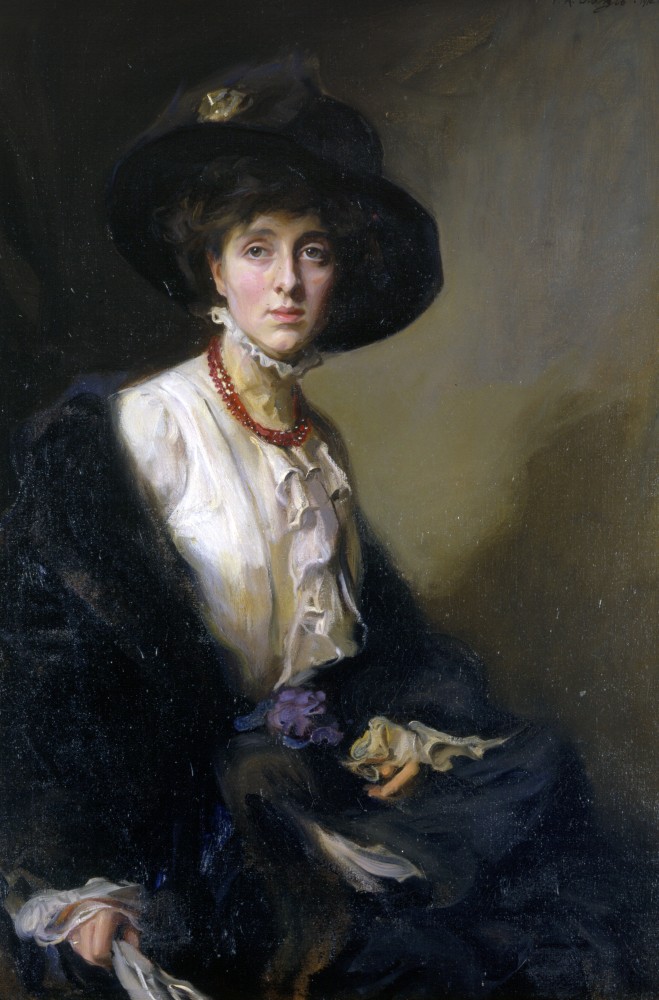
Vita Sackville-West (1892 - 1962) writer, aristocrat.

Vita Sackville-West by Philip de László, 1910
Victoria Mary Sackville-West was born at Knole House in Kent, the only child of Lionel Sackville-West, and his cousin Victoria, the daughter of his uncle, also Lionel, the 2nd Baron Sackville and Pepita, a Spanish dancer. Victoria Mary was usually known as Vita, to distinguish her from her mother. In 1908 the elder Lionel Sackville-West died, and his eldest son, Ernest claimed the Barony, but the English courts declared that he and his siblings were all illegitimate. The younger Lionel thus became the 3rd Baron Sackville.

In 1913 Vita married Harold Nicolson, the 3rd son of the 1st Baron Carnock, of HM Diplomatic Service, which made her the Honourable Lady Nicolson. It was Nicolson’s duty in August 1914, to hand Britain’s declaration of war to the German ambassador. He served at the 1919 Paris Peace Conference and was appointed Companion of the Order of St Michael and St George.

In the closing months of the Great War and for some years afterwards Vita conducted a passionate affair with her childhood friend Violet Keppel, daughter of the old king’s mistress.  Violet would soon marry Denys Trefusis. Vita took the name Julian, and put a khaki bandage around her head, which in the immediate aftermath of war was not uncommon, and browned her face and hands. She was successful in this persona - being tall was an advantage. Julian and Violet travelled to Cornwall, Paris and southern France. The two husbands pursued in a private plane, and the press picked up on the story.

In 1924, Vita published Challenge, a novel, based on their affair, with herself as Julian Davenport the leader of a revolution on a Greek island. His cousin Eve (Violet) joins him as his lover but becomes jealous of his attachment to the island. The book was published in the States only, for Vita’s father found the portrayal obvious enough to identify his family. In the real world, Julian and Violet broke up because the latter had sex with her own husband.

Vita and Harold remained in a loving marriage relationship despite, or because, they both conducted same-sex relations with others. They had two sons. Both their fathers died in 1928. Knole and the Sackville Barony went to Lionel’s brother Charles.

Vita as Orlando, 1928
In the late 1920s, Vita had an affair with Virginia Woolf, who immortalized Vita by imagining her as the gender-switching protagonist of the novel Orlando, 1928.

In 1926 and again in 1933 Vita won the Hawthornden Prize for her long narrative poems. She is the only person to win the prize twice.

In the early 1930s Vita had an affair with Gwen St Aubyn. In the novel, Dark Island, she wrote herself into both the jealous husband, Venn, and his secretary, Christina, as they compete for Shirin, Vita’s real-life name for St Aubyn.

In the 1930s Vita and Harold acquired Sissinghurst Castle in Kent. Sissinghurst is now owned by the National Trust and its gardens are the most visited in England. Gordon Langley Hall, the child of servants on the estate later emigrated to the US where she made a very public transition as Dawn Langley Simmons.

Vita at Sissinghurst 1955
In 1947 Vita was made a Companion of Honour for her services to literature. The same year she began a weekly column in The Observer called “In your Garden”. In 1948 she became a founder member of the National Trust's garden committee. She also published books on travel and literary topics.

In her last novel, No Signposts in the Sea (1961), she denies what we now know her for by having the main character, Laura, muse:
“Perhaps a relationship between two women must always be incomplete--unless, I suppose, they have Lesbian inclinations which I don't happen to share. Then, or so I have been given to understand, the concord may approach perfection.”.
Her fifty-five books include seven collections of poems and stories, twelve novels, and twenty-two works of nonfiction.

She died of stomach cancer in 1962. Harold died six years later.
  • Vita Sackville-West. Challenge. New York: George H. Doran 1924. London: Collins 1974
  • Virginia Woolf Orlando: A Biography. London: Hogarth Press 1928.
  • Vita Sackville-West. The Dark Island. Hogarth Press, 1934.   
  • Nigel Nicolson. Portrait of a Marriage. New York: Atheneum, 1973.
  • “Virginia Woolf and Vita Sackville-West”.  http://kaykeys.net/passions/virginiawoolf/virginiaandvita.html


 GLBTQ    EN.WIKIPEDIA  WORLDCAT  AMAZON.CO.UK


____________________________________________________________

The Wikipedia article comments “The Sackville family custom of following the Salic rules of agnatic male primogeniture prevented Vita from inheriting Knole on the death of her father”.  It was hardly a family custom, it was standard practice. The Wiki authors imply that she would have inherited Knole and the barony otherwise.  However if the custom were not observed,  Pepita’s son, Ernest would have been the 3rd Baron.

Like Dorian Gray, Vita kept the 1910 portrait by Philip de Laszlo in her attic, although not with the same results.

Vita dabbled with transvestity in her 20s but then gave it up.  If she were not so famous in literary circles we would not be considering her as a transvestite.

Dawn Langley Simmons used the name Pepita, precisely because it was the name of Vita's grandmother.

14 February 2009

Bryher (1894 - 1983) novelist, poet.

Annie Winnifred Ellerman was born in Margate. Winnifred was the daughter of a millionaire shipping magnate, John Ellerman, who had risen from humble origins to run the Ellerman shipping line, The Times and The Illustrated London News.

With her first novel, Development 1920 Winnifred took for herself the name of one of the Scilly Isles. She grew up intelligent, rebellious and furious that she was not a boy who could take over the family empire.

She instead became a writer and cultivated artistic friends. She became the lover of Hilda Doolittle (H.D.) in 1918, and her second novel Two Selves, 1923, brings the heroine into a relationship with an H.D.-like poet.

When she consulted Havelock Ellis, Bryher did not see herself as having a 'lesbian problem'. She saw herself as a boy and it was only natural that she become involved with a woman. She cautioned H.D. never to refer to her as 'she'. Not able to become a boy, she attempted to integrate her feminine social self with her masculine inner self.

In general she wrote historical adventure stories about a lone boy, danger and a battle. She thought that she was writing adult fiction and could not understand why the publisher marketed them as juveniles. Nor would she give in to the suggestion that she put sex in the stories. It has been commented that these adventure stories are thoroughly conventional in their presentation of gender roles, although the lack of a romantic interest allowed her to elude heterosexual conventions. An exception was Civilians, 1927, which brought a feminist perspective on female labour during the First World War.

While Bryher is not known as a cross-dresser herself, she was interested in the topic, and as early as 1920 wrote an essay, 'The Girl-Page in Elizabethan Literature' for the Fortnightly Review. Her most poetic novel, The Player's Boy, 1953, follows a young man who plays female parts in an Elizabethan company of travelling players. In the 1930 film, Borderline, she played a butch innkeeper with H.D. and Paul Robeson.

In the early years of the Second World War she provided her home in Switzerland to help Jewish refugees from Germany.

Bryher made two marriages of convenience to men protect her lesbian identity. The first was to the writer Robert McAlmon, which lasted from 1921-7. The second was to Kenneth Macpherson, a bisexual lover of H.D., with whom she adopted H.D's daughter. This one lasted 1927-47. She became pregnant by him, but terminated the pregnancy.

Throughout her life she used her money to subsidize books and publishing including the Paris bookshop, Shakespeare and Company, and James Joyce and Edith Sitwell. She also subsidized film, psychoanalysis and Hellenic studies.
  • Diana Collecott. 'Bryher' in Harriett Gilbert(ed). The Sexual Imagination from Acker to Zola. Jonathan Cape. 1993.
  • Barbara Guest. Herself Defined: The Poet H.D. and her World. Quill 1984 p112-5,122,136.
  • “Bryher”. Wikipedia, the free encyclopedia. http://en.wikipedia.org/wiki/Bryher.
________________________________________

Yes, I was very conscious of writing the sentence "She cautioned H.D. never to refer to her as 'she' ". I attempted to rewrite this using male pronouns, but that does not work either. I had this same problem previously with Mathilde de Morney, but could not become comfortable saying 'he' for a person who answered to 'Missy', and never took a male name.

Bryher is similar. She thinks of herself as a boy, but as she grew older she had two husbands, and a daughter. By modern standards of transsexuality she can be dismissed as merely a dabbler, particularly as she had so much money that literally she could do anything that she wanted to. However she and de Morney preceded the social construction of transsexuality and of trans men, although they had in turn been proceeded by many female husbands. However they probably saw female husbands as a lower class phenomenon. For their generations, what they did was the upper class social construction of female masculinity.

01 January 2009

Bo Laurent (1956 - ) intersex activist, programmer, translator.

Brian Sullivan was born in New Jersey (although some accounts say that he was named Charlie Chase at birth). He was surgically re-assigned to female at 18 months, when doctors found a uterus and ovotestes. While Brian was what was then called a ‘true hermaphrodite’ (although some accounts specify different intersex conditions), the doctors told the parents that he was actually a girl. They excised her penis/clitoris, and her parents moved to another town and called the child Bonnie Sullivan. The child stopped speaking for six months.

They were advised to shield the child from her medical history. Bonnie frequently felt different, but was never told why, although she found out about the clitoridectomy when she was 10. From the age of 19 she tried to access her medical records, and it took three years before she succeeded.

She did a degree in mathematics at Massachusetts Institute of Technology, and studied Japanese at Harvard. She then helped to found a technology company in Japan doing computer and translation work.

At age 35 she had a nervous breakdown and she flew to Florida and asked her mother a lot of questions. She then moved to San Francisco and started contacting anybody who might help. One such was Anne Fausto-Sterling who was about to publish her paper “The Five Sexes” in The Sciences. Sullivan wrote a letter which was published in the next issue (July/August 1993) asking persons with intersex conditions to contact ‘Cheryl Chase’ at the Intersex Society of North America (ISNA), which jump-started the organization.

She became quite critical of the standard of care for intersexed infants developed by Dr John Money, which proposed early corrective surgery and silence to the child so that he/she will not grow up questioning his/her sexual identity. As Cheryl Chase, Sullivan has been a major voice for the position that surgery on intersex children should not be done until the person is able to make an informed choice, that parents and doctors should be open with the child about the condition, and that parents should be ready if the child later opts for the other gender from that in which it was raised.

Chase has appeared in several documentaries on intersex. She changed her legal name to Bo Laurent in 1995. In 1998 she wrote an amicus brief for the Columbian constitutional court re proposed surgery on a six-year-old boy. In 2004 she persuaded the San Francisco Rights Commission to hold hearings on medical procedures for intersex children. She has published in medical journals, and has criticized feminist writers for ignoring surgery on intersex children while condemning female genital cutting. ISNA was honored with the International Gay and Lesbian Human Rights Commission's 2000 Felipa de Souza Human Rights Award.

However in later years she has worked more closely with doctors than with other intersex activists. In particular, she has worked closely with the non-intersex Alice Dreger, who became a major voice in ISNA. She co-authored a paper with Dreger advocating that ‘Intersex’ be replaced by ‘Disorders of Sex Development’ (DSD) – a position strongly criticized by other intersex activists as repathologization.

In 2004 Laurent married her wife of five years in San Francisco, when same-sex marriage was briefly permitted in California for the first time. They live on a hobby farm in Sonomo, California.

In 2008 ISNA was closed down with an anonymous statement, and Chase, who was now openly calling herself Bo Laurent, joined The Accord Alliance (founded by Katrina Karkazis, the author of Fixing Sex: Intersex, Medical Authority, and Lived Experience) which has anonymous funding through the Tides Center and a $305,000 grant from The California Endowment, a spin-off from Blue Cross insurance.

Also in 2008, Bo completed an MA in Organization Development that she had started at the Institute for Advanced Study of Human Sexuality in San Francisco and completed at Sonomo State University.

*Not Cheryl Chase the voice actress.
______________________________________________________________________________________________________

Confusion has arisen from Bo's practice of using both 'Cheryl Chase' and 'Bo Laurent', sometimes in the same publication. Remember the brouhaha when Wayne Dynes also used the name Evelyn Gittone in The Encyclopedia of Homosexuality. In Phyllis Burke's Gender Shock, 1996 (an otherwise well-researched book) Burke somehow managed to interview both Chase and Laurent without noticing that they were the same person.

Susan Stryker's Transgender History, which was published only a few months ago, mentions Chase only as an activist, without a single word about her Bo Laurent persona, and without a single word about the controversy over the DSD terminology.

The 'Cheryl Chase' Wikipedia page has a link at the bottom to a category called "American Intersex Activists'. When you click on it it turns out to be a set of one. There is no mention of Sherri Morris of the AIS Support Group, Hale Hawbecker who is developing a legal challenge to infant intersex surgeries or Curtis Hinkle, the founder of OII. These three are also missing from Stryker's book.