This site is the most comprehensive on the web devoted to trans history and biography. Well over 1800 persons worthy of note, both famous and obscure, are discussed in detail, and many more are mentioned in passing.

There is a detailed Index arranged by vocation, doctor, activist group etc. There is also a Place Index arranged by City etc. This is still evolving.

In addition to this most articles have one or more labels at the bottom. Click one to go to similar persons. There is a full list of labels at the bottom of the right-hand sidebar. There is also a search box at the top left. Enjoy exploring!

Showing posts with label accountant. Show all posts

14 August 2022

Berthold Buttgereit (1891 - 1983) bookkeeper

Buttgereit was born and raised in Berlin, a tomboy who grew up to be a trans man. In 1912, at the age of 21, Buttgereit approached Magnus Hirschfeld and with an expert opinion from Hirschfeld and the neurologist Ernst Burchard was able to obtain a Transvestitenschein from the Berlin police. 

He lived with a woman who was in all but name his wife. In 1918 the Buttgereits moved to Cologne and he obtained a Transvestitenschein from the police there. 


His Transvestitenschein


The next year he attempted to legally change his first name to Berthold, and obtained new expert opinions from the Berlin physicians Ernst Burchard and F. Lehmann. A year later, September 1920, the process was still ongoing. In an attempt to speed it up, he submitted his Transvestitenschein, and the application was finally approved. The decision became legally effective with the announcement on 8 November 1920 in the Deutscher Reichsanzeiger and the Preußischer Staatsanzeiger


The public announcement in the Deutscher Reichsanzeiger.


Buttgereit then applied to officially marry his wife of eight years, but the registry office refused based on his birth certificate. Despite being represented by the Berlin lawyer Walther Niemann (who was close to the WhK) he apparently did not succeed. 

Buttgereit lived the rest of his life in Cologne. From 1920-5 he was a bookkeeper, from 1926 - 1942 (through most of the war) he was bookkeeping foreman, and in 1950 he was promoted to office manager. By 1958 he had retired, and he died at the age of 92.

  • Magnus Hirschfeld. Geschlechtskunde, (4th vol.).  Stuttgart : Julius Püttmann, Verlagsbuchhandlung, 1930: 593 (fig. 883, 884).
  • Rainer Herrn. Schnittmuster des Geschlechts. Transvestismus und Transsexualität in der frühen Sexualwissenschaft. Giessen, 2005: 128-131.
  • Erwin In het Panhuis. “Bertha/Berthold (Emma Charlotte) Buttgereit (1891 – 1983) Tragen von Herrenkleidung nicht untersagt”. Lesbengeschichte, 2006. Online.
  • Erwin In het Panhuis. “Queerer Pionier: Als trans Mann offiziell anerkannt vor genau 100 Jahren”. queer.de.    Online.

27 March 2022

Karl M. Baer (1885 – 1956) journalist, accountant, manager, Hirschfeld patient

Baer was born in Arolson, Hesse, Germany, to a Jewish family, and was assigned female and raised with the name Martha. After a childhood of not fitting in with other girls and preferring to play with boys, her puberty was odd in that she grew facial hair, her voice changed and she never menstruated or grew breasts - she thought that perhaps she had tuberculosis. 

After school, Baer was trained in economics, sociology and pedagogy in Berlin and Hamburg, and became a social worker and feminist activist in B’nai B'rith working against the sexual trafficking of Jewish women. In 1904 she was sent to Lemberg (later Lwow, now Lviv which was then in Galacia) but was sent back early after censure about her male body language. 

By 1905 Baer was living as male. He smoked and drank beer, and was in love with Beile Heilpern Waldberg from Czernowitz, a married woman whom he had met in Lemberg, and who had been supportive in his gender change. They were even contemplating joint suicide, when Karl was hit by a tram and was admitted to the Berlin Charité Hospital. Inspection resulted in him being moved - under protest - to the women’s special ward. He came to the attention of Magnus Hirschfeld, whose opinion that he was mainly male was seconded by Dr Iwan Bloch. Surgery by Dr Georg Merzbach corrected his body to male as far as was possible in 1905, releasing a penis and one testicle. Baer was discharged with a medical certificate confirming his male identity, and an endorsement by Magnus Hirschfeld. In the jargon of the time, he was deemed to be a male pseudo-hermaphrodite.

To get the State to endorse the change of documented birth sex, a wax form was made of the corrected external genital area and taken with a report by Hirschfeld to be inspected by the Minister for the Interior, and since now this was clearly not a female, the Minister conceded to the request for a correction of documents. Hirschfeld gave a lecture on Baer and two others, with Baer present, for Wochenschrift für soziale Medizin, Hygiene und Medizinalstatistik, 1905, using the pseudonym “Anna Laabs” for Baer, and worked with him on his book, a semi-fictional, semi-autobiographical account published under the name N. O. Body. The book was called Aus eines Mannes Mädchenjahren (Memoirs of a Man’s Maiden Years). The account in the book said that Body was French Catholic rather than Jewish, born in Bergheim in Saxony-Thuringia, and named Nora later Norbert.

In January 1907 Baer received his revised birth certificate. He gave his name as Karl M Baer. Initially the M was for Martha, but later he said that it was for Max.

He wrote accounts of the trafficking in women for the magazine Arena and for the journal  Sexualwissenschaft Nr. 9, and then a book on the topic, published by Seemann Nachf in Berlin, all in 1908.

Beile sued for divorce from her husband, Herr Waldberg, who raised the question whether Beile’s affair with Baer should equally be considered adultery as Baer was apparently actually a man. The divorce was granted and she and Karl married. However she died of pneumonia in March 1909. This led to a new court case in that the Heilpern family contested - albeit unsuccessfully - Baer’s inheritance on the grounds that he was not a man.

Karl then married Beile’s friend Elza.


The N. O. Body book sold well and was positively reviewed even in the conservative press. It was reprinted at least six times. It was made into a film twice, in 1913 and 1919 (the latter directed by Karl Grune)

Baer worked for the Victoria Versicherungs AG of Berlin selling life insurance until 1911 when he started working for the Berlin Jewish community. In 1920 he became the director of the Berlin B’nai B'rith. In 1937 B’nai B'rith was raided by the Gestapo and Baer was violently interrogated. On release he sold his apartment and he and Elza moved to Palestine. 

He again worked as an insurance agent, and then as an accountant. He had an affair with his secretary Gitla. Elsa died in 1947, and three years after that Karl married Gitla.

Karl died in 1956 age 71. His tombstone says that M is for Meir.

  • Magnus Hirschfeld: "Drei Fälle von irrtümlicher Geschlechtsbestimmung". Medizinische Reform. Wochenschrift für soziale Medizin, Hygiene und MedizinalstatistikXV, 1906, 51:
  • O. Body: Aus eines Mannes Mädchenjahren. Vorwort von Rudolf Presber. Nachwort von Dr. med. Magnus Hirschfeld.Riecke, 1907.
  • Baer: “Mädchenhandel”. Arena.3. 5 August 1908: 549–555.
  • M. Baer-Berlin. “Über den Mädchenhandel”.Zeitschrift für Sexualwissenschaft Nr. 9, 1908: 513–528.
  • M, Baer. Der internationale Mädchenhandel. Seemann Nachf, 1908.
  • Seigfried Dessauer (dir). Aus eines Mannes Mädchenjahren. Based on the book by N.O.Body. Germany 21mins 1913.
  • Magnus Hirschfeld. Sexualpathologie : Ein Lehrbuch für Ärzte und Studierende. 2. Teil: Sexuelle Zwischenstufen: Das männliche Weib und der weibliche Mann. Marcus & Webers Verleag,1918: 44-8.
  • Paul Legband & Karl Grune (dir). Aus eines Mannes Mädchenjahren. Scr: Karl Grune & Beate Chess, based on the book by N.O.Body, with Erika Glässner as NO Body . Germany75 mins
  • O. Body: Aus eines Mannes Mädchenjahren. Reprint Hermann Simon mit einer Vorbemerkung und einem abschließenden Beitrag: „Wer war N.O. Body?“ Ed. Hentrich, 1993.
  • Sander L. Gilman. Making the Body Beautiful: A Cultural History of Aesthetic Surgery. Princeton, N.J.: Princeton University Press, 1999: 281-2.
  • Myriam Spörri. “N. O. Body, Magnus Hirschfeld und die Diagnose des Geschlechts: Hermaphroditismus um 1900”. L’Homme Z F G, 14,2, 2003.
  • N O Body. Memoirs of a Man’s Maiden Years.English Translation by Deborah Simon of Aus eines Mannes Mädchenjahren. University of Pennsylvania Press, 2006.

  • Sander L Gilman. “Whose Body is it Anyway? Hermaphrodites, Gays and Jews in N. O. Body’s Germany” in Simon, 2006.
  • Hermann Simon. “Afterword: In Search of Karl Baer” in Simon, 2005.
  • Petra Henderson, Original English Wikipedia page on Karl M Baer. 3 November 2008. Online.
  • Jana Funka. “The Case of Karl M.[artha] Baer: Narrating ‘Uncertain’ Sex”. In Ben Davies & Jana Funke (eds) Sex, Gender and Time in Fiction and Culture. Palgrave Macmillan, 2011: 132-153.
  • Geertje Mak. “Scripting the Self: N.O. Body’s Autobiography”. In Doubting Sex: Inscriptions, Bodies and Selves in Nineteenth-Century Hernaphrodite Case Histories. Manchester University Press, 2012.
  • David A. Brenner. “A German-Jewish hermaphrodite: or what sexology contributed to B’Nai B’rith”. In German-Jewish Popular Culture Before the Holocaust: Kafka's Kitsch. Routledge, 2014: 41-9. .
  • “Karl M. Baer”. In: Persönlichkeiten in Berlin 1825 - 2006. Erinnerungen an Lesben, Schwule, Bisexuelle, trans- und intergeschlechtliche Menschen. Senatsverwaltung für Arbeit, Integration und Frauen, Berlin 2015, S. 10–11.PDF.
  • Michaela Koch. “N.O. Body and the Making of a True Man”. In Discursive Intersexions: Daring Bodies between Myth, Medicine, and Memoir. Transcript-Verlag, 2017: 75-111.
  • Ofer Oderet. “Recalling the First Sex Change Operation in History: A German-Israeli Insurance Salesman: The long-forgotten story of a German Jew who was born as Martha and escaped the Nazis as Karl, rediscovered by a Tel Aviv University student”. Haaretz, May 10, 2018. Online.

DE.Wikipedia     EN.Wikipedia      PATA Queens

----------------------

While it is always difficult to interpret old medical accounts in terms of modern diagnoses, it is plausible that Baer had 5-Alpha Reductase Deficiency, which would have been hard for a non-specialist doctor to spot in 1885 as it was not officially recognised until 1961.

No explanation is given of how he avoided conscription 1914-18.

Geertje Mak compares Baer to Herculine Barbin: “The protagonists of N. O. Body’s autobiography Aus einem Mannes Mädchenjahren (Memoirs of a Man’s Maiden Years), published in 1907, and of Barbin’s autobiographical writings have a lot in common. Both were raised as girls and only discovered that they were male in their twenties. Both had already had a passionate love affair with a woman for quite some time before the medical discovery of the error of sex. For both the breakthrough came after a confession of their life story, which in both cases led to a medical examination. Both had been more or less aware that there had been a mistake with regard to their sex, although Barbin seemed to have been more clear about the exact nature of the mistake than N. O. Body. Both were relatively well educated and obviously modelled their narratives on fictional or (auto)biographical examples they themselves had read.”

The major difference of course - which Mak does not mention - is that Barbin did not want to be a man, did not have a male gender identity, but was compelled into being a man. Thus Barbin used suicide to escape from masculinity, while Baer thrived as a man. Some writers compare Baer to David Reimer assuming that biology will out, that a biological male cannot be raised successfully as female. However Reimer was not intersex, he was a cis male. Mak’s comparison of Barbin and Baer is valid in that both had comparable intersex conditions, but what the comparison should show is that biology is only part of what we are. The self-fashioning resulting from biology and environment and choice produces different results.

Petra Henderson in her original version of the EN.Wikipedia page on Baer wrote: “Copies of the medical publications obtained by the University Medical College of Oregon enabled at least one of their female graduates (Dr. Alan L. Hart) to get his sex change surgery in the University hospital in 1917”. It is possible that Dr J Allen Gilbert did read German, and had come across Hirschfeld’s lecture to Wochenschrift für soziale Medizin, Hygiene und Medizinalstatistik  1906, but it was more likely to have read Hirschfeld’s Die Transvestiten, 1910. In either case the diagnosis and treatment were very different between Baer and Hart. Hart did menstruate, did not have a testicle and underwent a hysterectomy.

IMDB gives the plot of the 1919 film as: “A child born without a clear gender is raised by the father as a boy, later by the uncle as a girl and dissected after death” - which is a further deviation from Baer’s life.

Of the three biographies of Magnus Hirschfeld, that of Charlotte Wolff, Magnus Hirschfeld,1986, of Elena Mancini, Magnus Hirschfeld and the Quest for Sexual Freedom, 2010 and of Heike Bauer, The Hirschfeld Archives, 2017, none make any mention of Martha/Karl Baer, Anna Laabs or N. O. Body.

17 June 2018

Thomas de Croismare (1779-1847) soldier, book-keeper, civil servant, musician

Thomas de Croismare was a lieutenant with Napoleon’s army at the Battle of Borodino 1812 outside Moscow (Bataille de la Moskova) the deadliest day of the Napoleonic Wars.

He was also present when Napoleon was defeated at the Battle of Waterloo 1815. de Croismare was wounded in the shoulder and the mouth.

With the creation of Belgium in 1830, de Croismare became a book-keeper, and later an employee at the Ministry of Finance, where he rose to a post of considerable trust.

He was noted for his playing of the violoncello, and for the attentions that he paid to women, although he never did marry.

He died at the age of 68. This resulted in an astonishment in that, when his body was being washed prior to interment, it was discovered that it was of the female type.

  • “Life-Time Disguise of Sex” various newspapers May 1847. Reprinted in William Arthur. The Antiquarian and General Review, Vol 3, 1847: 264 Online; reprinted in The Western Literary Messenger, 1847: 354 Online; reprinted in the Port Tobacco Times, 13 May 1847 Online;  

20 April 2018

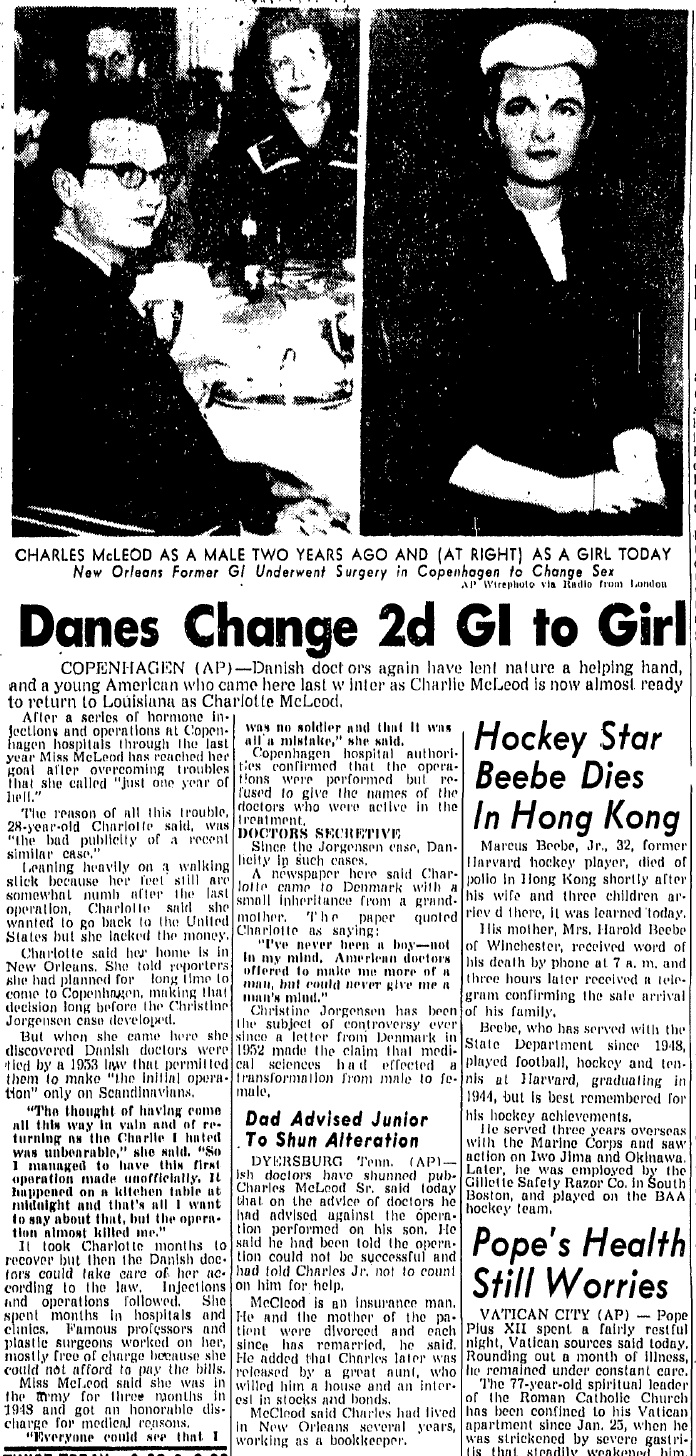
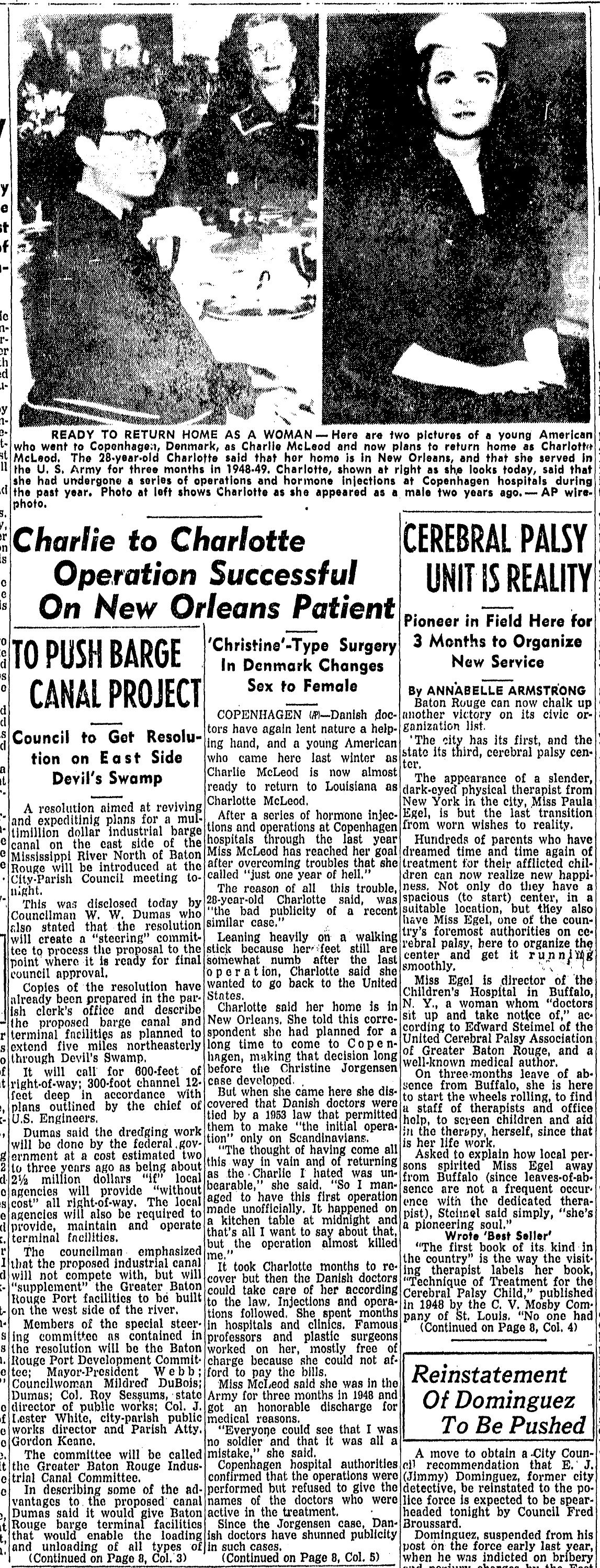
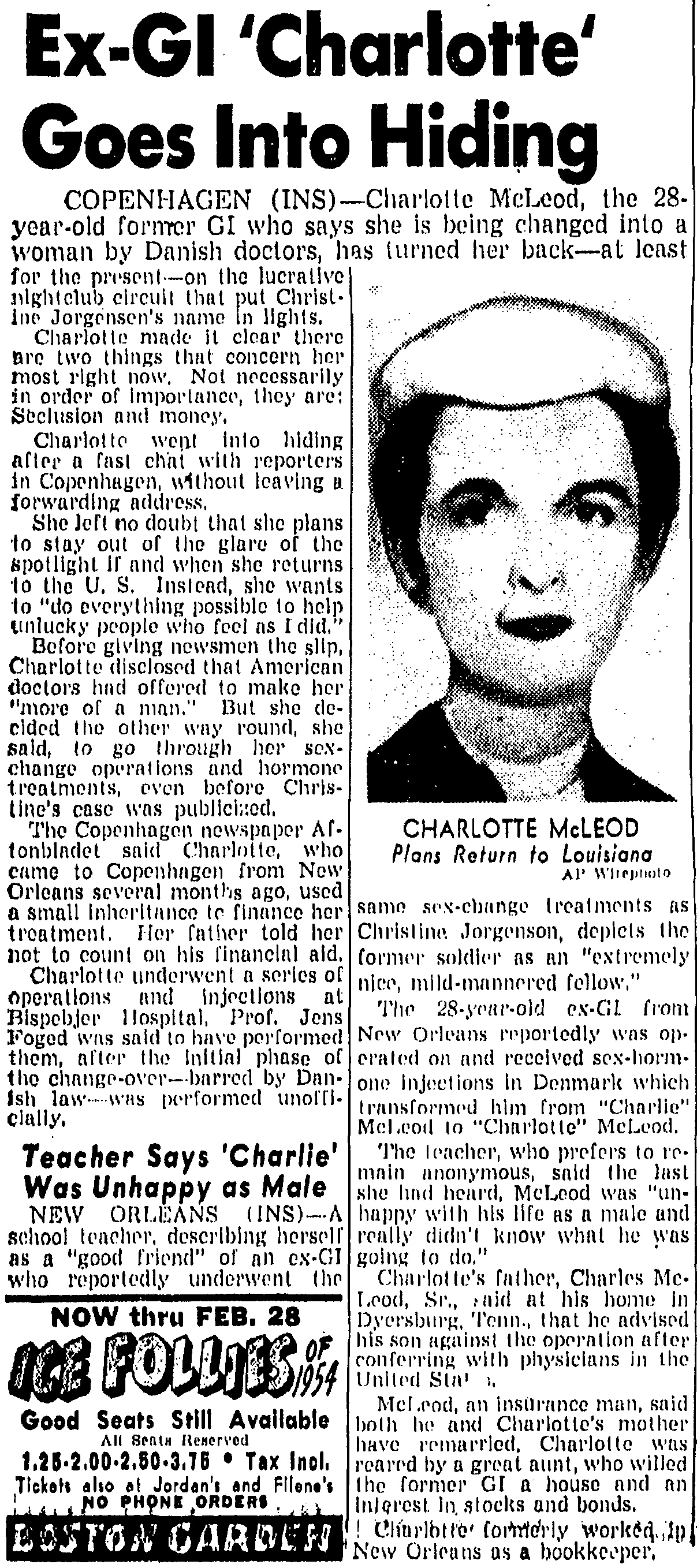
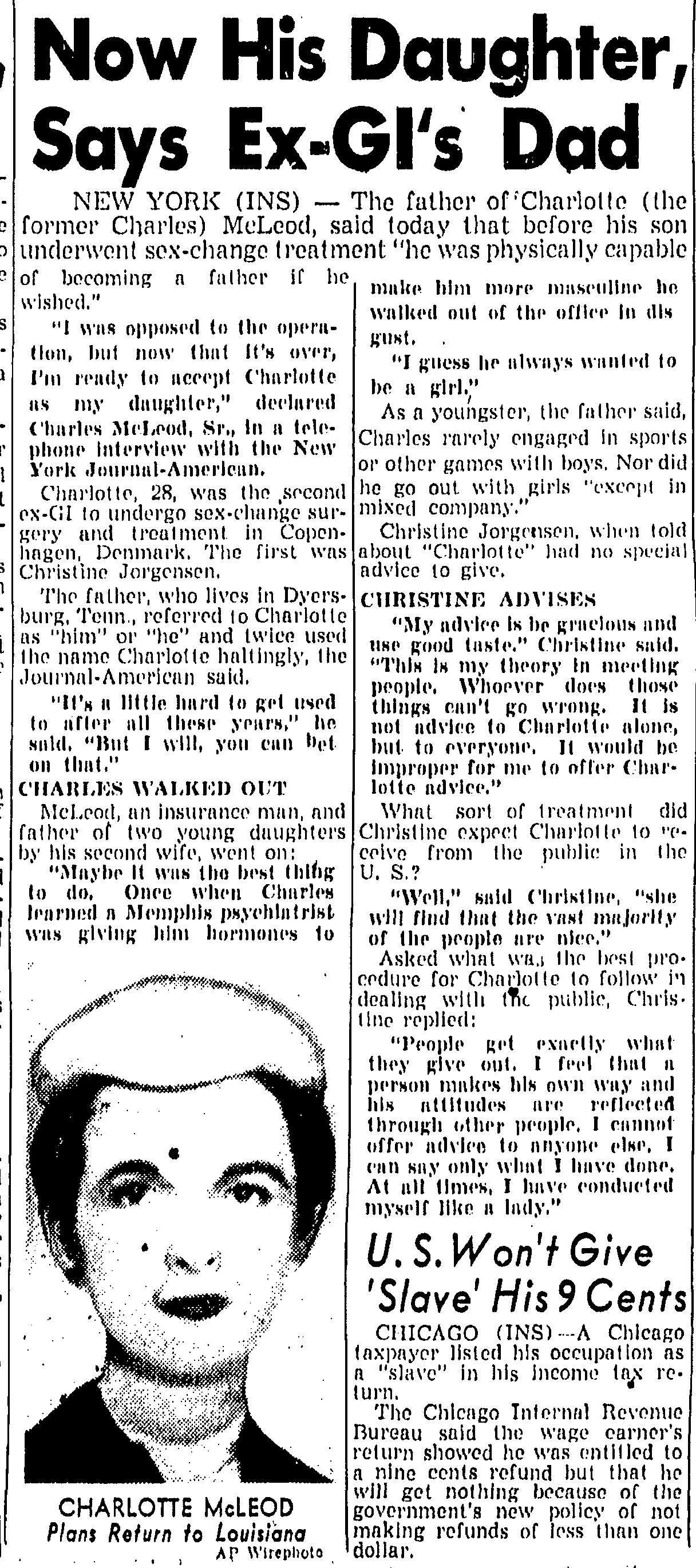
Charlotte McLeod (1925 - 2007) a bookkeeper goes to Copenhagen

Part 1: Youth and Copenhagen
Part II: fame and marriage
Part III: The geography of Charlotte McLeod in New York, 1957

Charles McLeod Jr., the only child of a Ford Motors salesman, was born in Nashville and raised in Dyersburg, Tennessee. The parents divorced when he was 16: both remarried. He was a lonely sensitive boy who lacked interest in masculine things. He was sometimes taken as a girl in boys’ clothing.

He consulted doctors and in the early 1940s went to the Mayo Clinic in Rochester, Minnesota. He also stayed with cousins in Los Angeles in the hope of finding a medical specialist in that city who could help – but without success.

McLeod served three months in the US Army 1948 before being medically discharged with a 4-F rating. McLeod found doctors sympathetic to the idea of a sex change, but they apologized that the US laws re Mayhem would not permit such surgery.

McLeod was advised to “find such little happiness as I could in life by going to one of the ‘colonies’ that abound in our large cities” (McLeod, 1956:12). In 1948, McLeod moved to the French Quarter in New Orleans, but did not fit in the gay world either. He did find work as a bookkeeper for $75.00 a week (a good wage at the time). He tried Boston for a while, but returned to New Orleans.

He went to the Mayo Clinic a second time. They still could not offer anything, because it would be illegal.

In April 1953 McLeod, at age 28, read about Christine Jorgensen and her operation in Copenhagen. He quickly packed, and went to Dyersburg to tell his father what he was doing. With apparent parental approval, McLeod continued to New York and quickly took ship to Denmark using a minor inheritance from a grand aunt. He sailed on the MS-Maasdam. Many of the people on the ship were crossing to England for the Coronation in June.

In Denmark, the Folketing had passed a new law restricting sex-change operations (that is the ‘first’ operation, the orchiectomy or castration) to Danish nationals who were not over 26. By asking around, McLeod was directed to a renegade doctor, Dr Emil Petersen:
“a rather unscrupulous physician, a man who had been charged with collaborating with the Nazis and who had only recently returned from exile. … of frightening appearance who, from the results of a British bullet through the base of his skull, habitually walked so bent over that he never met one’s eye.” (McLeod, 1956:13).
McLeod moved into the doctor’s apartment and waited five days while Petersen came down sufficiently off narcotics to regain his surgical skill. His wife and eldest son were to assist with the operation which took place on the kitchen table. The wife administered the anesthetic.

McLeod awoke in great pain and hemorrhaging. Petersen retreated into drugs, and collapsed outside McLeod’s door. She tore the stitches in her abdomen attempting to get him up, and then an infection set in. She fled and found that she no longer had her passport. She reported this to the police, and she was told that she had to leave the country, but was allowed time to settle her medical problems.

McLeod was admitted to Bispebjerg hospital. The first operation being already done, it was now legal to complete the transition. The Danish doctors led by Dr Jens Foged (1897 – 1956) agreed to do a penectomy and relocate the urethra. Christian Hamburger, who had attended to Christine Jorgensen, was the endocrinologist, and explained to Charlotte about the need for external hormones. She was unable to pay for the medical attention, and so the medical team worked free of charge.

Charlotte then started wearing female clothes, and applied to the US embassy for a new passport. It was re-issued but again in the name of Charles. Her father was contacted, but said that he would give neither financial nor emotional support.

After recovery, Charlotte went with a church outing for a weekend in Bergen, Norway, where she met a US-Norwegian, Ralph Heidal, a seaman, who helped her with skiing.

Twice in 1953, on 5 March and 20 May, a Polish pilot defected to the West by landing his MIG fighter plane on the Danish island of Bornholm in the Baltic. It was probably the second occasion when Charlotte was there having been invited to visit for the weekend. She created a stir: “ I never saw so many Russian troops. Microscopic was their examination of all of our papers and when it was found that my passport didn’t match, I think they thought that they had found the master spy.” (Stryker: 23)

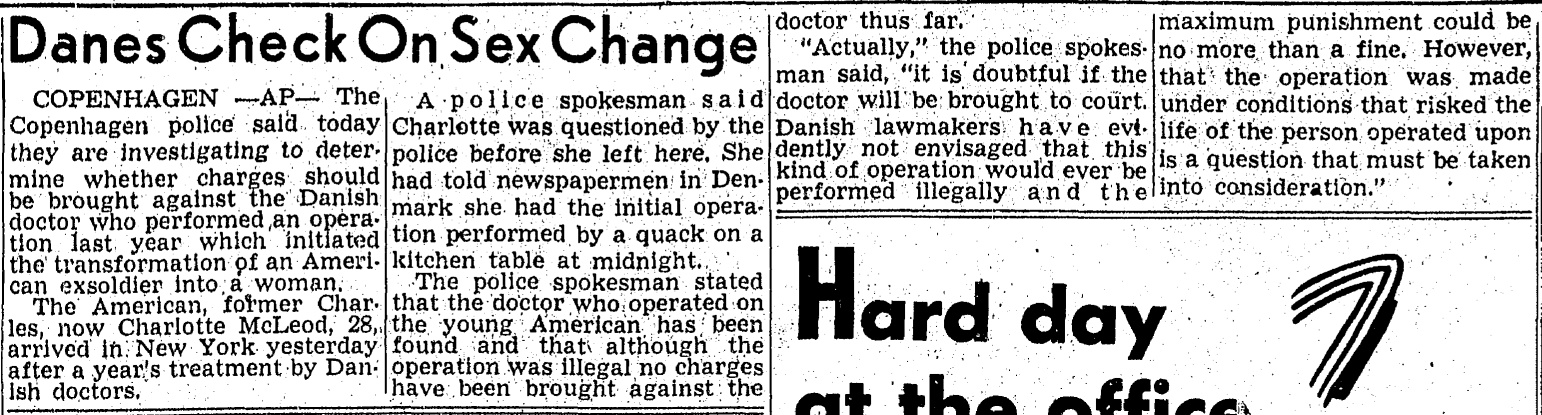
In early 1954 Charlotte gave a very brief interview to journalists in Copenhagen. A 47-page pamphlet, Da Karl blev Karl: En dansk læges bedrift, came out telling of a second US person operated on – this time on a kitchen table. The book names the person as Karla, and the doctor as Petersen.

A few weeks later, on 24-5 February the Danish publication, Aftenbaldet (Evening Magazine) told almost the same story of Charlotte McLeod – and in retrospect it is apparent the Karla and Charlotte were the same person.

The US press picked up on the story immediately.

In early March the story broke that Roberta Cowell in England had also completed a gender change.

In late April the Copenhagen police found that Dr Petersen was the doctor who did the initial operation, and after statements that perhaps he would not be charged, finally he was charged with violating the castration law.

Charlotte inadvertently interrupted a press event for the Canadian actress, Yvonne de Carlo:
“She had all the press lined up for this big landing that she was going to make when she came in from Europe. And they found that I was in next car coach and everybody that was supposed to interview her came gang banging on me.” (Stryker p24)
It was 16 April 1954 when Charlotte arrived at New York’s Idlewild airport. She intended to transfer and fly directly to Tennessee. However fog grounded the plane. She stayed overnight in a hotel, and was swarmed by the press, to the point that she fell over. It was said that in the struggle she struck a photographer with her umbrella, and she and they were arrested and charged with assault. However the charges were quickly dropped.
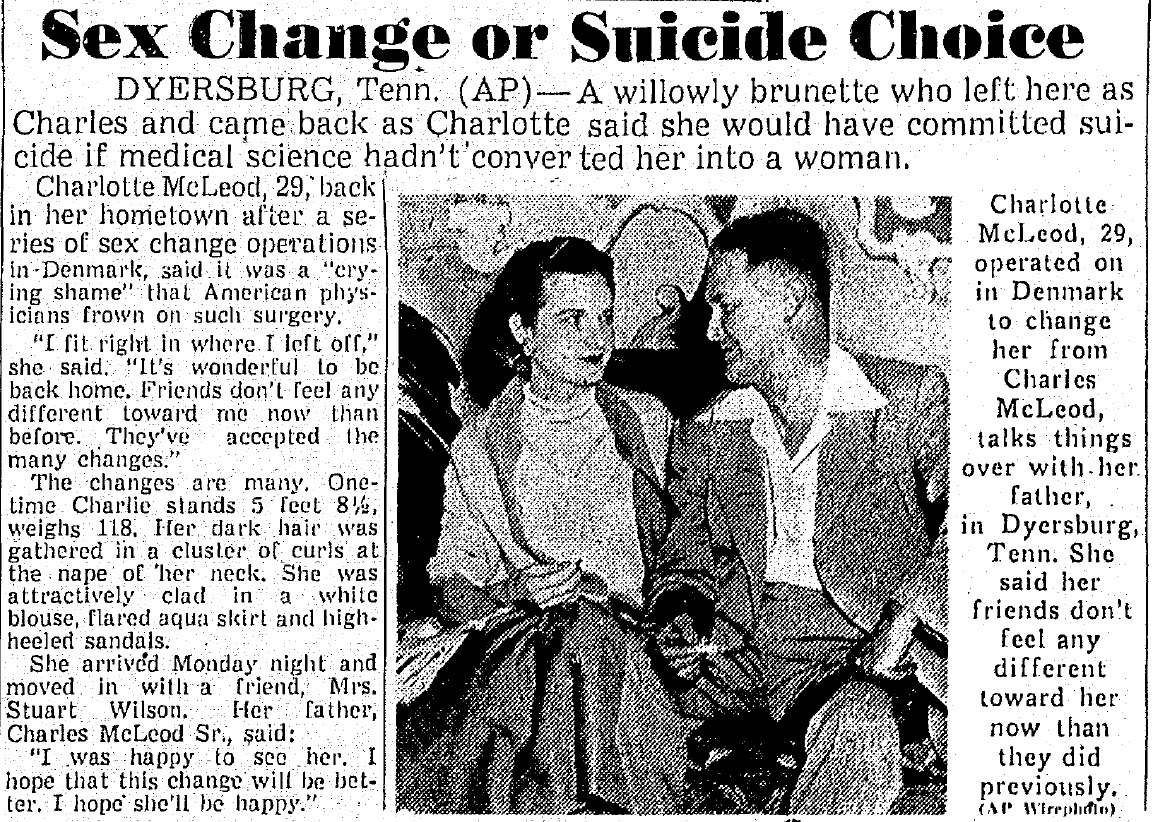
Charlotte reconciled with her father.

She returned to Dyersburg and was reconciled with her father.


Continued in Part II.
__________________

Thank you to Tina Thranesen of Vidensbanken om kønsidentitet who first identified that Da Karl blev Karl: En dansk læges bedrift was actually about Charlotte.

The high quality photographs are from Transas City.

In an interview with Susan Stryker in 2002, Charlotte said (p6) that her father was a Ford Motors salesman. However several newspaper accounts in 1954 said that he was in insurance.

She also said that she was in Denmark for ‘two years’ (p24, 29). However April 1953-April 1954 is one year.

Charlotte did not know, most trans persons in 1953 did not know, but Elmer Belt had quietly started doing vaginoplasties for trans women at the University of California at Los Angeles. He got around the Mayhem restrictions by preserving the testicles, pushing them into the abdomen.

The encounter with Yvonne DeCarlo. This is recounted on p24 of the interview with Susan Stryker. Charlotte says it immediately after saying that she was in Denmark for two years which implies that it was at about the time that she returned to the US. It is unclear whether it happened in Denmark or the US. The expression ‘next car coach’ implies that that they were on a train. I have placed the anecdote immediately prior to her flight to the US, but with further information this may have to be adjusted.
  • Bent Rosenwein. Da Karl blev Karla: En dansk læges bedrift. Self published, 1954.
  • “Ny amerikansk Chris Jørgensen skjult her I byen efter operation”. Aftenbaldet. 24 feb 1954. PDF. Text.
  • “Danes Change 2d GI to Girl”. Boston American, Feb 24, 1954: 3. Online.
  • “Charlie to Charlotte Operation Successful on New Orleans Patient: ‘Christine’-type Surgery in Denmark changes Sex to Female”. Baton Rouge State Times Advocate, 2/24/1954: 1-a, 8-a. Online.
  • “Operation Changes Sex of American”. Eugene Register-Guard. 24 Feb 1954. Online
  • “Ex-Gi ‘Charlotte’ Goes into Hiding”. Boston American, Feb 25, 1954: 3. Online.
  • “Now His Daughter, Says Ex-GI’s Dad”. Boston American, Feb 25, 1954: 3.2. Online.
  • “Medicine: In Christine’s Footsteps”. Time, March 8. 1954. Online.
  • “Charlotte, Who Was Charles, Falls in Hotel Scuffle”. Sacramento Bee, 17 April, 1954:6. Online.
  • “Danes Check on Sex Change”. Sacramento Bee, April 19, 1954: 7. Online.
  • “Sex Change or Suicide Choice”. Boston Daily Record, May 13, 1954:3. Online.
  • Susan Stryker interviews Charlotte McLeod, transcribed by Loren Basham. GLBT Historical Society, August 22, 2002. PDF.

TransasCity Collection           Vidensbanken om konsidentitet


05 September 2017

Sylvia Rae Rivera (1951-2002) activist - beginnings

Part I: beginnings
Part II:  GAA & Weinstein Hall
Part III: Street Transvestite Action Revolutionaries
Part IV:  Other activities to 1973
Part V:  Later years

Early life


Ray José Christian Rivera Mendoza, was three years old when his mother, aged 22, facing death threats from her husband, drank rat poison mixed with milk and gave the same mixture to her children. They would not drink it, but she, after two days of agony, died.

Ray’s Puerto Rican father had already disappeared. He came back only once, and never paid child support. Ray’s Venezuelan-born grandmother, called Viejita (‘old lady’, even though she was only in her forties) took Ray and his younger half-sister to live in Jersey City, where she raised them on less than $50 a week. In 1958 Viejita fell ill for a matter of months, and afterwards sent Ray to live with friends.

He returned at weekends and holidays. By now Viejita was living in Manhattan’s Lower East Side. Ray had had sex with an older cousin at age seven, and at age 10 was having regular sex with a married man down the street. He also wore Viejita’s clothes and makeup when Viejita was out. Ray wore makeup at school from the fourth grade, apparently with no-one noticing except for one teacher who seduced him.

Ray was a noted athlete in track and gymnastics. In the sixth-grade there was an incident when a larger classmate called him a ‘faggot’, and Ray won the resulting fight.

However at age eleven, in 1962, Ray discovered 42nd Street where he had heard that the maricónes were to be found. However a neighbour spotted him, which led to a row with Viejita, a suicide attempt and two months in Bellevue Hospital.

A few months later Ray left and moved in with Gary, a lover that he would stay with for seven years. They both hustled and did drugs, and became well-known around Times Square. Ray was urged to take a new name. ‘Sylvia’ was proposed: “There is no Sylvia around”. So with a formal christening, a white gown and a preacher from a Pentecostal Hispanic church, she became Sylvia Lee Rivera.

By now she had met Marsha P Johnson, who – although only seven years older – acted as a drag mother and showed Sylvia how to survive on the streets. Marsha got her a job at the Childs restaurant chain, first as a messenger. Sylvia was then promoted to billing clerk, and then, working in suit and tie with full makeup, in accounts payable.

Sylvia still did hustling, and after her first arrest she was in the Brooklyn House of Detention for three days. Sylvia was welcomed by Gary’s family, but Viejita was resistant.
“You can’t love another man!”, and later “Why can’t you have a Spanish boy?” – to which Sylvia came back: “Oh, sure, sure – so I can go kill myself like my mother did?”

By the time that she was 15, Sylvia was hustling as a woman. Several times guns were pulled on her, but she never had more than $20 in her purse – the rest was in the hem of her skirt. Sometimes her gender was challenged, but with a wig hair on a tight gaff, she was able to bluff it through. However one night with a trick, her penis did pop out. He beat her hard, she pulled the gun from her purse, and had to use it. After he recovered, the trick toured the Times Square area with two cops in tow until he had her arrested.

Ray called Viejita who did the grandmother act and got Ray released. On a lawyer’s advice, Ray cut his hair, quit the makeup, enrolled in school and appeared in court a model clean-cut teenage boy. “I ask you, your honor; does this look like a street hustler or a transvestite?” The judge agreed, and Sylvia walked.

In Spring 1966, the new New York City mayor, John Lindsay, announced a crackdown on pornography and prostitution. Sylvia, at her usual spot on 9th Avenue and 44th Street was one of many caught in the sweep. Sylvia was put in the gay section in Rikers Island prison. It was here that she started doing heroin. She also met a good-looking black queen who went by the name Bambi L’Amour. They threw shade at each other, and then became firm friends.

Back on the streets, Sylvia teamed up with Kim, a cis woman, and they hustled together, often robbing their tricks. Sylvia was sometimes spending $200 a day on heroin, and hustling in a white fox coat. She also paid for hormone treatments. At first she and her friends had gone to a doctor on the Lower East Side until she got a discharge from her right breast, and found that she had been taking monkey hormones. She switched to Dr Stern on 5th Avenue, who was willing to take bodily contact instead of payment. However she decided to stop the injections.
“I don’t want to be a woman. I just want to be me. … I like pretending. I like to have the role. I like to dress up and pretend, and let the world think about what I am. Is he, or isn’t he?”
One night Sylvia was told that Viejita was ill. Although it was 2am, and she was stoned and in full drag, she hailed a cab and went right over. Viejita opened the door and exclaimed:
“Oh my god, you look just like your mother!” Sylvia replied: “Well, who am I supposed to look like?”
Cohen p146
On her sixteenth birthday, Ray was invited to attend the local draft board. She appeared in high heels, miniskirt, long red nails, the works. Despite her proclamation, “I’m one of the boys”, she was sent with a bunch of women to an induction center in Newark. A psychiatrist asked if there were a problem with her sexuality.
“I know I like men. I know I like to wear dresses. But I don’t know what any problem is.”
She also produced papers from the stay in Bellevue that stated that she was homosexual. The psychiatrist stamped HOMOSEXUAL on the induction notice, and told her that she could go home.  On a roll, Sylvia announced that she hadn’t any money, and needed a lift home. And she got it.

where was Sylvia the night of 27/28 June 1969?


Sylvia was still 17 on this date, five days short of her birthday July 2. 18 was the legal drinking age in New York State at this time. Despite being underage she had a preferred bar: the Washington Square at Broadway and 3rd Street. It opened at 3 am and catered primarily to transvestites.

27/8 June 1969, of course was the first night of the Stonewall riots. (the following accounts are sorted by date).

Holly Woodlawn, A Low Life in High Heels, 1992: 124-5:

"June 26, 1969, was a hot, muggy Thursday night. The humidity in the air was unbearable because every queen in the city was in tears. Judy Garland was dead. ... When I returned to the Stonewall the next night, there was so much commotion --sirens blaring, people screaming --I thought that a bomb had gone off. The cops were everywhere, and a chill shot up my spine as I drew closer, fearing the worst. I wedged myself into the mob for a closer look and heard a raspy scream, 'Asshole!' A street queen named Crazy Sylvia had just broken a gin bottle over a cop's head!"

Rey “Sylvia Lee” Rivera. “The Drag Queen” in Eric Marcus. Making History: The Struggle for Gay and Lesbian Equal Rights, 1945-1990 : an Oral History. HarperPerennial, 1992: 191-2.

“We had just come back from Washington, DC, my first lover and I. At that time we were passing bad paper around and making lots of money. And I said, ‘Let’s go to the Stonewall,’ So I was drinking at the bar, and the police came in to get their payoff as usual. They were the same who always used to come into the Washington Square Bar.
“I don’t know if it was was the customers or if it was the police, but that night everything just clicked. Every was like, ‘Why the fuck are we doing all this for? Why should we be chastised? Why do we have to pay the Mafia all this kind of money to drink in a lousy fuckin’ bar? And still be harassed by the police?’ It didn’t make any sense. The prople at them bars, especially at the Stonewall, were involved in other movememts. And everybody was like: “We got to do our thing. We’re gonna go for it!”
“When they ushered us out, they very nicely put us out the door. …
“That night I got knocked around a bit by a couple of plainsclothes cops. I didn’t really get hurt. I was very careful that night, thank God. But I saw other people being hurt by the police. There was one drag queen, I don’t know what she said, but they just beat her her into a bloody pulp. There were a couple of dykes they took out and threw in a car.”

Martin Duberman. Stonewall. Plume, 1994: 190-3.

Sylvia and Gary had returned from passing bad checks in Washington, DC. Sylvia also had a job as an accounting clerk in a Jersey City warehouse. There was to be a party at Marsha’s, but Sylvia decided to stay home, until Tammy Novak phoned, and absolutely insisted, would not take ‘no’ for an answer, that they meet later in the Stonewall. When the cops raided, Sylvia panicked thinking that she had forgotten her ID, but Gary had brought it. A cop asked if she were a boy or a girl, and she almost swung at him, but Gary grabbed her in time. The cop told her to get out of the place. She then watched from the park across the street.

Duberman adds in the endnotes p300n40: “At least two people credit Sylvia herself with provoking the riot: Jeremiah Newton (New York Native, June 15, 1990) has her throwing an empty gin bottle that smashed in front of the Stonewall door; and Ivan Valentin (interview July 5, 1991) insists that Sylvia actually jumped a cop and thereby ‘started the Gay Liberation movement’. But I’ve found no corroboration for either account, and Sylvia herself, with a keener regard for the historical record, denies the accuracy of both versions. She does remember ‘throwing bricks and rocks and things’ after the mêlée began, but takes no credit for initiating the confrontation.”

Sylvia Rivera. “Queens in Exile, the Forgotton Ones” in Joan Nestle, Clare Howell & Riki Wilchins. GenderQueer: Voices from Beyond the Sexual Binary. Alyson books, 2002: 77-8.

This account of Stonewall is notable in being in the plural. Sylvia does not say that she actually was there.

“The night Stonewall happened everybody was out partying. People were mourning, even me. We were mourning Judy Garland’s death. Some authors have said that the riot came out of Judy Garland’s death, but that’s not true. Judy had nothing to do with the riot. … We fought back. … So this night was different. This was the start of out talking back, speaking up for ourselves. … they proofed us. We went out the door. But no one dispersed.”

Bebe Scarpinato & Rusty Moore. “Sylvia Rivera Obituary”. Transgender Tapestry, 98, Summer 2002:34.

“She was present and participated in the Stonewall Riots, which became the determining event of her life.”

That is all that they say about Stonewall.

David Carter, author of Stonewall : the riots that sparked the gay revolution, 2004, did not mention Sylvia Rivera even once in his book. He was interviewed by Gay Today, and asked about this lacuna.

“I am afraid that I could only conclude that Sylvia's account of her being there on the first night was a fabrication. Randy Wicker told me that Marsha P. Johnson, his roommate, told him that Sylvia was not at the Stonewall Inn at the outbreak of the riots as she had fallen asleep in Bryant Park after taking heroin. (Marsha had gone up to Bryant Park, found her asleep, and woke her up to tell her about the riots.) Playwright and early gay activist Doric Wilson also independently told me that Marsha Johnson had told him that Sylvia was not at the Stonewall Riots. Sylvia also showed a real inconsistency in her accounts of the Stonewall Riots. In one account she claimed that the night the riots broke out was the first time that she had ever been at the Stonewall Inn; in another account she said that she had been there many times. In one account she said that she was there in drag; in another account she says that she was not in drag. She told Martin Duberman that she went to the Stonewall Inn the night the riots began to celebrate Marsha Johnson's birthday, but Marsha was born in August, not June. I also did not find one credible witness who saw her there on the first night.”

Stephan L. Cohen. The Gay Liberation Youth Movement in New York: 'an Army of Lovers Cannot Fail', 2008: 90.

“Overcoming adversity is but one aspect of their story. Street transvestites were in the forefront of the gay liberation movement—joining those responsible for the Stonewall Rebellion: transvestites and lesbians who resisted inside the bar, street kids protesting outside, including Jackie Hormona reported to have “kicked a cop,” the effeminate gay male “flame queens,” and the “lesbian who fought the police” along with other gays, lesbians, agitators, students, and passers-by. Street transvestite Marsha P. Johnson was seen climbing a lamppost and dropping “a bag containing a heavy object” on a police car windshield, shattering it. Although Sylvia Rivera later explained that she had come down the avenue, turned the corner and joined the protest (this would presumably have been on one of the subsequent nights, as neither Bob Kohler nor Marsha saw Sylvia that first night).”


Cohen adds a footnote: p244n6. “Martin Duberman’s lively, Stonewall account of Sylvia’s participation in the Stonewall rebellion conflicts with Bob Kohler’s understanding: Sylvia privately acknowledged to Kohler that she was not present the first night of rioting (Bob Kohler, interview by author, NYC, July 21, 2003).”

-----------------------------------------------

It does not matter whether Sylvia was at Stonewall or not; whether she watched passively or joined in.  What she did later, in STAR and in being the public face of transgender in 1970s New York, is what is important.   This we will see in the next part.


01 October 2014

Charl Marais (1958 - 2013) teacher, bookkeeper, activist.

Marais was born and raised in Cape Town, in a religious family. As both parents worked, the child lived, until the age of ten, with other family members, and was sexually abused by an uncle.
"I knew that I was a girl because I looked like all the other girls, but why did that make me sad? … The most permanent thought and feeling in me almost all of my life was this feeling of just going though the motions. Medication was the only thing that could bring me out of this feeling of wanting to die and possibly commit suicide."
When in hospital having the appendix removed, a friend suggested that to Marais that she was a lesbian. She knew that she had had crushes on girls but thought that "this was wrong as it's not Christian". At this time, 'lesbian' was the only concept that she had encountered that approximated her feelings.

Marais qualified as a teacher, but did not feel suited to the profession,  and was admitted to a psychiatric hospital in 1978. The uncle who had abused her came to visit and Mrs Marais applied for a court order to keep him away. The lawyer who was assisting met Marais, and straight-away asked: "Have you ever considered having a sex change?". This set her thinking.

Marais obtained a teacher's post in a small school of 50 children in Port St Johns in the Eastern Cape.
"I met a girl there, and it was like an instant attraction for both of us. The sex-change thing didn't yet sit well with me because it was impossible, So we went with the lesbian thing."
In 1981 Marais moved back to Cape Town and found work at a newspaper. When the girlfriend arrived she was pregnant, which led to their breaking up.

In the mid-1980s Charl Marais discovered the Cape Town group, Phoenix, which was a Virginia Prince type group of mainly married cross-dressers. Charl was welcomed to their meetings and parties, and made a fuss of as he was their only female-to-male member, and also their only coloured member (this was still the apartheid era). One of the members was transsexual and told Charl about gender surgeries, and that operations were being done in Durban by Dr Derk Crichton.

In 1992 Charl had a hysterectomy and an ovarectomy, and was able to change the name on his ID card (but not the gender code embedded in the ID number).

One girlfriend left because he didn't have phalloplasty, even though he couldn't afford it. Another committed suicide.

From 2002 Charl worked as a bookkeeper.

After the Alteration of Sex Description and Sex Status Act 2003, he applied again to change his ID number but each person he saw demanded different documentation. In 2009 he tried again armed with letters from a psychiatrist, psychologist and two GPs, and the Department of Home Affairs lost his application form. He tried again in June 2010, and this time was successful.

He became involved with Gender DynamiX, South Africa's major transgender organization, and for some years was their bookkeeper and newsletter editor. In 2010 he was a co-editor and contributor to Trans: Transgender Life Stories from South Africa.

He died at age 55 after a period of illness.
LinkedIn

21 August 2014

Miranda Yardley (1967 - ) accountant, music magazine publisher

++some changes of detail, based on feedback from Miranda.

From Manchester, Yardley completed a degree in Accounting and Finance at Bangor University in 1990.

After moving to London, Yardley qualified as a Chartered Accountant and worked externally for a publishing company. In 2000 Yardley & Co, a small independent accounting business was set up. The publisher considered shedding a couple of titles.
“Early in 2002 the company wanted to remove Terrorizer from their portfolio of titles, and they offered it to me earlier in the year and I politely declined, later on the same year the company’s circumstances changed and when they offered again, I took it with both hands”.
Terrorizer, published every four weeks, specialized in extreme music, and Yardley's takeover was at the time of its first Genre Specials: Punk, Gore and Prog in 2002 and Thrash in 2003. They also arranged live gigs. Yardley incorporated as Dark Arts Ltd.


Terrorizer Online was launched in 2007.  2009 saw the bi-monthly Dominion and the standalone Sick Sounds.
“I made a very difficult decision last year to move from a role as a practising accountant and earning a reasonable amount while part-time managing Terrorizer to taking on these concepts that I had in my head”.
It was also during this period, 2008, that Yardley completed transition as Miranda.
"I am known as being a trans woman who gets along in a world that’s very male dominated, not that I would ever deny the male privilege that got me here."
Miranda is an outspoken woman, and does not automatically accept the new dogmas of the trans movement.
"What are the implications for women of positing the existence of a "female brain" in a society where to be female is to be considered inferior? Should someone be accepted as a woman just because they say they are? Do the rights of a trans woman who has lived as a man for 60 years to not feel intimidated by having to use male facilities trump the rights of women to have a safe space where they do not need to be concerned about voyeurism or sexual violence? "
Others have rushed in to proclaim her to be a TERF, or a 'self-hating trans woman". She labels her own position as 'gender critical' a term proposed by Joan W Scott in 1986, also used by some anti-trans feminists with far less nuance.

On 11 August 2014 BBC's Newsnight attempted to set a discussion re the boxing promoter and UKIP candidate, Kellie Maloney, who had recently come out as trans. They approached some feminists such as Julie Bindel and Sarah Ditum, but based on previous experience none of them would have anything to do with the topic. Therefore Newsnight settled on two trans women and one trans man: Miranda Yardley, Paris Lees and Fred McConnell. Paris took umbrage with the lineup and tweeted that she was “not prepared to enter into a fabricated debate about trans people’s right to exist/express themselves". Fred tweeted that it was a “TERF-filled trap”. Then Newsnight had to inform Miranda that the proposed session was cancelled. The Independent invited both Miranda and Paris to write about the experience. Miranda filed her version, but again Paris pulled out.
LinkedIn     SoundSphere      Terrorizer   blog
_______________________________________________________________________________

The prospect of three transsexuals being able to discuss their differences without the balance of others that the media always seem to feel is obligatory was a delightful opportunity squandered.

Miranda Yardley is an admirable example of a trans woman who has done something useful with her life.

We do need to hear from Paris Lees about why she is so terrified of discussing with another transwoman who has different opinions. 

15 January 2010

Maxwell Anderson (1956 – 2010) tax accountant, psychologist.

After spending early adulthood in Chicago, Maxwell began transition to male in the mid 1980s.

He moved to Florida in 1990 where he ran the transgender support group, The Eden Society.

In 1996 he moved to  the Atlanta area. He worked as a lecturer and was a certified tax expert. He was a friend of Robert Eads, and in 2000 he co-chaired the 10th Southern Comfort convention. Maxwell and Robert are in the associated documentary Southern Comfort.

He later married his girlfriend and did a PhD in Psychology and had a practice specializing in GLBT issues. He was also a certified Grief Counselor. He was working on a second documentary, Southern Comforted.

He died of brain cancer at the age of 53.

*Not the playwright.

08 September 2008

Frenchy Vosbaugh (1827 - 1907) bank clerk, restaurateur, ranch hand.

Katherine Vosbaugh was born in France to a well-off father who gave her an excellent business education. He died when she was twenty, but by that point she was an expert accountant and spoke four languages.

She assumed male guise when she moved to the United States with the ostensible reason of securing employment - although he stayed in the male role for the rest of his life.

After working in various cities, Frenchy settled in Joplin, Missouri where he worked for fifteen years as a bank clerk. He took a wife at this time. At least part of the reason was to save her good name for she was pregnant. However the child died after a few months.

After the child died, the couple moved to Trinidad, Colorado where they opened a restaurant.

The wife drifted off and Frenchy took a job as cook on a big sheep ranch, sleeping the same room as the other men.

At the age of 78 he contracted pneumonia and was hospitalized. The medical treatment led to the discovery that he was a woman. However he was allowed to remain in the hospital, working as a man, for what turned out to be the last two years of his life.
  • “Woman Who Posed as Man 60 Years, Dead/Born in France/Only Reason Was to Secure man’s Work”. The Trinidad Advestiser. Nov 11, 1907. In Jonathan Ned Katz. Gay/Lesbian Almanac: A New Documentary, Harper & Row Publishers, Inc. 1983, Carrol & Graf Publishers, Inc. 1994: 323-4
  • Louis Sullivan. Information for the female to male cross dresser and transsexual. Seattle: Ingersoll Gender Center. 1st Ed Janus Information Facility. 20 pp1980.2nd ed 48 pp 1985. 3rd ed.. iii, 123 pp1990: 10.