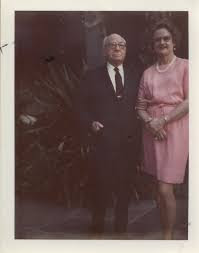
 A decade ago a fair number of trans activists - especially the Harry Benjamin Syndrome people and the ‘Classic Transsexuals’ - strongly distanced the all-accepting Harry Benjamin from the homophobic, transgender-phobic Virginia Prince. For historians this is problematic in that Benjamin and Prince were associates. Robert S Hill in his pioneering 'As a man I exist; as a woman I live': Heterosexual Transvestism and the Contours of Gender and Sexuality in Postwar America says that they were ‘personal friends’ (p 303) but gives almost no examples of them working together.
In my close-reading of Benjamin’s The Transsexual Phenomenon I showed how Prince had influenced the book, and noted the references to her and the acceptances of her ideas. However, we should note that Benjamin always puts quotation marks around “Virginia” thereby not accepting it as her real name - hardly the action of a ‘personal friend’ as Hill puts it.
What about the other side? How is Benjamin mentioned in Transvestia magazine, edited by Prince?
Up to 1962 writings by Benjamin were frequently reprinted in Transvestia, with positive comments. A break point seems to be the 1962 Halloween meeting at Susanne Valenti’s Chevalier D’Eon Resort. The guests included Virginia Prince, Katherine Cummings, Felicity Chandelle, Darrell Raynor and Gail Wilde, and psychologists Hugo Beigel and Wardell Pomeroy. Raynor, Cummings and Beigel later wrote about the event. Benjamin was invited and expected, but gave the excuse that he was in Europe and could not get back in time.
Was this a polite excuse to avoid going? Was umbrage taken? Shortly after this, Siobhan Fredericks in New York, who had quit FPE, started a competing magazine, Turnabout and made fun of the many femme* words that Prince had coined, and attracted cross-dressers who were critical of Prince and her ideas. Fredericks started a support group in her home, to which Harry Benjamin sent some of his patients, including Renée Richards.
Whatever the reason or the emotion, only twice again was an article by Benjamin featured in Transvestia (#22, August and #24, December 1963). Contributors Susanna Valenti and Sheila Neils continued with positive mentions of Benjamin, but Prince went mute for most of the rest of the 1960s with only three exceptions: the review of The Transsexual Phenomenon; the accounts of her travels wherein, being in New York or San Francisco, she would manage to wrangle an invitation for a meal with Harry Benjamin; and an extended article (#60 December 1969) to discourage surgery in which she disagrees with Benjamin on whether one who has been a husband and father can properly become a woman.
Benjamin continued his practice of supporting all transvestite and transsexual groups, and visited some (including FPE chapters) when it was convenient. He also wrote to the US Passport Bureau in 1966 in support of Prince's application for a passport in her female name.
All issues of Tranvestia are available at the Digital Transgender Archive.
Transvestia # 2, March 1960.
p 21- 7 is a reprint of the paper “Homosexuality, Tranvestism and Transsexualism: reflections on their Etiology and Differentiation” by CV Prince, Phd, with a preamble by Harry Benjamin who is mentioned several times in the text. It was originally published in the American Journal of Psychiatry, 80. 57. 1957.
Prince says of it:
“The following article was written by your Editor and through the assistance of Dr. Harry Benjamin whose help is gratefully acknowledged.”
On p 51 there is a letter:
Dear Ed: I am 42 yrs., 6 ft. 190 lb., married, 4 children. Wife knows but doesnt understand. Have consulted with Dr. George Henry of Rochester N.Y. the greatest M.D. expert on TV, also Dr. Harry Benjamin. There is no cure so lets deal with it out in the open. I was Capt. of a (major university) team— got the D.S.C. in combat but I still have this problem.
S.C. Kentucky
Transvestia # 3, 4, 5, May, July, September 1960
A reprint of N Lukianowicz. “”Survey of Various Aspects of Transvestism in the light of our Present Knowledge” is presented in three parts. It was originally published in the Journal of Nervous and Mental Diseases, 128,1, 1959, and draws on Benjamin’s publications. Prince interjects editorial comments of disagreement at various points.
Transvestia #6, November 1960
p 37-48 is a reprint of Benjamin’s “Transsexualism and Transvestism as Psycho-Somatic and Somato-Psychic Syndromes”, a paper which had been given at the Association for the Advancement of Psychotherapy December 1953, and printed in the American Journal of Psychotherapy, 8,2, 1954. Prince republished it here without any comments.
Transvestia #7, January 1961
The Cover Girl Denise wrote:
“Since I am to be married in the near future I decided to consult a doctor for my own sake and also for the sake of my future wife. Fortunately I live in a large city and was able to see one of the formest men in the sexological field and a man who knew a great deal about TVism. He assured me that I was a perfectly normal male but that I had certain feminine characterists as do most men. He also spoke to my fiancee and explained my practices.”
Prince added an editorial note that the doctor was Dr Benjamin.
Transvestia #11, October 1961
“ QUESTIONAIRES STILL NEEDED: SEXOLOGY has accepted an article based on our survey of TVs which was published in #9. I entitled this one ‘l66 Men in Dresses’. It will appear in a forthcoming issue. I wish to write up the same material for a medical journal, Dr. Harry Benjamin has encouraged me to do so saying that the Survey is a real medical contribution. I’d like to have a round 200 to report on as doctors like large numbers of cases. I still need about 3 doz. Please help the cause. If you have mislaid your copy write for another.”
Transvestia # 12, December 1961
p 14. Prince tells out she flew into New York on her way to that year’s Halloween Weekend at Susanna Valenti's Casa Susanna in upstate New York. While in New York City,
“I was chauffeured over to Dr. Benjamin's office for a nice but too brief visit and dinner with him. Those of you who have never met Dr. Benjamin have missed a real treat. People of our persuasion have no better professional friend.”
p 48-54 is the account “The Unfree” by “William J O’Connell” (although she is a trans woman, no female name is given. ) It recounts the difficulties that she encountered in trying to change sex and gender. This account was republished five years later in The Transsexual Phenomenon, where Benjamin appended a note:
“To bring this tale to a close and up to date, this patient, after another year or so, did find a skillful surgeon abroad. The operation was successful as I was able to convince myself. This is a more contented person now.”
This presumably happened later than 1961.
In The Transsexual Phenomenon, Benjamin’s introduction to the account is a single paragraph, and does not mention the prior publication in Transvestia #12:
“One of my patients had a deeply disturbing experience, disturbing not only to him but to every fair-minded person, including independent physicians. Being a highly articulate and educated man, he wrote up his experiences for a magazine, Sex and Censorship, which was published on the West Coast several years ago, but exists no longer. I was impressed with this patient's truthful statements and agreed to write an introduction to his story. In it, I explained the fundamental facts of transsexualism and discussed (regretfully) medical censorship as it exists in this country and in this day and age. Here, in a slightly abbreviated form, is what the patient wrote.”
However in Transvestia #12, Benjamin’s introduction, is 5½ pages and called “Sex Censorship in Medicine” where he explains how medical treatments desired by the patient and approved by doctors are thwarted by lay persons (often priests etc on the hospital board of trustees).
Transvestia #17, October 1962
p 63
“Halloween time is fast approaching . . so far the only time of the year in which the law won’t frown . . most of you have by now heard of our planned get-together . . on Oct. 27 - 28 . . Dr. Pomeroy of the Kinsey Institute has just notified me he’s accepting my invitation to meet all of us . . his letter says in part" . . It sounds fascinating and I am looking forward to the opportunity of meeting so many TVs all in one place." Dr. Harry Benjamin has promised he’ll shorten his European tour in order to attend with his wife . They’ll both be our guests of honor.”
As we know, Benjamin did not make that meeting.
Transvestia #18, December1962
p 64, Susanna Valenti reported on the Halloween meeting at her upstate resort.
“As you all know, there was a big get-together for Halloween at our resort. Dr. Pomeroy of the Kinsey Institute was there as well as Dr. Hugo Beigel. Both as our guests for the event. We missed Dr. Benjamin who just could not return from Europe on time to be with us. The presence of his two colleages was indeed a novelty for most of the girls as well for the 9 wives who managed to retain their sanity as well as their sense of humor in the midst of a veritable tornado of skirts and barely covered blue shadows.”
Transvestia #22, August 1963
P 62-8 is a reprint of Harry Benjamin’s article, “7 Kinds of Sex” originally published in Sexology, 27,7, February 1961.
Transvestia #24, December 1963
P 68-71 is also a reprint of an article by Harry Benjamin. This is labelled “I Want to Change my Sex” and was a letter to Sexology answered by Benjamin in issue 30, 5, December 1963., and was accompanied by this photograph of an otherwise unknown trans woman, giving both her male and her female names.
The letter and Benjamin’s replay are also included in The Transsexual Phenomenon.
Prince adds an editorial comment:
"The preceeding article was reprinted by permission of the Editor of Sexology where it originally appeared, and at the request of it’s author, Dr Harry Benjamin. It was with full willingness that your Editor concurred with this, for I too feel that this subject can hardly be overemphasized . While there are certainly true transsexualists who may be benefited by surgery, but who should nevertheless consider the complications carefully beforehand, there is a stage in the development of a TV that leads him that surgery would be the "answer” . I say a "stage” because with a little further development, most of us come to realize that this is not the answer at all . The problem is to help the individual to develop past this point. A clear consideration of the problems involved, such as Dr. Benjamin has given in this article is one of the best ways of helping such people to outgrow this feeling and to accept themselves and their transvestism and to seek their happiness without surgery."
p 84-7 is an account by Virginia Prince of a trip to New York in early November 1963. The day after arrival:
"I got up early, fixed myself up as pretty as possible and caught a taxi to go down to the hotel where the meeting of the Society for the Scientific Study of Sex was in session . My part of the program did not come till the after noon so I had not tried to make the moring session. I had lunch with several prominant members of the Society and with Dr. Burchart of Germany who was also to be one of the panel speakers.
It was very difficult to get the idea over to him that TV’ s where not necessarily interested in surgery. In fact, this confusion was apparent during the afternoon session too.
Finally luncheon was over and we adjourned to the auditorium and I took my place on the stage. The panel consisted of Dr. Harry Benjamin, who spoke first and reported on a number of transexual patients in his experience, the first time any consideable number of such persons had been reported on to a scientific meeting. Then came my turn and I presented my paper. I have reprinted it here because I felt that all readers would be interested in how the subject was presented to the meeting .
….
Had a wonderful dinner with Dr. & M r s . H. Benjamin and Dr. Beigel which topped it off. I was taken to lunch by Mr. Hugo Gernsback , Dr. Rubin and two of the editors of SEXOLOGY Magazine. Mr. Gernsback was the founder and publisher of the magazine and the grand old man of the field of public education on the subject sex. We all owe him a debt because it was he that provided the outlet for Dr. Cauldwell’ s writings on the subject of TV which gave a modicum of understanding and encouragement to many of us in the dark ages many years ago."
Prince’s paper that was presented along with Benjamin’s was “The Expression of Femininity in the Male” and was also printed this issue of Transvestia, was later printed in The Journal of Sex Research, 3,2, 1967.
Transvestia # 25, February 1964
p80 Susanna Valenti writes:
“Did anyone say that women are great gossipers? I guess TV's reaffirm that concept . . we certainly love to gossip . . the trouble with gossip is that the original story, as it passes from mouth to mouth, becomes a bit distorted . . and one distortion is added to another . . until the story assumes the proportions of a sensational event . . for instance, if a TV should be seen at Dr. Benjamin's office, his reputation as a normal human being is shot to pieces . . his presence there immediately suggests hormone treatments . . the treatments are immediatly thought to be a preliminary step towards Casablanca.”
Transvestia # 26, April 1964
p79 Susanna announcing two “fabulous TV movies in bright, brilliant Eastman color, produced entirely by TV’s. Not the average home movie variety”. They were filmed by “Andrea (formerly Jacqueline)” . …. “We have invited Dr. Benjamin and Dr. Pomeroy to the premiere showing before the official release. So as you see, we'll have an added attraction for our guests who come to spend a week - end at the resort . . . .”
Transvestia # 35, October 1965
p65-6 Sheila Niles reviews Man Into Woman by Gilbert Oakley (see also my summary and review). As is usual with FPE persons, she is keen to distinguish TVs from TSs. “Dr. Oakley has clearly read and half-digested too many "authorities” , and casually gives equal weight to the opinions of the Rev. A . M. Smith and Hugo Beigel versus those of such eminent medical specialists as Dr. W. S. Pugh and Dr. Harry Benjamin. ”
Transvestia # 37, February 1966
p30 Sheila responds to a wife with negative opinions.
“many eminent and impartial medical authorities have reached quite a different conclusion from yours. In the past, Drs. C. G. Jung, Havelock Ellis, W. S. Pugh (and the non-medical Alfred Kinsey) have studied this subject: their findings are at present being confirmed by Drs. Money (John Hopkins) Stoller (UCLA), Benjamin (New York) and others.”
Transvestia # 41, October 1966
p9 Cover girl Crystal tells her own tale, and how her FPE group in San Francisco had
“been honored by visits from Sheila, Anette from Sweden, and Dr. Benjamin”.
Transvestia # 43, February 1967
p 2-10. An article by Karin mentions that their local branch of FPE had had Harry Benjamin as a distinguished guest.
P 61-6. Sheila reviewed The Transsexual Phenomenon. She is pleased to see three of the ten chapters are about transvestites, and differs from Benjamin in asserting that transvestism is quite distinct from transsexualism, rather than they being two aspects or stages, and she objects to his finding an erotic basis. The second part of the review is by Gail, a post-op trans woman who summarizes the book without any criticisms. Then Virginia adds a third opinion.
“First I would like to call to the attention of those who answered my original questionaire, that your assistance in that work found its way into Dr. Benjamin's book. Most unfortunately, due to a misunderstanding on Dr. Benjamin's part as to their source, the statistics were credited to Buckner, the graduate student at UC who did the tabulating and computing of the results. But the statitics are important never the less.
But the most important comment I wish to make is that there are a great number of TVs who think of themselves as being TSs and toy with the idea of urgery. Gail, in her comments just prior to this, provides just the starting point for this discussion when she says in her opening paragraph that the request for surgery can serve as a definition of a TS. I would like to take vigorous exception to this statement. Several years ago I would have gone along with it and probably made the same statement myself. However, by this time it is very evident to me that this is not valid. I have talked to and written to a number of TVs who talk surgery and want to find some way to have it done, who? where? how much? etc. But on further talking with them and looking into their past histories and present status etc. it be comes evident that they are not true TSs but only TVs who have not realized yet that TS and TV are divergent paths just as TV and Homosexuality are and that the motivations are quite different.”
p84. Prince wrote:
“I was also asked and accepted to go up to Boston from New York and appeared on the Bob Kennedy 'Contact' show over station WBZ on both radio and TV. Dr. Lee Wollman of New York, a friend of mine and and associate of Dr. Harry Benjamin appeared with me. The subjects of TV and TS were discussed and I hope some new points of view were given the listeners and viewers. I hope too that we were heard by a lot of previously undiscovered sisters in the New England listening area.”
Transvestia # 44, April 1967
p 52 Susanna Valenti seconded the question:
“Gisele proposes the following question to all readers .. . "Do you femme-dream? And if so, do you see yourself as a GG or as a TV?" Gisele's theory is that the TS will see himself as a G G ...not so the TV. Doctor Benjamin has shown interest in this subject. It might contain a few additional answers as to who is who and what is what. Would you care to drop me a card on the subject so that I can pass it on to Dr. Benjamin?”
p53 Susanna recommends the film Funeral in Berlin, and Tom Buckeley’s article “The Transsexual Operation” Esquire April 1967:
“The article was prompted by the publication of Dr. Harry Benjamin’s book, ‘The Transsexual Phenomenon’, a MUST on every TV's reading list . . . It tells where we differ from the TS in great detail and will surely allay the fears of many wives about their TV hubby’s possible trip to Casablanca”
p 58-64 Sheila Niels agues for the ‘nature’ theory against the ‘nurture’ theory espoused by Virginia Prince. Niels twice mentions Benjamin in her piece, unlike in Prince’s response where he is not mentioned at all.
Transvestia # 47, October 1967
Virginia Prince wrote how she was in San Francisco in August 1967.
“The following evening I had dinner with Dr. Benjamin which is always a pleasure for me. He is always so polite and courtly and treats me as a lady should be treated. We had one of our usual discussions of the subject and swapped various ideas about it.”
Transvestia # 48, December 1967
p 63-5 Book reviews by Sheila. She compares Jan Woliner’s Transsexualism, A Study of Forty-Three Cases with Benjamin’s The Transsexual Phenomenon, and mentions Benjamin twice in her account of Christine Jorgensen’s Autobiography.
Transvestia # 49, February 1968
p63-7 Sheila in her review of Abnormal Sexual Development by Daniel Federman makes a comparison to Benjamin’s findings.
Transvestia # 50, April 1968
p 70 Susanna wrote of Virginia’s appearance on a television show:
“As Dr. Benjamin remarked ‘it was a very nice public relations job’ . The TV image emerged in a most palatable guise totally devoid of all the usual ‘sick’ connotations”.
p 73 She wrote:
“Dr. Benjamin writes in his fabulous study: ‘The Transsexual Phenomenon’ that he does not know of a single one of the TS's operated on who regrets what was done. Far be it from me to dispute this statement. I admire Dr. Benjamin too much for that . But the germ of a doubt gnaws inside me. If I were a TS - I say to myself - - and had had the operation, would I be willing to admit to any living soul that I regretted my decision, if I really did regret it?”
Transvestia # 51, June 1968
p 54-7 Sheila reviewed Transactions of the N.Y. Academy of Sciences, II, 29, 4 - which is the record of the January 1967 symposium presented by the Harry Benjamin Foundation with papers by Benjamin, Robert Stoller, Herbert S Kupperman, Richard Green, Wardell B Pomeroy, John Money & Ralph Epstein, Ruth Rae Doorbar, Leo Wollman & Henry Guze.
p 74 Virginia told of her May 1968 trip to Boston for the American Psychiatric Convention where she participated in a seminar with Benjamin, John Money, Richard Stoller, Richard Green and a Dr Marks from England who advocated aversion therapy.
p78 Some days later in New York:
“I had the pleasure of having both lunch and dinner with Dr. Benjamin, the latter in the company of Sheila’s brother and his wife and enjoyed both very much as I always do in Dr. B’s company — a wonderful man and a dear friend. I also had another evening with Dr. Wollman and his wife and talked over many things —cabbages and kings (also queens) as Alice said.”
Transvestia # 59, October 1969
p46-7 In June 1969 (as it happened, just a few days before the Stonewall riots) Prince visited San Francisco.
“June 20th. Up at 6 a.m. to do the “A.M.” show on KGO. Next to police headquarters to see Officer Blackstone, a good friend to all TVs and TSs in S.F. Later walking across Market Street someone called, “Hello Virginia.” I looked around and saw no familiar face, but the cop on the intersection was walking toward me with a smile. “I saw you on television this morning,” he said. So policeman and Virginia stood on the corner and talked for about 15 minutes. “A policeman’s life is not a happy one,” the operetta says. Hope I cheered him up. Had dinner with Dr. Benjamin— the principle reason I went to S.F. because he would not be back in N.Y. till after I’d passed through and didn’t think he would come to L.A. this year. (He did however and he attended an Alpha FPE meeting in Sept, to everyones pleasure).”
Transvestia # 60, December 1969
p 53-65 a long article “Change of Sex or Gender” by Virginia Prince on her repeated topic that it is a mistake for Transvestia readers to think that they can progress and become transsexals/women.
“ I’ve argued with Dr. Benjamin about this several times. A person who has been a husband and a father may try to minimize the degree of his success as a male in his sexual experiences by saying something to the effect that, “I was only able to have sex with my wife by imagining myself to be a female and she to be the male”. That is trying to pit his psychology against his biology and it won’t work.”


