Essays on trans, intersex, cis and other persons and topics from a trans perspective.......All human life is here.
This site is the most comprehensive on the web devoted to trans history and biography. Well over 1800 persons worthy of note, both famous and obscure, are discussed in detail, and many more are mentioned in passing.
There is a detailedIndexarranged by vocation, doctor, activist group etc. There is also a Place Index arranged by City etc. This is still evolving.
In addition to this most articles have one or more labels at the bottom. Click one to go to similar persons. There is a full list of labels at the bottom of the right-hand sidebar. There is also a search box at the top left. Enjoy exploring!
Croot was raised in small towns in New South Wales, and at 16 was seriously ill with spinal meningitis, and spent a year in hospital.
Croot transitioned to Estelle Maria Croot while at Wollongong University studying science and maths. She also started creating abstract art on large canvases, and was in a music group that played experimental and avant-garde music. Because of discrimination Estelle left university, and studied dance at Sydney Dance Company and also belly dancing with an Egyptian Dance instructor.
As Estelle Asmodelle she worked as a belly dancer in variety shows in Australia and in East Asia. She was detained in Singapore and elsewhere because her passport had an ‘M’ for gender. She, and others, lobbied the Australian and the New South Wales governments that she be allowed to amend her birth certificate. In 1987, she was the first Australian transsexual to get her birth certificate, and then her passport changed. She also lobbied for changes to the anti-discrimination laws and for research into ectopic pregnancies for transwomen. This resulted in a media storm which she was able to ride appearing in hundreds of magazine articles and frequently on Australian and Japanese television.
She took up modelling to promote her dancing, but it became her more important career. She was the first Australian transsexual to appear nude in a mainstream magazine, Australian Playgirl.
She lived in Japan 1988-1992 working as a model. She had a walk-on part in the Japanese film Ai to heisei no iro – Otoko, 1989, a transgender sexual fantasy that mainly played in art galleries. She also did some technology consulting.
In Australia she was in Secret Fantasies, 1992, and the belly-dance instructional film, The Enchanted Dance, 1994 that was controversial purely because Estelle was trans. She also made an appearance as 'girl on beach' in one episode of the television soap opera Home and Away.
In 1998 she published an autobiographical novel, An Aesthetic Dream - an autobiography. Also that year she founded the internet company Ellenet Pty. Ltd.
In 2000, Estelle lived and modelled in Los Angeles, and took acting classes at the Lena Harris Workshop.
She had continued large canvas abstract art, and was exhibited in Tokyo, Melbourne and Sydney, and Los Angeles. Her first art book was Transience, 2010.
Since 2005 Estelle has been composing electronic music, and has released 11 albums.
In 2008 she took a course in Astronomy at the University of Central Lancashire. She was interested in special and general relativity and its relationship to cosmology and time, and published papers in the Journal of the Institute of Science and Technology and the Asian Journal of Physics. In Cosmos Magazine she published "Neptune's day measured to the second", and "The Milky Way is a galactic cannibal", both June 2012. In 2013 she published Cosmology - the Ultimate Introduction. In June 2012 she became a Member of the Australian Society of Gravitation and General Relativity, and in May 2013 also became a Member of the International Society on General Relativity and Gravitation (ISGRG).
In 2016 her internet company Ellenet Pty. Ltd was sold.
In 2018 Estelle started a PhD at the Centre for Quantum Computation & Communication Technology, School of Mathematics and Physics, University of Queensland, working in the field of quantum mechanics and relativity.
Estelle died, age 62, in 2026.
Music albums:
2009 – Electronic Mischief
2010 – Transelectric
2010 – Dark Universe
2012 – Asmelectrix
2013 – Grooveatropolis Vol I
2013 – Electronic Mischief II
2014 – Near Earth Landscape
2015 – Dark Universe II
2015 – Monotonic Meditations
2015 – Improvera - Quite Moments
2016 – Grooveatropolis Vol II
Some of her newspaper and magazine articles:
Cleo (May 1987),
People (Nov 1985 & 1993),
Post (Dec 1988 Sep 1992),
Penthouse Forum (1986 & 1991),
New Idea (March 1986),
She (July 1996),
New Woman (June 1992 & 1998),
Naughty Sydney (Cover – November 1991),
Tomadachi (June 1991),
Wellbeing (May 1989 & 1993),
Nature & Health (November 1997).
We have already discussed Madeleine Pelletier and Violet Morris, who while dressing, looking, behaving like (trans) men and being taken as men, retained their female names and she/her (elle) pronouns. This was at a time when the social construction of transsexuality was still decades away in the future. Without role models, without the social construction and without external hormones, Pelletier and Morris made decisions about how to live that differ from the options available to trans men today. Likewise Marlow Moss.
Moss, born and raised in Kilburn by prosperous Jewish parents, studied piano as a child, but this was interrupted for a few years by tuberculosis and the death of the father. A new guardian offered the best teachers for dance and movement, but on the condition of remaining non-professional. This condition Moss refused, and studied at the St John’s Wood School of Art, later cutting off ties with the family to study at the Slade School of Fine Art (which was at that time opposed to any type of modern art). By then the Great War had just finished, and Moss withdrew down to Cornwall for a while.
On return to London Moss shaved the head, switched to male clothes and took the male name of Marlow. Moss read Rimbaud and Nietzsche at the British Museum Reading Room and studied the paintings of Van Gogh and Rembrandt. In 1927, age 37, Moss went to Paris and enrolled at the Académie Moderne, the free art school in Montmartre that had been founded in 1924. Moss studied under the cubist artist Fernand Léger. Moss was one of very few English artists at that time to engage with European Modernism.
Moss was impressed by the early work of the Dutch artist Piet Mondrian (1872-1944) and his non-representational art which he deemed Neoplasticism. They met in 1929 when Moss’ studio on Boulevard Raspail was only a few doors away from Mondrian’s, and there were lively discussions between them. Like Mondrian and others associated with Neoplasticism and Constructivism, Moss considered radical abstraction the ultimate art form for an increasingly fast-paced and technologically advanced society.
Moss produced a variation on Neoplasticism by using a double line, to render ‘the composition dynamic instead of static’. Despite this criticism, Mondrian incorporated the innovation two years later. He nominated Moss for founding membership of the new Association Abstraction-Création which was to foster abstract art and counter the influence of Surrealism. Mondrian was a mystic, fascinated by the occult and the Theosophist Madame Blavatsky. Moss, on the other hand, was a theoretician, organising her compositions according to a set of mathematical and geometric rules.
Also in 1929 Moss met a Dutch writer, Netty Wind (1897-1971) also known by her married and professional name as Antoinette Hendrika Nijhoff. They became lovers and had a studio at Gauciel, Normandy, a commune to the north-west of Paris where they welcomed other artists.
In 1933, the Swiss abstract artist, Max Bill, encountered Moss and Wind at an opening at a Paris gallery, pointed to a group of pictures on the wall and commented, "Thank goodness Mondrian has sent in such beautiful works!" There was a silence. Then Moss said quietly: "Those are my paintings".
Moss often wore jodhpurs (riding trousers) but sometimes a man’s suit. Many took her to be male, but others thought she was a Garçonne (many of whom wore male or near-male clothes). Despite this Netty and other close friends continued to refer to Moss as ‘elle’, and Moss accepted being addressed as ‘Mademoiselle Moss’.
In September 1938, given the changing political situation, Mondrian moved to London, and in September 1940 after Paris had fallen, he moved to New York City, where he was quite successful. He died in 1944. In recent years, his works have sold for tens of millions.
In 1939 Moss moved to the Netherlands, but when that country was invaded, Moss, being Jewish, quickly left for England, but without Netty who stayed to be with her son. Moss managed to talk her way onto a fishing trawler going to Cornwall.
During the war Moss failed to connect with the artists (some of them abstract) in St Ives. However Moss met a naval engineer, who helped train her to work in metal. Unfortunately in 1944, wartime shelling destroyed the commune in Gauciel, and much of Moss’ earlier work was lost.
After the war, Moss and Nijhoff-Wind reunited and lived alternatively in Den Haag (with Nijhoff-Wind’s husband Martinus Nijhoff) and in Cornwall where Moss had opened a studio in 1940 in the village of Lamorna, a short distance from Penzance. The marriage of Netty Wind and Martinus Nijhoff ended in 1950. He remarried to a Dutch actress, but died in 1953.
Moss’ second phase as sculpturist resulted in solo shows at the Hanover Gallery in London in 1953 and 1958, organised by the agent Erica Brausen, a lesbian: this work made no reference to Mondrian at all, although Moss did still do some Neoplasticist pieces.
Moss died in August 1958, in Penzance. Four years later Nijhoff-Wind published a book about Moss and her art. Moss's postwar work was left, at her death, to Nijhoff's son, Wouter Stefan Nijhoff, a Man Ray-trained photographer who worked under the name Stephen Storm and who died in 1986. He in turn left it to his partner, who has seldom lent or shown the work since.
Antoinette H. Nijhoff-Wind died in March 1971.
In 2014 there was tour of Moss’ work at Tate St Ives, the Leeds Art Gallery, the Jerwood Gallery in Hastings and Tate Britain in London. As a result the Dutch museum that lent two works to the first show was alerted to the fact that they owned Mosses at all. As a result, the paintings are now hanging on the museum's walls for the first time in half a century, and will not be shown at Tate Britain.
A H Nijhoff. Marlow Moss. Amsterdam: Stedelijk Museum, 1962.
Germaine Greer. The Obstacle Race: The Fortunes of Women Painters and Their Work. Farrar Straus Girouxm 1979: 103.
Randy Rosen. “Marlow Moss: Did she influence Mondrian’s work of the thirties?”. Arts Magazine, 53, 1979.
Sarah Wilson. “Marlow Moss” in Delia Gaze. Dictionary of Women Artists. Fitzroy Dearborn, 1997.
Alan Fowler. Constructivist Art in Britain 1913-2005. PhD Thesis University of Southampton, March 2006: 34-6, 37-9. Online.
Lucy Harriet Amy Howarth, Marlow Moss (1889–1958). PhD Thesis University of Plymouth, 2008. Online.
Élisabeth Lebovici translated by Lucy Pons. “Marlow Moss”. Aware Women Artists, 2013. Online.
Charles Darwent. “Marlow Moss: forgotten art maverick”. The Guardian, 25 Aug 2014, Online.
Lucy Howarth, ‘Marlow Moss: Space, Movement, Light’, in Marlow Moss, Tate Research Publication, 2014. Online.
Alex Pilcher. “Marlow Moss” A Queer Little History of Art. Tate Publishing, 2017: 66-7. Also Online.
“Marlow Moss and the quest for ‘space, movement and light’ “. Christie’s, 13 October 2022. Online.
Nicole Lampert. “The transing of Marlow Moss: It is narcissistic to project our own ideas back through history” . co.uk, 19, May 2023. Online.
Claudio Vogt. “Notes on an Overlooked Maverick”. Vonbartha, June 7, 2024. Online.
Emily Snow. “Marlow Moss: The Queer Abstract Artist Who Influenced Mondrian”. Daily Art Magazine, 21 April 2025. Online.
Florette Dijkstra. De sprong in het licht: Marlow Moss (1889-1958). Querido, 2025.
Joanna Moorhead. “ ‘Her time has come’: did Mondrian owe his success to a cross-dressing lesbian artist who lived in a Cornish cove?”. The Guardian, 12 Jan 2026. Online.
“Moss's prewar paintings do look like Mondrians, in the way that some early Mondrians look like Derains. There is a difference between influence and imitation. Moss's take on neoplasticism is mathematically based, Mondrian's instinctual. When Moss – always ‘Miss Moss’ to Mondrian – writes to explain her theories to him, he answers, stiffly, ‘Numbers don't make any sense to me.’ Her works look like his, but they also don't.”
Germaine Greer, who does not discuss Moss’ life or gender construction, does write:
“The modern version of this calumny is the easy assumption that is made about closely related male and female painters, that the man led and the woman followed, which accords her the status of an imitator, and assumes that differences in outlook are evidence of inferiority or incompetence. A superficial judgment would place Marlow Moss as an imitator of Piet Mondrian, with whom she spent a great deal of time in Paris between 1929 and 1938, but in fact the relationship between them was one of equals, and in the case of double-line compositions, Mondrian followed the lead set by Moss. Their careers diverged when Moss began to use relief in her paintings with superimposed white slats and collage. She was, as many women have been, interested in constructivism and the boundaries of painting and moved eventually to plastic constructions. It is arguable that she had a greater influence on subsequent developments in twentieth-century painting than Mondrian did.”
Of course the Constructivist Art and Social Construction are completely different things.
Čháŋ Óhaŋ (c1840-1877) a Lakota Sioux, was given his father’s name of Tȟašúŋke Witkó on reaching maturity. He became a resistance fighter and war chief defending his people’s land against the invading Euro-Americans. He was one of the commanders at the victory of the Little Bighorn in 1876. He is known to the invaders as Chief Crazy Horse.
One of his grandchildren was Jacob Goodshot/Big Elk who was born on the Pine Ridge Reservation, South Dakota. He served as a military policeman at the National Airport in Washington and the Port of Embarkation in Boston. He married Maude Dowd of the Passamaquoddy/Peskotomuhkati nation in Maine, and they had one child who was born in 1937. Jacob died when the child was 13, and Maud and her child moved to Miami, where the young Goodshot’s ability as a comic strip artist was recognized and the Miami News ran the strip.
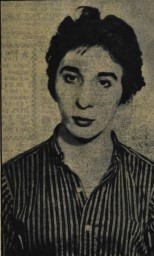
By 1954 Maud’s child was living as female, and had taken the name Jela St John Murphy. By 1956 they were living in East Greenwich, Rhode Island, near a naval construction station. Jela met a Navy Seabee from Michigan by the name of Cox. They fell in love. Cox soon realized that Jela was pre-op, but still wanted to marry her – which they did September 1, with the bride’s mother as a witness. The Navy recognised Jela as Mrs Cox and paid her a dependent wife’s allowance. All was going well.
However, in 1958, Maud declared that she was ‘fed-up’ with Rhode Island and wanted to live in the Mid-West. She insisted that Jela go with her. Which left Cox alone without his wife. So he deserted, and went to find her – which he did in Denver, Colorado. The Navy called in the FBI to find Cox, and their investigation discovered that Jela was not legally female. She was arrested in Denver. After a secret indictment by a Federal Grand Jury, Cox was arrested at his home in rural Michigan. Mr and Mrs Cox were both charged with conspiracy to defraud the Government over the wife’s allowance, a total of $548.40. Jela was charged under her male name. When released on bail, Jela told reporters that she had half-completed an autobiography. She also said:
Jela, 1958, after cutting her hair
“I’ve been posing as a woman nearly four years. Before that, my life was miserable. Everybody made fun of me. Then when I changed over, nobody said anything. They accepted me as a woman”.
Cox was given a suspended two-year prison term, four years of probation and was ordered to repay the $548.40. Jela was given two years’ probation and ordered that she ‘undergo psychiatric treatment to bring out his masculine qualities’. She expressed a desire for genital surgery, but this was ignored. They were also ordered to separate.
What happened afterwards is not documented, apart from a few snapshots.
Maud and Jela moved to the San Francisco Bay area. Jela presumably completed transition. She married and changed her name with the US Social Security system in December 1962 to Jela Hicks.
In February 1967, Jela was arrested for drunken driving in Mill Valley, California and fined $100. Her past apparently was not discovered.
Maud Goodshot, described in her obituary as ‘beloved mother of Jela Goodshot-Hicks” died in San Francisco, June 1976.
In December 1980, the Hicks were injured but survived when their car stalled on a rail line and was hit by a six-engine freight train.
Jela died April 1989, age 52.
Thank you Bianca Zell for the research.
“Chief Jacob Goodshot”. The Boston Globe, September 10, 1950: 18. Obituary.
“Indian Youth Will Draw Comic Strip for Roundup”. The Miami News, Feb 9, 1951:31.
“Arrests disclose Navy fraud case: He ‘wed’ female impersonator”. The Saginaw News, Oct 23, 1958: 12.
“Impersonator Awaits Sentence; His life used to be ‘miserable’ ”. The Saginaw News, Oct 27, 1958.
Barrie Harding. “John Got Married – to a Sailor”. The Sunday Pictorial, November 2, 1958: 19.
Bill Jones. “Impersonator to take Psychiatric Treatment”. Denver Rocky Mountain News. Nov 22, 1958.
“Judge Blasts Men’s Hoax of Marriage”. Spokane Spokesman Review, Dec 9, 1958.
“Male ‘Bride’; Hubby Placed on 2-Year Probation”. Jet, 25 Dec 1958: 47.
“Drunken Driver is fined”. San Rafael Daily Independent Journal, April 15, 1967: 30.
“Goodshot, Maud Esther”. The San Francisco Examiner, June 15, 1976:32. Obituary.
“Woman in good condition after car rammed by train”. Reno-Gazette-Journal, Dec 15, 1980: 3.
Joanne Meyerowitz. How Sex Changed: A History of Transsexuality in the United States. Harvard University Press, 2002: 87.
------------------
Some accounts say that Jela was born and raised in Boston; others say a reservation in South Dakota.
The US average male wage in 1958 was just under $100 a week. So the secret indictment by a Federal Grand Jury was for only a few weeks wage.
Hermann was born in Vienna and raised as Hermine
Gartner. The father was a government councillor, and the elder
brother was Theodor
Gartner who became a noted
linguist and philologist specializing in the Ruthenian (Ukrainian)
language.
Hermann studied painting under Josef
Hoffmann and Joseph
von Fuhrich. Using
the excuse that male attire made for easier working conditions, he
adopted the pseudonym ‘Antonius Hermann’. Hermann
succeeded in being admitted at the Akademie
der bildenden Künste Wien (Vienna Academy of
Fine Arts) to study even though no women were then admitted.
As Hermine Gartner, Hermann was engaged to the
painter Carl Hofman in 1871, but that did not work out. Gartner became known as a painter of religious motifs and of portraits,
taught painting in Munich, and carried out restorations
in Kremsmünster
Abbey in Upper Austria.
In 1899 Hermann retired to the Italian Riviera,
and bought a house in Sori, south of Genoa. Hermann now dressed as
male consistently, and often wore a black moustache – although he
was sometimes spotted without it, and once it came off while he was
in church. He worked as a language teacher.
Hermann died age 59, possibly of cancer. He was
outed on his death-bed, which created quite a stir and was reported
in Italian and German-language newspapers. Theodor Gartner, summoned
by telegraph, came from Innsbruck and registered the death of his
sister Hermine Gartner.
Magnus Hirschfeld: Die
Transvestiten: eine Untersuchung über den erotischen
Verkleidungstrieb. Mit umfangreichem casuistischen und historischen
Material. 2. Auflage. Verlag
Wahrheit Ferdinand Spohr, Leipzig 1925: 404–405.
Hanna Hacker. Frauen
und Freundinnen: Studien zur "weiblichen Homosexualität"
am Beispiel Österreich 1870-1938.
University of Virginia, 1987: 146.