This site is the most comprehensive on the web devoted to trans history and biography. Well over 1800 persons worthy of note, both famous and obscure, are discussed in detail, and many more are mentioned in passing.

There is a detailed Index arranged by vocation, doctor, activist group etc. There is also a Place Index arranged by City etc. This is still evolving.

In addition to this most articles have one or more labels at the bottom. Click one to go to similar persons. There is a full list of labels at the bottom of the right-hand sidebar. There is also a search box at the top left. Enjoy exploring!

30 July 2025

Finocchio’s – post WWII

 Original version, January 2010.

 Part I: the early years

Part II: post WWII 

In 1946, Joe, and other club owners, were having problems with the Board of Fire Prevention and Investigation after a fire at the Herbert Hotel and Backstage Cocktail Lounge in which four firemen had lost their lives.  Temporarily the number of patrons was limited to 250, until required structural changes were made.  

During this time Majorie was absent.  On 16 July it was reported that she had married another clubman, Percy Harman of San Mateo, in Calexico on the Mexican border, but only four days later, back in San Francisco, she obtained a separation and the restoration of her Finocchio name.  She explained that immediately after the marriage, Harman had pestered her for large sums of money.

In September 1947 a burglar entered the home of Joe and Marjorie and took $40,000 in furs and a safe containing $15,000.  While the break-in occurred at about 10.30 pm, it was not discovered until the 350lb house safe was discovered by a motorist at 1:45am southwest of the city.  The safe had been punched open.  The Finocchios, still at the club were informed by the police, and hurried home.

Howard Hughes grew bored with Pussy Katt. However, he did finance a drag club for her in Acapulco which they called Finocchio’s South.  In later years she performed at Madame Arthur’s in Paris.

William Stoffler, a San Francisco stockbroker, married and noted for his good looks, became a dancer at Finocchio’s, and an occasional date of Howard Hughes.  His suspicious wife discovered his second life, and divorced him. 

In 1948, the Finocchios sued four former employees, Ray Bourbon, Jackie May, Johnnie Magnum, and Francis Russell, for putting out records and advertising with the words “The new Bourbon Records presents the world’s foremost female impersonators from Finocchio’s of San Francisco”.  Later that year Joe and Marjorie travelled together to England. 

The 5th edition of Where to Sin in San Francisco, 1948, asked “Is it true what they say about Finocchio’s?”, and answered: 

“Yes, it is. Even if the girls were women, the shows would be provocative. But the artists in the costly gowns are not women. Without saying what they are, twinkling Marjorie Finocchio does declare, “They’re the only stable ones in the country.” Tall, beautiful, stable Freddie Renault, the $200-a-week MC, has been here fourteen years. . . . Cute, Oriental Li Kar, double stable after ten years, is both a dancer and the club’s costume designer. . . . Stablest of all is Walter Hart, $275-a-week specialist in murky songs.”

Walter Hart, had been at Finocchios since 1933.  He was billed as the male Sophie Tucker, and the real Sophie Tucker was delighted.  She gave him many of the gowns and furs he wore and never failed to catch his show when in the city.  However in 1948, as Herb Caen wrote: “ After 15 solid years on the job, Entertainer Walter Hart is out of Finocchio’s, on acct. some verbal twanging with Mrs. F. That’s sort of like the last ferry leaving the Ferry Bldg”.  However Hart soon found employment at the Tivoli.

Lucian Phelps took over the “male Sophie Tucker” persona, and, as with Walter Hart, the real Sophie Tucker caught his act and sent him gowns and furs. 

The 1949 San Francisco Real Property Directory listed only Marjorie as the club owner.

By 1950 the City Directory listed Joseph and Eve Finocchio living at the same address.

The local competition was the Black Cat Bar, which was developing from being a bohemian and Beat bar, to being more gay.   Jose Sarria entered a competition to get a gig at Finocchio’s, but did not get it, and then went to the Black Cat where he started as a waiter, and graduated to being the major singer, openly gay, openly in drag, singing a re-working of Bizet’s Carmen.  Unlike Finocchio’s, customers were permitted to dress as they chose.  In 1951 the State Board of Equalization suspended the Black Cat's liquor license in that known homosexuals ate and drank there.

The other competition was Jewel Box Revue, and many of the impersonator stars worked for both the Revue and Finnochio’s at different times.  As a touring revue, the Jewel Box was in San Francisco only intermittently.  However, even when the Revue was in town, Finocchio’s was filled to capacity, four shows a night, six nights a week, attracting locals, tourists and celebrities such as Bob Hope, Frank Sinatra, Bette Davis and Tallulah Bankhead. 

1954: UCLA psychologist Evelyn Hooker started her groundbreaking work comparing the psychological adjustment of homosexual and heterosexual men that showed that gay men were not significantly different.  Her research included a visit to Finocchio’s.

Marjorie died in 1956 after a lingering illness.  Joe then married Eve, and Eve was finally allowed into the club, and quickly took over Marjorie’s role. She took over with a vengeance.  Her brother George Filippis also came in as club manager, her sister Maria Filippis as the cashier and Eve’s teenage daughter Concetta as the official photographer.   Joe continued to oversee the bar and the door.   The huge photos of the performers which were hanging in the club and outside on the street were all taken down. The club was redecorated – the décor was said to be based on that of Le Carrousel of Paris – and at the same time Le Carrousel star Les Lee was hired. 

Another new hire was Lavern Cummings, who sang as both soprano and baritone, and who stayed until 1982.

A chorus line, Las Vegas style, were introduced known as the Eve-ettes, after the second Mrs Finocchio. Eve quickly cut the number of musicians from five to three, and refused to be addressed as ‘Madame’ as that was how Marjorie had been addressed.

1958: Francis Blair, star of Seatle’s Garden of Allah, also performed a comedy drag routine with Ray Francis, “Two Old Bags from Oakland” which they did at Finocchio’s that year.

In the summer of 1959, the future Aleshia Brevard, moved to Los Angles and found a Catholic priest lover who, after giving her gonorrhea, took her to San Francisco and to see the show at Finocchio’s.  Lucian as Sophie Tucker fabricated a story about having a training school for impersonators, and picked out Aleshia in the audience and said "And this, ladies and gentlemen, is my star pupil.   Isn't she beautiful?   Stand up and take a bow."   Aleshia then knew what she wanted.  “I auditioned at Finocchio's, based solely on a photograph I'd submitted.   Before having that audition photo taken, I'd never been in female attire. Talk about an untrained 'New Nanette'!   I would have never gotten hired at the most prestigious impersonation club in the country if it had it not been for Stormy Lee, Finocchio's star exotic dancer.   People HATED Stormy, I'm well aware of that, but she put me under her protective wing on the night of my audition.”   Aleshia was given the stage name of “Lee Shaw” by the MC Lestra Lamonte. Aleshia had the looks and developed an act as Marilyn Monroe singing "My Heart Belongs To Daddy".  The real Monroe came one night to see the act.

'Lee Shaw' and Eve

Aleshia and Stormy had extra kudos in that they each had a boyfriend. Off-stage Aleshia became a patient of Harry Benjamin during his summer sojourns in San Francisco – it was Stormy who shared her Premarin and then took Aleshia to her first appointment with Harry Benjamin.  The aspect that Aleshia hated most was “having to remove my makeup and despised dressing in men's clothes before leaving the club - but that was the law.   What I detested most was how Mrs. Finocchio's sister, Maria, who sold tickets, would call out ‘Good night, Lee Shaw’ - or whomever, as we were exiting the club.   She was pointing out to lingering customers how impersonators looked 'off stage'.   I always felt that was very unkind.”

Libby Reynolds, two years after his tryst with actor Raymond Burr, and then selling the story to Confidential Magazine, was hired in 1962.  

Aleshia/Lee Shaw left the club in 1962, and was one of the last trans woman to have surgery with Dr Elmer Belt in Los Angeles.  This was to the chagrin of the Finocchios who threatened that she would never work again.

There was a shortage of dancers at the club.  Reggie Dahl was in the hospital, a Spanish dancer by the name of Néstor had a mental breakdown, and the only dancer left at the club was Stormy Lee.   Robin Price, previously of the Jewel Box, heard of the vacancy and came from Los Angeles to audition, and was not hired.  However Price was phoned a few days later, asked if she could do the Can-Can, and after a second audition was hired.

Concetta, Eve’s daughter, graduated from UC Berkeley.  In 1963 she married Eric Jorgensen, and they called their first child Eric.

Stormy had surgery the next year with Dr Burou in Casablanca.  Lestra Lamonte, the emcee died, and Price became the new emcee.  Price fell out with Eve Finocchio when she tried to tell him not to visit a certain club on his own time, despite her sister going to the same place.  They stopped talking until the last day of Price’s contract, when Eve finally wanted to talk, but Price simple packed bags and left.

The Black Cat Bar,  following some 15 years of unrelenting pressure from the police and the Alcoholic Beverage Control (ABC) finally closed in1963.

Carroll Wallace, who had a sideline as a real-estate investor, became the emcee. As such he  had to do the stage lighting and sound, which was not easy and it was very tiring on his feet to be standing for the whole show.

David de Alba joined as a star performer in 1971, and he did hair-styling and wigs for the other performers.  Two years later, he asked permission for four days off for plastic surgery.  However on returning he found that he had been fired, and was told to pick up his costumes, make-up cases, wigs and musical charts.  He still did wigs and hair styling for the other performers, and was often contracted as a guest star.  “What I didn’t realize at the time was that there was a new cost cutting trend going on at the club.   Mrs. Finocchio was getting rid of the main supporting acts and replacing them with members of her beloved chorus line, 'The Eve-ettes'.   They now had two jobs, being in the chorus and then as main supporting acts.   So there you had it, two acts for the price of one!”

Lucian Phelps, 65, who had performed at Finocchio’s since 1949, died after a long illness in 1973. 

An ad 1977 

A wildfire destroyed the area surrounding the Jorgensen house, but not their house.

Jae Stevens, 27, was a performer at Finocchio’s when she was murdered in Golden Gate Park in 1974.  The police actually pulled over her car, presumably driven by her murderer, but, after a chase and a crash into a house, the man escaped.

Mr and Mrs Jorgensen had three more children, and then were divorced, leaving Concetta as a single mother of four.  The very same year she was diagnosed with Multiple Sclerosis.  She became a disability activist, did publicity for the club and despite her disability – and she was eventually a paraplegic - she was 30 years on the Alameda County Consumer Affairs Commission.


In 1981, in an interview in the San Francisco Chronicle, Joe was quoted: “We always keep our eyes open. It’s easy to get fellows in women’s clothes. But we don’t allow any filth, and most of them resort to filth.”  Eve did the first interview, and if Joe agreed, Eve made arrangements for costuming and rehearsals.  At that time dancers were paid $80 to $125 a week.  Eve arranged for Holiday Tours and Gray Lines to add Finocchio’s to their tour lists.  Gray Lines included a Finocchio’s photograph in its brochure.  During the 1970s, as topless and then bottomless revue bars had opened, there had been fears that business at Finocchio’s would decline. But with time the topless bars became passé and Finocchio’s was still going.  In the late 1970s it managed as many as 300,000 customers a year. There were four shows a night, each running about an hour. The shows had themes that were not always the same from show to show, and guests could stay for extra shows.

Joe Finocchio died of a stroke in January 1986, aged 88. This left Eve as the sole owner.  She brought in Eric Jorgensen, Concetta’s eldest son, then 23 to be groomed as a future manager – which he was by 1989.  Eve continued to manage the shows and performers, but the zest was declining.  Gray Lines dropped Finocchio’s in 1988, but later restored it.   An article in the Chronicle in 1989 claimed that Finocchio was grossing $2 million a year.  However in 1990 they upped the cover charge from $10 to $15, with a new two-drink minimum, and now opened only four days: Tuesday, Thursday, Friday and Saturday.

Again in 1991, a wildfire destroyed the surrounding area, but again not the Jorgensen house.  A television movie was made of the event, Firestorm: 72 Hours in Oakland. Actress Jill Clayburgh played a character based on Concetta Jorgensen. 

 A few years later Finocchio’s started presenting lip-synching performers – weakening what had made the club special.  Eve later fired the band and it became all lip-synching.  The press paid less and less attention.  Openings were reduced to only three nights: Friday to Sunday, and only three shows a night.  Sometimes there were no customers, and the show was cancelled.

Eve Finocchio decided to close the club in November 1999 because of a major rent increase and dwindling attendance.

Eve died 2007, age 92.

Concetta Finocchio Jorgensen, daughter of Eve died in 2012, age 71, survived by 4 children and 12 grandchildren.

Lavern Cummings died in 2018 age 91 in Las Vegas after being hit by a car.

Other artists who performed there include: Katherine Marlow, Holly White, Russell Reed, Val DeVere, Ted Hendrix, Harvey Lee, Francis Stillman, Jeri-Lane, Frank Doran, Jackie Philips, Bobby Johnson, John Lonas, Vaughn Auldon, Johnny Mangum, Del LeRoy, Milton La Maire, Ray Francis, Francis David, Paul La Ray, Mike Michelle, Bobby Belle.


--------------------------------

  • “Police Raiders Arrest Ten in S.F. Night Club: Patrons Rush for Exits as Officers Visit Finocchio’s”.  San Francisco Chronicle. July 20, 1936: 5.
  • Ki-Lar Finocchio’s.  Finocchio’s program, 1944. Online.
  • “Ex-Finocchio Wife Divorced: ‘Quickie’ Marriage to San Mateo Man Aired in Action”. San Francisco Examiner, Aug 2, 1946,
  • “Finocchio Defies Order To Close S.F. Night Club: Fire Marshal Threatens to Jail Owner For Disregard of Safety Rules”.  San Francisco Examiner, Aug 24, 1946: 5.
  • “Finocchio Home Looted of Furs”.  San Francisco Examiner, Sep 11, 1947:11.
  • Jack Lord and Lloyd Hoff, Where to Sin in San Francisco, 5th ed. (San Francisco: Richard F. Guggenheim, 1948), 145.
  • “In Memoriam: Lucian Phelps”.  Drag, 3, 10, 1973:40. Online.
  • “In Memoriam: Jae Stevens 1947-1974”.  Drag, 4, 16, 1974:34. Online.
  • “San Francisco drag bar owner Joseph Finocchio dies at 88’.  Santa Cruz Sentinel, Jan 15, 1986:10.
  • Norman Melnick. “Deaths: Joseph Finocchio”.  San Francisco Examiner, Jan 15, 1986: 19.
  • Jacqueline Frost. “Home alone: ‘House of mixed blessings’ in lunar landscape: Fire survivors lament lost neighborhoods”. Oakland Tribune. Jan 27, 1992:1.
  • Tracie Reynolds.  “Star Struck: Survivor to give proceeds to son, who suffered burns: Firestorm victim with multiple sclerosis sells story to TV”. Oakland Tribune. Nov 9, 1992:1.
  • Michael Tuchner (dir). Firestorm: 72 Hours in Oakland. With Jill Clayburgh playing a character based on Concetta Jorgensen.  US 104 mins 1993. IMDB.
  • Les Wright. “San Francisco”. In David Higgs (ed). Queer Sites: Gay Urban Histories Since 1600. Routledge, 1999: 171-2.
  • Jesse Hamlin.  “Strutting Into History / Laughter gives way to tears as Finocchio's ends 63-year drag-show run”,  San Francisco Chronicle, 29 November 1999.
  • Jesse Hamlin.  “What a Drag: Finocchio’s to Close/Cross-dressers have entertained at club for 63 years”.  SFGate, Nov 4, 1999.  Online.
  • Nan Alamilla Boyd. Wide Open Town: A History of Queer San Francisco to 1965. University of California Press, 2003: 49,52-6,187.
  • D.J. Doyle. “Finochio’s”. Queer Musical Heritage.   http://www.queermusicheritage.us/oct2002f.html
  • “David de Alba on Finocchio's”.   www.david-de-alba.com/david4.htm.  www.david-de-alba.com/david5.htm.
  • “David de Alba on Shaw”. www.david-de-alba.com/aleshia.htm.
  • “David de Alba on Price”.  www.david-de-alba.com/Price.htm.
  • Mel Gordon et al. "UC Berkeley Interview on Finocchio Club Legend: David de Alba". http://david-de-alba.com/Berkeley%20Interview.htm
  • Aleshia Brevard. The Woman I Not Was Born to Be: A Transsexual Journey. Temple University Press, 2001:
  • Darwin Porter.  Howard Hughes: Hell’s Angel.  Blood Moon Productions, 2010: 575-6, 593-5, 733.
  • Aleshia Brevard. The Woman I Was Born to Be. A Blue Feather Book, 2010:
  • Kathleen Brosnan & Amy Scott.  City Dreams, Country Schemes: Community and Identity in the American West.  University of Nevada Press, 2011: 248-250.
  • Chris Treadway. “Berkeley disabled rights activist dies at 70”. The Mercury News, January 11, 2012. Online.
  • David Artavia.  “Trans Trailblazer Aleshia Brevard Dead at 79”.  The Advocate, July 25, 2017.  Online.
  • James Smith.  “Finocchio’s club: A San Francisco Legend”.  The Argonaut, 28, 2, Winter 2018. Online.
  • James Smith. “Finocchio’s” Except from San Francisco’s Lost Landmarks.  Online.
  • Susan Stryker. “Finocchio's, a Short Retrospective”.  FoundSF: the San Francisco digital history archiveOnline.
  • Michail Takach & B J Daniels.  A History of Milwaukee Drag: Seven Generations of Glamour.  History Press, 2022: 64-6.
  • Margot Canaday.  Queer Career: Sexuality and Work in Modern America. Princeton University Press, 2023: 95-99.
  • Lucas Hilderbrand. The Bars are Ours: Histories and Cultures of Gay Bars in America, 1960 and After.  Duke University Press, 2023: 74-5, 77.


EN.Wikipedia    GLBT Historical Society   Online Archive of California    Queer Music Heritage     Digital Commonwealth 


Discussion in other books:

Canaday: 

“For the trans women who performed at Finocchio’s, this was more than just a job. The actress Aleshia Brevard was first taken to the night club by a man she was involved with and “instantly felt she had to be there. …  It was common, she remembered, for trans women to dance at Finocchio’s just long enough to earn the money for surgery and then leave. As a result, Finocchio’s eventually preferred hiring cross-dressers to trans women because they tended to stay on the job.”  

She also includes a footnote Chp 2 n167 

“Friedman thought (citing letters between the sexologists Harry Benjamin and William Masters) that a date with a performer at Finocchio’s (usually made through a waiter) could be arranged for around $50. The higher price was because these women were, according to some, considered exotic. Certain young gay hustlers “who ordinarily might not have cross-dressed” did so in order to command a higher wage.”  

This is taken from Harvey Friedman. Strapped for Cash: A History of American Hustler Culture, 2010: 124-5.  This in turn is based on Harry Benjamin & R E L Masters. Prostitution and Morality, 1964: 305-9, which does not actually mention Finocchio’s but the comment probably does apply to it. 

“Impersonators  working  in  clubs,  and  making  their  contacts  there,  earn  far  more  money  than  do  other  types  of  male  hustlers,  for  the  reason,  no  doubt,  that  they  are  to  some  extent  “celebrities.”  Fifty dollar  fees  are  not  unusual,  and  at  the  club  most  intensively  studied,  a  $20.00  fee  for  a  single  sexual  act  was  the  absolute  minimum  the  prostitutes  would  consider.”

Takach &  Daniels: 

“Despite offering drag shows for seven decades, Finocchio’s was never really a gay-friendly destination. The club capitalized on its gay performers for amusement, but its owners never really wanted to deal with gay customers.  While Joe Finocchio provided gainful employment to generations of gay men who might otherwise struggle to survive in San Francisco, he was always more interested in running a profitable tourist attraction than a LGBTQ safe space, social outlet or historical landmark. … Joe’s first wife, Marjorie, was the front face of the operation. … Robyn Raye, an impersonator … said of Marge Finocchio, ‘I don’t think she liked gay people, but she certainly knew how to use them.’ … ‘Marge Finocchio made millions off drag queens. We made that woman rich.’ “

My comments:

’finocchio’ is Italian for fennel and by extension a negative word for gay. Some say that this is because its bulb looks like male genitals, but the corresponding word in Portuguese, ‘fanchono’ would seem to be cognate.


Rachel Harlow in Philadelphia was also born with the Finocchio name.  However there does not seem to be any connection between the San Francisco Finocchios and those of Philadelphia.  Likewise there does not seem to be any connection between the San Francisco Jorgensens (the family of Concetta’s husband), and the family of Christine Jorgensen in New York City.  The fact that Concetta bore both names, Finocchio and then Jorgensen, is a fascinating trivium – but without significance.

Many – less informed - articles maintain that it was Joe Finocchio who built up and ran the 201 Club.  However it was Marjorie who used her money to buy the first club, and then chose the acts and ran it, and afterwards Eve – who despite despising her – stepped into her shoes.  Marjorie ran the club 1929-1956, 27 years.  Eve ran it less well, but for longer, 1956-1999, 43 years – and carried on after Joe’s demise.

The requirement for the performers to arrive and leave in male drag also applied at the 181 Club/Club 82 in New York.   But not at Le Carrousel in Paris.  The Finocchios were strict, sometimes shouted at their employees and threatened blacklisting if a performer left without permission.  However the 181 Club/Club 82 was mafia owned – by the Genovese family - and if you crossed them, worse things could happen.   

I could not have written this without James Smith's  “Finocchio’s club: A San Francisco Legend” in  The Argonaut.

29 July 2025

Finocchio’s – a nightclub: Part I: the early years

Original version, January 2010.

Part I: the early years

Part II: post WWII 


Part I: the early years

Joe Finocchio (1897 - 1986) was born in Italy.  His father Bernardo Finocchio emigrated to San Francisco, and at age 14 Joe, the eldest child, joined him. His first job was in the produce market at $2 a week.  He served in the US army during the Great War (March 1918-February 1919).  Alcohol Prohibition came in January 1920, and in August and September that year Joe working in a restaurant was arrested three times in Prohibition raids.  In the third, officers confiscated two truckloads of wine and whisky, as well as liquor from the tables. A search produced more liquor stashed in various places throughout the restaurant.  Joe was bailed at $1,000.   Also that year Bernardo visited Italy and returned with the rest of his children, two girls and a boy.  He now owned the Hotel Maxwelton at 515 Bush Street (near Grant Avenue), and Joe took over the management there. He also worked in a speakeasy owned by his father.

By early 1925 Joe was married, to Marjorie Faxon (1891-1956), a divorcee with a teenage son and an upscale beauty shop.  In 1929 Majorie Faxon Finocchio bought the 201 Club, a speakeasy at 406 Stockton Street in the Tenderloin.  Joe worked there part-time.  The club attracted a mixed gay-straight crowd including writers, artists and thespians.  Some would perform for their friends, and as such for the other customers.  One night a customer in mufti performed an imitation of the legendary Sophie Tucker. This gave Joe and Marge the idea of a nightclub with men performing with all the glitter, sophistication and glamour of sophisticated women.   Initially the show was a female impersonator paired with a exotic dancer – hula or Chinese.  This arrangement attracted a gay clientele.  Harry Hay, the future gay activist, met men there. 

Elsewhere in California: 1932 had been a peak year for pansy revues (which featured female impersonation) with appearances in Los Angeles by Karyl Norman and Jean Malin, and the next year Hollywood made a record number of films with pansy content. However, from 1932 onwards, and especially after the end of Alcohol Prohibition in 1933, the Los Angeles Police Department (LAPD) started busting the pansy clubs. BBB's Cellar and Jimmie's Back Yard were raided repeatedly. The raid on The Big House in fall 1932 met resistance: the patrons fought back and a female impersonator attempted to escape through a window. The bar, renamed Buddy's Rendezvous, reopened, and the police returned eight months later and arrested five transvestites on vagrancy charges. In November 1933 another raid on Jimmie's Back Yard resulted in 90-day sentences for the owner, the mistress of ceremonies and the piano player. Three other female impersonators were each sentenced to six months – the maximum penalty. Harold Brown, arrested on suspicion of posing as a narcotics officer, was discovered to be female bodied and got a suspended 30-day sentence for masquerading. Three pansy bars were shut down in 1936, and another three the next year. Frank Shaw, the Los Angeles Mayor, ran a notably corrupt administration from 1933 until he was recalled in 1938. He was opposed by Clifford Clinton, a restaurateur, who with others filed a grand jury report that led to the recall. Part of Shaw's fight back was to step up the attack on 'sex pervert' bars.

With the repeal of Prohibition, the 201 Club had been able to promote itself more openly, and they hired more dancers and expanded the floor show. Freddie Renault, with experience in ballet and musical comedy joined the cast.

However performers mixed with the customers, and were paid on a percentage basis. This was not permitted by new police regulations.  San Francisco Police Chief William Quinn announced , “Lewd entertainers must be stopped!”  In the early morning of July 20, 1936, the 201 Club was crowded, and five female impersonators were doing a dance routine followed by a ‘vulgar parody’.  A police officer took the microphone and announced: “This place is under arrest. Patrons will not be molested. Those who have nothing to do with this place may leave without fear of arrest.”  120+ patrons quickly left.  10 persons remained, and were taken to the Hall of Justice.  Joe and Marge Finocchio and Jack Peterson the club manager were charged with keeping a disorderly house, selling liquor after 2:00 a.m., and employing entertainers on a percentage basis. However as the raid took place at 1:45 the Finocchios were able to challenge the charge of selling after 2:00.  The performers, Walter Hart (the male Sophie Tucker), Carroll Davis, Eugene Countryman, Jack Lopez, Dick Vasquez, and Frank Korpi were booked on vagrancy charges, a $1,000 fine.  The following day, the municipal judge  sentenced Hart and Davis to 30 days in the county jail.  The arresting officers said that Eugene Countryman took no part in the singing, so he was given a thirty-day suspended sentence. The Judge dismissed charges against the other performing defendants. The Finocchios asked for a jury trial, charging that the undercover police specifically requested songs in contention.  Apparently a settlement was reached in that there were no further reports in the press.

The publicity brought in even more customers.  That November there was a write up in the Chronicle on Joe Finocchio when he flew to South Bend, Indiana via Chicago to purchase a luxurious Studebaker Dictator Coupe, and drove it back to San Francisco, a trip that took six days.

The Finocchios realized that tourist business was the growth portion of their clientele, and, as such, being located in the seedy Tenderloin was a problem. They elsewhere found a suitable nightclub space with a stage and orchestra pit at 506 Broadway above Enrico’s Café.  There was an outside stairway for easy access.  The sign outside was now ‘Finocchio’s’ and the club opened 15 July 1937.  They hired more impersonators, and enlarged the band to five performers. Marjorie planned the entertainment on a grand scale. She booked the finest entertainers, supervised and planned elaborate productions. Joe dealt with the drinks, and negotiated with the police. The club was allowed to exist because it became a tourist attraction, a symbol of the city’s sophistication. Joe had to promise the police that the entertainers would not mingle with the customers. Tourist magazines billed Finocchio’s as ‘America’s most unusual night club’. The club had always included ethnic impersonators, and this continued. Li-Kar did a Geisha dance; Billy Herrero recreated Hedy Lamarr in the film Algiers, 1938;  in 1940 the club developed an Argentine feature; later Juan Jose did a flamenco dance; Reene de Carlo a hula dance; Bobby de Castro did a striptease in a gorilla costume (this was supposed to be Cuban).    Top female impersonators were booked.  They advertised as “Where the entertainment is different, and how”.  That the performers were female impersonators was an open secret, but was not admitted within the show until the end when performers as per tradition removed their wigs.

Herb Caen, who would become a celebrity columnist at the San Francisco Chronicle and was noted for his sarcasm, joined the paper in 1938.  He often referred to Finocchio’s as the Italian-Swish Colony.  His put-downs of the club were taken in good-humor and were after-all publicity for the club.  The February – October 1939 Golden Gate International Exposition, a World’s Fair was held on an artificially built island in San Francisco Bay to celebrate the two new bridges, the San Francisco–Oakland Bay Bridge and the Golden Gate Bridge. Although not part of the Exposition, Finocchio’s benefited by being the main attraction down town. 


In late 1939, a newly hired waiter, George Dasch, was causing disruption in the kitchen by arguing the Nazi cause.  Marge quickly fired him.  (In 1942, he returned to the US as part of the Third Reich’s Operation Pastorius. Dasch betrayed his colleagues and defected to the FBI.  Most of the team were captured, tried and then executed.  Dasch, despite his defection, was sentenced to 30 years, but released and deported after 6.)

Marjorie

The ‘After Dark’ column in the Chronicle declared in January 1941 that Finocchio’s was one of the places that made San Francisco famous. In September 1941, Herb Caen was repeating gossip that the Finocchios had “rifted to the point where they’re discussing property settlement”, and the next day the Chronicle reported “Mrs. Joe Finocchio, soon-to-be-divorced wife of the No. Beach night club operator, fell off her new boat in the bay the other day – and was rescued by a sailor who got to her just in time”.  Joe had been seeing Eva/Eve Filippis, a recent immigrant from Italy, who had given birth to a daughter 1 February 1941 whom she named Concetta Finocchio.  It was claimed that Marjorie had divorced Joe for ‘extreme cruelty’ in 1941 and that then Joe and Eve were married – however recent researchers have failed to find the records.  Joe and Marge continued to live at the same address.  Marjorie made it very clear that Eve Filippis was never to enter the club.

Other than that, there was a little trouble at the club during the war years.  Many civilians moved to San Francisco to take jobs in the shipyards.  Accommodation was available in the Fillmore district from which the Japanese-Americans had been interned. The still underage Tony Midnight, who was working in munitions during the war, snuck into Finocchio’s using fake ID.

In 1942 military authorities declared Finocchio's "off limits" for selling liquor to WWII military personnel outside of authorized hours. That temporary sanction was lifted New Year's Eve 1943 after Joe Finocchio and other bar owners signed an agreement to limit liquor sales to military personnel to between 5 pm and midnight. Beer could, however, be sold between 10 am and midnight.

Despite the growing rift between Joe and Marjorie, they continued to collaborate and in March 1943 opened a new lounge adjacent to the main auditorium.

Harvey Goodwin moved to San Francisco and became a performer at Finocchio's night club.

Rae Bourbon had been arrested during a police raid while broadcasting live from Tait’s in San Francisoco in 1933.  A decade later she was back in town and headlining at Finocchio’s, as was Karyl Norman, billed as the highest paid female impersonator at the time.

In late 1941 Tex Hendrix from England became the emcee. He wowed the audiences by changing evening gowns for each of his 12 acts.

The ex-tight-rope walker from Barnum and Bailey’s circus, Nicki Gallucci came to sing at Finocchio’s.  Gallucci was a natural soprano, the only male coloratura soprano capable of reaching high D above middle C.

Carol Davis often sang in a tux behind the Theatre Bar.  His act was to look like a woman dressed like a man.

The 1944 program designed by Ki-Lar
In 1945 there was a rumor that Errol Flynn, David Niven and two others had taken Finocchio’s Pussy Katt (then aged 16) and friends back to a hotel suite at the Fairmont for a night of ‘debauchery’. Gossip columnist Louella Parsons heard this, but couldn’t use it. Howard Hughes who had first met Katt when he escorted Ava Gardner to Finocchio’s, returned for another meeting, and became her lover. Later Hughes flew with Katt to Mexico City for an operation that made her America's first surgical transsexual, and she was paid $50,000. Afterwards he installed her in a villa in the new resort of Acapulco, and repeatedly visited her for almost two years.


30 June 2025

15 other persons worthy of more attention

 Buzz feed a few days ago ran a list of 19 trans persons who had achieved something in life. I have two problems with it.

  • It is a list of the usual suspects. Why are such lists almost always aimed at readers who have been off-grid for years and are unaware of trans persons? These days even most cishet persons, old and young, are aware of Lili Elbe, Billy Tipton, Coccinelle, Christine Jorgensen, Renee Richards, Sylvia Rivera. Why not devote more of the list to the lesser known?
  • The inclusion yet again of Roberta Cowell, referred to by those who knew her as Betty. Yes, Betty was one of the first trans women in Britain (preceded by Norma Jackson and Dorothy Medway – who unlike her were not nepo-babies and had far fewer resources), but she refused to consider herself as one of us – and in fact was quite transphobic. She insisted that Christine Jorgensen was a transvestist. She declined Michael Dillon’s advances, as she said later: “But as far as I was concerned, it would have been two females getting married (p87 in Hodgkinson’s book)”. On p101 of her autobiography she wrote: “One thing was certain. I had not the slightest desire to swell the ranks of the gentlemen of no particular gender. It is true that I had become a little more tolerant in this direction than I had been in the past; this meant, however, that had I met one I would have refrained from actually kicking his spine up through the top of his head.” When interviewed for the Sunday Times in March 1972 the interviewer commented: “She doesn’t approve of the Permissive Society and she doesn’t welcome Women’s Lib. She certainly hopes the trend towards Unisex has stopped. It’s unhealthy, unnatural.” And quoted her: “My experience shows that men and women are so completely different as to be almost different species. …. I was a freak. I had an operation and I’m not a freak any more. I had female chromosome make-up, XX. The people who have followed me have often been those with male chromosomes, XY. So they’ve been normal people who’ve turned themselves into freaks by means of the operation.” And of course, Cowell totally abandoned the two daughters that she had fathered. And indeed how could she have fathered children were she not XY?

Cowell is not at all a positive role model.

-----------------------------------

Here are 15 other trans persons worthy of more attention. I could easily list 50 or more.

The sort is by birth date.

John de Verdion (1744-1802)

German book dealer and language teacher. De Verdion, after some embarrassment re his sex, emigrated to London, where he taught German to Edward Gibbon, and English to the Prussian ambassador. He lived 30 years in London, despite suspicions about his sex. GVWW


Toupie Lowther (1874-1944)

From teenage, a fencing champion, Toupie in 1898 vanquished the army’s Sergeant instructor at The Military Gymnasium of the Army Camp in Aldershot, and in 1903 held her own against the Maître, or Prof. Yvon at the Civil Engineers Hall in Paris. An accomplished singer and composer, Toupie set poems by Oscar Wilde and Alfred Tennyson to music, and her music was performed at the Wigmore Hall in London. Toupie was also a keen tennis player and participated in championship games, especially those held at Homburg 1896-1901, and at Wimbledon where she reached the singles semi-final in 1903. Toupie was one of the ‘first women’ to own a motorbike and lift weights. In 1917 Toupie organized an ambulance unit which worked on the front lines during the war. They were heavily involved in the battles at Compiègne, in June 1918. Lowther and several others in the unit were awarded the Croix de Guerre. Radclyffe Hall’s short story, "Miss Ogilvy Finds Herself", and her novel The Well of Loneliness were largely based on Toupie Lowther’s life. In later years Toupie lived in a small village in Sussex, mainly in male dress. GVWW.

Wilmer Broadnax (1922-1992)

From Louisiana, Broadnax took the identity of the elder brother who had died, and moving to Los Angeles, became a successful gospel singer, singing with the Spirit of Memphis and the Five Blind Boys of Mississippi. He died age 70 after a jealousy fracas with his younger girlfriend who stabbed him. GVWW.


Lucy Salani (1924-2023)

Compulsorily inducted into the Wehrmacht, in German-occupied Italy, the Repubblica di Salò, Salani from Bologna deserted twice. She survived in Bologna as a sex worker with even German officers as clients, until she was recognised and sentenced to a forced labour camp working on parts for the V-1 rockets. With another inmate, Salani escaped. On recapture, she was deported to the Dachau concentration camp, and had to wear a Pink Triangle. As allied troops approached, Salani was in a group that was lined up and machine-gunned. Salani was hit in the leg but was found alive under some dead inmates. After the war she worked in a drag show, and then became an upholsterer. She had completion surgery in London in the 1980s. In the 2010s she was discovered by LGBT groups and became an advocate for concentration camp survivors criticising how they were ignored and forgotten. She lived till age 98. GVWW.

Anne Vitale (1938 - )

Vitale transitioned while doing a psychology PhD. She opened a clinic in San Rafeal, California in 1984, and has treated many trans persons. She treats older transition persons for what she calls Gender Deprivation Anxiety Disorder (GEDAD). It is this deprivation, not a person’s gender identity, that she seeks to treat. GVWW


Dolly Van Doll/Carla Follis (1938 - )

From Turin, Dolly performed at Madame Arthur and then Le Carrousel. She had completion surgery from Dr Burou in Casablanca in 1964. . In 1971 she accepted a contract in Barcelona. She rose to become a star performer in Franco’s Spain, and also met the love of her life. After Franco’s death she revamped her act and opened her own club in Valencia. GVWW.


Roberta Perkins (1940-2018)

Perkins did a dissertation on transvestism and transsexuality at Macquarie University in Sydney in 1981 – one if the very first by an openly trans woman. She was also one of the members of the newly founded Australian Transsexual Association. Roberta’s book The Drag Queen Scene: Transsexuals in Kings Cross, a study of 146 lives based on her dissertation came out in 1983. The New South Wales Minister for Youth and Community Services read it and approved a grant of $A80,000 which was used to open a centre, Tiresias House. Within a few years, the centre has expanded to four houses. A residential nurse and a community worker were employed. Six years later it was renamed the Gender Centre. Perkins later wrote and published books and articles in peer-reviewed journals on trans women and sex workers. She was involved in the struggle for decriminalization of sex work in New South Wales and Australia. GVWW.

Janine Roberts (1942-2016)

Roberts was ordained a Catholic priest, and did degrees in theology, philosophy and sociology. Roberts then resigned from the priesthood and married a woman. They moved to Australia where they had two daughters. Roberts started working with Australian Aboriginals, and in 1976 published a book on their culture and institutional racism. She worked with aboriginal groups in resisting mining on their territory, and researched Granada TV’s World in Action program on the issue. By this time she had transitioned. In the late 1980s Janine was working on a documentary on the diamond industry for Australian, US and UK television. The Sun newspaper outed her to attack her credibility. In 1992, when The Diamond Empire was two-thirds shot, her home was invaded and she was seriously beaten and was in hospital for two months. While she was on the critical list, the BBC took control of the project away from her. The program was shown on the BBC and in the US with her name on it. Pressure from the diamond monopoly, De Beers, resulted in its showing on Australian Broadcasting Company being cancelled, and in the BBC not selling it abroad, especially to South Africa. GVWW.

Sonia Burgess (1947-2010)

Sonia was a lawyer from Yorkshire who had an office in Islington, London where she aided trans persons and immigrants. She sued the Home Secretary in 1991 when a teacher from Zaire was deported in defiance of a court ruling. She was the lawyer for Mark Rees in his appeal to the European Court of Human Right (ECHR) in 1986, and for Stephen Whittle in his four-year struggle to be recognised as his child’s parent – this also went to the ECHR in the early 1990s. Burgess was the lawyer for Press for Change. She building up to transition when in 2010, travelling on the Underground with a frustrated client, the client lashed out and Sonia went under a train. GVWW.

Brenda Lee (1948 – 1996)

She lived in São Paulo from age 14. Brenda was one of the first Brazilian travesties to work in Paris in the late 1970s as a prostitute. She returned to São Paulo in 1984 and bought a house in the Bixiga neighbourhood. She turned the building into a Casa de Apoio to care for those with HIV who had been rejected by their relatives, as many were after a series of murders of travesties in the South Zone of Sao Paulo in 1985. It started with three patients and an agreement with the São Paulo Ministry of Health, and in 1992 was legally incorporated. She worked with the Emilio Ribas Hospital which took those who needed hospitalization. Brenda also had a car repair business and a hairdressers in the building. She was brutally murdered in 1996. She was given a full Catholic funeral with representation from the Cardinal-Archbishop. A Brazilian award for defending human rights was named the Brenda Lee Award. GVWW.

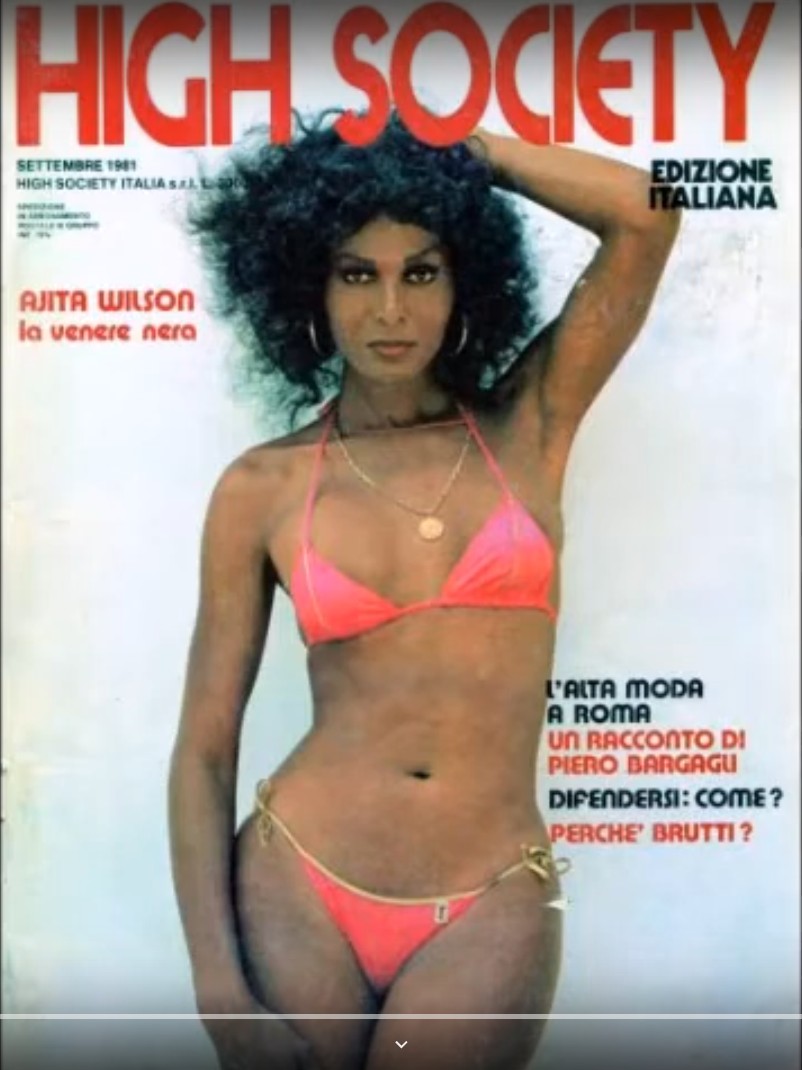
Ajita Wilson (1950-1987)

From Brooklyn, Ajita Wilson moved to Europe where she appeared and often starred in almost 50 films, mainstream, porno and Euro-trash. She died from the complications from a road accident. GVWW.


Anna Grodzka (1954 - )

After marriage and raising a son, Anna transitioned in 2010. She was co-founder and then president of Trans-Fuzja, she was also vice-president of the Commission for Social Dialogue Committee for Equal Treatment under the President of the Capital City Warsaw. She was list Member of Parliament 2011-2015. GVWW.


Helen Savage (1955 - )

Savage was also an archeologist and a wine columnist, but was ordained in the Church of England in 1983, and in 1993 became the vicar in the parish of St Cuthbert’s in Bedlington, Northumberland. She transitioned with doctors at the Edinburgh Royal Infirmary. She did a PhD on gender dysphoria and Christian theology at the University of Durham, which draws upon the experiences of seven trans Christians who were interviewed over a period of eight months from 2002-3. She wanted to return to being a parish vicar, but encountered more problems as a woman than as a trans person in that some parishes would not take a woman priest, and she wished to remain in the north. Finally in 2015 she took the Moorland group of seven parishes around Hexham in Northumberland, and the Hexham Courant acquired its first ever wine columnist. She is also a Master of Wine (one of only 300 or so worldwide). GVWW.

Yasmene Jabar (1956 - )

A farmer’s daughter from North Carolina, she had completion surgery at age 20. She married two Moslem men (sequentially). She set up Cafe Trans Arabi and the International Transsexual Sisterhood, thefirst to help trans women in the middle east, and then expanded to help trans women wherever they are. In 2005 she was involved in the Trans Eastern Conference (TEC) in Istanbul. GVWW.


Karine Espineira (1967 - )

Born in Chile. The family fled to France after the US-backed Pinochet coup in September 1973. In the early 1990s Karine was involved in the Association du Syndrome de Benjamin that had just been founded by Tom Reucher; She and her life-partner Maud-Yeuse joined the anti-essentialist, anti-psychiatry, queer-theory group organized by University of Lille sociologist, Marie-Hélène Bourcier. In 2008 Karine published La transidentité: de l'espace médiatique à l'espace public; in 2012 Karine, Maud-Yeuse and Arnaud Alessandrin published La Transyclopedie: Tout Savoir Sur Les Transidentites, a history-cum-encyclopedia of transgender in France. GVWW.

26 June 2025

Erwin K Koranyi (1924-2012) psychiatrist at Ottawa's 1970-1980s gender clinic

Koranyi was born and raised in Budapest. During the Holocaust Koranyi was compelled into slave labour, and his wife had been arrested and was in a holding camp before transit to Auschwitz, when they – and thousands others- were saved by the intervention of the Swedish diplomat Raoul Wallenberg

Lici emigrated to Sweden where she became a physician. Erwin was able to complete his medical studies in Innsbruck, Austria. After some time in Israel, he emigrated to Canada, where he became a psychiatrist at Montreal's McGill University. Dr. Koranyi married Edie Rosenbaum, also a Holocaust survivor. In 1970, he moved to the University of Ottawa, and joined the Psychiatric Outpatient Unit at the Ottawa General Hospital. 

Later he transferred to the Royal Ottawa Hospital, where he became Director of Education and later head of a Neuropsychiatric Unit. Among the patients who came to see him were some transsexuals. 

In 1976 Koranyi published "Sex Change Surgery in a Male Transsexual" in the Psychiatric Journal of the University of Ottawa, which included some dubious comments:

“Sometimes deceived by their intense fantasy and desire to be a female, they indulge in self- administered or prescribed estrogen therapy, but as soon as they become impotent as a result of this practice, they stop. …Only some, feminized to an extreme, may ask for a sex change operation. In the face of otherwise good ego strength, if the desire is sufficiently intense and the narcissistic pleasure surpasses the loss of orgastic satisfaction, they may be considered reasonable candidates for the operation. … The transvestite is a part-time cross-dresser, essentially a fetishist, whose 'turn ­on' is the act of dressing itself. Secretly, or sometimes in trusted company, not infrequently with so-specialized prostitutes, rarely with their consenting wives, they cross-dress in order to bring about erection and sexual excitement. … Their actual appearance is frequently of secondary importance, even grotesque, as they do not really wish to convince anyone of their femininity, except themselves, in their sexual fantasies.”

Inevitably, these comments caused kerfuffles.

Linda Stephens, editor of The Journal of Male Feminism, wrote and asked Koranyi for permission to reprint the article. Koranyi declined: 

“this is a topic which may well be easier misunderstood than understood. In our gender clinic we often run into problems with certain patients who have built false hopes and who are therefore exposed to disappointments or worse. We wish to avoid such situations as much as possible.” 

Stephens printed the reply and commented 

“I believe a considerable portion of Dr. Koranyi's article consists of misinformation and unsupported and unsupportable opinion. Nevertheless, we had wished to publish his article and to allow our readers to draw their own conclusions.”

The TVIC Journal printed significant quotes from the article without asking.

The Ottawa gynaecologist Bernard Barwin did an emergency vaginoplasty that year for a trans woman who had done a self-penectomy. Barwin and Koranyi then worked together re trans patients.

In 1980 Koranyi published Transsexuality in the Male: The Spectrum of Gender Dysphoria, with a chapter on trans surgery by Norman Barwin, and a chapter on the legal implications and complications by psychologist Betty Lynch and psychiatrist Selwyn Smith, both also of the Royal Ottawa Hospital. He defined homosexuality, transvestism and transsexuality. 

“The clinically clearly delineated and easily separable cases of these three conditions are the ones that remain in the majority. However, these neatly packaged definitions often collapse, particularly when applied to cases having overlapping characteristics. Therefore, some of these cases are more accurately regarded as manifestations of a spectrum of disorders that defy unambiguous distinction.” 

He did agree with surgery for those whom he sees as true transsexuals:

“Surgery, so fervently desired by transsexuals, should currently be considered an effective, palliative, symptomatic treatment in well-selected cases, particularly because other treatment modalities are not really available. Psychological treatment forms, be they analytical or behavioral in orientation, are effective therapeutic tools in many other instances but fail as a rule with transsexuals, who are rarely, if ever, interested in what these treatments can offer.”

However his definition of Transvestism was still reactionary:

“TRANSVESTISM. In its pure clinical form, this form of fetishism is typified by periodic crossdressing accompanied by sexual excitement. This is relieved by autoerotic means or by the services of specialized prostitutes. The usual sexual orientation is heterosexual, sometimes homosexual.” 

He cited Stoller more than Benjamin. As this book predated The Clarke Institute’s Gender Dysphoria, 1985, there is no suggestion of Autogynephilia.

In 1983 he gave a paper at the 7th World Congress of Psychiatry (W.P.A.) in Vienna, which was printed in the Australian Journal of Forensic Sciences.

“The rationale for this surgery was the notorious failure of all forms of psychotherapies, the intention to reduce the high suicide rate and self-castration and to enhance the potential for social adaptation among transsexuals. … In our gender clinic forty-one male transsexuals were assessed. Seven of them are expecting surgery and in 12 cases the surgery has been completed. Of these 12 transsexuals, four are married; we have indirect information on three who are prostitutes, at least one with a drug addiction problem. We have also seen three female-to-male transsexuals; surgery was performed on two, one of whom lives in a steady relationship, the other conducts a promiscuous lifestyle. On the third. female-to-male transsexual surgery is pending.”

Koranyi retired in 1990, but continued some teaching assignments.

He died aged 88 in 2012.

  • Erwin K Koranyi. "Sex Change Surgery in a Male Transsexual". Psychiatric Journal of the University of Ottawa, 1, 3, November 1976. Excerpt in TVIC Journal, 6, 55, May 21 1977 p5 Online.
  • Erwin K Koranyi. Letter, and Linda Ann Stephens “Are We in The Middle Ages or Approaching The 21st Century?”. The Journal of Male Feminism, 77, 4 & 5, 1977 p7-8, Online.
  • Erwin K Koranyi. Transsexuality in the Male: The Spectrum of Gender Dysphoria. Charles C Thomas Pub Ltd, 1980. With a forward by Ralph Slovenko of Wayne State University, and contributions by Norman Barwin of Ottawa General Hospital and Betty Lynch and Selwyn Smith, both of the Royal Ottawa Hospital.
  • Alfred J Koonin. Review of Transsexuality in the Male. Plastic and Reconstructive Surgery, September 1981.
  • Erwin K Koranyi. Physical Illness in the Psychiatric Patient. Charles C Thomas Pub Ltd, 1982.
  • Erwin K Koranyi. “Transsexuality Revisited”. Australian Journal of Forensic Sciences, 16,1, 1983. Reprinted as “Transsexuality of the 80s” in P Pichot, P Berner, R Wolf & K Thau (eds) Psychiatry The State of the Art:6 Drug Dependence and Alcoholism, Forensic Psychiatry, Military Psychiatry . Springer, 1985.
  • Erwin K Koranyi. Dreams and Tears: Chronicle of a Life. General Store Publishing House, 2006.
  • Erwin K Koranyi. Echo of Edith. ‎ General Store Publishing House, 2012.
  • Myrna & Norman Barwin. “Remembering Erwin Koranyi 1924-2012”. Ottawa Jewish Bulletin, July 23, 2012: 4.

Legacy.com         The International Raoul Wallenberg Foundation


Quotations, mainly from the 1980 book, in writings by others:

  • Carole-Anne Tyler. “The Supreme Sacrifice?: TV, ‘TV’ and the Renee Richards Story”. Differences: A Journal of Feminist Cultural Studies, 1,3, Fall 1989. Republished as Chapter 5 in Carol-Anne Tyler. Female Impersonation. Taylor & Francis, 2013: 195-6n22.
  • Morris Meyer. “I Dream of Jeannie: Transsexual Striptease as Scientific Display. The Drama Review, 35, 1, 1991:34-6.
  • Alex Sharpe. “Anglo-Australian Judicial Approaches to Transsexuality: Discontinuities, Continuities and Wider Issues At Stake”. Social & Legal Studies, 6,1, 1997: 29, 38-9.
  • Alex Sharpe. Transgender Jurisprudence: Dysphoric Bodies of Law. Cavendish Publishing Limited, 2002: 33, 34, 97.
  • Moe Meyer. An Archeology of Posing: Essays on Camp, Drag, and Sexuality. Macater Press, 2010: 25.

21 June 2025

Magnus Hirschfeld’s Die Transvestiten – some more observations

Part 1:  3 misconceptions

Part 2: 2 more misconceptions


Hirschfeld as trans.

Misconception #4: the assumption that Hirschfeld was himself a transvestite.

The first such claim seems to be Vern Bullough’s Science in the Bedroom: A History of Sex Research, 1994:62 where he starts his 14-page essay on Hirschfeld with “Undoubtedly influenced by his own homosexuality and transvestism ….”. However, in the digital version of the book obtainable from Archiv für Sexualwissenschaft, (online) the words “and transvestism” have been removed. Nor did Bullough claim a transvestite Hirschfeld in his 11-page biography in Sexuality and Culture 7 (1) Winter 2003. Bullough had not given any footnote or other reason for his claim, and in effect withdrew it. However those two words in the 1994 hardcover version of the book seem to be the basis of claims elsewhere.

->Find a Grave’s Magnus Hirschfeld page says: “As a Jew living in a historically anti-Semitic country, and as a gay man and transvestite”, and of its nature gives no citations.

-> Tim Armstrong in his Modernism, Technology, and the Body: A Cultural Study, 1998, page 167, writes of Magnus Hirschfeld “Himself homosexual (like Haire) and transvestite, he was less dogmatic than Krafft-Ebing had been”. Armstrong gives no citation or quote to support this. 

->Marta Vicente. "The Medicalization of the Transsexual: Patient-Physician Narratives in the First Half of the Twentieth Century". Journal of the History of Medicine and Allied Sciences 76 (4), Oct 2021: 10, says “Hirschfeld, who also cross-dressed and was known among Berlin transvestites as ‘Aunt Magnesia’ ” and gives a footnote citing Charlotte Wolff’s 1986 biography of Hirschfeld, which does record his distaste at being referred to as “Aunt Magnesia” but no transvesting.

-> Patricia Gherovici, in her “Psychoanalysis Needs a Sex Change”, p4, says “He was also an occasional cross-dresser himself” – her only citation is Bullough, 1994, p68 - not p62. 

->Daniel Brook’s The Einstein of Sex, p96, says “When Magnus researched drag bars and balls, he reputably sometimes went in drag himself as ‘Auntie Magnesia’. A dowdy feminine version of his rumpled self, Auntie Magnesia presumably favored frumpy dresses…”. Endnote p276n96 cites only Robert Beachy’s Gay Berlin which talks of the balls but says nothing of Hirschfeld in drag. Brook actually then mentions that Hirschfeld found the practice of men doing female drag while “boasting moustaches or full beards” ‘distasteful and repellant’. This is Magnus Hirschfeld, famous for his bushy moustache, whom Brook has just suggested did transvest. There is no record of a Hirschfeld without his moustache.

Christopher Isherwood lived in Hirschfeld’s institute and has no such gossip in his autobiography Christopher and his Kind: A Memoir, 1929-1939, published 1976. And of course, if there had been any such rumours, the Nazis would have delighted in repeating them.

The canard is repeated in the EN.Wikipedia article.

We might also note that a gay man who does drag once or twice for a party or a ball, is not thereby a transvestite. Despite what Virginia Prince and the DSM have ignorantly claimed, there are indeed gay transvestites. However being a transvestite does require more than dressing up once or twice for a social event. The soldiers who put on drag shows for fellow soldiers and in prisoner of war camps – with a few exceptions – are not taken to be transvestites, nor are rugby players who drag up for a laugh.


Modern commentaries:

Misconception #5: the advertising pitch that Hirschfeld and Die Transvestiten are an untold tale.

The blurb for Shillace’s book says they are “the forgotten story”; the blurb for Brook’s book says “Today, he’s been largely forgotten”; a review of Brook on Amazon says: “Hirschfield comes up in many contexts but this is the first book I’ve found specifically about him.” And Bullough in his 2003 paper for Sexuality and Culture, wrote “For most of the last half of the twentieth century, however, Hirschfeld was more or less ignored in the English speaking world, despite the fact that two of his works, Die Transvestiten (1910) and Die Homosexualität des Mannes und des Weibes (1914), were the most significant and authoritative works written on the subjects before Kinsey and his data and are still of importance to the current generation of researchers.” 

Er, No!

While there are no way as many books about Hirschfeld, as about Sigmund Freud, there are more books about Hirschfeld than about each of Havelock Ellis, John Addington Symonds, Edward Carpenter, Albert Ellis, August-Henri Forel, Bernard Talmey, Karl Heinrich Ulrichs, Norman Haire and even Richard von Krafft-Ebing.

In my personal memory there were discussions with trans, gay and cishet persons where they knew at least of the book burnings, and often more. This is going back to at least the 1970s. However more importantly there have been many books, journal articles and magazine articles starting with Wolff’s biography in 1986, and then more and more.

A partial list:

  • Charlotte Wolff. Magnus Hirschfeld: A Portrait of a Pioneer in Sexology. Quartet Books, 1986: 107-6
  • Vern L. Bullough & Bonnie Bullough. Cross Dressing, Sex, and Gender. University of Pennsylvania Press 1993: 207-13. 
  • Geertje Mak. ,Passing Women': im Sprechzimmer von Magnus Hirschfeld. Österreichische Zeitschrift für Geschichtswissenschaften, 9,3, 1998.
  • Vern L Bullough. "Magnus Hirschfeld, an often overlooked pioneer". Sexuality and Culture7(1) Winter 2003: 62–72.
  • J Edgar Bauer. “Magnus Hirschfeld's Doctrine of Sexual Intermediaries and the Transgender Politics of (no-) Identity” in Gert Hekma (ed). Past and Present of Radical Sexual Politics. Mosse Foundation for the Promotion of Gay and Lesbian Studies at The University of Amsterdam, 2004.
  • Rainer Herrn. Schnittmuster des Geschlechts: Transvestitismus und Transsexualität in der frühen Sexualwissenschaft. Giessen: Psychosozial-Verlag, 2005.
  • Ralf Dose. Magnus Hirschfeld: Deutscher – Jude – Weltbürger. Verlag Hentrich & Hentrich, 2005.
  • Ibon Zubiaur. Pioneros de lo homosexual (Karl-Heinrich Ulrichs, K M Kertbeny, M Hirshfeld). Anthropos, 2007.
  • Elena Mancini. Magnus Hirschfeld and the Quest for Sexual Freedom: A History of the First International Sexual Freedom Movement. Palgrave Macmillan. 2010.
  • Magnus Hirschfeld (1868-1935) Une Pionier du mouvement homosexual confronte au nazisme. Le Mémorial de la Déportation Homosexuelle, 2010.
  • Patricia Gherovici. “Psychoanalysis Needs a Sex Change”. Gay and Lesbian Issues and Psychology Review, 7(1), 2011. 
  • Jack Molay. “Magnus Hirschfeld's Theory of Transgender Intermediaries”. Crossdreamers, 19/12/2014.
  • Ralf Dose. Magnus Hirschfeld: The Origins of the Gay Liberation Movement. Monthly Review Press, 2014 (translation of Dose’s 2005 book)
  • Wouter Egalmeers. Magnus Hirschfeld’s exposition of ‘universal’ fetishism in his 1930 Bilderteil zur Geschlechtskunde. Research Masters Thesis, Radboud University, 2016.
  • Ken Plummer. „Hirschfeld, Magnus (1868-1935)”. In George Ritzer (ed) The Blackwell Encyclopedia of Sociology. John Wiley & Sons, Ltd, 2016.
  • Heike Bauer, The Hirschfeld Archives: Violence, Death, and Modern Queer Culture. Temple University Press, 2017.
  • Manfred Herzer. Magnus Hirschfeld und seine Zeit. Gruyter, 2017.
  • Emma Heaney. „’I am not a friend to men’: Embodiment and desire in Magnus Hirschfeld's Transvestites case studies”. Journal of Lesbian Studies,
  • Wissen schafft Akzeptanz: Bundesstiftung Magnus Hirschfeld. Tätigkeitsbericht 2017.
  • Darryl B Hill. “Sexuality and Gender in Hirschfeld's Die Transvestiten: A Case of the ‘Elusive Evidence of the Ordinary’”. Journal of the History of Sexuality, 14, 3, 2018.
  • Rainer Herrn. Der Liebe und dem Leid: Das Institut für Sexualwissenschaft 1919-1933. Suhrkamp, 2022.
  • Brandy Schillace. The Intermediaries: A Weimar Story. W W Norton & Company, 2025
  • Daniel Brook. The Einstein of Sex: Dr Magnus Hirschfeld Visionary of Weimar Berlin. W W Norton & Company, 2025

20 June 2025

Magnus Hirschfeld’s Die Transvestiten – some observations

Part 1:  3 misconceptions

Part 2: 2 more misconceptions


Hirschfeld’s other Books

Misconception #1: the claim that Die Transvestiten is Hirschfeld’s definitive work on trans topics.


The Bulloughs, Cross Dressing, Sex, and Gender, 1993 describe the book as “may well be the key work on cross dressing, even to this day”.

Most accounts of Hirschfeld on trans topics rely only on this 1910 book, Die Transvestiten, and sometimes the 1912 pictorial supplement, Der erotische Verkleidungstrieb. This is especially so with writings in English, in that these two are the only ones from Hirschfeld with a proper translation.

A list of Hirschfeld’s writings on trans and other Zwischenstufen persons (intermediaries) – the last two are in French as Hirschfeld spent his last years in exile in France:

  • 1899. „Die objektive Diagnose der Homosexualität“. Jahrbuch für sexuelle Zwischenstufen, 1.

  • 1905. Geschlechtsübergänge: Mischungen männlicher und weiblicher Geschlechtscharaktere (Sexuelle Zwischenstufen). Verlag der Monatsschrift für Harnkrankheiten und sexuelle Hygiene, W. Malende, Leipzig.

  • 1906. Berliner Tageblatt, 11. December, cited from Monatsbericht des Wissenschaftlich-humanitären Komitees, VI, 1,

  • 1910. Die Transvestiten: Eine Untersuchung über den erotischen Verkleidungstrieb, mit umfangreichem kasuistischem und historischem Material. Verlag Alfred Pulvermacher, Berlin.

  • 1912. with Max Tilke. Der erotische Verkleidungstrieb: Die Transvestiten. Verlag von Alfred Pulvermacher & Co., Berlin.

  • 1912. with Ernst Burchard. „Zur Kasuistik des Verkleidungstriebs“. Ärztliche Sachverständigen-Zeitung, 18(23).

  • 1913. with Ernst Burchard. „Ein Fall von Transvestismus bei musikalischem“. Neurologisches Centralblatt, 52.

  • 1918. Sexualpathologie. Ein Lehrbuch für Ärzte und Studierende. Bonn. Volume II: Sexuelle Zwischenstufen. Das Mannlicher Weib und der Weiblicher Mann. (5 Sections: Hermaproditismus, Androgynie, Transvestitismus, Homosexualität, Metatropismus)

  • 1926. „Ein Transvestit“ in Ludwig Levy-Lenz (ed). Sexualkatastrophen. Bilder aus dem modernen Geschlechts- und Eheleben. A H Payne.

  • 1930. Geschlechtskunde, auf Grund dreißigjähriger Forschung und Erfahrung bearbeitet. Stuttgart. Volume IV Bilderteil.

  • 1933. 'L'amour et la science'. Voila, 3, 199, 1 Juli.

  • 1935. translated by W R Fürst. Le Sexe Inconnu. Éditions Montaigne.


For his more considered thoughts, it is essential to consult Sexualpathologie, Geschlechtskunde and Le Sexe Inconnu.

------

Hirschfeld’s opinions, jargon and influence also appear in publications by his associates, which should also be considered.

Rainer Herrn. Schnittmuster des Geschlechts 2005:73:

“Hirschfeld's construction of transvestitism initially found its way into the discourse of sexual science and psychiatry only hesitantly. In 1911, the psychiatrist Theodor Ziehen was the first to use Hirschfeld's term in a textbook (Ziehen 1911, p. 622-3). Primarily due to the lack of published case studies, Hirschfeld tried to convince some of his sexually scientific colleagues of his new discovery through direct contact with transvestites. To this end, he invited sexologists who were friends or well-disposed towards him to a meeting. The renowned psychiatrist Paul Näcke reports on this:

'I myself had not yet seen such a case [...] and was therefore very grateful to Hirschfeld when he introduced me and several colleagues to about ½ dozen transvestites in his flat on 19 October 1911, two of whom appeared in very elegant ladies' clothes.' (Näcke 1912, pp. 237-238)

Following this presentation, which was attended by “several sexologists” - Näcke only mentions "Dr. Burchard and Dr. Merzbach" - a dialogue developed between the scientists and the transvestites, who, with one exception, were heterosexual. After this meeting, Näcke, who had already written several reviews, wrote the above-mentioned approving report on Hirschfeld's transvestite concept, but with the reservation that not all transvestites were heterosexual, but that bisexual, homosexual and asexual ones also existed. Hirschfeld came back to this later.

A total of eleven reviews were found for the text volume Die Transvestiten (The Transvestites), and a further eight for the book published two years later (Hirschfeld & Tilke 1912) in leading medical, legal and criminological journals. The majority of the reviewers report approvingly on Hirschfeld's separation of transvestites from homosexuals, their assignment to the intermediate stages, and on his proposal to make the official legitimisation of wearing clothes of the "other" sex dependent on medical certificates.” (DeepL translation)


  • 1911. Theodor Ziehen. „Psychiatrie für Arzte und Studierende“. Vierte, vollständig umgearbeitete Auflage.

  • 1912. Ralph Pettow. „Zur Psychologie der Transvestie“. Archive für die gesamte Psychologie, XXII.

  • 1912. Paul Näcke. „Zum Kapitel der Transvestiten nebst Bemerkungen zur weiblichen Homosexualität“. Archiv für Kriminal-Anthropologie und Kriminalistik, 47 (3/4).

  • 1913. Ossian Oehmig. „Beitrag zur Lehre vom Transvestitismus“. Zeitschrift für die gesamte Neurologie und Psychiatrie, 15.

  • 1916. Max Marcuse. „Ein Fall von Geschlechtsumwandlungstrieb“. Zeitschrift für Psychotherapie und medizinische Psychologie, VI.

  • 1920. Hans Abraham. „Einige Bemerkungen über den weiblichen Transvestitismus“. Mitteilungen aus dem Institut für Sexualwissenschaft, X(4).

  • 1921. Hans Abraham. Der weibliche Transvestitismus. Dissertation at Friedrich-Wilhelm-Universität, Berlin.

  • 1930. Felix Abraham. „Transvestiten!”, Die Aufklärung 2: 165.

  • 1931. Felix Abraham. „Genitalumwandlungen an zwei männlichen Transvestiten”. Zeitschrift für Sexualwissenschaft und Sexualpolitik, 18: 223-226.


The translations that we do have :

  • 1931. French translation by Pierre Vachet. Perversions sexuelles, d’après l’enseignement du docteur Magnus Hirschfeld, par son premier assistant le docteur Félix Abraham. Paris: François Aldor. Discussion.

  • 1932. English translation by Jerome Gibbs. Sexual Pathology: A Study of Derangements of the Sexual Instinct, Julian Press. Some extracts from Sexualpathologie, but no trans content.

  • 1936. Magnus Hirschfeld, edited and translated by Dr Costler (Arthur Koestler), revised by Norman Haire. Sexual Anomalies and Perversions: Physical and Psychological Development and Treatment : a Summary of the Works of the Late Magnus Hirschfeld. Francis Aldor. The closest that we have to a translation of Sexualpathologie. Discussion.

  • 1991. English translation by Michael A Lombardi-Nash. Tranvestites: The Erotic urge to Crossdress. Prometheus Books.

  • 1998. Anonymous English translation. Felix Abraham. “Genital Reassignment on Two Male Transvestites”. The International Journal of Trangenderism. 2, 1. Archive

  • 2022. English translation by Michael A Lombardi-Nash. The Erotic Drive to Cross-Dress Illustrated Part (Supplement to Transvestites). Urania Manuscipts.

  • English translation by Ericka Christie & Anne M Callahan of “Chapter XII: Androgyne Mania” from Le Sexe Inconnu. Online.


The Title

Misconception # 2: the assumption that the title is accurate

The full title is Die Transvestiten: Eine Untersuchung über den Erotischen Verkleidungstrieb which translates as The Transvestites: An Investigation into the Erotic Disguise Drive. Michael Lombardi-Nash slightly revised this for his 1991 translation: Transvestites: The Erotic Drive to Cross-Dress.

An ongoing problem was and is created by the word Erotischen.

It is generally accepted that being trans* is not a sexual orientation. Trans persons may be androphilic, gynephilic, asexual, hypersexual. None of these is part of the definition of being trans. For sure some persons do find cross-dressing arousing, but it is a severe distortion to put it in the title. Trans persons, however dressed, at work, shopping, walking in the street, visiting others etc, are not doing something erotic. Transvestitenscheins were issued to enable working in the desired gender – not an erotic activity.

Initially, Hirschfeld had complied with the general opinion at that time that Geschlechtsverkleidung (German for cross-dressing) was a type of homosexuality. However among his patients and elsewhere he encountered trans women who were not at all androphilic, and objected to the assumption. For 1910’s Die Transvestiten, Hirschfeld overcompensated, and for the 17 case studies that comprise Part 1, he systematically excluded gay trans persons. This created a problem re ‘female transvestites’, almost none of whom went with men or had a husband. Only one such case was included: his 15th case, Helene N, who alternated between men and women.

Rainer Herrn: (Schnittmuster des Geschlechts 2005:57-8)

“Hirschfeld had described cross-dressing as a characteristic typically associated with homosexuals around 1900, and in 1906 he distinguished for the first time between homosexual and heterosexual cross-dressers. And although there were enough homosexual men in the environment of the Scientific-Humanitarian Committee who presented themselves in women's clothes - not only at balls - including Hermann von Teschenberg and Willibald von Sadler-Grün - Hirschfeld chose for his casuistry of seventeen cases exclusively those who neither exhibited same-sex inclinations nor had corresponding experience. At the same time, he also knew other homosexual transvestites personally, as can be seen in Volume II of his Sexual Pathology” (DeepL translation)

Hirschfeld of course reverted back in Sexualpathologie, 1918. As quoted in Koestler-Haire’s Sexual Anomalies and Perversions, p197 hard copy, p167 ecopy:

“From the comprehensive data at our disposal we find that about 35 per cent of transvestites are heterosexual and an equal percentage homosexual, while about 15 per cent are bisexual. The remaining 15 per cent are mostly automonosexual, but also include a small proportion of asexuals”.

Hirschfeld had altered the meaning of ‘transvestism’ by making it by definition an erotic activity. The Transvestitenscheinen were issued - at least nominally - for mainly vocational reasons. They were not regarded as erotischen Verkleidungstrieb (erotic urge to dress up). They were issued so that the trans person could live, work and get on with life - the frequency or lack of a sex life did not come into it.


Darryl Hill questions just how heterosexual, the 16 male-born cases studies in Die Transvestiten were? He writes (p324)

“Despite the fact that Hirschfeld wanted to differentiate transvestites from homosexuals, a minority of the cases described homosexual experiences and fantasies. Vern and Bonnie Bullough [p210] observed homosexual fantasies in six of the cases: Messrs. C, D, F, I, J, and P. Including Mr. J, however, is a mistake, since he did not relate any homosexual fantasy. Only one case study, Mr. F, clearly desired men and had had both previous experiences and fantasies. Hirschfeld recorded this: "At twenty-one, on vacation in the Orient, he consented to anal intercourse by Arabians" (51).

Even more problematic for Hirschfeld's contentions was the fact that many of the male cases entertained sexual desires for men but only when presenting themselves as women. Since the man-to-woman crossdressers largely see themselves as women, this desire is probably best understood as heterosexual, but even in that day it was probably partly seen as homosexual. Following this rationale, Messrs. B and M expressed desires to be with men when dressed as a woman. Mr. B indicated a willingness to flirt with men only when dressed as a woman: "I have never had an inclination toward men; only when dressed as a woman do I like to flirt and play with them" (27). Mr. M, who desired to be the passive partner in a heterosexual encounter, said that he was willing to give sex with men a try but only as a woman.

Hirschfeld's contemporaries criticized him for not seeing the latent homosexual tendencies in most of his respondents, mainly because he failed to use deep psychoanalysis, but these tendencies are obvious even without psychoanalysis.”


Some may see most of Hirschfeld’s 16 case studies in Part One of the book as Autogynephiles or something similar (this is not my opinion) and therefore Erotischen as an appropriate label. Even if this were the case, it would apply to Part One of the book only, and not to Part Two “Criticism (Differential Diagnosis)” or Part Three Ethnology and History”. So Arguably Erotischen could be acceptable in the subtitle for Part One, but is definitely inappropriate in the title of the entire book.


However, it is Die Transvestiten that is mostly read, and Kurt Freund and Ray Blanchard in the 1980s, as they developed their concept of Autogynephilia, were able to cite Hirschfeld as a pre-cursor.

  • Kurt Freund, Betty Steiner & S. Chan. Two types of cross-gender identity. Archives of Sexual Behavior, 11, 1982:49–63.

  • Ray Blanchard. “Origins of the Concept of Autogynephilia”. Feb 2004. 

  • Darryl B Hill. “Sexuality and Gender in Hirschfeld's Die Transvestiten: A Case of the ‘Elusive Evidence of the Ordinary’”. Journal of the History of Sexuality, 14, 3, 2018.


Trans words in German

Misconception # 3: the claim that Hirschfeld ‘coined’ transvest* words.

Book after book after book claims that Hirschfeld ‘coined’ Transvestiten, etc. The earliest claim that I have found re Hirschfeld supposedly coining Transvestiten (not Transvestitismus) is in Charlotte Wolff’s 1986 biography where she simply says on p107 that he coined it, but gives no support to the claim. The problem of course, as I have pointed out several times, is that one cannot coin a word, or group of words, that already exist. It seems that he did introduce the transvest* words unto German, and they quickly did replace the rather cumbersome Geschlechtsverkleidung. He also altered the meaning to make transvesting an erotic activity.

However various transvest* or travest* words had existed in Italian, French and English since the 17th century, sometimes but not always meaning gender crossing. Those who claim that Hirschfeld ‘coined’ the terms implicitly imply that he was so badly read that he was unaware of the various forms of these words. For a man of his education, who had travelled in the US, England, France and Italy, this is unlikely.

Then there is the word Transvestitenschein, the licence or permission to transvest. The Paris Préfecture de Police had been issuing Permissions de Travestissement since 1800, and Transvestitenschein is a translation of Permissions de Travestissement (altering the emphasis from the permission to the actual licence). Hirschfeld rendered the French word travestissement into German as Transvestismus, and travesti/e as Transvestiten.

Hirschfeld had an extended stay in Paris in 1892 while studying for his medical exams, and would have become aware of the French practice. He made contact there with the eminent Jewish physician Max Nordau. In 1910 just before finishing Die Transvestiten, Hirschfeld spent a few months in London and then Paris.

Hirschfeld was also an active nudist, and German and French nudist groups had joint meetings. We know that it was at such a meeting that Hirschfeld met the French future sexologist Pierre Vachet. Vachet was still a teenager in 1910 (he was born in 1892) but as he was training to become a doctor, he would have talked about medical practices in Paris.

Hirschfeld mentions the French Permissions de Travestissement in his Die Transvestiten, although he does not give the French expression.

P274-5 in the Lomabardi-Nash translation, “There are cases in which women work in bricklayers’ suits and driving uniforms, and the police overlook that. At the governor’s office they said that strictly speaking the present question could only be decided by a police regulation dated November 7, 1800, that made the authorization of the many frequent masquerades at the time subject to a physician’s certificate that the male or female applicant needed the special clothing for reasons of health. Exceptions to this have occurred from time to time, for example, Aurore Dupin (George Sand), Rosa Bonheur and Marguerite Bellanger, the Margo of Napoleon III, who made the empress jealous. In earlier days there were more applications for permission to wear men’s clothing, but since the introduction of clothing that easily reminds a person of the stronger sex, for example, for women who ride bicycles, the desire of women for other manly apparel appears to have decreased.”

P384: “A French farmer from the suburbs of Paris went to the police for permission to wear women’s clothing and received it, for “business reasons” no less. He said that a woman’s dress was necessary as a part of his equipment to do his kind of work at a nursery garden. Permission for the same thing was granted to a Paris potato merchant.”

P385: “Rosa Bonheur, too, in her petition to the government for permission to wear men’s clothing, gave as her reason that dresses prevented her from finding artistic motifs in nature.”