This site is the most comprehensive on the web devoted to trans history and biography. Well over 1800 persons worthy of note, both famous and obscure, are discussed in detail, and many more are mentioned in passing.

There is a detailed Index arranged by vocation, doctor, activist group etc. There is also a Place Index arranged by City etc. This is still evolving.

In addition to this most articles have one or more labels at the bottom. Click one to go to similar persons. There is a full list of labels at the bottom of the right-hand sidebar. There is also a search box at the top left. Enjoy exploring!

22 October 2023

Ernst Buchard's Lexikon

Part I: life

Part II: Lexikon

Part III: history of cis words


Transgender lexicons:

Virginia Prince
Rose White
Raven Usher
Chris Bartlett
Jack Molay
Raphael Carter
John Money – part 1: gender and transexual
John Money - part II: other words

Morgan Lev Edward Holleb    


Introduction

  • Ernst Burchard.  Lexikon des gesamten Sexuallebens.  Adler-Verlag, 1914.

Burchard's Encyclopedia of all sexual life was published in 1914, four years after Magnus Hirschfeld's Die Transvestiten; eine Untersuchung uber den erotischen Verkleidungstrieb, and five years after Hirschfeld and psychoanalyst Karl Abraham wrote an evaluation so that trans man Karl Kohnheim under the pseudonym ‘Katharina T’ and referred to as 'Fräulein' was able to obtain the first German Transvestitenschein, Hirschfeld's German rendering of the French term permissions de travestissement.

Hirschfeld and the French sexologist Pierre Vachet were both active nudists and had first met when German and French nudist groups had joint meetings. It is most likely that it was from Vachet that Hirschfeld learned of the French practice of permissions de travestissement, which dates from November 1800 and continued through into the 20th century - and was also introduced to the French word travestissement which he rendered in German as Transvestismus, and travesti/e which he rendered as Transvestiten.

However Hirschfeld altered the meaning by making it an erotic activity. The permissions de travestissement were issued - at least nominally - for mainly vocational reasons. They were not regarded as erotischen Verkleidungstrieb (erotic urge to dress up). Nor were the German Transvestitenscheinen regarded as erotic - they were issued so that the trans person could live, work and get on with life - the frequency or lack of a sex life did not come into it.

Unfortunately Burchard's Lexikon was published only a short while before the outbreak of war, and this probably contributed to the fact that it was never translated into English.

I used DeepL to translate the terms that seem most relevant to trans history. I also edited them slightly, mainly using bold for cross-references rather than the German 's.d.' (= see also).

Note that the entry for Geschlechtsübergänge merely says 'see Zwischenstufen'. This despite Geschlechtsübergänge being the title of Hirschfeld's 1906 book on sexual intermediaries.

In 1914 the German word Geschlecht would have invariably been translated as 'sex'.  However by usage it sometimes has the meaning which we would now translate as 'gender'.  Sometimes I adjusted the translation to this effect.

While Hirschfeld titled his 1910 book Die Transvestiten, in the contents to the book he mainly uses Geschlechtsverkleidung (sex-gender dress up) the older German term, and in the text itself, he often shortened it to Verkleidung (dress up).  Buchard's Lexikon has an entry for "Verkleidungstrieb, erotischer" but no entry for "Geschlechtsverkleidung".

Verkleidung is tricky to translate.  Kleidung=clothing, garments etc, and the prefix Ver=non standard.  Verkleidung is often translated as disguise or dress-up - neither of which is appropriate for trans persons.  This is probably why modern German writers use the English loan-word 'cross-dressing' rather than Geschlechtsverkleidung or Verkleidung, 

There is no entry for "Transvestitenschein".  Burhard used the more cumbersome "polizeiliche Genehmigung".

The Lexikon is sometimes modern - for example in stressing that trans and gay are congenital - and at other times seem quite old fashioned - see the entry for Degeneration, and the assumption that transvesting is an erotic activity.  It is a good mirror of the discussions at that time amongst Hirschfeld, Buchard and their associates.


Selections from the Lexikon.

Androgynie, Mannweiblichkeit (=Androgyny, man-femininity)

Echoes of the female sex in the bodily development of men. The symptoms can be isolated, e.g. in the development of the breasts, width of the pelvis, daintiness of the hands and feet, length and softness of the hair, etc. (gynecomastia, gynecosphysia, etc.) or they can be expressed more in the general structure of the body, as depicted by classical art in the hermaphrodite. Often Androgyny is found as a concomitant of other sexual transitional forms such as homosexuality and transvestitism. The counterpart is male body development in women: Gynandry.

Cisvestitismus (=Cisvestitism)

the tendency to put on the clothes of another age group, ethnicity, or occupational class of the same sex for the purpose of sexual relaxation, analogous to transvestitism (see Verkleidungstrieb).

Damenimitatoren (=Female impersonators)

Female impersonators, persons who professionally portray females on the stage - mostly in vaudeville or in farces, but also in serious plays.  The predisposition and inclination to do so will usually coincide and be based on the abnormal drive, recognised by Hirschfeld and described as transvestitism, to adapt the external appearance and lifestyle to the ways of the other sex.  In most cases this disposition is also supported by androgynous body development, feminine posture and movements, so that the deception, even in such distinctly feminine roles as "Gretchen" or the "Maid of Orleans", is sometimes complete.

Since transvestic inclinations also occur relatively frequently as a concomitant of homosexuality - representing a feminine stigma - homosexual predisposition is also relatively frequent with Damenimitatoren. A necessary or even only predominant coincidence does not exist in every case, as transvestitism need not be linked with homosexuality.

The counterpart of the Damenimitatoren, are female Herrenimitatoren (male impersonators and performers of so-called "trouser roles".

Degeneration. Entartung (=Degeneration)

By degeneration, we mean a state of the whole personality or of particular mental or physical characteristics, which is not adapted to the demands of the struggle for existence.  Degeneration may be due to the continued deterioration of one of the parental germ plasm or to an unfavourable result of the union of the two germinal substances. It is possible that a degenerative factor inherent in one germ cell (sperm cell or egg) can be compensated for by a compensating favourable property of the other. Accordingly, a similar strain of the parents will be more prominent in the offspring than a dissimilar one. ....

Certain sexual perversities, especially if they occur as compulsive acts as a result of neuropathic, in particular epileptic or hysterical conditions, are to be regarded as degenerative phenomena. The partial or complete inversion of the sex drive (see Geschlechtstriebes), bisexuality and homosexuality, as well as transvestitism, should not in themselves be regarded as degenerative phenomena, although they seem to be relatively more frequently associated with degeneration than heterosexuality. Similarly, we must not regard physical transitional phenomena such as androgyny, hermaphroditism and pseudohermaphroditism as degenerative phenomena in themselves, but this should be done in so far as they can be explained biologically as developmental disorders and not as transitional or mixed forms. The decision in a particular case will often not be easy and will have to depend more on the individual overall picture than on the individual phenomenon.

Erreur de sexe.

Erroneous determination of sex, caused by false hermaphroditism (pseudohermaphroditism). Correction often occurs later in life, sometimes after death by dissection.

Fetischismus, (Fetischzauber,) (=Fetishism, (fetish magic,))

Sexual fixation on a partial sexual object, or a category of identical or similar objects. It can be certain body parts, certain objects carried by beloved persons, or finally only these objects themselves. The Fetish is always based on the idea of an adequate sexual object, a beloved human person; insofar as fetishistic inclinations are only linked to this, they fall within the range of the normal ("a cloth from her breast, a garter of my love lust" Goethe, Faust.). Only when the personal object pales in comparison with the partial or objective one, and the latter, detached from the former, becomes the sole aim and content of the sexual striving, is the phenomenon to be regarded as pathological. The earlier this detachment takes place, the more pronounced the fetish appears, the less a connection can be found with a drive directed towards human persons. Only the nature of the fetish indicates this. Thus one can assume that a man who loves garters is heterosexual, a man who is only attracted by hussar boots is homosexual. The desire to take possession of the fetish, if it concerns adjuncts of the body, such as braids, can lead to bodily harm, if it concerns objects, to property crimes. The Fetish, probably always arises on the ground of a psychopathic personality, particularly unstable, but on the other hand also predisposed to obsessive fixations. Its treatment can only be psychological and must aim at a careful redirection of the sexual feeling towards a person, which of course is only possible if a personal type adequate to the sexuality of the fetishist can be determined.

Geschlecht (=Gender/Sex)

A word with multiple and comprehensive meanings. Apart from the narrower sense of the physically sexual, as expressed in the terms "sexual organs" or "venereal diseases", Geschlecht denotes not only the peculiarity of sexually differentiated living beings, but also that of all things and finally of all concepts, in that the language gives them a certain Geschlecht through the article. Finally, the "sexes" and the "succession of the sexes" are understood to be the connection of all that inhabits the earth in present, past and future times.

Geschlechtsübergänge, s. Zwischenstufen (=Sex transitions, see Intermediate Stages)

Geschlechtsumwandlung (=Gender reassignment)

The later necessary correction of the sex as a result of erroneous sex determination (see Erreur de sexe),

Gynandrie (=Gynandry)

Analogous to androgyny in the male sex, the occurrence of male secondary sex characteristics, especially in body hair, formation of the skeleton and body formation in the female sex, often associated with deficient development of the sex characteristics actually belonging to the female sex (mammary glands, etc.).

Hermaphroditismus (=Hermaphroditism)

Physical hermaphroditism in the narrowest sense. True Hermaphroditism, which consists of the presence of both male and female germ tissue (testicular and ovarian tissue), has been observed - as far as is known - five times. According to more recent findings, there seems to be more frequent occurrence of testicular interstitial tissue in ovaries and vice versa; possibly the development of the psychosexual variants or intermediate stages can also be explained by partial internal secretion of the opposite sex. In addition, a complete contrast of inner and outer sexuality, as described by Magnus Hirschfeld and this author as "sperm secretion from a female urethra", is to be regarded as Hermaphroditism. Finally, half-sided hermaphroditism, the sexual difference between the two halves of the body, occurs quite frequently in certain butterfly species, has also been observed by Hertwig in a bullfinch and by the author once in humans. Pseudo-hermaphroditism is far more common.

Historische Urninge (=Historical Urnings)

The fact that urnings, homosexuals, have often played a role in history is as indisputable as the fact that the individual peculiarities based on their disposition have played a specific part in their significance. Their biographies are of the greatest importance both for the understanding of homosexuality and of history.

Homosexualität (=Homosexuality)

Same-sex. A word formed from the Greek o/no- and the Latin sexus. In contrast to heterosexuality, Homosexuality denotes the innate or natural direction of the sexual instinct towards the same sex. It is an endogenous, original disposition, which we must count among the sexual transitions, intermediate stages (Zwischenstufen), in that it is the deviation of an important sexual character, the sex drive in the sense of the opposite sex. Not only does the fact that only sexual stimuli emanating from persons of the same sex have an a priori and constant attracting effect on homosexuals speak in favour of the predetermined disposition of this deviant drive, but also especially the fact that the entire psychosexual personality of homosexuals shows characteristic peculiarities - essentially based on a fusion of male and female components - which in a number of individual nuances represent a series of biologically typical manifestations. - In addition, the homosexual man, Urning, and the homosexual woman, Urninde, show sexual characteristics of the opposite sex relatively more frequently than heterosexuals, so-called sexual incongruities, which are causally connected with the character of the phenomenon as a gender transitional phenomenon.

In terms of time and place, homosexuality has been assessed very differently by different peoples and in different epochs according to the prevailing views. While primitive peoples were and are mostly naive about it, accepting it as a given form of manifestation and making use of the special gifts and abilities of homosexuals in appropriate professions (nursing, priesthood, teaching, etc.), while in classical antiquity it was an integral part of culture and reached its highest flowering in the scientific, artistic and especially pedagogical development of the psychological values based on it, it was later included in the general decline of morality, just like conventional love-seeking. When the ascetic worldview of Christianity countered this, it naturally turned against homosexuality in principle, in accordance with its view of the sinfulness of all extra-marital sexual activity. Thus there are - scientifically, of course, completely unfounded and untenable - threats of punishment against male or same-sex intercourse, among other things, in Germany in § 175 Str.G.B.'s, in Austria in § 129b.

On the part of doctors, attempts have been made to eliminate H. by therapeutic means, or to transform it into heterosexuality. Psychological methods of treatment have been used: Waking suggestion, hypnosis, association therapy, psychoanalysis. Success with pure H. is of course impossible, since it is, according to its endogenous disposition, too firmly integrated into the psychic personality as a whole. Suggestive healing, which usually lasts only a short time, can therefore only be based on self-deception. In the case of bisexuality (see below), a strengthening of the heterosexual component is possible under certain circumstances. It is the duty of the doctor to make a rigorous diagnosis on an individual basis. The guiding principle must be to maintain the homosexual as a useful member of human society or to make him so.

In most cases it will be the duty of the doctor to warn homosexuals against normal intercourse, to which they have no inclination, and especially against entering into marriage. Apart from the tragic conflicts which such a marriage usually causes for both parties, eugenics demands that the indication of nature, which with homosexuality so clearly points away from procreation, be heeded, especially since the offspring of homosexuals do indeed show relatively frequent and severe symptoms of stress and degeneration.

Hormone (=Hormones)

The chemical products of internal secretion in their grouping for the purpose of certain effects.

Inversion, sexuelle (=Inversion, sexual)

The inversion may be complete, so that only persons of one's own sex are sexually arousing, homosexuality, or partial and fluctuating in the choice of objects between the two sexes, bisexuality.  Sexual Inversion always represents an original, endogenous characteristic of the psychosexual personality as a whole, even if it often only appears after fully developed sexual maturity, as a reaction to adequate stimuli, which are then often mistakenly regarded as essential determining factors. With the differentiation of the sexes, a restriction to the stimuli appropriate to the disposition occurs, in the case of I. therefore to same-sex stimuli. If this attitude to the individual drive direction predetermined in the disposition is inhibited for a disproportionately long time, which is not infrequently caused by sexual mimicry, and then still appears at a later age, one speaks of delayed homosexuality.

Konträrsexualität (=Contrary sexuality)

Contrary sexual sensation is the term introduced by Westphal and adopted by Krafft-Ebing for homosexuality or sex, inversion, which does justice to the essence of the phenomenon as a reversal of the direction of the drive, i.e. a variant of the sexual life of sensation.

Perversion (=Perversion)

Any variant of the drive direction (homosexuality and bisexuality) based on psychosexual hermaphroditism. As such, perversion is fundamentally different from perversities, which represent anomalies with regard to the drive and activity type.

Perversität (=Perversity)

In contrast to perversion (Sexual Inversion, Contrary Sexuality, Homosexuality), which represents a deviation or reversal of the direction of the drive due to a variation in psychosexual individuality, Perversity means an unusual approach to sexuality, which is essentially based on subjective qualities of sensation, cruelty in active or passive form (Sadism and Masochism, Curiosity or Vanity (see Watching or Exhibitionism) or is fixed to partial attributes (fetishism) or inanimate or dead objects (pygmalionism and necrophilia), or, in the normal direction of the drive, finds satisfaction only in other forms of activity than normal coitus for reproduction.

Perversity., in contrast to perversion, which is a variation in the direction of the drive, thus represents an anomaly in the type of drive and activity.

Pseudohermaphroditismus (=Pseudohermaphroditism)

Transitions respectively of the primary sex characteristic: In the male sex there is no complete regression of Müller's ducts; in the female sex of Wolff's ducts, transitional and mixed forms of the genital organs arise, which lead from hypospadias to the formed Pseudohermaphroditism, masculinus or femininus, which, because the constitution of the external genitals is more or less in contrast to the real sex determined by the gonads, leading to erreur de sexe, which, if the secondary or tertiary sex characters reveal the true sex, gives rise to sex changes. In its most extreme form, the complete incongruence between external and internal genitalia, Pseudohermaphroditism can be classed with true hermaphroditism.

Pseudohomosexualität (=Pseudohomosexuality)

Same-sex activity without an adequate predisposition. Pseudohomosexuality can take the form of male prostitution for the purpose of gain, or for nobler motives: Attachment, veneration, gratitude to a homosexual friend, or also for lack of normal intercourse - faute de miuex. The latter occurs especially where the opposite sex is absent, in so-called single-sex environments, with men on ships, in prisons, barracks, colonial troops, with women in monasteries and convents. Among adolescents, too, sexual intercourse in the form of mutual onanism is a widespread phenomenon, especially in boarding schools.

Psychoanalyse (=Psychoanalysis)

Modern method of psychic treatment developed by Freud and his students, based on the assumption that the repression of sexual drives during the developmental years results in sexual abnormalities and nervous disorders. It is assumed that those sexual impulses are suppressed, pushed into the subconscious, as it were, which run counter to the sensibilities of today's cultured man. First and foremost among these are the child's ideas of incest, then narcissism (see below) and the homosexual component which, according to Freud, is always present in human bisexuality (see Homosexuality). If it is possible to recall these repressed ideas from the subconscious into the consciousness, which is to be helped by the real and daydreams in particular, taking into account their symbolic interpretation, then a relaxation, a reaction should occur which eliminates the state of illness caused by the repression. - Although these theories - which are only superficially hinted at here - are certainly worthy of attention, and there is no question that every psychological treatment must "dig deep", the generalisation that every neurosis can be cured in this way is certainly just as daring as the conclusions which Psychoanalysis draws from the symbolism of dreams,

Psychotherapie (=Psychotherapy)

Mental treatment. In all disorders of the sexual life, Psychotherapy is of essential importance, in addition to local or general physical treatment of existing disorders, or as an independent and sole method of cure. The aim of Psychotherapy must be the attainment of a harmonious sexuality or, if this is impossible, the happiest possible adaptation of an abnormal one to the requirements of life. Its prerequisite is that the doctor obtains complete and unreserved clarity about the entire psychosexual individuality of the person to be treated, possibly by way of psychoanalysis. The relaxation associated with this in itself is an essential healing factor for the doctor. Further therapy must be strictly individualised, using the usual methods: suggestion, hypnosis, association, milieu and adaptation treatment, in order to exert an influence on the patient in the sense of the desired success.

Transvestitismus. Erotischer Verkleidungstrieb (=Transvestitism. A type of Erotic urge to dress differently)

A variant of sexual disposition identified and described by Magnus Hirschfeld, Transvestitism expresses itself in the tendency to put on the clothes of the opposite sex, usually to style their whole appearance accordingly, often also in their habits, their nature and their occupation to follow completely what is generally customary with the opposite sex. Transvestitism therefore represents the drive to shape the surface in an opposite-sex way, or to relax an opposite-sex component inherent in the psychosexual individuality by appropriate surface shaping. Only if one takes into account that clothing in the broadest sense belongs to the individuality of man, that in many respects it plays the same role as, for example, the plumage of birds or the color of butterflies, it becomes comprehensible that an apparently so external inclination can represent a dominating basic trait of the personality, which in its constancy and uncontrollability can only be compared with the variants of the drive (see homosexuality). In fact, Transvestism, for those so predisposed is a question of life, its violent suppression leads to a disturbance of the inner harmony, which causes an unfree, cranky personality or leads to despair.

This author, in joint activity with Hirschfeld, received a picture of the enormous, previously undreamed-of spread of transvestism, since the publication of the discovery of this phenomenon, more and more such predisposed persons found the courage to entrust their inclinations to the expert, in order to receive, on the basis of an appraisal of their condition, the police permission to move about in public in the clothing of the opposite sex, which - at least in Berlin - is usually granted to them, on the condition that they do not cause public annoyance by their behavior.

As a rule, transvestites are not satisfied with an occasional and temporary relaxation, which they can obtain by putting on clothes of the other sex in their domesticity; they rather feel the need to be able to show themselves in public, dressed according to their inclination, and, if possible, to live at least for some time completely in the manner of the other sex. In general, it is easier for the transvestite woman under the present circumstances to follow her inclinations at least partially than for the man, since today's women's fashion allows a close approximation to that of men, but a man dressed femininely is conspicuous under all circumstances. There are male transvestites who prefer the role of the hard-working housewife, others who prefer that of the elegant lady of the world, and still others who prefer that of the discreet bourgeois woman; female transvestites who dress as sportsmen, as plain men from the people, but also those who like to dress in uniform. Often one finds in transvestites a peculiar combination of artistic receptivity and productivity, sometimes a special creative power, especially in the musical field. In this respect Richard Wagner, whose disposition is certainly proven by "his correspondence with a cleaning lady", is a particularly striking example of Transvestism

The historic and ethnological modifications of Transvestism, which can be traced from the primitive peoples through the cultures of all times and peoples according to the respective dress customs, are also interesting.

In the preference for certain pieces of clothing and the sexually justified inclination to wear them on one's own body, connections between transvestism and fetishism come to light. In the most pronounced cases transvestism represents the only and entire need of sexuality, the satisfaction of which requires an absolute relaxation, in others it is connected with normal direction of sexual drive, in others again with homosexuality. In the latter it appears less pure and independently expressed, being more a partial and concomitant phenomenon of the femininity often present in homosexual predisposition.

In some cases, transvestism is favored by feminine body formation in the man, androgyny, virile in the woman, gynandry, but in others there is a quite striking contrast between the absolutely masculine or feminine exterior and the urge to perform just in the exterior completely the role of the other sex.

Verkleidungstrieb, erotischer (=Dress up instinct, erotic)

The erotic disguise instinct is understood to be the urge, based on sexuality, to express in external appearance, but especially in clothing, a personality that does not correspond to actuality. If this urge refers to dressing in the manner of the opposite sex, it is called transvestitism and can be explained by the presence of other-sex components on the individual’s sex/gender identity. Another form of erotic disguise is the urge to dress in the costume of another age group of the same sex, which is called cisvestism and can be explained by infantilism and auto-eroticism as causal factors. Combinations of different forms also occur: one such combination of trans- and cisvestitism is adolescent men who long to dress as little girls. Erotic disguise may completely fill the sexuality, so that in the possibility of satisfying it, other sexual inclinations do not exist and only its compulsory suppression causes sexual irritations, possibly also nervous symptoms of illness; but it can also occur in connection with sexual urge expressions of a hetero- and homosexual nature. Infantilistic cisvestitism naturally often coincides with paedophilic tendencies.

Zwischenstufen (=Intermediate stages)

By Zwischenstufen we mean all sex/gender transitional phenomena both physical and mental: The different forms of androgyny, pseudohermaphroditism and hermaphroditism in the field of physical; homosexuality and transvestitism in the field of mental hermaphroditism. The latter finds their explanation by analogy to physical transition symptoms, to which they are often concomitant.

19 October 2023

Ernst Burchard (1876-1920) doctor and sexologist

Part I: life

Part II: Lexikon

Part III: history of cis words


Ernst Burchard was born in Heilsberg, then in Germany, but now Powiat Lidzbarski in Poland. His father was a doctor, but apparently he was raised by foster parents in Gumbinnen, Danzig and Insterburg. He studied medicine in Tübingen, Würzburg and Kiel. His dissertation, submitted in Kiel in 1900, dealt with some cases of transient glycosuria. He then opened a practice in Berlin as a general practitioner and neurologist.

Being himself gay, he inevitably came into contact with Magnus Hirschfeld, and was one of the co-founders of the Wissenschaftlich-humanitäres Komitee, WhK ( Scientific-Humanitarian Committee) in May 1897.

In 1904, two young gay men, Karl Feigl and the writer Kurt Münzer attempted to blackmail Burchard and Hirschfeld. Burchard filed a complaint, and testified as an expert witness. He declared both men to be mentally defective, and he described Feigl thus: “The homosexually inclined young man had a strongly feminine character and also showed the characteristics of gossip, intrigue, and lack of judgment and criticism, which some women possess". Feigl only was sent to prison: Münzer later became a well-known writer. 

Burchard published a pamphlet Erpresserprostitution(=Blackmailer Prostitution).

Burchard frequently appeared for the defense together with Hirschfeld as a court expert in trials of gay men charged under § 175 of the penal code, which made gay sex a crime.

Burchard left

In 1911, a year after the publication of Die Transvestiten, Hirschfeld was attempting to get other sexologists to use the new term, Transvestiten, that he had adapted from French usage. To this end he invited several colleagues and a few trans women to meet in his flat in October 1911. Burchard was of course one of the colleagues. He and Hirschfeld co-wrote some papers to widen the awareness that it was possible to obtain a Transvestitenschein.

In 1912 Burchard supported Hirschfeld in writing reports to enable the obtaining of Transvestitenscheins and/or approved name changes for Berthold Buttgereit, Louis Sch. and Emilie Kellner.

Burhard published three books: on sexual infantilism, on the psychology of self-accusation, and a lexicon of sexology.

After the outbreak of war in 1914, Burchard gave a lecture to the Ärztliche Gesellschaft für Sexualwissenschaft (Medical Society for Sexual Science) on 18 December, which he then repeated at the WhK. He described how trans women reacted when conscripted as men, and the impact on their mental condition.

Due to the anchoring of the bodily transformation tendency in the soul, however, the feeling of the impossibility of military service still seems to be particularly strong among transvestites. For many it is not in the least fear of danger or strain, but merely the feeling of complete unsuitability for a continued masculine way of life. For example, I know of transvestites who went to the district command in their female clothes and declared quite seriously that they would like to go into the field as a nurse or market-servant, but that they would never live in the barracks as a man among men. In such cases, of course, the doctor's judgement as to the military unfitness at hand cannot be in doubt. (Burchard 1914/1915, p. 376)

He emphasised that this was not shirking and that many trans women were quite willing to enlist as nurses or in food services.

Burchard was a poet, and published poems in gay publications. He was also active in the Bund für Menschenrechte (League for Human Rights).

He had resigned from the board of the WhK on December 14, 1908, due to illness. He was to give a series of lectures on "The Cultural Significance of the Mentally Abnormal" at the newly founded Institut für Sexualwissenschaft from 1919. His early death, however, was the reason that it took place with only one event. He was only 44.

Burchard’s publications:

  • Erpresserprostitution. Kampf-Verlag, Berlin, 1905.
  • with Magnus Hirschfeld. „Zwei Gutachten über Beziehungen homosexueller Frauen“. Zeitschrift für Kriminalanthropologie 50, 1912: 49-61.
  • with Magnus Hirschfeld. „Zur Kasuistik des Verkleidungstriebs“. Ärztliche Sachverständigen-Zeitung, 18, 23, 1912: 477-9.
  • with Magnus Hirschfeld. „Spermasekretion au seiner weiblichen Harnröhre“. Ein Mann mit vollkommen weiblichen äußeren Genitalien. Deutsche medizinische Wochenschrift, 37, 1912: 2425-8,
  • with Magnus Hirchfeld. „Ein Fall von Transvestitismus bei musikalischem Genie“. Neurologisches Centralblatt,, 52, 1913:946-950.
  • Der sexuelle Infantilismus (Juristisch-Psychiatrische Grenzfragen; Bd. 9, Heft 5). Verlag Marhold, Halle/Saale 1913 (zusammen mit Magnus Hirschfeld).
  • Zur Psychologie der Selbstbezichtigung. Adler-Verlag, Berlin 1913 (Beiträge zur forensischen Medizin).
  • Lexikon des gesamten Sexuallebens. Adler-Verlag, Berlin 1914.
  • „Sexuelle Fragen zur Kriegszeit“ Zeitschrift für Sexualwissenschaft, 1, 10, 1914/15: 372-380,
  • „Weibliche Soldaten“, In: Berliner Illustrierte Zeitung, XXV. Jahrgang, 6. August 1916, Nr. 32, S. 477.

Other

  • Bernd-Ulrich Hergemöller. Mann für Mann : biographisches Lexikon zur Geschichte von Freundesliebe und mannmännlicher Sexualität im deutschen Sprachraum. Hamburg: MännerschwarmSkript, 1998: under “Burchard, Ernst”, “Feigl, Karl” and „Münzer, Kurt“.
  • Rainer Herrn. Schnittmuster des Geschlechts: Transvestitismus und Transsexualität in der frühen Sexualwissenschaft. Giessen: Psychosozial-Verlag, 2005: 73, 79, 85, 88-90, 91-2, 96-7, 99, 118, 119, 129, 137n18.
  • „Ernst Burchard, Dr. med., Arzt“. Magnus-Hirschfeld-Gesellschaft e.V. Online.

EN.Wikipedia

30 September 2023

William Smith (1824 - ?) boot cutter

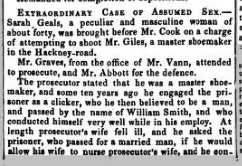
William had been raised as a girl called Sarah Geals, and trained in the family trade of boot-making. In the 1840s Smith arrived in London, began to dress as male and gave out the name of William Smith. His brother – and possibly his mother – knew of his gender change and were supportive. Soon after he was joined by Caroline, his apparent wife. They lived in a small house in Shoreditch, an area then known for furniture making. Money was tight, but William found work as a ‘clicker’ cutting out leather for boots and shoes, a high status role in the shoe industry. Much of this was work-at-home, but also some shop work, for James Giles, a boot-master on the Hackney Road. This arrangement continued for over a decade. At a time when most working-class couples did not socialize together in pubic, William and Caroline were often seen walking together, especially on Sunday.

In January 1863 Mrs Giles took to her bed with a severe illness. James asked William if his wife could come and nurse, which she did. However Mrs Giles died three days later. Caroline continued to go during the day to organize the household and help out, and this continued for a few months. At some point she let it slip that William was a ‘woman’.

Giles took advantage of this insisting that William dress as a woman, and also that Caroline become his wife. In exchange, William – now to be Sarah again - would be set up as manager of Giles’ second shop on Bow Street in Covent Garden and would continue at a man’s wage. And ‘Sarah’ and Caroline were allowed to spend Sundays together.

Sarah and her brother only were present at the wedding of James and Caroline. James lodged Sarah in what he called ‘respectable apartments’, actually a row of tenements on the Mile End Road owned by a single landlord where many of the other tenants were sex workers. After two years Giles decided that the profit at the Bow Street shop was inadequate and it should be closed. After an altercation which was remembered differently by all three, Giles received an unsigned letter which was clearly from Sarah in which she wrote that she was a “woman for spirit”, and suggested that he pay for emigration to New Zealand. 

A month went by with no answer, and then Sarah went to Giles’ shop with a gun, aimed at his face and pulled the trigger. The gun was incorrectly loaded, and he was unhurt. Giles was somewhat traumatised and it was a while before he summoned a constable. The policeman found her at home, and she went quietly to a police station. It was decided that the case warranted being sent to the Central Criminal Court. Sarah was taken to Newgate prison where she waited for her case to come to trial. 

The trial at the Old Bailey was on Wednesday 20 September 1865. The charge was:

"Feloniously attempting to discharge a loaded pistol at James Giles, with intent to murder him. Second count: with intent to do him some grievous bodily harm".

The first witness was Giles who emphasised that he had ‘helped’ Sarah regain her rightful identity and that her attack was supreme ingratitude. Two employees of his shop testified as did the police constable. All stated that the pistol had been incorrectly loaded. The defense called several persons who had known the defendant as William, and spoke of his excellent character. Caroline did not appear. Sarah never spoke. The judge instructed the jury as to the gravity of the crime, but added that if they believed she had merely intended to frighten or threaten the complainant, they might find her guilty of the second count only. Which they did. Sarah was then sentenced to five years – the minimum that incurred penal servitude rather than time in a local prison.

Sarah was removed to Millbank Prison, (located on the river front where the Tate Art Gallery now stands, ⅔ of a mile from Parliament) where she was given her first work assignment. She was to sew or pick thread from ropes for 10 hours a day, and was separated from other inmates for the first several months. In February she was transferred to Brixton Prison (then a women’s facility). The three-monthly report in the prison ledger for Sarah always stated: "Surgeon's report: good. Behavior: good". After 3 ½ years she received a ticket of leave, and was released 5 February 1869. 

Neither William Smith nor Sarah Geals was heard of again.

  • Camilla Townsend. " ‘I Am the Woman for Spirit’: A Working Woman's Gender Transgression in Victorian London”. Victorian Studies, 36, 3, Spring 1993.

-------

Why did Caroline tattle on William? Townsend muses: 

“There are several possible reasons for Caroline's actions. She may have thought the new situation would be economically advantageous for both Sarah and herself. She may have feared exposure, or have been threatened by James, who could apparently be violent. (She was "frightened almost to death" of him, according to Sarah, which was not unreasonable, as he once held Sarah herself until her arms were "black and blue.") Or she may have been tired of feeling different, wishful of being a real ‘wife’.”

Was five years penal servitude lax or harsh in the context of 1860s penology? Townsend compares with three other sentences from the same judge that same morning: 

“a man who had run over a child and killed her received nine months; a man who had killed another man in a fight received twelve; a man accused of rape was released”. 

So was she also being punished for gender transgression, and also in that Giles was of a higher station?

Townsend never uses male pronouns, despite the almost twenty years lived as William.

Apparantly William and Caroline had a fairly nice life - by the standards of the time - but then it fell apart, and even more so when the shop in Bow Street was closed.  Understandably William was aggreived.  This should have been understood.   A middle-class jury did not do so; the judge - who was of an even higher station - did not do so.   Townsend compares newspaper accounts and find that those aimed at the middle classes were generally negative, the penny and half-penny news-sheets aimed at workers were much more sympathetic, understanding why a 'woman' would pass as a man to get a man's wage. 

 
The Shoreditch Observer, 29 July 1865 page 3


27 September 2023

Samantha Kane (1960 - ) executive.

Original version 6/10/2011, revised March 2017, September 2023.


Sam Hashimi was born and raised in Zofaranaya, a suburb to the south of Baghdad. When the family was out, he would dress in his sister’s clothes, until caught by his brother. His one masculine interest at school was football. However he was perceived as feminine by the other boys, and started having sex with them in the passive role.

At age 16, he moved to England, to Swindon where he took a National Diploma in engineering. He financed it by selling hot food at night from a van. He met a woman in a disco, and eventually married her in 1984 in a Anglican church in a village outside Swindon. They soon had two children. He launched two companies: one importing fruit and vegetables, and the other making computers.

He later met an Arabian sheikh and they created a property and investment company. This company thrived. Hashimi became known for negotiating on behalf of wealthy Arabs. He also ran a club and a restaurant in Mayfair. In 1990 he had the opportunity of investing in Manchester United Football Club, but was unable to raise the required ₤10 million in the specified 24 hours. Later the same year he launched an unsuccessful takeover bid for Sheffield United FC, at a time - unlike today - when foreign ownership of British football clubs was not done. The bid resulted in much publicity. It was discussed in the House of Commons, and the Saudi King expressed his disapproval. Coincidentally it came out that a Sheffield company was supplying materials for Iraq to build a ‘supergun’, and then Iraq invaded Kuwait. The deal was off; his major investor pulled out; Hashimi was bankrupt.

For the first time he told his wife that he was a woman trapped in a man’s body. She was at first sympathetic and helped him to cross-dress, but quickly segued to divorce, and, once she found another rich man to keep her, ousted Sam from the family home, and obtained injunctions to keep him from seeing the children. In violation of those injunctions he was arrested and served a few months in HMP Wormwood Scrubs.

During a subsequent period of depression and living at the Ealing YMCA, he started going to gay and trans clubs and was told how great it was to be a woman. He applied through his doctor to be evaluated by the Gender Identity Clinic at the Charing Cross Hospital. However the wait would be over a year, and if he were to become a woman he needed money.

Through his old contacts he was able to get restarted as a property refurbisher. In the course of that work he met an Israeli divorcee, and they became both business partners and spouses. However that was short lived, and a second divorce ensued.

He then contacted Dr Russell Reid and was accepted as a private transsexual patient.
"First of all, I thought I would do my nose to make it look more feminine. I had eye correction surgery to get rid of my glasses. Then I did my teeth to give me a better smile and I had electrolysis all round my face to remove the masculine beard. I had my Adam's apple removed and my vocal chords tightened. I had breast implants, all before the sex change surgery to remodel my genitalia".
Six months after first seeing Dr Reid, in December 1997 Samantha Kane had genital surgery with Michael Royle. She spent over £100,000 in total on her transition.

She had not seen her family for 10 years. She contacted them and, because of the situation in Iraq, they arranged to meet in Amman, Jordan. They did not know about her change until they actually met at Amman airport, but they did accept her.

Samantha wrote an autobiography, A Two-Tiered Existence, when she was trying to launch a football magazine to take advantage of the 1998 World Cup. She was even considered as chief executive at Sheffield United FC because of the possibility that she could attract supporters in Asia and the Middle East who would watch on subscription television. She built a new career in interior design, and lived an expensive life in London and Spain.

Within four years he regretted the mistake, as he missed being one of the boys talking football, business and girls.
"In fact, I found being a woman rather shallow and limiting. So much depends on your appearance, at the expense of everything else. I wasn't interested in shopping. My female friends would spend hours shopping for clothes, trying on different outfits. But having been a man I knew exactly what would suit me and appeal to men. I could walk into a shop and be out again in five minutes with the right dress. Nor have I ever been interested in celebrity magazines or the things that interest other women, but when I tried to talk to men about blokey things they didn't take me seriously.”
In 2004, after the collapse of her engagement to a wealthy landowner when it became apparent that he did not regard her as a ‘real’ woman, Kane decided that it had been a mistake, and as Charles Kane reverted to male. He complained, at the time that the Gender Recognition Bill was going through Parliament, to the General Medical Council that Russell Reid had been too easy in accepting him. Charles was referred to the Charing Cross Hospital Gender Identity Clinic, and as a private patient spent a further £25,000 on breast removal and phalloplasty.
"After what I've been through, I now think that sex-change operations shouldn't be allowed. They should be banned. We live today in a consumerist society where we all believe we can have everything we want, but too much choice can be a dangerous thing."

However when Russell Reid was found guilty of misconduct by the General Medical Council, Kane was quoted in the Guardian: 

"I think generally he [Dr Reid] is a kind-hearted doctor and he didn't really mean to be malicious to the patient. Most of the patients came here to support him because of this quality in him. He is a caring, almost father-figure."

Charles prospered again in the property market, and by 2010 was living in a £2.6 million property in west London, and had recently announced his engagement to a 28-year-old woman, Victoria. His son, then 25, reconciled with his father. Charles  completed a novel, and was seeking funding for a
documentary on the “the Sex Change Delusion”.
“In many ways I see myself a victim of the medical profession. Even with the glamour of Samantha Kane and the £100,000 I spent on myself, I had people shouting abuse at me and builders throwing stones at me from rooftops.”
Charles was featured in 2004 in “Make me a man again” in the BBC documentary series One Life directed by Todd Austin.  A reviewer in the Guardian wrote: 
“Austin’s film managed to make Charles a likeable creature and by the end I was rooting for him. Austin allowed Charles the dignity of privacy and that, in TV-land, is a rare and precious commodity.”

In 2011 the US ABC’s Primetime Nightline featured teenaged trans kids, and as ‘balance’ Charles Kane who never was a trans kid, and who objected to children being given gender assertive therapy. 

In March 2017, in an exclusive interview with the Daily Mail, Kane announced a return to being a woman, and a change of name to Sam Kane,
"The reversal operation did not return me to the man I once was, just an approximation.  With the exception of Victoria, I was rejected by both men and women. The original surgery was effectively irreversible. You can’t turn back into a man because whatever defines the male has been completely removed, so how can you bring it back?
‘I discovered to my detriment that there is only so far medical science can go.  As Charles, I still sometimes wanted to wear a blouse or a pretty ring, and wear my hair long.  Having become Samantha, I should have stayed Samantha. When I told Victoria how I was feeling, it effectively ended the relationship.  She said she preferred men and did not want to live with a woman, but we are still friends."

In 2018 she published the novel that she had been working on.  Called Mohammed and Susan, the plot is: 

Susan Green is an Iraqi British architect and the only witness to a fatal accident on a building site in West London. A suspicious police detective discovers a book written by Susan, revealing huge secrets about her life and narrating a story of love, taboos, desire and murder.”


By 2022 Samantha had a considerable property portfolio in London.  She spotted an article about the sale of Carbisdale Castle in Ayrshire.  This intrigued her: "So I took a last-minute flight to Inverness and made my first trip to that far north in the Highlands”.  The castle had been built during the first world war for Mary Caroline, Duchess of Sutherland.  In 1933 it was purchased by a Scots-Norwegian millionaire, and in 1945 it was donated to the Scottish Youth Hostels Association. By the 2010s it needed extensive renovations, and the SYHA attempted to sell it in 2014 because of the cost.  It was purchased by a corporation in 2016, but their plans fell through, and they sold it to Samantha Kane.  She is using her London property portfolio to finance further renovations, and is now known as Lady Carbisdale.


*Not the romance novelist, Samantha Kane, nor Charles Kane the protagonist in Citizen Kane, 1941, nor the character in Tomb Raider, nor the boxer, nor the President of One Laptop Per Child.
  • Samantha Kane edited by Sarah Harding. Two-Tiered Existence. London: Writers and Artists. 130 pp. 1998. Review.
  • Jack O’Sullivan. “Cold Call: Jack O'Sullivan rings Samantha Kane”. The Guardian, 24 Oct 1998. Online.
  • Todd Austin (dir) One Life: Make me a Man Again. UK BBC1 19 Oct 2004.
  • David Batty. “Sex-change patient complains to GMC “. The Guardian, 18 Feb 2004. Online.
  • Helen Weathers. “A British tycoon and father of two has been a man and a woman ... and a man again ... and knows which sex he'd rather be”. Daily Mail, June 14, 2008. Online.
  • Helen Weathers. “A VERY peculiar engagement: Charles had a sex change - then hated being Samantha so became a man again. Now he's getting married. So is his fiancée barmy, brave... or just in love?”. Daily Mail, 7th Dec 2010. Online
  • "My (Extra) Ordinary Family: My Kid is Transgender".  Primetime Nightline. US ABC 6 August 31, 2011.  Review.
  • Helen Weathers.  "The top London lawyer who's changed gender THREE times: Extraordinary tale of transgender career woman, 57, who's spent more than £100,000 switching sex - and why she believes life's easier for men than women".  The Daily Mail, 21 March 2017.   Online.
  • Samantha Kane.  Mohammed and Susan.  Diversity Books, 2018. Blurb.
  • Helen Weathers. “Samantha changed gender three times and is 'happier than ever' in her new Highland castle home”. The Daily Mail, 3 Oct 2022.  Online.
  • Lara Wildenberg. “Dream comes true for castle’s new lady”.  The Times, October 05 2022.  Online
  • Steven McKenzie. 'I booked a last-minute flight and bought a castle'.  BBC News, 26 Aug 2023.  Online
____________________________________________________________

I also had the surgery only six months after first meeting Russell Reid, but unlike
Hashimi/Kane I had by that point been on female hormones for some years, was living full-time as female and working as female.

Why is it that many of those who change back, then feel that they want to ban the operation for everyone?

23 September 2023

Leon Belmont (1853- ?)

Raised as a girl in Warren, Massachusetts, east of Springfield, Addie Walker, the child of a shoemaker, became Mrs Leon Stanley.  

In 1876 Walker/Stanley was indicted in Springfield, Massachusetts for obtaining money under false pretenses, and was jailed for nine months. 

Walker took the name Leon Belmont  around 1878, and moved to Kansas, and then the Dakota territory. There Leon met Clarinda Watts and her daughter, Grace. He courted Grace, went on carriage rides with her, and they became engaged.  He returned with Clarinda and Grace to their home in Minneapolis, which Clarinda ran as a boarding house. Leon was allowed to live there rent free, and started studies with a local doctor. 

However he transfered his attentions to another tenant, Grace’s friend, Sarah Bracket.  He was still allowed to stay rent free, and Sarah loaned $50 to Leon. When he did not repay it, she, in late October 1880, went to the police claiming that he had obtained the money under false pretenses – that is by pretending to be a man.  As Minneapolis had passed a city ordinance against transvesting in 1877, the police chief quickly arrested Belmont and arranged for Dr Putman to examine him.  The doctor reported that Belmont was ‘entirely feminine”.  

In court, Belmont ‘confessed’ to being a woman, and was ordered to pay $50 or serve 60 days in jail.  He declined to pay.  However he was not taken to the jail, but was to serve the time in the home of one of the sheriffs – an unusual arrangement.  

Belmont became a local celebrity.  Photographs of Belmont in a photography gallery, and in the windows of a bookstore attracted crowds of people. A fundraiser to pay his fine was started.  Belmont avoided speaking to the press but did receive supporters in the sheriff’s parlor.  At first the local press was positive, but as no further information was forthcoming, in the second week Belmont was denounced – not as a gender deviant but as a liar who had misled the community that welcomed him.  

11 November Belmont was recalled to court and paid the $50 fine.  It was expected that he would then face re-arrest for obtaining money from Sarah Brackett, but her attorney withdrew the charge, and Belmont was free.   

Then rumors started that he was actually a man. A reporter for the Minneapolis Tribune attributed this idea to 61-year-old Charlotte O. Van Cleve, who worked on behalf of ‘fallen women’ and was famous as the first white woman to be born west of the Mississippi.  Van Cleve had visited Belmont and was said to have verified  his masculinity.  However she immediately sent a letter to the editor saying that she 

“supposed, with others, that [Belmont] is a woman in man’s attire, and [had] consulted with her and others with regard to the preparation of clothing suitable to her sex”.   

A few days later, the St Paul Pioneer Press published an interview with Dr Albert Alonzo Ames, a former mayor of Minneapolis.  Ames maintained that Belmont was a man who had pretended to be a woman to escape from matrimonial promises to Grace and Sarah.  This was complicated when the Minneapolis Tribune discovered an affectionate letter to Belmont from a James Taylor who had lived with Belmont in the Dakota territory.  Two men loving each other was inconceivable.   

Dr Putman, whose original examination was being questioned, confronted Belmont and demanded that he admit that he was a woman.  Belmont refused but agreed to a second examination – for which he never showed up.  By this time Van Cleve had changed her mind, and wrote a second letter to the Tribune

“Leon A. Belmont is unequivocally masculine, and hence entitled to wear the garments he now wears”. 

By mid November the Leon Belmont story was running nationwide, including on the front page of the Boston Globe, and papers in Connecticut – where a reader recognized Addie Walker and wrote to a friend in Minneapolis who passed the information on to the Tribune.  The Boston Globe confirmed the indictment in Springfield, and other early details. 

Belmont largely ignored the kerfuffle and in midwinter met one Melvina Campbell.  Campbell divorced her husband and moved in with Belmont.  In April 1881 they moved to the hamlet of Spencer Brook, 40 miles north of Minneapolis, were people did not read the Minneapolis/St Paul newspapers.  They were married by a Justice of the Peace with Campbell’s brother and sister-in-law as witnesses. 

Later they moved back to Minneapolis where Belmont ran for the office of city physician – but without success.  In 1884 they moved away from Minnesota.

  • Lizzie Ehrenhalt. “ ‘Curious and Romantic Sensation‘: Sex, Fraud, and Celebrity in the Leon A. Belmont Case of 1880. Minnesota History, 67, 5, Spring 2021.
  • Lizzie Ehrenhalt. “The Story of Leon Belmont”.  Minnesota Now, Jun 26, 2023.  Online.
---------------

$50 in 1880 is just over $1,500 today.   Average wages in the US in 1880 were 12-16 ¢ per hour. So $6 for a 40 hour week, or $9 for a 60 hour week.   $50 was a considerable sum.

10 September 2023

Latina Seville (1940 - ) performer

The boy who later grew up to be Latina Seville was pretty and grew neither body nor facial hair, and because of this was called ‘fruit’ or ‘queer’ at school, often by the same bullies who made passes when they were alone. 

Age 16 having dropped out of school and gone to New York, she became Latina Seville, found work as a female impersonator, and lived fulltime as female. She was recruited by the Jewel Box Revue, and with them travelled across the USA. As also happened at Le Carrousel in Paris, conversation among the Jewel Box performers often drifted to discussions about sex changes, especially with Dr Borou in Casablanca. 

She often felt lonely and had difficulties relating to men, and thought that it would be easier as a completed woman. She wrote to Dr Burou giving a complete medical history. He accepted her and gave her a date in July 1963 – she was then 22. She saved up, got a passport and went. 

The bill was $2,500. She was told no sex for six months after the operation. She recuperated at her mother’s, and practiced Flamenco dancing. Under the impression that being post-op she could no longer work as a female impersonator, she became a stripper with a Flamenco opening. This went well and her salary doubled and then tripled. But she could not handle the men who were pushy about making passes. 

After six months she had a close male friend make love to her, but experienced no pleasure. She thought that perhaps she still thought like a man, and started seeing psychiatrists who advised that she adjust to herself.

At age 25 she wrote an account of herself for the National Insider, saying that she wanted to be a man again. As they often did, the National Insider recycled her article in a book later that year as a supplement to Abby Sinclair’s autobiography and an essay by Carlson Wade mainly about eunuchs and castratos.

She was not heard of again.

  • Latina Seville. “I Want to be a Man Again”. The National Insider, 6,7, Feb 14 & 6,8 Feb 21, 1965.
  • Latina Seville “I Want to be Male Again” in Abby Sinclair, George Griffith, Carlson Wade & Latina Seville. I Was Male. Novel Books. 95 pp 1965.
  • Liam Oliver Lair. Disciplining Diagnoses: Sexology, Eugenics, and Trans* Subjectivities. PhD thesis, University of Kansas, 2016 : 147n95.
---------------------

Remember this is 1963-5.   The amount of information available to prospective trans women was miniscule compared to what we have today.  Obviously she did need advice from someone who had already transitioned.   She also needed advice from women (cis or trans) on how to handle pushy men.  

Do women think differently than men do?  She writes: "Maybe this is because I still think like a man.  I know what they are thinking, I know what they want from me.  Many guys have asked me how I got so hip, how I know just what they're going to say before they say it."  This is learned anticipation.  There are many cis women who can do it - especially prostitutes, but not only prostitutes.

If you are not the party type, or not good at socializing, and end up feeling lonely, a gender change will not change that.

$2,500 in 1963 is almost $25,000 today.

21 August 2023

Arrested in Southend, 1922

We know only the male name under which she was arrested.  She was not bothering anyone, except the nosy policeman with nothing better to do. No evidence of 'loitering for the purpose of committing a felony' was presented.

We know nothing of her at a later date. 


 This is from the Lancashire Evening Post, 11 January 1922 p6.  I looked but failed to find an equivalent article in a Southend newspaper or even a London paper (only 42 miles away).