This site is the most comprehensive on the web devoted to trans history and biography. Well over 1800 persons worthy of note, both famous and obscure, are discussed in detail, and many more are mentioned in passing.

There is a detailed Index arranged by vocation, doctor, activist group etc. There is also a Place Index arranged by City etc. This is still evolving.

In addition to this most articles have one or more labels at the bottom. Click one to go to similar persons. There is a full list of labels at the bottom of the right-hand sidebar. There is also a search box at the top left. Enjoy exploring!

30 September 2023

William Smith (1824 - ?) boot cutter

William had been raised as a girl called Sarah Geals, and trained in the family trade of boot-making. In the 1840s Smith arrived in London, began to dress as male and gave out the name of William Smith. His brother – and possibly his mother – knew of his gender change and were supportive. Soon after he was joined by Caroline, his apparent wife. They lived in a small house in Shoreditch, an area then known for furniture making. Money was tight, but William found work as a ‘clicker’ cutting out leather for boots and shoes, a high status role in the shoe industry. Much of this was work-at-home, but also some shop work, for James Giles, a boot-master on the Hackney Road. This arrangement continued for over a decade. At a time when most working-class couples did not socialize together in pubic, William and Caroline were often seen walking together, especially on Sunday.

In January 1863 Mrs Giles took to her bed with a severe illness. James asked William if his wife could come and nurse, which she did. However Mrs Giles died three days later. Caroline continued to go during the day to organize the household and help out, and this continued for a few months. At some point she let it slip that William was a ‘woman’.

Giles took advantage of this insisting that William dress as a woman, and also that Caroline become his wife. In exchange, William – now to be Sarah again - would be set up as manager of Giles’ second shop on Bow Street in Covent Garden and would continue at a man’s wage. And ‘Sarah’ and Caroline were allowed to spend Sundays together.

Sarah and her brother only were present at the wedding of James and Caroline. James lodged Sarah in what he called ‘respectable apartments’, actually a row of tenements on the Mile End Road owned by a single landlord where many of the other tenants were sex workers. After two years Giles decided that the profit at the Bow Street shop was inadequate and it should be closed. After an altercation which was remembered differently by all three, Giles received an unsigned letter which was clearly from Sarah in which she wrote that she was a “woman for spirit”, and suggested that he pay for emigration to New Zealand. 

A month went by with no answer, and then Sarah went to Giles’ shop with a gun, aimed at his face and pulled the trigger. The gun was incorrectly loaded, and he was unhurt. Giles was somewhat traumatised and it was a while before he summoned a constable. The policeman found her at home, and she went quietly to a police station. It was decided that the case warranted being sent to the Central Criminal Court. Sarah was taken to Newgate prison where she waited for her case to come to trial. 

The trial at the Old Bailey was on Wednesday 20 September 1865. The charge was:

"Feloniously attempting to discharge a loaded pistol at James Giles, with intent to murder him. Second count: with intent to do him some grievous bodily harm".

The first witness was Giles who emphasised that he had ‘helped’ Sarah regain her rightful identity and that her attack was supreme ingratitude. Two employees of his shop testified as did the police constable. All stated that the pistol had been incorrectly loaded. The defense called several persons who had known the defendant as William, and spoke of his excellent character. Caroline did not appear. Sarah never spoke. The judge instructed the jury as to the gravity of the crime, but added that if they believed she had merely intended to frighten or threaten the complainant, they might find her guilty of the second count only. Which they did. Sarah was then sentenced to five years – the minimum that incurred penal servitude rather than time in a local prison.

Sarah was removed to Millbank Prison, (located on the river front where the Tate Art Gallery now stands, ⅔ of a mile from Parliament) where she was given her first work assignment. She was to sew or pick thread from ropes for 10 hours a day, and was separated from other inmates for the first several months. In February she was transferred to Brixton Prison (then a women’s facility). The three-monthly report in the prison ledger for Sarah always stated: "Surgeon's report: good. Behavior: good". After 3 ½ years she received a ticket of leave, and was released 5 February 1869. 

Neither William Smith nor Sarah Geals was heard of again.

  • Camilla Townsend. " ‘I Am the Woman for Spirit’: A Working Woman's Gender Transgression in Victorian London”. Victorian Studies, 36, 3, Spring 1993.

-------

Why did Caroline tattle on William? Townsend muses: 

“There are several possible reasons for Caroline's actions. She may have thought the new situation would be economically advantageous for both Sarah and herself. She may have feared exposure, or have been threatened by James, who could apparently be violent. (She was "frightened almost to death" of him, according to Sarah, which was not unreasonable, as he once held Sarah herself until her arms were "black and blue.") Or she may have been tired of feeling different, wishful of being a real ‘wife’.”

Was five years penal servitude lax or harsh in the context of 1860s penology? Townsend compares with three other sentences from the same judge that same morning: 

“a man who had run over a child and killed her received nine months; a man who had killed another man in a fight received twelve; a man accused of rape was released”. 

So was she also being punished for gender transgression, and also in that Giles was of a higher station?

Townsend never uses male pronouns, despite the almost twenty years lived as William.

Apparantly William and Caroline had a fairly nice life - by the standards of the time - but then it fell apart, and even more so when the shop in Bow Street was closed.  Understandably William was aggreived.  This should have been understood.   A middle-class jury did not do so; the judge - who was of an even higher station - did not do so.   Townsend compares newspaper accounts and find that those aimed at the middle classes were generally negative, the penny and half-penny news-sheets aimed at workers were much more sympathetic, understanding why a 'woman' would pass as a man to get a man's wage. 
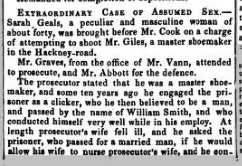
 
The Shoreditch Observer, 29 July 1865 page 3


27 September 2023

Samantha Kane (1960 - ) executive.

Original version 6/10/2011, revised March 2017, September 2023.


Sam Hashimi was born and raised in Zofaranaya, a suburb to the south of Baghdad. When the family was out, he would dress in his sister’s clothes, until caught by his brother. His one masculine interest at school was football. However he was perceived as feminine by the other boys, and started having sex with them in the passive role.

At age 16, he moved to England, to Swindon where he took a National Diploma in engineering. He financed it by selling hot food at night from a van. He met a woman in a disco, and eventually married her in 1984 in a Anglican church in a village outside Swindon. They soon had two children. He launched two companies: one importing fruit and vegetables, and the other making computers.

He later met an Arabian sheikh and they created a property and investment company. This company thrived. Hashimi became known for negotiating on behalf of wealthy Arabs. He also ran a club and a restaurant in Mayfair. In 1990 he had the opportunity of investing in Manchester United Football Club, but was unable to raise the required ₤10 million in the specified 24 hours. Later the same year he launched an unsuccessful takeover bid for Sheffield United FC, at a time - unlike today - when foreign ownership of British football clubs was not done. The bid resulted in much publicity. It was discussed in the House of Commons, and the Saudi King expressed his disapproval. Coincidentally it came out that a Sheffield company was supplying materials for Iraq to build a ‘supergun’, and then Iraq invaded Kuwait. The deal was off; his major investor pulled out; Hashimi was bankrupt.

For the first time he told his wife that he was a woman trapped in a man’s body. She was at first sympathetic and helped him to cross-dress, but quickly segued to divorce, and, once she found another rich man to keep her, ousted Sam from the family home, and obtained injunctions to keep him from seeing the children. In violation of those injunctions he was arrested and served a few months in HMP Wormwood Scrubs.

During a subsequent period of depression and living at the Ealing YMCA, he started going to gay and trans clubs and was told how great it was to be a woman. He applied through his doctor to be evaluated by the Gender Identity Clinic at the Charing Cross Hospital. However the wait would be over a year, and if he were to become a woman he needed money.

Through his old contacts he was able to get restarted as a property refurbisher. In the course of that work he met an Israeli divorcee, and they became both business partners and spouses. However that was short lived, and a second divorce ensued.

He then contacted Dr Russell Reid and was accepted as a private transsexual patient.
"First of all, I thought I would do my nose to make it look more feminine. I had eye correction surgery to get rid of my glasses. Then I did my teeth to give me a better smile and I had electrolysis all round my face to remove the masculine beard. I had my Adam's apple removed and my vocal chords tightened. I had breast implants, all before the sex change surgery to remodel my genitalia".
Six months after first seeing Dr Reid, in December 1997 Samantha Kane had genital surgery with Michael Royle. She spent over £100,000 in total on her transition.

She had not seen her family for 10 years. She contacted them and, because of the situation in Iraq, they arranged to meet in Amman, Jordan. They did not know about her change until they actually met at Amman airport, but they did accept her.

Samantha wrote an autobiography, A Two-Tiered Existence, when she was trying to launch a football magazine to take advantage of the 1998 World Cup. She was even considered as chief executive at Sheffield United FC because of the possibility that she could attract supporters in Asia and the Middle East who would watch on subscription television. She built a new career in interior design, and lived an expensive life in London and Spain.

Within four years he regretted the mistake, as he missed being one of the boys talking football, business and girls.
"In fact, I found being a woman rather shallow and limiting. So much depends on your appearance, at the expense of everything else. I wasn't interested in shopping. My female friends would spend hours shopping for clothes, trying on different outfits. But having been a man I knew exactly what would suit me and appeal to men. I could walk into a shop and be out again in five minutes with the right dress. Nor have I ever been interested in celebrity magazines or the things that interest other women, but when I tried to talk to men about blokey things they didn't take me seriously.”
In 2004, after the collapse of her engagement to a wealthy landowner when it became apparent that he did not regard her as a ‘real’ woman, Kane decided that it had been a mistake, and as Charles Kane reverted to male. He complained, at the time that the Gender Recognition Bill was going through Parliament, to the General Medical Council that Russell Reid had been too easy in accepting him. Charles was referred to the Charing Cross Hospital Gender Identity Clinic, and as a private patient spent a further £25,000 on breast removal and phalloplasty.
"After what I've been through, I now think that sex-change operations shouldn't be allowed. They should be banned. We live today in a consumerist society where we all believe we can have everything we want, but too much choice can be a dangerous thing."

However when Russell Reid was found guilty of misconduct by the General Medical Council, Kane was quoted in the Guardian: 

"I think generally he [Dr Reid] is a kind-hearted doctor and he didn't really mean to be malicious to the patient. Most of the patients came here to support him because of this quality in him. He is a caring, almost father-figure."

Charles prospered again in the property market, and by 2010 was living in a £2.6 million property in west London, and had recently announced his engagement to a 28-year-old woman, Victoria. His son, then 25, reconciled with his father. Charles  completed a novel, and was seeking funding for a
documentary on the “the Sex Change Delusion”.
“In many ways I see myself a victim of the medical profession. Even with the glamour of Samantha Kane and the £100,000 I spent on myself, I had people shouting abuse at me and builders throwing stones at me from rooftops.”
Charles was featured in 2004 in “Make me a man again” in the BBC documentary series One Life directed by Todd Austin.  A reviewer in the Guardian wrote: 
“Austin’s film managed to make Charles a likeable creature and by the end I was rooting for him. Austin allowed Charles the dignity of privacy and that, in TV-land, is a rare and precious commodity.”

In 2011 the US ABC’s Primetime Nightline featured teenaged trans kids, and as ‘balance’ Charles Kane who never was a trans kid, and who objected to children being given gender assertive therapy. 

In March 2017, in an exclusive interview with the Daily Mail, Kane announced a return to being a woman, and a change of name to Sam Kane,
"The reversal operation did not return me to the man I once was, just an approximation.  With the exception of Victoria, I was rejected by both men and women. The original surgery was effectively irreversible. You can’t turn back into a man because whatever defines the male has been completely removed, so how can you bring it back?
‘I discovered to my detriment that there is only so far medical science can go.  As Charles, I still sometimes wanted to wear a blouse or a pretty ring, and wear my hair long.  Having become Samantha, I should have stayed Samantha. When I told Victoria how I was feeling, it effectively ended the relationship.  She said she preferred men and did not want to live with a woman, but we are still friends."

In 2018 she published the novel that she had been working on.  Called Mohammed and Susan, the plot is: 

Susan Green is an Iraqi British architect and the only witness to a fatal accident on a building site in West London. A suspicious police detective discovers a book written by Susan, revealing huge secrets about her life and narrating a story of love, taboos, desire and murder.”


By 2022 Samantha had a considerable property portfolio in London.  She spotted an article about the sale of Carbisdale Castle in Ayrshire.  This intrigued her: "So I took a last-minute flight to Inverness and made my first trip to that far north in the Highlands”.  The castle had been built during the first world war for Mary Caroline, Duchess of Sutherland.  In 1933 it was purchased by a Scots-Norwegian millionaire, and in 1945 it was donated to the Scottish Youth Hostels Association. By the 2010s it needed extensive renovations, and the SYHA attempted to sell it in 2014 because of the cost.  It was purchased by a corporation in 2016, but their plans fell through, and they sold it to Samantha Kane.  She is using her London property portfolio to finance further renovations, and is now known as Lady Carbisdale.


*Not the romance novelist, Samantha Kane, nor Charles Kane the protagonist in Citizen Kane, 1941, nor the character in Tomb Raider, nor the boxer, nor the President of One Laptop Per Child.
  • Samantha Kane edited by Sarah Harding. Two-Tiered Existence. London: Writers and Artists. 130 pp. 1998. Review.
  • Jack O’Sullivan. “Cold Call: Jack O'Sullivan rings Samantha Kane”. The Guardian, 24 Oct 1998. Online.
  • Todd Austin (dir) One Life: Make me a Man Again. UK BBC1 19 Oct 2004.
  • David Batty. “Sex-change patient complains to GMC “. The Guardian, 18 Feb 2004. Online.
  • Helen Weathers. “A British tycoon and father of two has been a man and a woman ... and a man again ... and knows which sex he'd rather be”. Daily Mail, June 14, 2008. Online.
  • Helen Weathers. “A VERY peculiar engagement: Charles had a sex change - then hated being Samantha so became a man again. Now he's getting married. So is his fiancĂ©e barmy, brave... or just in love?”. Daily Mail, 7th Dec 2010. Online
  • "My (Extra) Ordinary Family: My Kid is Transgender".  Primetime Nightline. US ABC 6 August 31, 2011.  Review.
  • Helen Weathers.  "The top London lawyer who's changed gender THREE times: Extraordinary tale of transgender career woman, 57, who's spent more than £100,000 switching sex - and why she believes life's easier for men than women".  The Daily Mail, 21 March 2017.   Online.
  • Samantha Kane.  Mohammed and Susan.  Diversity Books, 2018. Blurb.
  • Helen Weathers. “Samantha changed gender three times and is 'happier than ever' in her new Highland castle home”. The Daily Mail, 3 Oct 2022.  Online.
  • Lara Wildenberg. “Dream comes true for castle’s new lady”.  The Times, October 05 2022.  Online
  • Steven McKenzie. 'I booked a last-minute flight and bought a castle'.  BBC News, 26 Aug 2023.  Online
____________________________________________________________

I also had the surgery only six months after first meeting Russell Reid, but unlike
Hashimi/Kane I had by that point been on female hormones for some years, was living full-time as female and working as female.

Why is it that many of those who change back, then feel that they want to ban the operation for everyone?

23 September 2023

Leon Belmont (1853- ?)

Raised as a girl in Warren, Massachusetts, east of Springfield, Addie Walker, the child of a shoemaker, became Mrs Leon Stanley.  

In 1876 Walker/Stanley was indicted in Springfield, Massachusetts for obtaining money under false pretenses, and was jailed for nine months. 

Walker took the name Leon Belmont  around 1878, and moved to Kansas, and then the Dakota territory. There Leon met Clarinda Watts and her daughter, Grace. He courted Grace, went on carriage rides with her, and they became engaged.  He returned with Clarinda and Grace to their home in Minneapolis, which Clarinda ran as a boarding house. Leon was allowed to live there rent free, and started studies with a local doctor. 

However he transfered his attentions to another tenant, Grace’s friend, Sarah Bracket.  He was still allowed to stay rent free, and Sarah loaned $50 to Leon. When he did not repay it, she, in late October 1880, went to the police claiming that he had obtained the money under false pretenses – that is by pretending to be a man.  As Minneapolis had passed a city ordinance against transvesting in 1877, the police chief quickly arrested Belmont and arranged for Dr Putman to examine him.  The doctor reported that Belmont was ‘entirely feminine”.  

In court, Belmont ‘confessed’ to being a woman, and was ordered to pay $50 or serve 60 days in jail.  He declined to pay.  However he was not taken to the jail, but was to serve the time in the home of one of the sheriffs – an unusual arrangement.  

Belmont became a local celebrity.  Photographs of Belmont in a photography gallery, and in the windows of a bookstore attracted crowds of people. A fundraiser to pay his fine was started.  Belmont avoided speaking to the press but did receive supporters in the sheriff’s parlor.  At first the local press was positive, but as no further information was forthcoming, in the second week Belmont was denounced – not as a gender deviant but as a liar who had misled the community that welcomed him.  

11 November Belmont was recalled to court and paid the $50 fine.  It was expected that he would then face re-arrest for obtaining money from Sarah Brackett, but her attorney withdrew the charge, and Belmont was free.   

Then rumors started that he was actually a man. A reporter for the Minneapolis Tribune attributed this idea to 61-year-old Charlotte O. Van Cleve, who worked on behalf of ‘fallen women’ and was famous as the first white woman to be born west of the Mississippi.  Van Cleve had visited Belmont and was said to have verified  his masculinity.  However she immediately sent a letter to the editor saying that she 

“supposed, with others, that [Belmont] is a woman in man’s attire, and [had] consulted with her and others with regard to the preparation of clothing suitable to her sex”.   

A few days later, the St Paul Pioneer Press published an interview with Dr Albert Alonzo Ames, a former mayor of Minneapolis.  Ames maintained that Belmont was a man who had pretended to be a woman to escape from matrimonial promises to Grace and Sarah.  This was complicated when the Minneapolis Tribune discovered an affectionate letter to Belmont from a James Taylor who had lived with Belmont in the Dakota territory.  Two men loving each other was inconceivable.   

Dr Putman, whose original examination was being questioned, confronted Belmont and demanded that he admit that he was a woman.  Belmont refused but agreed to a second examination – for which he never showed up.  By this time Van Cleve had changed her mind, and wrote a second letter to the Tribune

“Leon A. Belmont is unequivocally masculine, and hence entitled to wear the garments he now wears”. 

By mid November the Leon Belmont story was running nationwide, including on the front page of the Boston Globe, and papers in Connecticut – where a reader recognized Addie Walker and wrote to a friend in Minneapolis who passed the information on to the Tribune.  The Boston Globe confirmed the indictment in Springfield, and other early details. 

Belmont largely ignored the kerfuffle and in midwinter met one Melvina Campbell.  Campbell divorced her husband and moved in with Belmont.  In April 1881 they moved to the hamlet of Spencer Brook, 40 miles north of Minneapolis, were people did not read the Minneapolis/St Paul newspapers.  They were married by a Justice of the Peace with Campbell’s brother and sister-in-law as witnesses. 

Later they moved back to Minneapolis where Belmont ran for the office of city physician – but without success.  In 1884 they moved away from Minnesota.

  • Lizzie Ehrenhalt. “ ‘Curious and Romantic Sensation‘: Sex, Fraud, and Celebrity in the Leon A. Belmont Case of 1880. Minnesota History, 67, 5, Spring 2021.
  • Lizzie Ehrenhalt. “The Story of Leon Belmont”.  Minnesota Now, Jun 26, 2023.  Online.
---------------

$50 in 1880 is just over $1,500 today.   Average wages in the US in 1880 were 12-16 ¢ per hour. So $6 for a 40 hour week, or $9 for a 60 hour week.   $50 was a considerable sum.

10 September 2023

Latina Seville (1940 - ) performer

The boy who later grew up to be Latina Seville was pretty and grew neither body nor facial hair, and because of this was called ‘fruit’ or ‘queer’ at school, often by the same bullies who made passes when they were alone. 

Age 16 having dropped out of school and gone to New York, she became Latina Seville, found work as a female impersonator, and lived fulltime as female. She was recruited by the Jewel Box Revue, and with them travelled across the USA. As also happened at Le Carrousel in Paris, conversation among the Jewel Box performers often drifted to discussions about sex changes, especially with Dr Borou in Casablanca. 

She often felt lonely and had difficulties relating to men, and thought that it would be easier as a completed woman. She wrote to Dr Burou giving a complete medical history. He accepted her and gave her a date in July 1963 – she was then 22. She saved up, got a passport and went. 

The bill was $2,500. She was told no sex for six months after the operation. She recuperated at her mother’s, and practiced Flamenco dancing. Under the impression that being post-op she could no longer work as a female impersonator, she became a stripper with a Flamenco opening. This went well and her salary doubled and then tripled. But she could not handle the men who were pushy about making passes. 

After six months she had a close male friend make love to her, but experienced no pleasure. She thought that perhaps she still thought like a man, and started seeing psychiatrists who advised that she adjust to herself.

At age 25 she wrote an account of herself for the National Insider, saying that she wanted to be a man again. As they often did, the National Insider recycled her article in a book later that year as a supplement to Abby Sinclair’s autobiography and an essay by Carlson Wade mainly about eunuchs and castratos.

She was not heard of again.

  • Latina Seville. “I Want to be a Man Again”. The National Insider, 6,7, Feb 14 & 6,8 Feb 21, 1965.
  • Latina Seville “I Want to be Male Again” in Abby Sinclair, George Griffith, Carlson Wade & Latina Seville. I Was Male. Novel Books. 95 pp 1965.
  • Liam Oliver Lair. Disciplining Diagnoses: Sexology, Eugenics, and Trans* Subjectivities. PhD thesis, University of Kansas, 2016 : 147n95.
---------------------

Remember this is 1963-5.   The amount of information available to prospective trans women was miniscule compared to what we have today.  Obviously she did need advice from someone who had already transitioned.   She also needed advice from women (cis or trans) on how to handle pushy men.  

Do women think differently than men do?  She writes: "Maybe this is because I still think like a man.  I know what they are thinking, I know what they want from me.  Many guys have asked me how I got so hip, how I know just what they're going to say before they say it."  This is learned anticipation.  There are many cis women who can do it - especially prostitutes, but not only prostitutes.

If you are not the party type, or not good at socializing, and end up feeling lonely, a gender change will not change that.

$2,500 in 1963 is almost $25,000 today.